First Esdras opens with Josiah’s Passover, the fall of Jerusalem, Cyrus’s decree and a letter that stops the rebuilding — matter the Hebrew Bible has in 2 Chronicles 35–36 and Ezra 1 and 4. Then it tells a story the Hebrew Bible does not: three young bodyguards of King Darius write down what is strongest, and the third answers twice. This page measures both halves. Where the Hebrew Bible says one sentence twice — Cyrus’s decree, nineteen consecutive Hebrew words at 2 Chronicles 36:23 and Ezra 1:2 — the Greek of Chronicles and the Greek of Ezra say it twice too, seventeen words in a row; 1 Esdras, the third Greek telling, shares nine with Greek Ezra and six with Greek Chronicles. Set against the Greek of their canonical parallels, not one of the 81 rows of chapters 1–2 is identical, and the two Greeks do not even call the feast by the same word. And the contest touches little: chapter 3 never shares more than four consecutive words with anything in the Greek Old Testament outside 1 Esdras, chapter 4 never more than six, and the crowd’s verdict, μεγάλη ἡ ἀλήθεια — great is truth — stands in one of the 30,348 Greek Old Testament units screened here: this one. It is not Scripture for us: it is filed with the Apocrypha, and nothing taught here rests on it. There is no Hebrew 1 Esdras on this disk and no ESV, and the Latin held here is counted, not printed; the English is the King James Apocrypha of 1769, quoted verbatim, and the page says plainly what that costs. See the method →
1 Esdras is a Second-Temple Greek book of the end of the kingdom of Judah and the return from exile, running in nine chapters from Josiah’s Passover to Ezra’s reading of the Law. Most of it is matter the Hebrew Bible also has, in a different order; one long episode — the contest of the three bodyguards — it has alone. It is absent from the Hebrew Bible, and it is not Scripture for us. We read it as a witness: a window onto how the fall and the return were being retold in Greek in the centuries before Christ, and onto a story that Josephus also tells (Stage 2).
We read it critically, gratefully for what it shows, and test everything by the canon. Jerome, translating Ezra, named a “third book” only to set it aside (Stage 2); the churches have not all agreed with him, and the page reports their positions rather than taking one.
⚠️ What this page can and cannot measure — read this first.
HELD: the Greek of 1 Esdras in full (CATSS 1Esdras.mlxx, 434 rows, every label numeric); the King James Apocrypha’s 1 Esdras (448 verses); the Greek of the canonical parallels in their own CATSS files — 2 Chronicles, and Ezra–Nehemiah as the single Greek book 2 Esdras; the Masoretic Hebrew and Aramaic of 2 Chronicles, Ezra and Leviticus; the Greek New Testament (7,927 SBLGNT verses); the Greek Old Testament files (30,348 verse units screened, of 30,637 held — the Odes are held and not screened); the Greek of Josephus’s Antiquities (Niese’s text, Perseus digitisation, 7,376 sections); and Jerome’s prefaces in Latin (The Latin Library). The last two were fetched to this disk for earlier studies and are held with their provenance.
HELD, NOT USED: the Latin 3 Esdras of the Clementine appendix (Latin Wikisource’s transcription of the 1598 Vatican print, 451 rows), kept apart from the Clementine Vulgate corpus, which stops at the canon. Its verses are counted in the versification note; its text is neither printed nor measured on this page.
NOT HELD: any Hebrew or Aramaic 1 Esdras; any Old Latin of 1 Esdras (the only Old Latin volume on disk, Sabatier’s of 1743, runs from Genesis to Job; its books of Esdras are the canonical Ezra and Nehemiah, and a search of its text finds no third); the Göttingen critical edition and its apparatus, so no manuscript variant is checked; any Dead Sea Scrolls text; and any ESV — of 1 Esdras, which the ESV this shelf may quote does not contain, or of the canonical parallel chapters, none of which is cached here.
CONSEQUENCE: the Hebrew-side screens cannot be run on 1 Esdras at all, and no run can be measured between a Greek text and a Hebrew one. What this page measures is Greek against Greek — 1 Esdras against Greek Chronicles, Greek Ezra, the rest of the Greek Old Testament, the Greek New Testament and Josephus — and Hebrew against Hebrew. Every statement about 1 Esdras’s relation to the Hebrew is printed beside the Hebrew, never measured against it.
1 Esdras 1:1–4:63 — ten verses, with the canonical parallels beside them
Greek: CATSS 1 Esdras (Rahlfs’s Esdras A), with CATSS 2 Chronicles and CATSS 2 Esdras (Ezra–Nehemiah) where a parallel exists · Hebrew/Aramaic: Masoretic text of the parallel · English: KJV Apocrypha (1769 standard text, public domain)2 CHRONICLES (PARALEIPOMENON B) 35:1 (CATSS) καὶ ἐποίησεν Ιωσιας τὸ φασεχ τῷ κυρίῳ θεῷ αὐτοῦ καὶ ἔθυσαν τὸ φασεχ τῇ τεσσαρεσκαιδεκάτῃ τοῦ μηνὸς τοῦ πρώτου1:1KJV APOCRYPHA 1:1 “And Josias held the feast of the passover in Jerusalem unto his Lord, and offered the passover the fourteenth day of the first month;”
One feast, two Greek words. The Hebrew has פֶּסַח [our gloss: pesaḥ, Passover]. 1 Esdras writes πασχα — twelve times in chapter 1; Greek 2 Chronicles writes φασεχ — twelve times in chapter 35, and the other word not once in the whole book. The New Testament’s word is the first (29 times); the second does not occur in it.
2 CHRONICLES (PARALEIPOMENON B) 35:19c (CATSS) πλὴν οὐκ ἀπεστράφη κύριος ἀπὸ ὀργῆς θυμοῦ αὐτοῦ τοῦ μεγάλου οὗ ὠργίσθη θυμῷ κύριος ἐν τῷ Ιουδα ἐπὶ πάντα τὰ παροργίσματα ἃ παρώργισεν Μανασσης1:22KJV APOCRYPHA 1:24 “As for the things that came to pass in his time, they were written in former times, concerning those that sinned, and did wickedly against the Lord above all people and kingdoms, and how they grieved him exceedingly, so that the words of the Lord rose up against Israel.”
A seam where both Greek books carry something the Hebrew does not. The Masoretic chapter goes straight from 35:19 (the eighteenth year) to 35:20 (Neco). At that seam Greek 2 Chronicles carries four extra rows, 35:19a–d, and 1 Esdras carries two, 1:21–22. Measured against each other (pair runs), the two pluses share two consecutive words at most (1:22) and one (1:21). The KJV numbers this verse 1:24.
2 CHRONICLES (PARALEIPOMENON B) 36:1 (CATSS) καὶ ἔλαβεν ὁ λαὸς τῆς γῆς τὸν Ιωαχαζ υἱὸν Ιωσιου καὶ ἔχρισαν αὐτὸν καὶ κατέστησαν αὐτὸν εἰς βασιλέα ἀντὶ τοῦ πατρὸς αὐτοῦ ἐν Ιερουσαλημ1:32KJV APOCRYPHA 1:34 “And the people took Joachaz the son of Josias, and made him king instead of Josias his father, when he was twenty and three years old.”
Three texts, two names. The Hebrew and Greek 2 Chronicles name Josiah’s successor אֶת־יְהוֹאָחָז / Ιωαχαζ; the CATSS 1 Esdras names him Ιεχονιαν; and the KJV, at its 1:34, prints Joachaz. The KJV of 1611 was not translated from the 1935 edition quoted here; where the two disagree on a name this page prints both and decides nothing.
2 CHRONICLES (PARALEIPOMENON B) 36:21 (CATSS) τοῦ πληρωθῆναι λόγον κυρίου διὰ στόματος Ιερεμιου ἕως τοῦ προσδέξασθαι τὴν γῆν τὰ σάββατα αὐτῆς σαββατίσαι πάσας τὰς ἡμέρας τῆς ἐρημώσεως αὐτῆς ἐσαββάτισεν εἰς συμπλήρωσιν ἐτῶν ἑβδομήκοντα1:55KJV APOCRYPHA 1:58 “Until the land had enjoyed her sabbaths, the whole time of her desolation shall she rest, until the full term of seventy years.”
One Hebrew verb, two Greek verbs — and both are in Leviticus 26. The Hebrew’s עַד־רָצְתָה הָאָרֶץ [our gloss: until the land had enjoyed] carries the verb of Leviticus 26:34 (תִּרְצֶה) and 26:43 (וְתִרֶץ). Greek Leviticus has εὐδοκήσει at 26:34 and προσδέξεται at 26:43. 1 Esdras has the first verb; Greek Chronicles has the second. The KJV numbers this verse 1:58.
2 CHRONICLES (PARALEIPOMENON B) 36:23 (CATSS) τάδε λέγει Κῦρος βασιλεὺς Περσῶν πάσας τὰς βασιλείας τῆς γῆς ἔδωκέν μοι κύριος ὁ θεὸς τοῦ οὐρανοῦ καὶ αὐτὸς ἐνετείλατό μοι οἰκοδομῆσαι αὐτῷ οἶκον ἐν Ιερουσαλημ ἐν τῇ Ιουδαίᾳ τίς ἐξ ὑμῶν ἐκ παντὸς τοῦ λαοῦ αὐτοῦ ἔσται ὁ θεὸς αὐτοῦ μετ' αὐτοῦ καὶ ἀναβήτω
2 ESDRAS = EZRA 1:2 (CATSS) οὕτως εἶπεν Κῦρος βασιλεὺς Περσῶν πάσας τὰς βασιλείας τῆς γῆς ἔδωκέν μοι κύριος ὁ θεὸς τοῦ οὐρανοῦ καὶ αὐτὸς ἐπεσκέψατο ἐπ' ἐμὲ τοῦ οἰκοδομῆσαι αὐτῷ οἶκον ἐν Ιερουσαλημ τῇ ἐν τῇ Ιουδαίᾳ2:2KJV APOCRYPHA 2:3–4 “Saying, Thus saith Cyrus king of the Persians; The Lord of Israel, the most high Lord, hath made me king of the whole world, And commanded me to build him an house at Jerusalem in Jewry.”
The page’s finding, in one line. The Hebrew Bible says this sentence twice: Ezra 1:2 (printed) and 2 Chronicles 36:23 share nineteen consecutive Hebrew words (the shelf’s count, which reads each maqaf-joined pair as two words: the bold run is seventeen printed forms in Ezra 1:2, and sixteen in 2 Chronicles 36:23). The Greek of Chronicles and the Greek of Ezra–Nehemiah say it twice too: seventeen consecutive words in common (bold), each the other’s deepest contact in the Greek Old Testament. 1 Esdras, the third Greek telling, shares nine with Ezra and six with Chronicles. Where they read πάσας τὰς βασιλείας τῆς γῆς [our gloss: all the kingdoms of the earth], 1 Esdras reads βασιλέα τῆς οἰκουμένης [our gloss: king of the inhabited world]. The KJV divides the verse in two.
2 ESDRAS = EZRA 4:7 (CATSS) καὶ ἐν ἡμέραις Αρθασασθα ἔγραψεν ἐν εἰρήνῃ Μιθραδάτῃ Ταβεηλ σὺν καὶ τοῖς λοιποῖς συνδούλοις αὐτοῦ πρὸς Αρθασασθα βασιλέα Περσῶν ἔγραψεν ὁ φορολόγος γραφὴν Συριστὶ καὶ ἡρμηνευμένην2:12KJV APOCRYPHA 2:16 “But in the time of Artexerxes king of the Persians Belemus, and Mithridates, and Tabellius, and Rathumus, and Beeltethmus, and Semellius the secretary, with others that were in commission with them, dwelling in Samaria and other places, wrote unto him against them that dwelt in Judea and Jerusalem these letters following;”
Three readings of one word. Where the Hebrew of Ezra 4:7 has בִּשְׁלָם [our gloss: Bishlam] before Mithredath and Tabeel, Greek 2 Esdras has ἐν εἰρήνῃ [our gloss: in peace] and 1 Esdras has a man, Βεσλεμος, in the same position, before Mithradates and Tabellius. The king is Αρθασασθα in 2 Esdras and Ἀρταξέρξου in 1 Esdras. The KJV, numbering this verse 2:16, prints Belemus.
2 ESDRAS = EZRA 4:24 (CATSS) τότε ἤργησεν τὸ ἔργον οἴκου τοῦ θεοῦ τοῦ ἐν Ιερουσαλημ καὶ ἦν ἀργοῦν ἕως δευτέρου ἔτους τῆς βασιλείας Δαρείου τοῦ βασιλέως Περσῶν2:26KJV APOCRYPHA 2:30 “…and the building of the temple in Jerusalem ceased until the second year of the reign of Darius king of the Persians.”
The hinge. The work stops until the second year of Darius — the two Greek texts share six words here (band 1 from 1 Esdras 2:26’s side, among the units outside 1 Esdras; 2 Esdras 4:24’s own deepest contact is seven, with 2 Esdras 5:16). This is the first time Darius is named in 1 Esdras, and the next verse begins his banquet. The Hebrew of Ezra is Aramaic from 4:8; the KJV folds the Greek 2:25 and 2:26 into its single 2:30.
The third sentence answers twice. The first two bodyguards each write three words: ὑπερισχύει ὁ οἶνος and ὑπερισχύει ὁ βασιλεύς. The third writes nine, and names two things. The three words in bold stand in no other unit of the 30,348 screened Greek Old Testament units, and in no verse of the New Testament. There is no Hebrew of this chapter anywhere in the Hebrew Bible.
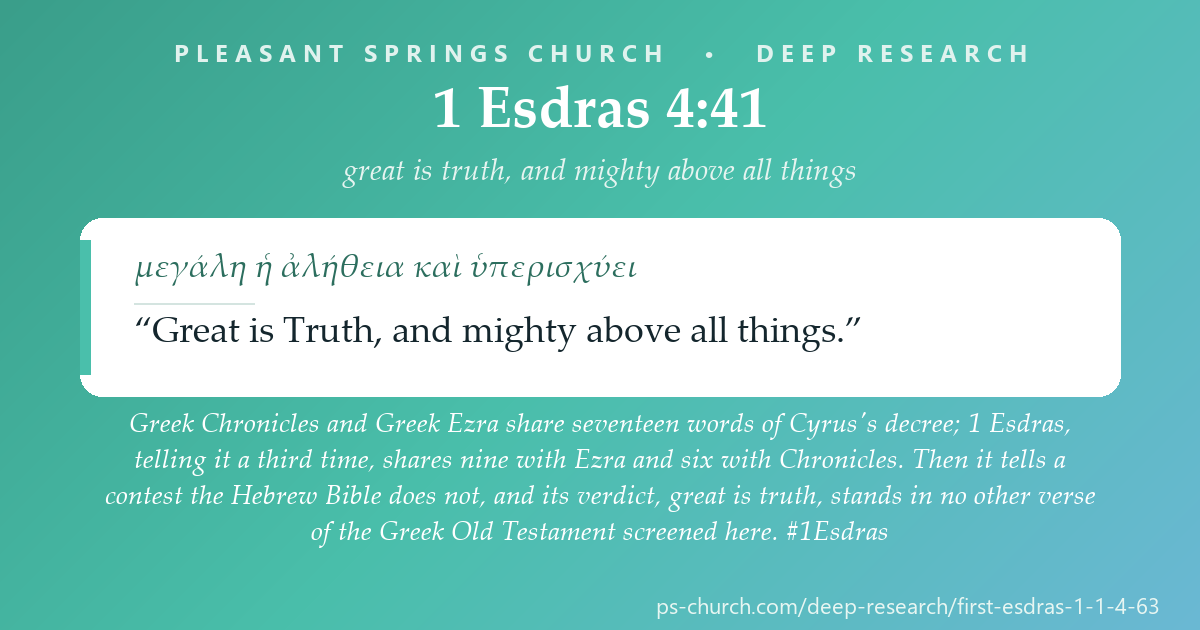
The verdict. The first three of the bold words stand in one of the 30,348 screened Greek Old Testament units — this one — and in no New Testament verse. The verb that ends it is the contest’s own: ten of its fifteen occurrences in the screened Greek Old Testament are in 1 Esdras 3–4. This verse’s deepest New Testament contact is four words, and all the people, shared with three verses of Luke (band 3) and with 69 Greek Old Testament units outside 1 Esdras.
Seven days at each end. Within 1 Esdras 1–4 the two words in bold stand in exactly two verses: here, and 1:17 — the Passover and the feast of unleavened bread ἡμέρας ἑπτά. The four chapters open on one seven-day feast and close on another. The chapter division is the page’s; the two feasts are the text’s.
⚠️ The verse numbers on this page are the Greek’s. The KJV numbers chapters 1 and 2 differently — 58 and 30 verses where the Greek has 55 and 26 — and each line above names the KJV verse it prints. The seams this study began with for chapter 2, 2:1–15 = Ezra 1 and 2:16–30 = Ezra 4:7–24, are the KJV’s numbers; in the Greek they are 2:1–11 and 2:12–26.
On the columns. The Greek is the CATSS morphological Septuagint (Rahlfs’s text), quoted at verse level with attribution, each line labelled with its book. The English is the King James Version Apocrypha, 1769 standard text, public domain, quoted verbatim from the verse-per-line edition held on this disk, KJV spelling and all; it is quotation, not a translation measured against the Greek. The Hebrew and Aramaic are the Masoretic text of the canonical parallel, not of 1 Esdras: no Hebrew or Aramaic 1 Esdras is on this disk. No ESV of 2 Chronicles 35–36 or Ezra 1 and 4 is cached here, so English for those lines is our gloss, marked as ours. There is no Latin column: the Clementine Vulgate corpus on this disk stops at the canon, but the Latin 3 Esdras of the Clementine appendix (Latin Wikisource’s transcription of the 1598 Vatican print) is held separately; this page counts its verses (below) and neither prints nor measures its text.
Versification — stated, as on every page here, in a third state: no Masoretic 1 Esdras and no ESV; a Latin held, and counted below, but not printed. There is no Hebrew–Greek offset to report for the book itself, because there is no Hebrew of it.
• Three names. Rahlfs prints the book as Esdras A; the English Apocrypha calls it 1 Esdras; the Latin tradition, which prints it in the Vulgate’s appendix, calls it 3 Esdras. And the numbers cross: the Greek 2 Esdras on this disk is Ezra–Nehemiah in one book (Nehemiah 1 is 2 Esdras 11), while the KJV’s 2 Esdras is the apocalypse also called 4 Ezra.
• Greek. 1 Esdras is 434 rows in nine chapters, every label a plain number. This study’s four chapters are 55 + 26 + 24 + 63 = 168 rows and 3,563 Greek words.
• Greek against the King James Apocrypha: +3 and +4, then none. The KJV counts 58, 30, 24, 63 here and 448 over the book (fourteen more than the Greek: three in chapter 1, four in chapter 2, two in chapter 5, one in chapter 6, four in chapter 8). Aligned by content, not by label: in chapter 1 the anchors fall on the same labels up to 1:15 (Helkias 1:8, Asaph 1:15), though the verses between are divided differently — the KJV joins Greek 1:10–11, so that Moses, Greek 1:12, is KJV 1:11. Then the KJV splits Greek 1:15 and 1:16 and runs +2 from Greek 1:17 to 1:48 (Samuel 1:18→1:20; Carchemish 1:23→1:25; Zedekiah 1:44→1:46), splits 1:49 and runs +3 to the end (the Chaldeans 1:49→1:52; the Persians 1:54→1:57; the seventy years 1:55→1:58). In chapter 2 the two start together (2:1 is 2:1), and the KJV then divides the decree and the letters into more verses, running between +3 and +6: Benjamin 2:5→2:8, Sanabassar 2:11→2:15, Artaxerxes 2:12→2:16, Coele-Syria 2:18→2:24 and 2:22→2:27, and Darius 2:26→2:30 — the KJV’s last verse holds the Greek’s last two. Chapters 3 and 4 have the same counts and are divided differently in four places: the KJV splits Greek 3:14 (so Greek 3:15, call the young men, is KJV 3:16) and realigns at 3:18; and it moves a clause across the verse break at 4:10–11, 4:33–34 and 4:39–40.
• Latin (3 Esdras, Clementine appendix, held, not printed). Counted, not aligned by content: 58, 31, 24, 63, 73, 34, 15, 97, 56 = 451 rows. Against the KJV that is one more in each of chapters 2, 8 and 9 and the same count elsewhere; against the Greek, 17 more (+3, +5, 0, 0, +2, +1, 0, +5, +1). Over this study’s four chapters: 176 Latin rows, 175 KJV verses, 168 Greek rows. Equal counts are not equal divisions; the Latin’s verse boundaries are not mapped here. Its row 4:41 carries the crowd’s verdict, at the same number as the Greek and the KJV.
• The canonical parallels. Greek 2 Chronicles 35 and 36 have 31 rows each where the Masoretic chapters have 27 and 23: twelve lettered rows (35:19a–d, 36:2a–c, 36:4a, 36:5a–d) stand in the Greek alone. Ezra 1 and 4 are 2 Esdras 1 and 4, with the Masoretic verse counts (11 and 24). The English numbering of those canonical chapters is not checked here: no ESV of them is cached.
• Josephus is cited by Niese’s section numbers (Ant. 11.36).
The Shape of the Passage
A sequence of five blocks, with measured threads (not a chiasm)The contest is a sequence, and the text marks where each speech ends. The first two speeches end the same way — ὦ ἄνδρες … καὶ ἐσίγησεν (3:24, 4:12). The women speech ends with the address but no silence (4:32): the king and his nobles look at one another, and the same speaker goes straight on to truth (4:33–34). The truth speech names every earlier subject in one verse, ἄδικος ὁ οἶνος ἄδικος ὁ βασιλεύς ἄδικοι αἱ γυναῖκες ἄδικοι πάντες οἱ υἱοὶ τῶν ἀνθρώπων (4:37), and ends with a different verb of silence, καὶ ἐσιώπησεν.
This is NOT offered as a chiasm. The five blocks follow one another; the threads run through them; nothing mirrors. The page claims the sequence it can read and the threads it can count.
⚠️ Where this page sits. 1 Esdras stands in the Greek Bible of the Orthodox churches; the Latin tradition printed it in an appendix to the Vulgate as 3 Esdras; the Protestant Bibles of the Reformation era printed it among the Apocrypha; it is absent from the Hebrew Bible. Those statements of status are reported, not checked on this disk. This library reads it as a Second-Temple witness and files it under Apocrypha / Deuterocanon. Nothing taught at Pleasant Springs rests on it.
Author
Anonymous, and working with material the Hebrew Bible also has — in a different order. Chapter 1 is the matter of 2 Chronicles 35–36; chapter 2 sets Ezra 1 and then Ezra 4:7–24 side by side, so that the letter stopping the work follows Cyrus’s decree directly. In Ezra the register of the returning exiles (Ezra 2) stands between them; in 1 Esdras it comes only in chapter 5, after the contest — seven of that chapter’s 71 rows share runs of five words or more with Greek 2 Esdras 2. That is the next study.
Its Greek is its own — measured. Where it tells what Greek Chronicles tells, the two seldom share more than a handful of words in a row, and they name the Passover differently (Stage 4). And it is not a longer telling. Josiah’s Passover runs to 470 Greek words in 1 Esdras 1:1–20 against 546 in Greek 2 Chronicles 35:1–19 (61 in Greek 4 Kingdoms 23:21–23).
And it has one story the Hebrew Bible lacks. Three young men of the king’s bodyguard, a riddle, four speeches, and a winner who turns out — at 4:13, the only time he is named in these four chapters — to be Zerubbabel.
Audience
Readers of Greek who knew the return from exile as a story about a temple. The thread that runs from the first chapter to the fourth is the temple vessels: taken (1:39, 1:43, 1:51), counted out by Cyrus (2:7–11), asked for by the contest’s winner (4:44) and sent by Darius (4:57).
Readers who could enjoy a court tale. A Persian king who goes to bed and wakes, a prize of purple and gold, a concubine who takes the crown off the king’s head and slaps him (4:29–31), and a crowd that shouts the answer. The book is commonly dated to the second century BC — a dating reported from general knowledge, not from the commentaries named in Stage 5 (none was consulted), and not measured here.
And readers for whom it mattered who had prevailed. The contest asks what is strongest; the Jewish winner answers truth and is granted the rebuilding of Jerusalem. Josephus tells the same contest in his Antiquities (Stage 2), so the story was known to at least one Jewish writer of the first century AD.
Orient on the book, its three names, and the two Greek texts it stands beside.
Search by topic: Esdras, First Book of; 3 Esdras; Esdras A; Zerubbabel; Darius I; Artaxerxes; Josiah’s Passover; Cyrus edict; Paraleipomenon; Ezra–Nehemiah, Greek versions.
Which articles are relevant?
- Anchor Bible Dictionary — entries on 1 Esdras, Zerubbabel, Darius and Artaxerxes.
- Eerdmans Dictionary of Early Judaism — entries on 1 Esdras and on Ezra–Nehemiah.
- Dictionary of New Testament Background (IVP) — entries on the Apocrypha and on the Persian period.
- On the Greek — the NETS introductions to its two Greek Esdras books (Rahlfs’s Esdras A and B), which treat the two Greek books apart. An article that says “the Septuagint of Ezra” without saying which of the two Greek Ezras it means is not usable for this book.
Bibliography surfaced (not consulted for this page — see Stage 5):
- Zipora Talshir, I Esdras: From Origin to Translation, and her I Esdras: A Text Critical Commentary.
- Jacob M. Myers, I and II Esdras (Anchor Bible).
- Michael F. Bird, 1 Esdras: Introduction and Commentary on the Greek Text in Codex Vaticanus.
- Lisbeth S. Fried (ed.), Was 1 Esdras First? — essays on whether the book is a reworking of Ezra–Nehemiah or witnesses an older form of it.
- Robert Hanhart, Esdrae liber I (Göttingen Septuagint) — the critical edition, with the apparatus this page does not have.
Josephus tells the contest too, a Persian court is set with a familiar number, and Jerome’s preface to Ezra sets a ‘third book’ aside.
Three ancient witnesses stand beside 1 Esdras 1–4 on this disk. The page measures what it can of each rather than summarising them.
Josephus, Antiquities 11.1–67 — the same story, measured:
Josephus tells this whole sequence, from Cyrus’s decree (11.1–18) through the letter that stops the work (11.19–30) to Zerubbabel’s arrival and the contest of the three bodyguards (11.31–57) and its reward (11.58–67). Measured against a window of 205 sections — Ant. 10.48–185 (Josiah to the exile) and 11.1–67 — the 168 rows of 1 Esdras 1–4 reach two consecutive words at 165 rows, three at 80, four at 19, five at 9, six at 4, and nine at one: 2:19 against 11.26, the king’s reply to the letter-writers. Inside the contest the deepest are six words, at 3:6 (the prizes, 11.35) and 4:34 (the sky and the sun, 11.55), each band 1, as is the nine. The two tell one story in largely different words.
Where they differ, measured on the two texts:
- The king who stops the work. 1 Esdras names him Artaxerxes (2:12, 2:25), as Ezra 4 does. Josephus names Cambyses — Καμβύσου δὲ τοῦ Κύρου παιδὸς (11.21), and again at 11.26 and 11.30 — and does not name Artaxerxes anywhere in 11.1–67.
- Who the third bodyguard is. 1 Esdras names Zerubbabel once in these four chapters, at 4:13, after the riddle is set. Josephus introduces him before the contest as one of the three: σωματοφυλακεῖν αὐτὸν μετʼ ἄλλων δύο (11.32).
- The contest’s verb. Josephus uses it once — ἐρωτᾷ μὲν τὸν πρῶτον, εἰ ὁ οἶνος ὑπερισχύει (11.36) — and that is its only occurrence in all twenty books of the Antiquities.
- The verdict. The words great is truth do not occur in the Antiquities, in either order. Josephus’s crowd says something else: ὅτι τὸ ἀληθὲς ἰσχὺν ἄτρεπτον καὶ ἀγήρω μόνον ἔχοι (11.57) [our gloss: that the truth alone has strength unchanging and ageless].
- The concubine. 1 Esdras 4:29 calls Apame τὴν θυγατέρα Βαρτάκου τοῦ θαυμαστοῦ; Josephus has ὑπὸ τῆς Ῥαβεζάκου τοῦ Θεμασίου παιδὸς Ἀπάμης (11.54). Two different fathers’ names; the page does not adjudicate.
- The feast. Both end with seven days: 1 Esdras 4:63 and Josephus ἐφʼ ἡμέρας ἑπτὰ (11.66).
The Persian court — a banquet and a number:
The 127 satrapies. 1 Esdras 3:2 gives Darius ἐν ταῖς ἑκατὸν εἴκοσι ἑπτὰ σατραπείαις. The three words for one hundred and twenty-seven stand in ten screened Greek Old Testament units: this verse; the Old Greek of Daniel 6:2 and 6:4, in a chapter whose first verse names both an Artaxerxes and a Darius; five rows of Greek Esther, whose Greek calls its king Artaxerxes; and two ages, Sarah’s (Genesis 23:1) and Tobias’s (Tobit BA 14:14). A court number, shared by the court tales.
The great banquet. ἐποίησεν δοχὴν μεγάλην [our gloss: made a great feast] (3:1). The two words great feast stand in three screened Greek Old Testament units — this one, Abraham’s feast for Isaac (Genesis 21:8), and the Old Greek of Daniel in the unnumbered row before chapter 5 (labelled 0:0 by the parser), where Belshazzar makes one — and the three words above stand word for word in one New Testament verse, Luke 5:29: ἐποίησεν δοχὴν μεγάλην, Levi’s feast for Jesus. A run of three, one of six New Testament verses that 3:1 reaches at three (band 6) — and a coincidence of idiom: Luke is not telling a Persian court tale.
Jerome, preface to his Latin Ezra — a ‘third book’ set aside:
Jerome translated Ezra–Nehemiah from the Hebrew as one book, and wrote in its preface: Nec quemquam moveat, quod unus a nobis editus liber est, nec apocriforum tertii et quarti libri somniis delectetur; quia et apud Hebraeos Ezrae Neemiaeque sermones in unum volumen coartantur, et quae non habentur apud illos nec de viginti quattuor senibus sunt, procul abicienda.
[our gloss: Let no one be troubled that I have put out one book, nor delight in the dreams of the apocryphal third and fourth books; for among the Hebrews too the words of Ezra and Nehemiah are drawn together into one volume, and what is not held among them and is not of the twenty-four elders is to be thrown far away.] (Latin: The Latin Library’s transcription, held on this disk. No English translation of this preface is held here; the English is ours.)
The “third” book is commonly read as the book studied here, by the numbering the Latin Bible later printed in its appendix. Jerome’s judgement is reported as testimony. This library’s own reading is stated in the frame above: a witness, not Scripture.
The contest’s verb, a word for truth the women speech never uses, and two Greek names for one feast.
Every count below is over the Greek Old Testament files held on this disk — 30,348 verse units screened, the Odes excluded — and the 7,927 verses of the Greek New Testament, and it is a count of word tokens unless it says units or rows. It is not a count over “the Septuagint.”
Fifteen occurrences in the 30,348 screened Greek Old Testament units, and ten of them are in 1 Esdras 3–4 — 3:5, 3:10, 3:11, 3:12, 3:18, 3:24, 4:2, 4:3, 4:12 and 4:41. The other five are Genesis 49:26, Joshua (B) 17:18, 2 Samuel 24:4, and Daniel (Theodotion) 3:22 and 11:23. Zero in the Greek New Testament. Once in all of Josephus’s Antiquities, at 11.36, in the contest. Two-thirds of the Greek Old Testament’s uses of the word, in one story.
Nine rows of these four chapters carry the word, and all nine fall between 3:12 and 4:41: the third written sentence, the narrator’s introduction of the third speaker (4:13), and seven of the nine verses of the truth speech (4:34–38, 4:40, 4:41). The women speech, 4:14–32, does not use it once. μεγάλη ἡ ἀλήθεια (4:41), ἡ ἀλήθεια μεγάλη (4:35) and νικᾷ ἡ ἀλήθεια (3:12) each stand in exactly one of the 30,348 screened units, and in no New Testament verse. The fourth phrase of the speech, the God of truth (4:40), is shared with one unit: Psalm 30:6 in the Greek numbering.
1 Esdras 1 writes the first twelve times, and the book fourteen. Greek 2 Chronicles never writes it: it has the second, twelve times in chapter 35 — and six times in chapter 30, spelled φασεκ. Across the screened Greek Old Testament the first stands in 40 units, ten of them in 1 Esdras 1; the second in 18 — sixteen in 2 Chronicles 30 and 35, one in Jeremiah 38:8 (Greek numbering), and one where it is a man’s name, Phasek, at 2 Esdras 13:6. The New Testament has the first 29 times and the second never.
The end of chapter 1 says the land kept its sabbaths for seventy years. The Hebrew verb is the one Leviticus 26 uses at 26:34 and 26:43 for the same idea, and Greek Leviticus uses one of these two verbs at each place: 26:34 has 1 Esdras’s verb, 26:43 has Chronicles’. 1 Esdras 1:55 and Greek 2 Chronicles 36:21 share the five words that follow, τὴν γῆν τὰ σάββατα αὐτῆς (band 1 from 1:55’s side, among the units outside 1 Esdras; from 2 Chronicles 36:21’s side the deepest contact is six words, with Leviticus 26:34 and 26:35). Two Greek texts, each with one of Leviticus’s two verbs. The page reports which; it does not say why.
Eight rows of 1 Esdras 1–4: 1:39, 1:43, 1:51 (carried to Babylon), 2:7, 2:10, 2:11 (brought out by Cyrus and counted), 4:44 and 4:57 (asked for by the winner, sent by Darius). Not one inside the contest. The vessels are what the story is about before the riddle and after it; the riddle is how they come home.
Four units of the screened Greek Old Testament carry this address, and all four are in the contest: 3:24, 4:2, 4:12, 4:32 — the close of the wine speech, the opening and close of the king speech, the close of the women speech. The New Testament has it once, when Paul addresses the ship’s company — ὦ ἄνδρες (Acts 27:21).
Counted here, not assumed:
- The three written sentences (3:10–12) run three words, three words, and nine. The third names two things, and the contest’s verb is not used of the second: truth νικᾷ [our gloss: conquers].
- The speeches grow, then shrink: wine 126 Greek words (3:17–24), the king 205 (4:1–12), women 368 (4:13–32), truth 218 (4:33–41). The longest speech is the one the winner does not rest his case on.
- The last two speeches each open by recalling what has been said. The women speech opens οὐ μέγας ὁ βασιλεὺς καὶ πολλοὶ οἱ ἄνθρωποι καὶ ὁ οἶνος ἰσχύει (4:14), naming the king, men and wine; the truth speech opens οὐχὶ ἰσχυραὶ αἱ γυναῖκες (4:34), and at 4:37 calls all four unjust.
- Zerubbabel is named once in these four chapters, at 4:13, as the third speaker begins — οὗτός ἐστιν Ζοροβαβελ.
- Darius is first named at 2:26, in the last verse before his banquet; then six times in 3:1–8 and once at 4:47.
Three Greeks for one decree; a contest that touches little; and a New Testament ceiling of five.
Three screens, each with its scope. (1) 1 Esdras 1–2 against the Greek of its own canonical parallels, row by row. (2) All 168 rows against the 29,914 screened Greek Old Testament units outside 1 Esdras. (3) All 168 rows against the 7,927 verses of the Greek New Testament, and every New Testament verse back against the Greek Old Testament. Contiguous runs of whole word forms; the tie band — how many units reach the same depth — is printed beside each run these screens report. Where the page sets two chosen verses side by side, the figure is a pair run, which has no band, and it is called one.
1. The same Hebrew, three Greek tellings:
The cleanest test the shelf can run is the one sentence the Hebrew Bible itself says twice. Cyrus’s decree closes 2 Chronicles (36:22–23) and opens Ezra (1:1–3). Measured on the Masoretic text, 2 Chronicles 36:23 and Ezra 1:2 share nineteen consecutive Hebrew words (counting each maqaf-joined pair as two; seventeen printed forms in Ezra); 36:22 and Ezra 1:1 share nine, the verse broken in three places — by against from the mouth of Jeremiah, and the spellings of Jeremiah’s and Cyrus’s names — into runs of eight, four and nine.
| pair | run | band | shared words |
|---|---|---|---|
| Greek 2 Chronicles 36:23 ~ Greek 2 Esdras 1:2 | 17 | 1, both ways | Cyrus king of the Persians: all the kingdoms of the earth the Lord God of heaven has given me, and he |
| Greek 2 Chronicles 36:22 ~ Greek 2 Esdras 1:1 | 11 | 1, both ways | …mouth of Jeremiah, the Lord stirred up the spirit of Cyrus king of the Persians and commanded |
| 1 Esdras 2:2 ~ Greek 2 Esdras 1:2 | 9 | 1 from 2:2’s side; from 2 Esdras 1:2’s, second to Chronicles’ 17 | to build him a house in Jerusalem, that in Judea |
| 1 Esdras 2:1 ~ Greek 2 Chronicles 36:22 and ~ 2 Esdras 1:1 | 7 | 2 (these two) | the Lord the spirit of Cyrus king of the Persians and |
| 1 Esdras 2:2 ~ Greek 2 Chronicles 36:23 | 6 | pair run (2:2’s deepest is the 9 above) | me to build him a house in Jerusalem |
So the Greek of Chronicles and the Greek of Ezra–Nehemiah, two separate books, read nearly alike where the Hebrew doubles the sentence; 1 Esdras, the third Greek telling, does not. From Greek 2 Esdras 1:2’s side, 1 Esdras is not even its nearest neighbour: its deepest contact is Chronicles’ seventeen. The Greek-to-Greek figures are pair runs and screen bands over the 30,348 units; the Hebrew-to-Hebrew figures are pair runs on the Masoretic text. The English in the table is our gloss.
Then the whole of chapters 1–2. For each row of 1 Esdras 1–2, the longest run it shares with any row of its parallel Greek: chapter 1 against Greek 2 Chronicles 35:1–36:21 (60 rows, lettered rows included); 2:1–11 against Greek 2 Esdras 1 with 2 Chronicles 36:22–23 (13 rows); 2:12–26 against Greek 2 Esdras 4:7–24 (18 rows).
| longest shared run | 1 | 2 | 3 | 4 | 5 | 6 | 7 | 8 | 9 |
|---|---|---|---|---|---|---|---|---|---|
| rows of 1 Esdras 1–2 (81) | 5 | 17 | 17 | 14 | 12 | 8 | 4 | 2 | 2 |
Median four words; maximum nine (2:2 against 2 Esdras 1:2, and 2:14 against 2 Esdras 4:12, each band 1 among the 29,914 units outside 1 Esdras; from the other side, 2 Esdras 4:12’s deepest contact is 2:14, but 2 Esdras 1:2’s deepest is Chronicles’ seventeen, with 2:2 second at nine); not one row identical. Chapter 1 alone: median four, maximum eight (1:4 against 2 Chronicles 35:4 and 1:19 against 35:18, each band 1 on the 1 Esdras side; from the other side 2 Chronicles 35:4’s deepest is 1:4 alone, while 2 Chronicles 35:18 reaches eight with 1:19 and with 2 Chronicles 34:30, band 2). Every one of these figures is generous: each row was allowed its best match anywhere in the parallel chapter, not only at its own verse.
It shows that 1 Esdras 1–2 is not a copy of the Greek Chronicles or the Greek Ezra on this disk. Two texts copied one from the other share long runs; these share four words at the median, and even their names for the feast differ.
It does not show how 1 Esdras came to be. Whether it is a separate translation of a Hebrew text, a reworking of an older Greek, or something else is argued in the scholarship named in Stage 1 and Stage 5, from evidence this disk does not hold. No run can be measured between Greek and Hebrew, and the page does not pretend to.
2. Against the rest of the Greek Old Testament — the contest touches little:
The 168 rows against the 29,914 screened Greek Old Testament units outside 1 Esdras: 166 reach two, 151 three, 104 four, 54 five, 22 six, 11 seven, 5 eight, and 2 reach nine — and those two are 2:2 and 2:14, the parallels above. By chapter, the ceilings are 8, 9, 4 and 6.
Chapter 3 never shares more than four consecutive words with anything in the screened Greek Old Testament outside its own book. Chapter 4 reaches six three times, and none is a parallel: 4:15 with 2 Samuel 17:16, the king and all the people (band 1); 4:19 with five units, the gold and the silver and (band 5); and 4:37 with 1 Maccabees 7:18 (band 1), οὐκ ἔστιν ἐν αὐτοῖς ἀλήθεια καὶ [our gloss: there is no truth in them, and]. The doxology of 4:40 reaches five with Daniel (Theodotion) 7:27 (band 1), καὶ ἡ ἐξουσία καὶ ἡ.
3. Against the New Testament — both sides, and a ceiling of five:
1 Esdras 1–4, 168 rows against 7,927 New Testament verses: 166 reach two, 119 three, 30 four, 5 reach five, and nothing reaches six. Two rows (4:8, 4:9) share only single words. The whole book, 434 rows, reaches five ten times and six never.
| row | run | NT band | NT verse(s) | from the NT side |
|---|---|---|---|---|
| 1:16 | 5 | 1 | 2 Timothy 1:18 | 5, band 5: of the Lord in that day also in 1 Chronicles 29:22; a different five, in that day and, in Deuteronomy 31:22, 32:44 and 1 Maccabees 11:48 |
| 1:37 | 5 | 1 | Luke 6:17 | 5, band 2: this row and 2 Chronicles 31:1 |
| 4:2 | 5 | 4 | Acts 4:24, 14:15; Revelation 7:2, 12:12 | Acts: 13 with Exodus 20:11 (band 1); Revelation: 5, band 4 |
| 4:25 | 5 | 5 | Matthew 15:4, 19:5, 19:19; John 6:42; Ephesians 5:31 | Matthew 19:5 and Ephesians 5:31: 8 with Genesis 2:24; 19:19: 7 with Leviticus 19:18; 15:4 and John 6:42: 5, band 2 (this row and Deuteronomy 21:13) |
| 4:38 | 5 | 1 | Hebrews 1:8 | 10 with Psalm 44:7 (band 1) |
Every five is a formula, and from the New Testament side not one of them is 1 Esdras’s alone. 4:38’s five are εἰς τὸν αἰῶνα τοῦ αἰῶνος [our gloss: for ever and ever], which stand in 24 screened Greek Old Testament units; Hebrews 1:8 sets them, as words said to the Son, inside its citation of Psalm 44:7 (Greek numbering), and measures ten against the Psalm.
Across the whole New Testament, 14 verses find their deepest Greek Old Testament contact in 1 Esdras 1–4 and nowhere else, each band 1 from the New Testament side: eight at four words, six at three, and none is a citation. One of the eight is Hebrews 11:28, τὸ πάσχα καὶ τὴν, against 1 Esdras 1:17 (band 3 from that row’s side, with Mark 10:30 and Luke 18:30, which meet it on in this time) — Hebrews is speaking of Moses’ Passover, and the screen’s nearest match is Josiah’s, because 1 Esdras writes the feast’s name before and the. Four others (Acts 9:28, 1 Corinthians 5:4 and 6:11, James 5:14) meet 1:46 on the name of the Lord (band 4 from 1:46’s side: exactly these four), which in 1 Esdras is the oath Zedekiah broke. The other three at four are Luke 5:17 (with 1:37), Acts 11:16 (with 1:54) and 1 John 4:18 (with 4:39).
For scale: among Greek Old Testament books of 1 Esdras’s size or larger, the only others whose deepest New Testament contact is five or less are the Wisdom of Solomon (435 rows, 4), Job (1,083 rows, 5) and Sirach (1,402 rows, 5). Greek 2 Chronicles reaches 8 and Greek Ezra–Nehemiah 6.
4:20 against Genesis 2:24 and Matthew 19:5 — a run of TWO. The women speech says it outright: ἄνθρωπος τὸν ἑαυτοῦ πατέρα ἐγκαταλείπει … καὶ πρὸς τὴν ἰδίαν γυναῖκα κολλᾶται [our gloss: a man leaves his own father … and cleaves to his own wife]. It is the idea of Genesis 2:24, which Matthew 19:4–5 introduces as what was written and Mark 10:7 and Ephesians 5:31 also carry. Measured, 4:20 shares two words with Genesis 2:24 and with each of the three — a man the (pair runs; 4:20’s own deepest New Testament contact is three words, band 3, with none of them).
And five verses later, 4:25 reaches FIVE with Matthew 19:5 and Ephesians 5:31, on τὸν πατέρα καὶ τὴν μητέρα [our gloss: father and mother] — words that stand in two Greek Old Testament units (this row and Deuteronomy 21:13) and five New Testament verses. The run the screen ranks highest is an article-and-noun formula; the run that carries the shared idea measures two. That is why the page prints both.
4:41 against the New Testament — four words, and they are and all the people (Luke 7:29, 18:43, 21:38; band 3), which stand in 72 screened Greek Old Testament units. 4:39 has λαμβάνειν πρόσωπα [our gloss: to accept persons] — unique in the screened Greek Old Testament — and reaches three with Ephesians 6:9 and Colossians 3:25, one with Romans 2:11 (pair runs). Its own deepest New Testament contact is four words, band 2, with Acts 4:12 and 1 John 4:18: there is not in. The truth speech against 1 Corinthians 13, the nearest New Testament passage in kind (a virtue praised for what it does), measures two at most (pair runs). Those comparisons were chosen by us for their subject, not found by the screen.
What this measurement does and does not settle:
It settles that no New Testament writer cites 1 Esdras 1–4 in any form a run engine can see. The ceiling is five words, every five is a formula, and the crowd’s verdict, great is truth, stands in no New Testament verse.
It does not settle that the book was unread. Josephus tells the contest too (Stage 2). A screen for verbatim contact cannot see a shared idea, and a run of two is not proof of independence any more than a run of six is proof of copying.
What this page could not check, what it got wrong before it started, and where it is weakest.
This is the section that makes the shelf trustworthy. For a book with no Hebrew on disk, a Latin that is held but not used, and no licensed English, it is long.
⚠️ What the page found wrong before it started:
- The map of chapter 2 this study began with is in the KJV’s numbers. 2:1–15 = Ezra 1 and 2:16–30 = Ezra 4:7–24 are true of the KJV’s chapter of thirty verses. In the Greek printed here, the seams are 2:1–11 and 2:12–26. Measured by content, not assumed.
- The 2 Kings 21–25 study on this shelf says 1 Esdras “expands” Josiah’s Passover, to be read beside 2 Kings 23:21–23. Measured, 1 Esdras 1:1–20 runs to 470 Greek words against 61 in Greek 4 Kingdoms 23:21–23, so it is the larger telling of those two; but Greek 2 Chronicles 35:1–19 runs to 546. The larger celebration is already in Chronicles, and 1 Esdras’s telling is the shorter of those two.
⚠️ What this page could NOT check:
- Anything on the Semitic side of 1 Esdras. No Hebrew or Aramaic 1 Esdras is on this disk. Whether 1 Esdras was translated from a Hebrew text that differed from the Masoretic one — the question behind Was 1 Esdras First? — is reported, not tested. The page prints the Hebrew of the canonical parallel beside the Greek and measures nothing across the two languages.
- The origin of the contest. The contest is commonly read as a court tale older than the book, with the praise of truth joined to it — a reading reported from general knowledge, not from a commentary consulted here. The page measured one thing that bears on that: the word truth is absent from the women speech and gathered in 4:34–41. That is consistent with the common reading and does not prove it; a single author building to a climax would produce the same count.
- Any manuscript variant. The Göttingen edition’s apparatus is not here. Every name and word on this page is the CATSS text’s, and the CATSS text is one edition.
- The Latin. Held, not used. The Latin 3 Esdras of the Clementine appendix (Latin Wikisource’s transcription of the 1598 Vatican print) is on this disk, apart from the Clementine corpus, which stops at the canon; it is counted in the versification note, and its row 4:41 carries the crowd’s verdict. A Latin column would need its own alignment by content, which this page has not done. The only Old Latin volume on disk (Sabatier, 1743) runs from Genesis to Job and has no third book of Esdras. No Latin wording is printed or measured on this page, so every statement here about 4:41 is a statement about the Greek and the KJV.
- The chronology. In 1 Esdras an Artaxerxes stops the work before a Darius resumes it, and Josephus names Cambyses instead. The page reports what each text names and does not adjudicate the order of the Persian kings; the commentaries that do were not consulted.
- The book’s status in the churches. Reported from general knowledge, not checked on this disk: canonical in the Orthodox churches, printed in the Vulgate’s appendix, printed among the Apocrypha in the Reformation-era Protestant Bibles.
⚠️ Where this page is weakest:
- The English column is quotation, not a measured parallel — and it was not made from the Greek printed here. The KJV of 1611 was translated from Greek editions of its own day, three centuries before Rahlfs. Where the two disagree on a name the page shows both: Joachaz (KJV 1:34) against Ιεχονιαν; Zaraces (1:38) against Ζαριον; Belemus, Rathumus and Semellius (2:16) against Βεσλεμος, Ραουμος and Σαμσαῖος. The page reports the differences and explains none of them.
- The verse alignment rests on anchors. Names and numbers fix the Greek–KJV offsets in chapters 1 and 2; between anchors the mapping is read from the sense, and four boundaries in chapters 3–4 are clause-shifts, not offsets.
- The headline rests on one sentence. Seventeen against nine and six is the Cyrus decree alone. The broader measure is the 81-row distribution, and it is generous: each row was given its best match anywhere in the parallel chapter.
- “No canonical parallel” is a statement about the Hebrew Bible. What is measured is that chapter 3 shares no more than four consecutive words with any screened Greek Old Testament unit outside 1 Esdras. Josephus has the story; the Hebrew Bible does not.
- Dating and provenance are reported from general knowledge, not from the commentaries (none was consulted), and nothing on the page rests on them.
Commentaries & studies:
- Zipora Talshir, I Esdras: From Origin to Translation; I Esdras: A Text Critical Commentary. Not consulted for this page.
- Jacob M. Myers, I and II Esdras (Anchor Bible). Not consulted.
- Michael F. Bird, 1 Esdras. Not consulted.
- Lisbeth S. Fried (ed.), Was 1 Esdras First? Not consulted.
- Robert Hanhart, Esdrae liber I (Göttingen). Not held.
- Josephus, Antiquities 11.1–67 (Niese) — held, measured, quoted at section level.
Three Greek tellings of one decree, and a riddle with a Jewish answer.
Name what you learned, why it matters, and one concrete response.
What should we carry away — and do?
- “The Greek” of a book can be more than one Greek. The events of 2 Chronicles 35 to Ezra 4 stand on this disk in two Greek tellings that share four words at the median and call the Passover by different names. When someone quotes “the Septuagint” of Ezra, it is fair to ask which.
- The Hebrew Bible says one decree twice. Chronicles ends and Ezra begins with the same decree — nineteen Hebrew words in a row. The fall of Jerusalem and the decree to rebuild it stand side by side, and in 1 Esdras, whatever else it is, they are adjacent too (1:55, 2:1).
- The crowd’s verdict is in no other screened verse. Great is truth stands in one unit of the Greek Old Testament screened here and in no verse of the New. Its idea runs through Scripture; its words, on this disk, stand only here.
- The contest is won by a speaker who gives up his own first answer. The women speech runs to 368 Greek words (4:13–32); then the same speaker calls women, kings and wine all unjust, and says that truth “doeth the things that are just” (4:39, KJV).
- One concrete response. The winner’s first act is to ask for something for others — a city and its vessels — and his second is to bless God (4:58–60). This week, when you win something, spend the first request on someone else — the charge Scripture itself gives (Philippians 2:4); the story only illustrates it.
1 Esdras 4:41 · to share
Greek (CATSS) · KJV Apocrypha (1769 standard text, public domain)Every Deep Research page traces its passage across the whole sweep — the Old Testament, the Second-Temple world between the testaments (historical witnesses, not Scripture), and the New Testament. Follow the thread:
Pleasant Springs Church — Deep Research
Research method after Michael S. Heiser’s Bible Research Method (examine dictionaries → ancient literature → important words → textual connections → academic publications → share), with the Pleasant Springs “Author & Audience” foundation. Scripture set in the Hebrew, the Greek editions named on each page and the ESV (Old Testament), and the Greek New Testament and the ESV (New Testament), per the practice of Pleasant Springs Church. ⚠️ Status: 1 Esdras is not part of the Protestant canon and is absent from the Hebrew Bible. This study is filed under Apocrypha / Deuterocanon and nothing taught at Pleasant Springs rests on it. Greek text: the CATSS morphologically analysed Septuagint (Rahlfs), quoted at verse level with attribution — 1 Esdras, 2 Chronicles and 2 Esdras (Ezra–Nehemiah) are separate files and are never merged; every row count, phrase count, run depth and tie band was re-derived from the corpus files for this study. Hebrew and Aramaic: the Masoretic text of the canonical parallels (Sefaria, Miqra according to the Masorah), never of 1 Esdras, which has none on this disk. English: the King James Version Apocrypha, 1769 standard text, public domain (the verse-per-line edition held on this disk), quoted verbatim; the page’s self-check compares every English line with that file. English for the canonical parallels is our own gloss, marked as such, because no ESV of those chapters is cached here. Josephus: Greek text of B. Niese (1885–1890), Perseus Digital Library digitisation, CC BY-SA 4.0, quoted at section level. Jerome: Latin from The Latin Library’s transcription of his prefaces, held on this disk; the English is ours. Latin: the Clementine appendix’s 3 Esdras (Latin Wikisource, 1598 Vatican print) is held and counted in the versification note, not printed or measured. ⚠️ NOT HELD: any Hebrew or Aramaic 1 Esdras, any Old Latin of it, any critical apparatus, any ESV of this book. Direction of influence is nowhere asserted.
Scripture quotations marked ESV are from the ESV® Bible (The Holy Bible, English Standard Version®), © 2001 by Crossway, a publishing ministry of Good News Publishers. ESV Text Edition: 2016. Used by permission. All rights reserved. The ESV text may not be quoted in any publication made available to the public by a Creative Commons license, and the ESV may not be translated in whole or in part into any other language. www.esv.org
|
Did this study bless you today? 💚 Give to Support PS Church100% of gifts go to the General Fund — thank you. |