Five chapters of 1 Esdras tell, in Greek, most of the book of Ezra and one chapter of Nehemiah: the register of those who came back, the altar and the second temple, Ezra’s journey, the crisis over foreign marriages, and the public reading of the Law. A second Greek telling of the same events is held here, and across the 260 verses the two share they agree on a median of three consecutive words. But the difference that matters is not wording. It is what they call Ezra. Wherever the Hebrew and Aramaic call him the scribe, the other Greek book says scribe; 1 Esdras says reader — six times in seven — and at the reading of the Law it calls him high priest. Reader occurs six times in the 30,348 Greek Old Testament units screened here, and all six are in 1 Esdras. And where Nehemiah 8:9 has Nehemiah, he is the Tirshatha, the other Greek book has the name and 1 Esdras has only a word commonly read as that title. It is not Scripture for us: it is filed with the Apocrypha, and nothing taught here rests on it. Its English here is the King James Apocrypha — which, at some of the words that matter most, is not a rendering of this Greek (Stage 5). See the method →
1 Esdras is a Greek book of nine chapters that runs through events the Hebrew Bible tells in 2 Chronicles 35–36, Ezra, and Nehemiah 7–8, in its own order, and has a story the Hebrew Bible does not have — the contest of the three young bodyguards in chapters 3–4, which brings Zerubbabel back to Jerusalem (Josephus tells the contest too, Antiquities 11.33–58). It is not Scripture for us. We read it the way we read the other Second-Temple books — as a window onto how the return from exile was told in Greek, and onto what a Greek-speaking reader was told about Ezra, the temple and the Law. We read it critically, gratefully for the light it throws, and we test everything by the canon. Where it and Ezra–Nehemiah differ, this page reports what each reads and does not decide between them.
⚠️ What this page can and cannot measure — read this first.
HELD: the Greek of 1 Esdras in full (CATSS 1Esdras.mlxx, 434 verse rows in nine chapters, every label a plain number; this study’s five chapters are 266 rows and 5,431 Greek words); the Greek 2 Esdras, which is Ezra and Nehemiah in one book (CATSS 2Esdras.mlxx, 672 rows); the King James Apocrypha’s 1 Esdras (448 verses); the Hebrew and Aramaic of Ezra and Nehemiah (Masoretic, Sefaria’s Miqra according to the Masorah); the Clementine Vulgate’s Ezra and Nehemiah; the Greek of Josephus’s Antiquities (Niese’s text, Perseus digitisation, 7,376 sections); the Greek New Testament (7,927 SBLGNT verses); and the Greek Old Testament files (30,348 verse units screened, of 30,637 held — the Odes are held and not screened).
NOT HELD: any Hebrew or Aramaic 1 Esdras — none is on this disk, and the book is commonly described as surviving complete only in Greek and in translations made from it. No critical edition — Hanhart’s Göttingen text and its apparatus are not here, so no manuscript variant is checked. No Latin 1 Esdras — the Clementine files here stop at the canon and carry no appendix. No Old Latin, no Syriac, no Dead Sea Scrolls corpus, no ESV of Ezra or Nehemiah cached for this shelf, and no licensed modern English of 1 Esdras.
CONSEQUENCE: the Hebrew-side screens this shelf owns cannot be run on 1 Esdras at all. Everything said here about Hebrew or Aramaic is said of the canonical parallels in Ezra–Nehemiah, and every statement about a Semitic text behind 1 Esdras is outside scholarship, reported and labelled, never measured.
1 Esdras 5:1–9:55 — eleven verses
Greek: CATSS 1 Esdras (Rahlfs) · English: KJV Apocrypha (1769 standard text, public domain) · Hebrew, Aramaic and Latin only for the canonical parallels, with our own glossesThe first of the two places 1 Esdras names Nehemiah — Νεεμιου, in the list of those who came with Zerubbabel and Jeshua. The Hebrew of Ezra 2:2 and the Greek of 2 Esdras 2:2 (Νεεμιας) name him in the same list. In all 434 rows of 1 Esdras the name stands twice: here, and at 5:40.
The second — and here the name stands beside a title-word. Where 1 Esdras has Νεεμιας καὶ Ατθαριας, the Hebrew of Ezra 2:63 has a title alone, הַתִּרְשָׁתָא (the Tirshatha, commonly explained as a Persian title of office), and the Greek 2 Esdras 2:63 has the title written out like a name, Αθερσαθα. Ατθαριας occurs in no other of the 30,348 screened Greek Old Testament units. And the priest the verse waits for is ἀρχιερεὺς, a high priest, where 2 Esdras 2:63 has ἱερεὺς.
The total is the total of Ezra 2:64 and Nehemiah 7:66 — 42,360, written μυριάδες τέσσαρες δισχίλιοι τριακόσιοι ἑξήκοντα, four myriads, two thousand, three hundred, sixty. The qualification is 1 Esdras’s alone: ἀπὸ δωδεκαετοῦς, from twelve years old — the adjective occurs in no other screened unit. The English divides the figure: forty thousand, beside menservants and womenservants two thousand three hundred and sixty; and it gives the servants as seven thousand three hundred forty and seven where the Greek row reads ἑπτακισχίλιοι τριακόσιοι τριάκοντα ἑπτά, 7,337. Stage 2 sets six copies of the register side by side.
The frame opens. The seventh month, and the people gathered ὁμοθυμαδὸν, with one accord, into τὸ εὐρύχωρον — the open square — of the first gate toward the east. In all 434 rows of 1 Esdras the seventh month is named four times, in two pairs: 5:46 and 5:52, 9:37 and 9:40 — and in none of the 195 rows between 5:52 and 9:37. The KJV numbers this verse 5:47.
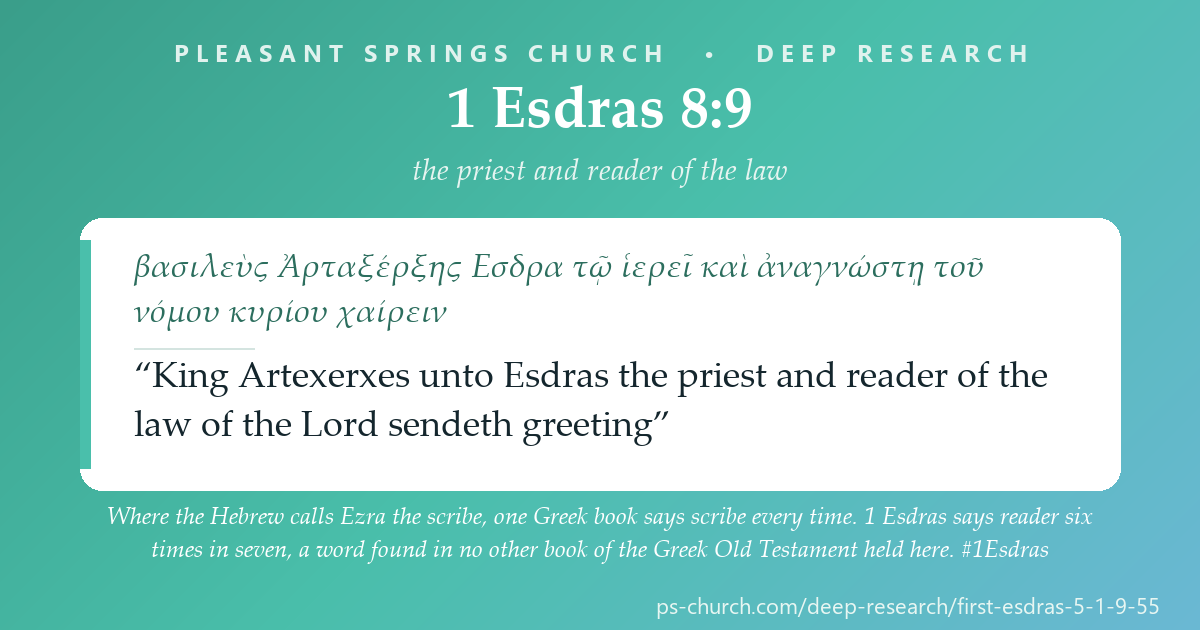
Priest and reader. The king’s letter. The Aramaic of Ezra 7:12 reads לְעֶזְרָא כָהֲנָא סָפַר דָּתָא — to Ezra the priest, scribe of the law (our gloss) — and the Greek 2 Esdras 7:12 reads Εσδρα γραμματεῖ νόμου, scribe of the law. 1 Esdras reads Εσδρα τῷ ἱερεῖ καὶ ἀναγνώστῃ. The word for reader occurs six times in the 30,348 screened Greek Old Testament units, and all six are in 1 Esdras; none in the Greek New Testament. Josephus has the same two titles in the same letter (Stage 2).
Four words found once in the Greek Old Testament held here. τὸ θέλημα τοῦ θεοῦ, the will of God, stands in this verse and in no other of the 30,348 screened units — and in nine verses of the Greek New Testament (Stage 4). The Aramaic of Ezra 7:18 has כִּרְעוּת אֱלָהֲכֹם (according to the will of your God, our gloss); 2 Esdras 7:18 has ὡς ἀρεστὸν τῷ θεῷ ὑμῶν — as is pleasing to your God.
The frame closes. The seventh month again (9:37), and the whole multitude gathered ὁμοθυμαδὸν into τὸ εὐρύχωρον of the east gate — the same words as for the earlier seventh-month assembly at 5:46, under Jeshua and Zerubbabel — one accord, the open square, the gate. The Greek 2 Esdras 18:1 gathers them ὡς ἀνὴρ εἷς (as one man) εἰς τὸ πλάτος τὸ ἔμπροσθεν πύλης τοῦ ὕδατος — to the square before the Water Gate. Measured, the longest run these two Greek verses share is one word. Josephus, Ant. 11.154, has the east gate: πρὸς τὴν πύλην τὴν ἐπὶ τὴν ἀνατολὴν ἀποβλέπουσαν.
High priest and reader. Where the Hebrew of Nehemiah 8:1 has לְעֶזְרָא הַסֹּפֵר — to Ezra the scribe — and 2 Esdras 18:1 has τῷ Εσδρα τῷ γραμματεῖ, 1 Esdras has Εσδρα τῷ ἀρχιερεῖ καὶ ἀναγνώστῃ. The KJV prints Esdras the priest and reader — priest, not high priest. At this word the English is not a rendering of the Greek row printed above it (Stage 5).
The verse this page is about. The Hebrew of Nehemiah 8:9 opens וַיֹּאמֶר נְחֶמְיָה הוּא הַתִּרְשָׁתָא וְעֶזְרָא הַכֹּהֵן הַסֹּפֵר — and Nehemiah — he is the Tirshatha — and Ezra the priest, the scribe, said (our gloss). The Greek 2 Esdras 18:9 opens καὶ εἶπεν Νεεμιας καὶ Εσδρας ὁ ἱερεὺς καὶ γραμματεὺς: the name, and no title. 1 Esdras opens καὶ εἶπεν Ατταρατης Εσδρα τῷ ἀρχιερεῖ καὶ ἀναγνώστῃ: a title-word, and no name — and Ezra is high priest and reader, where both the others have priest and scribe. Ατταρατης occurs once in the 30,348 screened units. The KJV prints “Then spake Attharates unto Esdras the chief priest. and reader” — the full stop after priest is in the file and is quoted as it stands.
One of the two deepest agreements between the two Greek books in the reading of the Law, seven words each, tie band 1 each within that section of 2 Esdras (the other is 9:37’s formula of settlement, which against all 29,914 screened units outside 1 Esdras has tie band 5 — 2 Chronicles 23:6 and 2 Esdras 2:70, 6:16, 17:73, 21:3; this verse stays at band 1 on that wider screen): with 2 Esdras 18:10 (φάγετε λιπάσματα καὶ πίετε γλυκάσματα καὶ ἀποστείλατε). The five words φάγετε λιπάσματα καὶ πίετε γλυκάσματα stand in exactly these two of the 30,348 screened units. Then the two part again: 1 Esdras sends ἀποστολὰς, 2 Esdras μερίδας.
The last verse of the book, as it reads. It ends on καὶ ἐπισυνήχθησαν — and they were gathered together — with nothing after the verb. 2 Esdras ends the same sentence at 18:12 (ὅτι συνῆκαν ἐν τοῖς λόγοις οἷς ἐγνώρισεν αὐτοῖς) and opens the next verse with a gathering: καὶ ἐν τῇ ἡμέρᾳ τῇ δευτέρᾳ συνήχθησαν, and on the second day there were gathered. The KJV takes the last verb with the relative pronoun before it — and for the which they had been assembled — and so closes the sentence. The Greek row does not settle which reading is right, and Stage 4 prints both.
⚠️ The difference that matters here is not the wording. It is the titles. Wherever the Hebrew and Aramaic call Ezra the scribe and 1 Esdras has the verse, 2 Esdras says scribe every time; 1 Esdras says reader six times in seven, and at the reading of the Law it calls him high priest three times. In the same scene, where Nehemiah 8:9 has Nehemiah, he is the Tirshatha, 2 Esdras has the name and 1 Esdras has only the title-word. Stage 4 has the full table.
On the columns. The Greek is the CATSS morphological Septuagint (Rahlfs’s text), quoted at verse level with attribution, as on every page of this shelf. The English is the King James Version Apocrypha, 1769 standard text, public domain, quoted verbatim from the verse-per-line edition held on this disk, KJV spelling and all; it is quotation, not a licensed parallel measured against the Greek, and at several places it is not a rendering of this Greek text at all (Stage 5). There is no ESV of 1 Esdras and none is named for it. There is no Hebrew column, because there is no Hebrew 1 Esdras; there is no Latin column, because the Clementine Vulgate on this disk has no appendix. English in italics in the prose is our own literal gloss unless it is marked KJV.
Versification — stated, as on every page here, in a third state: no Masoretic text of this book and no licensed modern English. There is no Hebrew–Greek offset to report because there is no Hebrew 1 Esdras.
• Greek. 5:1–9:55 is 71 + 33 + 15 + 92 + 55 = 266 rows, every label a plain number running 1 to n without gaps; the whole book is 434 rows in nine chapters.
• Greek against the King James Apocrypha: the KJV runs longer, and the offsets are measured by content. The KJV counts 73, 34, 15, 96, 55 for these chapters (448 verses over the book). Chapter 5: Greek 5:41 is KJV 5:41–42, Greek 5:53 is KJV 5:54–55, Greek 5:56–57 is KJV 5:58–60, and Greek 5:70–71 is KJV 5:73 — so Greek 5:46 is KJV 5:47 and Greek 5:66 (Azbazareth) is KJV 5:69. Chapter 6: Greek 6:7–8 is KJV 6:7–9, and from 6:9 the KJV runs one ahead. Chapter 7: fifteen verses in both, divided differently at 7:4–5. Chapter 8: one ahead from Greek 8:44, level again at 8:51, then one, two, three and finally four ahead — Greek 8:66 (the Idumeans) is KJV 8:69, Greek 8:88 is KJV 8:91, Greek 8:92 is KJV 8:96. Chapter 9: fifty-five in both, the same labels.
• Greek against the canonical parallels, by content. 5:1–6 has none. 5:7–71 = Ezra 2:1–4:5 (5:46 = Ezra 3:1). 6:1–7:15 = Ezra 5:1–6:22. 8:1–9:36 = Ezra 7:1–10:44, with Ezra 10:1–5 = 1 Esdras 8:88–92 (KJV 8:91–96) and Ezra 10:6–44 = 1 Esdras 9:1–36. 9:37–55 = Nehemiah 7:73–8:12 (English numbering; see below). The correspondence of Ezra 4:7–24 stands earlier in 1 Esdras, in chapter 2 (by shared wording; not studied on this page).
• The Greek Ezra–Nehemiah. CATSS files it as 2 Esdras: Ezra 1–10 is 2 Esdras 1–10 verse for verse, and Nehemiah n is 2 Esdras n+10 — so Nehemiah 8:9 is 2 Esdras 18:9. Inside Nehemiah 7 the Greek has a verse the Hebrew lacks (2 Esdras 17:68, the horses and mules), so from there 2 Esdras 17 runs one ahead of the Hebrew. So ‘Nehemiah 7:73’, used on this page for the verse 1 Esdras 9:37 parallels, is the English verse number: the Masoretic text numbers that verse 7:72 (Hebrew 7:72 = English 7:73 = 2 Esdras 17:73). Hebrew verses quoted on this page from Nehemiah 7 (7:65, 7:69) carry the Masoretic number; Hebrew 7:69 is English 7:70.
• The Vulgate’s Nehemiah numbers by the English chapters at two places used here: its 7:70 is Hebrew 7:69, and its 10:1 is Hebrew 10:2.
• Josephus is cited by Niese’s section numbers (Ant. 11.154).
The Shape of the Passage
Inclusio (measured) around a sequenceThe frame is not 1 Esdras’s alone. Ezra–Nehemiah has the same pair of settlements and seventh months, at Ezra 2:70–3:1 and Nehemiah 7:73–8:1 (English numbering; see the versification note). What 1 Esdras has is the two ends close together: 201 rows between 5:46 and 9:37 here, against 392 rows between their two parallels in 2 Esdras, 3:1 and 17:73.
This is NOT offered as a chiasm. The middle is a sequence — altar, house, journey, marriages — in the order the story tells it, and nothing in it mirrors anything else, so the four middle rungs are drawn at one depth and no rung is marked as a pivot.
⚠️ Where this page sits. 1 Esdras is commonly described as canonical in the Eastern Orthodox churches, where it is called Esdras A; in the Latin tradition it was printed after the New Testament as 3 Esdras, outside the canon; and it stood among the Apocrypha in the Protestant Bibles of the Reformation era. It is absent from the Hebrew Bible. This library reads it as a Second-Temple witness and files it under Apocrypha / Deuterocanon. Nothing taught at Pleasant Springs rests on it.
Author
Anonymous, and telling a story the Hebrew Bible also tells. 1 Esdras names no author. It runs through events the Hebrew Bible records in Ezra and Nehemiah, in an order and a Greek of its own. Commentators commonly date it to the second century BC; that is reported, not measured here.
Its Greek is its own — measured. The open square of the temple, τὸ εὐρύχωρον, four times; with one accord three times; reader six times; Ezra as high priest three times; God’s will twice. The Greek 2 Esdras uses none of those five words, anywhere in its 672 rows. It has scribe for Ezra where 1 Esdras has reader, and what is pleasing where 1 Esdras has will.
And its hero is Ezra. Nehemiah’s name stands twice in 434 rows, both in the register (5:8, 5:40). In the scene where the Hebrew names him beside Ezra, 1 Esdras does not.
Audience
Greek-speaking Jews, in the period the commentators assign it to, when the second temple stood. The story runs from a list of families to an altar, a house, a law read aloud in a public square, and a people sent home to eat and drink and send portions to those who have nothing. It tells how the community of the return came to exist.
A book that counts its people. The register is printed in full, numbers and all, and the families who could not prove their descent are named as such (5:37–40). So is the crisis of 8:65–9:36, with the names of the men who had married wives of other peoples and the line the Ezra material ends on: they sent them away with their children (9:36). The page reports that as the text reads and does not soften it; it is a hard chapter in both Greek books and in the Hebrew.
And people who heard the Law read. The book’s last scene is a reading: the people weep, are told the day is holy, go away to feast, and — in its last word — are gathered.
Orient on the book, its relation to Ezra–Nehemiah, and the titles of Ezra and Nehemiah.
Search by topic: Esdras, First Book of; Esdras A; 3 Esdras; Ezra (person); scribe; Tirshatha; Nehemiah (person); returnees, list of; reading of the Law; Josephus, Antiquities 11.
Which articles are relevant?
- Anchor Bible Dictionary — the entries on 1 Esdras, on Ezra and Nehemiah as persons, and on scribes. Article titles are not given here: no dictionary is held on this disk, and the headwords were not checked against the printed volumes.
- Eerdmans Dictionary of Early Judaism — the entries on 1 Esdras, on Ezra, and on scribes (headwords not checked).
- Dictionary of New Testament Background (IVP) — the articles on the Apocrypha and, if indexed, on scribes (headwords not checked).
- On the naming of the Esdras books — any article that sets out the numbering systems side by side. For this book it is not a nicety: the Greek Bible’s Esdras A is the KJV’s 1 Esdras and the Latin tradition’s 3 Esdras; the Greek Esdras B — this shelf’s 2 Esdras — is Ezra–Nehemiah; and the KJV’s 2 Esdras is a different work again, the apocalypse this shelf files as 4 Ezra.
Bibliography surfaced (not consulted for this page — see Stage 5):
- Zipora Talshir, I Esdras: From Origin to Translation (SBL Septuagint and Cognate Studies 47, 1999).
- Zipora Talshir, I Esdras: A Text Critical Commentary (SBL Septuagint and Cognate Studies 50, 2001).
- Robert Hanhart, Esdrae liber I (Göttingen Septuagint VIII,1, 1974) — the critical edition, with the apparatus this page does not have.
- Jacob M. Myers, I and II Esdras (Anchor Bible 42, 1974).
- Lisbeth S. Fried (ed.), Was 1 Esdras First? (SBL Ancient Israel and Its Literature 7, 2011) — the question this page does not enter.
- Michael F. Bird, 1 Esdras (Septuagint Commentary Series, Brill, 2012).
- R. Glenn Wooden, “1 Esdras”, in A New English Translation of the Septuagint (NETS).
Two Greek tellings of one story, six copies of one register, and Josephus as a third Greek telling.
Every run figure in this stage is Greek against Greek, both sides from CATSS, normalised the same way (with the edition’s own spelling equivalences — the convention the shelf’s study of Ezra 10 used for these same two books). Every number in the register tables was parsed out of the texts on this disk, word by word, for this page.
Two Greek tellings of one story — how much wording do they share?
Each of the 260 rows of 5:7–9:55 was screened against its own parallel section of 2 Esdras, and the longest shared run of consecutive words recorded.
| 1 Esdras | against 2 Esdras | rows | reach 3 | reach 5 | deepest | median |
|---|---|---|---|---|---|---|
| 5:7–71 | 2:1–4:5, 4:24 (89 rows) | 65 | 41 | 14 | 12 | 3 |
| 6:1–7:15 | 5:1–6:22 (39) | 48 | 35 | 14 | 8 | 3 |
| 8:1–9:36 | 7:1–10:44 (123) | 128 | 75 | 24 | 12 | 3 |
| 9:37–55 | 17:72–18:13 (15) | 19 | 11 | 2 | 7 | 3 |
| all | 260 | 162 | 54 | 12 | 3 |
Seventeen rows share only a single word with their whole parallel section — among them 9:38, the assembly at the east gate. Across chapters 6–9 alone (195 rows) the median is again three and forty rows reach five.
The two deepest runs, both twelve words, are a name-chain and an inventory. 5:54 with 2 Esdras 3:8: ἤρξατο Ζοροβαβελ ὁ τοῦ Σαλαθιηλ καὶ Ἰησοῦς ὁ τοῦ Ιωσεδεκ καὶ οἱ. 8:57 with 2 Esdras 8:28: τῷ κυρίῳ καὶ τὰ σκεύη ἅγια καὶ τὸ ἀργύριον καὶ τὸ χρυσίον. Where the two Greek books agree at length, it is on patronymics and on gold and silver. Each of the two has a tie band of 1: no other row of its 2 Esdras section reaches twelve with it.
Same list, same Greek book: 2 Esdras 17 (Nehemiah 7) against 2 Esdras 2 (Ezra 2) puts 24 of its 73 rows at a run of five or more and reaches eleven. Same list, the other Greek book: 2 Esdras 17 against 1 Esdras 5 puts 4 of 73 at five or more, reaches seven, and leaves 35 rows at two or fewer. Those are the figures this shelf’s study of Nehemiah 7 published; re-run here, they stand.
And a 1 Esdras row can share more with a book that is not its parallel than with the one that is. Screened against all 29,914 screened Greek Old Testament units outside 1 Esdras, 110 of the 260 rows that have a parallel find their deepest partner somewhere other than 2 Esdras. 6:17, the temple vessels Nebuchadnezzar carried off, shares nine words with Daniel 5:2 in Theodotion’s Greek (tie band 1) and six with its own parallel, 2 Esdras 5:14. 8:79, Ezra’s prayer, shares eight with Baruch 2:20 (tie band 1) and four with 2 Esdras 9:11.
So run depth here measures shared wording, not shared story. A reader shown these numbers cold would not guess that 1 Esdras 5–9 and its four parallel sections of 2 Esdras tell the same events in the same order. They do. Nothing in this stage says which of the two is older or whether either writer knew the other.
The register, counted six ways
The list of those who came back stands in Ezra 2 and Nehemiah 7, in both Greek books, and in the KJV’s English of 1 Esdras. Every figure below was parsed out of the text on this disk, word by word, and summed for this page.
| copy of the register | numbered entries | they sum to | the total it states |
|---|---|---|---|
| Ezra 2:3–60 (Hebrew) | 42 | 29,818 | 42,360 (2:64) |
| Nehemiah 7:8–62 (Hebrew) | 40 | 31,089 | 42,360 (7:66) |
| 2 Esdras 2:3–60 (Greek Ezra) | 42 | 32,008 | 42,360 (2:64) |
| 2 Esdras 17:8–62 (Greek Nehemiah) | 41 | 31,080 | 42,360 (17:66) |
| 1 Esdras 5:9–37 (Greek) | 43 | 31,600 | 42,360 (5:41) |
| 1 Esdras 5:9–37 (KJV English) | 45 | 33,922 | forty thousand, beside menservants and womenservants two thousand three hundred and sixty (5:41) |
Six copies, six different sums, and none reaches the total its own text states. This shelf’s study of Ezra 2 published the two Hebrew sums, 29,818 and 31,089, and a Greek 2 Esdras 2 figure of 32,008; re-parsed here from the texts, all three stand. Its table left 1 Esdras “not summed”; the sum is 31,600.
Only 1 Esdras qualifies the total: οἱ δὲ πάντες ἦσαν Ισραηλ ἀπὸ δωδεκαετοῦς — all Israel, from twelve years old (5:41). 2 Esdras 2:64 has πᾶσα δὲ ἡ ἐκκλησία ὡς εἷς — the whole assembly as one, as the Hebrew does. It is tempting to read the age as the answer to the arithmetic. The text does not say that, and the page does not.
| one family | Ezra 2 | Nehemiah 7 | 2 Esdras 2 | 2 Esdras 17 | 1 Esdras 5 | KJV 1 Esdras 5 |
|---|---|---|---|---|---|---|
| Azgad עַזְגָּד | 1,222 | 2,322 | 3,222 | 2,322 | 1,322 | 3,222 (“Sadas”) |
| Senaah | 3,630 | 3,930 | 3,630 | 3,930 | 3,330 | 3,330 |
| horses | 736 | no such verse | 736 | 736 | 7,036 | 7,036 |
| male and female servants | 7,337 | 7,337 | 7,337 | 7,337 | 7,337 | 7,347 |
| sons of Adonikam | 666 | 667 | 666 | 667 | 667 | 667 |
| singers | 200 | 245 | 200 | 245 | 245 | 245 |
One family, four different figures — all four ending in twenty-two, and differing only in the thousands and the hundreds. The KJV’s register is not this Greek register: against the Greek row it reads differently at five figures (Azgad, Ariphou/Azephurith, Jericho, Phassurou, the servants) and has two entries the Greek row lacks (the sons of Arom, thirty two; they of Pira, seven hundred). Which Greek text the 1611 translators had before them is not something this disk can show.
Josephus — a third Greek telling, measured
Josephus tells these events too, in Antiquities 11, and his Greek is on this disk. At four points the wording can be checked.
- Ezra’s titles in the king’s letter. Ant. 11.123: Ἔζδρᾳ ἱερεῖ καὶ ἀναγνώστῃ τῶν τοῦ θεοῦ νόμων — to Ezra, priest and reader of the laws of God; and again at 11.127. Priest and reader, as 1 Esdras 8:9 and 8:19 have it. The word for reader occurs twice in all 7,376 sections of the Antiquities, and both are in this letter.
- But not high priest. Ant. 11.121 names the high priest of that time, ἀρχιερεὺς ἦν Ἰησοῦ παῖς Ἰωάκειμος — Joakim, son of Jeshua — and calls Ezra πρῶτος ἱερεὺς τοῦ θεοῦ, first priest of God (the participle that follows, καλούμενος, is read here with his name: named Ezra). On that title Josephus sides with neither Greek book.
- The gate. Ant. 11.154 sets the reading of the Law at the Feast of Booths in the seventh month, πρὸς τὴν πύλην τὴν ἐπὶ τὴν ἀνατολὴν ἀποβλέπουσαν — toward the gate that looks east, as in 1 Esdras 9:38. The Hebrew and 2 Esdras have the Water Gate.
- Nehemiah. In book 11 his name first appears at 11.159 (Ξέρξου Νεεμίας ὄνομα, of Xerxes, Nehemiah by name) — after the reading of the Law (11.154–157) and after Ezra’s death (11.158). In Josephus’s reading of the Law, as in 1 Esdras’s, the name does not occur.
That is agreement with 1 Esdras at three points, and with neither Greek book at one. It is not evidence about which text Josephus had before him, and the page does not claim it.
Reader, high priest, a title in a name’s place, the will of God, and a breath.
Every count below is over the Greek Old Testament files held on this disk — 30,348 verse units screened, the Odes are held and not screened — or over the 7,927 verses of the Greek New Testament, and it says which. It is not a count over “the Septuagint”.
Six occurrences in the 30,348 screened Greek Old Testament units, and all six are 1 Esdras calling Ezra by it — 8:8, 8:9, 8:19 in the king’s letter, and 9:39, 9:42, 9:49 at the reading of the Law. None in the Greek New Testament. Josephus has it twice, in the same letter. The Greek 2 Esdras, at every one of the six parallels, has γραμματεὺς — scribe.
Four times in 1 Esdras 5–9: once of the priest the register waits for (5:40) and three times of Ezra at the reading of the Law (9:39, 9:40, 9:49). The Greek 2 Esdras never uses the word at all. At Nehemiah 8:2 and 8:9 the Hebrew calls Ezra הַכֹּהֵן, the priest; at 8:1 it gives him no priestly title. 1 Esdras has high priest at all three places.
Once in the 30,348 screened units (9:49), and so is Ατθαριας (5:40). 2 Esdras writes the Hebrew title as Αθερσαθα twice (2:63, 17:65). Three spellings, four occurrences, and every one stands where the Hebrew has הַתִּרְשָׁתָא — a title the Hebrew Bible uses five times, all in Ezra–Nehemiah. That 1 Esdras’s two words are forms of that title is how commentators commonly read them; what is measured here is only where they stand.
48 occurrences in the screened Greek Old Testament; two in 1 Esdras (8:16, 9:9); none in 2 Esdras, which at both parallels has ἀρεστὸν, what is pleasing. In the screened Greek Old Testament, only at 1 Esdras 8:16 is the word followed by of God; in the Greek New Testament that pairing stands in 21 verses.
Twice in the screened Greek Old Testament, and both are in the last eight verses of 1 Esdras: the Levites ἐμφυσιοῦντες ἅμα τὴν ἀνάγνωσιν (9:48), and the people ἐνεφυσιώθησαν by the words (9:55). Where 2 Esdras 18:8 and 18:12 have understanding (συνῆκαν), 1 Esdras has this rare verb, which we gloss as breathing into. The KJV renders both as understanding.
Counted here, not assumed:
- Ezra’s titles, whole books. 1 Esdras gives him a title after his name eight times: priest and reader (8:8, 8:9, 8:19, 9:42), priest (9:16), high priest and reader (9:39, 9:49), high priest (9:40) — and once describes him ὡς γραμματεὺς εὐφυὴς, as a gifted scribe (8:3). 2 Esdras gives him a title after his name twelve times — priest and scribe (7:11, 7:21, 18:9, 22:26), scribe (7:12, 18:1, 18:4, 18:13, 22:36), priest (10:10, 10:16, 18:2) — and never reader or high priest.
- Nehemiah’s name. Twice in 1 Esdras (5:8, 5:40). Eight times in 2 Esdras, and eight in the Hebrew of Ezra–Nehemiah (once, at Nehemiah 3:16 and 2 Esdras 13:16, of a different man). In the stretch 1 Esdras parallels — Ezra 1–10 and Nehemiah 7:73–8:12 — 2 Esdras names him twice (2:2, 18:9).
- The seventh month: 5:46, 5:52, 9:37, 9:40 — and in no other of the book’s 434 rows.
- The gathering verb. ἐπισυνήχθησαν stands five times in 1 Esdras (5:49, 8:69, 8:88, 9:5, 9:55) — and the book ends on it. 2 Esdras opens Nehemiah 8:13 with the simple verb, συνήχθησαν.
- The Idumeans. At 8:66 the list of peoples ends Αἰγυπτίων καὶ Ιδουμαίων, Egyptians and Idumeans; the Hebrew of Ezra 9:1 ends הַמִּצְרִי וְהָאֱמֹרִי, the Egyptian and the Amorite, and 2 Esdras ὁ Μοσερι καὶ ὁ Αμορι. 1 Esdras names the Idumeans three times (4:45 and 4:50 in an earlier chapter, and here); 2 Esdras not at all. Reported as each column reads; the page draws nothing from it.
Every title Ezra is given, a name and a title that trade places, the New Testament screen, and how the book ends.
Hebrew and Aramaic are quoted from the Masoretic text with cantillation removed; the Greek from CATSS; the Latin from the Clementine Vulgate. No ESV of Ezra or Nehemiah is cached on this disk, so the English in these tables is our own gloss. New Testament runs are contiguous word forms against all 7,927 verses of the SBLGNT, with the tie band — how many verses reach the same depth — printed beside every run, from both sides.
Every title the Hebrew gives Ezra from Ezra 7 to Nehemiah 8:13, and what each Greek book has there:
| Hebrew / Aramaic | Ezra’s title there | 2 Esdras | 1 Esdras |
|---|---|---|---|
| Ezra 7:6 | וְהוּא־סֹפֵר and he a scribe | 7:6 γραμματεὺς | 8:3 γραμματεὺς |
| Ezra 7:11 | הַכֹּהֵן הַסֹּפֵר the priest, the scribe | 7:11 τῷ ἱερεῖ τῷ γραμματεῖ | 8:8 τὸν ἱερέα καὶ ἀναγνώστην |
| Ezra 7:12 | כָהֲנָא סָפַר priest, scribe | 7:12 γραμματεῖ | 8:9 τῷ ἱερεῖ καὶ ἀναγνώστῃ |
| Ezra 7:21 | כָהֲנָא סָפַר priest, scribe | 7:21 ὁ ἱερεὺς καὶ γραμματεὺς | 8:19 ὁ ἱερεὺς καὶ ἀναγνώστης |
| Ezra 10:10 | הַכֹּהֵן the priest | 10:10 ὁ ἱερεὺς | 9:7 no title |
| Ezra 10:16 | הַכֹּהֵן the priest | 10:16 ὁ ἱερεὺς | 9:16 ὁ ἱερεὺς |
| Nehemiah 8:1 | הַסֹּפֵר the scribe | 18:1 τῷ γραμματεῖ | 9:39 τῷ ἀρχιερεῖ καὶ ἀναγνώστῃ |
| Nehemiah 8:2 | הַכֹּהֵן the priest | 18:2 ὁ ἱερεὺς | 9:40 ὁ ἀρχιερεὺς |
| Nehemiah 8:4 | הַסֹּפֵר the scribe | 18:4 ὁ γραμματεὺς | 9:42 ὁ ἱερεὺς καὶ ἀναγνώστης |
| Nehemiah 8:9 | הַכֹּהֵן הַסֹּפֵר the priest, the scribe | 18:9 ὁ ἱερεὺς καὶ γραμματεὺς | 9:49 τῷ ἀρχιερεῖ καὶ ἀναγνώστῃ |
| Nehemiah 8:13 | הַסֹּפֵר the scribe | 18:13 τὸν γραμματέα | 1 Esdras has ended |
Where the Hebrew or Aramaic calls Ezra scribe in this table — eight places — 2 Esdras says scribe at all eight. The Hebrew of Ezra–Nehemiah does so at two more places, Nehemiah 12:26 and 12:36, ten in all; 2 Esdras has scribe there too (22:26, 22:36), and 1 Esdras has no counterpart to either. 1 Esdras has the verse at seven of the eight and says scribe once, at the first (8:3, where the word describes him rather than titles him), and reader at the other six.
Where the Hebrew says priest at the reading of the Law (Nehemiah 8:2, 8:9), 1 Esdras says high priest — and it says high priest at 9:39 too, where the Hebrew of 8:1 has no priestly title. Before the reading, 1 Esdras gives him plain priest four times (8:8, 8:9, 8:19, 9:16); in the reading, high priest three times and plain priest once (9:42). So the title shifts inside 1 Esdras itself, where the Ezra material ends and the reading begins.
It shows that two Greek books telling one scene give its central figure different titles, consistently, and that the Greek 2 Esdras matches the Hebrew title for title at every place in the table but one (Ezra 7:12, where the Aramaic has priest, scribe and 2 Esdras has scribe alone). It does not show why. Whether 1 Esdras reflects a different Semitic text, a different idea of who Ezra was, or something else again is argued in the literature and cannot be settled from these files. What a reader can take away is narrower and firmer: in one Greek book Ezra reads the Law as a scribe; in the other, as a high priest and reader.
The name and the title — five places in the Hebrew, two Greek books, one Latin:
| Hebrew | what it has | 2 Esdras | 1 Esdras | Vulgate |
|---|---|---|---|---|
| Ezra 2:63 = Nehemiah 7:65 (the register) | הַתִּרְשָׁתָא — title | 2:63, 17:65 Αθερσαθα — title | 5:40 Νεεμιας καὶ Ατθαριας — name and a title-word | Ezra 2:63, Neh 7:65 Athersatha |
| Nehemiah 7:69 (the gifts) | הַתִּרְשָׁתָא — title | 17:70 τῷ Νεεμια — name | no parallel | 7:70 Athersatha |
| Nehemiah 8:9 (the reading) | נְחֶמְיָה הוּא הַתִּרְשָׁתָא — name and title | 18:9 Νεεμιας — name | 9:49 Ατταρατης — title-word | 8:9 Nehemias (ipse est Athersatha) |
| Nehemiah 10:2 (the sealed covenant) | נְחֶמְיָה הַתִּרְשָׁתָא — name and title | 20:2 Νεεμιας — name | no parallel | 10:1 Nehemias, Athersatha |
In the Hebrew, Nehemiah’s name and the title stand together twice (8:9, 10:2). In the Latin, at both. In neither Greek book, at either. At the one sentence both Greek books tell — the reading of the Law — 2 Esdras has the name and 1 Esdras has the title-word. At the register it is the other way round: 2 Esdras has the title alone, and 1 Esdras has the name with a title-word beside it, joined by and, which the KJV reads as two men: Nehemias and Atharias.
In the stretch 1 Esdras parallels — Ezra 1–10 and Nehemiah 7:73–8:12 — 2 Esdras names Nehemiah twice, and 1 Esdras names him twice in all. They agree on one place, the list of leaders (2 Esdras 2:2, 1 Esdras 5:8), and divide the other two between them.
The New Testament screen — the distribution first:
1 Esdras 5:1–9:55, 266 rows against 7,927 verses of the Greek New Testament: 255 reach two, 191 reach three, 50 reach four, 5 reach five, and nothing reaches six; eleven rows share no more than a single word.
The whole book, 434 rows: 421 reach two, 310 three, 80 four, 10 reach five, and nothing reaches six. No verse of 1 Esdras, in any chapter, shares six consecutive words with any verse of the Greek New Testament.
- 5:58 → Romans 11:36, Galatians 1:5, Philippians 4:20, 2 Timothy 4:18, Hebrews 13:21 — five words, tie band 5. ἡ δόξα εἰς τοὺς αἰῶνας — the glory for ever. From the other side Romans 11:36 reaches five against two units (this verse and 4 Maccabees 18:24); Galatians 1:5 and 2 Timothy 4:18 reach nine, Philippians 4:20 eight and Hebrews 13:21 six, each with 4 Maccabees 18:24 alone. A doxology formula.
- 6:12 → Acts 4:24, Acts 14:15, Luke 16:17, Revelation 14:7 — five, band 4. τὸν οὐρανὸν καὶ τὴν γῆν. From the other side Acts 4:24 and Acts 14:15 each reach thirteen with Exodus 20:11 alone, Revelation 14:7 reaches seven with Psalm 113:23 (Greek numbering) alone, and Luke 16:17 reaches five against twenty-six units. A creation formula.
- 6:17 → Revelation 9:20, Revelation 14:17 — five, band 2, and the band is two different runs. With Revelation 9:20: τὰ χρυσᾶ καὶ τὰ ἀργυρᾶ, the gold and the silver. With Revelation 14:17, other words: ἐκ τοῦ ναοῦ τοῦ ἐν, out of the temple that is in. From the other side Revelation 9:20 reaches five against six Greek Old Testament units — five on the gold and silver (this verse, 2 Esdras 5:14, Daniel 5:2 in both Greek versions, and Daniel 5:3 in Theodotion’s) and Isaiah 2:8 on other words, the works of their hands; and Revelation 14:17 reaches five against two (this verse and Daniel 5:2 in Theodotion’s Greek). Gold and silver, said of anything made of them; and a temple, with where it stands.
- 6:8 → Acts 26:20 — five, band 1, and band 1 from the other side too. τὴν χώραν τῆς Ιουδαίας καὶ / τὴν χώραν τῆς Ἰουδαίας, καὶ. Unique both ways, and it is a place-name with its articles — the region of Judea, and. The page’s own counter-example: a band of one is not a connection.
- 8:16 → Galatians 1:4, 1 Peter 4:19 — five, band 2; and from the other side, band 1 for each. κατὰ τὸ θέλημα τοῦ θεοῦ / κατὰ τὸ θέλημα τοῦ θεοῦ. See below.
The one that does not dissolve — the will of God:
The four words τὸ θέλημα τοῦ θεοῦ occur once in the 30,348 screened Greek Old Testament units, and that is 1 Esdras 8:16 — the Persian king’s letter, telling Ezra to do with the silver and gold according to the will of your God. In the 7,927 verses of the Greek New Testament they occur in nine (Mark 3:35; Romans 12:2; Galatians 1:4; Ephesians 6:6; Hebrews 10:36; 1 Peter 2:15, 3:17, 4:19; 1 John 2:17). Widen it to will followed by of God in any case, and the count is still one in the Greek Old Testament held here, against twenty-one New Testament verses.
Galatians 1:4 and 1 Peter 4:19 each reach five words with this verse, and with no other screened Greek Old Testament unit. κατὰ τὸ θέλημα τοῦ θεοῦ.
It does not mean any New Testament writer read 1 Esdras, and the page does not say so. Four words this plain can arise wherever someone wants to say them. What the count shows is a distribution: the will of God, as a phrase, is nearly absent from the Greek Old Testament held here and common in the New — and its one Old Testament occurrence is in the mouth of a Persian king, in a book that is not in the Hebrew Bible.
And the other Greek Ezra does not have it. At the same verse 2 Esdras 7:18 reads ὡς ἀρεστὸν τῷ θεῷ ὑμῶν, as is pleasing to your God; the Aramaic reads כִּרְעוּת אֱלָהֲכֹם; the Latin of Jerome reads juxta voluntatem Dei vestri.
⚠️ The page’s counter-example — band 1 both ways, and nothing in it:
5:5 → Luke 3:27 — four words, tie band 1 from the 1 Esdras side, and band 1 from Luke’s. τοῦ Ζοροβαβελ τοῦ Σαλαθιηλ / τοῦ Ζοροβαβὲλ τοῦ Σαλαθιὴλ — of Zerubbabel, of Shealtiel. Luke 3:27’s deepest partner among all 30,348 screened Greek Old Testament units is this verse alone.
It is two names and two articles — the shape of a genealogy written with the genitive article, as Luke’s is. Drop the first article and Haggai 1:14 has the same three words. It is printed here so that the band-1 result for 8:16 is not read as more than it is either.
How the book ends — and a clause it does not have:
Nehemiah 8:10 ends, in the Hebrew, כִּי־חֶדְוַת יְהֹוָה הִיא מָעֻזְּכֶם — for the joy of the LORD is your strength (our gloss). Four witnesses, four readings:
- 2 Esdras 18:10 — ὅτι ἐστὶν ἰσχὺς ὑμῶν, for it is your strength: strength, but no joy of the Lord.
- Vulgate, Nehemiah 8:10 — gaudium etenim Domini est fortitudo nostra: the joy of the Lord, and our strength.
- 1 Esdras 9:52 — ὁ γὰρ κύριος δοξάσει ὑμᾶς, for the Lord will glorify you; the KJV, for the Lord will bring you to honour. Neither joy nor strength in 9:52; and no ischys in the Greek and no strength in the KJV anywhere in 9:37–55 — the nearest is a title of God at 9:46, παντοκράτορι, which the KJV gives as Almighty; and at 9:54 the people do go away to make merry.
Then the last verse. 1 Esdras 9:55 reads ὅτι καὶ ἐνεφυσιώθησαν ἐν τοῖς ῥήμασιν οἷς ἐδιδάχθησαν καὶ ἐπισυνήχθησαν. Taken word by word, in our gloss: because they were breathed into by the words in which they had been taught, and they were gathered together. That is the end of the book.
Two readings, and the page holds both open. (1) The last two words begin a new sentence that is not there — commentators commonly describe the book as breaking off mid-narrative, and 2 Esdras 18:13 does open its next verse with the same root, καὶ ἐν τῇ ἡμέρᾳ τῇ δευτέρᾳ συνήχθησαν. (2) The last verb belongs with the relative pronoun before it, and the sentence is complete — which is how the KJV reads it: Because they understood the words wherein they were instructed, and for the which they had been assembled. The Greek row admits both; nothing on this disk decides between them.
What this page could not check, the tools it built for itself, and where it is weakest.
This is the section that makes the shelf trustworthy. Read it before quoting anything above.
⚠️ What this page could NOT check:
- Any manuscript evidence. Rahlfs prints one text of 1 Esdras; Hanhart’s Göttingen apparatus is not here. The titles in Stage 4 are the titles of this printed text; whether Codex Vaticanus, Codex Alexandrinus and the Lucianic witnesses agree at every one of those places was not checked.
- Any Semitic text behind 1 Esdras. None is held, and none is known to the literature this page reports. Every claim that 1 Esdras’s reader or high priest reflects a different Hebrew or Aramaic wording is a claim this page does not make.
- Whether Attharates and Attharias are the Persian title. The page measures where the two words stand, not what they are. Commentators commonly read them as forms of the title; the KJV prints them as names.
- The priority question. Whether 1 Esdras preserves an older shape of this material than Ezra–Nehemiah, or a later one, is a live argument in the literature (Fried’s volume is titled with the question). This page does not enter it. Nothing above is evidence for either side.
- The Latin 1 Esdras. Not held — the Clementine files here have no appendix — and no Old Latin. The Vulgate quoted above is Jerome’s Ezra and Nehemiah, not 1 Esdras.
- Which Greek text the KJV translators used. Not checked. The page shows only that at the register’s figures, at 9:39 (priest for high priest), at 8:25 (where the KJV has Then said Esdras the scribe and the Greek row has no such clause) and in several proper names, the English is not a rendering of the Greek printed beside it.
⚠️ Tools this page built for itself — and their limits:
- Three numeral parsers. The shelf had no way to read a number written in words. This page carries one for Hebrew, one for Greek and one for KJV English, and its self-check re-derives every register figure with them. As a check on the parsers themselves, the Hebrew one reproduces the two sums this shelf’s study of Ezra 2 published (29,818 and 31,089) and the Greek one reproduces its derived 2 Esdras figure (32,008). Two traps were met and handled: the Greek numeral one and the preposition into normalise to the same letters, as do six and out of, and only the accent tells them apart; and 1 Esdras 5:41 writes myriads four, noun before numeral, where the other copies write four myriads.
- Which entries count. An entry is a run of number words; 1 Esdras 5:16 gives one figure for two family names and is counted once. The sums are of what each text writes, not of what it means.
- The parallel blocks are this page’s. The four sections of 2 Esdras each 1 Esdras section was screened against are drawn from reading, verse by verse; a different boundary would move a few rows.
- The normaliser. Every Greek-against-Greek run on this page uses the edition’s spelling equivalences, as the study of Ezra 10 did. Without them one figure on that page — rows of 2 Esdras 10 reaching three words with 1 Esdras 9 — would be 14 instead of 15. Phrase counts use the plain normaliser.
⚠️ Where this page is weakest:
- The English column is the weakest column, and at some of its most important words it is not a rendering of the Greek. At 9:39 the KJV has priest where the Greek row has high priest, and at 8:25 it calls Ezra the scribe in a clause the Greek row does not have. A reader who knows 1 Esdras only in the KJV would count Ezra’s titles differently from this page.
- The last verse is read two ways and the page cannot choose. Stage 4 prints both readings.
- The titles finding is about one printed Greek text. If the manuscripts divide at these places, the table in Stage 4 is a table of Rahlfs’s choices.
- The Idumean list at 8:66 and the marriage crisis are reported, not interpreted. The page does not explain why the list ends as it does, or how the community ought to have acted; both questions need more than a word count.
- Dating and provenance are taken from the commentaries, and nothing on this page rests on them.
Commentaries & studies:
- Zipora Talshir, I Esdras: From Origin to Translation (1999) and I Esdras: A Text Critical Commentary (2001).
- Robert Hanhart, Esdrae liber I (Göttingen Septuagint VIII,1, 1974). Not held here.
- Jacob M. Myers, I and II Esdras (Anchor Bible 42, 1974).
- Lisbeth S. Fried (ed.), Was 1 Esdras First? (2011).
- Michael F. Bird, 1 Esdras (Septuagint Commentary Series, 2012).
- NETS, “1 Esdras,” trans. R. Glenn Wooden — a modern English made from the Greek, and the obvious next step for a reader; not the edition quoted on this page.
Two Greek books, one scene, two ideas of who stood on the wooden platform.
Name what you learned, why it matters, and one concrete response.
What should we carry away — and do?
- Which copy you read decides what Ezra is called. The Hebrew and one Greek book give Ezra the scribe’s title at each place where 1 Esdras has reader; the other gives him a reader’s and a high priest’s. When an old book tells you who someone was, it is fair to ask which copy.
- Count before you trust a total. Six copies of one register, and no two of them itemise to the same sum. None reaches the total its own text states.
- The phrase you think is everywhere may not be. The will of God is common in the New Testament; in the whole Greek Old Testament held here it stands once, in a Persian king’s letter.
- The book ends with a reading and a feast. The people weep at the Law, are told the day is holy, and go to eat and drink and send portions to those who have nothing. One concrete response: the next time you hear Scripture read aloud, send a portion to someone who has none that same week.
1 Esdras 8:9 · to share
Greek (CATSS) · KJV Apocrypha (1769 standard text, public domain)Every Deep Research page traces its passage across the whole sweep — the Old Testament, the Second-Temple world between the testaments (historical witnesses, not Scripture), and the New Testament. Follow the thread:
Pleasant Springs Church — Deep Research
Research method after Michael S. Heiser’s Bible Research Method (examine dictionaries → ancient literature → important words → textual connections → academic publications → share), with the Pleasant Springs “Author & Audience” foundation. Scripture set in the Hebrew, the Greek editions named on each page and the ESV (Old Testament), and the Greek New Testament and the ESV (New Testament), per the practice of Pleasant Springs Church. ⚠️ Status: 1 Esdras is not part of the Protestant canon; it is commonly described as canonical in the Eastern Orthodox churches, and it is absent from the Hebrew Bible. This study is filed under Apocrypha / Deuterocanon and nothing taught at Pleasant Springs rests on it. Greek text: the CATSS morphologically analysed Septuagint (Rahlfs), quoted at verse level with attribution — 1 Esdras and 2 Esdras (Ezra–Nehemiah) are two files and are never merged; every row count, phrase count, run depth, tie band and register sum was re-derived from the corpus files for this study. English: the King James Version Apocrypha, 1769 standard text, public domain (the verse-per-line edition held on this disk), quoted verbatim; the page’s self-check compares every English line with that file. There is no ESV of 1 Esdras. Hebrew and Aramaic of Ezra–Nehemiah from Sefaria’s Miqra according to the Masorah, and Latin of Ezra–Nehemiah from the Clementine Vulgate, both only for the canonical parallels and glossed by us. Josephus: Greek text of B. Niese (1885–1890), Perseus Digital Library digitisation, CC BY-SA 4.0, quoted at section level. ⚠️ NOT HELD: any Hebrew or Latin 1 Esdras, any critical apparatus. Direction of influence is nowhere asserted. Further reading, not consulted for this page: Talshir, Hanhart, Myers, Fried and Bird.
Scripture quotations marked ESV are from the ESV® Bible (The Holy Bible, English Standard Version®), © 2001 by Crossway, a publishing ministry of Good News Publishers. ESV Text Edition: 2016. Used by permission. All rights reserved. The ESV text may not be quoted in any publication made available to the public by a Creative Commons license, and the ESV may not be translated in whole or in part into any other language. www.esv.org
|
Did this study bless you today? 💚 Give to Support PS Church100% of gifts go to the General Fund — thank you. |