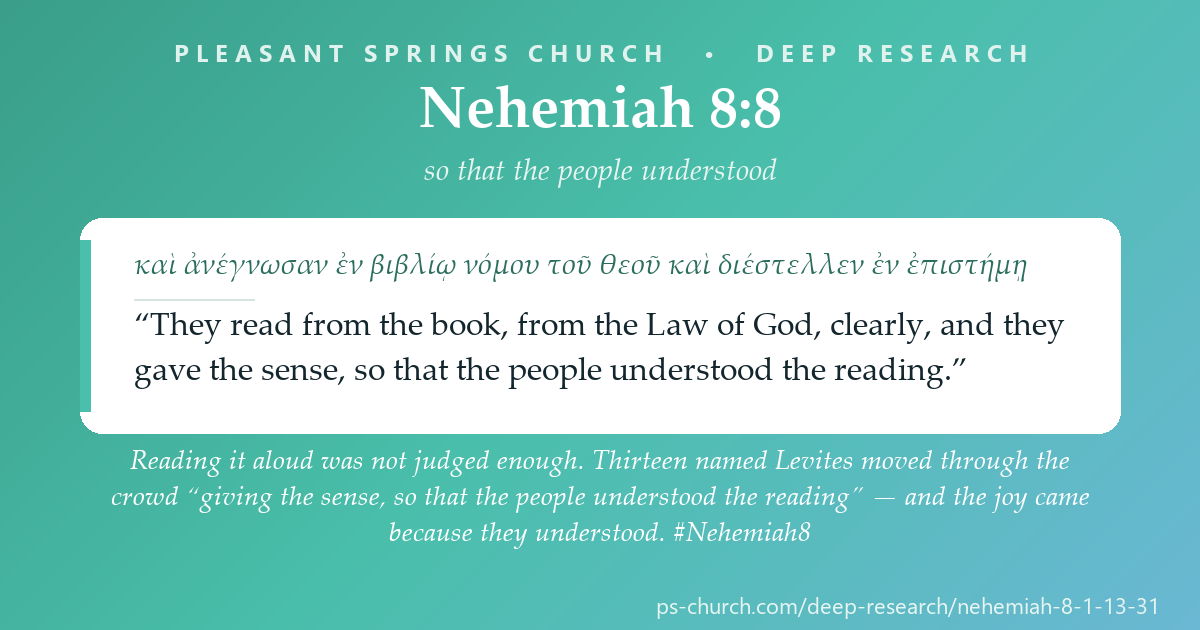
The wall is finished, and the book immediately stops being about the wall. In the seventh month the people gather at the Water Gate and ask for the book — nobody summons them. Ezra reads from daybreak to midday on a wooden platform built for the purpose, and thirteen named Levites move through the crowd doing the thing the text takes care to describe: they read clearly, and gave the sense, “so that the people understood the reading” (8:8). That is Ezra 7:10 reaching its third verb at last — he sought, he did, and here he teaches. The people weep at what they hear and are told to stop: go, eat, drink, and send portions to anyone who has nothing prepared, because “the joy of the Lord is your strength.” Then the longest prayer in the Old Testament, a covenant signed by eighty-four people, a city repopulated by lot, and a dedication in which two choirs walk the top of the wall in opposite directions until the joy of Jerusalem is heard far away. And then chapter 13 — Nehemiah returns years later to find Tobiah living in a temple storeroom, the Levites unpaid, and winepresses running on the Sabbath. The book stops mid-reform: “Remember me, O my God, for good.” See the method →
Nehemiah 8:1–13:31 (selections)
Hebrew · Greek (Rahlfs, 2 Esdras) · ESVAnd the people weep — which is the reaction of a congregation hearing the law properly explained for the first time in a long while. They are told to stop: go, eat the fat, drink the sweet, send portions to anyone who has nothing ready, because the day is holy. “Do not be grieved, for the joy of the Lord is your strength.” Then they keep the Feast of Booths — and the narrator says it had not been done like that since the days of Joshua son of Nun.
Then the longest prayer in the Old Testament (chapter 9), which is really the whole national story told back to God; a covenant signed and sealed with names attached; a city repopulated by lot, with a blessing on the volunteers who agreed to live in it; and a dedication in which two great choirs walk the top of the wall in opposite directions until they meet at the house of God, and “the joy of Jerusalem was heard far away” (12:43).
And then chapter 13. Nehemiah goes back to the king, returns some years later, and finds Tobiah living in a temple storeroom, the Levites unpaid and gone back to their fields, wine presses working on the Sabbath, and children who cannot speak the language of Judah. The book ends five verses later, mid-reform: “Remember me, O my God, for good.”
Numbering, and a substantial block of Greek minuses. Nehemiah n = 2 Esdras n+10, so these are 2 Esdras 18–23.
⚠️ A third numbering shift, and it runs the other way. The Masoretic Text puts “because of all this we make a firm covenant in writing” at 10:1, where English versions make it 9:38. So through chapter 10 the English runs one behind the Hebrew — MT 10:1 = ESV 9:38 and MT 10:40 = ESV 10:39 — the reverse of the six-verse shift in chapters 3–4, where English ran ahead. Verses from chapters 9–10 are cited below by the Hebrew number with the English in brackets.
⚠️ Twelve verses of these chapters are absent from Rahlfs — the largest block in the book. Nehemiah 11 has 36 verses in the Masoretic Text and 27 in 2 Esdras 21: 11:16, 20, 21, 28, 29, 32, 33, 34 and 35 are simply not there, all of them in the register of settlements and officials. Nehemiah 12 has 47 against 44, missing 12:4, 5 and 6 from the list of priests. Counted against both columns, not assumed. Chapters 8, 9, 10 and 13 match exactly.
⚠️ Two differences inside the printed verses. At 8:8 the Hebrew has no stated subject — “they read… and gave the sense” — while Rahlfs supplies one: ἐδίδασκεν Εσδρας, “and Ezra taught,” making it the scribe rather than the Levites. And at 8:10, the most quoted line in the book, the Greek does not have “of the Lord” at all: ὅτι ἐστὶν ἰσχὺς ὑμῶν, “for it is your strength.”
The Shape of the Passage
SequenceAnd then chapter 13. The Chronicler’s successor could have ended at 12:47. Instead he records that Tobiah — the man from chapter 2 — ended up with a room in the temple, and that most of the sworn covenant of chapter 10 had quietly lapsed. The book does not resolve. Its last words are a request that somebody else keep the record.
Behind these chapters stand the finished wall of Nehemiah 6 and the job description of Ezra 7:10, whose third verb finally happens here. In front of them stands Malachi, and four hundred years.
Author
He hands the book to Ezra and steps back. Nehemiah is barely in chapter 8 — he speaks once, in 8:9, alongside Ezra and the Levites. The governor who has dominated seven chapters gives the central scene of the book to a scribe and to thirteen named teachers. The wall was his; the reading is not.
He is precise about method. 8:3 gives the duration and the audience — from early morning to midday, before “those who could understand”; 8:4 names the platform and the men on it; 8:7 names the thirteen Levites; 8:8 describes what they actually did. Four verses of methodology for one act of teaching, which tells you what the writer thought was worth recording.
And he refuses a happy ending. Chapter 12 gives him a scene almost nothing in Scripture matches — two choirs on a wall, joy audible from outside the city. He then appends a chapter in which the enemy has a room in the temple and the tithes have stopped. That is an editorial decision, and it is the same instinct that made Asa’s reign end badly after thirty-five good years.
Audience
People who could no longer read their own Scriptures unaided. Two generations in Babylon had made Aramaic the working language; məpōrāš at 8:8 may mean “distinctly” or may mean “translated,” and the ambiguity is itself informative. Either way the point stands: the text had to be opened before it could be obeyed, and the community that produced the synagogue and the targum starts here.
People being asked to move house. Chapter 11 is a resettlement order carried out by lot — one family in ten uprooted into a half-empty city with a new wall and few jobs. The blessing on those who volunteered (11:2) is the writer noticing what it cost.
And people who had signed things before. Chapter 10 lists eighty-four names on a sealed covenant; chapter 13 shows most of its clauses broken within a working lifetime — by, in at least one case, a high priest. For readers living with the same compromises, the book’s refusal to end in triumph is not pessimism. It is recognition.
Orient on public reading and exposition, on Booths, on the covenant document, and on the reforms.
Search by topic: public reading of Scripture; targum; meturgeman; synagogue origins; Water Gate; Feast of Booths / Sukkot; penitential prayer; covenant renewal; sealed documents and bullae; tithes and the temple tax; Sabbath trade; Tobiah; Sanballat and the high priest’s family.
Which articles are relevant?
- Anchor Bible Dictionary — “Ezra (person),” “Nehemiah,” “Booths, Feast of,” “Targum,” “Synagogue,” “Covenant,” “Tithe,” “Sabbath,” “Seals and Sealings.”
- Dictionary of the OT: Historical Books (IVP) — “Ezra and Nehemiah, Books of,” “Worship,” “Prayer,” “Law,” “Feasts and Festivals,” “Levites, Priests.”
- NIDOTTE / TDOT — פָּרַשׁ (pāraš, make distinct / separate), שֶׂכֶל (śeḵel, insight), בִּין (bîn, understand), חֶדְוָה (ḥeḏwāh, joy), מָעוֹז (māʿōz, stronghold), אֲמָנָה (ʾămānāh, firm agreement).
- On the Greek — the NETS introduction to 2 Esdras, and its account of the shorter text in the register chapters.
Bibliography surfaced:
- H. G. M. Williamson, Ezra, Nehemiah (WBC); Joseph Blenkinsopp, Ezra–Nehemiah (OTL); Lester L. Grabbe, Ezra–Nehemiah.
- On Nehemiah 9 as a penitential prayer, compare Daniel 9 and Psalm 106 directly before reading any commentary — the three belong to one recognisable form and the differences are more instructive than any summary of them.
Reading aloud to people who needed it translated, sealed covenants, and choirs on a wall.
First the world: literacy, public reading and the beginnings of translation; sealed legal documents; and processional dedication. Then the honest question of what 8:8 actually describes.
Which parallels shed light on these chapters?
Public reading was how most people met a text at all. Literacy in the ancient Near East was low and scrolls were scarce; law was proclaimed rather than distributed. Deuteronomy 31:10–13 already legislates for exactly this — read this law before all Israel at the Feast of Booths every seventh year, “that they may hear and learn.” Nehemiah 8 is that command being kept, at that feast, which is presumably why Booths turns up in the next paragraph.
And the language had moved. After two generations under Babylon and Persia, Aramaic was the working tongue of the region — it is the language of the imperial correspondence in Ezra 4–6 and of the Elephantine community’s daily business. Whether məpōrāš at 8:8 means “distinctly” or “translated” is disputed (see below), but Jewish tradition read it as translation and traced the office of the meturgeman — the synagogue translator — to this verse. The institutions of synagogue and targum have their earliest plausible root here, though the text itself claims nothing so grand.
Sealed documents with witness lists were ordinary legal practice. Jeremiah 32:10–14 describes signing, sealing and witnessing a deed; the Elephantine papyri preserve the physical form; and hundreds of clay bullae from Judah carry the impressions of personal seals. Nehemiah 10 is a legal instrument, not a devotional resolution: eighty-four names, sealed, with enumerated obligations and a penalty clause of oath and curse (10:30 [ESV 10:29]).
Processional dedication with music is attested across the region, but the detail in 12:31 is unusual and worth picturing: the two thanksgiving companies were put on the wall itself and sent round in opposite directions. The wall is not the backdrop of the ceremony; it is the stage.
- Deuteronomy 31:10–13 — not an external witness but the law being obeyed: the septennial public reading at the Feast of Booths, “that they may hear and learn to fear the Lord.”
- The Elephantine papyri (Aramaic legal documents — witnesses, not Scripture) — for the form of a sealed, witnessed contract, and for Aramaic as the working language of a Jewish community in this period.
- m. Megillah 4:4; b. Megillah 3a; b. Nedarim 37b (rabbinic-era — witnesses, not Scripture) — the tradition reading məpōrāš as translation and grounding the targum in this verse. b. Nedarim 37b explicitly connects “giving the sense” with verse division and interpretation. Cited as later reflection on the verse, not as a report of what happened.
- Josephus, Antiquities 11.5.7–8 (§§154–158) (Second-Temple — a witness, not Scripture) — he gives the reading of the Law and the feast, and ends Nehemiah’s story with praise of his character and his monument. He does not reproduce chapter 13.
- 1 Esdras 9:37–55 (Second-Temple Greek, Apocrypha — a witness, not Scripture in our confession) — the same reading scene, placed after Ezra 10 rather than here, and used to end that book on “the joy of the Lord is your strength” instead of on a register of offenders.
The verse in Hebrew is seven words: wayyiqrəʾû ḇassēper bəṯōraṯ hāʾəlōhîm məpōrāš wəśōm śeḵel wayyāḇînû bammiqrāʾ — “and they read in the book, in the Law of God, məpōrāš, and giving śeḵel, and they understood the reading.”
What is not in doubt. Reading alone was not judged sufficient. Something additional was done — by thirteen named Levites, moving among the people — and the stated result is comprehension. The verse ends on wayyāḇînû, “and they understood.” The whole point is the last word.
What is disputed. Məpōrāš is a passive participle of a root meaning to separate or make distinct. It could mean read clearly, or read in separated units, or translated — and the same root in Ezra 4:18 is used of a letter being read out to the king, which the versions render both ways. Jewish tradition took it as translation and built the targum on it; many modern translators render “clearly.” Both are defensible and this page does not choose.
And the Greek adds a name the Hebrew does not have. Rahlfs reads ἐδίδασκεν Εσδρας, “and Ezra taught” — supplying a subject, and attributing to the scribe what the Hebrew attributes to the Levites. The Hebrew’s point is arguably the opposite of the Greek’s: the famous man reads, and thirteen people whose names nobody remembers do the work of making it land.
Two disputed words about teaching, one verb six times, and the last three words of the book.
Count bîn through Nehemiah 8 — six times in twelve verses — and notice that 8:12 makes comprehension the cause of the joy. Then read the last verse of the book beside 5:14–18.
“Distinctly” or “translated” — a passive participle from pāraš, to separate or make distinct. Its meaning here is genuinely disputed (see the insight above): clear articulation, division into units, or rendering into Aramaic. The same root appears at Ezra 4:18 of a letter read before the king. The Greek does not translate it at all but rewrites the clause around Ezra teaching.
“Setting understanding” — literally putting insight, hence “giving the sense.” Śeḵel is prudence, discernment, the capacity to grasp how something works (it is what Abigail has in 1 Samuel 25:3). The Levites are not adding content; they are supplying the faculty — putting the hearer in a position to take the text in. The Greek renders it διέστελλεν ἐν ἐπιστήμῃ, “he distinguished with knowledge.”
“To understand, discern.” Six times in twelve verses, and it governs everything: the assembly is defined as “all who could understand what they heard” (8:2), the reading is before “those who could understand” (8:3), the Levites help the people understand (8:7), the result is that they understood the reading (8:8), and the joy of 8:12 is “because they had understood the words that were declared to them.” The joy is explicitly caused by comprehension.
“Joy, gladness.” A rare word — it appears here and at 1 Chronicles 16:27, in the psalm sung when the ark came to the tent, and is otherwise Aramaic. Paired with māʿōz, “stronghold, place of refuge,” it makes a striking compound image: the gladness of the Lord is your fortress. And the Greek does not have the divine name here at all — ὅτι ἐστὶν ἰσχὺς ὑμῶν, “for it is your strength.”
“A firm agreement, a binding pledge” — from אמן, the root of amen and of the wordplay at 2 Chronicles 20:20. Not the usual word for covenant (bərîṯ) but a legal term for something made firm and signed. The community binds itself in writing, with names — and chapter 13 records what happened to it.
“Remember for me.” The last three words of the book, and its fourth occurrence. Nehemiah asks it after each of the reforms of chapter 13, and the final one is unqualified: zāḵrāh-llî ʾəlōhay ləṭōḇāh, “remember me, O my God, for good.” Read after 5:14–18 — the salary not drawn, the land not bought — it is a man asking the only witness left to keep an account he deliberately did not keep himself.
Two things here reported rather than tidied:
- Twelve verses are missing from the Greek, and they cluster. Nehemiah 11 has 36 verses in the Masoretic Text and 27 in 2 Esdras 21 — 11:16, 20, 21, 28, 29, 32, 33, 34 and 35 are absent, all from the register of who settled where. Nehemiah 12 has 47 against 44, missing 12:4–6 from the priestly list. The pattern is the same one visible in 1 Chronicles 1 and at 2 Chronicles 27:8: the Greek tradition abbreviates lists. That is an observation about where the minuses fall, not an explanation of them, and this page does not claim to know why.
- A third numbering shift, running opposite to the first. MT Nehemiah 10:1 = ESV 9:38, so through chapter 10 English runs one behind Hebrew — whereas in chapters 3–4 English ran six ahead. Neither is textual; both are chapter divisions; and a reader who does not know will cite the wrong verse.
The law that commanded this reading, the prayers it belongs with, and the joy that outlasted the book.
Read Deuteronomy 31:10–13 before Nehemiah 8 — the command, the feast and the purpose all line up. Then read Nehemiah 9 beside Psalm 106 and Daniel 9.
Which cross-references matter?
- Deuteronomy 31:10–13 → Nehemiah 8:1–18 — the command being kept. Every seventh year, at the Feast of Booths, read this law before all Israel “that they may hear and learn to fear the Lord… and the children, who have not known it.” Nehemiah 8 reads the law, in that month, and then discovers Booths in the book and keeps it.
- Nehemiah 8:8 → Ezra 7:10 → Luke 24:27, 45; Acts 8:30–31 — the line of exposition. Ezra set his heart to seek, to do and to teach; here Levites give the sense so the people understand; on the Emmaus road Jesus “interpreted to them in all the Scriptures the things concerning himself” and “opened their minds to understand”; and Philip asks the Ethiopian “do you understand what you are reading?” — who answers, “how can I, unless someone guides me?” That is Nehemiah 8:8 as a question.
- Nehemiah 9 beside Psalm 106 and Daniel 9:4–19 — three penitential prayers that retell the national story as confession. Nehemiah 9:17 quotes the self-description of Exodus 34:6 — “a God ready to forgive, gracious and merciful, slow to anger and abounding in steadfast love” — and adds two words of its own: you did not forsake them.
- Nehemiah 8:10 and 1 Chronicles 16:27; Psalm 28:7–8; Habakkuk 3:18–19 — joy as strength, and God as stronghold. Note again that the Greek of 8:10 omits “of the Lord,” so the familiar English form of the line rests on the Hebrew.
- Nehemiah 10 [ESV 9:38–10:39] → Nehemiah 13 — the covenant and its collapse, clause by clause. Sworn: no intermarriage (10:31 [10:30]) — broken at 13:23. Sworn: no Sabbath trade (10:32 [10:31]) — broken at 13:15. Sworn: the tithes and “we will not neglect the house of our God” (10:38–40 [10:37–39]) — broken at 13:10. The book indicts itself with its own document.
- Nehemiah 13:23–27 beside Ezra 10 and 1 Kings 11:1–8 — the same problem, and Nehemiah’s response is different from Ezra’s: he curses, strikes, pulls out hair and makes them swear, citing Solomon — but does not dissolve the marriages. Both accounts are printed in this library and neither is harmonised.
- Nehemiah 12:43 and Ezra 3:12–13 — two sounds heard far off. At the foundation the weeping and the shouting could not be told apart; at the dedication of the wall there is only joy, and it is “heard far away.” The same idiom, and the community has travelled between them.
Where the scholarship agrees, where it does not, and what closes the book.
Williamson, Blenkinsopp and Grabbe. Then four live questions — and on three the honest answer is that the evidence does not settle it.
Commentaries & studies:
- H. G. M. Williamson, Ezra, Nehemiah (WBC) — the standard treatment, and careful on the placement of chapter 8 and on the covenant document.
- Joseph Blenkinsopp, Ezra–Nehemiah (OTL) — strong on chapter 9 as a penitential prayer and on the social reforms of chapter 13.
- Lester L. Grabbe, Ezra–Nehemiah — on the historical questions and on the relationship to 1 Esdras.
- On 8:8: the discussions in Williamson and Blenkinsopp set out the translation question fairly. Read them after looking at Ezra 4:18, where the same root occurs.
Interpretation notes worth keeping:
- Whether Nehemiah 8 stands in its original place — long disputed. The chapter is about Ezra, not Nehemiah, and 1 Esdras places the same scene immediately after Ezra 10. Some scholars move it there; others defend the received order. This page reads the text as it stands and notes that an ancient editor already thought otherwise.
- What məpōrāš means — not settled. “Distinctly,” “in sections,” or “translated.” Jewish tradition took the third; many modern versions take the first. The page reports the range and does not choose.
- The twelve Greek minuses in chapters 11–12. That they cluster in lists is observable; whether they reflect a shorter Hebrew Vorlage or abbreviation in transmission is argued and cannot be settled from the versions alone.
- The ending. The book stops mid-reform with a personal petition and no resolution. Whether that is the memoir’s natural close, a deliberate open ending, or simply where the material ran out is argued. What is agreed is the effect: Ezra–Nehemiah does not report that the problems were solved.
Understanding as the point, joy as a command, and a covenant that lapsed.
Name what you learned, why it matters, and one concrete response.
What should we carry away — and do?
- Reading was not judged enough. Thirteen named Levites moved through the crowd until people understood — and 8:12 says the joy came “because they had understood the words.” Comprehension is not a preliminary to worship here; it is the cause of it.
- They were told to stop crying and go and eat — and to feed someone. The instruction in 8:10 has three parts, and the third is easy to drop: send portions to anyone who has nothing prepared. The holy day is marked by making sure nobody is left out of the meal.
- The most joyful scene in the book is followed by the most disheartening chapter. Two choirs on the wall, joy audible outside the city — and then Tobiah in a temple storeroom and the Levites back in their fields for lack of pay. Nehemiah put chapter 13 there on purpose. Renewal that is not maintained does not stay renewed.
- One concrete response. Take the last thing you heard taught that you genuinely understood — and check whether you did it. Chapter 10 was signed by eighty-four people who had just understood the law, and chapter 13 is what happened next.
Nehemiah 8:8 · to share
Hebrew + Greek (Rahlfs, 2 Esdras) + ESVEvery Deep Research page traces its passage across the whole sweep — the Old Testament, the Second-Temple world between the testaments (historical witnesses, not Scripture), and the New Testament. Follow the thread:
Pleasant Springs Church — Deep Research
Research method after Michael S. Heiser’s Bible Research Method (examine dictionaries → ancient literature → important words → textual connections → academic publications → share), with the Pleasant Springs “Author & Audience” foundation. Scripture set in the Hebrew, the Greek editions named on each page and the ESV (Old Testament), and the Greek New Testament and the ESV (New Testament), per the practice of Pleasant Springs Church. Nehemiah 8–13 research grounded in Williamson (WBC), Blenkinsopp (OTL) and Grabbe. This study completes Nehemiah. Book name and numbering: in the Septuagint Nehemiah is the second half of 2 Esdras (Ἔσδρας Βʹ), so Nehemiah n = 2 Esdras n+10 and these are 2 Esdras 18–23. ⚠️ A third chapter-division shift, running opposite to the first: the Masoretic Text puts the covenant clause at 10:1 where English versions make it 9:38, so through chapter 10 the English runs one behind the Hebrew (MT 10:40 = ESV 10:39) — whereas in chapters 3–4 the English ran six ahead. Verses from chapters 9–10 are cited by the Hebrew number with the English in brackets. Text: Hebrew from the Masoretic Text; Greek from Rahlfs’s Septuaginta (CATSS digitization), printed without editorial punctuation and with proper names unaccented; English ESV. ⚠️ Twelve verses are absent from Rahlfs — Nehemiah 11:16, 20, 21, 28, 29, 32, 33, 34, 35 (MT 36 verses, 2 Esdras 21 has 27) and 12:4, 5, 6 (MT 47, Greek 44), all of them in registers of settlements and priests. Counted against both columns, not assumed. That the minuses cluster in lists is reported as an observation, matching the pattern in 1 Chronicles 1 and at 2 Chronicles 27:8; whether they reflect a shorter Hebrew Vorlage or abbreviation in transmission is named as unsettled. ⚠️ Two differences inside the printed verses: at 8:8 Rahlfs supplies a subject the Hebrew lacks — ἐδίδασκεν Εσδρας, “and Ezra taught” — attributing to the scribe what the Hebrew attributes to the Levites; and at 8:10, the most quoted line in the book, the Greek does not contain “of the Lord” at all. The page states that the familiar English form of that line rests on the Hebrew. The meaning of məpōrāš (8:8) is reported as disputed — distinctly, in sections, or translated — with the Jewish tradition that grounded the targum in it cited as later reflection rather than as report, and no choice made. The placement of chapter 8 is reported as long disputed, with the note that 1 Esdras already positions the scene after Ezra 10; the page reads the text as it stands. Nehemiah’s response to intermarriage in 13:23–27 is set beside Ezra 10 and the difference — he does not dissolve the marriages — is stated, with neither account harmonised to the other. The covenant of chapter 10 is traced clause by clause to its breaches in chapter 13. Second-Temple and rabbinic witnesses (1 Esdras; Josephus, Ant. 11; m. Megillah 4:4; b. Nedarim 37b) are read as witnesses and never levelled with Scripture, and Apocrypha is tagged non-canonical at first mention. Typology is handled per the house position: what the text says, what the New Testament itself draws, and what we see from this side of the cross — with the seeing left to the reader.
Scripture quotations marked ESV are from the ESV® Bible (The Holy Bible, English Standard Version®), © 2001 by Crossway, a publishing ministry of Good News Publishers. ESV Text Edition: 2016. Used by permission. All rights reserved. The ESV text may not be quoted in any publication made available to the public by a Creative Commons license, and the ESV may not be translated in whole or in part into any other language. www.esv.org
|
Did this study bless you today? 💚 Give to Support PS Church100% of gifts go to the General Fund — thank you. |