Jehoshaphat is a good king with one weakness he never fixes, and the Chronicler builds the reign around both. The good is unique in Scripture: in his third year he sends five officials, nine Levites and two priests around Judah, “and they had the Book of the Law of the Lord with them… and taught among the people” (17:9). Later he appoints judges in every fortified city and tells them “you judge not for man but for the Lord.” The weakness is an alliance: he marries into the house of Ahab, goes to war beside a man who has just been told by a prophet that he will die, and comes home to be asked “should you help the wicked and love those who hate the Lord?” And then the best thing in the reign. Three nations march on Judah; the king is afraid, calls a fast, and prays in front of everyone, ending “we do not know what to do, but our eyes are on you.” A Levite answers “the battle is not yours but God’s,” and the king’s response is not a battle plan — he puts the choir in front of the army, singing the line the temple sang at its dedication. Then the last three verses: another partnership with Ahab’s house, and a fleet that never sailed. See the method →
2 Chronicles 17:1–20:37 (selections)
Hebrew · Greek (Rahlfs, Paraleipomenon B) · ESVThe good is remarkable and unique to this book. In his third year he sends a delegation round Judah — five officials, nine Levites, two priests — “and they had the Book of the Law of the Lord with them; they went about through all the cities of Judah and taught among the people” (17:9). No other king in Scripture does this. Later he appoints judges in every fortified city and tells them something no ancient king had any obligation to say: “consider what you do, for you judge not for man but for the Lord” (19:6).
The weakness is an alliance. He marries into the house of Ahab, goes to war beside a king who has just heard a prophet tell him he will die, survives, and comes home to Jehu son of Hanani asking “should you help the wicked and love those who hate the Lord?” (19:2).
And then the best thing in the reign. Three nations march on Judah. Jehoshaphat is afraid, proclaims a fast, and prays in front of everybody — ending with the most honest sentence any king says in Chronicles: “we do not know what to do, but our eyes are on you” (20:12). A Levite in the assembly answers with “the battle is not yours but God’s,” and the king’s response is not a battle plan. He puts the choir in front of the army, singing the same line the temple sang at its dedication — his steadfast love endures for ever — and by the time Judah reaches the lookout there is nothing to fight.
Then the last three verses: he goes into partnership with Ahaziah of Israel, and the ships break up in harbour. He does it again.
Text and numbering. In the Septuagint this book is 2 Paraleipomena, “things omitted” — Παραλειπομένων Βʹ (Paraleipomenōn B). Chapters 17–20 are numbered alike in Hebrew, Greek and English and the verse counts match exactly — 19, 34, 11, 37 — with nothing absent from Rahlfs. Counted against both columns, not assumed.
⚠️ The wordplay at 20:20 cannot be carried into any translation. The Hebrew is haʾămînû ba-YHWH… wəṯēʾāmēnû — two forms of one root, אמן: trust, and be made firm. “Believe in the Lord your God and you will be believed-in — established, held firm.” It is the same play Isaiah makes to Ahaz (Isaiah 7:9), and it is the reason English versions all sound slightly flat here. The Greek loses it too: ἐμπιστεύσατε ἐν κυρίῳ and then a different verb entirely.
⚠️ Chapter 18 is nearly the whole of 1 Kings 22, and Chronicles frames it differently. The Micaiah narrative is reproduced at length and very closely. What Chronicles adds is a sentence before it — 18:1, that Jehoshaphat “made a marriage alliance with Ahab” — and a scene after it, Jehu’s rebuke in 19:1–3, which 1 Kings does not have. Same episode, different verdict attached.
The Shape of the Passage
SequenceBehind these chapters stand the terms of 7:14 and Asa’s treaty in chapter 16 — the same mistake, one generation earlier. In front of them stands a marriage that will nearly end the house of David.
Author
He reproduces a whole chapter of Kings and changes its meaning with two sentences. Chapter 18 is 1 Kings 22 almost word for word — Micaiah, the lying spirit, the disguise, the arrow. The Chronicler adds 18:1 in front of it (the marriage alliance) and 19:1–3 behind it (Jehu’s rebuke). He has not altered the episode; he has framed it, so that what reads in Kings as an Israelite tragedy reads here as a Judean king’s misjudgment.
And he gives Jehoshaphat two institutions no other king gets. The teaching circuit of 17:7–9 and the judiciary of 19:5–11 are both unique to Chronicles. Both put something between the king and the people — a book, and a bench — and both are staffed by Levites. This is the same writer who gave the Levites five chapters and who has a Levite deliver the decisive oracle in chapter 20.
He also refuses to round the reign off. 20:32–33 gives the summary verdict — he did right, but the high places were not taken away and the people had not set their hearts on the God of their fathers — and then adds the shipping venture. The book will not let a good king exit clean, any more than it let Asa.
Audience
People whose survival depended on knowing the law. A community rebuilt around a book and its teachers would have read 17:7–9 as their own charter: officials and Levites going from town to town with the scroll, teaching. Ezra and Nehemiah describe exactly that activity (Nehemiah 8:7–8). The Chronicler is showing them a king who did it first.
People with no army. Chapter 20 is the passage in Chronicles that speaks most directly to powerlessness. Judah does not fight; Judah sings, and watches. For readers who had no realistic military option and lived at the discretion of an empire, “the battle is not yours but God’s” was not a slogan — it was the only strategy available.
And people under constant pressure to make useful arrangements with powerful neighbours. Two alliances, two prophets, two rebukes. The Chronicler does not say Jehoshaphat was wicked; he says a good king kept tying himself to people whose values he did not share, and paid for it each time. That is a pastoral warning aimed at a small province, not a foreign policy.
Orient on Jehoshaphat, on Israelite legal administration, on holy war, and on the Asaphite singers.
Search by topic: Jehoshaphat; Ahab; marriage alliance; Micaiah ben Imlah; Ramoth-gilead; judges and courts in Israel; bribery; holy war / Yahweh war; Asaph and the Korahites; Tekoa; En-gedi; Valley of Beracah; Ezion-geber; Tarshish ships.
Which articles are relevant?
- Anchor Bible Dictionary — “Jehoshaphat,” “Ahab,” “Micaiah,” “Ramoth-gilead,” “Judges (Israelite),” “Law (Israelite),” “War, Holy,” “Asaph,” “Ezion-geber,” “Tarshish.”
- Dictionary of the OT: Historical Books (IVP) — “Jehoshaphat,” “Law,” “Justice,” “Prophets and Prophecy,” “Warfare,” “Levites, Priests.”
- NIDOTTE / TDOT — אָמַן (ʾāman, believe / be firm), מִלְחָמָה (milḥāmāh, battle), מִשְׁפָּט (mišpāṭ, judgment), שֹׁחַד (šōḥaḏ, bribe), יָצַב (hiṯyaṣṣəḇû, stand firm), בְּרָכָה (bərāḵāh, blessing).
- On the Greek — the NETS introduction to 2 Supplements, and its notes on chapter 18 beside 3 Kingdoms 22.
Bibliography surfaced:
- Sara Japhet, I & II Chronicles (OTL); Raymond B. Dillard, 2 Chronicles (WBC); Ralph W. Klein, 2 Chronicles (Hermeneia); H. G. M. Williamson, 1 and 2 Chronicles (NCBC).
- On chapter 20 as a “holy war” narrative and its liturgical shape, the relevant sections of Dillard are the most useful starting point; on the Micaiah episode, read a commentary on 1 Kings 22 alongside.
Marriage as foreign policy, courts and bribes, and the shape of a war nobody fights.
First the world: dynastic marriage, judicial administration and the standing problem of the bribe. Then the recognised pattern of a battle in which God fights — and where chapter 20 keeps it and where it departs.
Which parallels shed light on these chapters?
Marrying a daughter to a neighbouring dynasty was ordinary statecraft. The Amarna letters, Hittite treaties and Assyrian records are full of it: a marriage seals an alliance and creates a standing obligation of mutual military support. That is exactly what happens here — 18:2–3 has Ahab ask “will you go with me to Ramoth-gilead?” and Jehoshaphat answer “I am as you are, and my people as your people.” The alliance was not an emotional lapse; it was a treaty obligation being called in. Which is what makes Jehu’s question in 19:2 so pointed: the objection is not that the policy was ineffective but that of all the houses in the world he had bound himself to that one.
Courts and the problem of the bribe are everywhere in ancient law. Mesopotamian legal collections and Egyptian instruction texts warn officials against partiality; the vizier’s installation text in Egypt charges him to judge without regard to persons. What 19:6–7 adds is the reason: not that bribery is inefficient or shameful, but that the judge is standing in for God — “you judge not for man but for the Lord… there is no injustice with the Lord our God, or partiality, or taking bribes.” The court’s standard is God’s character.
And chapter 20 follows a recognised biblical war pattern — up to a point. The shape appears at the Red Sea (Exodus 14:13–14, “stand firm and see the salvation of the Lord… you have only to be silent”) and in the Deuteronomic instructions for battle (Deuteronomy 20:1–4): do not fear, God fights. Jahaziel quotes the Exodus formula almost exactly. What is distinctive here is the choir. No other battle in Scripture is opened by sending singers ahead of the troops, and the line they sing is the temple refrain rather than a war cry.
- Josephus, Antiquities 9.1.1–9.3.2 (§§1–44) (Second-Temple — a witness, not Scripture) — he retells Jehoshaphat’s reign, the alliance, the invasion and the victory, and keeps the rebuke. Worth noticing that he expands the account of the judiciary: an administrator writing for Romans found the courts the most interesting part.
- Exodus 14:13–14; Deuteronomy 20:1–4 — not external witnesses but the pattern Jahaziel is quoting. “Stand firm and see the salvation of the Lord” is Moses at the sea.
- Amarna letters; Hittite treaty texts (ancient Near Eastern diplomatic documents — witnesses, not Scripture) — for dynastic marriage as a binding military alliance. Cited for the practice, which is what makes 18:3 a formula rather than a sentiment.
- The Installation of the Vizier (Egyptian administrative text — a witness, not Scripture) — for the ancient charge to judge impartially, and for the contrast with the ground given in 19:6–7.
The Hebrew. 20:20: haʾămînû ba-YHWH ʾəlōhêḵem wəṯēʾāmēnû — two forms of the root אמן, the root behind amen. The first is “trust, rely on”; the second is a passive: “be made firm, be held up, be confirmed.” The sense is something like: lean on the Lord and you will be held. Isaiah says the identical thing to Ahaz in the identical construction (Isaiah 7:9), which is worth knowing because it shows this is a formula, not a coinage.
What no translation manages. English has to pick two different words — “believe… be established” — and the link disappears. The Greek gives up too: ἐμπιστεύσατε ἐν κυρίῳ for the first and a different verb for the second. This is a case where the Hebrew column on this page is doing work the other two cannot.
What the sentence is not. It is not a general promise that confident belief produces success, and it is not advice about how to feel. The second half is “believe his prophets, and you will succeed” — and the prophet in question had just told them to go out and not fight. What is being asked for is obedience to a specific instruction that looked insane: march at a superior force with the choir in front. The verse describes what happened when they did it. It does not license reading any confident conviction as faith.
One root twice in one sentence, a battle that belongs to somebody else, and a valley named for thanks.
Read 20:20 in Hebrew and then in Isaiah 7:9 — the same play, to a very different king. Then notice that the instruction in 20:17 is military in form and entirely passive in content.
“Believe” and “be established” — the same three letters both times, אמן, the root of amen and of ʾĕmûnāh, faithfulness. Its basic sense is firmness: a thing you can put weight on. So the sentence is a pun with a theology in it — put your weight on him, and you will be held up. Isaiah 7:9 uses exactly the same play. Neither the Greek nor any English version can reproduce it, and this page prints the Hebrew rather than arguing from a wordplay the other columns do not show.
“The battle.” “The battle is not yours but God’s” — and the Hebrew is blunter than the English: not to you the battle, but to God, with no verb at all. It belongs to the war-formula of Deuteronomy 20 and Exodus 14, and 1 Samuel 17:47 says it in David’s mouth to Goliath: “the battle is the Lord’s.” The Greek uses παράταξις, the drawn-up battle line.
“Take your stand, station yourselves, stand firm.” “You will not need to fight in this battle. Stand firm, hold your position, and see the salvation of the Lord on your behalf.” It is the verb of Moses at the sea (Exodus 14:13), and the instruction is military in form and passive in content: take up battle stations and do nothing.
“Blessing” — and the name they give the valley where they stopped to bless God before going home. The Chronicler adds “therefore the name of that place has been called the Valley of Beracah to this day,” which is his usual way of anchoring a story to ground his readers could walk to. The battlefield is renamed for the thanksgiving rather than the slaughter.
“Bribe, gift given to sway a decision.” The judicial charge names three things God does not do — injustice, partiality (literally “lifting of faces”), and taking bribes — and makes them the standard for the bench. It is the vocabulary of Deuteronomy 10:17 and 16:19. The court is told to imitate God’s character, not merely to follow a rule.
“And they taught.” The piel of lāmaḏ, to learn — so, to cause to learn. 17:7–9 is the only royal teaching circuit in the Old Testament: officials, Levites and priests going city to city with the book. The same activity reappears when Ezra’s Levites “gave the sense, so that the people understood the reading” (Nehemiah 8:8). The Greek is ἐδίδασκον.
Two things here reported rather than tidied:
- Chronicles reproduces 1 Kings 22 and reframes it. Chapter 18 is the Micaiah narrative at length and very close to the Kings text — the four hundred prophets, Zedekiah’s iron horns, the lying spirit in the divine council, the disguise, the arrow shot at random. What Chronicles supplies is the frame: 18:1 tells you first that Jehoshaphat had made a marriage alliance with Ahab, and 19:1–3 brings him home to a prophet’s rebuke that 1 Kings does not contain. Neither book contradicts the other; the evaluation is Chronicles’ own.
- The identity of the invaders in 20:1 is textually uncertain. The Hebrew has Moabites, Ammonites, and “some of the Ammonites” — which most read as a copyist’s slip for Meunites, following the Greek Μιναίων and the sense of 20:10 and 20:22. This is a place where the versions help each other, and where English translations quietly follow the Greek. Reported rather than passed over.
The sea, the war law, the same episode in Kings, and a refrain that keeps being sung.
Read Exodus 14 and Deuteronomy 20 before 2 Chronicles 20 and Jahaziel stops sounding original — he is quoting, deliberately. Then follow the refrain of 20:21 back through the book.
Which cross-references matter?
- Exodus 14:13–14 → 2 Chronicles 20:15–17 — “Fear not, stand firm, and see the salvation of the Lord… the Lord will fight for you, and you have only to be silent.” Jahaziel is quoting Moses at the sea, almost phrase for phrase. A Levite of the sons of Asaph applies the exodus to a border raid.
- Deuteronomy 20:1–4 — the law for battle: when you see horses and chariots and an army larger than yours, do not be afraid, “for the Lord your God is he who goes with you to fight for you.” Chapter 20 is that law being obeyed.
- 1 Kings 22 beside 2 Chronicles 18 — the same Micaiah episode. Read them in parallel; the differences are small, and the significant ones are what Chronicles puts around the chapter rather than in it.
- 1 Chronicles 16:34, 41 · 2 Chronicles 5:13; 7:3, 6 → 20:21 → Ezra 3:11 — “give thanks to the Lord, for his steadfast love endures for ever.” Sung when the ark came to the tent, at the temple’s dedication, marching at an invading army, and again when the second temple’s foundation was laid. The Chronicler’s readers had sung it themselves.
- 2 Chronicles 17:7–9 → Nehemiah 8:7–8 — Levites teaching the law to the people, “giving the sense, so that the people understood the reading.” The institution Jehoshaphat starts is the one the Chronicler’s own community lived by.
- Isaiah 7:9 beside 2 Chronicles 20:20 — the same אמן wordplay, said to Ahaz, who did not believe and was not established. Two kings, one sentence, opposite outcomes.
- Deuteronomy 10:17; 16:19 → 2 Chronicles 19:6–7 — no partiality, no bribe. The judicial charge is Deuteronomy’s language, given a new ground: the judge acts for the Lord.
- 2 Chronicles 18:1 and 21:6; 22:2–3 — what the marriage alliance produced. Jehoshaphat’s son married Ahab’s daughter, and their son’s mother “was his counsellor in doing wickedly.” The alliance of chapter 18 nearly ends the house of David two chapters later, and the Chronicler lets the reader make the connection.
Where the scholarship agrees, where it does not, and what stays open.
Japhet, Dillard, Klein and Williamson. Then three live questions — and on two the honest answer is that the evidence does not settle it.
Commentaries & studies:
- Raymond B. Dillard, 2 Chronicles (WBC) — the best treatment of chapter 20 as a liturgical composition and of the reign’s two-alliance structure.
- Sara Japhet, I & II Chronicles (OTL) — on the judicial reform and its relation to Deuteronomy, and on the Chronicler’s handling of the Ahab material.
- Ralph W. Klein, 2 Chronicles (Hermeneia) — the technical work on chapter 18 beside 1 Kings 22 and on the text of 20:1.
- H. G. M. Williamson, 1 and 2 Chronicles (NCBC) — on 17:7–9 and the question of whether the teaching circuit reflects a later institution read back.
Interpretation notes worth keeping:
- Whether the reforms of 17:7–9 and 19:5–11 are historical or retrojected — argued. Some hold that the Chronicler is describing institutions of his own day and crediting them to a good king; others that he preserves genuine records of a ninth-century administrative reform, noting that the king’s name itself means “the Lord judges.” The evidence does not settle it, and this page reports the material as the book gives it while naming the question.
- The invaders at 20:1. The Hebrew’s repeated “Ammonites” is widely emended to Meunites with support from the Greek. This is a genuine textual problem, not a translation choice, and the page states it rather than silently adopting the emendation.
- The relationship of chapter 20 to a liturgy. The sequence — crisis, fast, assembly, communal lament, prophetic oracle of salvation, thanksgiving — matches the shape of a national lament liturgy closely enough that many read the chapter as shaped by one. That is an observation about form, and it does not by itself settle what happened.
- Jehoshaphat’s evaluation. The book gives him a good verdict with two named failures and a note that the high places remained. Chronicles is not tidy about him, and readings that make him either a model king or a compromised one have to ignore half the text.
Not knowing what to do, sending the choir first, and the alliance you make twice.
Name what you learned, why it matters, and one concrete response.
What should we carry away — and do?
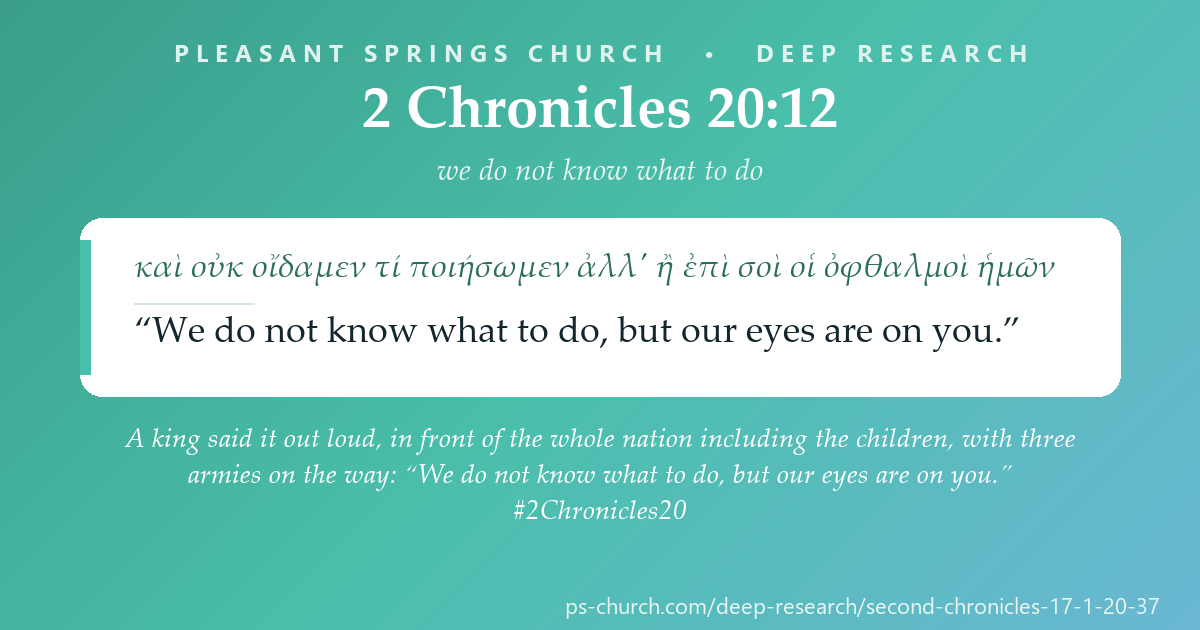
- “We do not know what to do, but our eyes are on you.” A king said that out loud, in front of the whole nation including the children, with three armies on the way. It is the most honest sentence in Chronicles, and it is offered as a prayer rather than an admission of failure.
- The battle plan was a choir. Not a metaphor — he consulted the people and put the singers in front of the soldiers, singing the line the temple sang. Whatever else that is, it is a decision about who is actually fighting, made in public, at cost.
- He was told once, and did it again. Jehu rebuked the alliance with Ahab; twenty years later Jehoshaphat went into business with Ahab’s son and the ships broke up. Being corrected is not the same as being changed, and the Chronicler puts the second alliance in the last three verses of the reign so you cannot miss it.
- One concrete response. Name the one correction you have received more than once. Not a new one — the repeat. Then do something this week that makes the third time less likely: tell someone, remove the occasion, or write it where you will see it.
2 Chronicles 20:12 · to share
Hebrew + Greek (Rahlfs, Paraleipomenon B) + ESVEvery Deep Research page traces its passage across the whole sweep — the Old Testament, the Second-Temple world between the testaments (historical witnesses, not Scripture), and the New Testament. Follow the thread:
Pleasant Springs Church — Deep Research
Research method after Michael S. Heiser’s Bible Research Method (examine dictionaries → ancient literature → important words → textual connections → academic publications → share), with the Pleasant Springs “Author & Audience” foundation. Scripture set in the Hebrew, the Greek editions named on each page and the ESV (Old Testament), and the Greek New Testament and the ESV (New Testament), per the practice of Pleasant Springs Church. 2 Chronicles 17–20 research grounded in Dillard (WBC), Japhet (OTL), Klein (Hermeneia) and Williamson (NCBC). Book name: in the Septuagint this book is Paraleipomenon B, Παραλειπομένων Βʹ; the Hebrew title is דִּבְרֵי הַיָּמִים. Text & numbering: Hebrew from the Masoretic Text; Greek from Rahlfs’s Septuaginta (CATSS digitization of the Rahlfs text), printed without editorial punctuation and with proper names unaccented; English ESV. Chapters 17–20 are numbered alike in Hebrew, Greek and English and the verse counts match exactly (19, 34, 11, 37) with nothing absent from Rahlfs — counted against both columns, not assumed. ⚠️ The wordplay at 20:20 is untranslatable and the page says so: haʾămînû and wəṯēʾāmēnû are two forms of אמן, and neither the Greek nor any English version carries the link; the argument is made from the Hebrew column while stating that the other two columns do not show it. The page also states what the verse is not — not a promise that confident belief produces success, since the instruction being believed was to march out and not fight. ⚠️ Chronicles and Kings: chapter 18 reproduces 1 Kings 22 closely; what Chronicles supplies is the frame — the marriage alliance at 18:1 and Jehu’s rebuke at 19:1–3, neither in Kings — and this is reported as evaluation added rather than narrative altered. ⚠️ A textual problem at 20:1 (the Hebrew’s repeated “Ammonites,” widely emended to Meunites with Greek support) is stated rather than silently resolved. The reforms of 17:7–9 and 19:5–11 are reported as the book gives them, with the scholarly question of whether they reflect later institutions named as unsettled. The liturgical shape of chapter 20 is noted as an observation about form that does not by itself settle what happened. Jehoshaphat’s evaluation is left as mixed as the text leaves it, including the high places at 20:33 and the second alliance at 20:35–37. Second-Temple witnesses (Josephus, Ant. 9) are read as witnesses and never levelled with Scripture; Amarna and Hittite diplomatic material and the Egyptian vizier text are cited for practice and contrast only. Typology is handled per the house position: what the text says, what the New Testament itself draws, and what we see from this side of the cross — with the seeing left to the reader.
Scripture quotations marked ESV are from the ESV® Bible (The Holy Bible, English Standard Version®), © 2001 by Crossway, a publishing ministry of Good News Publishers. ESV Text Edition: 2016. Used by permission. All rights reserved. The ESV text may not be quoted in any publication made available to the public by a Creative Commons license, and the ESV may not be translated in whole or in part into any other language. www.esv.org
|
Did this study bless you today? 💚 Give to Support PS Church100% of gifts go to the General Fund — thank you. |