Eight reigns, and the floor keeps dropping. Jehoram takes the throne and kills all six of his brothers, receives a letter from Elijah — the only time that name occurs in Chronicles — and dies with the coldest epitaph in the book: “he departed with no one’s regret.” Then Athaliah destroys the whole royal family, and the line of David survives because a priest’s wife steals one baby out of the massacre and hides him in the house of God for six years while his grandmother rules. That baby repairs the temple — and then, after the priest who saved him dies, has that priest’s son stoned in the temple courtyard. Zechariah’s last words are four Hebrew words: may the Lord see, and seek — and that is the murder Jesus names when he speaks of “the blood of Abel to the blood of Zechariah.” Then Amaziah, who defeats Edom and brings home Edom’s gods. Then Uzziah, who grows strong and walks into the sanctuary with a censer. Then Ahaz, who burns his sons and shuts the doors. And in the middle of the worst reign, the best thing in the unit happens in the north — a prophet stops an army at the gate, and two hundred thousand prisoners go home clothed, fed, anointed, and the ones who cannot walk carried on donkeys. See the method →
2 Chronicles 21:1–28:27 (selections)
Hebrew · Greek (Rahlfs, Paraleipomenon B) · ESVHis son reigns a year. Then Athaliah destroys the whole royal family, and the line of David survives because a priest’s wife steals one baby out of the massacre and hides him in the house of God for six years while his grandmother rules.
That baby, Joash, repairs the temple. And then, after the priest who saved him dies, he has that priest’s son stoned in the courtyard of the house of the Lord for saying the wrong thing. Zechariah’s last words are four Hebrew words: yēreʾ YHWH wəyiḏrōš — “may the Lord see, and seek.” That is the murder Jesus names when he speaks of “the blood of Abel to the blood of Zechariah, whom you murdered between the sanctuary and the altar.”
Then Amaziah, who defeats Edom and brings home Edom’s gods to worship. Then Uzziah, who becomes very strong and walks into the sanctuary with a censer. Then Jotham, briefly, who “ordered his ways before the Lord his God.” Then Ahaz, who burns his sons, sacrifices to the gods of the people who defeated him, and shuts the doors of the house.
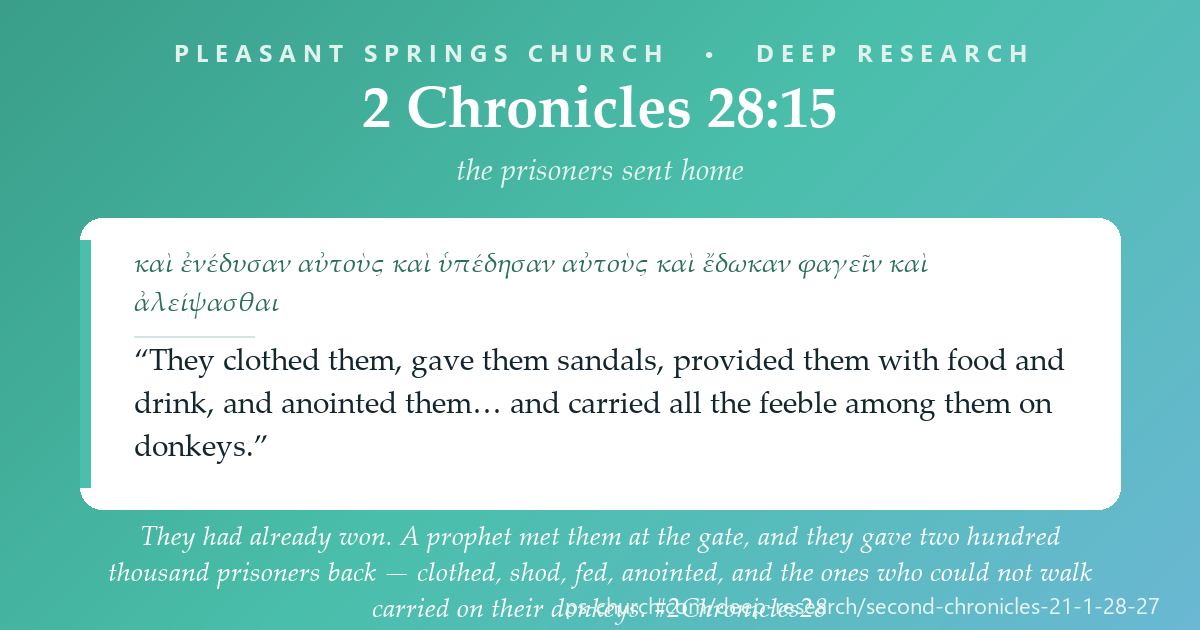
And in the middle of the worst reign, the best thing in the unit happens — in the north. Israelite troops come home with two hundred thousand Judahite prisoners, and a prophet named Oded stops them at the gate. They give the captives back. First they clothe them, put sandals on them, feed them, give them drink, anoint them, and carry the ones who cannot walk on donkeys to Jericho.
Text and numbering. In the Septuagint this book is 2 Paraleipomena, “things omitted” — Παραλειπομένων Βʹ (Paraleipomenōn B). Chapters 21–28 are numbered alike in Hebrew, Greek and English. Verse counts match Rahlfs throughout — 20, 12, 21, 27, 28, 23, 27 — with one exception. ⚠️ 2 Chronicles 27:8 is not in Rahlfs. The Masoretic Text gives Jotham nine verses; the Greek has eight. The missing one reads “He was twenty-five years old when he began to reign, and he reigned sixteen years in Jerusalem” — which is a near-verbatim repetition of 27:1, seven verses earlier. A Greek scribe declining to copy a regnal formula twice is the same behaviour visible in 1 Chronicles 1, where the stretches duplicated from Genesis 10 are absent. Counted against both columns, not assumed.
⚠️ The Greek loses the verb in Zechariah’s dying words. The Hebrew ends wəyiḏrōš — from dāraš, the verb this whole work is built on. Saul died for not seeking; Asa would not seek; and here a dying man asks God to seek what has been done. Rahlfs has κρινάτω, “let him judge” — correct in sense, and the thread to the rest of the book is cut.
The Shape of the Passage
Descending sequenceBehind these chapters stands the marriage alliance of chapter 18, which produced Athaliah, and the terms of 7:14, which every king here is measured against. In front of them stands a door that has to be opened again.
Author
He tells you the cause two chapters before the effect. Athaliah is introduced in 22:2 as “the daughter of Omri” and in 22:3 as the king’s counsellor “in doing wickedly” — and the reader has already been told, at 18:1, that Jehoshaphat made a marriage alliance with Ahab. The Chronicler never says “and this is what that alliance cost.” He simply puts the two facts four chapters apart and lets you carry one to the other.
He measures with the same three words throughout. Uzziah acted unfaithfully (maʿal, 26:16, 18) — the word that killed Saul and exiled Judah. Amaziah did right “yet not with a whole heart” (lēḇāḇ šālēm, 25:2). Zechariah’s dying prayer is dāraš. The vocabulary established in the first book is still doing the scoring in the eighth reign of the second.
And he gives the best behaviour in the unit to the other side. 28:9–15 has northerners — the schismatic kingdom, in Chronicles’ terms — obey a prophet, refuse the spoil, and treat their prisoners with a tenderness nobody in Judah manages in eight chapters. He could have left it out. It is not in 2 Kings 16.
Audience
People who existed because one woman hid a baby. 22:11 is the narrowest moment in the Old Testament: the entire promise to David reduced to one infant in a bedroom. The Chronicler’s readers traced their identity through that line, and he tells them it once ran through a priest’s wife and a storeroom.
People who knew what a shut temple meant. Ahaz “shut the doors of the house of the Lord” (28:24) — and the first readers had lived through a version of that, and had reopened a smaller building on the same ground. The sequence Ahaz → Hezekiah, closed door → opened door, is the shape of their own recent history.
And people tempted to write off the north. By the Chronicler’s day the northern tribes were long deported and their descendants were the neighbours the returned community quarrelled with. Putting Oded and his four named Ephraimite chiefs into the record — as the ones who did right when Judah’s king was burning his sons — is a deliberate refusal to make the story that simple.
Orient on the Omride marriage, on Athaliah, on temple finance, and on skin disease and the priesthood.
Search by topic: Jehoram of Judah; Athaliah; Jehoiada; Joash; Zechariah son of Jehoiada; temple repair and the chest; Amaziah; Uzziah / Azariah; tsaraath and the priesthood; incense and who may burn it; Ahaz; Tiglath-pileser III; Oded; Samaria.
Which articles are relevant?
- Anchor Bible Dictionary — “Athaliah,” “Jehoiada,” “Joash,” “Zechariah (son of Jehoiada),” “Uzziah,” “Ahaz,” “Leprosy,” “Incense,” “Temple, Jerusalem.”
- Dictionary of the OT: Historical Books (IVP) — “Athaliah,” “Priests and Levites,” “Prophets and Prophecy,” “Retribution,” “Disease and Healing.”
- NIDOTTE / TDOT — מַעַל (maʿal), דָּרַשׁ (dāraš), לָבַשׁ (lāḇaš, clothe), גָּבַהּ (gāḇah, be high, proud), צָרַעַת (ṣāraʿaṯ), חֶסֶד (ḥeseḏ).
- On the Greek — the NETS introduction to 2 Supplements, and its treatment of the minus at 27:8.
Bibliography surfaced:
- Sara Japhet, I & II Chronicles (OTL); Raymond B. Dillard, 2 Chronicles (WBC); Ralph W. Klein, 2 Chronicles (Hermeneia); H. G. M. Williamson, 1 and 2 Chronicles (NCBC).
- On 28:9–15 and its relation to Luke 10, the secondary literature is worth reading after you have read both passages cold. See the insight in Stage 2 for what can and cannot be claimed.
A queen who seized a throne, a king who took a censer, and prisoners sent home.
First the world: royal purges, the strict separation of king and priest, and the treatment of prisoners of war. Then Josephus, and the question of what 28:9–15 has to do with a parable told seven hundred years later.
Which parallels shed light on these chapters?
Killing the rival line was standard practice, and that is exactly why 22:10–12 matters. Assyrian and Levantine successions are full of purges; Jehoram opens this unit by killing his six brothers (21:4), and Athaliah closes the same generation by destroying “all the royal family of the house of Judah” (22:10). The convention makes the exception visible. Everything the book has said about the promise to David comes down to whether one woman can get one child out of a room.
King and priest were kept apart in Israel in a way they were not elsewhere. Mesopotamian and Egyptian kings performed priestly functions as a matter of course; the king was the chief cultic officer. In Israel the offices are divided, and Uzziah’s offence in 26:16–18 is precisely the assumption that a strong king may do what a king everywhere else could do. Azariah and eighty priests tell him “it is not for you, Uzziah, to burn incense to the Lord, but for the priests.” The disease that follows puts him permanently outside the building he tried to enter.
And prisoners of war were property. Enslavement of a defeated population was normal, assumed, and profitable; Assyrian reliefs show columns of captives with their goods. That is what makes 28:8–15 remarkable as an event rather than only as a sentiment: two hundred thousand people, already taken, are given back — and given back clothed, shod, fed and anointed, at the expense of the men who captured them, with the weak carried on the captors’ own donkeys.
- Josephus, Antiquities 9.5.1–9.12.3 (§§95–257) (Second-Temple — a witness, not Scripture) — he retells this whole stretch. On Uzziah he adds a detail found nowhere in Scripture: an earthquake at the moment of the king’s presumption, and light breaking through the temple roof onto his face. Cited as an example of the retelling instinct, not as information about the event.
- Assyrian royal annals and palace reliefs (royal propaganda — witnesses, not Scripture) — for dynastic purges and for the deportation and display of captives. Cited for the practice that makes 22:11 and 28:15 exceptional.
- 2 Kings 11 and 2 Kings 16 — not external witnesses but the parallel accounts. Read them beside chapters 22–23 and 28; the Oded episode is not in 2 Kings at all.
- Numbers 16 and Leviticus 10 — not external witnesses but the law behind Uzziah’s offence: Korah’s censers, and Nadab and Abihu’s unauthorised fire.
What 28:9–15 says. Northern troops return to Samaria with two hundred thousand Judahite prisoners. A prophet named Oded meets them at the gate and tells them to send them back. Four Ephraimite chiefs — the Chronicler names all four — stand against the army. And then the verse: they clothed the naked from the spoil, gave them sandals, gave them food and drink, anointed them, set the feeble on donkeys, and brought them to Jericho, the city of palm trees, to their kinsmen.
The resonance. A man is stripped and left half dead on the road from Jerusalem to Jericho. A priest and a Levite pass. Then a Samaritan — a northerner — binds his wounds, pours on oil, sets him on his own animal, and pays for his care (Luke 10:30–35). Oil, an animal, a rescued enemy, and the Jericho road. The overlap is real and it is not trivial.
What can honestly be said. That both passages describe a northerner doing for a Judean what Judeans were not doing, and that the vocabulary of care overlaps closely. That 2 Chronicles 28 was in the scriptures Jesus and his hearers knew. And that a first-century audience steeped in these texts may well have heard it.
What cannot be claimed. Luke does not cite 2 Chronicles 28, and Jesus does not say he is alluding to it. Nothing in the parable names the episode. So this page reports a resonance and does not assert a quotation, an intended allusion, or a key that unlocks the parable. If it is there, it is the kind of thing the Hebrew Bible trains a reader to notice over years — which is exactly how this library treats such things: printed, and left for the reader to see.
A dying man’s verb, a strong king’s trespass, and the kindness a king forgot.
Read dāraš at 24:22 against 1 Chronicles 10:14 and 2 Chronicles 16:12. Then notice that maʿal is used of Uzziah at his strongest, not at his weakest.
“And may he seek / require it.” Zechariah’s dying words are four words: yēreʾ YHWH wəyiḏrōš — “may the Lord see, and seek.” It is the verb the whole work is built on, used here of God investigating a murder. In legal Hebrew, to dāraš blood is to require it, to call it to account (Genesis 9:5; Psalm 9:12). The Greek cuts the thread: κρινάτω, “let him judge” — right in sense, and the reader of Greek cannot hear that it is the same word that condemned Saul.
“He acted unfaithfully, committed sacrilege.” The book’s hinge word, and here it lands on the strongest king in the unit at the height of his power: “when he was strong he grew proud, to his destruction, and he maʿal-ed against the Lord his God.” It is the same charge as Saul’s (1 Chr 10:13) and Judah’s (9:1), and it is specifically a cultic trespass — taking hold of what is holy. 28:19 and 28:22 use it of Ahaz, twice.
“His heart was high.” The idiom for pride, and it is paired here with strength: ûḵeḥezqāṯō gāḇah libbō, “and as he grew strong, his heart grew high” — the two clauses rhyme in Hebrew and the causation is the point. The Chronicler will use the same phrase of Hezekiah (32:25), which is a warning against reading it as a verdict on a bad man rather than on a strong one.
“Clothed.” “The Spirit of God clothed Zechariah” — the same idiom used of Amasai in 1 Chronicles 12:19 and of Gideon in Judges 6:34. A man is worn by the Spirit, and in all three cases what follows immediately is speech. Here the speech gets him killed.
“Kindness, covenant loyalty.” The narrator’s indictment of Joash turns on it: he “did not remember the ḥeseḏ that Jehoiada his father had shown him.” The kindness in question is that Jehoiada’s household kept him alive for six years. The word normally used of God’s covenant faithfulness is used here of a priest who hid a baby — and of a king who forgot.
“With a whole heart” — and Amaziah is the man of whom it is said he did what was right but not with one. It is the phrase from 16:9, where God’s eyes range the earth looking for hearts that are šālēm. The Chronicler applies the standard he stated nine chapters earlier, and Amaziah fails it by a margin the narrator names rather than leaves implied.
Two things here reported rather than tidied:
- The letter from Elijah (21:12–15) raises a chronological difficulty, and the page does not hide it. This is the only mention of Elijah in Chronicles, and it is a letter to a king of Judah. In 2 Kings 2 Elijah is taken up during the reign of Jehoram of Israel, and the relative chronology of the two Jehorams is genuinely hard to fix. Proposals include that Elijah wrote before his translation, that the letter was delivered later, that the chronology allows an overlap, or that the Chronicler has attached a prophetic word to the best-known name. Scripture does not resolve it, and this page reports the letter and the difficulty together.
- 27:8 is absent from the Greek. The Masoretic Text gives Jotham nine verses and Rahlfs eight; the missing verse repeats the regnal formula already given at 27:1. The most natural explanation is a translator declining to copy it twice — the same behaviour as the Genesis-derived omissions in 1 Chronicles 1 — but that is an explanation, and what is a datum is that the verse is not there.
The censer, the alliance that produced Athaliah, and the last murder in the canon.
Read Numbers 16 before 2 Chronicles 26, and 18:1 before 22:2. Then take 24:20–22 to Matthew 23 and Luke 11 and read what Jesus actually says.
Which cross-references matter?
- 2 Chronicles 24:20–22 → Matthew 23:35 and Luke 11:51 — “from the blood of righteous Abel to the blood of Zechariah the son of Barachiah, whom you murdered between the sanctuary and the altar.” In the Hebrew arrangement attested at b. Bava Batra 14b, where Chronicles stands last, that phrase runs from the first murder in the canon to the last — Genesis to Chronicles, the whole shelf. It is a striking fit. Two cautions kept here: Matthew calls him “son of Barachiah” where 24:20 has “son of Jehoiada,” a long-discussed difficulty with no agreed solution; and the order of the Writings was not fixed everywhere, so the canonical point is offered as illumination rather than proof.
- Numbers 16:1–40 and Leviticus 10:1–3 → 2 Chronicles 26:16–21 — the censer. Korah’s company take censers and are destroyed; Nadab and Abihu offer unauthorised fire and die. Uzziah takes a censer and is put outside the camp in the strict sense — a leper, in a separate house, “excluded from the house of the Lord.”
- 2 Chronicles 18:1 → 21:6 → 22:2–3, 10 — the alliance and its bill. Jehoshaphat marries into Ahab’s house; his son marries Ahab’s daughter; her son takes counsel from her; she destroys the royal family. Four chapters from a wedding to a massacre, and the Chronicler draws no line between them.
- 2 Kings 11 beside 2 Chronicles 22:10–23:21 — the same coup. Chronicles gives the rescuer a name and a marriage — Jehoshabeath, “the wife of Jehoiada the priest” (22:11), which 2 Kings 11:2 does not say — and makes the guard Levites rather than royal bodyguards. Both are printed; neither is harmonised.
- 2 Kings 16 beside 2 Chronicles 28 — the reign of Ahaz. The Oded episode (28:9–15) is not in Kings at all, and Chronicles omits the altar Ahaz copied from Damascus that 2 Kings 16:10–16 describes at length. Different material, different emphasis, both reported.
- 2 Chronicles 28:9–15 and Luke 10:30–35 — the resonance, stated as a resonance. See the insight in Stage 2 for what is and is not being claimed.
- 2 Chronicles 26:16 and 32:25 — “his heart was lifted up.” Said of Uzziah, and then of Hezekiah, the best king in the book. The phrase is not reserved for villains.
Where the scholarship agrees, where it does not, and what stays open.
Japhet, Dillard, Klein and Williamson. Then four live questions — and on three the honest answer is that the evidence does not settle it.
Commentaries & studies:
- Sara Japhet, I & II Chronicles (OTL) — on the Chronicler’s reconstruction of these reigns and on the Athaliah narrative.
- Raymond B. Dillard, 2 Chronicles (WBC) — particularly on the two-part structure the Chronicler gives Joash, Amaziah and Uzziah alike: faithful beginning, unfaithful end.
- Ralph W. Klein, 2 Chronicles (Hermeneia) — the technical work, including the Elijah letter and the minus at 27:8.
- H. G. M. Williamson, 1 and 2 Chronicles (NCBC) — on 28:9–15 and the Chronicler’s attitude to the northern kingdom.
Interpretation notes worth keeping:
- The Elijah letter — unresolved. See Stage 3. The proposals are all reasonable and none is demonstrable from the text.
- “Zechariah son of Barachiah” in Matthew 23:35 — unresolved. 2 Chronicles 24:20 calls him son of Jehoiada. Suggestions include a grandfather’s name, confusion with Zechariah the prophet (Zechariah 1:1), or a scribal addition; Luke 11:51 has no patronymic at all. This page states the difficulty and does not choose.
- The pattern imposed on these reigns. Dillard and others note that Joash, Amaziah and Uzziah are each given a faithful first phase and an unfaithful second, with a prophet at the hinge — a shape consistent enough to look like the Chronicler’s theology of retribution organising the material. That is an observation about arrangement; whether it also reflects what happened is a separate question the text does not address.
- The numbers in chapter 28. A hundred and twenty thousand killed in a day, two hundred thousand taken captive (28:6, 8). The standing question about אֶלֶף applies, and is not settled; the page neither converts nor defends the figures.
The kindness a king forgot, strength as the danger, and enemies who behaved better.
Name what you learned, why it matters, and one concrete response.
What should we carry away — and do?
- Joash forgot the kindness. He was alive because Jehoiada’s household hid him for six years, and he had Jehoiada’s son killed on the pavement of the building they had hidden him in. The narrator names the sin precisely: he did not remember the ḥeseḏ. Gratitude is not a sentiment here; it is a duty with a name.
- Uzziah’s downfall arrived with his success. “He was marvellously helped, till he was strong. But when he was strong, he grew proud, to his destruction.” The dangerous point of his life was not the crisis but the competence. And the same phrase is later used of Hezekiah, so nobody gets to file it under other people.
- The best behaviour in eight chapters came from the wrong side. Northern soldiers, in the reign of Judah’s worst king, listened to a prophet, gave back what they had won, and clothed and fed and carried the people they had captured. The Chronicler did not have to include it. He did.
- One concrete response. Name one person whose kindness you are currently living on — a teacher, a parent, someone who covered for you — and tell them so this week, specifically. 24:22 is what forgetting looks like when it has had twenty years to work.
2 Chronicles 28:15 · to share
Hebrew + Greek (Rahlfs, Paraleipomenon B) + ESVEvery Deep Research page traces its passage across the whole sweep — the Old Testament, the Second-Temple world between the testaments (historical witnesses, not Scripture), and the New Testament. Follow the thread:
Pleasant Springs Church — Deep Research
Research method after Michael S. Heiser’s Bible Research Method (examine dictionaries → ancient literature → important words → textual connections → academic publications → share), with the Pleasant Springs “Author & Audience” foundation. Scripture set in the Hebrew, the Greek editions named on each page and the ESV (Old Testament), and the Greek New Testament and the ESV (New Testament), per the practice of Pleasant Springs Church. 2 Chronicles 21–28 research grounded in Japhet (OTL), Dillard (WBC), Klein (Hermeneia) and Williamson (NCBC). Book name: in the Septuagint this book is Paraleipomenon B, Παραλειπομένων Βʹ; the Hebrew title is דִּבְרֵי הַיָּמִים. Text & numbering: Hebrew from the Masoretic Text; Greek from Rahlfs’s Septuaginta (CATSS digitization of the Rahlfs text), printed without editorial punctuation and with proper names unaccented; English ESV. Chapters 21–28 are numbered alike in Hebrew, Greek and English, and verse counts match Rahlfs throughout except at 27:8, which is absent from the Greek — the Masoretic Text gives Jotham nine verses and Rahlfs eight, and the missing verse repeats the regnal formula already given at 27:1. The natural explanation (a translator declining to copy it twice, as with the Genesis-derived omissions in 1 Chronicles 1) is named as an explanation; what is a datum is that it is not there. Counted against both columns, not assumed. ⚠️ The Greek cuts a thread at 24:22: the Hebrew wəyiḏrōš is dāraš, the verb this whole work is scored by, where Rahlfs has κρινάτω, “let him judge” — right in sense, and the link to Saul and Asa is inaudible in Greek. ⚠️ The letter from Elijah (21:12–15) is reported together with its chronological difficulty — it is the only mention of Elijah in Chronicles, and 2 Kings 2 places his translation in the reign of the northern Jehoram — with the proposals named and none adopted. ⚠️ Matthew 23:35 calls Zechariah “son of Barachiah” where 24:20 has “son of Jehoiada,” a long-discussed difficulty with no agreed solution; Luke 11:51 has no patronymic. The canonical observation (Abel to Zechariah spanning Genesis to Chronicles) depends on the order of the Writings attested at b. Bava Batra 14b, and the page states that this order was not universal rather than resting an argument on it. ⚠️ Chronicles and Kings are not harmonised: 2 Kings 11:2 does not call Jehoshabeath the wife of Jehoiada; the guard in 2 Chronicles 23 is Levitical where 2 Kings 11 has royal bodyguards; the Oded episode of 28:9–15 is absent from 2 Kings 16, and the Damascus altar of 2 Kings 16:10–16 is absent from Chronicles. ⚠️ The resonance between 28:9–15 and Luke 10:30–35 is stated as a resonance and explicitly not as a citation: Luke does not quote 2 Chronicles and Jesus does not say he is alluding to it, and the page declines to present it as a key to the parable, leaving the seeing to the reader per the house position. The large numbers of chapter 28 are neither converted nor defended and the unsettled question of אֶלֶף is named as unsettled. The observation that Joash, Amaziah and Uzziah each receive a two-phase structure with a prophet at the hinge is reported as an observation about arrangement, not as a claim about events. Second-Temple and rabbinic witnesses (Josephus, Ant. 9; b. Bava Batra 14b) are read as witnesses and never levelled with Scripture, and Josephus’s earthquake at Uzziah’s presumption is flagged as absent from Scripture. Typology is handled per the house position.
Scripture quotations marked ESV are from the ESV® Bible (The Holy Bible, English Standard Version®), © 2001 by Crossway, a publishing ministry of Good News Publishers. ESV Text Edition: 2016. Used by permission. All rights reserved. The ESV text may not be quoted in any publication made available to the public by a Creative Commons license, and the ESV may not be translated in whole or in part into any other language. www.esv.org
|
Did this study bless you today? 💚 Give to Support PS Church100% of gifts go to the General Fund — thank you. |