Every other account of David starts somewhere else. Samuel starts with a boy called in from the sheep; the psalm headings start in caves. The Chronicler starts on Mount Gilboa with Saul’s body on it — skipping 1 Samuel 16 through 2 Samuel 4 entirely. No anointing at Bethlehem, no Goliath, no fugitive years, no civil war. Nine chapters of names, and then a corpse. Then he does something the narrators of Samuel and Kings almost never do: he stops and gives his own verdict — two sentences with no parallel anywhere, in his own voice. “Saul died for his breach of faith… therefore the Lord put him to death and turned the kingdom over to David the son of Jesse” (10:13–14). And the word he uses, maʿal, is the word from one verse earlier, at the end of the genealogy, where Judah goes into exile for the same thing. What follows is not a rise to power but an acclamation: all Israel at Hebron in the first sentence, a city taken, and then two long lists — the men who fought for a king, and the men who came to him at Ziklag “while he could not move about freely because of Saul,” Saul’s own kinsmen among them. This study works 1 Chronicles 10:1–12:40 in Hebrew, Septuagint and ESV, with the Greek plus at 10:13, the ketiv/qere at 12:19, the Hebrew numbering that runs one ahead of English through chapter 12, and every difference from Samuel printed rather than reconciled. See the method →
1 Chronicles 10:1–12:40 (selections)
Hebrew · Greek (Rahlfs, Paraleipomenon A) · ESVThen he does something that happens almost nowhere else in the historical books: he stops the narrative and gives his own verdict. 10:13–14 has no parallel in Samuel — not a variant, not a longer version, but two sentences the Chronicler wrote himself. And the word he reaches for is the word he used one verse earlier, at the end of nine chapters of genealogy: maʿal, breach of faith. Judah went into exile for it (9:1). Saul died for it (10:13). The list and the story are stitched together with one word.
What follows is not a rise to power but an acclamation. All Israel comes to Hebron in the first sentence of chapter 11 — no northern kingdom, no rival house, no delay. A city is taken. And then two long lists of men: the ones who fought for him, and the ones who came to him before he had anything, at Ziklag, “while he could not move about freely because of Saul.” Among them, reported without comment, are men of Benjamin — Saul’s own tribe, his own kinsmen.
Three things to know before reading the columns above. In the Septuagint this book is 1 Paraleipomena, “things omitted” — Παραλειπομένων Αʹ (Paraleipomenōn A). ⚠️ The verse numbers diverge in chapter 12, and this page follows the Hebrew. From 12:5 onward the Masoretic and Greek numbering runs one ahead of the English: MT/LXX 12:19 is ESV 12:18, MT/LXX 12:33 is ESV 12:32, and the chapter ends at MT/LXX 12:41 where English has 12:40. Where this page cites a verse from chapter 12 it gives the Hebrew number and, where it matters, the English in brackets. Chapters 10 and 11 are numbered alike in all three.
⚠️ There is a Greek plus at 10:13, and it is not a small one. After “he consulted a medium, seeking guidance,” Rahlfs adds five words the Hebrew does not have: καὶ ἀπεκρίνατο αὐτῷ Σαμουηλ ὁ προφήτης — “and Samuel the prophet answered him.” The Hebrew of Chronicles never says the medium succeeded; the Greek says plainly that Samuel replied, harmonising Chronicles toward 1 Samuel 28. That is a real difference about a real question, and this page prints it rather than quietly following one column.
⚠️ Chronicles and Samuel differ here repeatedly, and none of it is smoothed. 10:6 has Saul and his sons and “all his house” die together, where 1 Samuel 31:6 has his armour-bearer and all his men. 10:12 has the men of Jabesh bring the bodies home and bury the bones — and omits the burning that 1 Samuel 31:12 reports. 11:11 gives Jashobeam three hundred slain where 2 Samuel 23:8 gives eight hundred. Each is printed in Stage 4 beside its counterpart. And the traffic runs both ways: 2 Samuel 23:8 has lost the phrase “he wielded his spear,” which survives here at 11:11 — so Chronicles repairs Samuel as often as it differs from it.
The Shape of the Passage
Parallel panels · inclusioBehind these chapters stands the genealogy that ends one verse earlier on the word maʿal, and the whole of 1 Samuel 28–31, which the Chronicler assumes his readers know. In front of them stand an ark, a tent, and a promise about a house.
Author
A writer who edits in public. The most striking thing about these three chapters is what is not in them. Between the last verse of chapter 9 and the first verse of chapter 10 he passes over the anointing at Bethlehem, Goliath, Jonathan, the spear, the cave, Nabal, Ziph, Achish, Endor — and after chapter 10 he passes over the whole war between the house of Saul and the house of David. He is not hiding it. He tells you at 10:13 that Saul consulted a medium, which only makes sense if you know 1 Samuel 28; he says David was anointed “according to the word of the Lord by Samuel” (11:3), which only makes sense if you know 1 Samuel 16. He is writing for people with the other scroll open.
And then he does something a compiler would never do: he gives a verdict. 10:13–14 is his own composition. No parallel, no source, no variant — two sentences in his own voice explaining why a king died and how a kingdom moved. It is worth pausing on how rare that is. The narrators of Samuel and Kings are famously reticent; they report and let you judge. The Chronicler steps forward and tells you.
He is also counting. Chapter 12 is a muster roll with numbers, tribe by tribe, and the numbers are large. Read it as a table and it is tedious; read it as an argument and it is the whole point — every tribe is represented, including the Transjordan ones, including Benjamin, and the totals are given so that a reader can see the nation whole. This is the same writer who gave Levi a chapter to himself. He makes his case with lists.
Audience
People with no king, reading about how a king was made. Under Persia there was a governor, not a monarch, and no realistic prospect of one. So the question these chapters answer is not “who should rule?” but something more useful to a subject province: what did it look like when God moved a kingdom? The answer given in 10:14 is blunt to the point of discomfort — God did it. Not the Philistine archers, not the politics of Hebron. “He turned the kingdom over.”
People for whom “all Israel” was a sore subject. The community in Yehud was Judah and Benjamin with Levites — a fraction of the twelve. And here is a writer using the phrase all Israel relentlessly, listing Zebulun and Naphtali and Asher and Dan among the men who came to Hebron. Whatever the political reality, he will not write as though the other tribes had ceased to belong. That is a pastoral decision as much as a historical one.
And people who knew what it was to have backed the wrong side. Chapter 12 opens with men coming to David at Ziklag “while he could not move about freely because of Saul” — and the first ones named are Benjaminites, Saul’s kinsmen (12:2–8). The narrator does not moralise about defection or loyalty; he lists them and moves on. For a community rebuilt out of people whose grandparents had made every kind of accommodation under Babylon, a list that simply records who turned up, without adjudicating their past, is not a small thing.
Orient on Saul’s death and its two accounts, on Hebron and Jebus, and on the institutions behind the warrior lists.
Search by topic: Saul; Gilboa; Beth-shan; Jabesh-gilead; necromancy and the medium of Endor; maʿal; David’s rise; Hebron; Jebus and Jerusalem; Zion; the Gibborim / mighty men; the Thirty; Ziklag; Amasai; Issachar; nagid.
Which articles are relevant?
- Anchor Bible Dictionary — “Saul,” “Gilboa,” “Beth-shan,” “Jabesh-gilead,” “Necromancy,” “Hebron,” “Jebus,” “Jerusalem (OT),” “Zion,” “Ziklag,” “Mighty Men,” “Joab.”
- Dictionary of the OT: Historical Books (IVP) — “David,” “Saul,” “Army, Armies,” “Chronicler’s History,” “State Officials,” “Divination and Magic.” The article on the army is the one that makes the lists in 11–12 legible as institutions rather than decoration.
- NIDOTTE / TDOT — מַעַל (maʿal), דָּרַשׁ (dāraš, seek/inquire), סָבַב (sāḇaḇ, turn round/over), גִּבּוֹר (gibbōr, mighty man), נָגִיד (nāgîd, prince/leader), לָבַשׁ (lāḇaš, clothe).
- On the Greek — the NETS introduction to 1 Supplements, on the character of the translation and on the pluses in this section.
Bibliography surfaced:
- Gary N. Knoppers, 1 Chronicles 10–29 (Anchor Yale); Sara Japhet, I & II Chronicles (OTL); Ralph W. Klein, 1 Chronicles (Hermeneia); H. G. M. Williamson, 1 and 2 Chronicles (NCBC).
- On the two accounts of Saul’s death read side by side: the relevant sections of any critical commentary on 1 Samuel 31 — and then read the two chapters themselves, in parallel columns, before reading anyone’s explanation of them.
What was done to a defeated king’s body, what a warrior list was for — and what the later witnesses did with Saul’s death.
First the world: display of enemy remains, the temple-deposit of captured armour, and the structure of an ancient royal guard. Then watch Josephus, who does retell this material — and notice which verdict he keeps and which he cannot bring himself to write.
Which parallels shed light on these chapters?
What was done to Saul’s body was standard practice, and that is why it is reported. Assyrian royal inscriptions and palace reliefs make the pattern plain: a defeated king’s head is cut off and displayed, his corpse is exposed on a wall, and his weapons are deposited in the victor’s temple. 1 Chronicles 10:9–10 gives all three — they stripped him, took his head, sent word “to their idols and to the people,” put his armour in the house of their gods and fastened his head in the house of Dagon. This is not gratuitous. It is the ancient way of saying that one god has beaten another, and it is the reason the men of Jabesh-gilead walked through the night: recovering the body was undoing the claim.
And Jabesh-gilead had a debt. Saul’s first act as king was to relieve that town from Nahash the Ammonite (1 Samuel 11). The men who came for his body forty years later were paying it. Chronicles keeps the burial and the seven-day fast and drops the burning that 1 Samuel 31:12 records — a small difference with no stated reason, and this page reports it rather than explaining it away.
A warrior list was a legal and political document. Egyptian and Hittite records name elite units and their commanders; the Amarna letters show local rulers reciting who stands with them. A list of names attached to a ruler establishes the reach of his support — which is exactly what chapters 11–12 are doing when they name men from Benjamin, from the Transjordan, from Zebulun and Naphtali. The Thirty is an institution, not a headcount; the number stays while the membership changes, which is why the lists in 2 Samuel 23 and 1 Chronicles 11 overlap without matching.
- Josephus, Antiquities 6.14.7–9 (§§368–378) and 7.1–2 (Second-Temple — a witness, not Scripture) — he retells Saul’s death at length, and he keeps the Philistine display of the body and the courage of the men of Jabesh. But watch what he does with the verdict. Josephus praises Saul’s bravery in going into a battle he had been told he would lose, and turns the death into a lesson on valour. The Chronicler’s sentence — that God put him to death and turned the kingdom over — is not what Josephus writes. A Roman-era historian with a Greek-reading audience found a hero’s death easier to hand over than a divine verdict.
- b. Berakhot 12b; b. Yoma 22b (rabbinic-era — witnesses, not Scripture) — the rabbis handle Saul with notable generosity, weighing his failures against his merits and his death against his kingship. Worth reading beside 10:13–14 precisely because they are so much gentler than the Chronicler is.
- Assyrian royal inscriptions and palace reliefs (ancient Near Eastern royal propaganda — witnesses, not Scripture) — for the treatment of a defeated king’s body and the deposit of captured weapons in a temple. Cited for the practice, not to prove anything about the text.
- 1 Samuel 31 beside 1 Chronicles 10 — not an external witness at all, but the comparison that matters most. Read them in parallel columns before reading a commentary on either.
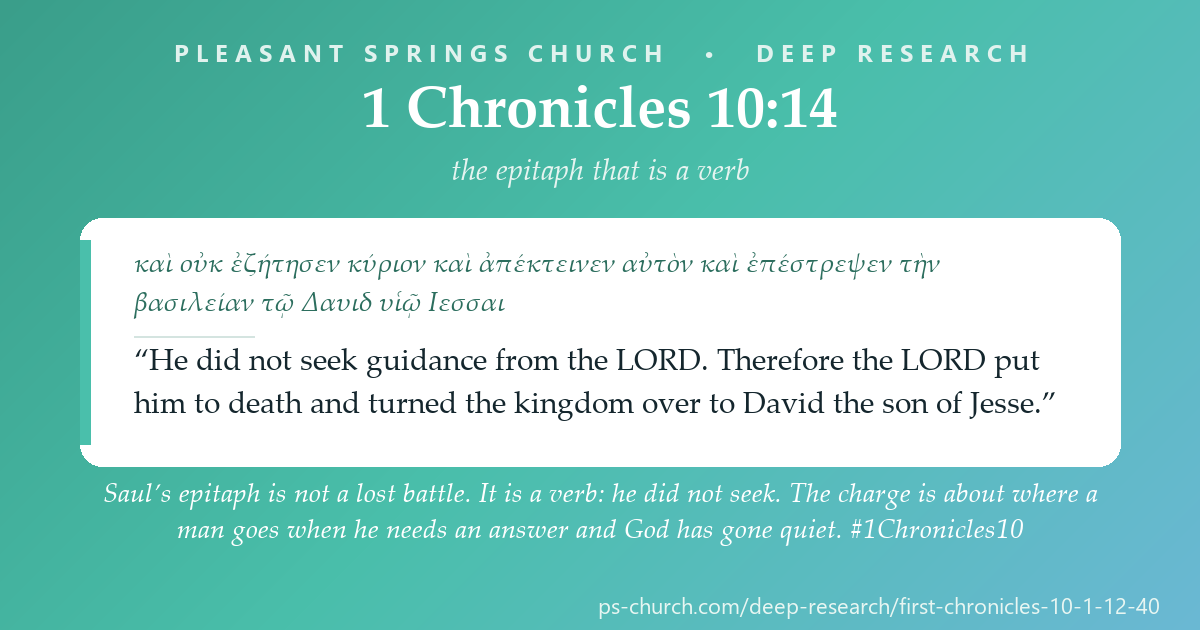
“Therefore the Lord put him to death and turned the kingdom over to David the son of Jesse” (10:14). There is no softening available. The Hebrew is wayyəmîtēhû — and he killed him — and the subject is God.
Three things are worth holding together.
First, this is a theological verdict, not a coroner’s report. The same chapter has already told you how Saul died: archers found him, he was badly wounded, and he fell on his own sword (10:3–4). Chronicles does not replace that account; it stands ten verses above. What 10:14 adds is a reading of it. Both sentences are in the same chapter, and a study that quotes one and forgets the other is quoting selectively.
Second, the charge is specific. Not “Saul was a bad king” in general, but two named things: he did not keep the word of the Lord, and he sought guidance from a medium instead of from God. The verb dāraš, “seek, inquire,” appears three times in two verses — he sought from a medium; he did not seek from the Lord. The indictment is not about the battlefield. It is about where a man goes for an answer.
Third, this page will not use the verse as a template. The Chronicler is passing judgment on one named king, at the end of his life, on the basis of things Scripture reports him doing. He is not licensing anyone to read a defeat, an illness or a death as a verdict on the person it happened to. That inference is not made here, and Scripture itself blocks it repeatedly — Job most of all. What the verse says is that God moved a kingdom. What it does not say is that every misfortune is a sentence.
One noun that crosses the seam, one verb that becomes an epitaph, and a Spirit who wears a man.
Read maʿal at 9:1 and 10:13 back to back — consecutive verses, and the whole reason chapters 1–9 and 10–12 belong in one book. Then count dāraš three times in two verses, and hold the Hebrew whole heart beside the Greek peaceable soul without choosing.
“Breach of faith” — and its second appearance is the reason this study begins where it does. In 9:1 Judah goes into exile bəmaʿalām, “in their breach of faith.” One verse into the narrative, Saul dies bəmaʿalō, “in his breach of faith.” Same noun, same construction, consecutive verses across the seam between list and story. It is not a general word for wrongdoing: in the Torah it is the term for sacrilege, for violating what belongs to God (Lev 5:15; Num 5:6–7) and for Achan’s theft of what was devoted (Joshua 7:1). Note the Greek honestly: Rahlfs has ἐν ταῖς ἀνομίαις in both places, so the link survives in Greek — but as “lawlessness,” and the cultic charge is gone.
“To seek, inquire of, consult.” It is the hinge verb of the verdict, and the Chronicler rings it three times: Saul consulted a medium liḏrōš; he did not seek (dāraš) the Lord; therefore he was put to death. This is a favourite word of this book — it will define the good kings of 2 Chronicles, who seek God, and condemn the ones who do not. Saul’s epitaph is a verb. The Greek uses ζητέω for both halves and keeps the play.
“And he turned round / turned over.” A causative of the ordinary verb for going round, used here of a kingdom being swung across from one man to another. It is a deliberately physical image — not that the kingdom passed, or was given, but that God turned it. The Greek ἐπέστρεψεν keeps the motion.
“Mighty man, warrior, champion.” The word that titles the whole of 11:10–47 and reappears through chapter 12. It is not merely “soldier”: it carries strength, standing and reputation, and it is used of Nimrod (Gen 10:8), of Boaz’s social standing (Ruth 2:1), and of God himself, gibbōr in Isaiah 9:6. The Greek is consistently δυνατός, “powerful one.”
“Leader, prince, designate.” The word God uses of David in the quoted promise: “you shall be nāgîd over my people Israel.” It is pointedly not meleḵ, “king” — it is the term for one appointed by someone, and it is used of Saul at his anointing too (1 Sam 9:16; 10:1). Set beside “you shall shepherd my people,” it defines the office as delegated and pastoral rather than absolute. The Greek εἰς ἡγούμενον, “for a leader,” is exact.
“The Spirit clothed” — literally, the Spirit put Amasai on like a garment. The same idiom is used of Gideon (Judges 6:34), of Amasai here, and of Zechariah son of Jehoiada in 2 Chronicles 24:20. It is the language of a man being worn by the Spirit rather than merely helped by him, and in all three cases what follows is speech. The Greek keeps the metaphor exactly: πνεῦμα ἐνέδυσε, “the Spirit clothed.”
“A whole heart” and “one heart.” The two phrases sit in the same verse and describe the muster at Hebron: the warriors came with a whole heart, and all the rest of Israel were of one heart to make David king. lēḇāḇ šālēm is a signature phrase of Chronicles for undivided loyalty. The Greek reads differently and it is worth seeing: Rahlfs has ἐν ψυχῇ εἰρηνικῇ, “with a peaceable soul,” and ψυχὴ μία, “one soul” — apparently reading šālēm as belonging to šālōm. Two ancient readings of one root, and both are in front of you.
Two things in the Hebrew here reported rather than tidied:
- The ketiv and qere at 12:19 [ESV 12:18]. The consonants written are השלושים (haššəlōšîm, “the thirty”); the Masoretic reading tradition says הַשָּׁלִישִׁים (haššālîšîm, “the officers” — the word for a chariot third-man, hence an adjutant). One letter, two different offices. The Greek sides with what is written, not with what is read: ἄρχοντα τῶν τριάκοντα, “chief of the thirty.” English versions vary, and this page prints the reading tradition in the Hebrew column, the Greek as it stands, and this note rather than a silent choice.
- Amasai’s oath reads differently in Greek. The Hebrew is a declaration of allegiance — “To you, O David, and with you, O son of Jesse!” The Greek has πορεύου καὶ ὁ λαός σου Δαυιδ υἱὸς Ιεσσαι, “Go, and your people, David son of Jesse,” which turns a pledge into something closer to a dismissal or a blessing on the march. The rest of the verse — peace, peace, and peace to your helpers — agrees closely. This is one of the places where the columns simply are not saying the same thing.
The chapter Chronicles is retelling, the four places it differs, and where “all Israel” is going.
Set 1 Chronicles 10 beside 1 Samuel 31 and read them in columns. Then trace maʿal backwards into the genealogy and forwards to the end of 2 Chronicles, and watch what the New Testament does with a shepherd who is a king.
Which cross-references matter?
- 1 Samuel 31 beside 1 Chronicles 10 — the primary comparison, and they differ in four reportable places. (1) 10:6: Chronicles has Saul, his three sons and “all his house” die together; Samuel has his armour-bearer “and all his men.” (2) 10:12: Samuel says the men of Jabesh “burned them there”; Chronicles omits the burning and goes straight to the burial of the bones. (3) 10:12: Samuel has them march all night and take the bodies “from the wall of Beth-shan”; Chronicles compresses. (4) 10:13–14: the verdict — present in Chronicles, absent from Samuel entirely. None of these is reconciled on this page.
- 2 Samuel 5:1–10 beside 1 Chronicles 11:1–9 — the same scene, and the differences are instructive. Chronicles adds the note that Joab went up first and so became chief (11:6), which Samuel does not have; Samuel has the taunt about the blind and the lame, which Chronicles drops. And Chronicles frames the whole with all Israel, having said nothing at all about the seven years when it was not.
- 2 Samuel 23:8–39 beside 1 Chronicles 11:10–47 — the two lists of the mighty men, overlapping and not identical. 11:11 gives Jashobeam three hundred slain; 2 Samuel 23:8 gives eight hundred. And the traffic runs the other way too: the phrase “he wielded his spear” has dropped out of the Hebrew of 2 Samuel 23:8 and survives here, which is why translators restore it from Chronicles. Neither book is simply the better witness.
- 1 Samuel 11 — why Jabesh-gilead. Saul’s first act as king was to save that town; its men came for his body at the end. The Chronicler keeps the episode without explaining it, because he expects you to know.
- 1 Chronicles 9:1 → 10:13 → 2 Chronicles 36:14 — the maʿal thread. Judah is exiled for it; Saul dies for it; the last generation before the fire commits it. Three verses, one word, and the whole argument of the book.
- Ezekiel 34 and John 10 — “you shall shepherd my people Israel” (11:2) is the office, and both Testaments follow it. Ezekiel indicts the shepherds of Israel who fed themselves and promises “my servant David” over them; Jesus says “I am the good shepherd” and defines the office by laying down his life. What the New Testament itself draws is worth stating and worth not overstating: the shepherd-king language runs from here through Ezekiel to Christ, and this page marks the thread and leaves the seeing to the reader.
- 1 Chronicles 11:17–19 and the pouring out — three men break through a garrison for a drink of water and David will not drink it, but pours it out to the Lord. Reported here without commentary, because the gesture explains itself: he treats what cost lives as something that belongs to God, not to him.
Where the scholarship agrees, where it does not, and what this page leaves open.
Knoppers, Japhet, Klein and Williamson on the unit. Then three live questions — and on two of them the honest answer is that the text does not say.
Commentaries & studies:
- Gary N. Knoppers, 1 Chronicles 10–29 (Anchor Yale) — the fullest treatment, and particularly good on the function of the lists and on the relationship to the Samuel material.
- Sara Japhet, I & II Chronicles (OTL) — the standard argument that the Chronicler is working with a coherent theology of retribution and legitimacy rather than merely abbreviating.
- Ralph W. Klein, 1 Chronicles (Hermeneia) — the technical text-critical work, including the Greek pluses and the relationship between the two warrior lists.
- H. G. M. Williamson, 1 and 2 Chronicles (NCBC) and Israel in the Books of Chronicles — on “all Israel” as a deliberate and sustained theme, which is the key to why chapter 12 exists.
Interpretation notes worth keeping:
- Why the Chronicler omits so much — disputed, and worth holding loosely. Proposals range from “he is idealising David” to “he assumes his readers have Samuel and is not repeating it” to “he is writing a temple-centred history and everything else is off-topic.” The omissions here (the fugitive years, the civil war) fit the second and third at least as well as the first, and it is worth noticing that he does not omit the census and the plague later in the book, which an idealiser would have. This page reports the proposals and does not adjudicate.
- The Greek plus at 10:13. That Rahlfs has “and Samuel the prophet answered him” is a datum. Whether it reflects a different Hebrew text or a translator harmonising toward 1 Samuel 28 is an argument, and this page says so. What it does not do is print the Greek and the Hebrew as though they agreed.
- The numbers in chapter 12. The muster totals are very large. The long-running discussion over whether אֶלֶף (ʾelep) always means “thousand” or sometimes a military unit or clan contingent applies here as it does elsewhere in the Old Testament, and it is not settled. This page does not convert the numbers, does not defend a particular figure, and does not pretend the question has been answered.
- Chapter 12 is not in chronological order, and nobody disputes that — Ziklag precedes Hebron. The interesting question is why it is placed second, and the reading offered in the structure note above (retrospective weight: these men came when there was nothing in it) is an argument, presented as one.
Where a story starts, who turns up early, and what a king does with water that cost blood.
Name what you learned, why it matters, and one concrete response.
What should we carry away — and do?
- Where you start a story is an argument. The Chronicler could have begun with a shepherd boy and a giant. He begins with a corpse and a verdict, and the effect is to make David’s reign an act of God rather than an achievement of David’s. Notice how differently the same life reads depending on which end you enter it from.
- Saul’s epitaph is a verb. Not a battle lost, not a throne forfeited — he sought in the wrong place. The charge in 10:13–14 is about where a man goes when he needs an answer and God has gone quiet. That is a question with a very short distance to the present.
- The second list is the better one. Chapter 11 names men who fought for a king. Chapter 12 names men who came to him at Ziklag when he was hunted, penniless and legally a fugitive — including men from the tribe of the king hunting him. Ask which list you would be on, and notice that the Chronicler does not rank them.
- One concrete response. Read 11:17–19 slowly. Three men risk their lives for a cup of water because a tired king said out loud that he wanted one, and he pours it on the ground rather than drink it. Then ask what has been brought to you at somebody else’s cost this week — and whether you have treated it as yours to consume or as something to be handed back to God.
1 Chronicles 10:14 · to share
Hebrew + Greek (Rahlfs, Paraleipomenon A) + ESVEvery Deep Research page traces its passage across the whole sweep — the Old Testament, the Second-Temple world between the testaments (historical witnesses, not Scripture), and the New Testament. Follow the thread:
Pleasant Springs Church — Deep Research
Research method after Michael S. Heiser’s Bible Research Method (examine dictionaries → ancient literature → important words → textual connections → academic publications → share), with the Pleasant Springs “Author & Audience” foundation. Scripture set in the Hebrew, the Greek editions named on each page and the ESV (Old Testament), and the Greek New Testament and the ESV (New Testament), per the practice of Pleasant Springs Church. 1 Chronicles 10–12 research grounded in Knoppers (Anchor Yale), Japhet (OTL), Klein (Hermeneia) and Williamson (NCBC). Book name: in the Septuagint this book is Paraleipomenon A, Παραλειπομένων Αʹ, “of the things left out” — a librarian’s name that misjudges the book; the Hebrew title is דִּבְרֵי הַיָּמִים, “the events of the days.” Text & numbering: Hebrew from the Masoretic Text; Greek from Rahlfs’s Septuaginta (CATSS digitization of the Rahlfs text), printed without editorial punctuation and with proper names unaccented; English ESV. ⚠️ Verse numbering: chapters 10 and 11 agree across Hebrew, Greek and English, but from 12:5 the Hebrew and Greek run one ahead of the English — MT/LXX 12:19 = ESV 12:18, MT/LXX 12:33 = ESV 12:32, and the chapter ends at MT/LXX 12:41 where English has 12:40. This was checked verse by verse against both columns, not assumed; chapter 12 has 41 verses in the Masoretic Text and 41 in Rahlfs, and chapters 10–12 have no verses absent from the Greek. Verses from chapter 12 are cited by the Hebrew number with the English in brackets. ⚠️ Greek plus at 10:13: Rahlfs adds καὶ ἀπεκρίνατο αὐτῷ Σαμουηλ ὁ προφήτης, “and Samuel the prophet answered him,” which the Hebrew does not have — a harmonisation toward 1 Samuel 28, reported as a difference and not blended. Whether it reflects a different Hebrew Vorlage or a translator’s harmonisation is named as an argument, not a datum. ⚠️ Chronicles and Samuel are not harmonised: 10:6 (“all his house” against 1 Sam 31:6 “his armour-bearer… and all his men”); 10:12 (Chronicles omits the burning reported at 1 Sam 31:12, and compresses the night march from the wall of Beth-shan); 10:13–14 (the verdict, absent from Samuel entirely); 11:6 (Joab’s promotion, absent from 2 Sam 5); 11:11 (three hundred against 2 Sam 23:8’s eight hundred). The traffic is reported in both directions: the phrase “he wielded his spear” has dropped out of the Hebrew of 2 Samuel 23:8 and survives at 11:11, so Chronicles repairs Samuel as well as diverging from it. ⚠️ Ketiv/qere at 12:19 [ESV 12:18]: written השלושים (“the thirty”), read הַשָּׁלִישִׁים (“the officers”); the Greek τῶν τριάκοντα agrees with what is written, and the page prints the note rather than choosing silently. Amasai’s oath differs materially between the columns and this is stated. The large numbers of chapter 12 are not converted, defended or explained away; the unsettled question of אֶלֶף is named as unsettled. 10:14 is printed plainly and not softened, with 10:3–4 set beside it — the same chapter reports both how Saul died and God’s hand in it — and the page explicitly declines to generalise the verse into a rule that misfortune is a verdict on the sufferer. Second-Temple and rabbinic witnesses (Josephus, Ant. 6–7; b. Berakhot 12b; b. Yoma 22b) are read as witnesses and never levelled with Scripture. Typology is handled per the house position: what the text says, what the New Testament itself draws (the shepherd-king line from 11:2 through Ezekiel 34 to John 10), and what we see from this side of the cross — with the seeing left to the reader.
Scripture quotations marked ESV are from the ESV® Bible (The Holy Bible, English Standard Version®), © 2001 by Crossway, a publishing ministry of Good News Publishers. ESV Text Edition: 2016. Used by permission. All rights reserved. The ESV text may not be quoted in any publication made available to the public by a Creative Commons license, and the ESV may not be translated in whole or in part into any other language. www.esv.org
|
Did this study bless you today? 💚 Give to Support PS Church100% of gifts go to the General Fund — thank you. |