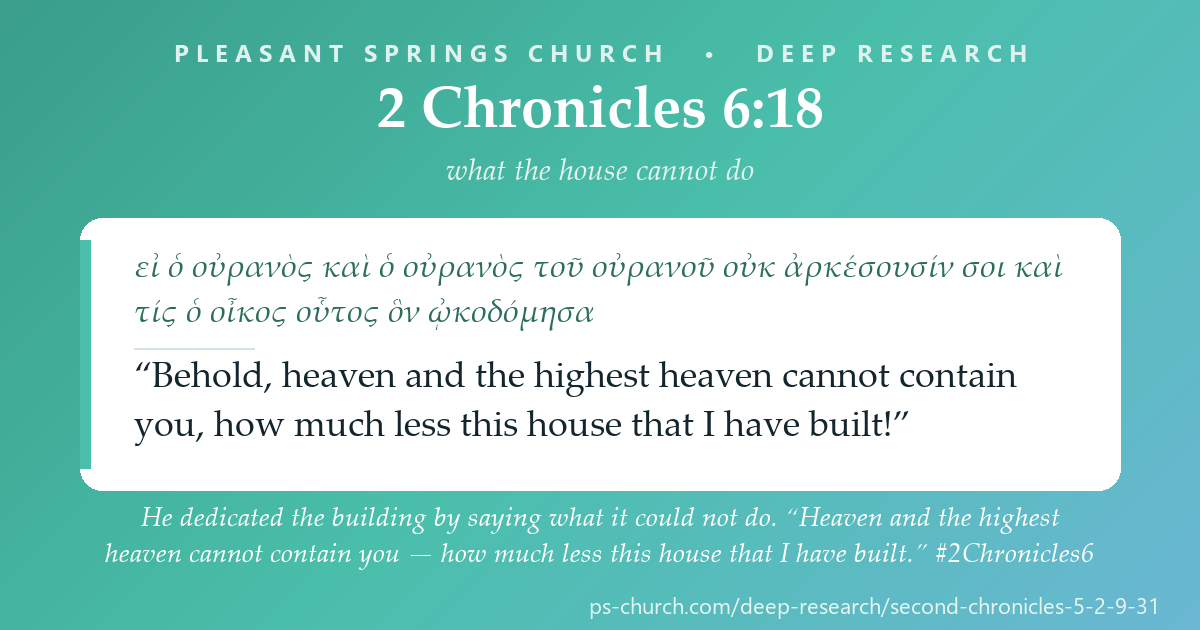
The house is finished, and the first thing that happens in it is that nobody can work. The ark is carried in, the singers and the hundred and twenty trumpeters make one sound, and a cloud fills the building so heavily that the priests cannot stand up to do their jobs. Then Solomon prays — the longest prayer in Chronicles, asking God to hear seven kinds of trouble — and opens it by conceding everything: “heaven and the highest heaven cannot contain you, how much less this house that I have built” (6:18), which is what he said before the first stone was laid. The building is dedicated with a statement of what it cannot do. Then fire falls from heaven — 1 Kings 8 does not report it — the glory fills the house a second time, and the people go down on the pavement. And that night God answers with the sentence that has been quoted, printed and pressed into more causes than anything else in this book: if my people who are called by my name humble themselves… This study works 2 Chronicles 5:2–9:31 in Hebrew, Septuagint and ESV, and it takes 7:14 slowly — what it says, who it is said to, and what it does not say. See the method →
2 Chronicles 5:2–9:31 (selections)
Hebrew · Greek (Rahlfs, Paraleipomenon B) · ESVThen Solomon prays, and the prayer is the longest in Chronicles. It asks God to hear — seven times, for seven kinds of trouble: defeat, drought, famine, plague, exile, and the private disasters of individuals. And it opens by conceding everything: “will God indeed dwell with man on the earth? Heaven and the highest heaven cannot contain you, how much less this house that I have built” (6:18) — the same objection he made before the first stone was laid (2:5). The building is dedicated with a statement of what it cannot do. Notice too who is prayed for in 6:32–33: the foreigner, who is not of Israel, who comes from a far country because of God’s name.
Then fire falls from heaven and the glory fills the house again — and 1 Kings 8 does not report the fire at all. And God answers by night with a sentence that has been quoted, printed on more things and pressed into more national causes than anything else in this book.
Text and numbering. In the Septuagint this book is 2 Paraleipomena, “things omitted” — Παραλειπομένων Βʹ (Paraleipomenōn B). Chapters 5–9 are numbered alike in Hebrew, Greek and English and the verse counts match exactly — 14, 42, 22, 18, 31 — with nothing absent from Rahlfs. Counted against both columns, not assumed. (The one-verse offset in this book affects chapters 1–2 only; see the previous study.)
⚠️ Chronicles adds the fire, and ends the prayer differently. 1 Kings 8 has the cloud and the glory, but no fire from heaven; 2 Chronicles 7:1–3 has fire consuming the offering and the people falling on the pavement. And the prayer itself closes differently: 1 Kings 8:50–53 ends with an appeal to the exodus and to Moses, while 2 Chronicles 6:41–42 ends by quoting Psalm 132:8–10 — “arise, O Lord God, to your resting place, you and the ark of your might.” Both endings are printed in Stage 4 and neither is called the original.
⚠️ A small difference inside that quotation. The Hebrew of 6:41 has “let your ḥăsîḏîm” — your godly ones, your covenant-loyal ones — “rejoice in your goodness.” Rahlfs reads οἱ υἱοί σου, “your sons.” One letter’s difference in an unpointed text, and two ancient readings.
The Shape of the Passage
InclusioBehind these chapters stand the tabernacle’s dedication in Exodus 40 and Leviticus 9, and the ground bought in 1 Chronicles 21. In front of them stands a division, and eventually a fire of a different kind.
Author
He adds the fire, and he adds 7:13–15. Two of the best-known moments in these chapters are not in 1 Kings. The fire from heaven at 7:1 is Chronicles’ own; so is the night speech about drought, locusts and pestilence that contains “if my people.” Neither is a contradiction of Kings — Kings simply does not have them — but a reader should know which book they come from, and that the writer who supplies them is the one whose whole work turns on whether a generation sought God.
He is obsessed with the music. 5:12–13 names the instruments, the hundred and twenty trumpeters, and insists the singers and players were “as one, to make one sound.” Kings does not mention them. This is the same writer who gave the singers a chapter of their own and called their work prophecy.
And he lets Solomon pray for foreigners. 6:32–33 asks God to hear “the foreigner, who is not of your people Israel, when he comes from a far country for the sake of your great name” — and gives the reason: that all the peoples of the earth may know your name and fear you. It sits in the middle of the most nationally specific prayer in the Old Testament, and the Chronicler kept it.
Audience
People who had watched a house be destroyed. That is the fact that governs how these chapters read. 7:19–22 is not hypothetical to the Chronicler’s readers: this house will become a heap of ruins, and everyone passing by will be astonished. They knew people who had passed by. The dedication and the warning were both already history when this was written.
Which is exactly why 7:14 is here. It is God’s stated procedure for what to do after the disaster has happened. Not a formula for avoiding trouble — the trouble in 7:13 is described as something God himself sends — but an answer to the question a defeated people actually asks: is there a way back?
And people in a much smaller building. Every superlative in chapters 8–9 — the gold, the ivory throne, the ships, the queen who had no breath left in her — belonged to a past they could not reproduce. The Chronicler reports it in full. What he also reports, in the same breath, is that the glory came down on a building whose priests then could not do their jobs, and that the whole thing was conditional from the night after it opened.
Orient on dedication rites, the glory-cloud, prayer toward the temple, and the covenant framework behind 7:13–22.
Search by topic: temple dedication; kabod / glory; shekinah; cloud; fire from heaven; prayer (posture and direction); Solomon’s prayer; covenant blessings and curses; Deuteronomy 28; drought and locust as judgment; queen of Sheba; Ophir.
Which articles are relevant?
- Anchor Bible Dictionary — “Temple, Jerusalem,” “Glory of God,” “Dedication,” “Prayer (OT),” “Blessings and Curses,” “Sheba, Queen of,” “Ophir.”
- Dictionary of the OT: Historical Books (IVP) — “Solomon,” “Temple,” “Prayer,” “Retribution,” “Repentance,” “Worship.” The article on retribution is the one to read before 7:14.
- NIDOTTE / TDOT — כָּבוֹד (kāḇōḏ, glory), כָּנַע (kānaʿ, humble oneself), בָּקַשׁ (bāqaš, seek), שׁוּב (šûḇ, turn), רָפָא (rāpāʾ, heal), חָסִיד (ḥāsîḏ).
- On the Greek — the NETS introduction to 2 Supplements, and its notes on the dedication chapters.
Bibliography surfaced:
- Sara Japhet, I & II Chronicles (OTL); Ralph W. Klein, 2 Chronicles (Hermeneia); Raymond B. Dillard, 2 Chronicles (WBC); H. G. M. Williamson, 1 and 2 Chronicles (NCBC).
- On the theology of immediate retribution in Chronicles — the framework 7:14 belongs to — Japhet’s The Ideology of the Book of Chronicles is the standard treatment.
How temples were opened, what fire from heaven meant, and a queen who came a long way.
First the world: dedication festivals, the god taking possession of a house, and long-distance trade with south Arabia. Then Josephus, who retells the dedication at length and is very interested in the fire.
Which parallels shed light on these chapters?
A temple was not finished when it was built; it was finished when the god moved in. Mesopotamian and Egyptian dedication rites culminate in the deity taking possession — the image installed, the house declared occupied, a festival of many days. The pattern in 2 Chronicles 5–7 is the same shape with one enormous difference: there is no image. What enters is a cloud and a box containing two stone tablets, and 5:10 goes out of its way to say the ark contained nothing but the tablets.
Fire from heaven is the biblical sign of an accepted offering, and it has a short pedigree. It falls at the ordination of Aaron (Leviticus 9:24), on Elijah’s altar at Carmel (1 Kings 18:38), and at David’s altar on Ornan’s threshing floor (1 Chr 21:26) — the same site as this temple. So the fire at 7:1 is not a new marvel; it is the confirmation that this altar is the successor of those altars. That is very likely why Chronicles includes it and Kings does not need to.
And the queen’s journey was a real trade route. Sheba is most plausibly in south-west Arabia, and the goods named — gold, spices, precious stones, and later almug wood and ivory — are the documented cargo of the incense road. Assyrian records name Arabian queens paying tribute, so a ruling woman leading a delegation is not a storyteller’s flourish. The narrative detail worth noticing is what she came for: 9:1 says she came “to test him with hard questions.”
- Josephus, Antiquities 8.4.1–8.6.6 (§§100–175) (Second-Temple — a witness, not Scripture) — he retells the dedication, the prayer and the queen’s visit. He keeps the fire, and he is careful to say the cloud was not a storm-cloud but a mild and temperate air — a Greek-educated writer heading off the obvious naturalistic reading for his readers.
- Leviticus 9:23–24; 1 Chronicles 21:26; 1 Kings 18:38 — not external witnesses but the biblical pattern the fire belongs to. Read them together and 7:1 stops being an isolated wonder.
- Mesopotamian and Egyptian temple dedication rites (ritual and royal texts — witnesses, not Scripture) — for the shape of an opening festival and the notion of a god taking possession. Cited for the convention, and for the contrast: no image enters this house.
- Assyrian records of Arabian queens; the south Arabian incense trade (documentary and archaeological evidence — witnesses, not Scripture) — for the plausibility and the goods of the journey in chapter 9.
This is the most quoted verse in Chronicles and the most misapplied, so it is worth being exact.
What it says. Four conditions and three results. Humble themselves (kānaʿ, be brought low), pray, seek my face, turn from their wicked ways — then I will hear, forgive, and heal their land. It is not a technique and it is not vague: the third clause, turn from their wicked ways, means the prayer is not the point of it. Repentance is.
Who it is said to. “My people who are called by my name” — and the addressee is Solomon, standing in a newly dedicated temple, in a land Israel holds under a covenant with stated blessings and curses (Leviticus 26; Deuteronomy 28). The troubles listed in the verse before are the covenant curses precisely: drought, locusts, pestilence — and God says he is the one who sends them. 7:14 is the covenant’s own repair clause. It is addressed to a people God had brought into a specific land on specific terms.
What it does not say. It does not say that any nation which prays hard enough will have its fortunes restored. That inference requires putting a modern country in Israel’s covenant position, and no modern nation stands there. The verse is regularly printed on posters, read at national prayer events and quoted in political campaigns as though “their land” meant whichever land the reader lives in. That is not what the sentence is doing, and reading it that way quietly swaps the church for a nation-state and the gospel for a civic programme.
What does carry over, and it is not small. The shape of the thing is permanent, because it is about the character of God rather than the status of a country: he is the kind of God who states, in advance and in writing, what a people who have wrecked things should do — and who commits himself to hear. The New Testament says the same in its own terms (1 John 1:9; James 4:8–10, which uses the identical vocabulary of humbling). Take the promise to the people it was made to, and take the God who made it to yourself.
A glory that is a weight, a verb that scores the rest of the book, and one word the columns disagree on.
Notice that kāḇōḏ means heavy, and read 5:14 again. Then track kānaʿ, “humble oneself,” forward through 2 Chronicles — it is the criterion the remaining kings are judged by.
“Glory, weight, heaviness.” The root means heavy, and that is not incidental here: what fills the house is a weight, and the effect on the staff is that they cannot stand up under it (5:14) and then cannot get in (7:2). The same thing happened at the tabernacle’s completion — “Moses was not able to enter the tent of meeting because the cloud settled on it and the glory of the Lord filled the tabernacle” (Exodus 40:35). The Greek is δόξα.
“To humble oneself, be brought low, submit.” The first of the four conditions, and it is a key word for the rest of 2 Chronicles: Rehoboam humbles himself and the wrath turns (12:6–12); Hezekiah humbles himself (32:26); Manasseh humbles himself greatly in a Babylonian prison and is heard (33:12–13); Josiah’s heart is penitent (34:27); and Zedekiah did not humble himself (36:12). 7:14 is not a set-piece — it is the rule the remaining chapters are scored against. The Greek uses ἐντρέπω, “be put to shame, turn in shame,” which catches the submission but adds a note of shame the Hebrew does not press.
“I will heal.” The object is their land — and in context the land is sick with the specific things named one verse earlier: no rain, locusts, plague. This is agricultural and epidemiological language, not a metaphor for national mood. The same verb heals water at Jericho (2 Kgs 2:21–22) and people throughout the prophets. The Greek is ἰάσομαι.
“Contain you.” The verb returns from the commissioning letter, and that is deliberate: Solomon said the house could not hold God before he built it, and says it again at the dedication with the building standing around him. The claim is bracketed by its own denial. Note the Greek chooses a different verb each time — φέρω at 2:5, ἀρκέω (“suffice”) here.
“Your godly ones” — those characterised by ḥeseḏ, covenant loyalty. It comes in the quotation of Psalm 132:9. The Greek reads something else: οἱ υἱοί σου, “your sons” — which in an unpointed Hebrew text is a small difference and in meaning is a considerable one. Both readings are ancient and this page prints both rather than choosing.
“Hear.” The verb the whole prayer is built on. Solomon asks God to hear, over and over, for every kind of trouble; and the answer at 7:12 begins “I have heard your prayer” and at 7:14 promises “I will hear from heaven.” The petition and the answer use the same word, which is the simplest way a narrator can say that a prayer was granted.
Two things here reported rather than tidied:
- The prayer ends differently in the two books. 1 Kings 8:50–53 closes with an appeal to the exodus — “they are your people, your heritage, which you brought out of Egypt… as you spoke by Moses your servant.” 2 Chronicles 6:41–42 closes instead by quoting Psalm 132:8–10 — “arise, O Lord God, to your resting place, you and the ark of your might… remember your steadfast love for David your servant.” Moses at one ending, David at the other. Both are Scripture; this page prints both and does not decide which is prior.
- Chronicles has fire from heaven and 1 Kings 8 does not. Kings has the cloud filling the house and the priests unable to minister (1 Kgs 8:10–11), and the sacrifices, but no fire consuming the offering and no people falling on the pavement. This is an addition, not a contradiction, and whether Chronicles preserves a tradition Kings lacked or develops the scene toward Leviticus 9 and 1 Chronicles 21 is argued. The page reports the difference and names the options.
The tabernacle filled, the fire that keeps falling, the covenant behind 7:14, and a foreigner in the prayer.
Read Exodus 40 and Leviticus 9 before 2 Chronicles 5 and 7 and the pattern is obvious. Then read Leviticus 26 and Deuteronomy 28 before 7:13–14 — the troubles named are the covenant curses, in order.
Which cross-references matter?
- Exodus 40:34–35 → 2 Chronicles 5:13–14 — “the cloud covered the tent of meeting, and the glory of the Lord filled the tabernacle. And Moses was not able to enter.” The temple’s opening deliberately repeats the tabernacle’s, down to the officials being unable to work.
- Leviticus 9:23–24 · 1 Chronicles 21:26 · 1 Kings 18:38 → 2 Chronicles 7:1 — fire from heaven consuming the offering: at Aaron’s ordination, at David’s altar on this very threshing floor, at Carmel, and here. Four altars, one sign.
- Leviticus 26:14–20 and Deuteronomy 28:15–24 → 2 Chronicles 7:13–14 — the troubles in 7:13 are the covenant curses: heaven shut up so there is no rain, locusts devouring the land, pestilence among the people. 7:14 is the repair clause for exactly those sanctions, which is why Stage 2 insists the verse be read inside the covenant it belongs to.
- 2 Chronicles 6:32–33 → Isaiah 56:6–7 → Mark 11:17 — the foreigner. Solomon asks God to hear the foreigner who comes from a far country for the sake of his name, “that all the peoples of the earth may know your name”; Isaiah promises foreigners a place in “a house of prayer for all peoples”; and Jesus quotes Isaiah in the temple court where the foreigners would have stood. The petition and the quotation are about the same physical building.
- 2 Chronicles 7:14 → 12:6–12; 32:26; 33:12–13; 34:27; 36:12 — the verse is not a set-piece. Kānaʿ, “humble oneself,” becomes the criterion for the rest of the book: Rehoboam does and is spared; Hezekiah does; Manasseh, the worst king in the book, does it in a Babylonian prison and is heard; Zedekiah does not.
- 1 Kings 8 beside 2 Chronicles 6–7 — read them in parallel. The prayers are largely identical; the endings differ; Chronicles adds the fire, the people on the pavement, and 7:13–15.
- 2 Chronicles 9:8 and 1 Chronicles 29:23 — the queen of Sheba says God “set you on his throne as king for the Lord your God.” A foreigner states the Chronicler’s doctrine of the throne, and it is the nearest thing in the book to a comment on the startling phrase at 1 Chronicles 29:23.
Where the scholarship agrees, where it does not, and the questions this page leaves open.
Japhet, Klein, Dillard and Williamson. Then three live questions — and on two the honest answer is that the text does not say.
Commentaries & studies:
- Sara Japhet, I & II Chronicles (OTL) and The Ideology of the Book of Chronicles — the standard account of the retribution theology that 7:14 belongs to, and of how it differs from Kings.
- Ralph W. Klein, 2 Chronicles (Hermeneia) — the technical work on the relationship of 2 Chronicles 6–7 to 1 Kings 8–9, including the two endings of the prayer.
- Raymond B. Dillard, 2 Chronicles (WBC) — particularly on 7:14 within the structure of the whole book.
- H. G. M. Williamson, 1 and 2 Chronicles (NCBC) — on the dedication narrative and the Chronicler’s use of the Psalms.
Interpretation notes worth keeping:
- Whether the fire at 7:1 is tradition or composition — argued. Some hold Chronicles preserves a genuine tradition Kings omitted; others that the Chronicler shaped the scene to match Leviticus 9 and 1 Chronicles 21. Nothing in the text settles it, and the difference does not change what the verse reports.
- The application of 7:14 — and the disagreement is not mainly scholarly. Commentators are broadly agreed that the verse addresses covenant Israel and its land; the contested use is homiletic and political rather than exegetical. Stage 2 states the position this page takes and the reason for it.
- The Chronicler’s retribution theology. That good is rewarded and evil punished promptly and visibly is much more explicit in Chronicles than in Kings, and it raises the obvious question of Job and of the many faithful people who are not spared. Chronicles does not answer that question and does not claim to; it is not the only book in the Bible, and this page does not present its framework as the whole of Scripture’s teaching on suffering.
- 6:41 — ḥăsîḏîm or “sons.” A real difference between the columns in a quotation of Psalm 132:9, where the Hebrew Psalter also reads ḥăsîḏîm. The Greek reading here is worth reporting and is not obviously an error.
A glory that stops the work, a promise read carefully, and the worst king in the book.
Name what you learned, why it matters, and one concrete response.
What should we carry away — and do?
- The first effect of the glory was that the professionals could not work. Twice. The priests cannot stand, then cannot enter. It is worth sitting with that before planning anything else: the presence of God is not a resource that makes ministry run more smoothly.
- Solomon dedicated the building by saying what it could not do. “Heaven and the highest heaven cannot contain you, how much less this house that I have built.” He said it before he started and again at the opening. Anything we build for God is worth describing that accurately.
- Read 7:14 to the end of the sentence, and to the end of the book. The condition is not “pray hard” but “turn from their wicked ways”; the promise is made to a covenant people about a covenant land; and the man who most spectacularly proves it works is Manasseh, who did more evil than the nations and humbled himself in a foreign prison and was heard. If the verse is going to be about anyone, let it be about him.
- One concrete response. Take the four verbs — humble, pray, seek, turn — and notice which one you habitually skip. Most of us are fluent in two of them. Do the missing one this week, specifically, about something particular.
2 Chronicles 6:18 · to share
Hebrew + Greek (Rahlfs, Paraleipomenon B) + ESVEvery Deep Research page traces its passage across the whole sweep — the Old Testament, the Second-Temple world between the testaments (historical witnesses, not Scripture), and the New Testament. Follow the thread:
Pleasant Springs Church — Deep Research
Research method after Michael S. Heiser’s Bible Research Method (examine dictionaries → ancient literature → important words → textual connections → academic publications → share), with the Pleasant Springs “Author & Audience” foundation. Scripture set in the Hebrew, the Greek editions named on each page and the ESV (Old Testament), and the Greek New Testament and the ESV (New Testament), per the practice of Pleasant Springs Church. 2 Chronicles 5–9 research grounded in Japhet (OTL and The Ideology of the Book of Chronicles), Klein (Hermeneia), Dillard (WBC) and Williamson (NCBC). Book name: in the Septuagint this book is Paraleipomenon B, Παραλειπομένων Βʹ; the Hebrew title is דִּבְרֵי הַיָּמִים. Text & numbering: Hebrew from the Masoretic Text; Greek from Rahlfs’s Septuaginta (CATSS digitization of the Rahlfs text), printed without editorial punctuation and with proper names unaccented; English ESV. Chapters 5–9 are numbered alike in Hebrew, Greek and English and the verse counts match exactly (14, 42, 22, 18, 31) with nothing absent from Rahlfs — counted against both columns, not assumed; the one-verse offset in this book affects chapters 1–2 only. ⚠️ Chronicles and Kings are not harmonised: the fire from heaven at 7:1–3 is not in 1 Kings 8, nor are the people falling on the pavement, nor the night speech of 7:13–15 that contains “if my people”; these are reported as additions rather than contradictions, and whether Chronicles preserves a tradition Kings lacked or shapes the scene toward Leviticus 9 and 1 Chronicles 21 is named as argued. The prayer ends differently in the two books — 1 Kings 8:50–53 appeals to the exodus and Moses, 2 Chronicles 6:41–42 quotes Psalm 132:8–10 and appeals to David — and both endings are printed with neither called prior. ⚠️ A difference inside that quotation: Hebrew 6:41 has ḥăsîḏeḵā, “your godly ones” (as does the Hebrew of Psalm 132:9), where Rahlfs reads οἱ υἱοί σου, “your sons”; both are printed. ⚠️ 7:14 is handled at length and deliberately. The page states what the verse says (four conditions, three results, with “turn from their wicked ways” as the substance), who it is addressed to (covenant Israel, in a land held on the terms of Leviticus 26 and Deuteronomy 28, whose curses are precisely the troubles named at 7:13), and what it does not say — naming plainly the common application to modern nation-states and explaining why the page declines it, since no modern nation stands in Israel’s covenant position. It then states what does carry over, on the ground that the promise reveals the character of God rather than the status of a country, and directs the reader to Manasseh (33:12–13) as the book’s own demonstration. The Chronicler’s retribution theology is named as more explicit than Kings’, and the page states that Chronicles does not answer the question Job raises and is not presented as the whole of Scripture’s teaching on suffering. 6:32–33, the prayer for the foreigner, is reported as part of the dedication and traced to Isaiah 56 and Mark 11:17. Second-Temple witnesses (Josephus, Ant. 8) are read as witnesses and never levelled with Scripture; Mesopotamian and Egyptian dedication rites and Assyrian records of Arabian queens are cited for convention and plausibility only. Typology is handled per the house position: what the text says, what the New Testament itself draws, and what we see from this side of the cross — with the seeing left to the reader.
Scripture quotations marked ESV are from the ESV® Bible (The Holy Bible, English Standard Version®), © 2001 by Crossway, a publishing ministry of Good News Publishers. ESV Text Edition: 2016. Used by permission. All rights reserved. The ESV text may not be quoted in any publication made available to the public by a Creative Commons license, and the ESV may not be translated in whole or in part into any other language. www.esv.org
|
Did this study bless you today? 💚 Give to Support PS Church100% of gifts go to the General Fund — thank you. |