David’s last public act is a handover, and he does it in front of everybody. Every official in Israel is summoned, and an old man stands up to say three things: what he wanted to do, why he was refused, and who will do it instead. He does not soften the refusal — “you are a man of war and have shed blood” (28:3) — and he says it to the nation. Then he hands over a taḇnîṯ, a pattern: the same word used of what Moses was shown on the mountain. Courts, chambers, the weight of gold for every utensil, the plan of the chariot of the cherubim. And the whole handover is bracketed by one command said twice — “be strong and do it” (28:10), and then “be strong and courageous and do it… he will not leave you or forsake you” (28:20), which is almost word for word what Moses said to Joshua. The old leader, the new leader, the unfinished task — only this time the task is a building. Then an offering nobody is compelled to give, and a prayer that pulls the ground out from under the generosity: “all things come from you, and of your own have we given you.” This study works 1 Chronicles 28:1–29:30 in Hebrew, Septuagint and ESV, including the crux at 28:19, the Greek plus at 29:11, and 29:23 — where the Hebrew has Solomon sitting on the throne of the Lord, a phrase found nowhere else in Scripture, and the Greek has the throne of David. See the method →
1 Chronicles 28:1–29:30 (selections)
Hebrew · Greek (Rahlfs, Paraleipomenon A) · ESVThen he hands over a taḇnîṯ — a pattern. It is the same word used of what Moses was shown on the mountain (Exodus 25:9, 40), and it is the point: the temple is not David’s design. Courts, chambers, weights of gold for each utensil, the plan of the chariot of the cherubim — all of it handed over in writing.
And the whole handover is bracketed by one command, said twice. Before the plan: “be strong and do it” (28:10). After it: “be strong and courageous and do it… he will not leave you or forsake you” (28:20) — which is, almost word for word, what Moses said to Joshua at the end of Deuteronomy. The old leader, the new leader, the unfinished task. Only this time the task is not a war; it is a building.
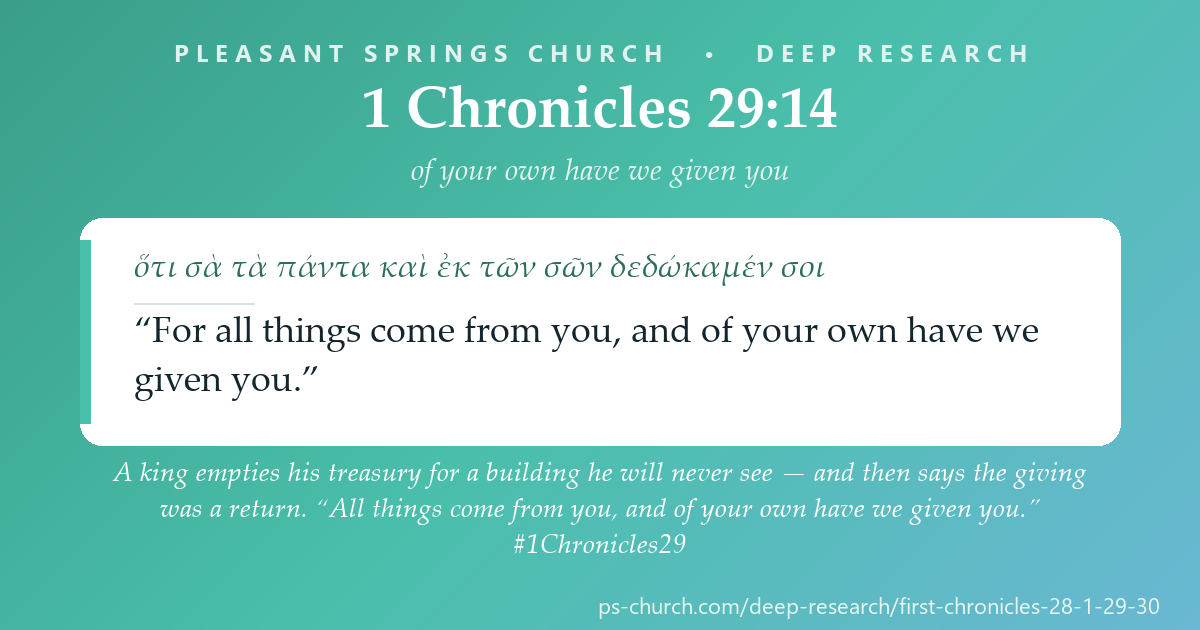
Then an offering nobody is compelled to give — the verb hiṯnaddēḇ, to volunteer, runs through the chapter — and a prayer that pulls the ground out from under the generosity: “all things come from you, and of your own have we given you” (29:14). A king who has just given a fortune says the fortune was never his.
Three notes on the columns. In the Septuagint this book is 1 Paraleipomena, “things omitted” — Παραλειπομένων Αʹ (Paraleipomenōn A). Chapters 28–29 are numbered alike in Hebrew, Greek and English and the verse counts match exactly (21, 30), with nothing absent from Rahlfs. Counted against both columns, not assumed.
⚠️ 28:19 is a genuine crux, and the Greek solved it by rewriting. The Hebrew runs, roughly, “all in writing from the hand of the Lord upon me, he made [me] understand, all the works of the pattern” — and the grammar is genuinely hard: who wrote, what “upon me” governs, and whether the writing is the plan or the understanding of it are all disputed. Rahlfs supplies a subject and an object the Hebrew does not have: ἔδωκεν Δαυιδ Σαλωμων, “David gave to Solomon.” That is a translator resolving a difficulty, and this page prints the difficulty.
⚠️ 29:11 ends differently in Greek. After “yours is the kingdom…” Rahlfs continues ἀπὸ προσώπου σου ταράσσεται πᾶς βασιλεὺς καὶ ἔθνος — “before your face every king and nation is troubled” — which the Hebrew does not have. It also renders tipʾereṯ (“glory, splendour”) as καύχημα, “boast.”
⚠️ 29:23 — and this is the largest difference in the unit. The Hebrew says Solomon sat on the throne of the Lord (כִּסֵּא יְהוָה) — a phrase found nowhere else in Scripture, and a startling thing to say about a human king. The Greek reads “the throne of David his father” (θρόνου Δαυιδ τοῦ πατρὸς αὐτοῦ). One column has a man on God’s throne; the other has a son on his father’s. Both are printed here and neither is called the real one.
The Shape of the Passage
InclusioBehind these chapters stands the refusal of chapter 17, the reason given at 22:8, and five chapters of rosters already in place. In front of them stands a building — and, for the first readers, a smaller one on the same ground.
Author
He ends the book with a handover, not a reign. Samuel and Kings give David a deathbed scene with a score to settle — instructions about Joab and Shimei, a succession secured by a rushed anointing while another son is feasting. None of that is here. Chronicles gives a public assembly, a plan, an offering and a prayer, and then a single sentence of death notice. The Chronicler is not writing the end of a life; he is writing the beginning of a house.
He also has David say the hard thing in public. 28:3 is the fullest statement in the book of why David was refused, and it is delivered to the assembled nation by the man it disqualifies. The Chronicler has been accused of idealising David; this is a strange way to do it. What he removes from the record is the private scandal; what he keeps is the public disqualification.
And he writes a prayer that dismantles its own occasion. Chapter 29 is a fundraising chapter — thousands of talents of gold, precious stones, the leaders competing to give — and it ends with the king saying the giving was an illusion of ownership: “of your own have we given you.” A writer trying to celebrate a donation would have stopped at verse 9.
Audience
People who had built a smaller house on the same spot. The second temple was modest enough that men who remembered the first one wept when its foundation was laid. Reading 29:2–8 — gold, silver, bronze, iron, onyx, antimony, marble in abundance — would have been an odd experience for that congregation. The Chronicler does not scale the memory down for them. What he gives them instead is the sentence that survives any budget: the offering was accepted because it was willing, and everything in it belonged to God already.
People being handed a task by people who would not finish it. That is the situation of the whole post-exilic community, and 28:20 is written for it. The plan is not theirs, the work is not finished, and the promise attached is not that it will be easy but that he will not leave you or forsake you.
And people who knew what it was to be resident foreigners. 29:15 — “strangers before you and sojourners” — is the vocabulary of a legal status: the gēr and the tōšāḇ, people living somewhere they do not own. David says it of the king and the nation at the height of their wealth. A community that had been literally that, in Babylon, and was now a province in someone else’s empire, would not have needed the metaphor explained.
Orient on royal succession and testament, on the temple plan, on freewill offerings, and on the language of sojourning.
Search by topic: David (death of); succession narratives; last words / testament; tabnit and the heavenly pattern; temple plan; freewill offering (nedabah); ger and toshav; Solomon (accession); throne of the Lord; doxology.
Which articles are relevant?
- Anchor Bible Dictionary — “David,” “Solomon,” “Temple, Jerusalem,” “Sacrifice and Sacrificial Offerings,” “Sojourner,” “Kingship,” “Testament (Last Words).”
- Dictionary of the OT: Historical Books (IVP) — “David,” “Solomon,” “Temple,” “Worship,” “Prayer,” “Chronicler’s History.”
- NIDOTTE / TDOT — תַּבְנִית (taḇnîṯ, pattern), נָדַב (nāḏaḇ, offer willingly), גֵּר (gēr) and תּוֹשָׁב (tōšāḇ), חָזַק (ḥāzaq, be strong), כִּסֵּא (kissēʾ, throne).
- On the Greek — the NETS introduction to 1 Supplements, and its notes on the freer renderings in the closing chapters, including 28:19 and 29:11.
Bibliography surfaced:
- Gary N. Knoppers, 1 Chronicles 10–29 (Anchor Yale); Sara Japhet, I & II Chronicles (OTL); Ralph W. Klein, 1 Chronicles (Hermeneia); H. G. M. Williamson, 1 and 2 Chronicles (NCBC).
- On the Moses–Joshua pattern behind 28:20: read Deuteronomy 31:1–8 and Joshua 1:1–9 first, in Hebrew if you can, and the borrowing is audible without any commentary at all.
Royal testaments, temple plans given by gods, and what a freewill offering was.
First the world: the last-words genre, and the widespread claim that a temple design came from the deity rather than the architect. Then watch Josephus, who retells this scene and cannot resist improving the speech.
Which parallels shed light on these chapters?
A king’s last speech was a recognised form. Egyptian instruction texts — the Instruction of Amenemhat, addressed by a dead king to his son — and Mesopotamian royal testaments do what 1 Chronicles 28 does: an old ruler reviews his reign, names an heir, and gives instructions. The Bible has the form elsewhere too: Jacob in Genesis 49, Moses in Deuteronomy 33, Joshua in Joshua 23–24, Samuel in 1 Samuel 12. What is unusual here is the content of the instruction — not statecraft, not enemies to watch, but a building plan and a command to be brave.
And ancient kings routinely claimed their temple plans were revealed. Gudea of Lagash is shown the plan of the temple of Ningirsu in a dream and has it inscribed on a tablet; Mesopotamian and Egyptian foundation accounts insist the design came from the god. So 28:11–19 stands inside a recognisable convention — and the convention is worth knowing precisely because it makes the differences visible. Here the revealed plan is not given to the builder. It is given to a man who has been told he may not build, and whose job is to hand it on.
A freewill offering was a legal category, not a mood. The nəḏāḇāh of Leviticus 22:18–23 and Deuteronomy 16:10 is an offering brought over and above what is required, and its defining feature is that no one can be compelled to bring it. The verb runs seven times through 1 Chronicles 29 — the leaders offered willingly, the people rejoiced because they had offered willingly, David rejoices to see the people offering willingly. It is the same word Ezra 2:68 uses of the returned exiles giving for the second temple, which is presumably not an accident.
- Josephus, Antiquities 7.14.10–15.2 (§§372–394) (Second-Temple — a witness, not Scripture) — he retells the assembly, the offering and the handover, and expands David’s speech considerably. Note what he does with the money: he is precise and enthusiastic about the totals. The line he does not reproduce with the same force is 29:14 — that the whole gift was God’s already. A historian writing for a Roman audience found the generosity more usable than the theology that dissolved it.
- The Cylinders of Gudea (Sumerian royal inscription — a witness, not Scripture) — a ruler shown the plan of a temple by his god and building to it. Cited for the convention behind 28:11–19, and to make the difference visible: Gudea builds what he is shown, David hands it on.
- The Instruction of Amenemhat (Egyptian instruction literature — a witness, not Scripture) — for the royal-testament form. Cited for genre only.
- Deuteronomy 31:1–8; Joshua 1:1–9 — not external witnesses but the passages 28:20 is quoting. Read them alongside and the borrowing is unmistakable.
What the Hebrew says. 29:23: “And Solomon sat on the throne of the Lord as king in place of David his father.” כִּסֵּא יְהוָה — the throne of YHWH, occupied by a man. The expression occurs nowhere else in the Hebrew Bible. Chronicles says something similar twice more, that the kingdom is the Lord’s and the king sits on his behalf (28:5; 2 Chr 9:8; 13:8), but the bare phrase is unique here.
What the Greek says. ἐκάθισεν Σαλωμων ἐπὶ θρόνου Δαυιδ τοῦ πατρὸς αὐτοῦ — “the throne of David his father.” The astonishing phrase is simply not there. Whether the Greek reflects a different Hebrew text or a translator smoothing something that read as too bold is exactly the kind of question that cannot be settled from the outside, and this page does not settle it.
Why it matters, and where the line is. The Hebrew makes a claim the rest of the book supports: the kingdom is God’s, and Israel’s king is a tenant on it. That is why 28:5 can say Solomon will sit “on the throne of the kingdom of the Lord over Israel,” and why the Chronicler can be so hard on kings who behave as though the throne were their own property. What this page will not do is run straight from 29:23 to a christological conclusion as though the verse were making it. The New Testament does have a man on God’s throne — Revelation 3:21, Hebrews 1:3, 8 — and a reader who has been formed by this book may well find those verses landing differently. But that seeing belongs to the reader, from this side of the cross. The verse itself is about Solomon, and one of our two ancient columns does not contain it at all.
A pattern from the mountain, a formula borrowed from Moses, and three words that dissolve a fortune.
Put taḇnîṯ beside Exodus 25:40, and ḥăzaq weʾəmaṣ beside Joshua 1:6 — both in Greek too, where the borrowing is even clearer. Then count hiṯnaddēḇ seven times in one chapter and notice what the people actually rejoice about.
“Pattern, plan, model.” From bānāh, to build. It is the word of Exodus 25:9 and 25:40 — “according to the pattern of the tabernacle … which is being shown you on the mountain” — and its reuse here is deliberate. The temple is the tabernacle’s successor and it is built the same way: to a design that came from above and was handed down. Note carefully who receives it. Moses was shown the pattern and built; David is given the pattern and may not. The Greek is παράδειγμα at 28:19 and ὑπόδειγμα elsewhere — the latter being the word Hebrews 8:5 uses when it quotes Exodus 25:40.
“Be strong and courageous.” The formula of commissioning, and it is quoted, not coined: Moses says it to Joshua and to Israel in Deuteronomy 31:6, 7, 23, and God says it to Joshua three times in Joshua 1:6, 7, 9. So does the clause that follows — “he will not leave you or forsake you” (Deut 31:6, 8). David is casting himself as Moses and Solomon as Joshua, and the Greek makes the borrowing audible: ἴσχυε καὶ ἀνδρίζου is exactly the Septuagint’s phrase at Joshua 1:6, 9. The New Testament picks up the promise at Hebrews 13:5.
“To offer willingly, volunteer.” Seven occurrences in one chapter, and the repetition is the argument. It is not about the size of the gift: 29:9 says the people rejoiced “because with a whole heart they had offered willingly,” and 29:17 has David say God tests the heart and “delights in uprightness” — then mentions what was given. The noun nəḏāḇāh is the technical term for the freewill offering of Leviticus 22 and Deuteronomy 16, and the same verb describes the returned exiles giving for the second temple in Ezra 2:68 — the Chronicler’s own readers.
“Resident alien” and “sojourner, tenant.” A legal pair, not a poetic one: these are the categories for people living on land they do not own. Leviticus 25:23 uses exactly this pairing of Israel before God — “the land is mine; for you are strangers and sojourners with me” — and Psalm 39:12 uses it of a life. David applies it to himself and the nation at the moment of maximum wealth, standing beside a fortune he has just given away. The Greek doubles the same root, πάροικοι… παροικοῦντες — the word behind 1 Peter 2:11 and Hebrews 11:13.
“All things are from you.” Three words, and they take the floor out from under the entire ceremony. The second half completes it: ûmiyyāḏəḵā nāṯannu lāḵ, “and from your hand we have given you.” Not “we gave generously,” but “we handed back.” The Greek is exact and just as blunt: σὰ τὰ πάντα καὶ ἐκ τῶν σῶν δεδώκαμέν σοι.
“The throne of the Lord” — and the phrase occurs nowhere else in the Hebrew Bible. Solomon does not sit on David’s throne; he sits on God’s. 28:5 has already prepared it (“the throne of the kingdom of the Lord over Israel”), and 2 Chronicles 9:8 and 13:8 keep the idea. But the Greek column does not have it here, reading “the throne of David his father.” See the insight above; the difference is real and it is not resolved on this page.
Two things here reported rather than tidied:
- 28:19 is one of the harder verses in the book. The Hebrew — הַכֹּל בִּכְתָב מִיַּד יְהוָה עָלַי הִשְׂכִּיל — has no explicit subject for “made understand,” and the relation of “in writing,” “from the hand of the Lord” and “upon me” is disputed. Translations divide over whether David is saying the plan was written, or that his understanding of it came by God’s hand upon him, or both. The Greek cut the knot by adding words: ἔδωκεν Δαυιδ Σαλωμων, “David gave to Solomon.” This page prints a rendering and says it is a rendering.
- The Greek of 29:11 has an extra clause. Rahlfs ends the verse ἀπὸ προσώπου σου ταράσσεται πᾶς βασιλεὺς καὶ ἔθνος, “before your face every king and nation is troubled” — not in the Hebrew. It also renders tipʾereṯ as καύχημα, “boast,” rather than “glory.” Both are reported here because this is the verse most often quoted from the chapter.
The mountain, the commission, the sojourners, and a doxology that is not where most people think it is.
Four threads: taḇnîṯ back to Exodus and forward to Hebrews; “be strong and courageous” back to Deuteronomy and Joshua; gēr and tōšāḇ forward to 1 Peter; and 29:11 to the end of the Lord’s Prayer — carefully.
Which cross-references matter?
- Exodus 25:9, 40 (and 26:30; 27:8) → 1 Chronicles 28:11–19 → Hebrews 8:5 — the pattern. Moses is shown a taḇnîṯ on the mountain and told to make everything according to it; David hands one to Solomon; and Hebrews quotes Exodus 25:40 to argue that the earthly sanctuary is “a copy and shadow” of the heavenly. The Septuagint’s vocabulary is the bridge — ὑπόδειγμα and παράδειγμα here, ὑπόδειγμα in Hebrews.
- Deuteronomy 31:1–8, 23 and Joshua 1:1–9 → 1 Chronicles 28:20 → Hebrews 13:5 — the commissioning formula, quoted almost verbatim: be strong and courageous; do not be afraid or dismayed; he will not leave you or forsake you. Moses to Joshua, David to Solomon, and then the same promise applied to every believer at Hebrews 13:5.
- Leviticus 25:23 and Psalm 39:12 → 1 Chronicles 29:15 → Hebrews 11:13; 1 Peter 2:11 — strangers and sojourners. “The land is mine; for you are strangers and sojourners with me”; “we are strangers before you and sojourners, as all our fathers were”; and then the patriarchs who “acknowledged that they were strangers and exiles on the earth,” and Peter’s “sojourners and exiles.” The same Greek root carries all of it.
- 1 Chronicles 29:11 and Matthew 6:13 — and this needs stating precisely. The doxology “for thine is the kingdom, and the power, and the glory, for ever” appears at the end of the Lord’s Prayer in many later manuscripts of Matthew and is absent from the earliest ones, which is why most modern versions footnote it rather than print it. Its vocabulary plainly echoes this verse. So the honest statement is that a much-loved liturgical ending draws on David’s prayer — not that Jesus quoted Chronicles, and not that the clause is an intrusion of no value. The Didache already has a form of it.
- 1 Chronicles 29:23 and 28:5; 2 Chronicles 9:8; 13:8 — the throne that belongs to the Lord and is occupied by a man. Four passages in this book and nowhere else in the Old Testament in these terms.
- 1 Kings 1–2 beside 1 Chronicles 28–29 — the same succession, told without any overlap of incident. Kings has Adonijah’s feast, Bathsheba and Nathan at the bedside, a hurried anointing at Gihon, and a deathbed list of scores to settle. Chronicles has a public assembly, a blueprint and a prayer. Both are in the Bible; this page reports the difference in kind and does not harmonise them.
- Ezra 2:68–69 — the returned exiles giving willingly for the house of God on its site, using the Chronicler’s own verb. The first readers had done a smaller version of chapter 29.
Where the scholarship agrees, where it does not, and what closes the first book.
Knoppers, Japhet, Klein and Williamson. Then three live questions — and on two the honest answer is that the text does not say.
Commentaries & studies:
- Gary N. Knoppers, 1 Chronicles 10–29 (Anchor Yale) — the fullest treatment of the handover chapters and of the Moses–Joshua typology in 28:20.
- Sara Japhet, I & II Chronicles (OTL) — on the theology of the throne in 29:23 and on the Chronicler’s conception of the kingdom as God’s.
- Ralph W. Klein, 1 Chronicles (Hermeneia) — the technical work on 28:19 and on the Greek of the closing chapters.
- H. G. M. Williamson, 1 and 2 Chronicles (NCBC) — on the relationship between this succession account and 1 Kings 1–2.
Interpretation notes worth keeping:
- 28:19 — unresolved. The syntax is genuinely difficult and the versions differ. What is not in doubt is the claim being made: the plan is not David’s invention. How exactly he received it, and what was written, the Hebrew does not make clear.
- 29:23 — a real textual difference, not a translation choice. “The throne of the Lord” against “the throne of David his father.” Whether the Greek reflects a different Vorlage or a translator’s hesitation cannot be decided from the versions alone, and the page says so.
- Whether chapters 28–29 idealise David — argued, and more complicated than it looks. The scandal of 2 Samuel 11 is absent from the book; but the disqualification of 28:3 is delivered by David to the whole nation, and the census of chapter 21 is kept in full. An idealising portrait would have handled both differently.
- The totals in 29:4–7. Three thousand talents of gold from David personally, five thousand talents and ten thousand darics from the leaders. The daric is a Persian coin, which means the figure is stated in the currency of the Chronicler’s own day rather than David’s — a detail worth noticing about how this book reckons. The standing question about אֶלֶף applies to the talents as elsewhere, and is not settled.
Handing on what you cannot finish, giving what was never yours, and dying full of days.
Name what you learned, why it matters, and one concrete response.
What should we carry away — and do?
- He prepared, in detail, for work he was forbidden to do. Not grudgingly, and not vaguely — courts, chambers, the weight of gold for each lampstand. David’s last recorded project is somebody else’s. Most of what matters in a church is like this, and the temptation is always to do less well the thing you will not get the credit for.
- The plan came with courage attached. The blueprint is bracketed, front and back, by “be strong and do it.” Specifications alone have never got anything built. Notice that the promise given is not that it will go smoothly but that he will not leave you or forsake you.
- “Of your own have we given you.” A king who has just emptied his personal treasury says the giving was, strictly speaking, a return. That sentence makes generosity impossible to boast about and impossible to resent — and it is the reason the people rejoice at the willingness in 29:9 rather than at the total.
- One concrete response. Write down one thing you are quietly proud of having given — money, time, a skill, years. Then write beside it where it came from. Then read 29:14 again. That is the whole exercise, and it takes about four minutes.
1 Chronicles 29:14 · to share
Hebrew + Greek (Rahlfs, Paraleipomenon A) + ESVEvery Deep Research page traces its passage across the whole sweep — the Old Testament, the Second-Temple world between the testaments (historical witnesses, not Scripture), and the New Testament. Follow the thread:
Pleasant Springs Church — Deep Research
Research method after Michael S. Heiser’s Bible Research Method (examine dictionaries → ancient literature → important words → textual connections → academic publications → share), with the Pleasant Springs “Author & Audience” foundation. Scripture set in the Hebrew, the Greek editions named on each page and the ESV (Old Testament), and the Greek New Testament and the ESV (New Testament), per the practice of Pleasant Springs Church. 1 Chronicles 28–29 research grounded in Knoppers (Anchor Yale), Japhet (OTL), Klein (Hermeneia) and Williamson (NCBC). This study completes 1 Chronicles. Book name: in the Septuagint this book is Paraleipomenon A, Παραλειπομένων Αʹ, “of the things left out”; the Hebrew title is דִּבְרֵי הַיָּמִים, “the events of the days.” Text & numbering: Hebrew from the Masoretic Text; Greek from Rahlfs’s Septuaginta (CATSS digitization of the Rahlfs text), printed without editorial punctuation and with proper names unaccented; English ESV. Chapters 28–29 are numbered alike in Hebrew, Greek and English and the verse counts match exactly (21, 30) with nothing absent from Rahlfs — counted against both columns, not assumed. ⚠️ 28:19 is a genuine crux — the Hebrew has no explicit subject for “made understand” and the relation of “in writing,” “from the hand of the Lord” and “upon me” is disputed; Rahlfs resolves it by supplying words the Hebrew lacks (ἔδωκεν Δαυιδ Σαλωμων, “David gave to Solomon”), and the page prints a rendering while saying it is one. ⚠️ Greek plus at 29:11: Rahlfs adds ἀπὸ προσώπου σου ταράσσεται πᾶς βασιλεὺς καὶ ἔθνος, not in the Hebrew, and renders tipʾereṯ as καύχημα. ⚠️ 29:23 is the largest difference in the unit: the Hebrew כִּסֵּא יְהוָה, “the throne of the Lord” — a phrase occurring nowhere else in the Hebrew Bible — against the Greek “the throne of David his father.” Both are printed, neither is called the real one, and whether the Greek reflects a different Vorlage or a translator’s hesitation is named as undecidable from the versions alone. The page explicitly declines to run from 29:23 to a christological conclusion as though the verse were making one: it notes Revelation 3:21 and Hebrews 1:3, 8 as places a formed reader may hear an echo, and leaves the seeing to the reader per the house position. Matthew 6:13 is handled precisely: the doxology “for thine is the kingdom, and the power, and the glory” is absent from the earliest manuscripts of Matthew and is footnoted rather than printed in most modern versions; its vocabulary echoes 29:11, an early form appears in the Didache, and the page says a liturgical ending draws on David’s prayer rather than claiming Jesus quoted Chronicles. Chronicles and Kings are not harmonised: 1 Kings 1–2 gives Adonijah’s feast, the bedside scene, the anointing at Gihon and a deathbed list of scores; Chronicles gives an assembly, a blueprint and a prayer, with no overlap of incident, and the difference is reported as a difference in kind. The daric of 29:7 is a Persian coin, so the figure is given in the currency of the Chronicler’s day rather than David’s, and this is noted rather than passed over; the standing question about אֶלֶף applies to the talents and is named as unsettled. The claim that these chapters idealise David is reported as argued and complicated by 28:3 and by chapter 21, both of which the book keeps. Second-Temple and rabbinic witnesses (Josephus, Ant. 7; the Didache) are read as witnesses and never levelled with Scripture; Gudea and the Egyptian instruction literature are cited for convention and genre only.
Scripture quotations marked ESV are from the ESV® Bible (The Holy Bible, English Standard Version®), © 2001 by Crossway, a publishing ministry of Good News Publishers. ESV Text Edition: 2016. Used by permission. All rights reserved. The ESV text may not be quoted in any publication made available to the public by a Creative Commons license, and the ESV may not be translated in whole or in part into any other language. www.esv.org
|
Did this study bless you today? 💚 Give to Support PS Church100% of gifts go to the General Fund — thank you. |