These are the five chapters everybody skips — rosters of Levites, priests, singers, gatekeepers, treasurers, judges, army divisions, tribal officers and the men who ran the king’s olive groves. There is no parallel to any of it in Samuel or Kings, which means it is not an abbreviation of anything: it is what the Chronicler came to write. And for people whose one surviving national institution was a temple and its staff, it was the most immediately useful passage in the book. It opens with a change of duty explained out loud. The Levites were by definition the tribe that carried — and David says the Lord has given rest and dwells in Jerusalem, “and so the Levites no longer need to carry the tabernacle” (23:26). The vocation was not diminished; it was redirected, to standing every morning and evening to give thanks. Then everything is allotted — priests, singers and gatekeepers all by lot, “small and great, teacher and pupil alike” — so that nobody negotiated their slot. The eighth priestly course drawn was Abijah, which is how Luke can date an angel’s visit a thousand years later. And at 27:24 the writer does something ancient historians almost never do: he records that a count was abandoned and that the number was never entered in the royal records. He is telling you where his own source has a hole in it. See the method →
1 Chronicles 23:1–27:34 (selections)
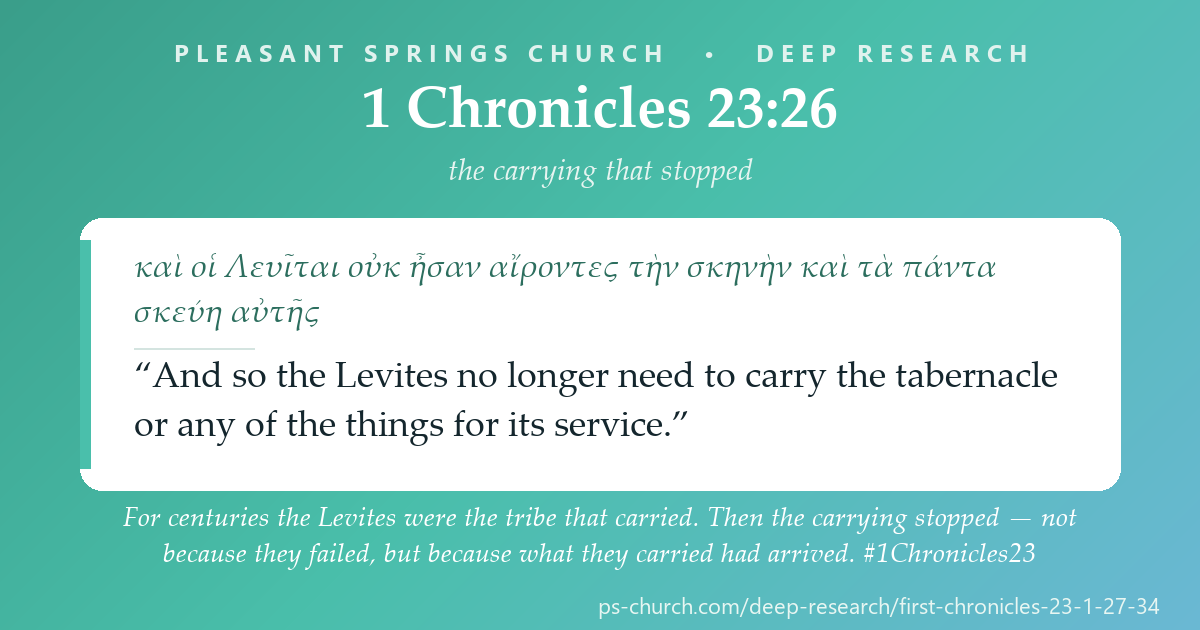
Hebrew · Greek (Rahlfs, Paraleipomenon A) · ESVIt opens with a change of duty explained out loud. The Levites were, by definition, the tribe that carried — poles on shoulders, the tabernacle taken down and put up again across forty years of desert and centuries of settlement. And David says: the Lord has given rest, he dwells in Jerusalem, “and so the Levites no longer need to carry the tabernacle” (23:26). The vocation did not shrink; it was redirected — to standing every morning and evening to thank and praise, and to the running of a house that no longer moved.
Then everything is allotted. Priests in twenty-four courses by lot; singers in twenty-four courses by lot; gatekeepers assigned gate by gate by lot. The lot is the point: no family bought the good months, and the roster ran “small and great, teacher and pupil alike” (25:8). The eighth priestly course drawn was Abijah — and a thousand years later a priest of that division was burning incense when an angel stood at the right of the altar (Luke 1:5).
And at 27:24 the writer does something almost no ancient historian does. He reports that a count was abandoned, that wrath came, and that the number was never entered in the royal records. He is telling you his source has a hole in it, and where.
The text and the numbering. In the Septuagint this book is 1 Paraleipomena, “things omitted” — Παραλειπομένων Αʹ (Paraleipomenōn A). Chapters 23–27 are numbered alike in Hebrew, Greek and English, and the verse counts match exactly — 32, 31, 31, 32, 34 — with nothing absent from Rahlfs. Counted against both columns, not assumed.
⚠️ A ketiv/qere at 25:1, and it changes what the singers are. The consonants written are הנביאים (hannəḇîʾîm, “the prophets” — a noun, an office); the Masoretic reading tradition says הַנִּבְּאִים (hannibbəʾîm, “those who prophesy” — a participle, an activity). One is a title and the other is a job being done. The Greek went a third way entirely: τοὺς ἀποφθεγγομένους, “those who utter” — the same verb Luke will use of the disciples’ speech at Pentecost (Acts 2:4). English versions divide, and this page prints the reading tradition in the Hebrew column with the note rather than choosing silently.
⚠️ The Levites are counted from two different ages in one chapter, and the text says so. 23:3 numbers them “from thirty years old and upward” — the age of Numbers 4. Then 23:24 and 23:27 record the count “from twenty years old and upward.” This is not a slip the Chronicler missed; 23:25–26 sits between the two and gives the reason — the work changed, so the eligible age changed. It is one of the clearest cases in Scripture of a rule being revised on stated grounds, and the text shows its working.
The Shape of the Passage
Parallel panelsBehind these chapters stands the Levites’ original charge in Numbers 3–4 — carry the holy things, and do not touch them — and the day that charge went wrong at a threshing floor. In front of them stand a temple, a roster, and a priest of the eighth course.
Author
He gives five chapters to administration and no chapters to Absalom. That single fact tells you what kind of history this is. Samuel and Kings are interested in the drama of the house of David; the Chronicler is interested in the institution David left behind. Chapters 23–27 have no parallel anywhere, which means they are not an abbreviation of anything — they are what he came to write.
And he shows his working. Twice in this unit he does something historians of his era almost never do. At 23:24–27 he records a change in the age of Levitical service and supplies the reason, so that a reader who notices the discrepancy with Numbers 4 finds the explanation already on the page. At 27:24 he reports that Joab abandoned a count and that the number never made it into the royal records. He is not smoothing his sources. He is telling you where they are incomplete.
He is also drawn to the lot. Three separate rosters are settled by casting lots, and he says so each time. For a writer this invested in Davidic authority, it is striking how much of the organisation he attributes to a procedure that removes human discretion — including the king’s.
Audience
Men whose names were on a rota. The priestly courses were still running when the Chronicler wrote and were still running in the first century — Luke can date the annunciation to Zechariah by naming a division (Luke 1:5), and Josephus refers to the courses as a live institution. These chapters were not history to the first readers; they were the shift pattern. A man reading chapter 24 could find the week his family served.
People who needed to know that a changed job is still the job. This is the pastoral centre of the unit. The Levites had one defining task for centuries: carry the holy things. Then the carrying stopped — not because they failed, but because the thing they carried had arrived. 23:26 is the moment a vocation is redefined without being diminished, and the ground given is not decline but rest. For a community whose forebears had lost a temple, a monarchy and a country, and who now had a smaller building and a narrower life, that is a serious word.
And people for whom “by lot” meant something. In a small province where a handful of priestly families held most of what status remained, a repeated insistence that the roster was drawn rather than negotiated — small and great alike — is not a neutral historical detail. It is a standard the writer is holding his own readers to.
Orient on the Levitical orders, the twenty-four courses, temple music, and the casting of lots.
Search by topic: Levites; priests and priesthood; courses / divisions (mishmarot); Eleazar and Ithamar; Zadok and Abiathar; temple singers; Asaph, Heman, Jeduthun; music in worship; gatekeepers; temple treasuries; lot (casting of); Urim and Thummim; Abijah (priestly division).
Which articles are relevant?
- Anchor Bible Dictionary — “Levites,” “Priests and Levites,” “Priestly Courses,” “Music and Musical Instruments,” “Asaph,” “Heman,” “Jeduthun,” “Gatekeepers,” “Lots,” “Temple, Jerusalem.”
- Dictionary of the OT: Historical Books (IVP) — “Levites, Priests,” “Music,” “Worship,” “State Officials,” “Chronicler’s History.”
- NIDOTTE / TDOT — נָשָׂא (nāśāʾ, carry), נוּחַ (nûaḥ, give rest), גּוֹרָל (gōrāl, lot), מִשְׁמֶרֶת (mišmereṯ, watch, charge, duty), נָבָא (nāḇāʾ, prophesy), עֲבֹדָה (ʿăḇōdāh, service).
- On the Greek — the NETS introduction to 1 Supplements, and its notes on the translation of the administrative vocabulary in these chapters.
Bibliography surfaced:
- Gary N. Knoppers, 1 Chronicles 10–29 (Anchor Yale); Sara Japhet, I & II Chronicles (OTL); Ralph W. Klein, 1 Chronicles (Hermeneia); H. G. M. Williamson, 1 and 2 Chronicles (NCBC).
- On the singers and their status: John W. Kleinig, The Lord’s Song: The Basis, Function and Significance of Choral Music in Chronicles — the standard monograph, and the place to go on what “prophesying with lyres” means.
- On the courses in later practice: the relevant sections of Emil Schürer, The History of the Jewish People in the Age of Jesus Christ (rev. Vermes–Millar), on the twenty-four mishmarot and their continuation into the Second Temple period.
Temple staff as an institution, the lot as a decision procedure, and the courses still running a thousand years later.
First the world: how large sanctuaries were actually staffed and rostered, and what casting lots was for. Then the evidence that these divisions were not an antiquarian reconstruction — they were still in operation in the first century, and they turn up at Qumran and in synagogue inscriptions long after.
Which parallels shed light on these chapters?
Large temples ran on rosters, and the documentation looks like this. Babylonian temple archives from Uruk and Sippar record prebendary shares — the right and duty to serve on particular days, held by family and inherited — along with rotas, allocations of income and lists of personnel by office. Egyptian temples ran on phyles, rotating groups serving by turn. The twenty-four courses of 1 Chronicles 24–25 are an instance of a widespread institutional form, which is worth knowing before dismissing these chapters as invented detail. What is distinctive is not that Israel had a rota; it is what the rota was for and how places on it were assigned.
Casting lots was a decision procedure, not a game of chance. In the Old Testament the lot allocates land (Numbers 26:55; Joshua 14–19), identifies a guilty party (Joshua 7:14–18; 1 Samuel 14:41–42), and here assigns duty. Proverbs 16:33 states the theology exactly: “The lot is cast into the lap, but its every decision is from the Lord.” The point of using it for the courses is that it takes the roster out of human hands — including the king’s, and including the high-priestly family’s. The last use of the procedure in Scripture is Acts 1:26.
And the courses were still running in the first century. This is not a system reconstructed from an old book. Luke dates the birth of John the Baptist by naming a division — Zechariah “of the division of Abijah” (Luke 1:5), the eighth lot in 24:10. Josephus refers to the courses as current institutional fact. Lists of the twenty-four mishmarot and their towns appear in later synagogue inscriptions and in liturgical poetry, and course-names occur in texts from Qumran. A roster drawn by lot in these chapters was still determining who was in the sanctuary on a given week when Gabriel turned up.
- Josephus, Antiquities 7.14.7 (§§363–367); Life 1–2 (Second-Temple — a witness, not Scripture) — he retells David’s organisation of the priests into twenty-four courses, and elsewhere identifies his own priestly descent by course. The institution is his, not just his source’s.
- Luke 1:5–23 — not an external witness but the New Testament’s own use of this chapter: a priest of the eighth division, chosen by lot to burn incense, meeting an angel at the right side of the altar. Both the division and the lot come from these pages.
- m. Taanit 4:2; m. Tamid 5:1–6 (rabbinic-era — witnesses, not Scripture) — the mishmarot and the daily service described as a working system, including the use of the lot to assign the day’s tasks among the priests on duty.
- Babylonian temple prebend records (Uruk, Sippar); Egyptian temple phyles (ancient Near Eastern administrative documents — witnesses, not Scripture) — for the institutional form of rostered sanctuary service. Cited for the practice, not to prove anything about the text.
25:1 sets apart the sons of Asaph, Heman and Jeduthun for a service described with the verb nāḇāʾ, to prophesy, “with lyres, harps and cymbals.” 25:2 says Asaph prophesied “under the direction of the king”; 25:5 calls Heman “the king’s seer.” The vocabulary of prophecy is applied to musicians, deliberately and repeatedly.
What can be said. That the Chronicler regards temple song as a form of inspired ministry rather than as accompaniment is not a stretch — he says it four times in one chapter. And it fits what the singers actually sang: the psalms are, very largely, God’s word given back to God in words he supplied.
What is disputed. Whether nāḇāʾ here means anything like the classical prophets’ ministry, or something narrower — ecstatic utterance, or simply authorised liturgical proclamation — is argued, and the ketiv/qere sits right on the question: the prophets (an office) against those who prophesy (an activity). The Greek chose neither and rendered ἀποφθεγγομένους, “those who utter.”
What this page will not do is turn the verse into a general warrant — that music is prophecy, or that musicians hold prophetic office. The text is describing a specific appointed order in a specific house, under the direction of a king, and it says so. Kleinig’s monograph is the place to go for the full argument; what belongs on this page is the observation, the dispute, and the restraint.
The verb that stops, the word that replaces it, and a word that occurs once in the whole Bible.
Put nāśāʾ in 15:15 beside 23:26 and the change of vocation is visible in one verb. Then count gōrāl through three rosters, and look at talmîḏ in 25:8 — the only time the word appears in the Old Testament.
“To carry, bear, lift.” The Levites’ defining verb, and 23:26 is where it is set down. In chapter 15 this same verb was the whole correction — the ark carried on shoulders, not wheels, because that is what the Levites are for. Eight chapters later the same writer records that they need not carry it any more. The tribe defined by carrying is told to stop carrying, and it is announced as good news. The Greek keeps the verb (αἴροντες).
“He has given rest.” The stated ground for the change: “the Lord… has given rest to his people, and he dwells in Jerusalem for ever.” It is the same root as the mənûḥāh promised to Solomon in 22:9 and the rest promised the land in Deuteronomy 12:10 and Joshua 21:44 — and, in the New Testament, the rest argued about at length in Hebrews 3–4. The Greek κατέπαυσεν is the same verb the Septuagint uses in Genesis 2:2 of the seventh day, which Hebrews 4 then quotes.
“Lot.” The instrument by which priests, singers and gatekeepers are all assigned, repeated until it is unmissable. It is the same word used for the allotment of the land in Joshua, and the theology behind it is stated in Proverbs 16:33: the lot is cast, and the decision is the Lord’s. Its effect here is to make favouritism structurally impossible — 24:31 and 26:13 both add “small and great alike,” and 24:31 specifies that the younger families drew on exactly the same terms as the elder. The Greek is κλῆρος, from which English gets clergy.
“Watch, charge, guard-duty, obligation.” The word behind the later Hebrew name for the priestly courses, the mishmarot. Its root is “to keep,” and it carries both senses at once — a duty you keep and a post you guard. 23:32 uses it three times in one verse: the Levites “keep charge of the tent of meeting and charge of the holy place and charge of the sons of Aaron their brothers.”
“Those who prophesy” — the reading tradition; the consonants as written give hannəḇîʾîm, “the prophets.” The difference is between an office and an activity, and it is one letter. The chapter presses the point either way: Asaph prophesies “under the direction of the king” (25:2), Jeduthun “prophesied with the lyre in thanksgiving and praise” (25:3), and Heman is called “the king’s seer” (25:5). The Greek declined both options and wrote τοὺς ἀποφθεγγομένους, “those who utter” — the verb Luke uses of the disciples at Pentecost (Acts 2:4) and of Paul before Festus (Acts 26:25).
“The skilled with the learner” — usually rendered “teacher and pupil alike.” Talmîḏ is the ancestor of the word Talmud and this is its only occurrence in the Hebrew Bible. The clause sits beside “small and great” and governs the casting of lots: the master musician and the apprentice went into the same draw. The Greek τελείων καὶ μανθανόντων, “the complete and the learning,” keeps it exactly.
Two things here reported rather than tidied:
- Two different ages of Levitical service in one chapter — and the text explains itself. 23:3 counts the Levites “from thirty years old and upward,” which is the age of Numbers 4:3. Then 23:24 and 23:27 give the count “from twenty years old and upward.” The explanation is supplied in between, at 23:25–26: the carrying has ended, so the terms of service change. This is a rule being revised on stated grounds, with the working shown — compare Numbers 8:24, which gives twenty-five, so Scripture already carries more than one figure. The page reports all three rather than harmonising them.
- 27:24 is an admission, and a rare one. “Joab… began to count, but did not finish. Yet wrath came upon Israel for this, and the number was not entered in the chronicles of King David.” The writer is telling his readers that a figure they might expect to find in the royal annals is not there, and why. Ancient historiography does not usually advertise the gaps in its sources. It also ties this administrative unit back to chapter 21, so the census is not left behind when the rosters begin.
The charge that ended, the rest that replaced it, and a priest of the eighth course.
Read Numbers 3–4 first — the Levites’ original job — then 1 Chronicles 23:26, and the change is unmistakable. Then follow the lot to Acts 1 and the eighth course to Luke 1.
Which cross-references matter?
- Numbers 3:5–9; 4:1–33; 7:9 — the Levites’ founding charge: they carry the tabernacle and its furnishings, the Kohathites bear the holy things on their shoulders, and no carts are given them. This is the job 23:26 declares finished — and it is the same law broken in chapter 13, which is why the writer is careful here.
- Numbers 4:3 · Numbers 8:24 · 1 Chronicles 23:3, 24, 27 — thirty years old, twenty-five years old, thirty, twenty. Four figures for the start of Levitical service across Scripture. The Chronicler gives two of them in one chapter and explains the change; the page prints all four.
- Deuteronomy 12:10; Joshua 21:44; 1 Chronicles 22:9; 23:25 — the thread of rest. The land is promised rest, the land receives it, Solomon is named a man of rest, and here rest is the reason an ancient duty can be laid down. Hebrews 3–4 will argue that the rest in question was never exhausted by any of these.
- Luke 1:5–23 — “there was a priest named Zechariah, of the division of Abijah” — the eighth lot at 1 Chronicles 24:10 — “and according to the custom of the priesthood he was chosen by lot to enter the temple of the Lord and burn incense.” Both the division and the lot are from these chapters. A roster drawn a thousand years earlier put that man in that room on that morning.
- Proverbs 16:33 and Acts 1:23–26 — the theology of the lot, and its last appearance in Scripture. “The lot is cast into the lap, but its every decision is from the Lord”; and the eleven casting lots for Matthias, after praying, before Pentecost.
- 1 Chronicles 16:4–6, 37–42 and 25:1–7 — the singers appointed at the tent and then organised into courses. Asaph, Heman and Jeduthun appear in both, and their names stand at the head of a dozen psalms — so the roster in chapter 25 is a list of the people whose work is still in the Psalter.
- 1 Chronicles 27:24 and 21:1–17 — the abandoned census, referred back to in the middle of an administrative list. The Chronicler will not let the rosters stand without remembering what counting cost.
Where the scholarship agrees, where it does not, and what is left open.
Knoppers, Japhet, Klein and Williamson on the unit; Kleinig on the singers. Then three live questions — and on two the honest answer is that we do not know.
Commentaries & studies:
- Gary N. Knoppers, 1 Chronicles 10–29 (Anchor Yale) — the fullest treatment, particularly on the relationship between these lists and the institutions of the Chronicler’s own day.
- Sara Japhet, I & II Chronicles (OTL) — on the Levites’ changed role and on 23:25–26 as a piece of deliberate theological reasoning rather than an editorial seam.
- Ralph W. Klein, 1 Chronicles (Hermeneia) — the technical work on the lists, the textual problems in chapter 24, and the ages of service.
- John W. Kleinig, The Lord’s Song — the standard study of choral music in Chronicles, and the best treatment of what “prophesying with lyres” does and does not mean.
- H. G. M. Williamson, 1 and 2 Chronicles (NCBC) — and his articles on whether parts of chapters 23–27 are secondary; see below.
Interpretation notes worth keeping:
- Whether all of 23–27 is original to the book — genuinely disputed. A long-standing argument holds that some of these lists (chapter 27 especially, and parts of 23–26) are later additions, on the grounds of vocabulary and of the way 28:1 resumes from 23:2. Others defend the whole as the Chronicler’s. This page treats the chapters as they stand, notes the argument, and does not build anything on either answer.
- How far the lists reflect David’s time and how far the Chronicler’s. That the courses were a live institution in the Second Temple period is documented; that they were established in the form given here under David is the book’s claim. Most historians read the lists as at least partly reflecting later practice traced back to David. The claim and the caution are both reported.
- What “prophesy” means at 25:1–5 — not settled. See the insight above. The ketiv/qere, the Greek’s third option, and the range of scholarly readings are all set out rather than resolved.
- The numbers. Thirty-eight thousand Levites (23:3), twenty-four thousand men per monthly division (27:1). The standing question about אֶלֶף (ʾelep, “thousand” or a unit) applies here as elsewhere and is not settled; this page neither converts the figures nor defends them.
When the job changes, why the roster was drawn and not negotiated, and the honesty of a missing number.
Name what you learned, why it matters, and one concrete response.
What should we carry away — and do?
- A vocation can end without being taken away. For centuries the Levites were the people who carried. Then the carrying stopped — not through failure, but because what they carried had arrived. And the same chapter that ends the old duty hands them a new one: to stand every morning and every evening to thank and praise. If you have ever had a role end and felt it as a demotion, 23:25–26 is written about that.
- Nobody negotiated their slot. Priests, singers, gatekeepers — all by lot, all “small and great alike,” the master musician and the apprentice in the same draw. It is a deliberate refusal to let seniority buy the good weeks. Ask what in your own church runs on lot-like fairness and what runs on who knows whom.
- The gatekeepers are on the list. Four chapters of the Bible are given to naming people who opened doors, guarded storerooms and looked after olive groves, at the same level of detail as the priests. Whoever compiled this did not think the visible jobs were the real ones.
- One concrete response. 27:24 records a number that was never written down, and says so. This week, say plainly about one thing that you do not know it — a question at work, a question about Scripture, a question about someone’s situation — instead of producing an answer to fill the gap. The Chronicler had five chapters of impressive records and still marked the hole.
1 Chronicles 23:26 · to share
Hebrew + Greek (Rahlfs, Paraleipomenon A) + ESVEvery Deep Research page traces its passage across the whole sweep — the Old Testament, the Second-Temple world between the testaments (historical witnesses, not Scripture), and the New Testament. Follow the thread:
Pleasant Springs Church — Deep Research
Research method after Michael S. Heiser’s Bible Research Method (examine dictionaries → ancient literature → important words → textual connections → academic publications → share), with the Pleasant Springs “Author & Audience” foundation. Scripture set in the Hebrew, the Greek editions named on each page and the ESV (Old Testament), and the Greek New Testament and the ESV (New Testament), per the practice of Pleasant Springs Church. 1 Chronicles 23–27 research grounded in Knoppers (Anchor Yale), Japhet (OTL), Klein (Hermeneia) and Williamson (NCBC), with Kleinig, The Lord’s Song, on the singers and Schürer (rev. Vermes–Millar) on the later history of the courses. Book name: in the Septuagint this book is Paraleipomenon A, Παραλειπομένων Αʹ; the Hebrew title is דִּבְרֵי הַיָּמִים. Text & numbering: Hebrew from the Masoretic Text; Greek from Rahlfs’s Septuaginta (CATSS digitization of the Rahlfs text), printed without editorial punctuation and with proper names unaccented; English ESV. Chapters 23–27 are numbered alike in Hebrew, Greek and English and the verse counts match exactly (32, 31, 31, 32, 34) with nothing absent from Rahlfs — counted against both columns, not assumed. ⚠️ Ketiv/qere at 25:1: written הנביאים (“the prophets,” an office), read הַנִּבְּאִים (“those who prophesy,” an activity); the Greek took a third route with τοὺς ἀποφθεγγομένους, “those who utter.” The page prints the reading tradition in the Hebrew column and states the variant rather than choosing silently, and it explicitly declines to turn 25:1–5 into a general warrant that music is prophecy — the text describes a specific appointed order under a king’s direction. ⚠️ Ages of Levitical service: 23:3 gives thirty and 23:24, 27 give twenty, with the reason supplied between them at 23:25–26; Numbers 4:3 gives thirty and Numbers 8:24 gives twenty-five. All four figures are printed and none is harmonised; the change is reported as the text reports it, a rule revised on stated grounds. 27:24 is reported as an admission of a gap in the sources — a count abandoned and a number never entered in the royal records — and is linked back to chapter 21 rather than left isolated. The large numbers (thirty-eight thousand Levites; twenty-four thousand per monthly division) are neither converted nor defended, and the unsettled question of אֶלֶף is named as unsettled. The literary-critical argument that parts of chapters 23–27 are secondary is reported as a live dispute; the page treats the chapters as they stand and builds nothing on either answer. How far the lists reflect David’s time rather than the Chronicler’s is likewise stated as the book’s claim alongside the historians’ caution. Second-Temple and rabbinic witnesses (Josephus, Ant. 7 and Life; m. Taanit 4:2; m. Tamid 5:1–6) are read as witnesses and never levelled with Scripture, and Babylonian and Egyptian temple-rota material is cited for institutional practice only. Typology is handled per the house position: what the text says, what the New Testament itself draws (Luke 1:5–23 depends directly on 24:10 and on the lot), and what we see from this side of the cross — with the seeing left to the reader.
Scripture quotations marked ESV are from the ESV® Bible (The Holy Bible, English Standard Version®), © 2001 by Crossway, a publishing ministry of Good News Publishers. ESV Text Edition: 2016. Used by permission. All rights reserved. The ESV text may not be quoted in any publication made available to the public by a Creative Commons license, and the ESV may not be translated in whole or in part into any other language. www.esv.org
|
Did this study bless you today? 💚 Give to Support PS Church100% of gifts go to the General Fund — thank you. |