The second book opens with a new king going to the wrong city — or so it looks. Solomon goes to Gibeon, not Jerusalem, where the ark already is. 1 Kings 3 reports the same journey and leaves it slightly awkward. Chronicles explains it: Gibeon is where the tent of meeting that Moses made in the wilderness was standing, and where the bronze altar that Bezalel made still stood before it. Solomon is not at a high place; he is at the oldest legitimate altar in Israel. And the verb for what he does there is the verb this whole work runs on — he sought. Saul died because he did not seek; David went wrong because he did not seek according to the rule; the new reign begins with seeking. Then “Ask what I shall give you” — and a request for wisdom to govern, answered with wisdom and everything he did not ask for. Then a levy, a letter to Tyre, a half-Israelite craftsman, and, inside the letter, the sentence that should stop the project: “who is able to build him a house, since heaven, even highest heaven, cannot contain him?” The builder states the absurdity before laying a stone. And then 3:1 — one verse that gives the site three names at once, and the first of them occurs in only one other place in the whole Hebrew Bible. See the method →
2 Chronicles 1:1–5:1 (selections)
Hebrew · Greek (Rahlfs, Paraleipomenon B) · ESVAnd the verb Chronicles uses for what he does there is the verb the whole work has been built on: wayyiḏrəšēhû — “and he sought it.” Saul died because he did not seek; David failed because he did not seek according to the rule; the new reign begins with a king seeking. Then God says “Ask what I shall give you,” and Solomon asks for wisdom to govern a people too numerous to count — and is given that and everything he did not ask for.
Then the work: a levy of a hundred and fifty thousand men, a letter to Huram of Tyre, a craftsman whose mother was an Israelite and whose father was a Tyrian. And in the middle of the letter, Solomon says the one thing that should stop the project: “who is able to build him a house, since heaven, even highest heaven, cannot contain him? Who am I to build a house for him — except as a place to burn incense before him?” The builder states the absurdity of the building before laying a stone.
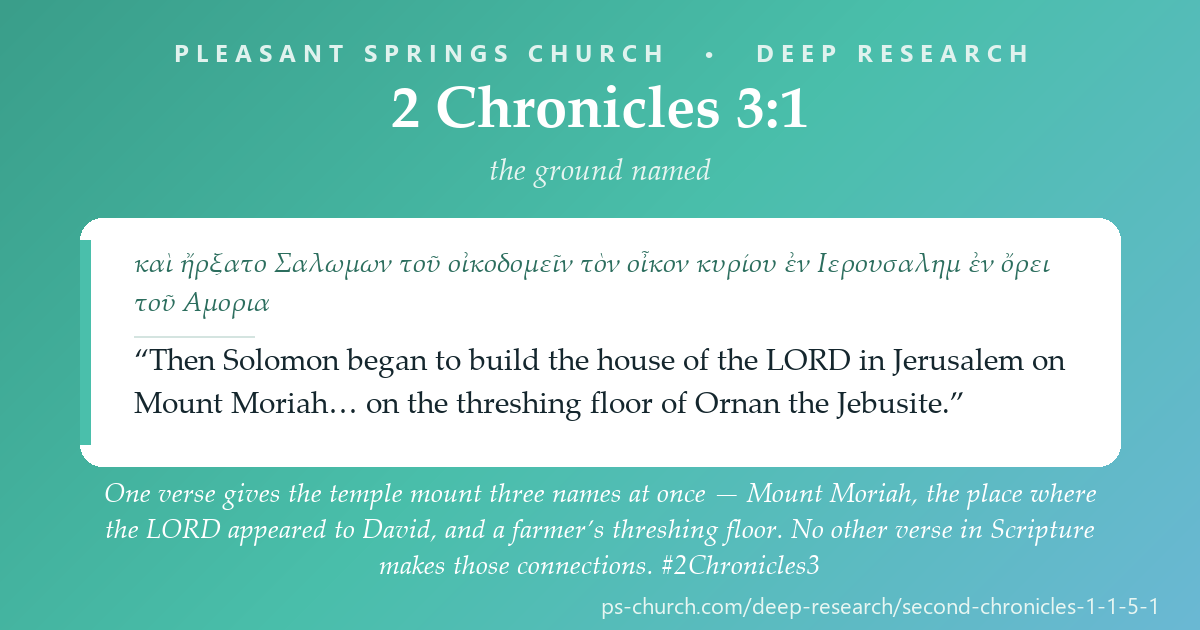
And then 3:1 — a single verse that does something no other verse in the Bible does.
Numbering, and two things in the columns. In the Septuagint this book is 2 Paraleipomena, “things omitted” — Παραλειπομένων Βʹ (Paraleipomenōn B). In Greek this is Paraleipomenon B, Παραλειπομένων Βʹ, the second half of one continuous work.
⚠️ The verse numbers diverge in chapter 2, and this page follows the Hebrew. The Masoretic Text and Rahlfs both put “Solomon resolved to build a house for the name of the Lord” at the end of chapter 1 as 1:18; English versions make it 2:1. From there the English runs one ahead through chapter 2: MT/LXX 2:5 is ESV 2:6, and the chapter ends at MT/LXX 2:17 where English has 2:18. Counted against both columns: 2 Chronicles 1 has 18 verses in the Masoretic Text and 18 in Rahlfs; chapter 2 has 17 in both. Verses from chapters 1–2 are cited by the Hebrew number with the English in brackets where it differs. Chapters 3, 4 and 5 agree in all three.
⚠️ A Greek plus at 2:5 [ESV 2:6]. The Hebrew says heaven and the highest heaven “cannot contain him”; Rahlfs has οὐ φέρουσιν αὐτοῦ τὴν δόξαν — “do not bear his glory.” The Greek supplies an object the Hebrew does not have, and softens the claim slightly: it is God’s glory the heavens cannot hold, rather than God.
The Shape of the Passage
Sequence · inclusioBehind these chapters stand the pattern handed over in 1 Chronicles 28, the site bought in chapter 21, and the tent and altar made in Exodus. In front of them stands a dedication, and a glory that fills the house.
Author
He answers a question 1 Kings leaves hanging. Kings says Solomon went to Gibeon because it was “the great high place,” and adds, a little uneasily, that the people were still sacrificing at high places because no house had been built. Chronicles gives the reason outright: the tent of meeting and the bronze altar were there. Same journey, and the awkwardness disappears — not by contradiction but by supplying a fact.
He is writing continuity, not novelty. Notice how much of these chapters is about inheritance. Moses’ tent. Bezalel’s altar. David’s plan, David’s site, David’s dedicated treasure. Even the craftsman is half Israelite and half Tyrian, and the Chronicler gives his mother’s tribe. The temple is presented as the next thing in a line rather than the start of something.
And he keeps the objection in. A writer selling a building project would not have left 2:5 [ESV 2:6] in the letter. “Heaven, even highest heaven, cannot contain him… who am I?” Solomon says the thing that makes the whole enterprise look absurd, and then defines what the house is for: not to house God, but as a place to burn incense before him. That distinction will matter enormously when the building is destroyed.
Audience
People rebuilding on the same ground with a fraction of the budget. Every number in these chapters — the gold, the levy, the six hundred talents of the Most Holy Place — is larger than anything the second-temple community could imagine raising. The Chronicler does not scale it down. What he gives them instead is 3:1: the ground is right. The building may be smaller; the place is the same place.
People who needed foreign help and knew it. Tyre supplies the timber and the master craftsman. The second temple was built with Persian authorisation and Persian money (Ezra 6:8–10), and a community touchy about foreign involvement is being shown that Solomon’s temple was built the same way. Huram’s letter even blesses the Lord — a Gentile king, in a Gentile city, saying “Because the Lord loves his people he has made you king over them.”
And people for whom “Moriah” would have landed hard. The only other place in Scripture the name occurs is Genesis 22, where a father takes a son up a mountain. To say that the temple stands there is to say that this ground has a history of costly obedience long before David bought it. Stage 4 handles what can and cannot be built on that.
Orient on Gibeon and the tabernacle, on Solomon’s wisdom, on Tyre, and on the temple’s architecture.
Search by topic: Gibeon; tabernacle (later history); Bezalel; high places; Solomon (wisdom of); dream revelation; Tyre; Hiram / Huram; corvée labour; temple architecture; Jachin and Boaz; the bronze sea; cherubim; Moriah.
Which articles are relevant?
- Anchor Bible Dictionary — “Gibeon,” “Tabernacle,” “Bezalel,” “High Place,” “Solomon,” “Wisdom,” “Tyre,” “Hiram,” “Temple, Jerusalem,” “Jachin and Boaz,” “Moriah.”
- Dictionary of the OT: Historical Books (IVP) — “Solomon,” “Temple,” “Architecture,” “Trade and Travel,” “Forced Labor,” “Wisdom.”
- NIDOTTE / TDOT — דָּרַשׁ (dāraš, seek), חׇכְמָה (ḥoḵmāh) and מַדָּע (maddāʿ, knowledge), כּוּל (kûl, contain), מוֹרִיָּה (Mōriyyāh), מָקוֹם (māqōm, place).
- On the Greek — the NETS introduction to 2 Supplements, on the character of the translation and on the chapter divisions.
Bibliography surfaced:
- Sara Japhet, I & II Chronicles (OTL); Ralph W. Klein, 2 Chronicles (Hermeneia); H. G. M. Williamson, 1 and 2 Chronicles (NCBC); Raymond B. Dillard, 2 Chronicles (WBC).
- On the temple’s architecture and its Near Eastern parallels: the relevant sections of any critical commentary on 1 Kings 6–7, read alongside 2 Chronicles 3–4 rather than instead of it — the two accounts do not describe identical furniture.
Temple-building as royal duty, Phoenician craftsmanship, and what a dream at a sanctuary was.
First the world: incubation at a shrine, the Phoenician building trade, and the convention of the royal temple account. Then Josephus, who has the letters to and from Tyre — and claims the originals could still be consulted.
Which parallels shed light on these chapters?
Going to a sanctuary to receive a dream was a recognised practice. Sleeping at a holy place to obtain a divine answer — incubation — is attested across the ancient Near East and the Greek world. 1 Kings 3:5 says the Lord appeared to Solomon at Gibeon “in a dream by night”; 2 Chronicles 1:7 says only “that night God appeared to Solomon.” The difference is small and worth noticing rather than flattening: Chronicles keeps the night and drops the word “dream.”
Phoenician craftsmen were the acknowledged experts, and everyone hired them. Tyre and Sidon supplied cedar, metalwork and skilled labour across the eastern Mediterranean; Assyrian kings boast of Lebanese timber in their building inscriptions, and Phoenician ivories and bronzes turn up from Nimrud to Spain. The arrangement in chapter 2 — timber floated down the coast, paid for in wheat, barley, wine and oil — is ordinary commerce described accurately. Huram-abi is given an Israelite mother (2:13 [ESV 2:14]), which matters to the Chronicler; 1 Kings 7:14 makes her a widow of the tribe of Naphtali, Chronicles says of the daughters of Dan. Both are printed in Stage 4.
And the royal building account was a genre. Kings from Gudea to Nebuchadnezzar left long inscriptions describing a temple’s dimensions, its materials, the gold applied and the labour levied. 2 Chronicles 3–4 reads like one because it is one. What the genre does not normally contain is a sentence like 2:5 — the king announcing that the god cannot be housed and that he himself is nobody. The convention is being used and broken in the same document.
- Josephus, Antiquities 8.2.6–8.3.9 (§§50–98); Against Apion 1.17–18 (Second-Temple — a witness, not Scripture) — he gives the correspondence between Solomon and Hiram and claims that copies were preserved in the Tyrian public records and could be consulted. He is arguing for the antiquity of his nation to a sceptical readership, so the claim is interested; it is reported here as a claim, not as corroboration.
- The Cylinders of Gudea; Assyrian and Babylonian building inscriptions (royal inscriptions — witnesses, not Scripture) — for the temple-account genre: divine authorisation, dimensions, materials, gold, labour. Cited for the convention.
- Phoenician metalwork and the Lebanese timber trade (archaeological and documentary evidence — witnesses, not Scripture) — for the ordinary commercial background of chapter 2.
- 1 Kings 3 and 5–7 beside 2 Chronicles 1–4 — not an external witness, but the comparison that governs the unit. Read them in parallel before reading anyone’s account of the differences.
What the verse does. 2 Chronicles 3:1 makes three identifications in a single sentence: the temple stands (1) on Mount Moriah, (2) where the Lord appeared to David, and (3) at the threshing floor of Ornan the Jebusite. The second and third refer plainly to 1 Chronicles 21. The first is the striking one: “Moriah” occurs in only one other place in the entire Hebrew Bible — Genesis 22:2, “the land of Moriah… on one of the mountains of which I shall tell you.”
What can be said with confidence. This verse is Chronicles’ own claim, made here and nowhere else in Scripture. Neither Genesis nor Kings identifies the site of the binding of Isaac with the site of the temple. The Chronicler does, and a reader is entitled to take him seriously as a witness — he is, after all, the writer who has just spent a chapter establishing exactly how David acquired that ground.
Where the caution lies. Genesis 22 says “the land of Moriah” and one of its mountains, not this mountain; the connection is an identification, not a quotation. And the ancient versions are not uniform: the Greek here transliterates Αμορια, while at Genesis 22:2 the Septuagint renders the phrase quite differently (τὴν γῆν τὴν ὑψηλήν, “the high land”), so a Greek reader would not necessarily hear the link at all. Samaritan tradition locates Moriah at Gerizim.
What this page will not do. It will not run from 3:1 to a chain of typological conclusions — a father, a son, a substitute, a hill — and present that chain as what the verse asserts. Genesis 22 and this verse are both on the page, the identification is Chronicles’ own, and the seeing belongs to the reader, from this side of the cross. Some things are meant to be noticed rather than argued.
The verb that opens a reign, the verb that empties a building, and a name used twice in the Bible.
Follow dāraš from Saul’s epitaph to Solomon’s first act. Then watch kûl at 2:5 and again at 6:18, and look up Mōriyyāh in a concordance — it will not take long.
“And he sought it.” The Chronicler’s master verb, placed at the first act of the new reign. Saul died because he did not seek (1 Chr 10:14); the ark went wrong because they did not seek according to the rule (15:13); and Solomon’s reign opens with the king and the assembly seeking. It will define the good kings for the rest of the book. A note on the object: the Hebrew suffix is masculine and most naturally refers to the altar — they sought it out, resorted to it — though some read it of the Lord. The Greek ἐξεζήτησεν αὐτό takes it as the altar.
“Wisdom and knowledge.” Note what Solomon asks for and what he does not. In 1 Kings 3:9 he asks for “an understanding mind to govern… that I may discern between good and evil”; here he asks for ḥoḵmāh ûmaddāʿ so that he may “go out and come in before this people.” Maddāʿ is a rare, late word for knowledge, used also of Daniel and his friends (Dan 1:4, 17). The Greek pairs σοφίαν καὶ σύνεσιν.
“Contain, hold, sustain.” “The heavens and the heaven of heavens cannot contain him.” The same verb returns in Solomon’s dedication prayer at 6:18, which is the point — the objection raised before building is repeated at the dedication, so the finished house never gets to be a container. The Greek changes the object: οὐ φέρουσιν αὐτοῦ τὴν δόξαν, “do not bear his glory” — supplying a word the Hebrew does not have.
“Mount Moriah.” The name occurs twice in the Hebrew Bible: here, and at Genesis 22:2, “the land of Moriah.” Its etymology is uncertain; Genesis 22:14 plays on rāʾāh, “to see,” in naming the place “the Lord will provide / be seen,” and this verse uses nirʾāh, “appeared,” of the Lord and David. Whether that echo is deliberate is not stated. The Greek transliterates Αμορια here but renders Genesis 22:2 as τὴν γῆν τὴν ὑψηλήν, so the link is invisible in Greek.
The two free-standing bronze pillars at the porch. The names are given without explanation and mean, roughly, “he establishes” and “in him is strength” — though Bōʿaz is also simply the name of Ruth’s husband, David’s ancestor, and the two possibilities are not exclusive. They hold nothing up. They are not structural, and no biblical text says what they were for; the honest position is that we do not know.
“Work, task, craftsmanship.” “Thus all the work that Solomon did for the house of the Lord was finished.” It is the word used of the tabernacle’s completion in Exodus 39:32 and 40:33 — and, before that, of God’s finished work in Genesis 2:2. Three completions, one vocabulary: creation, tabernacle, temple. The Chronicler does not comment; he just uses the word.
Two things here reported rather than tidied:
- The verse numbering of chapters 1–2. The Masoretic Text and Rahlfs both end chapter 1 with “Solomon resolved to build a house…” as 1:18; English versions open chapter 2 with it. So the English runs one ahead through chapter 2 and the two systems re-converge at chapter 3. This is a chapter-division difference, not a textual one — no words are gained or lost — but it makes references unreliable if unstated, so this page states it.
- Chronicles and Kings differ on the craftsman’s mother, and on the furniture. 2 Chronicles 2:13 [ESV 2:14] makes Huram-abi’s mother “of the daughters of Dan”; 1 Kings 7:14 makes her “a widow of the tribe of Naphtali.” And the inventories are not identical: Chronicles has ten lampstands and ten tables (4:7–8), where Kings emphasises the ten lampstands but the tabernacle tradition has one table. Both are printed; neither is harmonised.
Gibeon and the tent, Moriah and a mountain, and the house that cannot hold him.
Read 1 Kings 3 beside 2 Chronicles 1 and notice what Chronicles adds rather than what it removes. Then Genesis 22 beside 3:1, and 2:5 beside 6:18 and Acts 7.
Which cross-references matter?
- 1 Kings 3:4–15 beside 2 Chronicles 1:1–13 — the same night at Gibeon. Kings calls Gibeon “the great high place” and notes uneasily that people were still sacrificing at high places; Chronicles supplies the reason Gibeon was legitimate — the tent of meeting Moses made and the bronze altar Bezalel made were there (1:3–5). Kings says the appearance came “in a dream by night”; Chronicles says only “that night.” And the request differs in wording: “an understanding mind… to discern between good and evil” against “wisdom and knowledge… to go out and come in before this people.”
- Exodus 31:1–11; 35:30–35 → 2 Chronicles 1:5 — Bezalel son of Uri son of Hur, filled with the Spirit of God to design and to work in gold, silver and bronze. Chronicles is the book that tells you his altar survived, and that it was standing at Gibeon when Solomon came.
- Genesis 22:2, 14 → 2 Chronicles 3:1 — the two occurrences of Moriah. See the insight above for what this page does and does not build on the connection.
- 1 Chronicles 21:18–22:1 → 2 Chronicles 3:1 — the threshing floor, the appearance, the site David appointed. The second book picks up the first book’s deed of purchase and builds on it.
- 2 Chronicles 2:5 [ESV 2:6] → 6:18 → Acts 7:48–50; 17:24 — the objection, the dedication prayer that repeats it, and Stephen and Paul both insisting that God does not dwell in houses made by hands. The New Testament’s critique of temples is quoting the man who built one.
- Exodus 39:32; 40:33 and Genesis 2:2 → 2 Chronicles 5:1 — “all the work was finished.” Creation, tabernacle, temple: the same verb of completion each time.
- 1 Kings 5:13–18; 9:20–22 beside 2 Chronicles 2:2, 17–18 — the levy. Both books record the forced labour; Chronicles specifies that the conscripts were the resident aliens, not Israelites (2:17 [ESV 2:18]), which 1 Kings 9:22 also says while 1 Kings 5:13 speaks of a levy “out of all Israel.” The tension is inside Kings as much as between the books, and is left standing.
Where the scholarship agrees, where it does not, and what is left open.
Japhet, Klein, Williamson and Dillard on the unit. Then three live questions — and on two the honest answer is that we do not know.
Commentaries & studies:
- Sara Japhet, I & II Chronicles (OTL) — on the Chronicler’s legitimation of Gibeon and on the theology of the temple site.
- Ralph W. Klein, 2 Chronicles (Hermeneia) — the technical work on the relationship to 1 Kings and on the furniture lists.
- Raymond B. Dillard, 2 Chronicles (WBC) — particularly good on the Solomon narrative as a whole and on the Solomon–Moses and Solomon–David parallels.
- H. G. M. Williamson, 1 and 2 Chronicles (NCBC) — on the transition between the two books and on the treatment of foreign labour.
Interpretation notes worth keeping:
- The Moriah identification — the Chronicler’s own. That 3:1 makes it is a datum; whether it rests on older tradition or is the Chronicler’s theological claim is argued, and cannot be settled from the text. The Samaritan location of Moriah at Gerizim is worth knowing as a reminder that the identification was contested in antiquity.
- Whether Chronicles is defending Gibeon or explaining it. Both readings are current: that the Chronicler is answering an embarrassment in Kings, or simply preserving information Kings did not include. Nothing in either text settles it, and the difference matters less than it looks — on both readings the fact reported is the same.
- The pillars. No biblical text states the function or the meaning of Jachin and Boaz. Proposals abound — dynastic names, the opening words of inscriptions, cosmic pillars, fire-stands. We do not know, and this page says so.
- The numbers and the gold. Six hundred talents of gold for the Most Holy Place alone (3:8). As throughout, the question of אֶלֶף and of ancient royal figures generally is unsettled; the page neither converts nor defends them. See Money, Weights & Measures for what a talent was.
Seeking first, saying the objection out loud, and building on ground somebody else prepared.
Name what you learned, why it matters, and one concrete response.
What should we carry away — and do?
- The reign opens with a verb. Solomon sought. After a book in which a king died for not seeking and another was disciplined for not seeking properly, the new king’s first recorded act is to go to the oldest legitimate altar in Israel and look for God there. The Chronicler is not subtle about what he thinks makes a reign go well.
- He asked for what he needed to do the job. Not long life, not riches, not victory — wisdom and knowledge “to go out and come in before this people.” The request is entirely about the work he had been given, and the things he did not ask for arrived anyway.
- He said the objection out loud before starting. “Heaven cannot contain him. Who am I?” — in the letter commissioning the project. Naming the limits of what you are doing is not faithlessness; it is accuracy, and it is what stops a good thing turning into a claim it cannot support.
- One concrete response. Identify one thing you are currently building — a ministry, a habit, a piece of work — and write one sentence naming honestly what it cannot do. Then keep building. Solomon laid the foundations the same week.
2 Chronicles 3:1 · to share
Hebrew + Greek (Rahlfs, Paraleipomenon B) + ESVEvery Deep Research page traces its passage across the whole sweep — the Old Testament, the Second-Temple world between the testaments (historical witnesses, not Scripture), and the New Testament. Follow the thread:
Pleasant Springs Church — Deep Research
Research method after Michael S. Heiser’s Bible Research Method (examine dictionaries → ancient literature → important words → textual connections → academic publications → share), with the Pleasant Springs “Author & Audience” foundation. Scripture set in the Hebrew, the Greek editions named on each page and the ESV (Old Testament), and the Greek New Testament and the ESV (New Testament), per the practice of Pleasant Springs Church. 2 Chronicles 1–5:1 research grounded in Japhet (OTL), Klein (Hermeneia), Dillard (WBC) and Williamson (NCBC). Book name: in the Septuagint this book is Paraleipomenon B, Παραλειπομένων Βʹ, “of the things left out” — the second half of one continuous Greek work; the Hebrew title is דִּבְרֵי הַיָּמִים. Text & numbering: Hebrew from the Masoretic Text; Greek from Rahlfs’s Septuaginta (CATSS digitization of the Rahlfs text), printed without editorial punctuation and with proper names unaccented; English ESV. ⚠️ Verse numbering: the Masoretic Text and Rahlfs both place “Solomon resolved to build a house…” at 1:18, where English versions make it 2:1; the English therefore runs one ahead through chapter 2 (MT/LXX 2:5 = ESV 2:6; MT/LXX 2:17 = ESV 2:18) and the systems re-converge at chapter 3. This is a chapter-division difference, not a textual one, and it was checked against both columns rather than assumed: chapter 1 has 18 verses in the Masoretic Text and 18 in Rahlfs, chapter 2 has 17 in both, and chapters 3–5 have 17, 22 and 14 with nothing absent from the Greek. Verses from chapters 1–2 are cited by the Hebrew number with the English in brackets. ⚠️ Greek plus at 2:5 [ESV 2:6]: Rahlfs has the heavens not bearing αὐτοῦ τὴν δόξαν, “his glory,” supplying an object the Hebrew lacks. ⚠️ Chronicles and Kings are not harmonised: Gibeon is “the great high place” in 1 Kings 3:4 while Chronicles supplies the tent and the bronze altar as the reason for going there; Kings has a dream and Chronicles only “that night”; the request is worded differently in each; Huram-abi’s mother is of the daughters of Dan (2:13) against a widow of Naphtali (1 Kgs 7:14); and the furniture inventories differ (ten lampstands and ten tables at 4:7–8). All are printed and none reconciled. The tension over who was conscripted for the levy exists within Kings (5:13 against 9:22) as well as between the books, and is left standing. ⚠️ The Moriah identification at 3:1 is reported as Chronicles’ own claim, made here and nowhere else in Scripture: Genesis 22:2 has “the land of Moriah” and does not name this mountain, the Septuagint renders the Genesis phrase quite differently (τὴν γῆν τὴν ὑψηλήν) so the link is inaudible in Greek, and Samaritan tradition locates Moriah at Gerizim. The page explicitly declines to run from 3:1 to a chain of typological conclusions and presents it instead as something to be noticed, per the house position — what the text says, what the New Testament itself draws, and what we see from this side of the cross, with the seeing left to the reader. Jachin and Boaz are reported as unexplained: no biblical text states their function or meaning, and the page says we do not know rather than choosing a proposal. Large figures are neither converted nor defended and the unsettled question of אֶלֶף is named as unsettled. Second-Temple witnesses (Josephus, Ant. 8; Against Apion 1) are read as witnesses and never levelled with Scripture, and Josephus’s claim about the Tyrian archives is reported as an interested claim rather than as corroboration. Ancient Near Eastern building inscriptions are cited for genre only.
Scripture quotations marked ESV are from the ESV® Bible (The Holy Bible, English Standard Version®), © 2001 by Crossway, a publishing ministry of Good News Publishers. ESV Text Edition: 2016. Used by permission. All rights reserved. The ESV text may not be quoted in any publication made available to the public by a Creative Commons license, and the ESV may not be translated in whole or in part into any other language. www.esv.org
|
Did this study bless you today? 💚 Give to Support PS Church100% of gifts go to the General Fund — thank you. |