After the pillars are broken, the Chronicler spends twenty verses on storerooms. Tithes brought in heaps from the third month to the seventh, chambers prepared in the house, six men appointed by name, and a chief priest reporting to the king that “we have eaten and had enough and have plenty left” (31:10). Then the Assyrian at the wall and an arm of flesh; a tunnel under the city; and a sentence about the second-best king in the book that nobody preaches — “God left him to himself, in order to test him and to know all that was in his heart” (32:31). Then Josiah: seeking at sixteen, a scroll found in the building fund, Huldah saying you humbled yourself twice where 2 Kings says it once, and a Passover with no equal since Samuel. And then, in the Greek, four verses that are in no Hebrew manuscript and no English Bible. Rahlfs numbers them 35:19a–19d. One of them carries thirty consecutive Greek words shared with 4 Kingdoms 23:25 — tie band 1, the deepest verbatim contact any verse of the Greek 2 Chronicles has with the rest of the Greek Old Testament. And one of them says the thing the Hebrew Chronicler never says in thirty-six chapters: the Lord did not turn from his wrath, because of Manasseh. See the method →
2 Chronicles 31:1–35:27 (selections)
Hebrew (Masoretic) · Greek (CATSS/Rahlfs, Paraleipomenon B) · ESV“There was none like him before him, who turned to the Lord with his whole heart and with his whole soul and with his whole strength, according to all the law of Moses; and after him none like him arose.” Rendered here from the Greek. There is no Hebrew for this verse and no ESV.
“Nevertheless the Lord did not turn from the anger of his great wrath, with which the Lord was angry against Judah, on account of all the provocations with which Manasseh provoked him.” Rendered here from the Greek. There is no Hebrew for this verse and no ESV.
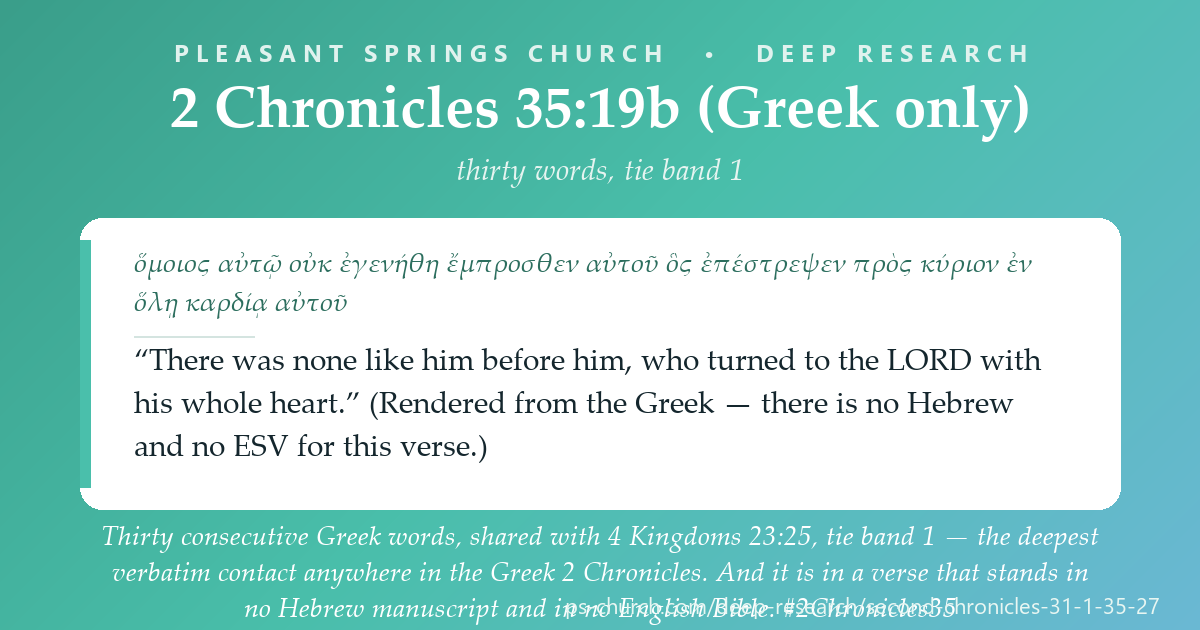
Measured, not asserted. Screened against the whole Greek Old Testament held here — 30,348 screened verse units, less the 833 rows of 2 Chronicles itself, so 29,515 targets — 35:19b shares thirty consecutive Greek words with 4 Kingdoms 23:25, tie band 1: one other verse in the corpus reaches that depth with it, and it is that one. 35:19a shares twenty with 4 Kingdoms 23:24, tie band 1. 35:19b is the deepest verbatim contact any verse in the entire Greek 2 Chronicles — all 833 rows — has with the rest of the Greek Old Testament, and it is in text the Hebrew does not have. Only five rows in the whole book reach twenty at all, and two of the five are these two (the other three are 25:18 at 23, and 18:22 and 18:33 at 20).
And 19c is the sentence the Hebrew Chronicler never writes. Across thirty-six chapters the Hebrew 2 Chronicles never once says that Judah fell because of Manasseh — it says instead that Manasseh humbled himself and was heard (33:12–13). 2 Kings says the opposite, twice (23:26; 24:3). The Greek Chronicles contains both. Chapter 33 keeps the repentance; 35:19c adds the verdict. This page reports that and does not resolve it.
Text and numbering. In the Septuagint this book is 2 Paraleipomena, “things omitted” — Παραλειπομένων Βʹ (Paraleipomenōn B). ⚠️ There IS an offset inside this passage, and it is an insertion, not a shift. Chapters 31, 32, 33 and 34 hold 21, 33, 25 and 33 verses in the Masoretic Text, in Rahlfs and in the ESV alike — the Hebrew and the Greek counted off disk here, the English chapter lengths agreeing with them. Chapter 35 holds 27 verses in Hebrew and English and 31 units in Rahlfs, the difference being 19a–19d. Verses 20–27 keep their numbers, so nothing downstream moves and no English reference in this study needs adjusting. For context outside the passage, the Greek of this book also has no 27:8, and chapter 36 runs to 31 units against the Hebrew’s 23 (2a–2c, 4a, 5a–5d).
⚠️ Two rows are not ESV. 35:19b and 35:19c exist only in Greek; their English is rendered here from the Greek and is labelled on the row. Every other English cell is ESV.
The Shape of the Passage
Sequence — four reigns, one repeating beatBehind these chapters stand the terms of 7:14 and the doors Hezekiah opened in 29:3. In front of them stands the fire, and a Persian decree.
Author
He spends twenty verses on storerooms. Chapter 31 is the least dramatic chapter in the last third of the book and the Chronicler gives it as much room as the Assyrian invasion. Portions assigned, heaps piled from the third month to the seventh, chambers prepared, six men appointed by name to distribute, genealogies of priests in their villages. Reform, for this writer, is not an event but a payroll. The measurement bears the point out: chapter 31 is the chapter here with the fewest verbal neighbours anywhere in Scripture — it is his own material, and it is about logistics.
He will not let a good king off. 32:31 is one of the strangest verses in Chronicles: when the Babylonian envoys came, “God left him to himself, in order to test him and to know all that was in his heart.” The writer who has just given Hezekiah the greatest Passover since Solomon reports, in the same chapter, that God withdrew to find out what he was made of — and does not tell us the result.
And he counts the humbling twice. Huldah’s oracle in 2 Kings 22:19 has the verb kānaʿ once. 2 Chronicles 34:27 has it twice in the one verse. That is not a bigger claim, it is the same claim said again, and it is the writer’s signature word.
Audience
People rebuilding an economy of worship. A community restoring temple service needed to know that tithes, chambers, rotas and named officials were not the boring part — they were the part that came after the pillars were broken and before God said anything else. Chapter 31’s closest verbal company in the Greek is Ezra–Nehemiah and 1 Esdras, not Kings, and that is where its readers were living.
People who had been told the exile was somebody’s fault. The Hebrew Chronicler never names Manasseh as the cause. His Greek readers, holding a scroll that contains 35:19c, had a book that did. Both audiences were reading 2 Chronicles. That is worth sitting with before anyone decides which one had the real Bible.
And people who needed permission to stop carrying things. 35:3 — “you need not carry it on your shoulders… now serve” — releases the Levites from the job their office was founded on, and reassigns them. For a generation whose fathers had done one thing, that is a hard and freeing sentence.
Orient on the tithe system, the tunnel, the finding of the book, and the Greek plus.
Search by topic: tithe and terumah; storehouse chambers (lishkot); courses of the priests; Siloam tunnel and the Gihon spring; Sennacherib’s third campaign; Merodach-baladan’s envoys; Josiah; Hilkiah; Huldah; the Book of the Law; Passover in the first month; Neco II and Carchemish; Megiddo; 1 Esdras; the Greek pluses in Paraleipomenon.
Which articles are relevant?
- Anchor Bible Dictionary — “Tithe,” “Levites,” “Siloam Inscription,” “Hezekiah,” “Sennacherib,” “Josiah,” “Huldah,” “Neco,” “Megiddo,” “Esdras, First Book of.”
- Dictionary of the OT: Historical Books (IVP) — “Hezekiah,” “Josiah,” “Priests and Levites,” “Worship,” “Chronicler’s History,” “Passover.”
- NIDOTTE / TDOT — כָּנַע (kānaʿ, humble oneself), דָּרַשׁ (dāraš, seek), תְּרוּמָה (tərūmāh, contribution), עֲרֵמָה (ʿărēmāh, heap), לִשְׁכָּה (liškāh, chamber), פֶּסַח (pesaḥ).
- On the Greek — the NETS introduction to 2 Supplements and to 1 Esdras, and any apparatus note on the plus at 2 Supplements 35:19a–19d. This is the one place in these chapters where a dictionary article will not be enough and the text itself has to be read.
Bibliography surfaced:
- Sara Japhet, I & II Chronicles (OTL); Raymond B. Dillard, 2 Chronicles (WBC); Ralph W. Klein, 2 Chronicles (Hermeneia); H. G. M. Williamson, 1 and 2 Chronicles (NCBC).
- On the Greek text: Klein’s textual notes on chapters 35–36, and any study of the relationship between Paraleipomenon B, 1 Esdras and 2 Esdras. This is where the page’s central finding needs a specialist, and this library does not have one on the shelf.
A tunnel you can walk, a prism that will not say it took the city, and a Greek scroll with four extra verses.
Take each item for exactly what it establishes — and say what it does not.
Which parallels shed light on these chapters?
The waterworks of 32:30 are visible and inscribed. The Siloam tunnel runs roughly 533 metres under the City of David and can be walked today; the Siloam Inscription cut in its wall describes two teams of diggers meeting in the middle. What that establishes: a major waterworks of that general period. What it does not do by itself is name Hezekiah — the inscription names no king. The convergence with 32:30 is strong and widely accepted; it is reported here as convergence, not proof.
Sennacherib’s own account is instructive where it differs. The Taylor Prism describes shutting Hezekiah up “like a bird in a cage,” lists tribute, and enumerates captured Judean towns — and does not claim to have taken Jerusalem. The Lachish reliefs from Nineveh show that siege in detail, and Lachish is a town 2 Chronicles 32:9 places him at. Two interested accounts of one campaign, set side by side rather than one used to certify the other.
Neco II and Carchemish are firmly dated, and the Babylonian Chronicle knows the campaign. An Egyptian army moving north to the Euphrates in support of what was left of Assyria is exactly the strategic situation the tablets describe. What no external source records is the message Neco sends in 35:21 — that God had told him to hurry. That is a claim inside the biblical narrative, and this page leaves it there.
1 Esdras retells this very passage in Greek, differently. 1 Esdras 1 covers 2 Chronicles 35–36. It calls the feast πάσχα twelve times in that one chapter, and fourteen times in the whole of 1 Esdras. Paraleipomenon B never once does — it transliterates the Hebrew (see Stage 3). Two Greek versions of one story, and they do not even use the same word for its subject.
- The Siloam Inscription and the Siloam tunnel (Hebrew monumental inscription and engineering works — witnesses, not Scripture) — cited for the works of 32:30, with the observation that the inscription names no king.
- The Taylor Prism (Sennacherib’s annals); the Lachish reliefs (Assyrian royal propaganda — witnesses, not Scripture) — “like a bird in a cage,” the tribute, and no claim to have taken Jerusalem.
- The Babylonian Chronicle (ABC 3–5) (Babylonian court record — a witness, not Scripture) — the fall of Nineveh and the Egyptian expeditions to the Euphrates, which is the setting of 35:20. It does not mention Josiah.
- 1 Esdras 1 (Second-Temple Greek, Apocrypha — a witness, not Scripture in our confession) — a second Greek telling of 2 Chronicles 35–36 which uses πάσχα where Paraleipomenon B writes φασεχ.
- Josephus, Antiquities 10.4.1–10.5.1 (Second-Temple — a witness, not Scripture) — his account of Josiah’s reform, Passover and death.
The fact. Rahlfs’s 2 Chronicles 35 has 31 verse units; the Masoretic chapter has 27. Between 35:19 and 35:20 stand four units labelled 19a, 19b, 19c and 19d. No Hebrew manuscript has them. Their content is 2 Kings 23:24–27 — the burning of the mediums and household gods, the “none like him” verdict, the statement that the Lord did not turn from his wrath because of Manasseh, and the announcement that Judah would be removed as Israel had been.
The measurement. Screened against the Greek Old Testament held here (30,348 screened verse units, less the 833 rows of 2 Chronicles itself, so 29,515 targets), 35:19b runs to thirty consecutive shared word forms with 4 Kingdoms 23:25 at tie band 1, and 35:19a to twenty with 4 Kingdoms 23:24, also band 1. Across all 833 rows of the Greek 2 Chronicles only five reach twenty; these are two of them, and 35:19b is the deepest single contact in the book. 19d runs 9 (band 1). And 19c — the verse that carries the whole theological weight — runs only 5, at tie band 7.
Why 19c measures so low, and why that matters. The two Greek texts of that sentence differ by a swapped noun pair: 4 Kingdoms 23:26 reads ἀπὸ θυμοῦ ὀργῆς, 2 Chronicles 35:19c reads ἀπὸ ὀργῆς θυμοῦ. Same words, same sense, opposite order — and the run breaks. This is the page’s own counter-example to its own headline number: a run of 5 at band 7 sits under a verse that is plainly the same sentence, while a run of 30 sits under one that is. The measurement finds verbatim contact. It does not measure significance, and it never makes the judgement.
What this does NOT settle. It does not settle which text is older. It does not settle whether a Greek translator worked from a Hebrew manuscript that had these verses, or whether the paragraph was carried across from the Greek of 4 Kingdoms, or whether a Hebrew tradition dropped it. This page asserts no direction of influence and names none of the proposals as settled. What it reports is the shape of the evidence: the paragraph is there, in Greek, at that seam, and it is the deepest verbatim contact in the book.
A verb said twice, a Passover that is never called Passover, and a heap of grain.
Two of these are counts, and both were run against the whole corpus rather than looked up. Read the caveat attached to each: one is a floor, not a total.
“And you humbled yourself.” The verb of 7:14, and the Chronicler’s signature. Word forms carrying the three letters k-n-ʿ contiguous stand fifteen times, in twelve verses of 2 Chronicles — more than in any other book of the Hebrew Bible (Judges is next with four; 2 Kings has one, at 22:19). 34:27 says it twice in a single verse where the Kings parallel says it once. The Greek answers with ἐταπεινώθης, also twice.
The Greek of this book will not translate the word “Passover.” πάσχα occurs 43 times in the Greek Old Testament held here — Exodus, Leviticus, Numbers, Deuteronomy, Joshua, 4 Kingdoms, 1 and 2 Esdras, Ezekiel — and not once in 2 Chronicles. Instead the Hebrew pesaḥ is carried over as sound: φασεκ six times in chapter 30, at Hezekiah’s Passover, and φασεχ twelve times in chapter 35, at Josiah’s. One Hebrew word, two spellings, eighteen occurrences, one book. Outside 2 Chronicles the only other instances in the screened corpus are a personal name at 2 Esdras 13:6 and one at Jeremiah 38:8. Whether the two spellings mark two hands, two exemplars or nothing at all is not decidable from a word count, and this page does not decide it.
“To seek.” Josiah at sixteen “began to seek the God of David his father.” This is the Chronicler’s test of a king, and he applies it to almost every one of them. Word forms with the three letters d-r-š standing contiguous appear 24 times, in 22 verses of 2 Chronicles, more than in any other book (Psalms, 21 verses). That is a floor, not a total: the screen matches forms, not roots, so a spelling like lidrōš written with a vowel letter (לדרוש) is not caught — including at 34:3 itself. The real count is higher; the ranking is the finding.
“Heaps.” The tithes are brought and “laid in heaps” — heaps upon heaps, begun in the third month and finished in the seventh, until Hezekiah and the officials come and see them and bless the people. The narrative slows down to look at a pile of grain. The same noun is the heap of threshed corn in Ruth 3:7 and Haggai 2:16. Chronicles is the only place it becomes a scene.
“To test him.” “God left him to himself, in order to test him and to know all that was in his heart.” The verb is the one used of Abraham in Genesis 22:1 and of Israel in the wilderness in Deuteronomy 8:2. The withdrawal is the test. The Chronicler reports it of his second-best king and declines to tell us the outcome — and then moves straight to the epitaph.
“A burden on the shoulder.” “You need not carry it on your shoulders. Now serve the Lord your God.” Carrying the ark on the shoulder was the Kohathites’ founding charge (Numbers 7:9). Josiah retires the job and reassigns the men in the same breath — the same move 1 Chronicles 23:26 reports David making. The office survives the task it was created for.
Three things here reported rather than tidied:
- The “more than any other book” counts are form screens, not root screens. The tool matches word FORMS after normalisation — never lemmas, never roots. For kānaʿ the three root letters stand contiguous in the reflexive forms this chip counts, and the figure is 15 word forms in 12 verses. It is still a floor: the hiphil at 28:19 puts a vowel letter between nun and ayin and is missed, and the two Chenaanah rows (18:10; 18:23) are a proper name and are not counted. For dāraš the gap is wider — spellings with a vowel letter between resh and shin are missed — so 24 forms in 22 verses is a floor, and the page says so where it prints it.
- The two spellings of the transliterated Passover are reported, not explained. Chapter 30 has φασεκ six times and chapter 35 φασεχ twelve, from the same Hebrew word. Several explanations are possible and none is checkable from what is on this shelf.
- The other Jeremiah instance is genuinely odd, and is left odd. LXX Jeremiah 38:8 (MT 31:8) reads “in the feast of phasek” at the point where the Masoretic verse has וּפִסֵּחַ, pisseḥ, “and the lame,” in a list with “the blind.” The observation is printed; no direction and no error is asserted, in either text.
Where the wording actually touches — with the tie band beside every run.
Every figure below was produced by the run screen: longest contiguous shared sequence of whole normalised word forms, exhaustive, with the tie band — the number of other verses reaching the same depth. A run without its band is not reportable.
Greek against Greek — 2 Chronicles 31–35 against the rest of the Greek Old Testament
143 rows, screened against the 30,348 screened verse units of the Greek Old Testament held here, less the 833 rows of 2 Chronicles itself — 29,515 target units. The Odes are excluded on purpose: two of them are Luke 1 and Luke 2 copied into a Greek Old Testament manuscript, and ten more are second copies of passages already in the corpus, which would double tie bands for no textual reason. 30,637 units are held; 30,348 are screened.
| row | run | band | nearest | |
|---|---|---|---|---|
| 35:19b (Greek only) | 30 | 1 | 4 Kingdoms 23:25 | the deepest contact in the whole Greek 2 Chronicles |
| 35:19a (Greek only) | 20 | 1 | 4 Kingdoms 23:24 | second deepest in this passage |
| 33:25 | 16 | 1 | 4 Kingdoms 21:24 | Amon’s death, near-verbatim |
| 34:23 | 12 | 1 | 4 Kingdoms 22:15 | Huldah’s opening |
| 34:15, 18, 24, 25 | 10 | 1 each | 4 Kingdoms 22:8, 10, 16, 17 | the book-finding scene |
| 35:19d (Greek only) | 9 | 1 | 4 Kingdoms 23:27 | |
| 35:18 | 8 | 1 | 1 Esdras 1:19 | the other Greek telling |
| 35:19c (Greek only) | 5 | 7 | 4 Kingdoms 23:26 | the counter-example — see below |
| 32:33 | 8 | 3 | 4 Kgdms 20:21; 3 Kgdms 11:43; 4 Kgdms 10:35 | a burial formula, not a link |
| 31:3 | 6 | 1 | 2 Esdras 3:5 | the whole chapter’s ceiling |
Chapter 31 is the outlier, and it is the finding this page did not expect. Its deepest contact anywhere in the screened Greek Old Testament is six words, and only six of its twenty-one rows have 4 Kingdoms in their nearest set at all — against 23 of chapter 34’s 33 rows. Its closest company is Ezra–Nehemiah and 1 Esdras. The chapter with no Kings parallel measures nearest to the books about rebuilding temple service.
35:19c against 4 Kingdoms 23:26 — run 5, band 7. Anyone reading the two verses sees one sentence. The screen sees five words, because θυμοῦ ὀργῆς and ὀργῆς θυμοῦ are the same two nouns in opposite order. A low run does not mean no relationship.
35:19b against LXX Deuteronomy 6:5 — run 1. 19b says Josiah turned to the Lord with his whole heart and with his whole soul and with his whole strength. That is the Shema, unmistakably. The measured run against LXX Deuteronomy 6:5 is one word (κύριον), because Deuteronomy has ἐξ ὅλης τῆς καρδίας σου where Chronicles has ἐν ὅλῃ καρδίᾳ αὐτοῦ. Against Luke 10:27 it is three; against Mark 12:30, one. The clearest allusion in this passage is nearly invisible to the measurement. That is what the tool is for and what it is not for.
Greek against Greek — 2 Chronicles 31–35 against the Greek New Testament
The same 143 rows against all 7,927 verses of the Greek New Testament, with MorphGNT’s own spelling equivalences applied on both sides (οὐ/οὐκ/οὐχ, ἐκ/ἐξ, the movable nu), so a shared run is not cut at a word the two editions merely spell differently.
All 143 rows reach two. 114 reach three. 37 reach four. Three reach five. Nothing reaches six. And all three fives are coincidences:
| row | run | band | NT verse | the shared words |
|---|---|---|---|---|
| 31:1 | 5 | 1 | Luke 6:17 | “from all Judea and” |
| 34:21 | 5 | 2 | Luke 24:44; John 20:30 | “all that is written in” |
| 34:25 | 5 | 1 | Acts 7:41 | “the works of their hands” |
Read 34:21 beside Luke 24:44 and the temptation is obvious — Josiah’s men sent to inquire “concerning the words of the book that has been found,” and the risen Christ on “everything written about me in the Law of Moses.” The run is five words of stock phrasing at a tie band of two. It is not a citation and this page does not present it as one. These chapters have no verbatim contact with the New Testament worth the name, and saying so plainly is part of what makes the rest of the shelf trustworthy.
Hebrew against Hebrew — and a chapter with almost no neighbours
Each chapter screened against the rest of the 23,204-unit Masoretic corpus with the chapter itself removed — 23,171 to 23,183 target units, depending on the chapter. ⚠️ On this side single words are not counted, so a low number means “shares few consecutive words,” not “shares nothing.”
| chapter | deepest run | band | with |
|---|---|---|---|
| 31 (21 verses) | 4 | 1 | 1 Chronicles 23:27 — “from twenty years old and upward” |
| 32 (33 verses) | 7 | 2 | 2 Kings 18:22 and Isaiah 36:7 — the Rabshakeh’s taunt, verbatim in three books |
| 33 (25 verses) | 15 | 1 | 2 Kings 21:24 |
| 34 (33 verses) | 12 | 1 | 2 Kings 22:20 — Huldah’s promise |
| 35 (27 verses) | 7 | 2 | 2 Chronicles 27:7; 36:8 — a source formula, not a parallel |
Twenty of chapter 31’s twenty-one verses top out at three shared words or fewer — eight of them at two. And here is the pair worth holding together: in Hebrew, chapter 35 is nearly as unparalleled as chapter 31 (deepest 7, and that a stock formula about royal annals). In Greek, chapter 35 contains the deepest verbatim contact in the entire book. The difference is four verses that only the Greek has.
Which cross-references matter?
- 2 Chronicles 35:19a–19d (Greek) ↔ 2 Kings 23:24–27 — the paragraph itself. Runs of 20, 30, 5 and 9 against 4 Kingdoms 23:24, 25, 26, 27, tie bands 1, 1, 7, 1. Direction of influence not asserted.
- 2 Chronicles 32:9–19 ↔ 2 Kings 18–19 ↔ Isaiah 36–37 — one crisis told three times. 32:12 shares seven consecutive Hebrew words with 2 Kings 18:22 and with Isaiah 36:7 identically (band 2). Chronicles is much the shortest of the three and keeps the one line the others also keep.
- 2 Chronicles 34:14–28 ↔ 2 Kings 22:8–20 — the book found and Huldah’s answer, close to verbatim in Greek (runs of 10 and 12, band 1). The one measurable divergence is 34:27, which says kānaʿ twice where 2 Kings 22:19 says it once.
- 2 Chronicles 35:3 ↔ Numbers 7:9 ↔ 1 Chronicles 23:26 — the ark on the shoulder, the charge given, and twice retired. Josiah is repeating a decision David had already made.
- 2 Chronicles 31:2–19 ↔ Nehemiah 10:35–39; 12:44–47; 13:10–13 — portions, chambers, storehouse officers, and a lapse repaired. The Greek measurement points the same way: chapter 31’s nearest verbal company is 2 Esdras and 1 Esdras, not Kings.
- 2 Chronicles 32:31 ↔ Genesis 22:1; Deuteronomy 8:2; 2 Chronicles 20:12 — the same verb nāsāh, “to test.” Here the test is not a command but an absence.
- 2 Chronicles 35:20–24 beside 2 Kings 23:29 — Kings reports only that Neco killed him at Megiddo; Chronicles has the message, the disguise, the refusal to listen “to the words of Neco from the mouth of God,” and the archers. Both are printed; neither is reconciled.
What was consulted, what was not, and where this page is weakest.
This section exists to be honest. Read it before quoting anything above.
Commentaries & studies that carry this passage:
- Sara Japhet, I & II Chronicles (OTL) — on the Hezekiah cult-organisation material in chapter 31 as the Chronicler’s own, and on Josiah’s Passover.
- Raymond B. Dillard, 2 Chronicles (WBC) — on the Hezekiah narrative as a deliberate counterpart to Solomon’s, and on the theology of 32:31.
- Ralph W. Klein, 2 Chronicles (Hermeneia) — the technical notes on chapters 34–36 and on the Greek text.
- H. G. M. Williamson, 1 and 2 Chronicles (NCBC) — on the relation of Chronicles to Kings across the Josiah material.
⚠️ What this page could NOT check, and where it is thin:
- No commentary was opened for this study. The four titles above are named because they are the standard technical works on 2 Chronicles and a reader should go to them. They were not consulted in writing this page, and nothing here rests on them. Every claim on this page is either a quotation of the text or an output of the local measurement substrate.
- The Greek plus was measured, not researched. This page establishes, from the text on disk, that 35:19a–19d exist in Rahlfs, that they correspond to 4 Kingdoms 23:24–27, and at what depth the wording is shared. It has not consulted the manuscript apparatus. It does not know which uncials carry the plus, whether it is in the Old Greek or a recension, whether it stands in the Antiochene text, or what the Vetus Latina and the Peshitta do with it. And note the limit on the negative: what this page measured is that the Masoretic text held here carries no Hebrew at 35:19a–19d. That no Hebrew manuscript anywhere carries the paragraph is the standard report of the printed editions, repeated here on their authority and not on a measurement of ours. Those are exactly the questions a specialist would ask first, and this page cannot answer any of them. A reader who needs the answer must go to a critical edition.
- The Greek text used is CATSS’s digitization of Rahlfs, not Göttingen. There is no Göttingen volume for Paraleipomenon. Rahlfs is an edition with an editor’s judgements in it, and this page prints one edition, not “the Septuagint.”
- The ESV is quoted, not verified against a Crossway feed. No ESV API key has ever been issued to this site; the English cells were typed from the ESV and proofread by eye. If a word is wrong, it is our error and not Crossway’s.
- The two Greek-only rows carry our own English. 35:19b and 35:19c have no ESV because they have no Hebrew and are not in the English Bible. The renderings are ours, are labelled as such on the row, and should be checked against the Greek printed beside them.
- The word counts are form screens, and they count FORMS, not verses. Stated at the chip and again in Stage 3: kānaʿ is 15 forms in 12 verses and dāraš is 24 forms in 22 verses; both are floors, because a form screen misses spellings that put a vowel letter inside the root. Neither is a lemma count and neither should be quoted as one.
- No acrostic or letter screen was run. These are prose chapters; the screen would have returned nothing, and a null result on an inapplicable test is not a finding.
- Chronology was not computed. Josiah’s eighteenth year, Neco’s march, and the fall of Nineveh can be correlated to absolute dates, and this page does not attempt it and prints no year numbers.
Live questions this page reports without settling:
- Where 35:19a–19d came from. Proposals in the literature include a Hebrew Vorlage that contained them, harmonisation from the Greek of 4 Kingdoms, and loss on the Hebrew side. Not settled; no direction of influence is asserted here.
- Why Paraleipomenon B transliterates the Passover. Eighteen occurrences, two spellings, and no πάσχα in the book. The fact is measured; the explanation is not available from this shelf.
- What 32:31 means. “God left him to himself… to know all that was in his heart” raises a question the Chronicler does not answer and this page will not answer for him.
- Whether the Chronicler knew Kings in the form we have it. The runs are consistent with a close relationship and do not determine its direction. They never can.
A pile of grain, a verb said twice, and four verses that were never in your Bible.
Name what you learned, why it matters, and one concrete response.
What should we carry away — and do?
- The reform is in the storerooms. Chapter 31 is twenty-one verses about tithes, chambers, rotas and six men appointed by name — and it is the least paralleled chapter in this whole stretch of Scripture. The dramatic part was the pillars. The lasting part was the payroll.
- Huldah says it twice. “You humbled yourself… you have humbled yourself before me.” The Kings parallel says it once. Whatever else the Chronicler is doing, he is not willing to say that sentence only once.
- God can withdraw in order to find out. 32:31 — “God left him to himself, in order to test him and to know all that was in his heart.” The silence was not abandonment and it was not punishment. It was the question.
- And four verses you have never read are in this book. A Greek-reading Jew in Alexandria opened 2 Chronicles 35 and found, after the greatest Passover since Samuel, the sentence that Judah was going to fall anyway because of Manasseh. The Bible he held was the Bible, and it had a paragraph yours does not. That should make us gentler about texts and more careful about what we claim we can prove.
- One concrete response. Find the least dramatic obligation you carry — the giving, the rota, the list, the thing nobody will thank you for — and do the next three months of it as though it were chapter 31. It is.
2 Chronicles 35:19b · to share
Greek only (CATSS/Rahlfs, Paraleipomenon B) — there is no Hebrew and no ESV for this verse“There was none like him before him, who turned to the Lord with his whole heart.” Rendered here from the Greek.
Every Deep Research page traces its passage across the whole sweep — the Old Testament, the Second-Temple world between the testaments (historical witnesses, not Scripture), and the New Testament. Follow the thread:
Pleasant Springs Church — Deep Research
Research method after Michael S. Heiser’s Bible Research Method (examine dictionaries → ancient literature → important words → textual connections → academic publications → share), with the Pleasant Springs “Author & Audience” foundation. Scripture set in the Hebrew, the Greek editions named on each page and the ESV (Old Testament), and the Greek New Testament and the ESV (New Testament), per the practice of Pleasant Springs Church. 2 Chronicles 31–35. Book name: in the Septuagint this book is Paraleipomenon B, Παραλειπομένων Βʹ; the Hebrew title is דִּבְרֵי הַיָּמִים. Text: Hebrew from the Masoretic Text (Sefaria, Miqra according to the Masorah), qere read, section markers and ketiv/qere markup stripped; Greek from the CATSS digitization of Rahlfs’s Septuaginta, Paraleipomenon B, printed without editorial punctuation and with proper names unaccented; English ESV except where a row says otherwise. ⚠️ Versification: chapters 31–34 hold 21, 33, 25 and 33 verses in Hebrew, Greek and English alike — the Hebrew and the Greek counted off disk here, the English agreeing with them. Chapter 35 holds 27 in Hebrew and English and 31 units in Rahlfs, the difference being the four units 19a–19d inserted between 19 and 20; verses 20–27 keep their numbers, so no English reference shifts. Outside the passage, the Greek of this book also lacks 27:8 and runs chapter 36 to 31 units against the Hebrew’s 23. ⚠️ Two rows in the codex have no Hebrew and no ESV — 35:19b and 35:19c stand only in Greek, their English is rendered here from the Greek, and each row says so. ⚠️ Every run figure carries its tie band, and the page prints its own counter-examples: 35:19c measures 5 at band 7 against a verse it plainly duplicates, and 35:19b measures 1 against LXX Deuteronomy 6:5 although it is quoting the Shema. Greek Old Testament screens were run against 30,348 verse units — the 30,637 held on disk minus the Odes, which are excluded because two of them are Luke 1 and Luke 2 copied into a Greek Old Testament manuscript and ten more are second copies of passages already in the corpus. New Testament screens were run against 7,927 verses of the SBLGNT via MorphGNT, with the edition’s own spelling equivalences applied on both sides. ⚠️ No direction of influence is asserted anywhere on this page — not for the Greek plus, not for Chronicles and Kings, not for Jeremiah 38:8. ⚠️ Chronicles and Kings are not harmonised: Josiah’s death differs (2 Kings 23:29 against 2 Chronicles 35:20–24) and is left standing. External evidence is taken narrowly: the Siloam Inscription names no king, so the convergence with 32:30 is reported as convergence; the Taylor Prism is a second interested witness that does not claim to have taken Jerusalem; the Babylonian Chronicle does not mention Josiah; 1 Esdras is tagged Apocrypha — a witness, not Scripture in our confession — at first mention. Stage 5 states what was not done: no commentary was consulted, no manuscript apparatus was examined, no critical edition beyond Rahlfs was available, and no chronology was computed. Typology is handled per the house position: what the text says, what the New Testament itself draws, and what we see from this side of the cross — with the seeing left to the reader.
Scripture quotations marked ESV are from the ESV® Bible (The Holy Bible, English Standard Version®), © 2001 by Crossway, a publishing ministry of Good News Publishers. ESV Text Edition: 2016. Used by permission. All rights reserved. The ESV text may not be quoted in any publication made available to the public by a Creative Commons license, and the ESV may not be translated in whole or in part into any other language. www.esv.org
|
Did this study bless you today? 💚 Give to Support PS Church100% of gifts go to the General Fund — thank you. |