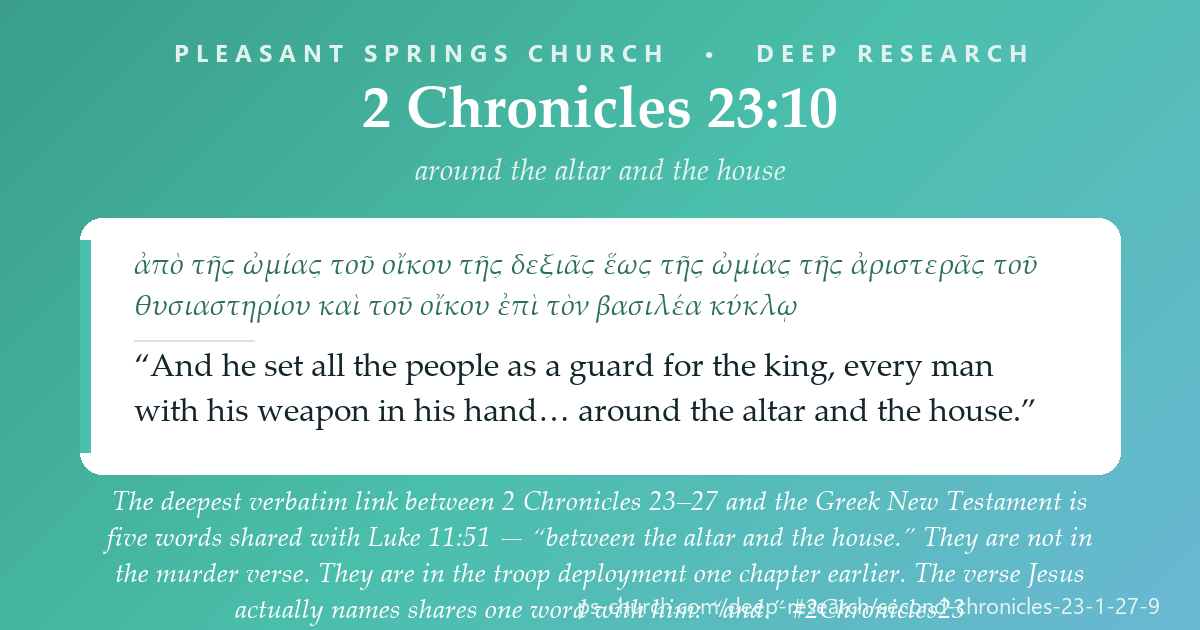
A priest hides a baby for six years, then fills the ground between the altar and the house with armed men and crowns a seven-year-old. Decades later that king has the priest’s son stoned in that same courtyard. Then his son opens the Book of Moses and spares the children of his father’s murderers — and comes home from Edom with Edom’s gods. Then his son seeks God for decades, builds machines on the towers, and is helped “till he was strong”: the next clause is a censer in the sanctuary and leprosy on his forehead. And then Jotham, nine verses, doing everything his father did except the one thing his father did wrong. And here is what the measurement found. Screened against all 7,927 verses of the Greek New Testament, nothing these five chapters share with it reaches six words, and one of the four runs of five is five consecutive words shared with Luke 11:51 — the verse in which Jesus names Zechariah, who perished, in the Greek, μεταξὺ τοῦ θυσιαστηρίου καὶ τοῦ οἴκου — between the altar and the house. But the five words are not in the murder verse. They are in 23:10, the troop deployment. The verse Luke is actually talking about, 24:21, shares exactly one word with him: “and.” See the method →
2 Chronicles 23:1–27:9 (selections)
Hebrew · Greek (Rahlfs, Paraleipomenon B) · ESVText and numbering. In the Septuagint this book is 2 Paraleipomena, “things omitted” — Παραλειπομένων Βʹ (Paraleipomenōn B). Chapters 23–27 are numbered alike in Hebrew, Greek and English, and there is no chapter or verse offset anywhere in this unit. Counted against both columns: the Masoretic Text gives 21, 27, 28, 23 and 9 verses; the CATSS Greek gives 21, 27, 28, 23 and 8. ⚠️ 27:8 is not in Rahlfs, and the Greek does not renumber around the gap — it runs 27:7 straight to 27:9, so this is a minus, not a shift. That the missing verse is also the most duplicative verse in its chapter is measured in Stage 4. (The one real offset in this book is far away, at the 1/2 seam, where Masoretic 1:18 is English 2:1 — it does not touch these chapters.)
⚠️ The two Greek columns are not the same Greek. Three hard Hebrew words in this unit have a parallel in Greek Kingdoms, and the two translators do three different things: at 23:11 Chronicles translates nēzer where Kingdoms transliterates; at 25:18 both transliterate ḥōaḥ but not alike; at 26:21 both transliterate bêt ha-ḥopšît identically. None of that establishes a relationship between the two translations in either direction, and this page does not argue one.
The Shape of the Passage
Sequence — four reigns and one doorwayThis unit sits inside the longer slope traced on 2 Chronicles 21:1–28:27, which reads the eight reigns as a whole. This page goes narrow instead, and asks what can actually be measured about the five chapters in the middle.
Author
He keeps you in one building. Read the unit for its architecture and it never leaves the temple precinct for long: a covenant made in the house of God, a guard set around the altar and the house, gatekeepers at the gates of the house, a chest at the gate of the house, a murder in the court of the house, a priest buried near it, a king thrown out of it, and a king who declined to enter it. The Chronicler is not narrating four reigns. He is narrating a doorway, four times.
The wording runs with Kings, and then it does not. Screened verse by verse against the whole Masoretic corpus, 42 of these 108 verses find their deepest Hebrew match in 2 Kings — but the distribution is lopsided. Chapter 23 is 15 of 21; chapter 25 is 15 of 28; and chapter 24 — the chapter with the murder in it — is 3 of 27. The one scene the New Testament will name is the one scene in this unit whose wording is almost entirely the Chronicler’s own. That is an observation about wording, not about sources.
He scores kings by the same three verbs he has used since chapter 10 of the first book. Dāraš (seek) makes Uzziah’s first phase; maʿal (trespass) ends it; and ḥāzaq (be strong) is the word that turns twice in five chapters — Uzziah is helped “till he was strong” and falls, Jotham “became mighty” and does not.
Audience
People whose whole question was who may go in. The Chronicler’s first readers lived around a rebuilt house with a working priesthood and an argument about access running through the community — who counts, who may serve, who may enter. These five chapters are four answers to that question, and the two that matter most are the king thrown out and the king who stayed out.
People who could be told that a priest was buried among kings. 24:16 is a very small sentence with a great deal in it. Jehoiada is not royal. He is buried in the city of David with the kings, and the reason given is not his office but his conduct: he “had done good in Israel, and toward God and his house.” For a community whose leadership was priestly rather than royal, that is not incidental.
And people who needed the law quoted at them out loud. 25:4 is one of the clearest inner-biblical citations in the historical books — a king spares the children of the men who killed his father, and the narrator stops the story to say where it is written. Measured against Deuteronomy 24:16, the Hebrew of 25:4 carries a five-word verbatim run. The Chronicler shows his reader the shelf he is reading from.
Orient on Jehoiada and the coup, on temple access, on skin disease and exclusion, and on the hardware of an eighth-century siege.
Search by topic: Jehoiada; Joash of Judah; Zechariah son of Jehoiada; Athaliah; Amaziah; Uzziah / Azariah; Jotham; gatekeepers (shoʿarim); nezer / diadem; edut / testimony; tsaraath and exclusion; incense and who may burn it; siege engines; Lachish; Seir and Edom.
Which articles are relevant?
- Anchor Bible Dictionary — “Jehoiada,” “Joash,” “Zechariah (son of Jehoiada),” “Amaziah,” “Uzziah,” “Jotham,” “Leprosy,” “Temple, Jerusalem,” “Gatekeeper,” “Crown,” “Warfare, Israelite.”
- Dictionary of the OT: Historical Books (IVP) — “Priests and Levites,” “Temple,” “Retribution,” “Prophets and Prophecy,” “Chronicler’s History.”
- NIDOTTE / TDOT — הֵיכָל (hêḵāl), נֵזֶר (nēzer), עֵדוּת (ʿēḏûṯ), חָזַק (ḥāzaq), דָּרַשׁ (dāraš), חִשָּׁבוֹן (ḥiššāḇōn).
- On the Greek — the NETS introduction to 2 Supplements, on the character of Paraleipomenon as a translation and on its handling of proper names and untranslated nouns.
Bibliography surfaced:
- Sara Japhet, I & II Chronicles (OTL); Raymond B. Dillard, 2 Chronicles (WBC); Ralph W. Klein, 2 Chronicles (Hermeneia); H. G. M. Williamson, 1 and 2 Chronicles (NCBC).
- For the Greek: Rahlfs’s Septuaginta, and the CATSS/CCAT digitization of it that this page measures against. No critical apparatus was consulted for this page — see Stage 5.
A palace coup with a priest in charge, a king who took a censer, and machines on the corners.
First the world these chapters assume: who guards a temple, who may burn incense, what a leper king means administratively, and what an eighth-century siege engine actually was. Then Josephus, read as a witness and not as Scripture.
Which parallels shed light on these chapters?
Temple guards were a real institution, not a narrative convenience. Ancient Near Eastern sanctuaries were staffed, gated, and controlled; access was graded by purity and by office, and gatekeepers were a named class with rosters. 23:19 is an administrative sentence — gatekeepers at the gates, so that no unclean thing enters — and it is placed immediately after a coup fought inside the precinct. The Chronicler’s point is procedural: the building has just been used as a fortress, and the first act of the restored order is to put the door back under discipline.
Elsewhere, kings burned incense as a matter of course. Egyptian and Mesopotamian royal iconography shows the king performing the cult; that is what a king was for. Israel divides the offices, and 26:18 states the division in as many words: it is not for you, Uzziah, to burn incense — but for the priests. Uzziah’s offence is not exotic. It is the normal behaviour of a strong king in that world, performed in the one place where it was forbidden.
And 26:15 is describing hardware. Whatever חִשְּׁבֹנוֹת were — the word is unclear and the versions differ — they sit “on the towers and on the corners” and they throw arrows and large stones. Assyrian reliefs from the same century show siege towers, battering rams and stone-throwing crews in exactly that architectural position. The Greek translator read them as machines: μηχανὰς μεμηχανευμένας λογιστοῦ, “engines engineered by a reckoner.”
- Josephus, Antiquities 9.7.1–9.11.3 (Second-Temple — a witness, not Scripture) — he retells all four reigns. On Uzziah he adds an earthquake and a shaft of light through a broken temple roof striking the king’s face, which is not in Scripture. Cited as evidence of how the episode was being retold, not as information about the event.
- Assyrian palace reliefs and royal annals (royal propaganda — witnesses, not Scripture) — for siege engines on walls and corners, and for the ordinary royal performance of cultic acts. Cited for the practice that makes 26:16–18 an offence rather than a prerogative.
- 2 Kings 11–15 — not an external witness but the parallel account, and the single most important comparison on this page. Read 2 Kings 11 beside 2 Chronicles 23 and 2 Kings 14:8–14 beside 2 Chronicles 25:17–24.
- Leviticus 13–14 and Numbers 12 — not external witnesses but the law and precedent behind 26:19–21: the diagnosis on the forehead, the exclusion, and Miriam.
What was measured. The 107 Greek verse units of 2 Chronicles 23–27 held here were screened against all 7,927 verses of the Greek New Testament, word form against word form, contiguous runs only. 106 of the 107 reach two words, 94 reach three, 27 reach four, 4 reach five, and nothing reaches six.
The row that matters. Three of the four rows at five land on formulae — 23:11 on και οι υιοι αυτου και, 24:7 on τον οικον του θεου και, 26:19 on και εν τη χειρι αυτου. The fourth is 2 Chronicles 23:10, run of 5, tie band 1 — του θυσιαστηριου και του οικου, and the single New Testament verse carrying it is Luke 11:51: “from the blood of Abel to the blood of Zechariah, who perished between the altar and the house” — where house renders τοῦ οἴκου literally; English versions normally print “sanctuary” there.
And Luke 11:51 is not about 23:10. It is about the murder in 24:21. So the same screen was run the other way: 2 Chronicles 24:21 against Luke 11:51 measures a run of one — και. The verse the sentence is about shares with it the word “and.” The verse that shares five consecutive words with it is a troop deployment one chapter earlier.
Why that is not nothing. Chapter 23 puts armed men “around the altar and the house” to keep a seven-year-old alive. Chapter 24 has that same king order a man killed in the court of the house. The space Luke names is the space Chronicles measured out — and the Greek phrase that measures it occurs in only two verse units of the 30,348 screened Greek Old Testament units held here: 2 Chronicles 23:10 and its parallel at 4 Kingdoms 11:11.
What is NOT being claimed. Not that Luke quotes 23:10. Not that anyone borrowed from anyone. τὸ θυσιαστήριον and ὁ οἶκος are the two ordinary nouns for the two ordinary objects, and two writers describing the same courtyard will reach for them independently. A run of five with a band of one is a strong signal that a phrase is rare. It is not a signal that a text was copied. The page prints the run, prints the counter-measurement beside it, and leaves the seeing to the reader.
One sanctuary noun that occurs twice, one plural noun that occurs twice in the whole Bible, and a root that turns both ways.
Count hêḵāl in 2 Chronicles before reading 27:2, and read 26:15 with Ecclesiastes 7:29 open. Then notice that ḥāzaq is the hinge of both the fall and the recovery.
“Palace, sanctuary” — the inner building, as distinct from bayiṯ/bêṯ, the whole house. Counted: it occurs eight times in 2 Chronicles — four in Solomon’s construction (3:17; 4:7, 8, 22), then 26:16 and 27:2 back to back, then 29:16 and 36:7. The two middle occurrences carry the same three-word phrase, אֶל־הֵיכַל יְהוָה, and screened against the whole Masoretic corpus that phrase occurs three times in the Hebrew Bible: these two verses and Ezekiel 8:16, where twenty-five men stand at the entrance of the same building with their backs to it.
“Devices, contrivances, calculations.” This plural noun occurs exactly twice in the Masoretic corpus — here, of Uzziah’s engines on the towers, and at Ecclesiastes 7:29: “See, this alone I found, that God made man upright, but they have sought out many schemes.” Two occurrences, and one of them is immediately followed by “But when he was strong, he grew proud, to his destruction.” The Greek does not preserve the pair: Paraleipomenon has μηχανάς, Ecclesiastes has λογισμούς, and the two verses share exactly one word form, καί — though both Greek renderings do reach for the λογισ- stem. Reported as a lexical coincidence in one language, not as an allusion.
“To seek, enquire of, resort to.” The verb the whole work is scored by, and 26:5 uses it twice in one verse to make Uzziah’s good years conditional: he set himself to seek God… and as long as he sought, God made him prosper. The Greek renders it with ἐκζητῶν and ἐζήτησεν — and ζητέω / ἐκζητέω is this translator’s standing equivalent for dāraš, and forms of it stand 34 times in 30 verses across the Greek of 2 Chronicles — counted without the homograph ζήτω, “long live,” which is a form of zaō and stands at 23:11. Except at 24:22, where the dying man’s wəyiḏrōš becomes κρινάτω, “let him judge.” And Luke 11:51 carries ἐκζητηθήσεται. That is a fact about vocabulary and nothing more; the page draws no line from it.
“The diadem and the testimony.” Two things are put on the seven-year-old at once: a royal band and the testimony — the same noun used of the tablets in the ark (Exodus 25:16). A king is crowned by being handed the document. The Greek splits the decision: τὸ βασίλειον translates the first and τὰ μαρτύρια translates the second, where the Greek of 4 Kingdoms 11:12 (2 Kings 11:12) transliterates the first (τὸ νεζερ) and keeps the second singular.
“To be strong, to strengthen oneself.” It turns twice in five chapters, in opposite directions. Uzziah is helped ʿaḏ kî-ḥāzāq, “till he was strong” (26:15) — and the next clause is ûḵeḥezqāṯō, “and when he was strong,” his heart grew high (26:16). Jotham wayyiṯḥazzēq, “became mighty” (27:6) — and the reason given is not his towers: because he ordered his ways before the Lord his God. Same root, two outcomes.
“The house of freedom” — or of separateness, or of exemption; the sense is disputed and the Hebrew carries a ketiv/qere. Whatever it means, the verse names it against the building Uzziah is barred from: he lived in the bêṯ ha-ḥopšîṯ because he was cut off from the bêṯ YHWH. Both Greek columns declined to translate it and transliterated instead, identically: οἴκῳ αφφουσωθ at 2 Paraleipomenon 26:21 and at 4 Kingdoms 15:5.
Three things reported rather than tidied:
- In the Greek column the murdered man is called Azariah. Rahlfs at 2 Paraleipomenon 24:20 reads τὸν Αζαριαν τὸν τοῦ Ιωδαε τὸν ἱερέα where the Masoretic Text reads אֶת־זְכַרְיָה בֶּן־יְהוֹיָדָע הַכֹּהֵן; 24:22 then says only “his son” and never names him again. A reader working only from this Greek book would find no Zechariah murdered here — the only Zechariah put to death anywhere in it is one of Jehoshaphat’s six sons, killed with all his brothers at 21:2–4. Azariah and Zechariah are both extremely common priestly names in this book — counted in the Greek column, Αζαρι- occurs eleven times across 2 Paraleipomenon and Ζαχαρ- nine, and 23:1 alone carries two Azariahs — so confusion in either direction is easy; this page prints the difference and does not decide which reading is prior. It also does not pretend the difference is unimportant — it sits on the one verse in the unit that the New Testament names.
- 26:5 has a Hebrew/Greek divergence in the middle of a compliment. The Masoretic Text says Zechariah instructed Uzziah בִּרְאֹת הָאֱלֹהִים, “in the seeing of God”; the Greek reads ἐν φόβῳ κυρίου, “in the fear of the Lord.” The ESV prints neither column exactly — “in the fear of God,” the Greek’s fear with the Hebrew’s God. The consonants are close and the page names the divergence rather than choosing.
- The zero in this unit. Screened Hebrew-side with single words not counted — so that 0 means “shares no two consecutive words with any other verse in the Masoretic corpus,” not “shares nothing” — exactly one of these 108 verses comes out at zero: 2 Chronicles 26:14, Uzziah’s armoury list (shields, spears, helmets, coats of mail, bows, slingstones). It shares plenty of individual words with the rest of the Bible. It shares no two in a row with anything.
The five-word run, the one-word run beside it, a fable of twenty-nine words, and the verse Rahlfs does not have.
Every figure below was produced by the same two screens: Greek word forms against the 7,927 verses of the Greek New Testament, and Hebrew consonantal forms against the 23,204 verse units of the Masoretic corpus. Tie band is printed beside every screened run; a verse-against-verse pair measurement has no band, and none is claimed for one. The Greek screen applies MorphGNT’s own spelling equivalences (ou/ouk/ouch, ek/ex, the movable nu), so these figures are not comparable with runs published on this shelf before 30 August 2026.
Which cross-references matter?
- 2 Chronicles 23:10 → Luke 11:51 — run 5, tie band 1. του θυσιαστηριου και του οικου. The equal-deepest contact this unit makes with the Greek New Testament — one of four rows in this unit that reach five, and the only New Testament verse that carries the sequence. The same five words occur in just two of the 30,348 screened Greek Old Testament verse units held here — this verse and 4 Kingdoms 11:11 (2 Kings 11:11), which is the same scene. Counter-measurement, printed beside it: 2 Chronicles 24:21, the verse Luke 11:51 is actually about, measures a run of 1 against it — και. And 24:20 and 24:22 also measure 1. The unit’s deepest Greek run is not its New Testament citation, and its New Testament citation is not measurable as a run at all.
- 2 Chronicles 23:10 → Matthew 23:35 — run 2. Matthew has μεταξὺ τοῦ ναοῦ καὶ τοῦ θυσιαστηρίου, “between the naós and the altar,” where Luke has τοῦ θυσιαστηρίου καὶ τοῦ οἴκου. The two Gospels use different nouns for the same building, and the difference is measurable: against 23:10 Luke runs 5 and Matthew runs 2. τοῦ ναοῦ καὶ τοῦ θυσιαστηρίου occurs in none of the 30,348 screened Greek Old Testament verse units held here.
- 2 Chronicles 25:18 → 2 Kings 14:9 — run 29, tie band 1. Twenty-nine consecutive identical Hebrew word forms, the whole thistle-and-cedar fable. This is by a wide margin the deepest Hebrew run anywhere in these five chapters; the next deepest are 23:10 at 13 and 23:8 and 25:21 at 12, each with a tie band of 1. The two Greek columns then diverge on the very first noun — ὁ αχουχ against ὁ ακαν — which is why a reader who only compares Greek will underrate how close the Hebrew is.
- 2 Chronicles 25:4 → Deuteronomy 24:16 — run 5. אבות על בנים ובנים לא. The Chronicler names his source in the verse itself — “as it is written in the Law, in the Book of Moses” — which is what makes this the control case for the whole page: this is what a citation looks like when a text tells you it is citing.
- 2 Chronicles 26:16 and 27:2 → Ezekiel 8:16. אֶל־הֵיכַל יְהוָה occurs three times in the Masoretic corpus and these are all three. Uzziah goes in; Jotham does not; and in Ezekiel men stand at its entrance, “between the porch and the altar,” facing the wrong way. In Greek, Ezekiel 8:16 carries both Gospel nouns at once — ναός and θυσιαστήριον — and it measures a run of 2 against Luke 11:51 and 2 against Matthew 23:35. That is the best evidence on this page that these are simply the ordinary words for the two ordinary objects.
- 2 Chronicles 26:15 → Ecclesiastes 7:29. חִשְּׁבֹנוֹת, twice in the Hebrew Bible and nowhere else. Reported as a lexical fact. The Greek does not carry it across.
- 2 Chronicles 27:8 — absent from Rahlfs, and measurably the most repetitive verse in its chapter. The Masoretic 27:8 shares 11 consecutive word forms, tie band 1, with 2 Kings 15:33, and 6 consecutive word forms with 2 Chronicles 27:1, seven verses earlier in its own chapter. Both facts are measurements; the inference that a translator declined to copy a regnal formula twice is an inference, and this page marks it as one. What is a datum is that the Greek runs 27:7 to 27:9.
- 2 Chronicles 23 → 2 Kings 11, verse by verse. Fifteen of the twenty-one verses of chapter 23 find their single deepest Masoretic match in 2 Kings 11, and they do it in order: 11:4, 5, 8, 9, 10, 11, 12, 13, 14, 15, 16, 17, 18, 19, 20. Chapter 25 does the same with 2 Kings for 15 of its 28 verses, fourteen of them in 2 Kings 14. Chapter 24 does it for 3 of 27.
What was consulted, what was not, what could not be checked, and where this page is weakest.
The commentaries first. Then, at length, the limits — because the measurements above are only worth what their scope statement is worth.
Commentaries & studies:
- Sara Japhet, I & II Chronicles (OTL) — on the Chronicler’s handling of the Joash and Amaziah narratives and on his theology of access to the temple.
- Raymond B. Dillard, 2 Chronicles (WBC) — on the two-phase reign pattern (faithful start, unfaithful end, prophet at the hinge) that Joash, Amaziah and Uzziah all receive.
- Ralph W. Klein, 2 Chronicles (Hermeneia) — the technical work, including the minus at 27:8 and the Greek name at 24:20.
- H. G. M. Williamson, 1 and 2 Chronicles (NCBC) — on the relationship of chapters 23 and 25 to the Kings account.
What this page could not check, and where it is weakest:
- No critical apparatus was consulted, and that limits every Greek statement here. The Greek column is one edition — Rahlfs, as digitized by CATSS. When this page says “27:8 is not in Rahlfs” or “the Greek reads Azariah,” it means exactly that and no more. The manuscript evidence behind those readings was not examined, the Lucianic and Antiochene traditions were not consulted, and it is entirely possible that other Greek witnesses read Zechariah at 24:20 or carry a verse 8. A reader who needs to know should go to Göttingen and to Klein’s notes.
- The five-word run is the weakest strong-looking thing on this page, and it is meant to be read that way. τοῦ θυσιαστηρίου καὶ τοῦ οἴκου is four common words and an article. Its rarity across 30,348 verse units is a real measurement; its significance is not a measurement. If this page has an overreach in it, it is here, and the counter-measurement (24:21 → Luke 11:51 = 1) is printed in three separate places on purpose.
- The Odes are excluded from every Greek Old Testament figure. The corpus held here is 64 CATSS files totalling 30,637 verse units; a run screen sees 30,348, because the Odes are held out. That exclusion is deliberate: Ode 9 is Luke 1 and Ode 13 is Luke 2 copied into a Greek Old Testament manuscript, and ten further Odes are second copies of Exodus 15, Deuteronomy 32, 1 Samuel 2, Habakkuk 3, Isaiah 26, Jonah 2, Daniel 3, Isaiah 5 and Isaiah 38. Leaving them in would inflate every “this phrase occurs N times” count on the shelf. Every Greek Old Testament figure on this page is therefore a figure over 30,348 units, and is stated that way.
- The two-phase pattern is an observation about arrangement, not a claim about events. Dillard’s shape fits Joash, Amaziah and Uzziah closely enough to look like the Chronicler’s theology organising his material. Whether it also reflects what happened is a separate question that neither the text nor this page addresses.
- The numbers were not converted or defended. 300,000 chosen men and 307,500 in the army (25:5; 26:13), 100,000 mercenaries hired for a hundred talents (25:6), 10,000 Edomites thrown from a rock (25:12). The standing question about the sense of אֶלֶף applies and is not settled. This page prints none of those verses as codex rows and makes no argument from them.
- What Josephus adds was not treated as evidence. The earthquake and the shaft of light at Uzziah’s presumption are in Antiquities 9 and not in Scripture. Named as a witness to first-century retelling; never levelled with the text.
- Chronicles and Kings are not harmonised anywhere on this page. Where they differ, both are printed. The verse-by-verse Hebrew profile in Stage 4 shows where the wording overlaps and says nothing whatever about which account is prior or whether either writer saw the other.
- And no direction of influence is asserted between any Old and New Testament text here. Not for the five-word run, not for ἐκζητηθήσεται, not for the courtyard. Luke 11:51 and Matthew 23:35 name a murder that 2 Chronicles 24 reports; that much the New Testament says out loud. Everything past it on this page is a count.
The ring that became a courtyard, strength as the hinge, and the son who did not go in.
Name what you learned, why it matters, and one concrete response.
What should we carry away — and do?
- The safest place in the book became the murder scene. Jehoiada filled the ground between the altar and the house with armed men so that one child would live. Decades later, inside the same forty-year reign, that child, now king, had that man’s son stoned on the same paving. Nothing about the place protected anyone. The people in it changed.
- The measurement will not do your reading for you. The deepest verbatim link between these chapters and the Greek New Testament is five words that mean nothing, and the real connection — the murder Jesus names — measures one word. A number can tell you a phrase is rare. It cannot tell you a text is being quoted. That is worth knowing every time somebody shows you a chart of parallels.
- Strength is the hinge, in both directions. Uzziah was helped “till he was strong” — and the very next clause is his ruin. Jotham “became mighty, because he ordered his ways.” Same Hebrew root, opposite outcomes, one chapter apart. The question was never how strong, but what the strength was ordered toward.
- One concrete response. Jotham’s whole verdict is that he did everything his father did except the one thing his father got wrong. Name, this week, one specific thing you watched go wrong in someone you otherwise admire — and decide, out loud to one other person, that you will not repeat it. 27:2 gives that verdict in a single clause and that is the entire content of it.
2 Chronicles 27:6 · to share
Hebrew + Greek (Rahlfs, Paraleipomenon B) + ESVEvery Deep Research page traces its passage across the whole sweep — the Old Testament, the Second-Temple world between the testaments (historical witnesses, not Scripture), and the New Testament. Follow the thread:
Pleasant Springs Church — Deep Research
Research method after Michael S. Heiser’s Bible Research Method (examine dictionaries → ancient literature → important words → textual connections → academic publications → share), with the Pleasant Springs “Author & Audience” foundation. Scripture set in the Hebrew, the Greek editions named on each page and the ESV (Old Testament), and the Greek New Testament and the ESV (New Testament), per the practice of Pleasant Springs Church. 2 Chronicles 23–27 research grounded in Japhet (OTL), Dillard (WBC), Klein (Hermeneia) and Williamson (NCBC), with every figure on the page re-derived locally. Book name: in the Septuagint this book is Paraleipomenon B, Παραλειπομένων Βʹ; the Hebrew title is דִּבְרֵי הַיָּמִים. Text & numbering: Hebrew from the Masoretic Text (Sefaria, Miqra according to the Masorah); Greek from Rahlfs’s Septuaginta (CATSS digitization), printed without editorial punctuation and with proper names unaccented; English ESV. Versification: chapters 23–27 are numbered alike in Hebrew, Greek and English and there is no offset anywhere in this unit — counted against both columns, 21/27/28/23/9 verses in the Masoretic Text and 21/27/28/23/8 in the CATSS Greek. ⚠️ 2 Chronicles 27:8 is not in Rahlfs, and the Greek does not renumber — it runs 27:7 to 27:9, so it is a minus rather than a shift. The book’s one genuine offset is at the 1/2 seam (Masoretic 1:18 = English 2:1) and does not touch these chapters. Measurement: Greek runs were taken against all 7,927 verses of the Greek New Testament (SBLGNT via MorphGNT), word form against word form, contiguous only, with MorphGNT’s own spelling equivalences applied (ou/ouk/ouch, ek/ex, the movable nu) — so these figures run higher than anything published on this shelf before 30 August 2026 and must not be compared with them. Greek Old Testament phrase counts are over 30,348 screened verse units of the 64 CATSS files held here (30,637 units in total; the Odes are excluded, because two of them are Luke 1 and Luke 2 and ten more are second copies of passages already counted). Hebrew runs were taken against the 23,204 verse units of the Masoretic corpus, consonantal word forms only, with single-word matches not counted — so a zero on this page means “shares no two consecutive words,” not “shares nothing”, and 26:14 is the only such verse in the unit. Tie bands are printed beside every screened run; the verse-against-verse pair measurements (25:4 ↔ Deuteronomy 24:16, 27:8 ↔ 27:1, 23:10 ↔ Matthew 23:35, Ezekiel 8:16 ↔ the two Gospel verses) have no band by construction. ⚠️ The page’s central finding is a negative as much as a positive: the deepest Greek run in these chapters (23:10 ↔ Luke 11:51, run 5, band 1, one of four rows that reach five) is not the New Testament’s reference to this unit, and the verse the New Testament does name (24:21) measures a run of one against the same sentence. No direction of influence is asserted anywhere on this page, and the run is explicitly not presented as a citation. ⚠️ The Greek column of 24:20 names the man Azariah where the Masoretic Text names him Zechariah; the difference is printed and not adjudicated, and no critical apparatus was consulted — every Greek statement here is a statement about Rahlfs as digitized by CATSS, not about the Greek manuscript tradition. ⚠️ 26:5 differs between the columns (“in the seeing of God” / ἐν φόβῳ κυρίου) and the page names the divergence rather than choosing. Chronicles and Kings are nowhere harmonised. The large numbers of chapters 25 and 26 are neither converted nor defended and the unsettled question of אֶלֶף is named as unsettled. Josephus is read as a witness to first-century retelling and never levelled with Scripture. The literary structure printed above is labelled a sequence, because that is what it is; the only bracket claimed is the twofold הֵיכָל at 26:16 and 27:2, which was counted. Typology is handled per the house position.
Scripture quotations marked ESV are from the ESV® Bible (The Holy Bible, English Standard Version®), © 2001 by Crossway, a publishing ministry of Good News Publishers. ESV Text Edition: 2016. Used by permission. All rights reserved. The ESV text may not be quoted in any publication made available to the public by a Creative Commons license, and the ESV may not be translated in whole or in part into any other language. www.esv.org
|
Did this study bless you today? 💚 Give to Support PS Church100% of gifts go to the General Fund — thank you. |