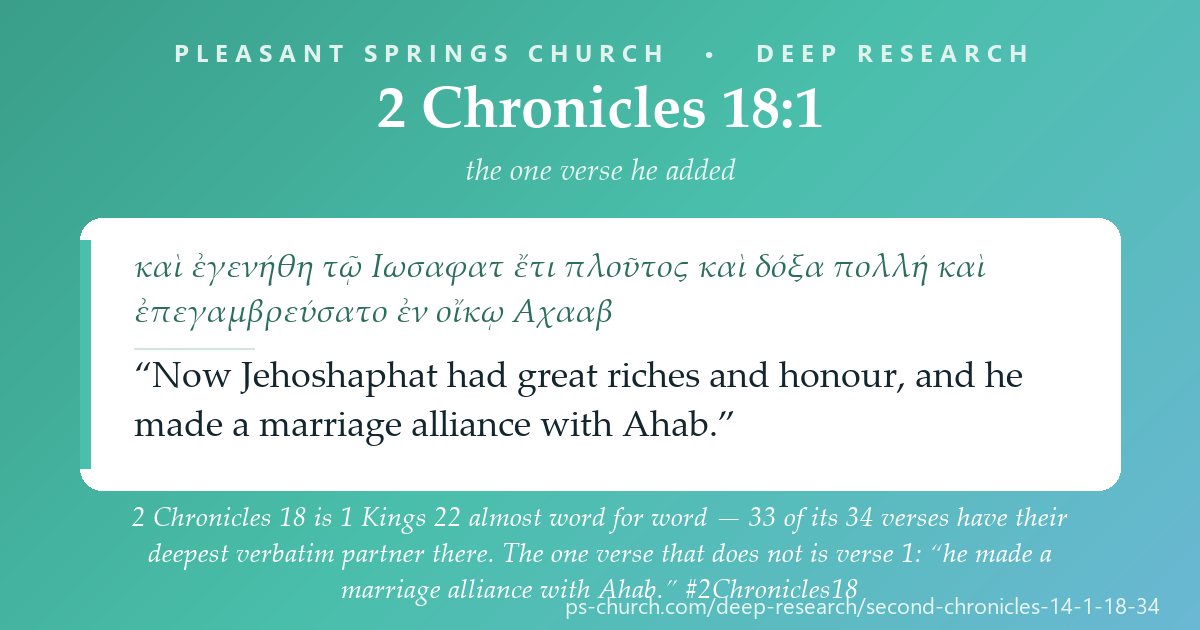
Asa prayed one of the best prayers in Chronicles with an impossible army in front of him — “there is none like you to help, between the mighty and the weak… we rely on you” — and thirty-six years later took the silver out of the house of God to hire Syria against a border town. When the seer told him what he had done, he put the seer in the stocks. His son Jehoshaphat opens with everything Asa had and more: garrisons, wealth, a heart courageous in the ways of the Lord, and a circuit of Levites carrying the book from town to town. Then one sentence — “he made a marriage alliance with Ahab” — and the whole Micaiah story follows: four hundred prophets saying yes, one man the king says he hates, a lying spirit volunteering in the divine council, a prophet led off to bread and water, a disguise, an arrow drawn without a target, and a king held upright in his chariot until sunset. The measurement came first on this page, and it found something not guessable in advance: chapter 18 is 1 Kings 22 verse for verse — thirty-three of its thirty-four verses have their deepest verbatim partner there, thirty of them uniquely. The single verse with no partner in Kings at all is verse 1, the marriage alliance. The screen isolates, without being asked, exactly the sentence this book adds to the story it borrows. See the method →
2 Chronicles 14:1–18:34 (selections)
Hebrew · Greek (Rahlfs, Paraleipomenon B) · ESVAsa gets ten years of quiet, tears down the foreign altars, tells Judah to seek the Lord, and then meets an army he cannot possibly beat. His prayer is the finest sentence in the Asa material: there is none like you to help, between the mighty and the weak… we rely on you. Then a prophet meets him coming home, all Judah swears an oath “with all their heart and with all their soul,” and there is no more war until the thirty-fifth year of Asa’s reign. In the thirty-sixth a neighbour fortifies a border town, and Asa takes the silver and gold out of the house of God and hires Syria. When the seer tells him what he has done, Asa puts him in the stocks.
Jehoshaphat gets the same opening, upgraded: garrisons, wealth, a heart “courageous in the ways of the Lord,” and a teaching circuit of officials, Levites and priests carrying the book from town to town (17:7–9). Then 18:1 — he made a marriage alliance with Ahab — and the whole of the Micaiah story follows: four hundred yes-men, one prophet the king says he hates, a lying spirit volunteering in the divine council, a prophet in prison on bread and water, a disguise, an arrow drawn without a target, and a king propped up in his chariot till sunset.
🔍 What the measurement found, before any of this was written. Run the five chapters verse by verse against every other verse of the 23,204-unit Masoretic corpus held here, counting only contiguous runs of whole consonantal word forms, and the two halves of the passage behave completely differently. In chapters 14, 15 and 17 not one verse shares as many as six consecutive words with any other verse in the Hebrew Bible. In chapter 18, twenty-eight of thirty-four do, and thirty of the thirty-four have a unique partner in it — 1 Kings 22, verse for verse, deepest run sixteen words.
And there is one exception in chapter 18. Verse 1 — the marriage alliance — has no 1 Kings partner at all. Against 1 Kings 22:1, 22:3 and 22:4 it shares no two consecutive words; against 22:2 it shares one, ויהי. Its only unique partner anywhere in the Hebrew Bible is 2 Chronicles 17:5, three words of the Chronicler’s own summary: riches and honor in abundance. The screen isolates, without being told to, exactly the sentence this book adds to the story it borrows.
Text and numbering. In the Septuagint this book is 2 Paraleipomena, “things omitted” — Παραλειπομένων Βʹ (Paraleipomenōn B). ⚠️ The English numbering diverges for one chapter. Abijah’s death notice is 13:23 in the Hebrew and the Greek and 14:1 in English, so through chapter 14 the English runs one ahead — MT/LXX 14:1 is ESV 14:2, and Asa’s prayer is MT/LXX 14:10 and ESV 14:11. Both numbers are printed on every affected row. The columns re-converge at chapter 15, and from 15:1 to 18:34 Hebrew, Greek and English agree throughout: 19, 14, 19 and 34 verses in each of chapters 15, 16, 17 and 18, in all three columns, counted here rather than assumed. Nothing in these five chapters is absent from Rahlfs.
The Shape of the Passage
Two matched panels — a sequence, not a chiasmBehind these five chapters stand the terms laid down at the dedication — 7:14 — and the two reigns already tested against them in chapters 10–16. In front of them stands the rest of Jehoshaphat, taken up in chapters 17–20.
Author
The measurement shows two different writing habits inside one passage. Chapters 14, 15 and 17 do not touch any other verse of the Hebrew Bible at a depth of six words — not once in fifty-two verses. Chapter 18 touches 1 Kings 22 at that depth twenty-eight times in thirty-four. Whatever the Chronicler is doing, he is not doing the same thing in both halves, and you can see the seam without reading a word of commentary.
He evaluates by putting things next to each other. He does not tell you Jehoshaphat repeated Asa’s error. He tells Asa’s story with a prophet jailed in it, then tells Jehoshaphat’s with a prophet jailed in it, and lets the second scene land on a reader who has just read the first. The verdict is in the arrangement.
And he will not let a good king exit clean. Asa gets rest to the thirty-fifth year of his reign and then the stocks, the diseased feet, and the physicians. Jehoshaphat gets the teaching circuit of 17:7–9 and then a marriage into the house of Ahab. Neither reign is summarised as a failure; both are left with the failure attached. That is a settled habit of this book, not a lapse in it.
Audience
A small province with powerful neighbours and no army. Every alliance in these chapters is a reasonable piece of statecraft: hiring Syria against Baasha worked, and Ahab’s daughter was a sensible match. The Chronicler is not writing to people tempted by obvious wickedness. He is writing to people tempted by sensible arrangements, and the two words he uses to judge them — seek and lean — are about where the weight goes, not about how the policy performed.
People who knew what happens to a prophet nobody wants to hear. The Hebrew word for the thing Asa put Hanani into occurs in only four verses of the Hebrew Bible, and three of them are about Jeremiah. A post-exilic reader would have made that connection immediately, because Jeremiah is the prophet whose warnings that generation had watched come true.
And people who had heard the Micaiah story before. Chapter 18 is not news to them; it is in Kings. What is new is the sentence in front of it. The Chronicler is not retelling — he is answering a question Kings never asks: what was the king of Judah doing there at all?
Orient on Asa and Jehoshaphat, on treaty and dynastic marriage, on the divine council, and on prophetic imprisonment.
Search by topic: Asa; Jehoshaphat; Zerah the Cushite; Baasha; Ben-hadad; Ramoth-gilead; Micaiah ben Imlah; divine council; false prophecy; stocks / prison in ancient Israel; Asherah; high places; physicians and healing in Israel.
Which articles are relevant?
- Anchor Bible Dictionary — “Asa,” “Jehoshaphat,” “Zerah,” “Ben-hadad,” “Ramoth-gilead,” “Micaiah,” “Council, Heavenly,” “Prophecy, False,” “Prison,” “Asherah,” “High Place.”
- Dictionary of the OT: Historical Books (IVP) — “Asa,” “Jehoshaphat,” “Chronicler’s History,” “Prophets and Prophecy,” “Warfare,” “Retribution.”
- NIDOTTE / TDOT — שָׁעַן (šāʿan, lean on), דָּרַשׁ (dāraš, seek), בָּקַשׁ (bāqaš, seek), שֶׁקֶר (šeqer, falsehood), אֱמֶת (ʾĕmeṯ, truth), תֹּם (tōm, integrity / innocence).
- On the Greek — the NETS introduction to 2 Supplements, and its notes on chapter 18 read beside 3 Reigns 22. The two Greek renderings of one Hebrew sentence are worth the comparison on their own.
Bibliography surfaced:
- Sara Japhet, I & II Chronicles (OTL); Raymond B. Dillard, 2 Chronicles (WBC); Ralph W. Klein, 2 Chronicles (Hermeneia); H. G. M. Williamson, 1 and 2 Chronicles (NCBC).
- For chapter 18 specifically, read a commentary on 1 Kings 22 alongside — the two chapters are the same text and the commentary traditions on them are not.
Treaty silver, dynastic marriage, a council of gods, and a prison ration.
Four things the ancient world would have found ordinary and the Chronicler does not: buying an ally with temple metal, sealing a treaty with a daughter, a heavenly assembly that deliberates, and prison bread. Then one number the page will not defend.
Which parallels shed light on these chapters?
Buying an ally was normal, and the price was normally the temple. Asa strips the treasuries of the house of the Lord and the king’s house to hire Ben-hadad (16:2–3). Assyrian and Aramean records are full of the same transaction running the other way — tribute paid out of sanctuary treasure to buy a great king off, or buy him in. The Chronicler does not object to the diplomacy; he objects to where the money came from, and to the sentence Hanani puts on it.
Marrying a daughter to a neighbouring house was ordinary statecraft too. Amarna correspondence and Hittite treaty texts show dynastic marriage sealing an alliance and creating a standing obligation of mutual military support. That is precisely what 18:2–3 shows being called in: Ahab asks “will you go with me to Ramoth-gilead?” and Jehoshaphat answers “I am as you are, my people as your people.” It was not a lapse of feeling; it was a treaty clause.
The divine council of 18:18–22 is a recognised ancient scene, and Scripture uses it elsewhere. Ugaritic texts describe the assembly of El with attendant deities; Job 1–2 has the sons of God presenting themselves; Psalm 82 has God standing in the divine assembly. Micaiah sees “the Lord sitting on his throne, and all the host of heaven standing on his right hand and on his left,” and a spirit steps forward and volunteers. The scene is not softened here and this page does not soften it either — see the Deuteronomy 32 worldview for how the rest of the shelf handles this material.
“Bread of affliction and water of affliction” is a prison ration, not a metaphor. 18:26 puts Micaiah on it until the king comes back in peace — which, the reader already knows from verse 16, he will not. Detention on reduced rations pending a royal return is exactly the sort of administrative detail that reads as procedural rather than cruel, which is part of why it lands so hard.
- Judith 11:19 (Second Temple — a witness, not Scripture) — ὡς πρόβατα οἷς οὐκ ἔστιν ποιμήν, the exact six-word Greek clause of 2 Chronicles 18:16, put in Judith’s mouth as she flatters Holofernes. Measured: those six words occur twice in the 30,348 Greek verse units screened here — 2 Chronicles 18:16 and Judith 11:19. The five-word core πρόβατα οἷς οὐκ ἔστιν ποιμήν occurs three times, adding Numbers 27:17, which opens it with ὡσεί instead. Neither form is in 3 Reigns 22:17, which renders the same Hebrew sentence differently.
- Sirach 38:1–15 (Second Temple — a witness, not Scripture) — “honour the physician,” and God created medicines out of the earth. Read against 16:12, where Asa in his disease “did not seek the Lord, but sought help from physicians.” Sirach is not correcting Chronicles and Chronicles is not banning doctors — the Chronicler’s complaint is the word sought, used of the physicians and not of God.
- Josephus, Antiquities Book 8 (Second Temple — a witness, not Scripture) — he retells Asa, Baasha, the Syrian hire, and the Ramoth-gilead campaign with Micaiah, largely following the Kings account.
- Amarna letters; Hittite treaty texts (ancient Near Eastern diplomatic documents — witnesses, not Scripture) — for dynastic marriage as a binding military alliance, which is what makes 18:3 a formula rather than a sentiment.
- Ugaritic council texts; Job 1–2; Psalm 82 — for the assembly scene of 18:18–22. The first is a witness to the shared ancient picture; the other two are Scripture using it.
The text. Zerah the Cushite comes out against Asa with a thousand thousand — a million men — and three hundred chariots, and the Chronicler gives it without comment. It is not even the largest figure in his own book: the muster of 17:14–18, three chapters on, totals 1,160,000, and 1 Chronicles 21:5 counts 1,100,000 men who drew the sword.
What can be said. Ancient royal inscriptions inflate enemy numbers as a matter of genre; the Assyrian annals and the Egyptian triumph texts do it consistently, and nobody reading them in antiquity took the arithmetic as a census. It is also possible that the Hebrew אֶלֶף here means a military unit rather than the number one thousand, a proposal with a long history and no settled resolution.
What cannot be said from this page. Which of those is right. The measurement tools here count words, not soldiers, and no local corpus can adjudicate a troop figure. The page prints the verse, names the problem, and leaves it open rather than quietly rounding it down.
A verb about where the weight goes, a phrase that occurs twice, an instrument that occurs four times, and an arrow the two columns disagree about.
Read 14:11 and then 16:7–8 in Hebrew and the prophet stops sounding general: he is quoting the king to his face. Then check what the Greek column shows — on three of these six words, it shows less than the Hebrew does, and the page says so instead of arguing from a column it is not printing.
“Lean on, put your weight on.” Asa prays “we lean on you” (14:11, MT 14:10 — the ESV column above renders the verb rely; lean is the literal sense of the Hebrew and this entry is about the Hebrew). Two chapters later Hanani gives him his own verb back: “because you leaned on the king of Syria, and did not lean on the Lord your God… when you leaned on the Lord he gave them into your hand” (16:7–8). Measured: the root occurs five times in the whole of Chronicles, and four of the five are in the Asa narrative (13:18; MT 14:10 = ESV 14:11; 16:7 twice; 16:8). It is the verb of Proverbs 3:5, lean not on your own understanding. ⚠️ The Greek column does not show it: πεποίθαμεν and πεποιθέναι, trust, at 14:10 and 16:7–8, and ἤλπισαν, hoped, at 13:18. The physical metaphor is a Hebrew-column argument and the page says so.
“Seek, enquire of, resort to.” The verb the whole book grades kings by. Measured: the five-word Hebrew string to seek the Lord, the God of their fathers (לדרוש את יהוה אלהי אבותיהם) occurs exactly twice in the 23,204-verse Masoretic corpus held here — 2 Chronicles 14:3 (ESV 14:4) and 15:12, both in this passage, tie band 1. It is a phrase of this writer’s and of nobody else’s. Then 16:12 turns it: in his disease Asa did not seek the Lord “but sought help from physicians.”
“The stocks” — a device for holding a body twisted, from the root hāpaḵ, to overturn. Measured, and this is the finding of the word list: in this sense the word occurs in only four verses of the whole Masoretic corpus held here — Jeremiah 20:2, 20:3, 29:26, and 2 Chronicles 16:10. (Of the six other occurrences of the consonants, five are the unrelated overthrow of Sodom — Deuteronomy 29:23, Isaiah 13:19, Jeremiah 49:18, 50:40 and Amos 4:11 — and the sixth, Isaiah 1:7, is an overthrow by strangers.) The only two prophets the Hebrew Bible says were put in the stocks are Jeremiah and Hanani, and Hanani was put there by a good king. The Greek does not carry the instrument at all: εἰς φυλακήν, simply into prison.
“A lying spirit” — literally a spirit of falsehood. Measured: counting the prefixed form at 18:21, the Hebrew phrase stands in exactly four verses — 1 Kings 22:22, 22:23, 2 Chronicles 18:21, 18:22 — and its Greek equivalent πνεῦμα ψευδές stands in exactly the same four out of 30,348 Greek verse units screened, and nowhere in the Greek New Testament. The expression belongs to one story, told twice. It is not a general category the Bible works with, and building a doctrine of deceiving spirits on it means building on four verses about one battle.
“Truth” — from the root אמן, firmness, the root behind amen. Ahab, who has just been given the answer he asked for by four hundred men, demands “nothing but the truth in the name of the Lord” — and then, given it, jails the man who spoke it. The Greek is ἀλήθειαν. The chapter’s problem is not that truth was unavailable.
“At random” — but the Hebrew says in his innocence, from תֹּם, integrity, wholeness, the word used of Job. The archer was not aiming at anyone. Measured: this exact form occurs twice in the entire Masoretic corpus — 1 Kings 22:34 and 2 Chronicles 18:33, the same sentence twice. In the whole Hebrew Bible the word for at random describes only this one arrow. ⚠️ And the Greek says the opposite: εὐστόχως, with good aim, in both Greek columns (2 Chronicles 18:33 and 3 Reigns 22:34; the adverb itself occurs only these twice in the Greek files held here, and the whole word-family three times — the third is the adjective εὔστοχοι at Wisdom 5:21). The page prints both columns and does not decide between them.
Three things here reported rather than tidied:
- The whole-Bible count for שָׁעַן cannot be given mechanically. The Niphal form ישענו (they lean) is spelled identically to ישענו (our salvation) once vowel points are dropped, which is what the screen does. So the figure quoted above is the Chronicles figure, which is unambiguous, and not a canon-wide total, which is not. A page that gave the canon-wide number would be quoting a homograph count as a lexical one.
- “The stocks” is a translation decision, not a certainty. מַהְפֶּכֶת is from overturn and describes a device that twisted the body; whether that is a set of stocks, a pillory or a cell is inferred from the four contexts, three of which are Jeremiah’s. The Greek translator did not attempt it, giving only “into prison,” and that silence is itself evidence about how hard the word was.
- Chapter 18 is 1 Kings 22, and this page says so at the top rather than in a footnote. The Chronicler reproduces the episode; what he supplies is the frame. Whether the two texts descend from a common source, or one from the other, is not something a run-length screen can decide, and this page does not claim to have decided it.
The Kings parallel, verse by verse; the shepherd formula, measured; and the deepest New Testament run in the passage — with the caveat that halves it.
Every run below was measured on the corpora held here, with the tie band beside it, and nothing about direction of influence is claimed anywhere. Where a run depends on a normalisation convention, the unnormalised figure is printed next to it.
1. Chapter 18 beside 1 Kings 22 — the whole chapter, measured
Each of the five chapters was screened verse by verse against every other verse unit of the 23,204-unit Masoretic corpus held here — 23,190 targets for chapters 14 and 16, 23,185 for chapters 15 and 17, and 23,170 for the thirty-four rows of chapter 18. Chapter and verse numbers in the table below are the Hebrew and Greek ones, so chapter 14 has fourteen verses here and fifteen in English. Consonants only, cantillation and points removed, final letter-forms folded, contiguous runs of whole word forms, never lemmas. A row reported as 0 shares no two consecutive words with any other verse in the Hebrew Bible — it may still share single words.
| chapter | verses | rows reaching 6+ words | deepest run | deepest partner (tie band) |
|---|---|---|---|---|
| 14 | 14 | 0 | 5 | 2 Chronicles 15:12 — itself (band 1) |
| 15 | 19 | 0 | 5 | two rows tie at 5 — 2 Chronicles 14:3 (itself) and 1 Kings 15:14 (each band 1) |
| 16 | 14 | 5 | 12 | 1 Kings 15:20 (band 1) |
| 17 | 19 | 0 | 4 | four rows tie at 4 — 1 Kings 15:24, and 2 Chronicles 14:7, 19:5, 20:29 (each band 1) |
| 18 | 34 | 28 | 16 | 1 Kings 22:16 (band 1) |
Thirty-three of the thirty-four verses of chapter 18 have 1 Kings 22 among their deepest partners; thirty of those matches are unique in 23,170 verses. The Micaiah chapter is not like 1 Kings 22. Verse for verse, it is 1 Kings 22.
The exception is verse 1. 2 Chronicles 18:1 shares no two consecutive words with 1 Kings 22:1, 22:3 or 22:4, and one word — ויהי — with 22:2. Its only unique partner anywhere is 2 Chronicles 17:5. The verse the Chronicler added is the verse the screen cannot match.
Two further rows measured 0 on the Hebrew screen — 2 Chronicles 15:3 (“for a long time Israel was without the true God, and without a teaching priest and without law”) and 17:8 (a list of Levite names). Each shares no two consecutive words with any other verse in the Hebrew Bible.
- 1 Kings 22 beside 2 Chronicles 18 — read them in parallel columns. Deepest single run: sixteen consecutive words, 2 Chronicles 18:15 against 1 Kings 22:16, band 1.
- 1 Kings 15:16–24 beside 2 Chronicles 16:1–14 — the Baasha war and the Syrian hire are shared too, five rows reaching six or more words. The Hanani episode of 16:7–10 is not. Chronicles supplies the prophet and the stocks.
- 2 Chronicles 18:1 → 21:6; 22:2–3 — what the marriage produced. Jehoshaphat’s son married Ahab’s daughter; their son’s mother “was his counselor in doing wickedly,” and she went on to try to destroy the royal line. See chapters 21–28.
2. “Sheep that have no shepherd” — the famous cross-reference, measured
This is the line every cross-reference column in every study Bible connects to the Gospels. Here is what it measures. Greek against Greek, MorphGNT’s normalised column against the CATSS form column, both sides lowercased and stripped of accents:
| pair | run | shared |
|---|---|---|
| 2 Chronicles 18:16 → Mark 6:34 | 2 | ὡς πρόβατα |
| 2 Chronicles 18:16 → Matthew 9:36 | 1 | καί |
| Numbers 27:17 → Matthew 9:36 | 2 | ὡσεὶ πρόβατα |
| Numbers 27:17 → Mark 6:34 | 1 | καί |
| 3 Reigns 22:17 → either Gospel | 1 | καί |
Two, and one, and two, and one. The reason is visible once the four texts are put side by side. The Greek Old Testament clause is a relative one — πρόβατα οἷς οὐκ ἔστιν ποιμήν, sheep to whom there is no shepherd — and it occurs three times in the 30,348 Greek verse units screened: Numbers 27:17, 2 Chronicles 18:16 and Judith 11:19. Both Gospels instead use a participle, μὴ ἔχοντα ποιμένα, not having a shepherd — and that participial phrase occurs zero times in the entire Greek Old Testament held here. The runs are short because the Gospel writers are not reproducing any Greek Old Testament wording this corpus contains.
And a detail worth printing on its own. The Hebrew of 2 Chronicles 18:16 and 1 Kings 22:17 is the same sentence — the Hebrew screen matches them at ten consecutive words, band 1. The two Greek columns are not the same. Chronicles has ὡς πρόβατα οἷς οὐκ ἔστιν ποιμήν; 3 Reigns has ὡς ποίμνιον ᾧ οὐκ ἔστιν ποιμήν — as a flock, singular. Mark’s noun agrees with the Chronicles rendering and Matthew’s adverb with the Numbers one. That is an observation about wording. It is not a claim that any writer used any other, and this page does not make one.
3. The deepest New Testament run in the passage — and the caveat that halves it
All 100 verses of chapters 14–18 were screened against the 7,927 verses of the Greek New Testament. The distribution: 16 rows top out at 2, 57 at 3, 26 at 4 — and exactly one row reaches 8. Nothing reaches 5, 6 or 7, and nothing reaches 9.
The row is not in the Micaiah chapter. It is 2 Chronicles 15:12, Asa’s covenant oath, against Mark 12:33 — ἐκ ὅλης τῆς καρδίας καὶ ἐκ ὅλης τῆς, eight consecutive words, tie band 1: unique in 7,927 verses, and four whole steps clear of the next-deepest row on the page.
And Mark 12:33 is not Jesus quoting the Shema. It is the scribe answering him back. Jesus’s own citation, Mark 12:30, measures 5 against the same verse; Luke 10:27 measures 4; and Matthew 22:37 measures 1 — because Matthew writes ἐν ὅλῃ τῇ καρδίᾳ where the others write ἐκ ὅλης τῆς καρδίας. One preposition, and the run collapses from eight to one.
⚠️ Now the caveat, and it is a large one. Cross-corpus runs on this shelf apply MorphGNT’s own spelling equivalences — οὐ/οὐκ/οὐχ, ἐκ/ἐξ, and the movable nu. The Chronicles manuscript reads ἐξ ὅλης and MorphGNT’s normalised column reads ἐκ ὅλης. Fold those two together and the run is 8. Do not fold them, and the same two verses share 4: ὅλης τῆς καρδίας καί. Mark 12:30 drops from 5 to 3, Luke 10:27 from 4 to 3.
Both numbers are true of different questions. Eight is the answer to “do these sentences say the same thing in the same words?” Four is the answer to “are these two manuscripts spelled alike?” A page that printed only the eight would be reporting a convention as a discovery. This one prints both, and notes that any run figure on the shelf published before 30 August 2026 was computed without the fold and is therefore lower than the same measurement is today.
- Deuteronomy 6:5 → 2 Chronicles 15:12 → Mark 12:30, 33 — the Shema formula, the covenant oath that reuses it without the possessive pronouns, and the two Markan forms. The pronoun is what does the work: Chronicles has with all the heart where Deuteronomy and Mark 12:30 have with all YOUR heart, and Mark 12:33 — the scribe — drops the pronouns too. That is why the scribe matches Chronicles more closely than Jesus does. It is a measurement, not a theology, and the page will not turn it into one.
- Numbers 27:17 → 2 Chronicles 18:16 → Judith 11:19 → Mark 6:34 / Matthew 9:36 — the shepherd formula. Moses asking for a successor so the congregation will not be shepherdless; Micaiah seeing Israel already so; Judith using the phrase as flattery; and the crowd on the shore.
- Proverbs 3:5 beside 2 Chronicles 14:11 and 16:7 — lean not on your own understanding uses the verb Asa used and Hanani threw back at him.
- Jeremiah 20:2–3; 29:26 beside 2 Chronicles 16:10 — the only other verses in the Hebrew Bible that use the word for the stocks.
- Job 1–2; Psalm 82 beside 2 Chronicles 18:18–22 — the divine council, presented as a working assembly in all three.
What was consulted, what was not, what could not be checked, and where this page is weakest.
This section exists to make the rest of the page trustworthy. Everything below is a limit on what has just been claimed.
Commentaries & studies:
- Sara Japhet, I & II Chronicles (OTL) — the standard treatment of the Chronicler’s theology of immediate retribution, which is what organises the Asa reign into a good half and a bad half.
- Raymond B. Dillard, 2 Chronicles (WBC) — on the reign-splitting pattern and on chapter 18 as reproduced material with an added frame.
- Ralph W. Klein, 2 Chronicles (Hermeneia) — the technical synopsis of chapter 18 beside 1 Kings 22 and the text-critical notes.
- H. G. M. Williamson, 1 and 2 Chronicles (NCBC) — on the sources named in the book and on whether the Asa material preserves independent record.
⚠️ What this page did NOT do, and could not:
- No critical apparatus was consulted for either column. The Hebrew is Sefaria’s Miqra according to the Masorah, not BHS or BHQ; the Greek is the CATSS digitization of Rahlfs, not the Göttingen edition, which for Paraleipomenon does not exist. Every variant reading in these five chapters is invisible to this page, and where the Hebrew and Greek columns differ — 18:33 most sharply — the page reports the difference and does not explain it.
- No Qumran witness was checked, because for this passage there is effectively none. The Chronicles material from Qumran is a single small fragment and does not cover chapters 14–18. That statement is repeated from the literature, not measured here, because no Dead Sea Scroll text is held in these corpora at all.
- The commentaries above were used for orientation, not quoted. No page of Japhet, Dillard, Klein or Williamson was re-read for this study; their positions are named because they are the standard starting points, and a reader who checks them will find nuance this page does not carry. No journal literature was consulted.
- The screens find verbatim contact, and nothing else. They cannot see allusion, paraphrase, shared theme or shared theology. A run of 2 does not mean two texts are unrelated; a run of 8 does not mean one text quotes another. Direction of influence is never asserted anywhere on this page, including in the Kings comparison, where the question of which text is prior is left exactly as open as the measurement leaves it.
- The ESV column was typed from the printed text. No Crossway API key has ever been issued to this site, so no English verse here was machine-fetched, and the damaged scraped ESV files held locally were not used. Readers should check the English against a printed ESV.
- The Greek corpus figure is 30,348, not 30,637. Sixty-four CATSS files are held, totalling 30,637 verse units, but a run screen excludes the Odes — Ode 9 is Luke 1 and Ode 13 is Luke 2 copied into a Greek Old Testament manuscript, and ten more Odes are second copies of Exodus 15, Deuteronomy 32, 1 Samuel 2, Habakkuk 3, Isaiah 26, Jonah 2, Daniel 3, Isaiah 5 and Isaiah 38. Leaving them in would manufacture matches out of duplicates. Every Greek figure on this page is against 30,348.
- Where this page is weakest. The claim that chapters 14–17 are the Chronicler’s own composition is a claim about what is held here, not about what existed. The book itself names sources we do not have — the chronicles of the kings, the records of Shemaiah, the history of Jehu son of Hanani. “No parallel in the Hebrew Bible” is not the same as “no source,” and the whole first half of this page’s argument rests on that distinction being kept.
Interpretation notes worth keeping:
- Whether the Asa material preserves independent record — argued. Some hold the Chronicler had genuine sources for 14–15 and 16:7–10; others that these are compositions expressing his theology. The measurement is consistent with both and settles neither.
- The army of 14:9. A million men — in a book that also musters 1,160,000 of Jehoshaphat’s own at 17:14–18. Genre inflation and the ʾelep-as-unit proposal are both live; the page names the problem and does not resolve it.
- The divine council of 18:18–22 raises a real theological question — a spirit volunteers to deceive and is sent. The page does not smooth this over, and it also does not build a general doctrine on it, because the vocabulary occurs in four verses about one battle.
- Asa’s physicians. 16:12 is regularly read as a prohibition of medicine. The Chronicler’s own verb is the point: he sought physicians and did not seek the Lord. Sirach 38, a Second-Temple witness, honours the physician explicitly. Reading 16:12 as anti-medicine requires ignoring the verb the sentence is built on.
Leaning, the sentence added in front, and the prophet you did not want to hear.
Name what you learned, why it matters, and one concrete response.
What should we carry away — and do?
- The word is lean, and it is about weight, not opinion. Asa prayed “we lean on you” when the odds were impossible, and hired Syria when the odds were manageable. The prophet did not accuse him of unbelief; he gave him back his own verb and asked where the weight had gone. Nothing about Asa’s theology had changed. The load had moved.
- Both kings were good, and both jailed or watched the jailing of the one man telling the truth. Asa put Hanani in the stocks — the word the Hebrew Bible otherwise uses only of Jeremiah. Jehoshaphat stood in the room while Micaiah was led out to bread and water, and said nothing. The people most likely to silence a correction are not the obviously wicked.
- The Chronicler’s verdict is one sentence long and it comes first. Before the four hundred prophets, before the disguise, before the arrow — “he made a marriage alliance with Ahab.” The measurement finds that sentence on its own, unmatched in a chapter that is otherwise word-for-word borrowed. Everything that follows is what the alliance cost.
- One concrete response. Name one arrangement in your life that is entirely sensible and that you would not want a prophet to ask you about. Do not cancel it this week. Tell one person about it — out loud, the way Asa did not — and ask them to ask you about it again in a month.
2 Chronicles 18:1 · to share
Hebrew + Greek (Rahlfs, Paraleipomenon B) + ESVEvery Deep Research page traces its passage across the whole sweep — the Old Testament, the Second-Temple world between the testaments (historical witnesses, not Scripture), and the New Testament. Follow the thread:
Pleasant Springs Church — Deep Research
Research method after Michael S. Heiser’s Bible Research Method (examine dictionaries → ancient literature → important words → textual connections → academic publications → share), with the Pleasant Springs “Author & Audience” foundation. Scripture set in the Hebrew, the Greek editions named on each page and the ESV (Old Testament), and the Greek New Testament and the ESV (New Testament), per the practice of Pleasant Springs Church. 2 Chronicles 14–18 research grounded in Japhet (OTL), Dillard (WBC), Klein (Hermeneia) and Williamson (NCBC), used for orientation and not quoted. Book name: in the Septuagint this book is Paraleipomenon B, Παραλειπομένων Βʹ; the Hebrew title is דִּבְרֵי הַיָּמִים. Text & numbering: Hebrew from the Masoretic Text (Sefaria, Miqra according to the Masorah, section markers stripped); Greek from Rahlfs’s Septuaginta (CATSS digitization), printed without editorial punctuation and with proper names unaccented; English ESV, typed from the printed text because no Crossway API key has ever been issued to this site. ⚠️ Versification: Abijah’s death notice is 13:23 in Hebrew and Greek and 14:1 in English, so through chapter 14 the English runs one ahead — MT/LXX 14:1 = ESV 14:2, MT/LXX 14:10 = ESV 14:11 — and both numbers are printed on every affected codex row. From 15:1 the three columns re-converge and agree verse for verse through 18:34 (19, 14, 19 and 34 verses in chapters 15–18 in all three), counted here rather than assumed; nothing in these chapters is absent from Rahlfs. Measurement: Hebrew screens run against every non-source verse unit of the 23,204-unit Masoretic corpus — 23,170 targets for the thirty-four rows of chapter 18 — with unigram fallback off, so a reported 0 means no two consecutive words shared with any other verse, not no shared word at all; Greek screens run against 30,348 CATSS verse units — 64 files totalling 30,637, with the Odes excluded because twelve of them are second copies of other biblical songs and two are Luke 1 and Luke 2 — and against the 7,927 verses of the Greek New Testament. Tie bands are printed beside every run. ⚠️ The page’s deepest run is convention-dependent and says so: 2 Chronicles 15:12 against Mark 12:33 measures 8 under MorphGNT’s ἐκ/ἐξ equivalence and 4 without it, and both figures are printed. ⚠️ The page prints its own counter-example: the celebrated “sheep that have no shepherd” link measures 2 against Mark 6:34 and 1 against Matthew 9:36, and the participial phrase both Gospels actually use occurs zero times in the Greek Old Testament held here. ⚠️ The Hebrew and Greek columns contradict each other at 18:33 (in his innocence against εὐστόχως, with good aim) and the page prints both without adjudicating. Direction of influence is never asserted, including for chapter 18 beside 1 Kings 22. No critical apparatus, no Göttingen edition (none exists for Paraleipomenon), no journal literature and no Qumran witness were consulted, and Stage 5 states each of those limits together with the weakest link in the argument — that “no parallel in the corpus held here” is not the same as “no source,” since the book names records we do not have. Second-Temple witnesses (Judith, Sirach, Josephus) and ancient Near Eastern material (Amarna, Hittite treaties, Ugaritic council texts) are read as witnesses and never levelled with Scripture. Typology is handled per the house position: what the text says, what the New Testament itself draws, and what we see from this side of the cross — with the seeing left to the reader.
Scripture quotations marked ESV are from the ESV® Bible (The Holy Bible, English Standard Version®), © 2001 by Crossway, a publishing ministry of Good News Publishers. ESV Text Edition: 2016. Used by permission. All rights reserved. The ESV text may not be quoted in any publication made available to the public by a Creative Commons license, and the ESV may not be translated in whole or in part into any other language. www.esv.org
|
Did this study bless you today? 💚 Give to Support PS Church100% of gifts go to the General Fund — thank you. |