God had just set out the terms at the dedication — humble yourselves, pray, seek my face, turn (7:14). These seven chapters are the first three test cases, run one after another. Rehoboam loses ten tribes in an afternoon by preferring the advice of the men he grew up with; then, with Egypt at the gates, he and his officials do the one thing the promise required — they humble themselves, the exact verb of 7:14, and say “the Lord is righteous.” The invasion is survived, though the gold shields go to Egypt and bronze ones replace them. Abijah, whom 1 Kings dismisses in three verses, gets a hilltop and a sermon here, and a victory “because they relied on the Lord.” And Asa is handed the principle in one sentence — “the Lord is with you while you are with him; if you seek him he will be found by you” — and spends thirty-five years proving it, before taking the silver out of the temple to hire Syria, jailing the seer who says so, and dying of a disease he would not bring to God. The narrator’s last word on him uses the verb this whole work runs on: he did not seek. See the method →
2 Chronicles 10:1–16:14 (selections)
Hebrew · Greek (Rahlfs, Paraleipomenon B) · ESVRehoboam loses ten tribes in an afternoon by preferring the advice of men he grew up with to the advice of men who had served his father. Then, when Egypt is at the gates and a prophet says why, something unexpected happens: the king and his officials humble themselves — wayyikkānəʿû, the exact verb of 7:14 — and say the Lord is righteous. The invasion is not cancelled, but it is survived, and God says why in as many words: “they have humbled themselves… I will grant them some deliverance” (12:7). The gold shields go to Egypt and Rehoboam has bronze ones made — a detail the Chronicler keeps, and one of the saddest sentences in the book.
Abijah gets three verses and a bad verdict in 1 Kings. Here he gets a hilltop and a sermon, preached across a valley to an army twice his size, and a victory “because they relied on the Lord” (13:18).
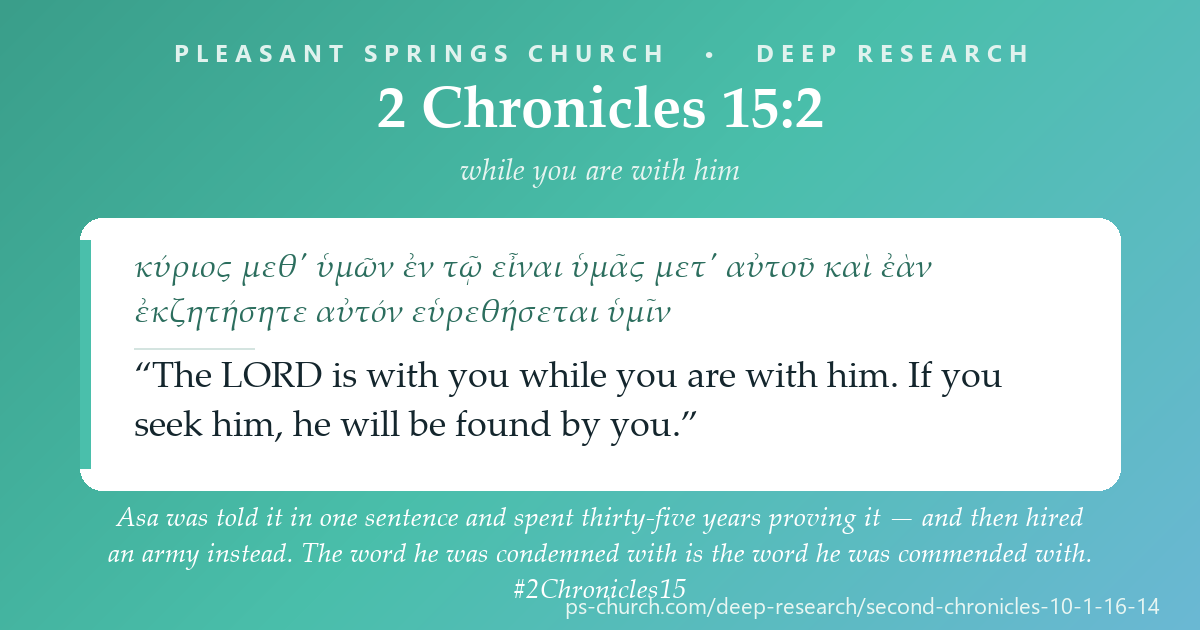
Asa is given the principle in a single sentence — “the Lord is with you while you are with him; if you seek him he will be found by you” (15:2) — and spends thirty-five years proving it. Then, threatened by a neighbour, he takes the silver and gold out of the house of God and hires Syria. When a seer tells him what he has done, he puts the seer in the stocks. And in his last illness “he did not seek the Lord” (16:12). The verb is dāraš, the one the whole work runs on, and this is the third king in a row it is used to measure.
Text and numbering. In the Septuagint this book is 2 Paraleipomena, “things omitted” — Παραλειπομένων Βʹ (Paraleipomenōn B). Verse counts in these chapters match between the Masoretic Text and Rahlfs throughout — 19, 23, 16, 23, 14, 19, 14 — with nothing absent from the Greek. Counted against both columns, not assumed.
⚠️ But the English numbering diverges for one chapter. Abijah’s death notice is 13:23 in the Hebrew and the Greek, and 14:1 in English versions. So through chapter 14 the English runs one ahead — MT/LXX 14:1 (“Asa did what was good and right”) is ESV 14:2, and the chapter ends at MT/LXX 14:14 where English has 14:15 — and the two systems re-converge at chapter 15. This is a chapter-division difference, not a textual one. Verses from chapter 14 are cited below by the Hebrew number with the English in brackets.
⚠️ The Greek reads “humbled themselves” as shame. Where the Hebrew has kānaʿ at 12:6, Rahlfs has ᾐσχύνθησαν, “they were ashamed” — the same instinct it showed at 7:14 with ἐντραπῇ. The submission is caught; a note of shame is added that the Hebrew does not press.
The Shape of the Passage
Parallel panelsBehind these chapters stands the promise at 7:14 and the warning at 7:19–22. Behind the division stands 1 Kings 12, told from the other side. In front of them stand Jehoshaphat, and a long slide.
Author
He is marking an exam. Having recorded the terms in chapter 7, the Chronicler now assesses every king against them, and this unit is where the method becomes obvious. The vocabulary is consistent and deliberate: humble oneself (12:6, 7, 12), rely on (13:18; 14:10 [ESV14:11]; 16:7, 8), seek (14:3, 6 [ESV 14:4, 7]; 15:2, 4, 12, 13; 16:12). Read the verbs and you have the verdicts.
He gives Abijah a sermon that Kings does not. 1 Kings 15:1–8 gives Abijam three verses and says his heart was not wholly true to the Lord. 2 Chronicles 13 gives him nine verses of direct speech and a victory. This is one of the sharpest differences of portrayal between the two books, and Stage 4 prints both rather than choosing.
And he will not let a good king end well by default. Asa gets three chapters, most of them admiring, and then the last chapter dismantles him: a treaty instead of trust, a prophet in the stocks, cruelty to some of the people, and an illness he would not bring to God. The Chronicler could have stopped at chapter 15. He did not, and the arrangement means a reader cannot take the early faithfulness as a settled verdict.
Audience
People living with the consequences of the split. The Chronicler’s readers were Judah and Benjamin — the two tribes left standing at 11:12 — and the northern tribes were long gone. So 11:13–17, where priests and Levites from all Israel migrate south, matters: it says the true worship of the north came to Jerusalem, and that people from every tribe “who had set their hearts to seek the Lord” came with them. The community reading this was descended from that migration.
People who knew what a foreign alliance costs. Asa’s sin in chapter 16 is a security arrangement funded from the temple treasury, and it worked — Baasha withdrew. The rebuke is not that it failed; it is that it was not needed. For a province surviving by careful management of imperial patronage, 16:7–9 is uncomfortably close to home.
And people who needed to know that a bad start is not final. Rehoboam is the king who loses the kingdom, and he is also the king of whom it is said “conditions were good in Judah” after he humbled himself (12:12). The Chronicler is not sentimental about him — 12:14 says he did evil because he did not set his heart to seek the Lord — but the mercy is recorded, and it is recorded first.
Orient on the division, on Shishak, on Judah’s fortifications, and on prophetic rebuke of kings.
Search by topic: Rehoboam; Jeroboam; Shechem; division of the kingdom; Shishak / Sheshonq I; Karnak relief; Abijah / Abijam; covenant of salt; Asa; Zerah the Cushite; Mareshah; Azariah son of Oded; Hanani the seer; Ramah; Ben-hadad; asa disease; physicians in the ancient world.
Which articles are relevant?
- Anchor Bible Dictionary — “Rehoboam,” “Jeroboam,” “Shishak,” “Abijah,” “Asa,” “Zerah,” “Salt, Covenant of,” “Prophecy (OT),” “Medicine and Healing.”
- Dictionary of the OT: Historical Books (IVP) — “Rehoboam,” “Asa,” “Chronicler’s History,” “Retribution,” “Prophets and Prophecy,” “Warfare.”
- NIDOTTE / TDOT — כָּנַע (kānaʿ, humble oneself), שָׁעַן (šāʿan, lean, rely), דָּרַשׁ (dāraš, seek), שָׁלֵם (šālēm, whole, blameless), רָפָא (rōpəʾîm, physicians).
- On the Greek — the NETS introduction to 2 Supplements, and its notes on the rendering of kānaʿ.
Bibliography surfaced:
- Sara Japhet, I & II Chronicles (OTL); Ralph W. Klein, 2 Chronicles (Hermeneia); Raymond B. Dillard, 2 Chronicles (WBC); H. G. M. Williamson, 1 and 2 Chronicles (NCBC).
- On the Shishak campaign: the Karnak relief of Sheshonq I is the primary external document, and any standard history of Egypt’s Twenty-second Dynasty will set it out. Read it noting what it does and does not say — see Stage 2.
A pharaoh who left a list, a covenant made with salt, and what physicians were for.
First the world: Sheshonq’s campaign as Egypt recorded it, treaty-making by payment, and ancient medicine. Then the honest question of what the external evidence does and does not corroborate.
Which parallels shed light on these chapters?
Shishak is the first king in the Bible we can put beside his own inscription. Sheshonq I, founder of Egypt’s Twenty-second Dynasty, left a relief at Karnak listing towns taken in a Levantine campaign, and a fragment of a stele of his was found at Megiddo. What the correspondence establishes and what it does not is worth being precise about. It establishes that an Egyptian king of that name campaigned in the region at about that time — which is real and not trivial. It does not, by itself, confirm the tribute figures, the theology of 12:5–8, or the detail about the shields; and the Karnak list names many northern sites, which is a genuine puzzle beside a biblical account focused on Judah. This page reports the convergence and the difficulty together.
A “covenant of salt” was a real formula. Abijah says the Lord gave David the kingship “by a covenant of salt” (13:5). Salt accompanies offerings in Leviticus 2:13 and marks the priestly portions in Numbers 18:19, and eating salt together is an idiom for binding obligation across the Near East — Ezra 4:14 has officials say they “eat the salt of the palace.” The force is permanence: salt does not spoil, and neither does the arrangement.
And physicians were ordinary, respectable and everywhere. Egyptian and Mesopotamian medical texts prescribe treatments in detail; Egypt’s doctors were famous. So 16:12 is not describing an exotic recourse. That matters for reading it correctly — and it is worth knowing that a Second-Temple Jewish writer took the opposite line explicitly: Sirach 38:1–15 tells the reader to honour the physician, because “the Lord created him,” while also urging prayer. See the insight below.
- The Karnak relief of Sheshonq I (Bubastite Portal) (Egyptian royal inscription — a witness, not Scripture) — a topographical list of places taken in a Levantine campaign, and the nearest external document to 12:2–9. Cited for the convergence, with the difficulties stated rather than suppressed.
- Josephus, Antiquities 8.10.2–4 (§§246–264) (Second-Temple — a witness, not Scripture) — he retells the Shishak invasion and follows the biblical account closely, keeping the humbling and the loss of the shields.
- Sirach 38:1–15 (Second-Temple, Apocrypha / Deuterocanon — a witness, not Scripture in our confession) — “Honour the physician with the honour due him… for the Lord created him.” A Jewish writer, a few centuries after Chronicles, holding prayer and medicine together. Directly relevant to how 16:12 is read.
- Numbers 18:19; Leviticus 2:13; Ezra 4:14 — not external witnesses but the biblical usage behind “covenant of salt.”
The verse. “In the thirty-ninth year of his reign Asa was diseased in his feet, and his disease became severe. Yet even in his disease he did not seek the Lord, but sought help from physicians” (16:12).
How it has been used. It has been quoted to discourage people from seeing doctors, and quoted at people who did. That reading does not survive contact with the sentence or with the chapter.
What the sentence actually contrasts. The charge is not that Asa consulted physicians. It is that he did not seek the Lord — and the Hebrew makes the two clauses a contrast, not a pair: he sought in the physicians rather than in God. The verb is dāraš, the word this whole work is built on, and it has been used of Asa twice already in a good sense (14:3, 6 [ESV 14:4, 7]).
What the chapter has already established. This is the third failure in twelve verses, and they are all the same failure. He relied on the king of Syria rather than on God (16:7). He jailed the man who told him so (16:10). Now he will not bring his body to the God he would not bring his kingdom to. The disease is the last item in a pattern, not a separate lesson about medicine.
And the Bible is not against physicians. Isaiah prescribes a fig poultice for Hezekiah’s boil (Isaiah 38:21); Luke is called “the beloved physician” (Colossians 4:14); Paul tells Timothy to take a little wine for his stomach (1 Timothy 5:23); and Jesus uses the doctor as a positive image of his own work (Mark 2:17). A study that uses 16:12 to discourage treatment has taken a verse about a king who would not repent and turned it into medical advice.
Three verbs that score three reigns, and a famous sentence read in its own paragraph.
Track kānaʿ, šāʿan and dāraš through these seven chapters and you will not need a commentary to know the verdicts. Then read 16:9 with the second half of the verse attached.
“To humble oneself, be brought low.” The verb of 7:14, and its first test. Four times in one chapter: the princes and the king humble themselves; the Lord sees that they have humbled themselves and says so twice; and 12:12 concludes “when he humbled himself the wrath of the Lord turned from him.” The promise made at the dedication is cashed five chapters later on the worst possible candidate. The Greek uses αἰσχύνω and ἐντρέπω — being ashamed — which catches the submission and adds a shade the Hebrew does not.
“To lean on, rely, support oneself against.” A physical picture — putting your weight on something. It is the Chronicler’s other measuring word, and this unit uses it to score three kings: Judah prevailed “because they relied on the Lord” (13:18); Asa in the invasion says “on you we rely” (14:10); and Hanani’s charge is exactly this verb — “you relied on the king of Syria and did not rely on the Lord your God” (16:7–8). Asa is condemned with the word he was commended with.
“To seek.” The book’s master verb, and the arc of Asa’s reign in one word. He commands Judah to seek the Lord (14:3); he says “we have sought him” (14:6); Azariah promises “if you seek him he will be found by you” (15:2); the assembly covenants to seek him with all their heart (15:12). And then, in the last three words of his story, he did not seek (16:12). Forty-one years measured by one verb.
“Whole, complete, at peace, undivided.” 15:17 says Asa’s heart was šālēm all his days — and 16:9 says God’s eyes range the earth looking for hearts that are šālēm toward him, in a speech rebuking Asa. The book holds both sentences about the same man, and does not explain how. The root is the same as šālōm; the sense is not moral perfection but undividedness.
“Run to and fro, range, rove.” Of God’s eyes, ranging the whole earth. The same root describes the Adversary “going to and fro on the earth” in Job 1:7, and the angelic patrols of Zechariah 4:10. It is a patrol image: not passive omniscience but active looking. Worth noticing where the sentence sits — it is the ground of a rebuke, not a greeting card: the eyes range the earth to strengthen the wholehearted — you have done foolishly. The Greek is ἐπιβλέπουσιν.
“A covenant of salt.” Abijah’s term for the grant of kingship to David and his sons. Salt is added to every grain offering (Leviticus 2:13) and marks the priests’ perpetual dues (Numbers 18:19); Ezra 4:14 uses eating a king’s salt for sworn obligation. The point is permanence and preservation — salt is what does not spoil. The Greek renders it plainly, διαθήκην ἁλός.
Two things here reported rather than tidied:
- The English verse numbers shift for one chapter. Abijah’s death notice is 13:23 in the Hebrew and Greek and 14:1 in English, so the English runs one ahead through chapter 14 before the systems re-converge at 15. No words are gained or lost — it is a chapter-division difference — but references are unreliable if it goes unstated.
- Chronicles and Kings portray Abijah very differently. 1 Kings 15:3 says “he walked in all the sins that his father did before him, and his heart was not wholly true to the Lord his God” — three verses, and a negative verdict. 2 Chronicles 13 gives him a nine-verse sermon defending the legitimate priesthood and a victory won by relying on God. Both are in the Bible. This page prints both and does not reconcile them, and notes that Chronicles never actually calls Abijah a good king — it reports one occasion on which Judah relied and prevailed.
The dedication terms being tested, the same division told from the north, and a verse about physicians.
Read 7:13–14 immediately before chapter 12 and the connection is unmistakable. Then set 1 Kings 12–15 beside these chapters, and 16:12 beside Isaiah 38 and Colossians 4.
Which cross-references matter?
- 2 Chronicles 7:13–14 → 12:6–12 — the terms and the first test case. God said “if my people… humble themselves… then I will hear.” Five chapters later the king and princes humble themselves, God says “they have humbled themselves; I will not destroy them,” and the narrator closes “when he humbled himself the wrath turned from him.” The same verb three times. The promise is demonstrated on the king who lost ten tribes.
- 1 Kings 12–15 beside 2 Chronicles 10–16 — the same events from the other side. Kings follows Jeroboam and the north; Chronicles follows Judah and barely mentions the northern kings except as opponents. Kings gives Abijam three verses and a bad verdict; Chronicles gives Abijah a chapter. Kings has Asa’s treaty with Ben-hadad (1 Kgs 15:18–20) without any rebuke; Chronicles adds Hanani, the prison, and the diseased feet. All printed; none reconciled.
- 2 Chronicles 11:13–17 — priests and Levites leaving their pasture lands in the north and coming to Judah, followed by “those who had set their hearts to seek the Lord God of Israel” from every tribe. Chronicles’ own material, and the basis of its claim that Jerusalem kept the legitimate worship of all Israel.
- Leviticus 2:13; Numbers 18:19; Ezra 4:14 → 2 Chronicles 13:5 — the covenant of salt. Grain offerings, priestly dues, sworn loyalty; and a dynasty described in the same terms.
- 2 Chronicles 15:2 → Jeremiah 29:13–14; Matthew 7:7 — “if you seek him he will be found by you.” Jeremiah says it to the exiles — “you will seek me and find me, when you seek me with all your heart” — which is the community the Chronicler was writing for. And “seek, and you will find” stands in the Sermon on the Mount.
- 2 Chronicles 16:12 beside Isaiah 38:21; Colossians 4:14; 1 Timothy 5:23; Mark 2:17 — a fig poultice prescribed by a prophet; a physician named as a beloved companion of Paul; medical advice given by an apostle; and Jesus using the doctor as an image of his own work. The Bible’s witness on physicians is not what 16:12 is usually made to say. See the insight in Stage 2.
- 2 Chronicles 16:9 and Job 1:7; Zechariah 4:10 — eyes ranging the whole earth. The image is of patrol, and Zechariah uses it of “the eyes of the Lord, which range through the whole earth.”
Where the scholarship agrees, where it does not, and what stays open.
Japhet, Klein, Dillard and Williamson. Then three live questions — and on two the honest answer is that the evidence does not settle it.
Commentaries & studies:
- Sara Japhet, I & II Chronicles (OTL) — on the Chronicler’s treatment of the division and on the theology of immediate retribution running through these reigns.
- Raymond B. Dillard, 2 Chronicles (WBC) — especially good on the structural pattern by which each reign is scored, and on Asa’s reign as a deliberate two-part composition.
- Ralph W. Klein, 2 Chronicles (Hermeneia) — the technical work on the relationship to 1 Kings and on the numbers in chapters 13–14.
- H. G. M. Williamson, 1 and 2 Chronicles (NCBC) — on 11:13–17 and the Chronicler’s attitude to the northern tribes.
Interpretation notes worth keeping:
- The Shishak correspondence — real, and narrower than it is often made. That Sheshonq I campaigned in the Levant is documented at Karnak. That the Karnak list is dominated by northern sites, while 2 Chronicles 12 concerns Judah, is a genuine difficulty discussed at length in the literature. This page states the convergence and the difficulty and does not use the inscription as proof of more than it says.
- The numbers in chapters 13–14. Four hundred thousand against eight hundred thousand (13:3), five hundred thousand fallen (13:17), a million Ethiopians (14:8 [ESV 14:9]). The standing question about אֶלֶף (ʾelep) applies here with unusual force, and the honest position is that it is not settled. This page neither converts the figures nor defends them.
- Whether Chronicles “rehabilitates” Abijah. The difference from 1 Kings is plain; what it means is argued. It is worth noting that Chronicles gives no overall verdict on his character — it reports a speech and a battle in which Judah relied on God. Whether that amounts to a rehabilitation is a reader’s judgment, and the page does not make it for you.
- The chronology of Asa’s reign. The thirty-sixth year of 16:1 is difficult beside 1 Kings 16, where Baasha is already dead; solutions have been proposed (a reckoning from the division rather than the accession, a textual error in the figure) and none is certain. Reported as a difficulty rather than resolved.
Mercy for the worst start, the danger of a good record, and where you take an illness.
Name what you learned, why it matters, and one concrete response.
What should we carry away — and do?
- The first man to prove 7:14 is the man who lost the kingdom. Rehoboam is not a good king, and the Chronicler says so in the same chapter (12:14). But when Egypt was at the gates and a prophet told him the truth, he agreed with God out loud — “the Lord is righteous” — and the wrath turned. That is the first thing the promise is used for.
- Thirty-five good years did not make the thirty-sixth safe. Asa is the cautionary figure here, and what he does wrong looks sensible: a defence treaty, paid for, and it worked. The rebuke is that he put his weight on it. The word he is condemned with is the word he was commended with.
- Being told you are wrong is a mercy, and he jailed the man who did it. 16:10 is the hinge of Asa’s decline: not the treaty, but what he did to the person who named it. Notice how fast it goes from there to a man refusing to bring his own illness to God.
- One concrete response. Think of the last person who told you something about yourself that you did not want to hear. Did you thank them, argue with them, or quietly put them in the stocks? Go back to them this week.
2 Chronicles 15:2 · to share
Hebrew + Greek (Rahlfs, Paraleipomenon B) + ESVEvery Deep Research page traces its passage across the whole sweep — the Old Testament, the Second-Temple world between the testaments (historical witnesses, not Scripture), and the New Testament. Follow the thread:
Pleasant Springs Church — Deep Research
Research method after Michael S. Heiser’s Bible Research Method (examine dictionaries → ancient literature → important words → textual connections → academic publications → share), with the Pleasant Springs “Author & Audience” foundation. Scripture set in the Hebrew, the Greek editions named on each page and the ESV (Old Testament), and the Greek New Testament and the ESV (New Testament), per the practice of Pleasant Springs Church. 2 Chronicles 10–16 research grounded in Japhet (OTL), Dillard (WBC), Klein (Hermeneia) and Williamson (NCBC). Book name: in the Septuagint this book is Paraleipomenon B, Παραλειπομένων Βʹ; the Hebrew title is דִּבְרֵי הַיָּמִים. Text & numbering: Hebrew from the Masoretic Text; Greek from Rahlfs’s Septuaginta (CATSS digitization of the Rahlfs text), printed without editorial punctuation and with proper names unaccented; English ESV. Verse counts match between the Masoretic Text and Rahlfs throughout these chapters (19, 23, 16, 23, 14, 19, 14) with nothing absent from the Greek — counted against both columns, not assumed. ⚠️ English numbering diverges for one chapter: Abijah’s death notice is 13:23 in Hebrew and Greek and 14:1 in English, so English runs one ahead through chapter 14 (MT 14:1 = ESV 14:2) before re-converging at chapter 15; a chapter-division difference, not a textual one, and verses from chapter 14 are cited by the Hebrew number with the English in brackets. ⚠️ Chronicles and Kings are not harmonised: 1 Kings 15:1–8 gives Abijam three verses and a negative verdict where 2 Chronicles 13 gives a nine-verse sermon and a victory — and the page notes that Chronicles never pronounces Abijah a good king, only that on one occasion Judah relied and prevailed; 1 Kings 15:18–20 records Asa’s Syrian treaty with no rebuke, where Chronicles adds Hanani, the stocks and the disease. Both are printed and neither reconciled. The Karnak relief of Sheshonq I is cited as the nearest external document to 12:2–9, with the convergence stated narrowly and the difficulty stated too — the Egyptian list is dominated by northern sites while the biblical account concerns Judah — rather than being used as proof of more than it says. The large numbers (13:3, 17; 14:8) are neither converted nor defended and the unsettled question of אֶלֶף is named as unsettled. The chronological difficulty at 16:1 (the thirty-sixth year, beside 1 Kings 16) is reported as a difficulty with the proposed solutions named and none adopted. ⚠️ 16:12 is handled explicitly: the page states that the charge is not consulting physicians but not seeking the Lord, sets the verse as the third item in a single pattern of misplaced reliance within twelve verses, and names and rejects the use of the verse to discourage medical treatment — citing Isaiah 38:21, Colossians 4:14, 1 Timothy 5:23 and Mark 2:17, and noting that Sirach 38 (Apocrypha — a witness, not Scripture in our confession) urges honouring the physician alongside prayer. 16:9 is printed with its second half attached, since the famous clause is the ground of a rebuke. Second-Temple witnesses (Josephus, Ant. 8; Sirach) are read as witnesses and never levelled with Scripture, and Apocrypha is tagged non-canonical at first mention. Typology is handled per the house position: what the text says, what the New Testament itself draws, and what we see from this side of the cross — with the seeing left to the reader.
Scripture quotations marked ESV are from the ESV® Bible (The Holy Bible, English Standard Version®), © 2001 by Crossway, a publishing ministry of Good News Publishers. ESV Text Edition: 2016. Used by permission. All rights reserved. The ESV text may not be quoted in any publication made available to the public by a Creative Commons license, and the ESV may not be translated in whole or in part into any other language. www.esv.org
|
Did this study bless you today? 💚 Give to Support PS Church100% of gifts go to the General Fund — thank you. |