Solomon finishes his building works, a foreign queen arrives to test him with hard questions and leaves saying the half had not been told her, and then he dies in a paragraph. His son goes north to Shechem to be made king, is asked to lighten a tax, is advised by old men to say one kind sentence and by his friends to say scorpions — and within a day ten tribes are gone. The narrator does not treat it as an accident: “it was a turn of affairs brought about by God” (10:15). But the finding this study is built on is not in the story. Almost all of this material also stands in 1 Kings 9–12, and set side by side in Hebrew the two books do not merely agree — eighty-one of these ninety-one verses share consecutive words with Kings, fifty of them four or more, and 2 Chronicles 10:9 runs nineteen consecutive words with 1 Kings 12:9. Then at 11:5 it stops dead, and across the last nineteen verses of the passage nothing reaches four. One verse in that silence — three fortress names — shares no two consecutive words with any other verse in the Hebrew Bible. This study prints the whole profile, and what fills the silence. See the method →
2 Chronicles 8:1–11:23 (selections)
Hebrew · Greek (Rahlfs, Paraleipomenon B) · ESVBut the finding this page is built on is not in the story. It is in the seam. Almost all of this material also stands in 1 Kings 9–12, and the overlap is not paraphrase — it is verbatim, to a depth of nineteen consecutive Hebrew words. Then, at 11:5, it stops, and for the rest of the chapter nothing reaches four. What fills the silence is fortresses, priests, Levites and sons. Stage 4 prints the whole profile, verse by verse.
Text and numbering. In the Septuagint this book is 2 Paraleipomena, “things omitted” — Παραλειπομένων Βʹ (Paraleipomenōn B). Chapters 8–11 are numbered alike in Hebrew, Greek and English, and the verse counts match exactly — 18, 31, 19, 23 — with nothing absent from Rahlfs. Counted against both columns, not assumed. There is no offset anywhere in this passage. The one-verse offset in 2 Chronicles affects chapters 1–2 only (Hebrew 1:18 = English 2:1) and lies outside these four chapters; see the study on 1:1–5:1.
⚠️ The columns are not harmonised. Six places on this page read differently in Hebrew and in Greek — 8:11, 8:16, 9:29, 11:15, 11:16 and 11:17 — and every one is printed with a translation note rather than smoothed away. The Latin of the printed Vulgate held here is brought in as a third witness where it decides something; it is a late edition and not a critical text, and Stage 5 says so.
The Shape of the Passage
Sequence — four panels around one sentence, framed by fortified citiesBehind these chapters stand the dedication and the night answer of 2 Chronicles 5–7. In front of them stands Shishak, five years later, and every king the rest of the book will score against the same rule.
Author
You can see his hand without guessing at it. This is the rare stretch where the Chronicler’s editorial work is not a matter of taste but of arithmetic. Set his Hebrew beside 1 Kings 9–12 and for the seventy-two verses of 8:1–11:4 the two books are, in long stretches, the same words in the same order. Then at 11:5 the resemblance ends and does not come back. Whatever else he is, he is a writer whose book runs with Kings for a long way and then goes on alone.
What is not here is as visible as what is. 1 Kings gives Solomon a chapter of foreign wives, foreign gods, and adversaries raised up against him (1 Kings 11). None of it is here. Chronicles takes Solomon from the queen of Sheba straight to the gold, the throne, the horses and the grave. The page states this plainly rather than defending it: the absence is real, it is not a contradiction of Kings, and readers who only have Chronicles get a Solomon whose reign ends without a reckoning.
And twice he stops to talk about Levites. The two Levitical blocks in these chapters, neither with a parallel in Kings, are 8:12–16, the courses of priests and gatekeepers “according to the ruling of David his father,” and 11:13–17, the priests and Levites abandoning their pasture lands to come south. He is the same writer who gave the singers a chapter of their own.
Audience
People for whom the division was ancient history and the fortresses were ruins. Lachish and Azekah, two of the three names in 11:9, are the two towns Jeremiah 34:7 says were the last to hold out before Jerusalem fell. A post-exilic reader hearing Rehoboam fortify them would have known exactly how that ended.
People who needed to know whether the split was a mistake or a judgment. The answer this book gives is neither comfortable nor evasive: it was a turn of affairs brought about by God (10:15), and it was also Rehoboam refusing to speak one kind sentence (10:7–8). Both are in the text, eight verses apart, and the Chronicler does not reconcile them.
And people who could be told that the way back had already happened once. 11:16 is the verse for a returned community: individuals out of every tribe of the north who set their hearts to seek the Lord and travelled to Jerusalem to sacrifice. It lasted three years (11:17), and the Chronicler says so in the same breath. He is not selling anyone a permanent revival.
Orient on the corvée, Ophir and the incense road, Sheba, the assembly at Shechem, and the fortress list.
Search by topic: store cities; corvée and forced labour; Ophir; Tarshish ships; Sheba; Shechem; the assembly (qahal); yoke as a political image; Jeroboam I; Shishak / Sheshonq I; goat demons (seʿirim); Levitical cities and pasture lands; Judahite fortress systems.
Which articles are relevant?
- Anchor Bible Dictionary — “Sheba, Queen of,” “Ophir,” “Tarshish,” “Shechem,” “Corvée,” “Jeroboam,” “Rehoboam,” “Fortifications,” “Demons (OT).”
- Dictionary of the OT: Historical Books (IVP) — “Solomon,” “Chronicler’s History,” “Divided Monarchy,” “Levites and Priests,” “Cities and Villages,” “Sources and Historiography.” The last of those is the one to read before Stage 4.
- NIDOTTE / TDOT — נְסִבָּה (nəsibbāh, a turn of affairs), עֹל (ʿōl, yoke), בָּקַשׁ (bāqaš, seek), שָׂעִיר (śāʿîr, goat / goat-demon), מַחְלְקוֹת (maḥləqōṯ, divisions), מִגְרָשׁ (miᴞrāš, pasture land).
- On the Greek — the NETS introduction to 2 Supplements (Paraleipomenon B), and its treatment of the translator’s habits with proper names and with words for idols.
Bibliography surfaced:
- Sara Japhet, I & II Chronicles (OTL); Ralph W. Klein, 2 Chronicles (Hermeneia); Raymond B. Dillard, 2 Chronicles (WBC); H. G. M. Williamson, 1 and 2 Chronicles (NCBC).
- On the fortress list of 11:5–12 specifically — the long-running argument about whether it belongs to Rehoboam or to a later reign is a standard topic in the commentaries above and in the archaeological literature on Judahite fortifications. Named here as contested; not decided here.
A queen on a trade route, a yoke that was a real tax, and what a goat-shaped god was.
First the world: south Arabian trade, the politics of an accession assembly, and the vocabulary of forced labour. Then Josephus, who retells all of it and is unusually interested in the queen.
Which parallels shed light on these chapters?
The queen’s journey was a trade route before it was a story. Sheba is most plausibly in south-west Arabia, and the cargo named in 9:1 and 9:9 — camels, spices, gold and precious stones — is the documented freight of the incense road. Assyrian royal inscriptions name Arabian queens paying tribute, so a woman leading a delegation is not a folk motif. What she came for is stated: 9:1 says she came to test him with hard questions (חִידוֹת, riddles), and 9:12 says Solomon gave her “all that she desired, whatever she asked.”
The yoke at Shechem was a fiscal instrument, not a metaphor. 8:7–10 has just told us how Solomon’s works were paid for: a permanent labour levy on the surviving Canaanite population, with two hundred and fifty Israelite officers over it. The northern delegation in 10:4 asks for the hard service and the heavy yoke to be lightened. The complaint in chapter 10 is about the building programme in chapter 8, and the two chapters sit next to each other for that reason.
And an accession was a negotiation. Rehoboam does not inherit the north; he goes to Shechem, because “all Israel had come to Shechem to make him king” (10:1). The old men understand the setting exactly — be good to this people and speak good words to them, and they will be your servants for ever (10:7) — and the blunter be a servant to this people today stands in 1 Kings 12:7, not here. The advice he rejects is the advice that understood the constitution he was standing in.
- Josephus, Antiquities 8.6.5–8.8.3 (Second-Temple — a witness, not Scripture) — he retells the queen’s visit at length, identifies her as ruling Egypt and Ethiopia rather than Arabia, and retells the assembly at Shechem and the division. Cited for what a first-century Jewish reader made of these chapters, not as evidence for what happened.
- Assyrian records of Arabian queens; the south Arabian incense trade (documentary and archaeological evidence — witnesses, not Scripture) — for the plausibility, the route and the goods of chapter 9.
- Leviticus 17:7 — not an external witness but the law the word in 11:15 comes from: “they shall no more sacrifice their sacrifices to goat demons, after whom they whore.” Stage 3 gives the count.
- Egyptian and Levantine royal building inscriptions (witnesses, not Scripture) — for the convention of a reign summarised by its store cities, chariot cities and fortresses, which is exactly the form of 8:1–6 and 11:5–12.
10:15 and 10:7 are eight verses apart and they are not saying the same thing.
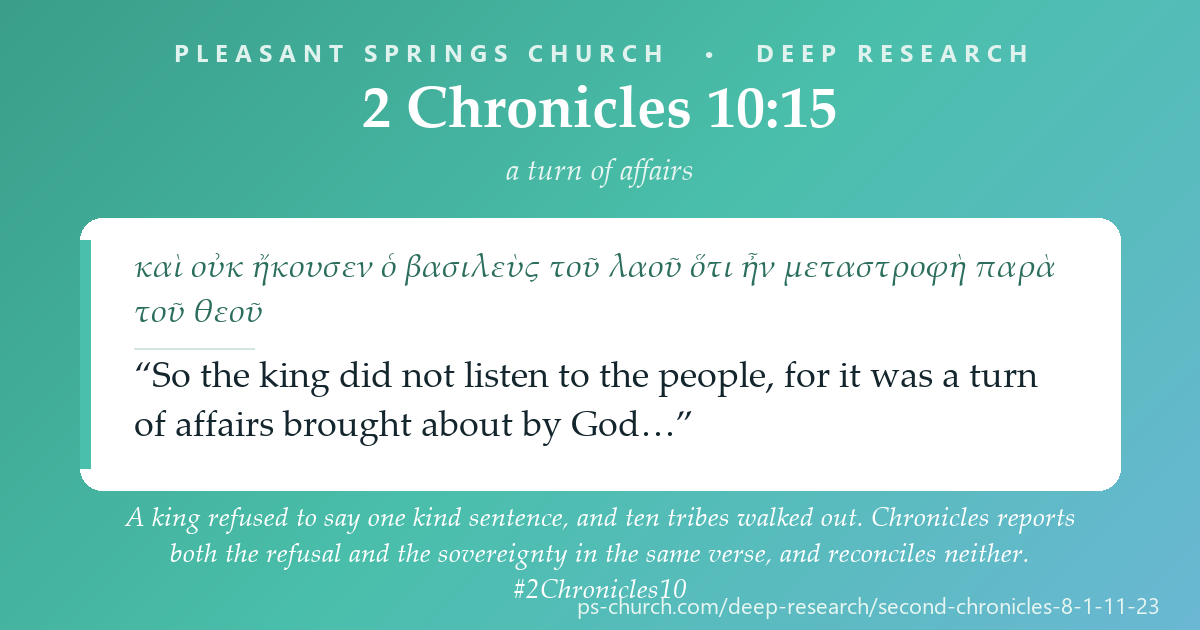
10:15 says the king did not listen “for it was a turn of affairs brought about by God that the Lord might fulfill his word” — the word Ahijah had spoken to Jeroboam. The split is not outside God’s purpose. It is the delivery of a sentence already passed.
10:7 says the old men told Rehoboam that if he would be good to this people and speak good words to them, they would be his servants for ever. He had that. He heard it. He put it down and asked the men he grew up with instead, and they told him to say scorpions.
The Chronicler prints both and reconciles neither. He does not say Rehoboam was helpless, and he does not say God was reacting. The verse that names God’s hand is the same verse that says the king did not listen — and the Hebrew uses the identical verb, šāmaʿ, for what the king would not do (10:15) and for what the army later did when the prophet spoke (11:4). One man refused to hear and a kingdom broke; a hundred and eighty thousand men agreed to hear and a war did not happen. That is the moral shape of these two chapters, and it is built out of one verb.
What this page will not do is use 10:15 to make Rehoboam a victim. The text gives the counsel he was offered, the counsel he took, and the word he chose to end on.
A noun that occurs once, a plural that means three different things, and the verb the whole division turns on.
Read chapter 10 counting the word yoke, and then read it again counting listen. Then look up śəʿîrîm in Leviticus 17:7 before you read 11:15.
“A turn of affairs.” Something turned round; a reversal engineered from outside. The consonantal string נסבה occurs four times in the Masoretic corpus and the other three (Ezekiel 26:2; 41:7; 1 Chronicles 13:3) are verbs — 2 Chronicles 10:15 is the only place it stands as a noun. 1 Kings 12:15 tells the same thing with a different noun, סִבָּה (sibbāh). Both are rendered μεταστροφή, which occurs exactly twice in the 30,348 Greek Old Testament verse units screened here — these two verses and nowhere else.
“Hairy ones, goat-shaped ones.” The plural forms שעירם / שעירים occur six times in the Masoretic corpus. Two are the literal goats of the Day of Atonement (Leviticus 16:7, 8); one is a homograph meaning rain-showers (Deuteronomy 32:2). That leaves three that mean a thing worshipped or a thing haunting a ruin: Leviticus 17:7, Isaiah 13:21, and this verse. The ESV renders it “goat idols”; Rahlfs splits it across two words, εἰδώλοις and ματαίοις; the Latin held here says daemoniorum.
“Hear, listen, obey.” The hinge verb of the two chapters. The king did not listen to the people (10:15); all Israel saw that the king did not listen to them (10:16); and then they listened to the words of the Lord (11:4) and the war was called off. Two refusals and one consent, in the same word. It is also the verb of 7:14, where God promises “I will hear from heaven.”
“Seek.” The Chronicler’s signature verb, and it appears twice here with two very different objects. At 9:23 all the kings of the earth are seeking the face of Solomon — the exact sequence מבקשים את פני occurs twice in the whole Hebrew Bible, here and at 1 Kings 10:24, and both are about this one man. At 11:16 people out of every northern tribe give their heart to seek the Lord (לבקש את יהוה, four occurrences: Hosea 5:6, Zechariah 8:22, and 2 Chronicles 11:16 and 20:4). Seventy verses separate a world seeking a king’s face from ordinary people seeking God’s.
“Divisions, courses.” The rota system by which priests, Levites and gatekeepers took turns. The word belongs to Chronicles: it is the organising noun of 1 Chronicles 23–27, and its reappearance here is one of the reasons 8:12–16 sounds like Chronicles and not like Kings. The Greek is διαιρέσεις.
“Pasture land, common land.” What the Levites left. These are the open lands attached to the Levitical towns in Joshua 21 and 1 Chronicles 6 — the Levites’ only property, since they had no tribal allotment. 11:14 is therefore a sentence about men giving up the one thing they owned. Rahlfs reads it as τὰ σκηνώματα τῆς κατασχέσεως αὐτῶν, “the dwellings of their possession.”
“Yoke.” Six times in eleven verses, and it is the only thing anybody at Shechem argues about. The northern demand is lighten it; the answer is I will add to it. The Greek uses ζυγός throughout, where the Greek of 1 Kings 12 prefers κλοιός, a neck-collar — the two Greek books do not agree on the image.
Three things here reported rather than tidied:
- 2 Chronicles 9:25 says four thousand stalls; 1 Kings 4:26 (Hebrew 5:6) says forty thousand. Both are in the corpora held here and both were read: אַרְבַּעַת אֲלָפִים against אַרְבָּעִים אֶלֶף. The page reports the difference and does not resolve it. A copying difference in a numeral is the ordinary explanation and it is not the only one; nothing in either text decides it.
- The Greek of 11:21 counts thirty concubines where the Hebrew counts sixty. παλλακὰς τριάκοντα against וּפִילַגְשִׁים שִׁשִּׁים. The Latin held here reads sexaginta, with the Hebrew. Reported; not decided.
- Chronicles has no counterpart to 1 Kings 11 at all. Solomon’s foreign wives, the high places for Ashtoreth and Milcom, the LORD’s anger, Hadad and Rezon and the adversaries raised up — none of it is in Chronicles, which goes from the queen of Sheba to the gold to the grave. This is an absence, not a denial, and the page names it rather than letting the silence do quiet work. A reader who has only these four chapters does not know why the kingdom was taken away; 10:15 tells them that a word had been spoken to Jeroboam, and 1 Kings 11:31–33 tells them what it was and why.
The measurement: where 2 Chronicles 8–11 runs with 1 Kings, exactly where it stops, and what the New Testament does and does not do with it.
Every figure below was re-measured for this page on 30 August 2026 against the substrate as it now stands. Nothing is copied from a neighbouring study, because the cross-corpus screen changed this week — it now applies MorphGNT’s own spelling equivalences (ou/ouk/ouch, ek/ex, the movable nu), so Greek figures run higher than anything published before that date.
MEASUREMENT 1 — the seam, in Hebrew
Method. All 91 verses of 2 Chronicles 8–11 in Hebrew, each one screened against all 133 verses of 1 Kings 9–12 in Hebrew, looking for the longest run of consecutive identical consonantal word forms. Sefaria’s Miqra according to the Masorah; the qere read; vowel points and cantillation removed; final letter-forms folded; maqqef treated as a separator and never as a weld. Whole word forms, never lemmas or roots. Exhaustive and deterministic.
Result. Of the 91 verses, 81 share at least two consecutive words, 62 reach three, 50 reach four, 39 reach six, 32 reach seven and 12 reach ten. The deepest is 2 Chronicles 10:9 against 1 Kings 12:9 — nineteen consecutive words. Screened not just against Kings but against the whole Masoretic corpus, that run holds at nineteen with a tie band of 1: no other verse in the Hebrew Bible comes close to it.
And then it stops. Here is the profile, verse by verse, of the deepest run each verse achieves against 1 Kings 9–12:
8:12–16 2 · 2 · 2 · 1 · 2 ← first silence
8:17–18 2 · 4
9 6 · 6 · 5 · 6 · 8 · 9 · 5 · 9 · 7 · 2 · 7 · 12 · 10 · 3 · 10 · 7 · 7 · 7 · 11 · 15 · 3 · 7 · 10 · 7 · 5 · 1 · 13 · 1 · 3 · 7 · 5
10 4 · 6 · 6 · 8 · 3 · 9 · 7 · 12 · 19 · 12 · 9 · 7 · 3 · 5 · 7 · 5 · 8 · 7 · 3
11:1–4 6 · 3 · 9 · 10
11:5–23 1 · 2 · 2 · 1 · 1 · 2 · 1 · 2 · 1 · 1 · 2 · 3 · 3 · 2 · 2 · 2 · 2 · 2 · 1 ← nothing reaches four
Reading the profile. A 1 means the verse shares single words with 1 Kings 9–12 but no two consecutive ones; on this screen a 0 would mean no shared word at all, and no verse in these four chapters reaches 0 against Kings. The separate 0 reported for 11:9 below is a different screen — the whole Masoretic corpus, with single words not counted — and Measurement 2 says which is which.
Two silences, and both of them are about worship. The first, 8:12–16, is the burnt offerings “according to the commandment of Moses” and the courses of priests, Levites and gatekeepers “according to the ruling of David his father.” The second, 11:5–23, contains 11:13–17 — the priests and Levites leaving their pasture lands and coming to Judah, and with them everyone who set their heart to seek God.
And where it stops matching Kings, it starts matching Chronicles. That is not an impression; it is the second screen. Run 8:12–16 against the whole Hebrew Bible rather than against Kings. The full tie group, printed rather than filtered: 1 Chronicles 16:40 (8:12); Deuteronomy 16:16 for the three feasts (8:13); 2 Chronicles 31:2, 1 Chronicles 16:37, 2 Chronicles 31:16 and — tying at the same depth, and not Chronicles — Nehemiah 12:24 and 12:36 (8:14); 2 Chronicles 31:9 and 1 Chronicles 28:21 (8:15); and 2 Chronicles 35:2, 1 Chronicles 26:22 and Isaiah 38:22 (8:16, where the run only reaches three because the normaliser counts the Masoretic section marker ס as a word — on the words alone it is two). Ten of the twelve ties are Chronicles or Nehemiah. Run 11:13 the same way and its two-word phrase “and the priests and the Levites” ties with twenty-one other verses, headed by Ezra 1:5, Ezra 9:1 and 1 Chronicles 23:2. The vocabulary neighbourhood changes at exactly the point the parallel ends.
Say what this is not. Every one of these numbers shows WHERE shared material sits. None of them shows which book is prior, whether either writer saw the other, or whether both drew on something older. This page asserts no direction of influence in either direction, and the reader should be suspicious of any page about Chronicles that does.
MEASUREMENT 2 — the verse that stands alone
2 Chronicles 11:9 — “Adoraim, Lachish, Azekah” — shares no two consecutive words with any other verse in the Hebrew Bible.
Screened against the other 23,203 verse units of the 39-book Masoretic corpus held here, its longest run is 0. On this screen a zero means no two consecutive words, not no word at all — Lachish and Azekah both occur elsewhere, and stand together in Jeremiah 34:7, the two cities left when Nebuchadnezzar was taking the rest. What does not occur anywhere else is the sequence.
It is worth knowing why: the neighbouring verses in the same list, 11:7 and 11:8, both open with the ordinary wəʾeṯ plus a place name that does recur (“and Beth-…,” “and Gath”), and score 2. 11:9’s three names never take that form anywhere else. The finding is small and it is real, and this page prints the reason as well as the number so it cannot be inflated.
MEASUREMENT 3 — against the Greek New Testament
Method. The 91 CATSS rows of 2 Chronicles 8–11 against all 7,927 verses of the Greek New Testament (SBLGNT via MorphGNT), longest run of consecutive identical word forms, with the edition’s own spelling equivalences applied on both sides.
Result: all 91 reach two, 61 reach three, 17 reach four, and nothing reaches five. There is no citation of these chapters anywhere in the New Testament, and the measurement agrees.
Now the counter-example this page prints against itself. The deepest rows are all four, and several of them have a tie band of 1 — which on most pages is the signal that a run is distinctive. Here it signals nothing at all:
11:14 run 4, band 1 Jn 4:12 καὶ οἱ υἱοὶ αὐτοῦ
10:2 run 4, band 1 Lk 1:41 καὶ ἐγένετο ὡς ἤκουσεν
9:20 run 4, band 1 Heb 9:21 καὶ πάντα τὰ σκεύη
10:12 run 4, band 7 Lk 7:29 · 18:43 · 21:38 καὶ πᾶς ὁ λαός
“In all the region” matches Herod killing the children around Bethlehem against Rehoboam distributing his sons through Judah and Benjamin. “And his sons” matches the Samaritan woman at the well against Jeroboam’s sons. A band of 1 on a run of 4 is not evidence of anything. These are the four commonest words in Greek falling in the same order twice, which over 7,927 verses is close to certain. The Obadiah study prints Luke 19:46 for the same reason; this is that discipline applied here.
MEASUREMENT 4 — the queen of the South, and what a real allusion measures
There is exactly one place in the New Testament that certainly uses this passage, and it is not a quotation. Jesus says: “The queen of the South will rise up at the judgment with this generation and condemn it, for she came from the ends of the earth to hear the wisdom of Solomon, and behold, something greater than Solomon is here” (Matthew 12:42; Luke 11:31 has it almost word for word).
Measured against the chapter it is summarising, the deepest verbatim contact is two words. 2 Chronicles 9:1, 9:5 and 9:27 give ἐν τῇ; 9:3 gives τὴν σοφίαν; 9:6 gives καὶ ἰδοὺ; 9:21 gives μετὰ τῶν; 9:14, 9:23 and 9:28 give τῆς γῆς. That is the whole of it. Even the title differs: the Greek Old Testament calls her βασίλισσα Σαβα, the queen of Sheba; the Gospels call her βασίλισσα νότου, the queen of the South.
This is the most important single line on the page. The one certain New Testament use of these four chapters is invisible to the run screen, and four accidental matches are louder than it. The measurement finds verbatim contact. It does not find allusion, and it never will. Any page that treats a deep run as proof of dependence, or a shallow one as proof of independence, has misunderstood what the number is.
Which cross-references matter?
- 1 Kings 9:1–12:24 beside 2 Chronicles 8:1–11:4 — read them in two columns. The overlap is the subject of Measurement 1. Note especially 2 Chronicles 11:4 against 1 Kings 12:24: ten consecutive words, and the run is broken by one letter — Chronicles has “they listened to the words” (דִּבְרֵי) where Kings has “the word” (דְּבַר). After that break the two verses end differently: Chronicles “and they returned and did not go against Jeroboam,” Kings “and returned to go home according to the word of the Lord.”
- 1 Kings 11:1–40 — the chapter Chronicles does not have. The foreign wives, the high places, the anger, and Ahijah’s ten torn pieces of cloak. 2 Chronicles 10:15 refers to a word spoken by Ahijah that 2 Chronicles never reports. The reader is expected to know it from elsewhere, and that is worth noticing about how this book was meant to be used.
- Leviticus 17:7 → 2 Chronicles 11:15 — “they shall no more sacrifice their sacrifices to goat demons.” The law names the practice and forbids it; the Chronicler says Jeroboam appointed priests for it. Isaiah 13:21 is the only other place the plural carries that sense, where they dance in the ruins of Babylon.
- Joshua 21 · 1 Chronicles 6 → 2 Chronicles 11:14 — the Levitical towns and their pasture lands. 11:14 is only legible against those lists: the Levites had no tribal territory, and the miᴞrāš was what they had instead. They left it.
- 2 Chronicles 8:11 → 1 Kings 9:24 — Kings reports the move of Pharaoh’s daughter in half a verse and gives no reason. Chronicles gives the reason and it is about holiness, and does it in a book that never mentions Solomon’s other foreign wives at all.
- 2 Chronicles 9:8 · 1 Chronicles 29:23 — a foreigner states the Chronicler’s doctrine of the throne: God “set you on his throne as king for the Lord your God.” The throne is not Solomon’s.
- 2 Chronicles 10:15 → 11:4 → 12:1–12 — and forward into the next study: the same Shemaiah who stops the war in 11:2 returns in 12:5 when Shishak comes, and Rehoboam humbles himself. The verb is kānaʿ, the one 7:14 asked for.
- Matthew 12:42 · Luke 11:31 — the queen of the South. Measurement 4.
The standard works, the live arguments, and — at length — what this page did not check and where it is weakest.
Japhet, Klein, Dillard, Williamson. Then the limits, which on this page are unusually important, because the page is making a quantitative claim.
Commentaries & studies:
- Sara Japhet, I & II Chronicles (OTL) and The Ideology of the Book of Chronicles — the standard treatment of the Chronicler’s handling of his sources, and of why Solomon is presented without 1 Kings 11.
- Ralph W. Klein, 2 Chronicles (Hermeneia) — the technical work on the relationship of these chapters to 1 Kings 9–12, and on the Greek of Paraleipomenon.
- Raymond B. Dillard, 2 Chronicles (WBC) — on the structure of the Solomon narrative and on 11:5–23 as the Chronicler’s own composition.
- H. G. M. Williamson, 1 and 2 Chronicles (NCBC) — on the Chronicler’s attitude to the northern kingdom, which 11:13–17 is the main evidence for.
Live arguments, named as arguments:
- Whether the fortress list of 11:5–12 is Rehoboam’s — argued. Some place it in his reign, in the aftermath of the split or in anticipation of Shishak; others assign it to Hezekiah’s or Josiah’s defences and read it back into Rehoboam. Nothing in the text settles it and no archaeological argument settles it either way in the literature. This page reports the list and does not date it.
- Whether the Chronicler had a text of Kings essentially like ours — argued. The high verbatim overlap measured above is compatible with several accounts, including a shared source, and the Greek of both books complicates all of them. This page measures the overlap and stops.
- Whether 11:13–17 is history or programme — argued. Read as report, it says northern Levites migrated south. Read as programme, it tells a post-exilic community that the true Israel is defined by seeking God rather than by geography. The two readings are not exclusive and the text does not choose.
- The Chronicler’s theology of immediate retribution. More explicit here than in Kings, and it raises the question Job raises. Chronicles does not answer it and does not claim to; this page does not present its framework as the whole of Scripture’s teaching.
⚠️ What this page did NOT check, and where it is weakest:
- No manuscript evidence was consulted. None. The Hebrew here is Sefaria’s Miqra according to the Masorah and the Greek is the CATSS digitization of Rahlfs. No critical apparatus was opened, no variant list, no Qumran evidence — and Chronicles is barely attested at Qumran in any case. Every “the Greek reads” on this page means “the Rahlfs text as digitized by CATSS reads,” not “the Septuagint reads.”
- The Antiochene / Lucianic text was not consulted. For Chronicles this matters more than for most books, because the Antiochene text of Paraleipomenon is known to diverge from Rahlfs across the book — and it was not opened here, so this page cannot say how it reads at any of the divergences printed. A reader should treat 9:29 (Iddo / Ioel), 11:15 and 11:16 as reported from one Greek edition only.
- The Latin is a weak third witness and is used as one anyway. What is on disk here is the printed Clementine Vulgate — a late edition, not a critical text and not Jerome’s autograph. Jerome translated Chronicles from the Hebrew, so its agreement with the Masoretic Text is worth less than it looks. It is cited on this page six times and each time only to say this reading is not unique to one column.
- No Targum, no Peshitta, no Josephus in Greek. Targum Chronicles and the Syriac were not consulted at all; Josephus is cited from the standard English and used only for what a first-century reader made of the story.
- The commentaries above were not read afresh for this page. They are named because they are the standard works on these chapters and because a reader should go to them. No claim on this page rests on any of them, and none of the measurements was checked against their figures, because they do not report figures of this kind.
- The run screen cannot distinguish quotation from formula, and it is blind to allusion. Measurement 4 is the demonstration: the one certain New Testament use of these chapters measures two, and four accidents measure four. If this page had reported only the deepest runs it would have been badly wrong.
- No acrostic or letter screen was run. These are narrative and list chapters, an acrostic would be a surprise in the genre, and no claim is made either way — the screen was not run, so the page says nothing about it rather than reporting a negative it did not measure.
- What the Greek corpus here is, exactly. 64 CATSS files are held, totalling 30,637 verse units; a run screen sees 30,348, because the Odes are excluded — Ode 9 is Luke 1 and Ode 13 is Luke 2 copied into a Greek Old Testament manuscript, and ten more Odes are second copies of Exodus 15, Deuteronomy 32, 1 Samuel 2, Habakkuk 3, Isaiah 26, Jonah 2, Daniel 3, Isaiah 5 and Isaiah 38. Every Greek figure on this page is against the 30,348.
- Where the page is weakest. The claim that “the two silences are both about worship” is an interpretation laid over a measurement. The measurement is exact: 8:12–16 and 11:5–23 have no close parallel in 1 Kings 9–12. The reading of that — that the Chronicler goes his own way when the subject is priests and Levites — is fair for 8:12–16 and for 11:13–17, and it is not what 11:5–12 (fortresses) or 11:18–23 (wives and sons) are about. Roughly half of the second silence is not Levitical at all, and the page says so rather than letting the pattern look tidier than it is.
One sentence refused, one sentence obeyed, and three place names that stand alone.
Name what you learned, why it matters, and one concrete response.
What should we carry away — and do?
- The kingdom broke over one sentence a king would not say. The old men asked Rehoboam for one good word. He had the throne, the temple, the treasury and the army, and he lost ten tribes in an afternoon because he preferred to sound strong. Scorpions was a line his friends thought was funny.
- And a war did not happen because a hundred and eighty thousand men agreed to hear. Same verb. 11:4: “they listened to the words of the Lord and returned.” They were mobilised, they were in the right, and they went home. Chronicles thinks that is worth a verse.
- The people who came to Jerusalem in 11:16 came one at a time. Not a tribe, not a treaty — “those who had set their hearts to seek the Lord … from all the tribes of Israel.” And the Levites who came with them left the only land they owned to do it.
- It lasted three years. 11:17 says so twice in one verse. The Chronicler will not let a revival be reported without its expiry date, and 12:1 begins “when the rule of Rehoboam was established… he abandoned the law of the Lord.” Take that as a warning about the third year, not about the first.
- One concrete response. Find the good word you have been declining to say to someone because saying it would look like losing. Say it this week. Rehoboam is the case study in what the other option costs.
2 Chronicles 10:15 · to share
Hebrew + Greek (Rahlfs, Paraleipomenon B) + ESVEvery Deep Research page traces its passage across the whole sweep — the Old Testament, the Second-Temple world between the testaments (historical witnesses, not Scripture), and the New Testament. Follow the thread:
Pleasant Springs Church — Deep Research
Research method after Michael S. Heiser’s Bible Research Method (examine dictionaries → ancient literature → important words → textual connections → academic publications → share), with the Pleasant Springs “Author & Audience” foundation. Scripture set in the Hebrew, the Greek editions named on each page and the ESV (Old Testament), and the Greek New Testament and the ESV (New Testament), per the practice of Pleasant Springs Church. 2 Chronicles 8–11 research grounded in Japhet (OTL and The Ideology of the Book of Chronicles), Klein (Hermeneia), Dillard (WBC) and Williamson (NCBC). Book name: in the Septuagint this book is Paraleipomenon B, Παραλειπομένων Βʹ; the Hebrew title is דִּבְרֵי הַיָּמִים. Text & numbering: Hebrew from the Masoretic Text (Sefaria, Miqra according to the Masorah); Greek from Rahlfs’s Septuaginta (CATSS digitization), printed without editorial punctuation and with proper names unaccented; English ESV. Chapters 8–11 are numbered alike in Hebrew, Greek and English and the verse counts match exactly — 18, 31, 19, 23 — with nothing absent from Rahlfs; counted against both columns, not assumed. There is no versification offset anywhere in this passage; the one-verse offset in 2 Chronicles affects chapters 1–2 only (Hebrew 1:18 = English 2:1) and lies outside it. ⚠️ The columns are not harmonised: six divergences are printed with translation notes rather than smoothed — 8:11 (house / city of David; plural / singular holiness), 8:16 (the Hebrew’s closing clause absent from Rahlfs and from the Latin held here), 9:29 (Iddo / Ιωηλ), 11:15 (three objects of worship in Hebrew, four in Rahlfs), 11:16 (the faithful come in Hebrew, are driven out in Rahlfs) and 11:17 (the Hebrew’s plural they walked against Rahlfs’s singular) — and none is called prior. Two numeric differences are reported and not resolved: 2 Chronicles 9:25’s four thousand stalls against 1 Kings 4:26’s forty thousand, and Rahlfs’s thirty concubines at 11:21 against the Hebrew’s sixty. Measurements. All figures were re-measured on 30 August 2026 and none is copied from a neighbouring page. Hebrew screen: the 91 verses of 2 Chronicles 8–11 against the 133 verses of 1 Kings 9–12 and, separately, against the 39-book Masoretic corpus; consonantal word forms, qere read, points and cantillation removed, maqqef a separator; 81 of 91 reach two, 50 reach four, 12 reach ten, deepest 19 at 10:9 // 1 Kings 12:9 with a tie band of 1; 11:5–23 reaches a maximum of three and 11:9 reaches 0, which on this screen means no two consecutive words and not no word at all. Greek screen: the 91 CATSS rows against 7,927 Greek New Testament verses with MorphGNT’s own spelling equivalences applied (ou/ouk/ouch, ek/ex, the movable nu) — all 91 reach two, 17 reach four, nothing reaches five; every band is printed beside its run, and the page prints its own counter-examples, since the deepest Greek runs are formulae with bands of 1 while the one certain New Testament use of the passage (Matthew 12:42 // Luke 11:31) measures two. Greek corpus: 64 CATSS files, 30,637 verse units held, 30,348 screened (the Odes excluded, two of them being Luke 1 and Luke 2). No direction of influence is asserted anywhere on this page, in either direction, between Chronicles and Kings or between Hebrew and Greek. Limits are stated at length in Stage 5, including that no critical apparatus, Qumran evidence, Antiochene/Lucianic Greek, Targum or Syriac was consulted; that the Latin used as a third witness is the printed Clementine Vulgate and a weak witness; that the named commentaries were not re-read for this page and no claim rests on them; and that the page’s own reading of the two silences is fair for 8:12–16 and 11:13–17 and not for the fortresses and the family lists that make up the rest. Second-Temple witnesses (Josephus) are read as witnesses and never levelled with Scripture. Typology is handled per the house position: what the text says, what the New Testament itself draws, and what we see from this side of the cross — with the seeing left to the reader.
Scripture quotations marked ESV are from the ESV® Bible (The Holy Bible, English Standard Version®), © 2001 by Crossway, a publishing ministry of Good News Publishers. ESV Text Edition: 2016. Used by permission. All rights reserved. The ESV text may not be quoted in any publication made available to the public by a Creative Commons license, and the ESV may not be translated in whole or in part into any other language. www.esv.org
|
Did this study bless you today? 💚 Give to Support PS Church100% of gifts go to the General Fund — thank you. |