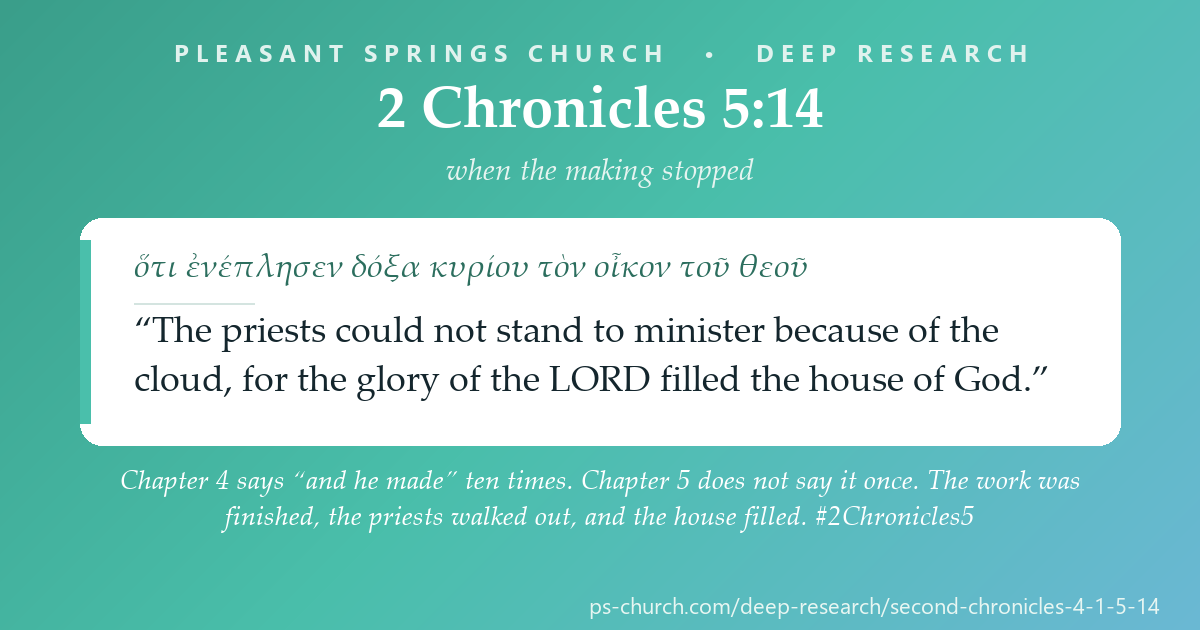
Ten times in twenty-two verses, 2 Chronicles 4 says וַיַּעַשׂ — and he made. A bronze altar thirty feet square. A sea of cast metal on twelve bronze oxen. Ten basins, ten lampstands, ten tables, a hundred gold bowls, two courts, doors plated in bronze. Chapter 5 does not use the verb once. It says instead that the work was finished, and then everything is carried: one verb of transport per verse, five verses running. And the last two verses of the passage use a third verb twice — מָלֵא, filled. Made, finished, carried, filled. Then there is what the measurement found, which nobody guessed in advance. Everyone calls these chapters a parallel to 1 Kings 7–8. Screen them verse by verse and the median run of consecutive shared Hebrew words is five — but run the same screen across the whole Solomon account and the number is not constant. It goes 2, 2, 1, 4, 5.5, 8, 5: lowest where the Chronicler describes the building, highest where he reports Solomon praying. The stonework the two books word differently; the prayer they word almost identically. And in the middle of the densest contact sits 2 Chronicles 4:9 — ten Hebrew words about a courtyard that share no two consecutive words with any other verse in the Hebrew Bible. This study works 2 Chronicles 4:1–5:14 in Hebrew, Septuagint and ESV, reports the tie band beside every run, prints four counter-examples against its own argument, and says what it could not check. See the method →
2 Chronicles 4:1–5:14 (sixteen of thirty-six verses)
Hebrew (Masoretic) · Greek (Rahlfs, Paraleipomenon B) · ESVAnd the emptiest thing in it is the ark. After twenty-two verses of bronze, gold, lampstands, tables and doors, 5:10 stops to say what was inside the one object all of it was built around: “nothing except the two tablets.”
Three things about the columns above. In the Septuagint this book is 2 Paraleipomena, “things omitted” — Παραλειπομένων Βʹ (Paraleipomenōn B). Numbering — and there is no offset in this passage. The Masoretic 2 Chronicles held for this study carries 822 verse units in 36 chapters; the CATSS Rahlfs text carries 833 verse units in 36 chapters. Chapters 4 and 5 have 22 and 14 verses in the Hebrew, in the Greek and in the ESV alike — measured chapter by chapter, not assumed. The book does diverge elsewhere, and the divergences are named: the English chapter 1 ends at verse 17 where the Hebrew runs to 18 (Hebrew 1:18 is English 2:1, and chapter 2 is one verse out of step all the way through); the English chapter 13 ends at 22 where the Hebrew has 23, so chapter 14 is one out of step; and on the Greek side, Rahlfs has 8 verses in chapter 27 to the Hebrew’s 9, and 31 each in chapters 35 and 36 to the Hebrew’s 27 and 23. Chapters 4 and 5 are clear of every one of them.
⚠️ Sixteen rows out of thirty-six verses. This page prints fewer than half of the passage. The verses not printed are 4:3–4, 4:7, 4:10–18, 4:20–21, and 5:2–4, 5:6, 5:8–9; several are named in the stages, and no measurement below is confined to the printed rows — every screen was run over all thirty-six.
⚠️ The passage overlaps two other pages on this shelf. On Mount Moriah reads 1:1–5:1 as a narrative and stops at the verse this page uses as its hinge; If My People begins at 5:2 and runs to the end of Solomon’s reign. Neither prints a verse of chapter 4 or of 5:2–14. This page is the measurement of the furnishings and the filling itself.
The Shape of the Passage
Sequence in six movements — made, finished, carried, emptied, sounded, filledBehind these two chapters stands a tent that had been carried for four hundred years (Exodus 37–38) and a threshing floor bought at full price (1 Chronicles 21:24). In front of them stands a prayer, a fire, and eventually an empty ruin — and a second temple with no ark in it at all.
Author
His verbal contact with 1 Kings is not at a constant distance, and that is measurable. Run the same verse-by-verse screen over the whole Solomon temple account and the median run of consecutive shared Hebrew words is not flat. It rises: 1 for the building of the house (2 Chronicles 3 against 1 Kings 6), 4 for the furnishings (chapter 4 against 1 Kings 7), 5.5 for the ark and the glory (chapter 5 against 1 Kings 8), 8 for Solomon’s prayer (chapter 6 against 1 Kings 8). Where the subject is architecture the two books share almost no wording; where it is the prayer they share nearly all of it. No direction is claimed by that sentence — it says where the wording is shared, not who wrote first. Stage 4 prints the whole table, and the caveats that go with it.
The musicians stand at the exact moment the glory comes, and 1 Kings has none of them. 1 Kings 8:10 has the priests come out and the cloud fill the house, in one verse, with no singers anywhere. 2 Chronicles covers the same moment in four verses: the suspended rota (5:11), the named guilds and the 120 trumpets (5:12), the one sound and the antiphon (5:13), and only then the cloud. The screen shows the seam: 5:12 reaches a run of two against the entire Hebrew Bible, and the only two verses it reaches are elsewhere in Chronicles.
And the two books part company on one word at the very end. 2 Chronicles 5:14 and 1 Kings 8:11 run nine consecutive words together and then diverge on the last word: Kings has the glory filling the house of the Lord, Chronicles the house of God. That is not a one-off flourish — בֵּית הָאֱלֹהִים is his standing idiom, 29 times across his two books and never once in 1 Kings — which is exactly why it is worth noticing that the two sentences part company on that word. (They part on one other, and the 5:14 row says so: Chronicles spells laʿamōd full where Kings spells it short.)
Audience
People whose temple had no ark in it. Whoever first read 5:10 — “there was nothing in the ark except the two tablets” — was standing in, or remembering, a second temple whose Most Holy Place was empty. A book that lingers on what the ark contained is speaking to readers for whom the ark itself is gone. It does not say so. It just keeps describing.
People who were the singers. The Levitical guilds named at 5:12 — Asaph, Heman, Jeduthun — are the guilds attested as functioning in the Second Temple, and the antiphon at 5:13 is the same one Ezra 3:11 puts in the mouths of the men laying the second temple’s foundation. The Chronicler is telling the choir where their part came from.
And people who needed to hear that the making stops. A community rebuilding an institution measures itself by output. These two chapters spend twenty-two verses on output, name every object, count every one, and then say the work was finished and the priests had to leave the room. Nothing in the passage suggests the craftsmanship caused the cloud.
Orient on the temple furnishings, the molten sea, the courts, the bread of the Presence, the Levitical singers, and the kabod.
Search by topic: temple, Solomon’s; molten sea; bronze altar; laver; lampstand; bread of the Presence; court of the temple; Huram-abi; ark of the covenant; cherubim; glory of God (kabod); music, Levitical; Asaph; Heman; Jeduthun; Chronicles, books of.
Which articles are relevant?
- Anchor Bible Dictionary — “Temple, Jerusalem,” “Sea, Molten,” “Altar,” “Laver,” “Bread of the Presence,” “Cherubim,” “Glory of God,” “Music and Musical Instruments,” “Asaph,” “Chronicles, Books of.”
- Dictionary of the OT: Historical Books (IVP) — “Temple,” “Solomon,” “Worship and Liturgy,” “Levites,” “Chronicler’s History.”
- NIDOTTE / TDOT — עָשָׂה (ʿāśāh, make, do), מָלֵא (mālēʾ, be full, fill), כָּבוֹד (kābōd, glory, weight), עֲזָרָה (ʿăzārāh, court, ledge), חֶסֶד (ḥesed, steadfast love).
- On the Greek — the NETS introduction to 2 Supplements, particularly on this translator’s handling of technical architectural vocabulary, which is what makes 4:9 look different in the two columns above.
Bibliography surfaced:
- Sara Japhet, I & II Chronicles (OTL); Gary N. Knoppers, 1 Chronicles (Anchor Yale, for the method); Ralph W. Klein, 2 Chronicles (Hermeneia); H. G. M. Williamson, 1 and 2 Chronicles (NCBC); Carol Meyers on the temple furnishings.
- For the synoptic question, any edition that prints 2 Chronicles beside 1 Kings in parallel columns. Read the columns before reading anybody’s account of them.
What a temple was for in this world, what a bronze sea was doing in a courtyard, and how the later witnesses describe the same liturgy.
First the world: Levantine temple plans, water basins, cast bronze at scale. Then Ben Sira, who describes this exact liturgy as a thing he had watched, and Josephus, who cannot resist telling you how much everything weighed.
Which parallels shed light on these chapters?
The building is an ordinary Levantine temple, and the inventory is not. The three-room long-house plan — porch, main hall, innermost room — is the standard sacred architecture of the region, and the excavated temple at Tell Ta’yinat — in the Amuq plain of south-eastern Turkey, on the north Syrian cultural fringe — is the closest known plan to the one Kings and Chronicles describe. What has no obvious parallel is what is not in the innermost room. A temple of this shape anywhere else in the ancient Near East houses an image. This one houses a box, and 5:10 pauses to tell you the box is empty except for two stone tablets.
A bronze sea of this size is a metallurgical claim, not a decorative one. Ten cubits across, a handbreadth thick, cast in one piece and standing on twelve bronze oxen: 4:17 says it was cast in the clay ground of the Jordan plain, and 4:18 says the weight of the bronze was never worked out. Large-scale bronze casting in clay moulds is attested in the Iron Age Levant, and the volume of metal here is at the top of what is plausible. Whether the sea meant anything — a cosmic ocean, a reservoir, both — is not stated by either book. Chronicles supplies the only functional note anywhere: it was for the priests to wash in (4:6). Everything beyond that is interpretation, and this page marks it as such.
The courts are where the ordinary worshipper actually stood. 4:9 distinguishes a court of the priests from a great court with bronze-plated doors between them. That two-court arrangement, with graded access, matches what is known of Second-Temple practice and is exactly the arrangement Revelation 11:2 assumes when it tells John to leave out “the court outside the temple.”
- Sirach 50:16–21 (Second-Temple — a witness, not Scripture) — Ben Sira watching the liturgy in his own day: “then the sons of Aaron shouted, they blew their trumpets of hammered metal… and the singers praised him with their voices.” The Greek word he uses for the singers is οἱ ψαλτῳδοί — the same word the Greek of 2 Chronicles 5:12 uses for the Levitical singers (run of 2 between the two verses; the phrase is short and the page does not inflate it). This is the closest thing the corpus holds to an eyewitness of the service 2 Chronicles 5 describes.
- Josephus, Antiquities 8.3 (a witness, not Scripture) — the furnishings retold at length, with weights, quantities and a good deal of enthusiasm. ⚠️ Josephus is not held on this shelf as machine-readable text, so nothing here is measured against him and no number of his is quoted; he is cited as a witness to how a first-century Jewish writer handled this inventory, and no more.
- Josephus, Antiquities 8.4 — the ark brought in, the priests unable to stand, and the cloud. Josephus expands the moment considerably and offers his readers an account of what the cloud was. Notice what the biblical text does instead. 2 Chronicles 5:13–14 reports an effect — the house filled, the priests unable to stand — and stops. It explains nothing, and neither does this page.
- Letter of Aristeas 83–99 (Second-Temple — a witness, not Scripture) — a description of the temple, its water system and its service, by a writer who wants you impressed. Useful for what a Hellenistic Jewish reader assumed a temple courtyard looked like, and cited for that and nothing more — it is not held here as searchable text and nothing was measured against it.
- Ancient Near Eastern temple-building inscriptions (royal self-presentation — witnesses, not Scripture) — Gudea of Lagash and the Neo-Assyrian building accounts, for the convention this chapter is working inside: a king lists what he made, in order, with quantities.
What is written. 2 Chronicles 4:1 records the making of a bronze altar twenty cubits square and ten high. It is the first object in the chapter and the largest single item in the courtyard.
What is not written — in Kings. The 1 Kings account of the furnishings runs from 7:13 to 7:51 and never records the altar being built. It mentions a bronze altar later, in passing, at 1 Kings 8:64 and 2 Kings 16:14 as a thing that exists, and 1 Kings 9:25 calls it הַמִּזְבֵּחַ אֲשֶׁר בָּנָה, “the altar that he built to the Lord” — a relative clause, not a construction notice. The verse that records the altar being made, with its dimensions, is in Chronicles and nowhere else.
What that is worth, measured. Screened against every other verse in the Hebrew Bible, 2 Chronicles 4:1 reaches a run of three words, tie band 2, and the two verses it reaches are 1 Kings 6:2 and 6:3 — where the same measuring formula is used of the house. In other words the screen finds no counterpart, only a shared way of stating dimensions.
What gets built in the gap. Two standing explanations: that Kings lost a verse, or that Chronicles supplied one. Both are arguments about a text nobody has. This page reports that the verse is in one book and not the other, and does not tell you which way the difference ran.
One verb that stops, one verb that starts, a noun that leaves a verse stranded, and a formula sung nine times.
Count וַיַּעַשׂ across the whole book before claiming anything about chapter 4. Then find every occurrence of עֲזָרָה and of the antiphon, and let the tie bands say which of them is distinctive and which is liturgy.
“And he made.” Ten times in chapter 4 and not once in chapter 5 — the single hardest fact on this page, and it takes no interpretation to establish. Across the whole of 2 Chronicles the form stands 45 times in 42 verses; chapter 4 is 22 per cent of them in 2.7 per cent of the book. The Greek keeps the drumbeat with καὶ ἐποίησεν. What follows the last one is not another making but וַתִּשְׁלַם (5:1), it was finished.
“To be full, to fill.” The passage’s last verb, twice in two verses: the house filled with cloud (5:13) and the glory filling the house of God (5:14). The exact sequence מָלֵא כְבוֹד־יְהוָה אֶת־בֵּית — ‘the glory of the Lord filled the house of’ — occurs four times in the Hebrew Bible: 1 Kings 8:11, Ezekiel 44:4, and 2 Chronicles 5:14 and 7:2. It is temple vocabulary. ⚠️ Exodus 40:34–35, which everybody pairs with this scene, is not one of the four — because Exodus fills the tabernacle (מִשְׁכָּן) and not a house. Measured, 2 Chronicles 5:14 against Exodus 40:35 is a run of 1.
The “great court.” A rare architectural noun, and the reason 4:9 stands alone. In the sense of an enclosure or ledge it occurs at 2 Chronicles 4:9 (twice) and 6:13 and then only in Ezekiel 43:14 (three times), 43:17, 43:20 and 45:19, where it is the ledge of the altar — nine occurrences in six verses in the whole Hebrew Bible. Its consonants are identical to the noun עֶזְרָה, help — though that homograph is not what makes 4:9 look connected: of the 515, וַיַּעַשׂ supplies 230 verses and הַכֹּהֲנִים 173, while the two עֲזָרָה forms supply six between them. 4:9 shares single words with 515 verses of the Hebrew Bible and two consecutive words with none of them. The Greek does not distinguish the two nouns at all: both חָצֵר and עֲזָרָה become αὐλή, and the Greek verse is not isolated.
“As one… one sound.” The trumpeters and the singers are said to be as one and to make one sound — two separate expressions of unison in a single clause. 1 Kings has no musicians in this scene, so the phrase has no counterpart to be compared with. The Greek doubles it too: μία φωνή at the head of the verse and φωνῇ μιᾷ a few words later.
“For he is good, for his steadfast love endures forever.” The exact word sequence occurs nine times in the Hebrew Bible — Psalms 106:1, 107:1, 118:1, 118:29, 136:1, 1 Chronicles 16:34, Ezra 3:11, 2 Chronicles 5:13 and 7:3. Run of 6 with a tie band of 8, which is the correct reading of it: this is a fixed liturgical formula, not a quotation of any one psalm, and the page does not claim that Chronicles is citing Psalm 136 or the reverse. Ezra 3:11 is worth pausing on: the same words sung at the laying of the second temple’s foundation, by people who could remember the first.
“The bread of the Presence” — literally bread of the face. The Greek here is ἄρτοι προθέσεως, and that exact two-word sequence occurs once in all the Greek Old Testament files held here: this verse. ⚠️ And it produces the page’s most instructive failed run — see Stage 4 on Mark 2:26.
Four things reported rather than tidied:
- The ‘he made’ count is a count, not a theme imposed on the text. Ten occurrences in chapter 4, zero in chapter 5, 45 in the book. Anyone can re-derive it from a concordance in ten minutes, and the page would rather be checked than believed.
- What 4:9’s zero means, said plainly. On the Hebrew-side convention this shelf uses for passage screens, a maximum of 0 means the verse shares no two consecutive words with any other verse in the Hebrew Bible. It does not mean the verse shares no words: run the same screen with the unigram convention and 4:9 reports 1, against 515 verses. Two different zeroes, and the page says which one it is using.
- 4:9 is rare, and it is not unique. Twelve of the 822 verses in 2 Chronicles come out at 0 on this screen — 3:9, 4:9, 11:9, 13:13, 15:3, 17:8, 20:11, 20:30, 26:14, 28:17, 29:26 and 30:11. That is 1.5 per cent of the book. 4:9 is the only one in this passage, and it sits in the two chapters with the densest verbal contact with Kings, which is what makes it worth printing — but “one of twelve” is the honest frame, not “the only verse in the book.”
- “Ten tables” and “ten lampstands” are not harmonised here. Exodus prescribes one table and one lampstand; 1 Kings 7:48–49 records one table and ten lampstands; 2 Chronicles 4:7–8 has ten of each, and 4:19 then speaks of “the tables” in the plural. Several harmonisations are on offer and none of them is measurable. The page prints the numbers as the texts give them.
The measurement this page was built on — and four printed counter-examples that keep it honest.
Every verse of 2 Chronicles 4 and 5 against every verse of 1 Kings 6–8 in Hebrew, counting the longest run of consecutive identical consonantal word forms. Then the same rows against the whole Masoretic corpus with tie bands. Then the same screen over the neighbouring chapters, to see whether the Chronicler’s distance from Kings is constant. Then the Greek against the Greek New Testament. Then the counter-examples.
First: the passage against 1 Kings.
Thirty-six verses, and the median run is five words. Set 2 Chronicles 4–5 beside 1 Kings 6–8, verse against verse, best match:
- 2 Chronicles 4 vs 1 Kings 7 — 22 rows. Median run 4, mean 4.82, longest 14 (4:4 against 1 Kings 7:25). Seven of the twenty-two sit at three or below.
- 2 Chronicles 5 vs 1 Kings 8 — 14 rows. Median run 5.5, mean 6.57, longest 17 (5:7 against 1 Kings 8:6, tie band 1 against the whole Hebrew Bible). Four of the fourteen sit at three or below.
- Both together — 36 rows, median 5, mean 5.61, longest 17. Ten rows fall at three or below. Four of them collapse to a run of ONE — 4:6, 4:8, 4:9 and 5:12 — and all four are material 1 Kings does not have: the function of the basins and the sea, the ten tables, the courts, and the Levitical singers. 5:13, the antiphon, is at two. ⚠️ Two more rows sit at two and do NOT fit that account: 4:14 (the stands and their basins) and 4:21 (flowers, lamps and tongs) both DO have 1 Kings counterparts — 7:43 and 7:49 — and score low only because they are short list-verses worded differently. The collapse to one is a signal; the collapse to two is not.
That is the shape of the difference: where the two books cover the same ground the contact is dense, and where Chronicles is on his own the screen falls off a cliff inside a single verse.
Second — the finding this page was not expecting.
The obvious next question is whether that density is a constant. It is not. Run the identical screen over each chapter of the Solomon narrative against its counterpart in 1 Kings, and the medians make a slope:
- 2 Chronicles 1 vs 1 Kings 3 + 10 — 18 rows, median 2, longest 14.
- 2 Chronicles 2 vs 1 Kings 5 — 17 rows, median 2, longest 5.
- 2 Chronicles 3 vs 1 Kings 6 (building the house) — 17 rows, median 1, mean 1.76, longest 5. Fifteen of the seventeen rows fall at three or below.
- 2 Chronicles 4 vs 1 Kings 7 (the furnishings) — 22 rows, median 4, longest 14.
- 2 Chronicles 5 vs 1 Kings 8 (the ark and the glory) — 14 rows, median 5.5, longest 17.
- 2 Chronicles 6 vs 1 Kings 8 (Solomon’s prayer) — 42 rows, median 8, mean 8.26, longest 17. Only three of the forty-two rows fall at three or below.
- 2 Chronicles 7 vs 1 Kings 8–9 (the fire and the answer) — 22 rows, median 5, longest 10.
2 · 2 · 1 · 4 · 5.5 · 8 · 5
The Chronicler is furthest from Kings when he is describing a building and closest when he is reporting speech. The stonework the two books word differently; the prayer they word almost identically; and this passage sits on the rising part of the slope, between them. ⚠️ The honest limits of that sentence: seven medians on small samples, chapter boundaries chosen by the editors of both books and not by this page, and a screen that is cut by one changed particle. It is a description of where the verbal contact is dense, and it is not an argument about who wrote what first. No direction of influence is asserted anywhere on this page.
Third: scale — what other numbers this same screen produces.
A median of five means nothing until you know the range. The identical measurement, on pairs where the relationship is not in dispute:
- 2 Kings 19 vs Isaiah 37 — 37 rows. Median 9, mean 10.43, longest 21, and not one row falls at or below three. That is what a duplicate looks like on this screen. 2 Chronicles 6 (median 8) is nearly there. 2 Chronicles 3 (median 1) is nowhere near it.
- Psalm 18 vs 2 Samuel 22 — 51 rows. Median 3, mean 3.76, longest 11. ⚠️ The page’s standing counter-example. Nobody doubts these are one poem preserved twice, and they score below 2 Chronicles 4. A low median does not prove independence and a high one does not prove copying.
- 1 Chronicles 13 vs 2 Samuel 6 — 14 rows, median 3. Measured for The Breach Both Ways. The same author, the same kind of material, and a much looser result than chapter 5 here.
Fourth: the Greek New Testament screen, and what it does not find.
The 36 CATSS rows of 2 Chronicles 4–5 were screened against all 7,927 verses of the Greek New Testament, on word forms with the editions’ own spelling equivalences applied (ou/ouk/ouch, ek/ex, the movable nu). The result:
36 rows reach two · 30 reach three · 10 reach four · nothing reaches five
The deepest contact is a three-way tie on one phrase, and all three point at the same New Testament verse:
- 2 Chronicles 4:11, 4:16 and 5:5 ↔ Hebrews 9:21 — και παντα τα σκευη, “and all the vessels,” run of 4, tie band 1 in each case. Hebrews 9:21 is about a tent and the vessels of its worship being sprinkled with blood, and 2 Chronicles 5:5 is about a tent and its holy vessels being carried into a house. ⚠️ And here is the honest reading of it: the band of 1 is on the New Testament side only. The same four-word phrase stands 43 times in the Greek Old Testament files held here — including Exodus 30:27–28, 31:8, 35:13, 35:14, 35:16 and 40:9, which is the material Hebrews 9 is actually working from. A tie band cannot tell you a phrase is a commonplace on the source side.
- 2 Chronicles 4:19 ↔ Revelation 8:3 — το θυσιαστηριον το χρυσουν, “the golden altar,” run of 4, tie band 1. The phrase occurs six times in the Greek Old Testament held here (Exodus 40:5, 40:26; Numbers 4:11; 3 Kingdoms 7:34; 2 Chronicles 4:19; 1 Maccabees 1:21) and once in the New. Rare on both sides — and still just the ordinary name of a piece of furniture.
- 2 Chronicles 4:9 ↔ Revelation 11:2 — και την αυλην την, run of 4, tie band 1. Revelation 11:2 tells John to leave out “the court outside the temple”; 2 Chronicles 4:9 is the verse that builds a court outside the court. The graded courtyard is a real institutional fact shared by both, and the four-word run is four common words.
- 2 Chronicles 5:14 ↔ Matthew 12:4, Mark 2:26, Luke 6:4 and Hebrews 10:21 — τον οικον του θεου, run of 4, tie band 4. The phrase stands 16 times in the Greek Old Testament held here. Nobody would mistake this one for a citation, which makes it the right yardstick for the three above.
- 2 Chronicles 5:11 ↔ Mark 4:4, Luke 5:12, Luke 7:11 and thirteen others — και εγενετο εν τω, run of 4, tie band 16. Pure formula, printed so the band-1 runs above are read against something.
Fifth: four counter-examples, printed on purpose.
Every one of these cuts against something this page would like to say, and each is here so that the numbers above are not read as more than they are.
- ⚠️ 2 Chronicles 4:2 vs 1 Kings 7:23 — 18 of 20 words identical, run reported 10. The two verses differ in one preposition and one plene spelling. The screen halves the result because a run stops at the first difference. Every median on this page is depressed by exactly this effect, and the amount is unknown.
- ⚠️ 2 Chronicles 5:14 ↔ Revelation 15:8 — run of 2. “And the sanctuary was filled with smoke from the glory of God… and no one could enter the sanctuary” is the closest thing in the New Testament to what 5:14 describes, and the two verses share του θεου and nothing else consecutive. The screen finds verbatim contact. It does not find allusion, and this is what that limitation looks like.
- ⚠️ 2 Chronicles 5:10 ↔ Hebrews 9:4 — run of 1. Chronicles says there was nothing in the ark but the two tablets; Hebrews 9:4 says it held a golden urn of manna, Aaron’s staff that budded, and the tablets. One object, two inventories, and the run screen returns εν. A screen that measures shared word sequences is blind to a contradiction, and would be equally blind to an agreement stated in different words.
- ⚠️ 2 Chronicles 4:19 ↔ Mark 2:26 — run of 1, and it should be 4. 4:19 is the only verse in the Greek Old Testament held here with the sequence ἄρτοι προθέσεως, and Mark 2:26, Matthew 12:4 and Luke 6:4 all have τοὺς ἄρτους τῆς προθέσεως — the same bread, the same idiom. The run is 1, because the screen matches word forms and never lemmas, and the case endings and one article differ. The control proves it: LXX 1 Samuel 21:7, which happens to carry the phrase in the accusative, runs 4 with all three Gospel verses. The same relationship scores 1 or 4 depending on grammar alone.
And the cross-references that matter without any screen:
- Exodus 37–38 — the tabernacle furnishings, made by Bezalel, in the same list-and-quantity form. 2 Chronicles 5:5 carries that tent into this building and stops mentioning it.
- Exodus 40:34–35 — “the cloud covered the tent of meeting, and the glory of the Lord filled the tabernacle, and Moses was not able to enter.” The scene 5:13–14 is plainly rhyming with. Measured, the two verses share one consecutive word, because Exodus fills a tabernacle and Chronicles a house. The rhyme is real; the wording is not shared.
- Ezekiel 43:5 and 44:4 — “the glory of the Lord filled the house.” These, not Exodus, are where 5:14’s exact phrase lives: 5:14 runs 5 with Ezekiel 44:4 and 3 with 43:5. A prophet in exile describing a temple he is being shown uses the wording Chronicles uses of the temple that had been pulled down.
- 2 Chronicles 7:1–3 — the second filling, a chapter and a half later, with fire this time, and the same antiphon sung again. 5:14 and 7:2 are the two occurrences in this book of “the glory of the Lord filled the house of…” — and they end on different words, 5:14 with God and 7:2 with the divine name.
- Ezra 3:10–11 — the foundation of the second temple, laid with trumpets and cymbals and the guilds of Asaph, and the same nine-word antiphon. The liturgy in 2 Chronicles 5:12–13 is the liturgy Ezra 3 describes being performed on rubble.
- 1 Kings 8:1–11 — the passage this one runs beside. Read it in a parallel column before reading anybody’s account of the differences, including this page’s.
Where the scholarship stands, what this page could not check, and where it is weakest.
The commentaries first. Then, plainly, the limits of everything above — because the measurements on this page are only as good as the corpora they ran on and the questions they were asked.
Commentaries & studies:
- Sara Japhet, I & II Chronicles (OTL) — the standard treatment of the Chronicler’s handling of his sources and of the additions in chapter 5.
- Ralph W. Klein, 2 Chronicles (Hermeneia) — the technical text-critical work, including the Greek and the numerical divergences at 4:5.
- H. G. M. Williamson, 1 and 2 Chronicles (NCBC) — concise and reliable on the synoptic relationship.
- Carol L. Meyers on the temple furnishings and on the molten sea — the standard entry point for the archaeology and metallurgy behind chapter 4.
- On the Greek: the NETS 2 Supplements introduction, and Leslie Allen’s work on the Greek Chronicles, for how this translator handles technical vocabulary — directly relevant to 4:9 and 4:22.
What this page could NOT check — stated plainly.
- No Qumran material was consulted, and it bears directly on Stage 4. The Hebrew of Samuel–Kings circulating in antiquity was not always the Masoretic text, and where it differed the medians on this page would move. Every run figure above was measured against the Masoretic 1 Kings and nothing else. How much that matters here is unknown and the page will not estimate it.
- The rising-slope finding is seven numbers. Seven medians, on chapters of 14 to 42 verses, with boundaries drawn by ancient editors rather than by the question being asked. It is a real pattern in the data held; it is not a demonstrated law of the Chronicler’s method, and a different segmentation could soften or sharpen it. This is the weakest load-bearing claim on the page and it is labelled as such.
- The screen is cut by a single word, and the cost is unmeasured. 4:2 against 1 Kings 7:23 is 18 of 20 words identical and reports 10. Every median here is depressed by that effect by an unknown amount, and the Psalm 18 / 2 Samuel 22 control is printed above precisely so no reader takes a low number for independence.
- The Greek Old Testament corpus is what is on disk, not the Septuagint entire. The counts of “43 times,” “six times” and “16 times” in Stage 4 are counts over 64 CATSS files, 30,637 verse units held — of which a run screen sees 30,348, because the Odes are excluded (Ode 9 is Luke 1 and Ode 13 is Luke 2 copied into a Greek Old Testament manuscript, and ten more Odes are second copies of Exodus 15, Deuteronomy 32, 1 Samuel 2, Habakkuk 3, Isaiah 26, Jonah 2, Daniel 3, Isaiah 5 and Isaiah 38 — counting them would double-count the same Greek). Where a book is not held, a zero would mean “not searched.”
- No manuscript was consulted. Hebrew from a digital edition of the Masoretic Text (Sefaria, Miqra according to the Masorah); Greek from the CATSS digitization of Rahlfs. Rahlfs is an eclectic edition and not a manuscript, and where this page says “the Greek,” it means that edition. The Greek of 1 Kings in particular has a chapter 7 in a different order from the Hebrew, and this page cites it by the CATSS numbering.
- Archaeology is used for orientation only. Nothing on this page depends on the Tell Ta’yinat plan, on the metallurgy of the sea, or on any identification of a site. No object described in 2 Chronicles 4 has been excavated.
- The Second-Temple witnesses were read in translation and in the Greek held here. Sirach 50 is in the CATSS corpus and the ψαλτῳδοί overlap was measured; Josephus and Aristeas were not screened at all — they are not held as machine-readable text on this shelf, and their use above is citation, not measurement.
Live questions, named as questions:
- Why 1 Kings has no construction verse for the bronze altar — open. Homoioteleuton in the transmission of Kings, deliberate abbreviation, and a Chronicler supplying what he thought must have been there are all live proposals. Two of the three require a text nobody has.
- Three thousand baths or two thousand — unsettled. Masoretic Chronicles and Greek Chronicles say three thousand; Masoretic Kings says two thousand; Greek Kings gives no figure. Four witnesses, three answers, and this page does not choose.
- Whether the Chronicler had musicians in his source or added them — not decidable here. The screen shows 5:12–13 has no verbal contact outside Chronicles. That is consistent with an addition and equally consistent with a source Kings did not use.
- What עֲזָרָה actually designates — imprecise. A court, an enclosure, a ledge: the nine occurrences, spread over six verses, do not agree well enough to fix it, and the Greek collapses it into αὐλή.
- Whether ‘the priests, the Levites’ at 5:5 is one class or two — a standing question. The Hebrew apposition is genuinely ambiguous and the Greek resolves it one way. The page prints both.
Ten times he made it, and then he had to leave the room.
Name what you learned, why it matters, and one concrete response.
What should we carry away — and do?
- The making stops. Ten times in chapter 4 “and he made”; not once in chapter 5. Between the last thing built and the glory arriving there is a verse that simply says the work was finished. The text puts a full stop where we would put another project.
- The most valuable object in the building was the emptiest. Twenty-two verses of gold and bronze, and then: “there was nothing in the ark except the two tablets.” The centre of the whole structure held two stones with words on them and no image at all.
- They were together before the cloud came, and the text says so twice. “As one” and “one sound” in a single verse, and every priest present consecrated without regard to whose week it was. The rota was suspended before the glory arrived.
- The last thing anybody sang was not about the building. “For he is good, for his steadfast love endures forever” — nine occurrences in the Hebrew Bible, and one of them is sung by men laying the foundations of a far poorer temple, on the ruins of this one (Ezra 3:11).
- One concrete response. Name one thing you have been building for God that is finished, or finished enough, and stop working on it this week. Chapter 4 is twenty-two verses of competent craftsmanship, and the priests still had to walk out of the room before anything happened.
2 Chronicles 5:14 · to share
Hebrew + Greek (Rahlfs, Paraleipomenon B) + ESVEvery Deep Research page traces its passage across the whole sweep — the Old Testament, the Second-Temple world between the testaments (historical witnesses, not Scripture), and the New Testament. Follow the thread:
Pleasant Springs Church — Deep Research
Research method after Michael S. Heiser’s Bible Research Method (examine dictionaries → ancient literature → important words → textual connections → academic publications → share), with the Pleasant Springs “Author & Audience” foundation. Scripture set in the Hebrew, the Greek editions named on each page and the ESV (Old Testament), and the Greek New Testament and the ESV (New Testament), per the practice of Pleasant Springs Church. 2 Chronicles 4–5 research grounded in Japhet (OTL), Klein (Hermeneia), Williamson (NCBC) and Meyers on the furnishings. Book name: in the Septuagint this book is Paraleipomenon B, Παραλειπομένων Βʹ; the Hebrew title is דִּבְרֵי הַיָּמִים. Text: Hebrew from the Masoretic Text (Sefaria, Miqra according to the Masorah), section markers and paseq stripped and the qere printed at 5:12 and 5:13; Greek from the CATSS digitization of Rahlfs’s Septuaginta, printed without editorial punctuation and with proper names unaccented; English ESV. Versification — measured, and there is no offset in this passage: the Masoretic 2 Chronicles held here carries 822 verse units in 36 chapters and the CATSS text carries 833 in 36; chapters 4 and 5 have 22 and 14 verses in Hebrew, Greek and English alike. Elsewhere in the book the numbering does part company — English 1 ends at verse 17 where the Hebrew has 18, so Hebrew 1:18 is English 2:1 and chapter 2 runs one verse out of step; English 13 ends at 22 where the Hebrew has 23, so chapter 14 runs one out of step; and Rahlfs has 8 verses in chapter 27 to the Hebrew’s 9, and 31 each in chapters 35 and 36 to the Hebrew’s 27 and 23 — and this passage is clear of every one of them. Measurement: Hebrew runs are contiguous runs of whole consonantal word forms (never lemmas, never roots), cantillation and vowel points removed, final forms folded, maqqef treated as a separator; Greek-against-Greek runs apply the editions’ own spelling equivalences (ou/ouk/ouch, ek/ex, the movable nu), so figures here are higher than any published before 30 August 2026 and were re-measured for this page rather than copied from a sibling. Greek Old Testament counts are over 64 CATSS files, 30,637 verse units held, of which a run screen sees 30,348 because the Odes are excluded; Hebrew screens run over the 39-book Masoretic corpus, 23,204 verse units; Greek New Testament counts are over all 7,927 verses of SBLGNT via MorphGNT. ⚠️ Every run is printed with its tie band, and the page prints four counter-examples against itself: 2 Chronicles 4:2 and 1 Kings 7:23 are 18 of 20 words identical and score 10; 5:14 and Revelation 15:8 describe the same thing and score 2; 5:10 and Hebrews 9:4 give different contents for the same ark and score 1; and 4:19 and Mark 2:26 name the same bread and score 1, where LXX 1 Samuel 21:7 scores 4 on grammar alone. ⚠️ The zero at 4:9 is stated in its own convention: on the Hebrew-side screen 0 means the verse shares no two consecutive words with any other verse in the Hebrew Bible; it does share single words, with 515 verses, and it is one of twelve such verses in 2 Chronicles, not the only one. ⚠️ No direction of influence is asserted anywhere, and the Qumran Samuel–Kings material, which bears on the comparison, is not held here and was not consulted. ⚠️ MT/LXX differences are printed, not smoothed: 4:5 has three thousand baths in Hebrew and Greek Chronicles, two thousand in Hebrew Kings and no figure at all in Greek Kings; 4:9 has two Hebrew nouns for the courts and one Greek word; 4:22 is divided differently in the two columns, the Greek beginning at the door with the basins, dishes and fire pans already standing at Greek 4:21; 5:5 has “the priests, the Levites” in Hebrew and “the priests and the Levites” in Greek; and 5:13 has the cloud alone in Hebrew and “a cloud of the glory of the Lord” in Greek, one verse before the Hebrew names the glory. The literary shape is labelled a five-movement sequence and explicitly not a chiasm; the 5:10 rung is marked as a hinge of sense and not as a positional centre. Second-Temple witnesses (Sirach 50; Josephus, Ant. 8; Letter of Aristeas) are read as witnesses and never levelled with Scripture. This page overlaps and does not duplicate On Mount Moriah (1:1–5:1) and If My People (5:2–9:31), neither of which prints a verse of chapter 4 or of 5:2–14.
Scripture quotations marked ESV are from the ESV® Bible (The Holy Bible, English Standard Version®), © 2001 by Crossway, a publishing ministry of Good News Publishers. ESV Text Edition: 2016. Used by permission. All rights reserved. The ESV text may not be quoted in any publication made available to the public by a Creative Commons license, and the ESV may not be translated in whole or in part into any other language. www.esv.org
|
Did this study bless you today? 💚 Give to Support PS Church100% of gifts go to the General Fund — thank you. |