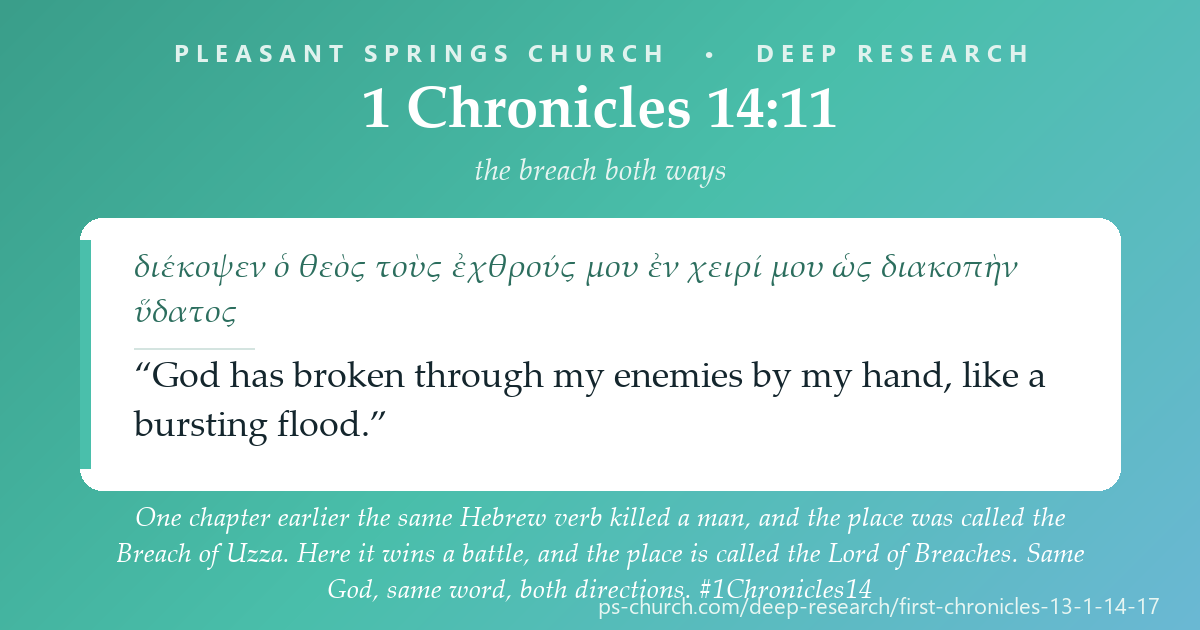
A man puts out his hand to steady the ark and dies on the road, and the place is named Perez-uzza — the Breach of Uzza, because “the Lord had broken out against him.” One chapter later the same king beats the Philistines and says, “God has broken through my enemies by my hand, like a bursting flood” — and that place is named Baal-perazim. One Hebrew root, fourteen verses apart, pointing in opposite directions. That is not a preacher’s connection: the root פרץ occurs fifteen times in 1 Chronicles; five are the clan name Perez and one is a family that increased (4:38), and every one of the remaining nine falls in four verses — two of which are these two. The Greek keeps the pun and translates both place names; English loses it entirely. And then there is what these chapters are supposed to be. Everyone calls 1 Chronicles 13–14 a parallel to 2 Samuel 6 and 2 Samuel 5. Put them on the screen verse by verse and the median run of consecutive shared Hebrew words is three — while 2 Kings 19 beside Isaiah 37 runs a median of nine and never once drops to three. Yet 64 to 69 per cent of these chapters’ words do occur in the Samuel counterpart. The vocabulary is shared and the sentences are not. This study works 1 Chronicles 13:1–14:17 in Hebrew, Septuagint and ESV, reports the tie band beside every run, prints its own counter-examples, and says what it could not check. See the method →
1 Chronicles 13:1–14:17 (sixteen of thirty-one verses)
Hebrew (Masoretic) · Greek (Rahlfs, Paraleipomenon A) · ESVThat is not an impression; it is a count. The root פרץ occurs fifteen times in 1 Chronicles. Five are the clan name Perez (2:4; 2:5; 4:1; 9:4; 27:3) and one is a family that increased (4:38). Every remaining occurrence — nine of them — falls in four verses: 13:2, 13:11 (three times), 14:11 (four times) and 15:13. The Greek follows it almost verse for verse: strip out διακόσιοι, “two hundred,” which merely shares letters, and the διακοπ- root in CATSS 1 Chronicles stands at 13:11 (three times), 14:11 (three) and 15:13 (once) — three of the same four verses (the Greek of 13:2 carries no form of it), and each place translated at the moment it is named rather than transliterated so that a Greek reader sees the pun and an English reader does not.
Three things about the columns above. In the Septuagint this book is 1 Paraleipomena, “things omitted” — Παραλειπομένων Αʹ (Paraleipomenōn A). Numbering — and there is no offset here to report. The Masoretic 1 Chronicles held for this study carries 943 verse units in 29 chapters; the CATSS Rahlfs text carries 930 verse units in the same 29 chapters, and the whole of that shortfall is thirteen verses the Greek does not have at all — 1:11–16, 1:18–23 and 16:24. Nothing is renumbered: every verse the Greek does carry sits at the Hebrew’s own number, so chapters 13 and 14 have 14 and 17 verses in the Hebrew, in the Greek and in the ESV alike. That was measured, not assumed. The English of this book does diverge from the Hebrew — but not here: the English chapter 5 stops at verse 26 where the Hebrew runs to 41, the English chapter 6 has 81 verses to the Hebrew’s 66, and English 12 has 40 to the Hebrew’s 41. Those three chapters are the whole of the divergence in 1 Chronicles, and this passage is clear of all of them.
⚠️ Sixteen rows out of thirty-one verses. This page prints just over half of the passage. The verses not printed are 13:2, 13:4–6, 13:13, 14:1, 14:3–7, 14:9, 14:12–13 and 14:16; several of them are named in the stages, and none of the measurements below is confined to the printed rows — every screen was run over all thirty-one.
⚠️ This page is the measured companion to another. According to the Rule reads 13:1–17:27 as a narrative and turns on 15:13. This one stops at 14:17 and asks a narrower question: what happens when these two chapters are put on the word-sequence screen against the 2 Samuel chapters everyone says they parallel. The answer was not what the writer of this page expected, and it is in Stage 4.
The Shape of the Passage
Sequence, hinged on one rootBehind these two chapters stand twenty years of an ark parked in a private house (1 Samuel 7:1–2) and a king who died because he consulted the wrong source (1 Chronicles 10:13–14). In front of them stands a second attempt done by the book, and a promise about a house.
Author
He writes with 2 Samuel in view and he does not transcribe it. That sentence is usually offered as an impression. On this page it is a measurement, and the measurement is in Stage 4: thirty-one verses put against 2 Samuel 6 and 2 Samuel 5, verse by verse, and the median stretch of consecutive shared Hebrew words is three. Meanwhile 64 to 69 per cent of the actual words of these chapters turn up somewhere in the Samuel counterpart. The vocabulary is shared and the sentences are not.
He frames the borrowed material with his own. The four verses that open chapter 13 — David consulting commanders and then the whole assembly — have no counterpart in 2 Samuel, and neither does 14:17 at the other end. Those are exactly the places where the word-level contact with Samuel collapses. It is a very ordinary compositional habit and it is visible in the numbers before anybody argues about it.
And he has a theme he will not let go of: asking. Chapter 10 ended with Saul dead because “he did not seek the Lord” and did inquire of a medium. Chapter 13 opens with David saying “we did not seek it in the days of Saul.” Chapter 14 has David inquiring of God twice in five verses and being answered both times — and the second answer is not the first. In Hebrew the verb for “inquire” and the name “Saul” are the same three consonants.
Audience
People who had the older book. A retelling that shares two thirds of its vocabulary with another text and almost never keeps five words in a row is written for readers who know the story and are meant to hear it said differently. The Chronicler is not filling a gap in his readers’ knowledge. He is putting the same events in his own sentences, in his own order.
People with no king, reading about a king being established. 14:2 — “the Lord had established him as king over Israel, and his kingdom was highly exalted for the sake of his people Israel” — is placed by this book after the ark disaster, in the gap where the ark is sitting in a stranger’s house and the king is too frightened to touch it. Whoever first read that had no throne of their own to look at.
And people who needed permission to ask twice. 14:10 and 14:14 are the only two occurrences of the verb וַיִּשְׁאַל in this book, and the whole point of the second is that God says something else. The instruction that worked last week is not automatically the instruction for this week. For a community rebuilding an institution from scratch, that is a working principle, not a devotional flourish.
Orient on the ark and how it was to be moved, on threshing floors, on inquiry of God, and on the two named places.
Search by topic: ark of the covenant; Kiriath-jearim; Uzzah; threshing floor; Obed-edom; Perez-uzzah; Baal-perazim; Rephaim, Valley of; balsam trees; Hiram of Tyre; inquiring of God; Urim and Thummim; Chronicles, books of.
Which articles are relevant?
- Anchor Bible Dictionary — “Ark of the Covenant,” “Uzzah,” “Obed-edom,” “Threshing Floor,” “Perez-uzzah,” “Baal-perazim,” “Rephaim, Valley of,” “Hiram,” “Chronicles, Books of.”
- Dictionary of the OT: Historical Books (IVP) — “Ark of the Covenant,” “David,” “Divination and Magic,” “Chronicler’s History,” “Philistines.”
- NIDOTTE / TDOT — פָּרַץ (pāraṣ, break out, burst through), דָּרַשׁ (dāraš, seek), שָׁאַל (šāʾal, ask, inquire), חָרָה (ḥārā, burn with anger), כּוּן (kũn, establish).
- On the Greek — the NETS introduction to 1 Supplements, and its notes on the translator’s handling of proper names, which is directly relevant to 13:7 and 14:11 above.
Bibliography surfaced:
- Gary N. Knoppers, 1 Chronicles 10–29 (Anchor Yale); Sara Japhet, I & II Chronicles (OTL); Ralph W. Klein, 1 Chronicles (Hermeneia); H. G. M. Williamson, 1 and 2 Chronicles (NCBC).
- For the synoptic question specifically, any edition that prints Chronicles and Samuel–Kings in parallel columns. Read the columns before reading anybody’s account of them.
How sacred objects were moved, what a threshing floor was, and what the later retellings did with a death nobody could explain.
First the world: processional images, carrying poles, and who was permitted to touch. Then watch Josephus, who cannot leave Uzza’s death bare — and supplies a reason this passage does not give.
Which parallels shed light on these chapters?
Moving a god was a guarded procedure everywhere in the ancient Near East. Mesopotamian and Egyptian cult images travelled on poles carried by consecrated personnel, and the rules about contact were strict. Israel’s ark is emphatically not a cult image — there is nothing inside it to look at — but the transport law works the same way: rings on the sides, poles through the rings, poles never removed (Exodus 25:12–15), and the Kohathites carry the holy things on their shoulders and do not touch them (Numbers 4:15; 7:9). The cart is the anomaly, and the text says whose idea a cart was: the Philistines built one to send the ark back (1 Samuel 6:7–8), and for them it worked.
A threshing floor is a public, level, elevated place — and this book keeps stopping at one. Grain was trodden and winnowed on open ground where the wind could take the chaff, which is why threshing floors sit on high, flat ground outside a town and why they turn up in the Bible as places where things get decided: Ruth’s (Ruth 3), the one at Chidon where Uzza dies (13:9), and Ornan’s, bought at full price later in this same book, which becomes the temple site. The Chronicler does not draw the line between them for you.
Hiram of Tyre is a real diplomatic fact, and 14:1 treats him as one. Cedar from Lebanon, Phoenician masons and carpenters: this is the ordinary machinery of a small Levantine state acquiring a capital, and Tyre’s timber trade is attested well outside the Bible. The verse is not making a theological point. It is telling you that the man whose ark procession had just failed was, at the same time, being recognised by his neighbours.
- Josephus, Antiquities 7.4.2 (§§81–85) (Second-Temple — a witness, not Scripture) — the death of Uzza retold, with a motive supplied that no biblical text supplies: that he was not a priest and touched the ark anyway. Notice what that does. It moves the fault off the procession and onto the man who died. 1 Chronicles itself, two chapters on, puts it in the first person plural — “we did not seek him according to the rule” (15:13) — with the king included.
- Josephus, Antiquities 7.4.1 (§§76–77) — on the Philistine campaigns and the Valley of Rephaim. He keeps the two engagements and the second, different, instruction.
- b. Sotah 35a (rabbinic-era — a witness, not Scripture) — the discussion of Uzza, including the argument that the ark carried its own bearers and therefore never needed steadying. Cited as homiletic reasoning, which is what it is.
- Ancient Near Eastern royal building inscriptions (royal self-presentation — witnesses, not Scripture) — for the convention behind 14:1: cedar, foreign craftsmen and a palace are how a king in this world announced that he had arrived.
What is written. The oxen stumbled. Uzza put out his hand to the ark. God struck him and he died there. David was angry, and then afraid, and stopped for three months. That is the whole record.
What is not written. Not his tribe. Not his motive. Not one word about his character. The text does not call him presumptuous, irreverent or faithless. His father Abinadab had housed the ark for twenty years, which can be read as an argument that he above all should have known, or as an explanation of why a thing you live beside stops being frightening. Scripture declines to choose, and so does this page.
What gets put in the gap. Josephus makes it about status. A great deal of preaching makes it about the heart. Both arrive at a more comfortable God, and both require inventing an inner life for a man of whom one gesture is recorded. When 1 Chronicles finally does explain, at 15:13, it points at the cart and the procedure and says we.
And the anger is left standing. 13:11 says David was angry, and the Hebrew uses the identical verb it used one verse earlier for God’s anger. Nobody in the narrative corrects him. Three months later he goes back and does it properly. A study that hurries past verse 11 to reach the lesson has skipped the part where a man is permitted to be furious and obedient in that order.
One root that breaks both ways, one verb that is also a king’s name, and a tree nobody can identify.
Count pāraṣ across the whole book before deciding whether the two named places belong together. Then follow the consonants שאל from chapter 10 into chapter 14 and watch what happens to them.
“To break out, burst through, breach a wall.” The hinge of the whole passage, and the count is exact. The root occurs fifteen times in 1 Chronicles; five are the clan name Perez and one is the family that increased at 4:38. The other nine sit in four verses — 13:2 (נִפְרְצָה — a hard form, construed as “let us spread out” or “let us send abroad,” and this page does not adjudicate it), 13:11 three times, 14:11 four times, and 15:13 once. God breaks out against Israel at Perez-uzza and breaks through for Israel at Baal-perazim. The Greek carries it in three of those four verses with διακόπτω / διακοπή — not at 13:2 — and translates both place names at the moment they are named, so the pun that dies in English survives in Greek.
“To ask, inquire.” וַיִּשְׁאַל occurs exactly twice in 1 Chronicles, and both are in chapter 14 — both of God, both answered, and the second answer contradicts the first. And the consonants are the point. שאל is also the name Saul. In chapter 10 the name stands twelve times and then, in 10:13, the verb: Saul died “because he consulted (לִשְׁאוֹל) a medium.” 13:3 names Saul once more. Then chapter 14 gives the verb back to David, aimed the right way. The Greek cannot carry this at all — it has Σαουλ for the name and ἐπηρώτησεν / ἠρώτησεν for the verb.
“To seek, resort to, consult.” The Chronicler’s master verb, eight occurrences in 1 Chronicles, three of them in this cluster. The precise form דְרַשְׁנֻהוּ — we sought him — occurs twice in the entire Hebrew Bible: 13:3 and 15:13, both negated, both from David. It is the same verb that closed Saul’s life at 10:14. The Greek uses ζητέω throughout — and then at 14:8 uses it of the Philistines seeking David.
“To burn, be kindled” — of anger. The Hebrew uses one verb twice in two verses: “the anger of the Lord was kindled (וַיִּחַר) against Uzza” (13:10), and then “and it burned to David” (וַיִּחַר לְדָוִיד, 13:11). The repetition is deliberate and it is uncomfortable: David’s anger is described in the same words as God’s. The Greek breaks the pair — ἐθυμώθη ὀργῇ κύριος for God, but ἠθύμησεν Δαυιδ for David, from ἀθυμέω, to lose heart. In Greek David is not angry; he is dejected.
“To establish, set firm.” “David knew that the Lord had established (הֱכִינוֹ) him as king over Israel.” The verse is placed where it is placed: after a man has died on the road and before anything has been put right. The Greek is ἡτοίμασεν / ἡτοίμησεν, “prepared.”
The trees David is told to go round behind. Nobody knows what they were. “Balsam” is a convention of English Bibles, not a translation; the word occurs only here and in the parallel at 2 Samuel 5:23–24, and its resemblance to the root for weeping has kept a long homiletic tradition alive without settling anything. The Greek translator did not know either and guessed τῶν ἀπίων, pear trees. This page reports the uncertainty rather than preaching the weeping.
Three things reported rather than tidied:
- The שאל wordplay is real in Hebrew and untranslatable. It is a fact about the consonantal text that the name Saul and the verb inquire are spelled alike, and a fact that 1 Chronicles puts both in one verse at 10:13. It is not a fact that the Chronicler intended a pun, and this page does not claim he did. What it claims is what can be counted: וַיִּשְׁאַל occurs twice in the book, both in chapter 14, and the root stands as a verb in only three other verses of 1 Chronicles — 4:10, 10:13 and 18:10.
- “Balsam trees” is a guess with a long history. The Hebrew בְּכָאִים appears here and in 2 Samuel 5 and nowhere else. Ancient and modern translators have offered balsams, mulberries, poplars and pears, and the Greek here has ἀπίων. Anything preached on the “valley of weeping” from this verse is built on an assonance, not on a known meaning.
- “Baal-perazim” contains the word baal, and the text is unembarrassed by it. Baʿal is an ordinary Hebrew noun for owner or master before it is the name of a god, and the place name reads as “master of breaches.” Whether the site had older associations is not something these two chapters address; what they do address is 14:12, where the Philistine gods are left on the field and burned.
The measurement this page was built on — what happens when two “parallel” chapters go on the word-sequence screen.
Every verse of 1 Chronicles 13 against every verse of 2 Samuel 6, and every verse of 1 Chronicles 14 against every verse of 2 Samuel 5, in Hebrew, counting the longest run of consecutive identical consonantal word forms. Then the same passage against the whole Masoretic corpus with tie bands. Then the Greek against the Greek New Testament. Then — because a number means nothing without a scale — three control pairs.
First: what the screen found.
Thirty-one verses, and the median run is three words. Set 1 Chronicles 13 beside 2 Samuel 6 and 1 Chronicles 14 beside 2 Samuel 5, verse against verse, and this is the profile:
- 1 Chronicles 13 vs 2 Samuel 6 — 14 rows. Median run 3, mean 3.29, longest 9 (13:14 against 2 Samuel 6:12). Ten of the fourteen rows sit at three or below.
- 1 Chronicles 14 vs 2 Samuel 5 — 17 rows. Median run 2, mean 3.12, longest 6 (14:2 against 5:12, and 14:8 against 5:17). Eleven of the seventeen rows sit at three or below.
- Both together — 31 rows, median 3, mean 3.19, longest 9. Only five rows in the whole passage reach five consecutive shared words.
And yet the words themselves are almost all there. Of the 213 Hebrew word tokens in 1 Chronicles 13, 136 — 63.8 per cent — occur somewhere in 2 Samuel 6. Of the 197 tokens in 1 Chronicles 14, 135 — 68.5 per cent — occur somewhere in 2 Samuel 5. Counting distinct forms rather than tokens: 74 of the 139 distinct forms in 1 Chronicles 13 (53 per cent) occur in 2 Samuel 6, and 89 of the 131 in 1 Chronicles 14 (68 per cent) occur in 2 Samuel 5. The vocabulary is shared and the sentences are not.
Second — and this is the part that keeps the first honest — three controls.
A median of three means nothing until you know what other numbers this same screen produces. So the identical measurement was run on three pairs where the relationship is not in dispute:
- 2 Kings 19 vs Isaiah 37 — 37 rows. Median 9, mean 10.43, longest 21, and not one row falls at or below three. That is what a duplicate looks like on this screen.
- 1 Chronicles 17 vs 2 Samuel 7 — 27 rows. Median 5, mean 5.26, longest 12; 14 of the 27 reach five or more. Inside Chronicles itself, the oracle chapter sits far closer to its Samuel counterpart than chapters 13 and 14 do to theirs.
- Psalm 18 vs 2 Samuel 22 — 51 rows. Median 3, mean 3.76, longest 11. ⚠️ This is the page’s own counter-example, and it is printed here on purpose. Nobody doubts that Psalm 18 and 2 Samuel 22 are one poem preserved twice — and they score in the same band as 1 Chronicles 13 against 2 Samuel 6. So a median of three does NOT prove that Chronicles is retelling rather than transcribing. It proves that this screen, which is cut by a single changed particle, cannot by itself tell those two things apart.
- 1 Chronicles 11 vs 2 Samuel 5 — 47 rows, median 1. The negative control: these two chapters overlap only at their opening, and the screen says so.
What the measurement can carry, then, is narrower than it first looks — and still worth having. It cannot settle the compositional question. What it can do is show where the contact is dense and where it stops, and there the answer is sharp: per verse, the fraction of 1 Chronicles 13’s words that occur anywhere in 2 Samuel 6 runs 38, 27, 50, 45 and 41 per cent across 13:1–5, and then 67, 85, 71, 71, 73, 80, 69, 80 and 95 per cent from 13:6 to 13:14. At the other end it drops back to 42 and 50 per cent at 14:16–17. The passage’s own frame is where Samuel is not.
Third: the Greek New Testament screen, and what it does not find.
The 31 CATSS rows of 1 Chronicles 13–14 were screened against all 7,927 verses of the Greek New Testament, on word forms with the editions’ own spelling equivalences applied (ou/ouk/ouch, ek/ex, the movable nu). The result:
28 rows reach two · 21 reach three · 8 reach four · nothing reaches five
All eight fours are formulae, and here are three of them printed against the page’s own argument:
- 1 Chronicles 13:7 ↔ Matthew 12:46, Matthew 13:55, Mark 3:31, Luke 8:19 — και οι αδελφοι αυτου, run of 4, tie band 4. This run exists only because the Greek read a proper name as a common noun. The Hebrew of 13:7 has וְעֻזָּא וְאַחְיוֹ — “and Uzza and Ahio”; Rahlfs has καὶ Οζα καὶ οἱ ἀδελφοὶ αὐτοῦ, “and his brothers.” The deepest New Testament contact in chapter 13 is an artefact of that one rendering. It is contact with nothing.
- 1 Chronicles 14:17 ↔ Romans 9:17 — εν παση τη γη, run of 4, tie band 1. A band of 1 usually means “distinctive.” Here it means nothing at all. The phrase occurs 40 times in the Greek Old Testament files held here and once in the New — and at Romans 9:17 Paul is quoting Exodus 9:16, not Chronicles. A tie band measures how many verses in the target corpus reach that depth; it cannot tell you the phrase is a commonplace on the source side.
- 1 Chronicles 13:8 ↔ 2 Thessalonians 2:9 — εν παση δυναμει και, run of 4, tie band 1, and the phrase occurs exactly once in the Greek Old Testament held here and once in the Greek New Testament. Band 1 on both sides — and it links David dancing before the ark with all his might to the coming of the lawless one with all power. An accident, printed so that the page’s other numbers are not read as more than they are.
- 1 Chronicles 13:12 ↔ Matthew 13:1, Luke 10:12, Acts 2:41, 2 Thessalonians 1:10 — εν τη ημερα εκεινη, run of 4, tie band 4. The phrase stands 179 times in the Greek Old Testament files held here. Nobody would mistake this one, which is precisely why it is a useful yardstick for the three above.
The honest summary of the New Testament screen is a negative: no verse of 1 Chronicles 13–14 has measurable verbatim contact with the Greek New Testament. Where these chapters reach the New Testament, they do it through 2 Samuel 7 and 1 Chronicles 17 — the promise, not the procession.
And the cross-references that matter without any screen:
- Exodus 25:12–15; Numbers 4:15; 7:9 — rings, poles, shoulders; the Kohathites carry the holy things and do not touch them; and carts are given to the other Levitical clans and explicitly withheld from the sons of Kohath, because the service of the holy things was theirs and those things went on the shoulder. The carts are named in the Torah and kept away from the ark.
- 1 Samuel 5–7 — where a new cart comes from, and where men have already died over this object. Then twenty years at Kiriath-jearim.
- 1 Chronicles 10:13–14 — “Saul died for his breach of faith… and also because he consulted a medium, seeking guidance, and did not seek guidance from the Lord.” Both verbs of this passage are already in that sentence.
- 1 Chronicles 15:13 — the explanation, two chapters on, that 2 Samuel never gives: “because we did not seek him according to the rule.” It is also the last of the four verses where פרץ stands.
- Isaiah 28:21 — and this one is worth measuring. “For the Lord will rise up as on Mount Perazim; as in the Valley of Gibeon he will be roused…” The prophet names two places together: הַר־פְּרָצִים and גִּבְעוֹן. Those are the two place names of 1 Chronicles 14 — Baal-perazim at 14:11, and 14:16 ending “from Gibeon to Gezer.” And 2 Samuel 5:25 does not have Gibeon: it reads מִגֶּבַע, “from Geba.” So the pairing Isaiah makes is the pairing this chapter makes and the Samuel chapter does not. That is an observation about where three texts agree, and nothing more — it does not establish who read whom, and this page will not say that it does. What it does show is that the theme this page draws out of פרץ — that God’s breaking out can be turned in a direction nobody expected — is the use a prophet already made of it.
- 2 Samuel 6:20–23 — Michal’s contempt and the exchange that follows it. 1 Chronicles 13–14 has no trace of it; the Chronicler keeps only the single sentence about Michal, and keeps it later, at 15:29.
Where the scholarship stands, what this page could not check, and where it is weakest.
The commentaries first. Then, plainly, the limits of everything above — because the measurements on this page are only as good as the corpora they ran on and the questions they were asked.
Commentaries & studies:
- Gary N. Knoppers, 1 Chronicles 10–29 (Anchor Yale) — the fullest treatment of the relationship between these chapters and 2 Samuel, and of the placement of chapter 14.
- Sara Japhet, I & II Chronicles (OTL) — on the Chronicler’s ideology and on reading his differences from Samuel as compositional rather than accidental.
- Ralph W. Klein, 1 Chronicles (Hermeneia) — the technical text-critical work, including the Qumran Samuel material.
- H. G. M. Williamson, 1 and 2 Chronicles (NCBC) — concise and reliable on the synoptic question.
- On the Greek: the NETS 1 Supplements introduction, for how this translator handles proper names — directly relevant to 13:7 (Ahio) and 14:11 (Baal-perazim).
What this page could NOT check — stated plainly.
- The Qumran Samuel scrolls are not held here. This is the single largest limit on Stage 4. 4QSama shows in several places that the Hebrew of Samuel circulating in antiquity was not always our Masoretic Samuel, and it sometimes agrees with Chronicles against it. Every run figure above was measured against the Masoretic 2 Samuel and nothing else. If the text the Chronicler had differed from ours, some of those medians would move, and this page cannot tell you by how much.
- No claim is made about direction. Nothing here says that Chronicles rewrote Samuel, or that both drew on something older, or that the Greek translator misread anything. The screens measure overlap. They cannot see priority, and the page does not pretend they can.
- The screen is cut by a single word. A run stops at the first difference of any kind — a changed particle, a different spelling of a name, a plural for a singular. That is exactly why the Psalm 18 / 2 Samuel 22 control is printed above: two texts that are unquestionably one poem score in the same band as this passage. Low medians are evidence of surface difference, not of independence.
- The Greek Old Testament corpus is what is on disk, not the Septuagint entire. The counts of “40 times” and “179 times” in Stage 4 are counts over 30,348 verse units screened — the 30,637 held in 64 CATSS files, less the Odes (Ode 9 is Luke 1 and Ode 13 is Luke 2 copied into a Greek Old Testament manuscript, and ten more Odes are second copies of Exodus 15, Deuteronomy 32, 1 Samuel 2, Habakkuk 3, Isaiah 26, Jonah 2, Daniel 3, Isaiah 5 and Isaiah 38 — counting them would double-count the same Greek). Where a book is not held, a zero would mean “not searched,” and this page has said which corpus each figure came from.
- No manuscript was consulted. Hebrew from a digital edition of the Masoretic Text; Greek from the CATSS digitization of Rahlfs. Rahlfs is an eclectic edition and not a manuscript, and where this page says “the Greek,” it means that edition.
- Archaeology is absent. Neither Perez-uzza nor Baal-perazim nor the threshing floor of Chidon has a secure identification on the ground, and this page makes no argument that depends on any of them being located.
Live questions, named as questions:
- Why 1 Chronicles 13–14 tracks 2 Samuel less tightly than 1 Chronicles 17 does — open. The measurement is firm (median 3 and 2, against median 5 for chapter 17). The explanation is not. Proposals run from genre — an oracle is quoted more carefully than a narrative — to a different Vorlage for the narrative chapters. This page reports the difference and declines to explain it.
- Whether the Chidon / Nacon divergence at 13:9 is textual or traditional — unsettled. 1 Chronicles has כִּידֹן, 2 Samuel 6:6 has נָכוֹן, and the Greek of Chronicles has no name at all. Three witnesses, three states.
- Whether Uzza was a Levite — not stated anywhere. Reported as a silence, not filled.
- What the בְּכָאִים were — unknown. Four occurrences in the Hebrew Bible — 14:14 and 14:15 here, 2 Samuel 5:23 and 5:24 in the parallel — and nowhere else. Every English rendering is a convention.
A breach that goes both ways, and permission to ask a second time.
Name what you learned, why it matters, and one concrete response.
What should we carry away — and do?
- The same God who broke out at Perez-uzza broke through at Baal-perazim. One Hebrew root, one chapter apart, and the text does not soften either end. It is not two Gods; it is one, and the difference between the two occasions is not his temperament.
- Enthusiasm was never the missing thing. Song, five instruments, all Israel, a brand-new cart. 1 Chronicles will eventually say what was wrong, and it will not be a shortage of feeling.
- You are allowed to be angry and obedient in that order. The Hebrew gives David’s anger the same verb it gave God’s one verse earlier, and no one in the story corrects him. Three months later he goes back.
- Ask again. David asks God the same question twice in five verses and gets two different answers. The instruction that worked last time was not the instruction for this time, and the only reason he found out is that he asked instead of assuming.
- One concrete response. Name one thing you are currently doing on the strength of an answer you received a while ago, and go back and ask about it this week — not because the old answer was wrong, but because 14:14 exists.
1 Chronicles 14:11 · to share
Hebrew + Greek (Rahlfs, Paraleipomenon A) + ESVEvery Deep Research page traces its passage across the whole sweep — the Old Testament, the Second-Temple world between the testaments (historical witnesses, not Scripture), and the New Testament. Follow the thread:
Pleasant Springs Church — Deep Research
Research method after Michael S. Heiser’s Bible Research Method (examine dictionaries → ancient literature → important words → textual connections → academic publications → share), with the Pleasant Springs “Author & Audience” foundation. Scripture set in the Hebrew, the Greek editions named on each page and the ESV (Old Testament), and the Greek New Testament and the ESV (New Testament), per the practice of Pleasant Springs Church. 1 Chronicles 13–14 research grounded in Knoppers (Anchor Yale), Japhet (OTL), Klein (Hermeneia) and Williamson (NCBC). Book name: in the Septuagint this book is Paraleipomenon A, Παραλειπομένων Αʹ; the Hebrew title is דִּבְרֵי הַיָּמִים. Text: Hebrew from the Masoretic Text (Sefaria, Miqra according to the Masorah); Greek from the CATSS digitization of Rahlfs’s Septuaginta, printed without editorial punctuation and with proper names unaccented; English ESV. Versification — measured, and there is no offset in this passage: the Masoretic 1 Chronicles held here carries 943 verse units in 29 chapters and the CATSS text carries 930 in the same 29 chapters — the difference being thirteen verses the Greek does not have at all (1:11–16, 1:18–23, 16:24) and no renumbering anywhere; chapters 13 and 14 have 14 and 17 verses in Hebrew, Greek and English alike. The English of this book does diverge from the Hebrew — English 5 ends at verse 26 where the Hebrew runs to 41, English 6 has 81 verses to the Hebrew’s 66, and English 12 has 40 to the Hebrew’s 41 — and those three chapters are the whole of it. Measurement: Hebrew runs are contiguous runs of whole consonantal word forms (never lemmas, never roots), cantillation and vowel points removed, final forms folded, maqqef treated as a separator; Greek-against-Greek runs apply the editions’ own spelling equivalences (ou/ouk/ouch, ek/ex, the movable nu), so figures here are higher than any published before 30 August 2026 and were re-measured rather than copied. Greek Old Testament counts are over 30,348 verse units screened — the 30,637 held in 64 CATSS files, less the Odes; Greek New Testament counts are over all 7,927 verses of SBLGNT via MorphGNT. ⚠️ Every run is printed with its tie band, and the page prints its own counter-examples: the run of four at 13:7 exists only because the Greek reads וְאַחְיוֹ as “his brothers”; the band-1 run of four at 14:17 links to Romans 9:17, where Paul is quoting Exodus 9:16 and not Chronicles; and the control pair Psalm 18 / 2 Samuel 22 — one poem preserved twice — scores in the same band as this passage, which is why the page states that a low median cannot by itself distinguish retelling from copying. ⚠️ No direction of influence is asserted anywhere, and the Qumran Samuel scrolls, which bear directly on the comparison, are not held here and were not consulted. ⚠️ MT/LXX differences are printed, not smoothed: 13:3 reads “we did not seek” in Hebrew and “they did not seek” in Greek (while 15:13 has the first person in both); 13:9 has the threshing floor of Chidon and plural oxen in Hebrew, an unnamed floor and a single ox in Greek; 13:11 uses one verb for God’s anger and David’s in Hebrew and two in Greek, the second meaning to lose heart; 14:14 has an unidentified tree in Hebrew and pear trees in Greek. Uzza is reported as the narrator reports him — no tribe, no motive, no character is stated in the text and none is supplied here. The literary shape is labelled a sequence hinged on a repeated root and explicitly not a chiasm. Second-Temple and rabbinic witnesses (Josephus, Ant. 7; b. Sotah 35a) are read as witnesses and never levelled with Scripture. This page is the measured companion to According to the Rule, which reads the same opening chapters as narrative.
Scripture quotations marked ESV are from the ESV® Bible (The Holy Bible, English Standard Version®), © 2001 by Crossway, a publishing ministry of Good News Publishers. ESV Text Edition: 2016. Used by permission. All rights reserved. The ESV text may not be quoted in any publication made available to the public by a Creative Commons license, and the ESV may not be translated in whole or in part into any other language. www.esv.org
|
Did this study bless you today? 💚 Give to Support PS Church100% of gifts go to the General Fund — thank you. |