These are the chapters people skip inside the book people already skip. Reuben, Gad and half of Manasseh east of the Jordan; then Levi, at length; then six more tribes in forty verses; then Benjamin, at length. So we measured them before we wrote about them — all 187 verses, against the whole Masoretic corpus and the whole Greek New Testament — and the result was not what we went looking for. Forty-eight of these verses share no two consecutive words with any other verse in the Hebrew Bible. That is 26%, where a narrative chapter returns nothing and even the census list of Numbers 26 returns 17%. Chapter 8 alone runs to 17 of its 40 verses. And the single deepest verbatim run anywhere in the passage is eighteen words long — between 8:33 and 9:39, Saul’s family written out twice, one chapter apart, by the same hand. Nothing else in these four chapters comes within seven words of it. Along the way: a whole chapter of Levitical cities that runs beside Joshua 21 for nine words at a stretch; a father who names a son for a disaster; a naming formula whose deepest New Testament partner is Matthew 1:25 and which turns out, when you count it, to be a formula and not a citation — we print that against ourselves; and two men whom Chronicles calls Eshbaal and Merib-baal, and 2 Samuel calls Ish-bosheth and Mephibosheth, with no overlap either way. In Hebrew, Septuagint and ESV, with the large verse-number offset inside chapter 6 stated and derived rather than assumed. See the method →
1 Chronicles 5:1–8:40 (selections)
Hebrew · Greek (Rahlfs, Paraleipomenon A) · ESV▶ 48 of the 187 verses share no two consecutive words with any other verse in the Hebrew Bible. That is 26%. For comparison, on the same screen Genesis 22 returns 4%, 2 Samuel 7 returns 0%, 1 Kings 18 returns 0%, and even the second census of Numbers 26 — a name list of the same kind — returns 17%. Six times Genesis 22, and half as much again as the second census. Chapter 8 alone runs to 17 of its 40 verses. It is not a record, and this page will not claim one: on the same screen the priest-and-Levite lists of Nehemiah 12 return 40% and the poetry of Job 39–41 returns 49%. What is true is narrower and still worth saying: a quarter of this passage is verbal territory no other biblical writer set foot on. Nobody else in Scripture wrote these sentences down.
▶ And the deepest verbatim run anywhere in the passage is eighteen words long. 1 Chronicles 8:33, Saul’s line, shares eighteen consecutive words with 1 Chronicles 9:39, with a tie band of 1: no other verse in the Hebrew Bible shares that sequence at all. One chapter apart, in the same book, by the same hand. The same four chapters hold both the passage’s most isolated verses and its deepest repetition. Neither is a record for the Hebrew Bible — 2 Kings 19:4 and Isaiah 37:4 share twenty-one consecutive words — and this page does not claim one.
That is the shape of the thing. A writer with almost no sources for most of this — and with two sources for the part that mattered to him, which he used twice.
The book, the name, and the numbering. In the Septuagint this book is 1 Paraleipomena, “things omitted” — Παραλειπομένων Αʹ (Paraleipomenōn A). ⚠️ The verse numbers move inside this passage, and the move is large. A Hebrew or Greek Bible ends chapter 5 at verse 41; an English one ends it at verse 26. MT/LXX 5:27–41 = ESV 6:1–15, and MT/LXX 6:1–66 = ESV 6:16–81. Chapters 7 and 8 carry identical numbers in all three columns. This offset was derived from the files on this disk, not copied from a table: the Masoretic and CATSS shapes for these four chapters are identical (41, 66, 40, 40 verses), the English shape is 26, 81, 40, 40, and the seam was confirmed by content — Hebrew 5:27 and English 6:1 are the same sentence. Rows above lead with the Hebrew and Greek number and give the English in brackets, as the other Chronicles pages on this shelf do.
⚠️ The Greek is complete here. 1 Chronicles is thirteen verses shorter in Rahlfs than in the Masoretic Text overall, but none of the thirteen is in chapters 5–8; twelve are in chapter 1 and the thirteenth is 16:24. The columns above are therefore a verse-for-verse comparison with nothing missing on either side. Where they differ they differ in wording, and every such place is named in the row it occurs in.
The Shape of the Passage
Sequence, weighted — not a chiasmESV 6:1–81The priestly line to Jehozadak, the Levite families, the singers David appointed, and the forty-eight Levitical cities. 81 verses — 43% of the passage, and more than the whole of chapter 7 and all four rungs above it put together.
Behind these four chapters stand the tribal allotments of Joshua 13–21, the censuses of Numbers 26 and 32, and the Assyrian deportations reported in 2 Kings 15 and 17. In front of them stands a small Persian province in which a family that could not document its descent could lose its land, its priesthood, or its place in the assembly.
Author
Anonymous, working in the Persian period, and here he is working at the edge of what he has. For chapters 2–4 the Chronicler had Genesis, Numbers and Samuel to quarry. For much of chapters 5, 7 and 8 he plainly did not, and the measurement shows it: 48 of these 187 verses share no two consecutive words with anything else in the Hebrew Bible. That is a writer holding records nobody else preserved — or nobody else thought worth preserving.
And where he does have a source, he uses it heavily. The Levitical cities in Hebrew 6:39–66 track Joshua 21 verse for verse, at one point for nine consecutive words. The list of Levi’s three sons is the list in Genesis 46:11. The Kohathite line runs through the family of Numbers 16. He is not inventing; he is assembling — and the seams between what he copied and what only he has are visible to a screen.
He also writes names other books had stopped writing. Saul’s fourth son is Eshbaal here and Ish-bosheth in 2 Samuel; Jonathan’s son is Merib-baal here and Mephibosheth there. The two books do not overlap on either name even once. That is a fact about the text, cleanly countable, and this page reports it before it reports anyone’s explanation of it.
Audience
People for whom two of these three tribal groups were already gone. Reuben, Gad and half-Manasseh had been deported by Assyria more than three centuries before this book was written, and 5:26 says so flatly, ending “to this day.” The Chronicler writes them out in full anyway — households, chiefs, pasture, a battle they won. He is recording the family of people who are not coming back.
And people for whom Levi was the live question. After the exile the priesthood was the one office in Judah that descent alone could confer, and Ezra 2:62 and Nehemiah 7:64 record men turned out of it because “these sought their registration among those enrolled in the genealogies, but they were not found there.” That is why Levi gets 81 of 187 verses. It is not devotion; it is documentation, and somebody’s livelihood depended on it.
And people who were, most of them, Benjaminites or Judeans. Benjamin appears twice in four chapters and takes 47 verses; Naphtali gets one. The proportions are not a judgment on Naphtali. They are a map of who was in the room — and the very last thing the list does before the story starts is walk a Benjaminite family down to Saul, so that when 10:1 opens on Mount Gilboa the reader already knows whose body it is.
Orient on the Transjordan tribes, on the Levitical cities, on the Assyrian deportations, and on the -baal / -bosheth names.
Search by topic: Reuben; Gad; Manasseh, half-tribe of; Transjordan; Hagrites; Jetur, Naphish, Nodab; Tiglath-pileser III; Pul; Halah, Habor, Gozan; Levitical cities; cities of refuge; Kohath; Heman; temple singers; Eshbaal; Ish-bosheth; Merib-baal; Mephibosheth; bosheth (dysphemism); Beriah; Ephraim; Dan (tribe).
Which articles are relevant?
- Anchor Bible Dictionary — “Reuben,” “Gad,” “Manasseh,” “Transjordan,” “Hagrites,” “Levitical Cities,” “Heman,” “Eshbaal,” “Ish-bosheth,” “Mephibosheth,” “Tiglath-pileser.” The pair of entries on Eshbaal / Ish-bosheth is the one to read carefully, because the standard account of the name change is an inference and the dictionaries generally say so.
- Dictionary of the OT: Historical Books (IVP) — “Chronicles, Books of,” “Genealogies,” “Levites, Priests,” “Cities of Refuge,” “Assyria, Assyrians.”
- NIDOTTE / TDOT — מַעַל (maʿal, breach of faith), יָחַשׂ (yāḥaś, to enrol by genealogy), מִגְרָשׁ (miḡrāš, pasture land), בֹּשֶׁת (bōšeṯ, shame), בַּעַל (baʿal, lord / Baal).
- On the Greek — the NETS introduction to 1 Supplements (Paraleipomenon A), for the character of this translation: heavily transliterating, and generally close to its Hebrew except where an idiom defeats it. Both traits are visible in the rows above.
Bibliography surfaced:
- Gary N. Knoppers, 1 Chronicles 1–9 (Anchor Yale) — a whole volume on this unit and the first place to go for chapters 5–8 in particular; Sara Japhet, I & II Chronicles (OTL); Ralph W. Klein, 1 Chronicles (Hermeneia), strongest on the text-critical questions; H. G. M. Williamson, 1 and 2 Chronicles (NCBC) and Israel in the Books of Chronicles, on why the northern tribes are here at all.
- On the Levitical cities: the long-running debate over whether Joshua 21 and 1 Chronicles 6 reflect a real institution, a utopian scheme, or a monarchic-period administrative list. It is not settled, and this page takes no side; what it reports is the verbatim overlap it measured.
The Assyrian records behind 5:26, what a temple singer actually was, and why a name with baal in it became a problem.
Three things the world outside the Bible can help with: the deportation of the Transjordan is one of the best-attested events in these four chapters; guilds of temple musicians are documented across the ancient Near East; and the personal names in chapter 8 sit inside a naming culture we can read from ostraca and seals. Witnesses, not Scripture, and marked as such.
Which parallels shed light on this passage?
5:26 names two Assyrian kings, and one of them left us his own account of the campaign. Tiglath-pileser III (745–727 BC) recorded deportations from Israelite territory in his annals and summary inscriptions, listing towns taken and populations moved. The Hebrew here gives him two names in one breath — Pul and Tiglath-pileser — which the Babylonian King List also does, entering the same ruler as Pūlu. Deportation as an instrument of empire, moving whole populations to break their attachment to land and shrine, is exactly what the Assyrian sources describe themselves doing. The Chronicler’s theological sentence and the Assyrian administrative record describe the same event from opposite ends: “the God of Israel stirred up the spirit of Pul” on one side, a campaign report on the other. This page prints both and does not collapse either into the other.
A guild of temple singers is not a peculiarity of Israel. Mesopotamian temples maintained kalû lamentation-priests and nāru singers as hereditary professions, with instruments, rosters and rations; Ugaritic and Egyptian temple personnel lists do the same kind of work. Hebrew 6:16–32 is that kind of document — an appointment recorded, with the line of the appointee traced back twenty-odd generations. What is unusual is not the guild but the genealogy: the chief singer’s credential is not his training but his descent, and the descent is written out so it can be checked.
And names ending in -baal were ordinary once. The word בַּעַל means “lord, master, owner” before it means anything else, and it turns up as a name-element on Israelite and Judean seals, on the Samaria ostraca, and in the wider Northwest Semitic onomasticon. Gideon is also called Jerubbaal (Judges 6:32). One of David’s own sons is Beeliada at 1 Chronicles 14:7 and Eliada at 2 Samuel 5:16. That a Benjaminite family in Saul’s generation used the element is unremarkable; that one book keeps it and another does not is the thing to notice.
- Assyrian royal inscriptions of Tiglath-pileser III (eighth century BC — witnesses, not Scripture) — the annals and summary inscriptions recording campaigns in the Levant and the deportation of populations. Cited for the practice and the period, not to prove anything about the text of Chronicles.
- The Babylonian King List A (a witness, not Scripture) — enters the ruler as Pūlu, which is why the double name at 5:26 is generally read as one man rather than two. Reported as the usual reading; the verse itself does not say.
- The Samaria ostraca; Israelite and Judean seals and bullae (witnesses, not Scripture) — personal names formed with baal and with yhw, from the world in which a boy could be called Eshbaal without comment.
- The Mesha Stele (ninth century BC — a witness, not Scripture) — a Moabite king writing about the same Transjordan country this chapter describes. His stele names Nebo, Aroer and Baal-meon — the three towns 1 Chronicles 5:8 puts the Reubenites in — and says of Ataroth, which the Chronicler does not list, that “the men of Gad had always dwelt in the land of Ataroth” (ANET 320–321, Albright’s translation, read in the copy held here). It is the one external text that speaks about the tribe of Gad on the ground the Chronicler is describing.
- Josephus, Antiquities (Second-Temple — a witness, not Scripture) — and again the witness is an absence. Josephus retells the Assyrian deportations at length in Book 9, but he does not retell the genealogies of 1 Chronicles 5–8. A historian writing for a Greek readership found four chapters of Israelite family names unusable; the Chronicler wrote them for readers who were in them.
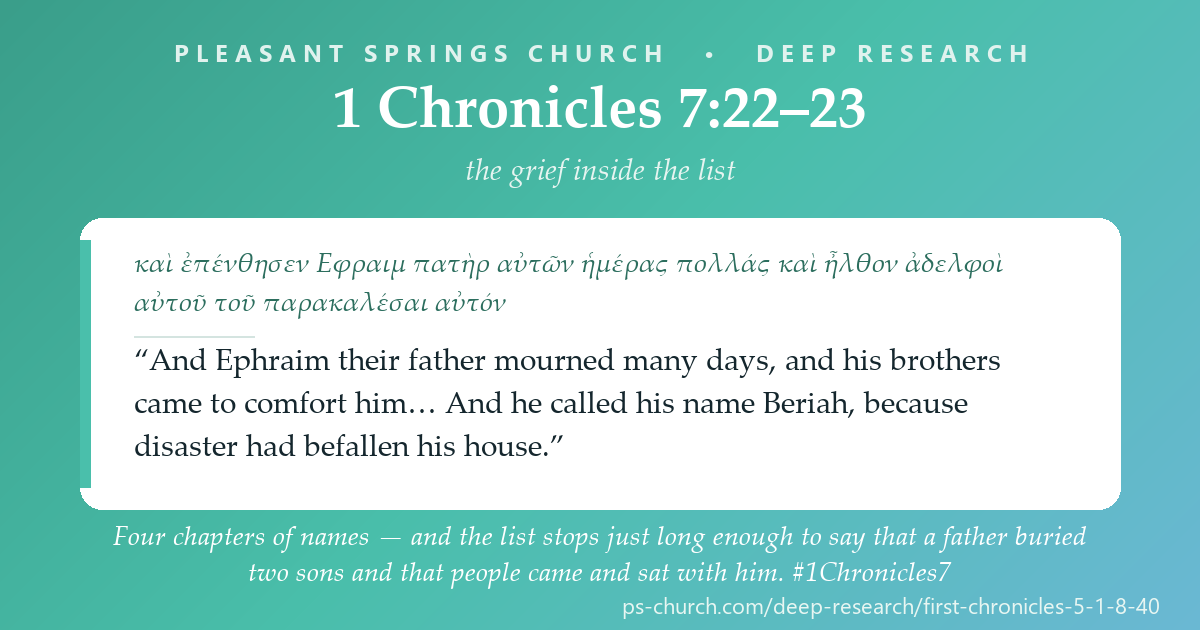
Twice in chapter 7 the list stops long enough for someone to be named, and the second time we are told why. Men of Gath kill two of Ephraim’s sons in a cattle raid. He mourns many days. His brothers come and sit with him. Then he goes in to his wife, a son is born, and he calls the boy בְּרִיעָה, Bərîʿāh, “because בְרָעָה — bərāʿāh, in disaster — it was in his house.”
The name is the grief, spelled with the same consonants. A man who has buried two sons names the third for what happened to the first two. Every time anyone in that household is called for supper, the raid is said out loud again.
And the Chronicler files it in a genealogy without comment. No moral is drawn, no providence is asserted, no comfort is offered beyond the one clause that says his brothers came. That restraint is the point. Most of the grief in the world is recorded like this or not at all — a line in a list, and the list goes on.
The Greek cannot carry the pun and does not pretend to. Rahlfs transliterates the name as Βαραγα and renders the reason ὅτι ἐν κακοῖς ἐγένετο. The sense survives; the sound does not. This page prints the loss rather than arguing from a Hebrew pun beside a Greek column that has no trace of it.
Two names that exist only in Chronicles, one verdict word arriving early, and a drumbeat noun.
The two -baal names were counted with a lexeme screen over the whole Masoretic corpus rather than looked up, because the interesting thing about them is a number: how many verses hold each form, and whether the two books ever overlap. They do not.
“Man of Baal” against “man of shame,” and the counts are exact. אֶשְׁבָּעַל occurs in two verses of the entire Hebrew Bible, 1 Chronicles 8:33 and 9:39 — nowhere else. The bare word בֹּשֶׁת occurs 23 times; eleven of those are the name Ish-bosheth in 2 Samuel 2–4, and the other twelve are the ordinary noun “shame” scattered from Isaiah to Daniel. The two books never once agree on what to call this man. The usual explanation — that a tradition replaced the divine element baal with bōšeṯ, “shame” — is a good one and it is an explanation, not a datum. What is a datum is the two counts. The Greek here transliterates whatever is in front of it: Ασαβαλ at 8:33.
The same pattern, one generation down, and the same kind of count — stated precisely, because the screen folds vowels. The consonantal form מריב stands in four verses of the Hebrew Bible. Two of them are this name — 1 Chronicles 8:34 and 9:40 — and the other two (Psalm 31:21, Proverbs 20:3) are the ordinary noun מֵרִיב, “from strife,” pointed differently. מְפִיבֹשֶׁת stands in thirteen, every one of them in 2 Samuel. This is Jonathan’s crippled son, the man David sought out and seated at his own table — and depending on which scroll you open he is called Merib-baal or Mephibosheth and never both. This page prints both and does not decide which is prior. The Greek of Chronicles has Μεριβααλ, following its Hebrew.
“To break faith, to commit sacrilege.” This is the Chronicler’s verdict word, and 5:25 is where it first lands in the book — four chapters before the famous use at 9:1 and five before Saul dies of it at 10:13. In the Torah it is the technical term for violating what is holy (Lev 5:15; Num 5:6–7) and for Achan taking what was devoted (Joshua 7:1). Here the Transjordan tribes “broke faith with the God of their fathers” and the next verse deports them. Note the Greek honestly: Rahlfs uses ἠθέτησαν here but ἀνομία at 9:1 and 10:13 — so the Hebrew thread that ties 5:25 to the end of 2 Chronicles is not visible in the Greek column at all.
“To be enrolled by genealogy” — a registry verb that lives almost entirely in Chronicles, Ezra and Nehemiah, which tells you which century cared. It is not “to be descended from” but “to be entered in the record.” 5:1 uses it for the birthright Reuben was not enrolled for; 5:17 dates a whole enrolment by two kings; 7:5, 7, 9 and 40 give the totals that enrolment produced. The Greek reaches for a rare register-office noun: ὁ καταλοχισμός at 5:17, a “mustering by lot or by company” — the same family of words it uses at 9:1.
“Pasture land” — the open ground around a town, and the word that beats like a drum through the list of Levitical cities. A Levite is given a town and the pasture round it, over and over. It matters because Levi has no tribal allotment: what he holds are islands inside other people’s territory, forty-eight of them, and each one comes with just enough grazing to keep a household alive. Landless, but not homeless. Counted rather than estimated: the word stands 42 times across 21 verses of Hebrew 6:40–66. The Greek is consistent and physical — τὰ περισπόρια, the ground around the seed-land — and it has the word 44 times, two more than the Hebrew.
A name and a phrase built from the same letters. Ephraim’s son is called Bərîʿāh “because bərāʿāh — in disaster — it was in his house.” Untranslatable, and the Greek proves it: Rahlfs transliterates the name Βαραγα and translates the clause ἐν κακοῖς, so a Greek reader gets the reason and loses the wordplay entirely. The same name appears again at 7:30 as a son of Asher, and at 8:13 (spelled בְּרִעָה, without the yod) as a Benjaminite — ordinary enough as a name, and only here explained.
Three things in these chapters reported rather than tidied:
- Dan and Zebulun are missing from chapter 7. Six tribes are listed there; two of the twelve are not, and the chapter never says why. A common proposal reads חֻשִׁם בְּנֵי אַחֵר at 7:12 (“Hushim, the sons of Aher”) as a damaged remnant of Dan, since Genesis 46:23 gives Dan a son Hushim. That is a conjecture about a text, not a reading of it, and the page names it as one. What can be said without conjecture is that a writer giving Levi 81 verses and Naphtali one was not attempting an even distribution, so an argument from silence here is weak in both directions.
- Ephraim mourns his sons in 7:21–22, and the chronology is hard. The Ephraim who is son of Joseph belongs to the generation that went down to Egypt; the raid described here happens in Canaan, with men of Gath. Proposals exist — a later Ephraimite of the same name; a compressed genealogy in which “father” means ancestor; a tradition of Israelites in the land before the exodus. None of them is stated in Scripture and this page chooses none. The difficulty is real and is left standing.
- 5:17 dates an enrolment by Jotham of Judah and Jeroboam of Israel, two kings whose reigns are not usually placed together. The verse is printed as it stands. Where a page cannot resolve something, saying so is the honest option and the one taken here.
Four measured connections — and the counter-example that keeps the deepest of them honest.
Every figure below was measured on this disk before it was written about. Hebrew rows were screened against 23,017 other verse units of the Masoretic corpus with single-word matches switched OFF, so a reported 0 means “shares no two consecutive words.” Greek rows were screened against all 7,927 verses of the Greek New Testament with single-word matches switched ON, so a 1 means “shares isolated words only.” Phrase counts run over 30,348 verse units of the Greek Old Testament held here. Every run is reported with its tie band, and no direction of influence is claimed anywhere on this page.
1. The deepest run in the passage is internal — eighteen words.
1 Chronicles 8:33 → 1 Chronicles 9:39. Run 18, tie band 1. Screened against every other verse in the Hebrew Bible, Saul’s genealogy finds exactly one partner and it is in the next chapter: ונר הוליד את קיש וקיש הוליד את שאול ושאול הוליד את יהונתן ואת מלכישוע ואת אבינדב ואת אשבעל. Eighteen consecutive words, seven deeper than the next deepest run anywhere in these four chapters, which is eleven.
And it is not one verse but a block. Running 1 Chronicles 8 against 1 Chronicles 9 verse by verse, nine rows reach four words or more, in order: 8:28→9:34 (5), 8:29→9:35 (4), 8:30→9:36 (6), 8:32→9:38 (7), 8:33→9:39 (18), 8:34→9:40 (4), 8:36→9:42 (11), 8:37→9:43 (5), 8:38→9:44 (11). The Chronicler wrote the household of Saul out twice, one chapter apart, in almost identical words. Why is a question the measurement cannot answer — a duplicated source, a deliberate reprise before chapter 10, or a scribal doubling are all live, and Stage 5 says so.
2. The deepest external run is with Joshua — nine words.
Hebrew 6:41 (ESV 6:56) → Joshua 21:12. Run 9, tie band 1. ואת שדה העיר ואת חצריה נתנו לכלב בן יפנה — “but the fields of the city and its villages they gave to Caleb the son of Jephunneh.” The same nine words in both books, and in no third place.
Run the two chapters against each other and twelve rows reach four or more, mostly in the same sequence: 6:46→21:5 (4), 6:47→21:6 (5), 6:48→21:7 (5), 6:49→21:8 (6), 6:50→21:9 (6), 6:39→21:10 (4), 6:41→21:12 (9), 6:52→21:21 (5), 6:54→21:25 (4), 6:55→21:25 (4), 6:56→21:27 (4), 6:61→21:32 (4). Two lists of the same forty-eight towns, and in stretches the same sentences. Which is prior, whether either writer saw the other, and whether both are copying an older register are questions this measurement is silent on, and the page will not fill the silence.
3. The deepest run into the Greek New Testament — and why it is a formula, not a citation.
LXX 1 Chronicles 7:23 → Matthew 1:25. Run 7, tie band 1. Across all 187 CATSS rows of these four chapters against all 7,927 verses of the Greek New Testament: 151 reach two, 44 reach three, 8 reach four, 2 reach six, 1 reaches seven, and nothing reaches eight. The seven are ετεκεν υιον και εκαλεσεν το ονομα αυτου — “she bore a son, and he called his name.” The second-deepest, six with a tie band of 1, is 7:16 → the same verse of Matthew.
⚠️ Here is the counter-example, and it is the most important sentence in this stage. That exact seven-word Greek sequence is not distinctive. Searched across the 30,348 verse units of the Greek Old Testament held here, it occurs six times: 1 Chronicles 7:23, Genesis 38:3, 38:4 and 38:5 (the three sons of Judah by Tamar), 1 Samuel 1:20 (Samuel), and 2 Samuel 12:24 (Solomon). It is the standard Greek birth-and-naming formula. Matthew 1:25 is written in the idiom of the Greek Bible, which is not the same thing as quoting 1 Chronicles 7:23, and this page does not claim that it is. The tie band of 1 is a fact about the New Testament side of the screen — only one NT verse carries the formula — not a claim about dependence.
And here is the part that is genuinely surprising, because the Hebrew and the Greek disagree about how common this is. The corresponding Hebrew run, ותהר ותלד בן ויקרא את שמו, occurs in exactly two verses of the entire Masoretic corpus: 1 Chronicles 7:23 and Genesis 38:3. Why six in Greek and two in Hebrew? Two reasons, and both were counted rather than guessed. First, the Greek run is shorter at the front. It begins at ετεκεν, the equivalent of ותלד, and so never has to match ותהר — which matters, because Genesis 38:4 puts עוד after it, Genesis 38:5 has ותסף instead of it, 1 Samuel 1:20 puts Hannah’s name after it, and 2 Samuel 12:24 does not have it at all. Second, Hebrew marks the gender of the one who names and Greek does not. Genesis 38:3 and 1 Chronicles 7:23 have וַיִּקְרָא, he called. Genesis 38:4, 38:5, 1 Samuel 1:20 and 2 Samuel 12:24 have וַתִּקְרָא, she called. Greek ἐκάλεσεν is the same word either way. Neither reason works on its own: putting the feminine verb into the six-word Hebrew run above returns nothing at all across the whole Masoretic corpus. It takes both differences together to turn a pairing that is nearly unique in Hebrew into a formula shared by six births. In Matthew 1:25 the one who names is Joseph — but the Greek of Matthew could not have told you that either, and it is the surrounding sentence, not the verb, that does.
4. Where else these chapters touch the rest of Scripture:
- Genesis 46:11 beside Hebrew 5:27 (ESV 6:1) — “the sons of Levi: Gershon, Kohath and Merari,” four consecutive words, tie band 1. The Levi genealogy opens by quoting the list of those who went down to Egypt.
- Exodus 6:16–19 and Numbers 16:1 — Hebrew 6:3 shares six consecutive words with Exodus 6:18 (band 1), and Hebrew 6:23 shares six with Numbers 16:1 (band 1): בן יצהר בן קהת בן לוי. The line of the temple’s chief singer runs through the household that rebelled and was swallowed. The Chronicler does not remark on it. He simply keeps writing the names.
- 1 Samuel 1:1 beside Hebrew 6:19 (ESV 6:34) — four words shared, band 1, and it is the same family: Heman the singer is “the son of Joel, son of Samuel” (Hebrew 6:18). Hannah’s son’s grandson leads the choir.
- Exodus 28:1 and 1 Chronicles 24:1 beside Hebrew 5:29 (ESV 6:3) — “Aaron, Nadab and Abihu, Eleazar and Ithamar,” five consecutive words with a tie band of 2. The priestly roll call is quoted the same way in three places.
- 2 Kings 15:29 and 17:6 beside 5:26 — the same imperial policy, and at 17:6 the same destinations (Halah, Habor, Gozan). They are not one event: 15:29 is Tiglath-pileser taking Galilee and Naphtali, 17:6 is the fall of Samaria roughly a decade later under a different Assyrian king, and 1 Chronicles 5:26 reports a deportation of the eastern tribes that Kings never narrates. Chronicles gives a theological cause; Kings gives a political one. Both are in the Bible and both are printed.
- Amos 1:1 beside 5:17 — four consecutive words, tie band 1, and the only place in the Hebrew Bible that sequence recurs. Two texts dating themselves by a king of Judah and then by Jeroboam. An identical dating habit is not a literary relationship and this page does not make it one.
- Numbers 32 and Joshua 13 — the Transjordan allotment itself, which chapter 5 assumes throughout without ever quoting it at length. Read against Joshua 22, where the eastern tribes build an altar and the western tribes come out to war over it, 1 Chronicles 5 is the after-history of a boundary that was always contested.
What the scholarship argues, what this page could not check, and where it is weakest.
The commentaries below are named as the bibliography a reader should go to next. They were not quoted, and none of the figures on this page came from them — every number was derived from the corpora on this disk and can be re-derived. Where a claim is a scholarly explanation rather than a measurement, it is labelled as one in the text.
Commentaries & studies:
- Gary N. Knoppers, 1 Chronicles 1–9 (Anchor Yale) — a full volume on exactly this unit, and the strongest treatment of the genealogies as political and literary construction rather than archive.
- Sara Japhet, I & II Chronicles (OTL) and The Ideology of the Book of Chronicles — the influential argument that the Chronicler is a theologian with a coherent position and that Chronicles is independent of Ezra–Nehemiah.
- Ralph W. Klein, 1 Chronicles (Hermeneia) — the fullest technical treatment of the text-critical problems, including the relation of chapter 8 to chapter 9 and of chapter 6 to Joshua 21.
- H. G. M. Williamson, 1 and 2 Chronicles (NCBC) and Israel in the Books of Chronicles — on the Chronicler’s attitude to the northern tribes, which is the question chapter 7 raises and does not answer.
- On the Levitical cities — a debate running from Albright and Alt through Kaufmann, Mazar, Haran and Na’aman about whether Joshua 21 / 1 Chronicles 6 preserves a real institution, an administrative list from the monarchy, or a programmatic scheme. Unsettled. This page reports the overlap it measured and takes no position on the institution.
⚠️ What this page could NOT check, and where it is weakest:
- No Dead Sea Scroll evidence was consulted. Chronicles is barely represented at Qumran — 4QChr is a very small fragment — and no scroll text of Chronicles is held on this disk. Every statement here about the Hebrew is a statement about the Masoretic text as Sefaria transmits it.
- Only one Greek text was screened. The Greek column is the CATSS digitization of Rahlfs. The Antiochene / Lucianic text of Paraleipomenon, which often matters precisely in the historical books, is not held here and was not consulted. Nor were the Syriac Peshitta, the Vulgate or the Targum of Chronicles, all of which have readings in these chapters.
- The run screen is blind to allusion. It finds contiguous identical word forms and nothing else. A verse can be saturated with a passage it shares no run with, and a seven-word run can be a formula — which is exactly what the Matthew 1:25 result turned out to be, and the page prints that against itself in Stage 4.
- The Greek Old Testament screen excludes the Odes. 30,637 verse units are held; a run screen sees 30,348, because the Odes are set aside — two of them are Luke 1 and Luke 2 copied into a Greek Old Testament manuscript, and ten more are second copies of Exodus 15, Deuteronomy 32, 1 Samuel 2, Habakkuk 3, Isaiah 26, Jonah 2, Daniel 3, Isaiah 5 and Isaiah 38. Counting them would have inflated every phrase count on this page.
- The doubling of Saul’s genealogy is measured but not explained. An 18-word run between 8:33 and 9:39 is a fact. Whether it reflects one source used twice, a deliberate reprise to set up chapter 10, or a copying accident is not settled, and this page declines to pick.
- The -baal / -bosheth substitution is an inference. That Ish-bosheth and Mephibosheth are dysphemistic replacements for Eshbaal and Merib-baal is the standard reading and a persuasive one. It is not stated anywhere in Scripture. What this page measured is four counts (2, 11, 2, 13) and a total absence of overlap. The inference is reported as an inference.
- The versification offset was derived here, not looked up. The shelf’s offset table has no entry for 1 Chronicles, so the numbers above were computed from the Masoretic, CATSS and English shapes on disk and checked at the seam by content. That is stronger than a copied table, but it is our arithmetic and a reader should be told so.
- The ESV footprint tool is currently returning zero for every book, because it selects builders by looking for a module variable that a shelf-wide trim on 30 August 2026 deleted. The exposure figure for this book was therefore taken from
dr_tools inventoryinstead, which scans every builder and does not use that variable. This page itself quotes 20 verses. With it added, the whole shelf quoted 132 of the 942 verses of 1 Chronicles — 14.0% on the day it was built, far inside Crossway’s half-a-book limit. Reported because a licence figure taken from a broken tool would be worse than no figure at all. - Chronology. 5:17 (Jotham and Jeroboam) and 7:21–23 (Ephraim mourning sons killed by men of Gath) both raise chronological problems this page states and does not solve.
What four chapters of names are for, and what to do with the ones nobody else wrote down.
Name what you learned, why it matters, and one concrete response.
What should we carry away — and do?
- A quarter of this passage exists nowhere else. 48 verses out of 187 share no two consecutive words with any other verse in the Hebrew Bible. Somebody wrote down households that no prophet mentioned, no historian used, and no later writer copied — and because he did, they are in Scripture. The record of ordinary people was worth ink to him. That is a judgment about human beings, made by a man with a limited supply of parchment.
- The one prayer in four chapters is not quoted. 5:20 says only that they “cried out to God in the battle, and he granted their urgent plea because they trusted in him.” No words are preserved. Most prayers are like that — unrecorded, unrepeatable, and answered.
- Grief goes in the list. Ephraim buries two sons, his brothers come and sit with him, and he names the next child for the disaster. Then the names resume. If you have ever felt that your worst year was a paragraph the world scrolled past, 7:21–23 is in the Bible for you.
- Read the differences honestly. Chronicles calls Saul’s son Eshbaal; 2 Samuel calls him Ish-bosheth. The two books never agree. Notice how much better it feels to be told that plainly than to be handed a smooth explanation — and carry the habit into every hard place in Scripture. A faith that needs the difficulties hidden is not being protected. It is being weakened.
- One concrete response. Write down the names of five people in your church nobody outside it would recognise, and one true sentence about each. Then read 1 Chronicles 7:13 — four names and a mother, one verse, and it made the canon. You have just done what the Chronicler did.
1 Chronicles 7:22–23 · to share
Hebrew + Greek (Rahlfs, Paraleipomenon A) + ESVEvery Deep Research page traces its passage across the whole sweep — the Old Testament, the Second-Temple world between the testaments (historical witnesses, not Scripture), and the New Testament. Follow the thread:
Pleasant Springs Church — Deep Research
Research method after Michael S. Heiser’s Bible Research Method (examine dictionaries → ancient literature → important words → textual connections → academic publications → share), with the Pleasant Springs “Author & Audience” foundation. Scripture set in the Hebrew, the Greek editions named on each page and the ESV (Old Testament), and the Greek New Testament and the ESV (New Testament), per the practice of Pleasant Springs Church. 1 Chronicles 5–8 research grounded in Knoppers (Anchor Yale, a full volume on this unit), Japhet (OTL), Klein (Hermeneia) and Williamson (NCBC) — named as bibliography; no figure on this page came from a commentary. Every number was derived from the corpora on this disk and can be re-derived. Book name: in the Septuagint this book is Paraleipomenon A, Παραλειπομένων Αʹ, “of the things left out”; the Hebrew title is דִּבְרֵי הַיָּמִים, “the events of the days.” Text: Hebrew from the Masoretic Text (Sefaria, Miqra according to the Masorah); Greek from Rahlfs’s Septuaginta (CATSS digitization), printed without editorial punctuation and with proper names unaccented; English ESV. ⚠️ Verse numbering — derived, not copied. The offset table on this shelf holds no entry for 1 Chronicles, so the offset was computed from the files on disk: Masoretic and CATSS chapters 5–8 are identical in shape (41, 66, 40, 40 verses) and the English is 26, 81, 40, 40, giving MT/LXX 5:27–41 = ESV 6:1–15 and MT/LXX 6:1–66 = ESV 6:16–81; chapters 7 and 8 are numbered alike in all three. The seam was confirmed by content: Hebrew 5:27 and English 6:1 are the same sentence, and the Hebrew prints it a second time at 6:1 with Gershom for Gershon. Rows lead with the Hebrew and Greek number and bracket the English. None of the thirteen verses by which Greek 1 Chronicles is shorter than the Hebrew falls in chapters 5–8, so these columns are a verse-for-verse comparison. ⚠️ Measurement scope: Hebrew rows screened against 23,017 other verse units of the Masoretic corpus with single-word matches OFF, so a reported 0 means “shares no two consecutive words”; Greek rows screened against all 7,927 verses of the Greek New Testament with single-word matches ON, so a 1 means “shares isolated words only”; Greek phrase counts over 30,348 verse units (30,637 are held; the Odes are excluded, two of them being Luke 1 and Luke 2 copied into a Greek Old Testament manuscript). Cross-corpus Greek runs apply MorphGNT’s own spelling equivalences (ou/ouk/ouch, ek/ex, the movable nu). Every run is printed with its tie band, and no direction of influence is asserted anywhere — not between 1 Chronicles 6 and Joshua 21, not between 8:33 and 9:39, and not between 7:23 and Matthew 1:25, where the page prints its own counter-example: the seven-word Greek run occurs in six verses of the Greek Old Testament and is a birth formula, not a citation. ⚠️ Chronicles and Samuel are not harmonised: Eshbaal / Ish-bosheth and Merib-baal / Mephibosheth are printed as they stand, with the counts (2, 11, 2, 13) and with the dysphemism explanation labelled an inference rather than a datum. Dan and Zebulun are absent from chapter 7 and the page names the Hushim conjecture as a conjecture. The chronological problems at 5:17 and 7:21–23 are stated and left unresolved. Second-Temple and Assyrian material (Josephus; the royal inscriptions of Tiglath-pileser III; the Babylonian King List; the Mesha Stele; the Samaria ostraca) is read as witness and never levelled with Scripture. No Qumran text of Chronicles, no Antiochene Greek, no Peshitta, Vulgate or Targum was consulted, and Stage 5 says so. Typology is handled per the house position: what the text says, what the New Testament itself draws, and what we see from this side of the cross.
Scripture quotations marked ESV are from the ESV® Bible (The Holy Bible, English Standard Version®), © 2001 by Crossway, a publishing ministry of Good News Publishers. ESV Text Edition: 2016. Used by permission. All rights reserved. The ESV text may not be quoted in any publication made available to the public by a Creative Commons license, and the ESV may not be translated in whole or in part into any other language. www.esv.org
|
Did this study bless you today? 💚 Give to Support PS Church100% of gifts go to the General Fund — thank you. |