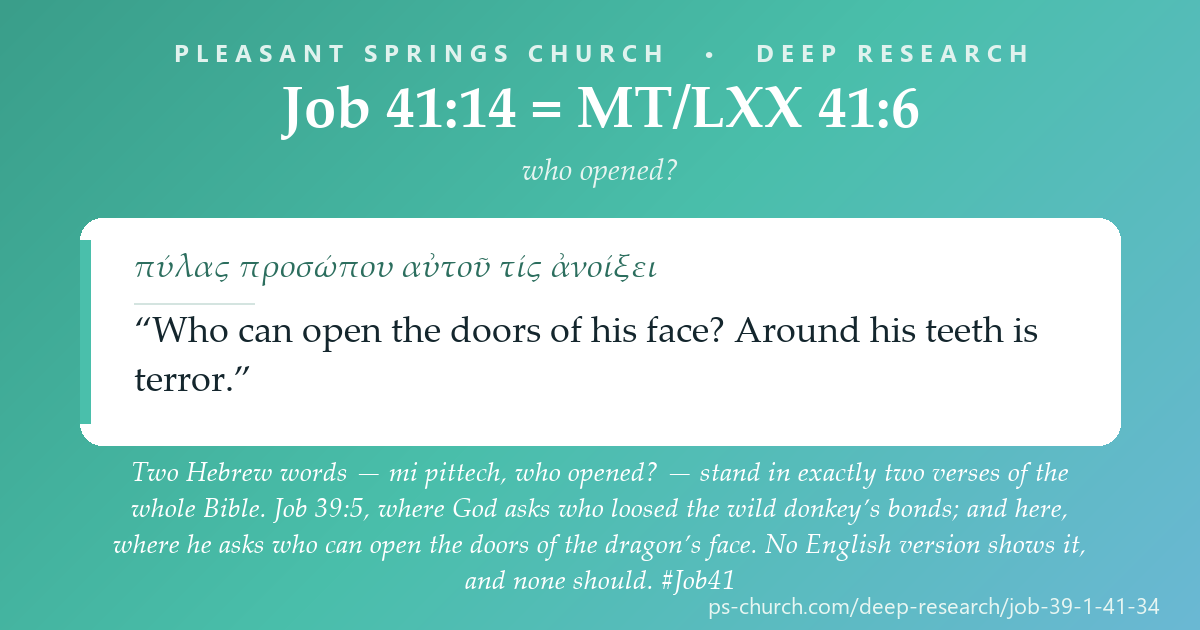
Two Hebrew words — מי פתח, who opened? — stand in exactly two verses of the whole Hebrew Bible. One is Job 39:5, where God asks who loosed the bonds of the wild donkey. The other is Job 41:14, where he asks who can open the doors of the dragon’s face. Screened over all 23,204 Masoretic verse units; tie band of one. No English translation shows it, and none should — one is a bond and one is a door. And the rest of the poem is stranger still: 43 of its 88 Hebrew verse units share no two consecutive words with any other verse in the Hebrew Bible, and against Psalm 104, Genesis 1 and Isaiah 27 — the three passages every commentary reads beside this one — the deepest run the whole of Job 41 reaches is one shared word, then two, then one, and the two, which are the ones against Genesis 1, are all the. The deepest contact with the Greek New Testament is four words, twice, and both are accidents. The one place the New Testament actually uses this poem measures two. See the method →
Job 39:1–41:34 (selections)
Hebrew (Masoretic) · Greek (CATSS, Rahlfs’ Septuaginta) · ESV⚠️ THE HEBREW AND ENGLISH TOTALS ARE IDENTICAL; THE GREEK IS NOT, AND THE SURPLUS IS NOT ALL AT THE END. Masoretic Job: 1,070 verse units. English Job: 1,070 verses. CATSS Job: 1,083 rows — a net surplus of thirteen. Counted off disk, the two sides part company at four chapters: 2 (18 rows against 13), 19 (30 against 29), 36 (35 against 33) and 42 (22 against 17). CATSS carries fourteen lettered rows in all — 2:9a–e, 19:4a, 23:15a, 36:28a–b and the appendix 42:17a–e — and carries no row numbered 23:14. Job 39, 40 and 41 are not among the differences: across 39:1–41:26 the Hebrew and the Greek have 88 verse units each, no lettered rows, and not one verse missing from either side. Within this page’s passage the disagreement is entirely about where chapter 41 begins.
⚠️ What the Greek column of Job is, and what this page cannot tell you about it. Rahlfs prints a Greek Job that is a composite: an Old Greek translator who rendered the book considerably shorter than the Hebrew, plus material supplied later from Theodotion, which Origen marked with asterisks. The CATSS digitisation held here carries no Aristarchian signs — the asterisks in the file mark capital letters, not hexaplaric additions. This page therefore cannot tell you which of its Greek words belonged to the original translation and which were filled in from Theodotion. Every statement about “the Greek” on this page means “the Greek row as CATSS prints Rahlfs,” and nothing more.
The Shape of the Passage
Sequence — ten creatures in descending order of what you can do about themEverything in these three chapters is spoken, and the speaker never stops. Across eighty-eight verses there are exactly three lines of narration — at 40:1, 40:3 and 40:6 — and everything else is speech. Job opens his mouth once inside this passage: three verses, 40:3–5, and what he says is that he will not say anything. He is then addressed for another fifty-two verses without replying, and does not speak again until 42:1.
Author
A poet who knew animals and would not moralise them. The catalogue does not say the ostrich is foolish and you should not be; it says God withheld her wisdom. It does not say the eagle is noble; it says his children drink blood. Nothing in Job 39–41 is a fable, and nothing in it draws a lesson. The page cannot date the poet, place him, or decide whether the Behemoth-and-Leviathan speech was written with the rest of the book — a live question in the commentaries — because nothing in the local corpora bears on it.
What can be counted is how unlike anything else the language is. Of the 88 Hebrew verse units in these three chapters, 43 share no two consecutive words with any other verse in the Hebrew Bible. That is very nearly half. The deepest verbatim contact anywhere in the passage is Job with himself — 40:6 against 38:1, five words, the formula that opens a divine speech. Outside the book of Job, nothing in these chapters reaches four.
Audience
A man who has just asked for a court date. Job’s last speech before the whirlwind ends with a signature and a demand for an indictment (31:35). What he gets is a zoo. The audience of these chapters is one person, and the speech is addressed to him in the second person singular throughout — do you know… can you… will he serve you… lay your hand on him.
And readers who could picture every animal in it. The mountain goat, the onager, the aurochs, the ostrich, the cavalry horse, the raptor: these are not exotic to the first audience, they are the edge of the settled world. The rhetorical force depends on the hearer knowing exactly how untameable each one is. Behemoth and Leviathan arrive at the end of a list every listener could verify, which is what makes them hard to dismiss and hard to identify.
Orient on a zoology that is not zoology, on two creatures nobody has identified, and on a chapter number that moves eight verses.
Search by topic: Job, book of; theophany; divine speeches; Behemoth; Leviathan; Rahab; chaos monsters; Chaoskampf; onager / wild ass; aurochs / wild ox; ostrich; horse, war; eagle and vulture; hippopotamus; crocodile; Septuagint of Job; Theodotion; Hexapla; Targum of Job (11QtgJob); chapter and verse divisions, history of.
Which articles are relevant?
- Anchor Bible Dictionary — “Job, Book of,” “Behemoth,” “Leviathan,” “Rahab,” “Zoology (Bible),” “Versions, Ancient (Greek).”
- Dictionary of the OT: Wisdom, Poetry & Writings (IVP) — “Job 3: Divine Speeches,” “Animal Imagery,” “Chaos,” “Creation Theology,” “Hebrew Language.”
- NIDOTTE — לִוְיָתָן, בְּהֵמָה, שַׁחַץ, פֶּרֶא, רְאֵם, פָּתַח.
- Dictionary of NT Use of the OT (Beale & Carson) — on Romans 11:33–36 and its Old Testament sources, which is the one place these chapters are visibly used.
- A New English Translation of the Septuagint (NETS) — Iob, introduction, on the shorter Old Greek and the asterisked supplement.
Settle the numbering — one offset, eight verses wide, and it is inside Leviathan
Job is easy to cite until chapter 41, and then it is not. The table below was derived for this page by counting the corpora on disk — the Masoretic text, the CATSS Greek, and the English verse shape — and not copied from a printed concordance.
| chapter | Masoretic | CATSS Greek | English (ESV) |
|---|---|---|---|
| 38 | 41 | 41 | 41 |
| 39 | 30 | 30 | 30 |
| 40 | 32 | 32 | 24 |
| 41 | 26 | 26 | 34 |
| 42 | 17 | 22 (17 + the appendix 17a–e) | 17 |
| whole book | 1,070 | 1,083 rows | 1,070 |
Stated exactly:
1. Chapter 39 has no offset at all. Thirty verses in Hebrew, thirty in Greek, thirty in English, and the same number against the same words. Every chapter-39 reference on this page is one number in all three columns.
2. Chapter 40 runs eight verses longer in Hebrew and Greek than in English. The Hebrew keeps “can you draw out Leviathan with a fishhook?” and the seven verses after it inside chapter 40. The English begins chapter 41 there. ESV 41:1–8 = MT/LXX 40:25–32.
3. Chapter 41 therefore runs eight behind. ESV 41:9 = MT/LXX 41:1, and so on to ESV 41:34 = MT/LXX 41:26. Romans’ verse, who has first given to me?, is ESV 41:11 = MT/LXX 41:3. A commentary discussing “Job 41:3” may mean either verse, and the two are eight apart in content.
4. The Hebrew and the Greek do not disagree here — but they do disagree elsewhere in the book, and the page will not smooth it. Counted off disk, the CATSS Greek and the Masoretic text part company at four chapters: 2 (18 rows against 13), 19 (30 against 29), 36 (35 against 33) and 42 (22 against 17). CATSS carries fourteen lettered rows in all — 2:9a–e, 19:4a, 23:15a, 36:28a–b and 42:17a–e — and no row numbered 23:14; the net surplus over the Hebrew is thirteen, of which only five are the appendix. Job 39, 40 and 41 are not among the differences: 88 verse units on each side, no lettered rows and no gaps.
Why the offset exists at all is not something this page can settle: chapter divisions are a thirteenth-century Latin convention, applied to a Hebrew text that had its own paragraph markers, and the Masoretic {פ} after 39:30 and after 41:26 shows where that tradition thought the units ended. The page reports both numbering systems and prefers neither.
Ten animals a farmer could name, and two nobody can.
What a catalogue of creatures was for
Lists of animals, plants, stones and stars are an ancient Near Eastern genre, and the Egyptians had a name for it. The Onomasticon of Amenemope is a bare enumeration of everything that Ptah created; comparable Mesopotamian lists run for tablets. Scholars have long compared Job 38–41 to that genre, and the comparison is useful for one reason above all: a list of this kind makes no argument. It enumerates.
What Job does with the genre is turn every entry into a question. The onomasticon says ostrich. Job says who gave her no share in understanding? The list form supplies the comprehensiveness and the interrogative supplies the sting, and the man being asked has just demanded a hearing in court. ⚠️ The Egyptian and Mesopotamian lists are not held locally in machine-readable form; nothing on this page is a measurement against them, and the comparison is reported as the scholarly commonplace it is.
The two creatures, and what the page will not do
Behemoth eats grass, lies under lotus plants in the marsh, and is unmoved when a river rages. Leviathan has scales, teeth, a hard heart, and fire in his mouth. The two standard readings are that these are the hippopotamus and the crocodile, described with poetic exaggeration; or that they are the chaos-creatures of Canaanite and Mesopotamian myth, brought on at the end to be shown as God’s pets. Both readings are old, both are defensible, and neither can be measured from a Hebrew, a Greek or an English text.
What can be measured is that the Bible has a Leviathan elsewhere and it is a sea-dragon. לִוְיָתָן stands six times in five verses: Isaiah 27:1 twice — the fleeing serpent… the twisting serpent… the dragon that is in the sea; Psalm 74:14 — you crushed the heads of Leviathan; Psalm 104:26 — where he is a creature God formed to play in the sea; Job 3:8, where Job asks for someone to rouse him; and Job 40:25 (ESV 41:1). Three of the five are unmistakably mythic-sounding, and one of them is a plaything.
The Ugaritic Baal cycle’s Litan, the fleeing serpent with seven heads, is the closest external parallel to Isaiah 27:1 and is regularly cited beside Job. It is not held locally, no measurement on this page touches it, and the page asserts no relationship in either direction.
Tartarus, in a Hebrew book
Twice in these chapters the Greek column puts a Greek underworld into the text. At 40:20, where the Hebrew says the mountains bring Behemoth his produce and the beasts of the field play there, the Greek says he goes up a sheer mountain and made joy for four-footed things ἐν τῷ ταρτάρῳ. At 41:24 (ESV 41:32), where the Hebrew says he leaves a shining wake and one would think the deep to be white-haired, the Greek says he reckoned τὸν τάρταρον of the abyss as a captive.
Counted: τάρταρος stands three times in the 30,348 Greek Old Testament verse units screened here — these two, and Proverbs 30:16 as CATSS labels it. In the Greek New Testament it stands once, as a verb: 2 Peter 2:4, ταρταρώσας, of the angels who sinned. The page counts the word and does not build a doctrine on it; a Greek translator reaching for a Greek word for a deep place is not evidence about what the Hebrew poet believed.
Eight words. Two of them occur twice in the Bible and both pairs are inside Job.
Two verses in the whole Hebrew Bible, and they are the two ends of this poem. Screened over all 23,204 Masoretic verse units: Job 39:5 — and the bonds of the swift donkey, who opened? — and Job 41:6, ESV 41:14 — the doors of his face, who opened? Tie band of one. Neither the Greek nor any English version preserves the repetition, and neither is at fault: the object is a rope in one verse and a mouth in the other.
Two verses in the whole Hebrew Bible, and both are Job. Job 28:8, in the wisdom poem — the path to wisdom is one the proud beasts have not trodden — and Job 41:26, ESV 41:34, the last line of the poetry, where Leviathan is king over them. Tie band of one. The Greek renders the first υἱοὶ ἀλαζόνων, sons of boasters, and does not render the second at all.
The exact word form stands ten times in the Hebrew Bible, and two of the ten are Job: 12:7, where Job says ask the beasts, and they will teach you, and 40:15, where God says behold. The English prints one as a common noun and the other as a proper name. The Greek does not name him either: it has θηρία, wild animals, plural.
Six occurrences in five verses of the Hebrew Bible: Isaiah 27:1 (twice), Psalm 74:14, Psalm 104:26, Job 3:8 and Job 40:25 (ESV 41:1). Job and the Psalms have two verses each; Isaiah’s two occurrences are both inside one verse. Job is named in Job’s first speech and in God’s last — but the Greek uses κῆτος at 3:8 and δράκων at 40:25, so a Greek reader cannot see it.
The Greek for Hebrew רְאֵם, the wild ox. Eight occurrences across the 30,348 Greek Old Testament verse units screened here — Numbers 23:22, 24:8, Deuteronomy 33:17, four Psalms — LXX 21:22, 28:6, 77:69, 91:11, that is ESV 22:21, 29:6, 78:69, 92:10 — and Job 39:9. It is the ancestor of the King James unicorn, but the Latin route runs through unicornis only in the four Psalms: the Clementine Vulgate held here reads rhinoceros at Numbers 23:22, 24:8, Deuteronomy 33:17 and Job 39:9.
Seven occurrences in the Greek Old Testament screened here, and four of the seven are Job: 3:9, 11:17, 38:12 and 41:10 (ESV 41:18), where it describes Leviathan’s eyes. The others are 1 Samuel 30:17, Psalm 109:3 = ESV 110:3 (before the dawn-star I begot you), and Isaiah 14:12, the verse the Latin renders Lucifer. Zero occurrences in the Greek New Testament, which has φωσφόρος once, at 2 Peter 1:19. A shared word, and the page asserts nothing beyond the count.
Exactly two occurrences in the whole Greek Old Testament screened here, and both are on this page: 40:19, of Behemoth, and 41:25 (ESV 41:33), of Leviathan. Both times in the same clause — made to be mocked by his angels at 40:19, by my angels at 41:25 — and neither clause is in the Hebrew.
Three occurrences in the Greek Old Testament screened here: Job 40:20, Job 41:24 (ESV 41:32) and Proverbs 30:16 as CATSS labels it — the three things never satisfied, where the Greek has Hades, a woman’s desire and Tartarus. One in the Greek New Testament, as a verb: 2 Peter 2:4. The Hebrew of both Job verses says something else entirely.
The two-word bracket, screened
This is the measurement the page is named for, at full width.
| sequence | Hebrew Bible (23,204 units) | where | what the ESV does with it |
|---|---|---|---|
| מִי פִתֵּחַ | 2 | Job 39:5, Job 41:6 (ESV 41:14) — and no third verse | “who has loosed” / “who can open” |
| מִי שִׁלַּח (the first half of 39:5) | 2 | 1 Samuel 26:9 and Job 39:5 | “who can put out” / “who has let… go free” |
| בְּנֵי־שָׁחַץ | 2 | Job 28:8, Job 41:26 (ESV 41:34) — both Job | “the proud beasts” / “the sons of pride” |
| שַׁחַץ (the noun alone) | 2 | the same two verses, and nowhere else | — |
Both pairs are inside Job, and one of them is inside this page’s passage. The wild donkey is loosed and the dragon’s jaws are shut; the proud beasts cannot reach wisdom and the dragon is their king. What the reader makes of either pairing is the reader’s business; the page’s business is that the words are there and nowhere else.
What the screen cannot do: it counts consonantal word FORMS, not lemmas, not roots and not parsings. פִתֵּחַ here is a piel perfect; the same consonants elsewhere carry a qal, a noun and a participle, and those are not in the count of two. A different screen — by root — would give a much larger number and a much weaker finding, and the page is telling you which screen it ran. Both Hebrew passes were run twice, on the qere and on the ketiv, and reported only where the two agreed.
Four screens: a silence, three near-neighbours that turn out not to be, a run that means nothing, and the one verse the New Testament really does use.
1. The Hebrew screen — nearly half of this passage shares nothing with anything
Every verse of Job 39, 40 and 41 was screened against every other verse of the 39-book Masoretic corpus. The screen runs without the single-word fallback, so a zero here means this verse shares no two consecutive words with any other verse in the Hebrew Bible. It does not mean the verse shares no words.
| chapter | verse units | units at 0 | deepest run | and where it goes |
|---|---|---|---|---|
| 39 | 30 | 16 | 3 | 39:22 → Proverbs 30:30, band 1; 39:24 → Jeremiah 4:19, band 1 |
| 40 | 32 | 13 | 5 | 40:6 → Job 38:1, band 1 — Job with himself |
| 41 | 26 | 14 | 3 | 41:3 → Genesis 7:19, Job 28:24 and 4 others, band 6; 41:26 → 1 Kings 4:1 and 2 others, band 3 |
| total | 88 | 43 — 49% | — | — |
Forty-three of eighty-eight. Four of the ten verses of the Behemoth paragraph are in that list — 40:17, 18, 21 and 24; so is can you draw out Leviathan with a fishhook (MT 40:25); so is the ostrich’s wing; so is the opening line about the mountain goats. The four verses in the whole passage that reach four or five shared words are 40:1, 40:3, 40:6 and 40:7, and all four have their partner inside the book of Job — 40:6 against 38:1 at five and 40:1 against the same verse at four; 40:3 against 42:1 at five, the two narrative formulas that open a divine speech and a human reply; and 40:7 against 38:3 at four, the challenge gird up your loins like a man. All four carry a tie band of one. Outside the book of Job, nothing in these three chapters reaches four.
This is a finding about vocabulary, not about quality, originality or date. A verse can be entirely conventional in thought and still share no two-word sequence, and a formulaic verse can share ten. What the number licenses is one modest claim: whoever wrote these chapters was not assembling them out of the sentences that make up the rest of the Hebrew Bible.
2. The three passages every commentary reads beside this one
Psalm 104 is the other great creation catalogue. Genesis 1 is the other account of the making of the sea creatures. Isaiah 27:1 is the other Leviathan. Here is what they actually share.
| screened | deepest shared run | the words (a sample: where the deepest run is one, a dozen single words tie) |
|---|---|---|
| Job 39 × Psalm 104 | 1 | אשר — which |
| Job 41 × Psalm 104 | 1 | אל, כל, פני |
| Job 39 × Genesis 1 | 1 | אשר, כל, על |
| Job 41 × Genesis 1 | 2 | את כל — 41:26 against Genesis 1:29, 1:30 and 1:31 |
| Job 39 × Isaiah 27 | 1 | מי — who |
| Job 41 × Isaiah 27 | 1 | לא, מי |
| Job 41 × Job 28 | 3 | תחת כל השמים — 41:3 against 28:24; and בני שחץ, 41:26 against 28:8 |
Psalm 104 names Leviathan and the wild donkeys. Isaiah 27:1 names Leviathan twice. Genesis 1 makes the sea creatures. Against Psalm 104 and against Isaiah 27 the whole of Job 41 reaches ONE shared word; against Genesis 1 it reaches TWO, and the two are אֶת־כָּל, all the. Whatever relates these passages to each other — and something does — it is not shared wording. Every reader who has felt Job 41 and Isaiah 27 belong together has felt something real; this screen simply reports that the thing they share is not a phrase.
The one chapter of the Hebrew Bible Job 41 does share language with is Job 28 — the wisdom poem, thirteen chapters earlier, in a different voice. Two separate contacts: a three-word run at 41:3, and the two-word phrase that stands only in these two verses. The page reports the shared words and does not say which is prior, or whether one hand wrote both.
3. The Greek New Testament screen — and its two winners are both accidents
All 88 CATSS rows of Job 39–41 were screened against all 7,927 verses of the Greek New Testament. Distribution: 79 rows reach two shared words, 28 reach three, 2 reach four, and nothing reaches five. Nine rows do not reach two at all.
| row | run | tie band | partner | the words — and what they mean |
|---|---|---|---|---|
| 39:5 | 4 | 1 | 1 John 5:5 | τίς δέ ἐστιν ὁ — who is it that… |
| 41:10 (ESV 41:18) | 4 | 1 | Revelation 19:12 | οἱ δὲ ὀφθαλμοὶ αὐτοῦ — and his eyes |
| 41:13 (ESV 41:21) | 3 | 1 | Revelation 19:15 | στόματος αὐτοῦ ἐκπορεύεται — out of his mouth comes |
| 39:29 | 3 | 1 | Revelation 1:14 | οἱ ὀφθαλμοὶ αὐτοῦ — his eyes |
| 39:14 | 3 | 1 | Revelation 12:1 | αὐτῆς καὶ ἐπί — of her, and upon |
| 39:24 | 3 | 29 | Luke 12:49 and 28 others | τὴν γῆν καί — the earth, and |
| 41:25 (ESV 41:33) | 3 | 53 | Matthew 6:19 and 52 others | ἐπὶ τῆς γῆς — on the earth |
Read the last two rows first. A run of three with a band of fifty-three is a Greek idiom, not a connection. That is what a tie band is for, and it is why this shelf prints one beside every run.
Now the top two, which are tied. Four words each, tie band of one each. One of them means who is it that and the other means and his eyes. Neither is a citation; neither could be. The 1 John verse is who is it that overcomes the world? and the Job verse is who is it that set the wild donkey free?, and the four shared words are an interrogative, a connective, the verb to be and an article.
There is a pattern in the middle of the table, and the page prints it with the brakes on. Eleven rows of these three chapters reach three or more with a tie band of one. Four of the eleven have their unique partner in Revelation, and three of those four are the same figure — the Son of Man of Revelation 1:14 and the rider of Revelation 19:12 and 19:15. Leviathan’s eyes and the rider’s eyes; Leviathan’s mouth and the rider’s mouth. ⚠️ The shared strings are his eyes and out of his mouth comes. They are the ordinary Greek for describing a face. What the measurement supports is a modest and interesting statement: the Greek Job and the Greek Revelation describe overwhelming creatures with the same small stock of anatomical phrases. It does not support the claim that Revelation is drawing on Job here, and this page does not make it — not in either direction.
4. The one verse the New Testament visibly uses — and the Greek column has not got it
Romans 11:35 is the single clear New Testament use of Job 39–41, and it is the strongest result on this page precisely because it goes against the page’s own screens.
| text | reads |
|---|---|
| Hebrew, Job 41:3 = ESV 41:11 | מִי הִקְדִּימַנִי וַאֲשַׁלֵּם — who has come before me, and I shall repay? |
| Greek (CATSS/Rahlfs), Job 41:3 | ἢ τίς ἀντιστήσεταί μοι καὶ ὑπομενεῖ — or who will withstand me and endure? |
| Romans 11:35 | ἢ τίς προέδωκεν αὐτῷ καὶ ἀνταποδοθήσεται αὐτῷ — or who has given a gift to him, that he might be repaid? |
| measured run, Romans 11:35 × Greek Job 41:3 | 2 — ἢ τίς, or who |
Paul’s two verbs answer the Hebrew’s two verbs and not the Greek’s. הִקְדִּימַנִי, anticipated me, came first to me, is met by προέδωκεν, gave beforehand; וַאֲשַׁלֵּם, and I will repay, is met by ἀνταποδοθήσεται. The Greek row on this page has neither idea in it.
And now the honest control, which cuts the other way. The verse immediately before it, Romans 11:34, is by universal agreement the Greek of Isaiah 40:13 — a certain, verbatim, Septuagintal citation. Measured against the Greek of Isaiah 40:13 it runs to THREE, because Paul inserts γάρ after τίς and the run is cut at the second word. So in two consecutive verses of Romans, a certain Septuagint quotation measures 3 and a use of the Hebrew measures 2, while an accidental phrase elsewhere on this page measures 4. ⚠️ That is the whole method in one paragraph: a run number without a band and without eyes on the text is worth very little.
What is NOT asserted: that Paul translated from Hebrew; that he used a revised Greek text; that a Greek text agreeing with the Hebrew existed and is lost; or that Romans 11:35 is a formal citation at all — it carries no citation formula, and 11:34 does not either. The single claim is the measured one: the Greek Job on this page is not the source of Romans 11:35’s wording.
What was consulted, what was not, and the four places where this page is weakest.
The literature this page stands on
- David J. A. Clines, Job 38–42 (Word Biblical Commentary 18B) — the fullest technical treatment of the animal poem and of the Behemoth/Leviathan question.
- Carol A. Newsom, The Book of Job: A Contest of Moral Imaginations — on what a catalogue of creatures does to a legal argument.
- Norman C. Habel, The Book of Job (OTL) — on the design of the two divine speeches.
- Marvin H. Pope, Job (Anchor Bible) — the classic case for the mythological reading of Behemoth and Leviathan.
- Claude E. Cox, Iob, in A New English Translation of the Septuagint — on the Old Greek of Job and the asterisked supplement.
- Peter J. Williams and others on the ancient versions — the standing caution that a version’s reading is evidence for the version first and for its parent text only afterwards.
⚠️ What this page could NOT check — four gaps, named
1. The Qumran Targum of Job (11QtgJob) is not held here, and it covers exactly these chapters. 11Q10 is an Aramaic translation of Job running from roughly chapter 17 to 42, and it is the single most relevant ancient witness to the text of Job 39–41 outside the Masoretic text and the Greek. It is not in the local corpora, it was not consulted, and nothing on this page is measured against it. Any statement here of the form “the Hebrew says X and the Greek says Y” is a statement about two witnesses when three survive.
2. This page cannot separate the Old Greek of Job from the Theodotionic supplement. The Greek Job of Rahlfs is composite: a short Old Greek plus material filled in later, which Origen marked with asterisks in the Hexapla. The CATSS file on disk carries no Aristarchian signs — its asterisks mark capital letters. So when this page says the Greek adds “made to be mocked by his angels”, it cannot tell you whether that clause is Old Greek or a later fill. This is the most serious limitation on the page, and it touches several of its most striking readings — the two Tartarus verses, the mocking-angels clause, king of all that are in the waters, and the substitution of terror for the horse’s mane.
3. No Hebrew critical apparatus was consulted. The Hebrew here is the Masoretic text as printed in one digital edition — Sefaria’s Miqra according to the Masorah. No BHS or BHQ apparatus, no manuscript collation, no conjectural emendation. Several verses on this page are famously difficult — 39:13 with its hapax נֶעֱלָסָה, 39:19 with רַעְמָה — and where a text is difficult the editions differ. The page prints one edition and says so.
4. The comparative material is named and not measured. The Ugaritic Litan, the Egyptian onomastica, Enuma Elish, 1 Enoch 60:7–9 and 4 Ezra 6:49–52 — where Behemoth and Leviathan are divided and assigned to land and sea — are all relevant and none of them is held locally in machine-readable form. Everything this page says about them is reported scholarship, flagged as such, and carries no number.
⚠️ And what the numbers themselves do and do not license
The 49% figure is not a claim of originality. Forty-three of eighty-eight Hebrew verse units sharing no two consecutive words with anything is a fact about word sequences. It does not say the poem is early, late, unique in thought, or independent of anything. A completely conventional idea can be phrased in an unshared sequence, and a wholly original one in a formula.
The two four-word runs are not evidence of contact. They are printed at the top of a table whose bottom rows show runs of three shared with fifty-three verses. The page’s own view is that both fours are coincidences of Greek function words, and it says so beside each of them, twice.
The ESV column was quoted by hand. No ESV API key has ever been issued to this site, so the English on this page was typed from the printed text rather than pulled from a licensed feed and checked mechanically. Verse-length and footprint figures for the ESV are estimated from a public-domain English text of the same verses, and are labelled as estimates wherever they appear.
And the identification question is left open on purpose. This page does not tell you whether Behemoth is a hippopotamus. It tells you that the Hebrew word is the ordinary plural for cattle, that the same form stands at Job 12:7, that the Greek renders it wild animals, and that the poem describes him for ten verses without naming a species. The evidence stops there and so does the page.
Three questions worth taking to a group, and one worth taking alone.
For a group
1. Job asked for a courtroom and got a zoo. Was that an answer? He asked for an indictment (31:35) and a hearing. He is given eighty-eight verses about animals he does not own, and he does not get a word in. Read 40:3–5 and 42:1–6 aloud together — his two replies, one on each side of this page’s passage — and ask what changed in between.
2. God says of the ostrich that he withheld her wisdom (39:17). What is that doing in a speech to a suffering man? It is the only creature in the catalogue whose deficiency is attributed directly to God, and it is stated without apology, in a poem being spoken to somebody who has just accused God of injustice.
3. The last line of the poetry of Job crowns a monster. He is king over all the sons of pride — and then the speech simply stops. Nobody kills Leviathan; nobody explains him. Why does the book end its poetry there?
For one person, quietly
Read Job 39:5 and Job 41:14 next to each other. The Hebrew ends both with the same two words. In the first, the answer is God, and the result is a creature nobody can catch and nobody needs to. In the second, there is no answer, and behind the door are the teeth. The same question about freedom and about terror, and one poem holds both.
The two-word link is a measured fact, reported above with its scope and its band. What it means is not a measurement, and the page hands that part over whole.
Every Deep Research page traces its passage across the whole sweep — the Old Testament, the Second-Temple world between the testaments (historical witnesses, not Scripture), and the New Testament. Follow the thread:
Pleasant Springs Church — Deep Research
Research method after Michael S. Heiser’s Bible Research Method (examine dictionaries → ancient literature → important words → textual connections → academic publications → share), with the Pleasant Springs “Author & Audience” foundation. Scripture set in the Hebrew, the Greek editions named on each page and the ESV (Old Testament), and the Greek New Testament and the ESV (New Testament), per the practice of Pleasant Springs Church. Job research grounded in Clines (WBC), Newsom, Habel (OTL), Pope (AB) and Cox (NETS Iob). Text: Hebrew from the Masoretic text as printed in the edition consulted — Sefaria’s Miqra according to the Masorah; no critical apparatus was consulted for the Hebrew. Greek from Rahlfs’ Septuaginta as digitized by CATSS; Greek New Testament from the SBL edition via MorphGNT. English is the ESV, quoted by hand: no ESV API key has ever been issued to this site, so the English column was not machine-checked against a licensed feed. ⚠️ VERSE NUMBERING — one offset, eight verses wide, inside Leviathan. Derived for this page by counting the corpora on disk. Job 39 is 30 verses in all three columns and carries no offset. Hebrew and Greek chapter 40 have 32 verses and English chapter 40 has 24; Hebrew and Greek chapter 41 have 26 and English chapter 41 has 34. So ESV 41:1 = MT/LXX 40:25, ESV 41:8 = MT/LXX 40:32, ESV 41:9 = MT/LXX 41:1, and ESV 41:34 = MT/LXX 41:26. Book totals: Masoretic 1,070 verse units, English 1,070 verses, CATSS 1,083 rows — a net surplus of thirteen spread over chapters 2, 19, 36 and 42, NOT confined to the Greek appendix at 42:17a–e; CATSS also has no row numbered 23:14. Across 39:1–41:26 there are 88 verse units on each side and no gaps. ⚠️ The Greek Job is composite and this page cannot unpick it. Rahlfs prints Old Greek plus material supplied later from Theodotion and marked with asterisks by Origen. The CATSS digitisation held here carries no Aristarchian signs — its asterisks mark capital letters — so no reading on this page can be assigned to one layer or the other. Every statement about “the Greek” means “the Greek row as CATSS prints Rahlfs.” ⚠️ 11QtgJob was not consulted. The Qumran Aramaic Targum of Job covers roughly chapters 17–42, including all of this passage. It is not held in the local corpora and no measurement here touches it. ⚠️ What a zero means, on each side. The Hebrew screens on this page run without the single-word fallback, so a zero means shares no two consecutive words with any other verse — the 43 silent verse units all share individual words. The Greek New Testament screen runs with it, so the nine rows below two there share at least one word. Both Hebrew passes were run twice, on the qere and on the ketiv, and reported only where the two agreed. ⚠️ The Greek measurement, in full. Greek against Greek. CATSS FORM column (cols 0–24), beta-code transliterated first; MorphGNT field 6, the normalised word. Both sides lowercased, accents and breathings dropped, final sigma folded, then filtered to Greek letters — the same filter applied to both corpora, and MorphGNT’s own spelling equivalences (ou/ouk/ouch, ek/ex, the movable nu) applied on both sides, so these figures are higher than anything this shelf published before 30 August 2026. Word forms, never lemmas and never roots. Corpus: the 88 CATSS rows of Job 39–41 against 7,927 verses across 27 MorphGNT files. Greek Old Testament word and phrase counts are over 30,348 verse units — the 64 CATSS files less the Odes, which are excluded because Ode 9 is Luke 1, Ode 13 is Luke 2, and ten further Odes are second copies of Exodus 15, Deuteronomy 32, 1 Samuel 2, Habakkuk 3, Isaiah 26, Jonah 2, Daniel 3, Isaiah 5 and Isaiah 38. Hebrew counts are over 23,204 Masoretic verse units. Exhaustive and deterministic; nothing sampled, so no seed applies. ⚠️ Deuterocanonical hits are witnesses, not Scripture. Sirach 43:25 appears in the Canon Thread and is labelled every time. ⚠️ Direction of influence is never asserted. Nothing here says Job 41 draws on Isaiah 27 or Psalm 104 or the reverse, that Job 41:26 answers Job 28:8 or the reverse, that Revelation 1:14, 19:12 or 19:15 draws on the Greek Job, that Paul translated from Hebrew, or what produced any Greek reading — including the two Tartarus verses, the mocking-angels clause at 40:19 and 41:25, terror for the horse’s mane at 39:19, and king of all that are in the waters at 41:26. Typology is handled per the house position: what the text says, what the New Testament itself draws, and what we see from this side of the cross — with the seeing left to the reader.
Scripture quotations marked ESV are from the ESV® Bible (The Holy Bible, English Standard Version®), © 2001 by Crossway, a publishing ministry of Good News Publishers. ESV Text Edition: 2016. Used by permission. All rights reserved. The ESV text may not be quoted in any publication made available to the public by a Creative Commons license, and the ESV may not be translated in whole or in part into any other language. www.esv.org
|
Did this study bless you today? 💚 Give to Support PS Church100% of gifts go to the General Fund — thank you. |