Nine times this book says “and Job answered and said.” Then, in the dialogue, it stops saying it — when the formula returns at 40:3 and 42:1 it has an object. Job’s last two speeches to the friends open instead with a formula whose only other home in Scripture belongs to Balaam — he took up his oracle and said — and the Greek of Job, which uses neither the Greek Bible’s jackal word nor its word for an oracle (parabolē, which stands at all seven of Balaam’s), calls Job’s speech a proem, the opening of a Greek oration. What follows is a man remembering when he was eyes to the blind and feet to the lame, and then saying “and now” three times as the floor gives way. He swears seventeen oaths, signs them, and the narrator writes a sentence that occurs nowhere else in the Hebrew Bible: the words of Job are ended. Then a man nobody sent for stands up and introduces himself with the exact phrase Job used four chapters earlier to describe the people mocking him — young in days. It is one of sixteen occurrences in the whole Hebrew Bible, and three of them are in these eight chapters. And when that young man asks his sharpest question twice, the Greek gives him a formula that the voice from the whirlwind is about to use three times. See the method →
Job 29:1–36:33 (selections)
Hebrew (Masoretic) · Greek (CATSS, Rahlfs’ Septuaginta) · ESVThe one difference inside the passage is that Rahlfs prints two extra lettered lines — 36:28a and 36:28b — which carry no verse number of their own and displace nothing, so the Greek chapter holds 35 units against the Hebrew’s 33. Across the whole book the Masoretic Job has 1,070 verses and the CATSS Greek 1,083 verse units: the extra lines are 2:9a–e, 19:4a, 23:15a, 36:28a–b and 42:17a–e — fourteen lettered lines, less one numbered verse (23:14) that this digitization does not carry, which is why the difference is thirteen and not fourteen.
The seam this page is about is visible in the Hebrew and invisible in the Greek. At 30:1 Job complains that he is mocked by men younger than he in days (לְיָמִים). At 32:6 the next speaker introduces himself: I am young in days — the same idiom. It occurs sixteen times in the Hebrew Bible; three of those are Job 30:1, 32:4 and 32:6, and there is not a fourth anywhere else in the book. In Greek the link disappears: 30:1 has ἐλάχιστοι and 32:6 has νεώτερος… τῷ χρόνῳ, and the two verses share exactly one word — δέ.
⚠️ Job stops answering. Nine times in this book the narrator writes “and Job answered and said” — at 3:2, 6:1, 9:1, 12:1, 16:1, 19:1, 21:1, 23:1 and 26:1. Then, in the dialogue, it stops — and when the formula comes back at 40:3 and 42:1 it has an object: “and Job answered the Lord and said.” His last two speeches to the friends open instead with וַיֹּסֶף אִיּוֹב שְׂאֵת מְשָׁלוֹ — “Job again took up his māšāl” — at 27:1 and again at 29:1. Those five Hebrew words occur exactly twice in the whole Hebrew Bible, and both are in Job. The nearest thing to them anywhere else is the formula וַיִּשָּׂא מְשָׁלוֹ וַיֹּאמַר, “he took up his oracle and said,” which occurs seven times — Numbers 23:7, 23:18, 24:3, 24:15, 24:20, 24:21 and 24:23, all of them Balaam. The verb differs; the object does not. Nine occurrences of a man taking up his māšāl in Scripture: seven belong to a hired diviner, and two to Job at the end of his rope. This page reports the count and does not tell you what to do with it.
⚠️ And the Greek does not have a māšāl at all. At both 27:1 and 29:1 Rahlfs reads ἔτι δὲ προσθεὶς Ιωβ εἶπεν τῷ προοιμίῳ — “Job continued and spoke in his proem.” προοίμιον is a term of Greek rhetoric: the exordium, the opening movement of a formal oration. It occurs three times in the 30,348 verse units of Greek Old Testament held here, and all three are in Job — 25:2, 27:1 and 29:1 — and at all three the Hebrew has a form of the root מ־שׁ־ל. The page states the correspondence and does not assert which way anyone was reading.
The Shape of the Passage
Sequence — and the page will not pretend otherwise⚠️ And a warning about that mirror. A run screen would not have found this hinge. The two verses share one word in Hebrew and, in Greek, nothing but δέ. It was found by counting where a rare idiom stands, not by matching strings — and this page prints that fact because it is the clearest illustration on the shelf of what these measurements do not see.
Two companion studies cover the ends of this passage — Job 27–31 on the oath, and Job 32–37 on Elihu. This page reads the join.
Author
Whoever assembled this book changed his speech formula and expected somebody to notice. Nine times he wrote “and Job answered and said” — a phrase that means there was something to answer. Then, for his last two speeches to the friends, twice, he wrote something else, and it is the formula a hired diviner uses in Numbers. The change is in the narrator’s voice, not in Job’s, which means it is an editorial judgement about what kind of speech is now happening.
He put the same idiom on both sides of the seam. Job says he is mocked by men younger than he in days; the very next speaker says he is young in days. Three occurrences in this book, all within four chapters of each other, none anywhere else in it. Either that is a joke made on purpose or it is the tightest coincidence in Job.
And he let the last words of the dialogue be a full stop. The words of Job are ended is not a formula — it occurs once in the Hebrew Bible. The book announces that the man has finished, and then gives the floor to someone nobody called for.
Audience
People who have lost standing. Chapter 29 is not nostalgia for wealth; it is nostalgia for being useful — eyes to the blind, feet to the lame, the father of the needy, the stranger’s case investigated. What Job misses is not his money. It is his usefulness, and the fall in chapter 30 is measured against that, not against his herds.
People who have been on the receiving end of contempt from below. The specific pain of 30:1 is that the mockers are younger. It is an old man’s complaint, precisely stated, and the book then makes the reader listen to a young man for six chapters.
People who need to hear a question nobody in the story asks. Where is God my Maker, who gives songs in the night? — and the sentence is a negative: none says it. Elihu’s sharpest line is about a prayer that never gets prayed.
Orient on the māšāl, on the oath of clearing, on Elihu, and on the Greek of Job.
Search by topic: mashal (proverb, oracle, taunt); Balaam oracles; oath of clearance and negative confession; city gate and elders; Elihu; Buz; the Old Greek of Job and the Hexapla; theodicy in the ancient Near East.
Which articles are relevant?
- Anchor Bible Dictionary — “Job, Book of,” “Mashal,” “Balaam,” “Elihu,” “Buz,” “Oath,” “Gate,” “Septuagint (Job).”
- Dictionary of the OT: Wisdom, Poetry & Writings (IVP) — “Job 29–31,” “Elihu,” “Honour and Shame,” “Lament,” “Legal Language.”
- NIDOTTE / TDOT — מָשָׁל (māšāl), זְמִרוֹת (zəmirōṯ, songs), תַּנִּים (tannîm, jackals), פָּקַד (pāqad, to appoint / give charge).
- On the Greek — NETS Iob (tr. Cox), which prints the Old Greek and marks what Origen supplied. Indispensable for a book where “the Septuagint says” is a dangerous sentence.
Bibliography surfaced:
- David J. A. Clines, Job 21–37 (WBC) — the fullest treatment of the final defence and of the Elihu question.
- Carol A. Newsom, The Book of Job: A Contest of Moral Imaginations — on chapters 29–31 as a performance of a lost social world.
- Norman Habel, The Book of Job (OTL) — on 29–31 as a single legal document with a signature at the end.
- Claude Cox, NETS Iob, from Ziegler’s Göttingen edition — for which lines in these chapters are Old Greek and which are Origen’s.
- J. B. Pritchard (ed.), Ancient Near Eastern Texts (3rd ed.) — for the innocent-sufferer texts named in Stage 2 (pp. 434–437, 589–591, 596–604).
A diviner’s formula, a Greek orator’s vocabulary, a siren in the desert, and the older sufferers.
Four things that can be checked: where the māšāl formula stands elsewhere in Scripture; what the Greek translator does with it; what he does with Job’s jackals; and which ancient texts pose the same problem.
Which parallels shed light on these chapters?
The formula that introduces Job’s last speech belongs to Balaam. Counted across the whole Masoretic corpus: the noun מְשָׁלוֹ, “his māšāl,” as the object of a verb of taking up occurs nine times — seven in Numbers 23–24, all Balaam, and two in Job, 27:1 and 29:1. Balaam’s verb is נָשָׂא, “he lifted up”; Job’s is יָסַף… שְׂאֵת, “he again took up.” The formula is not identical and the page does not say it is. What it says is that a book which has used “and Job answered” nine times reaches, for his last two speeches to the friends, for a construction whose only other home in Scripture is a foreign seer producing oracles he did not choose to produce. No direction of dependence is claimed. Two texts, one construction, and a count.
The Greek translator dressed Job as a Greek orator. Where the Hebrew has māšāl, Rahlfs has προοίμιον — the technical term for the exordium of a classical speech, the part where you establish your right to be heard. Three occurrences in the 30,348 verse units of Greek Old Testament held here, all three in Job (25:2, 27:1, 29:1), and at all three the Hebrew has the root מ־שׁ־ל. Greek Job is famously the most freely rendered book of the Septuagint; this is one of the places where that freedom has a vocabulary you can name.
And he put a siren in the desert. At 30:29 the Hebrew has תַּנִּים and בְּנוֹת יַעֲנָה — jackals and ostriches, the standard pair for a ruined place. Rahlfs has σειρήνων and στρουθῶν. The noun σειρήν occurs six times in the 30,348 verse units of Greek Old Testament held here — Isaiah 13:21, 34:13, 43:20, Jeremiah 27:39 (LXX numbering = MT and ESV Jeremiah 50:39), Micah 1:8 and Job 30:29 — and at all six the Hebrew has a desert animal. The adjective σειρήνιος stands once more, at 4 Maccabees 15:21, of “siren melodies” — a Greek composition with no Hebrew behind it, which is why it is counted apart. The Homeric monster has become the Greek Bible’s word for what howls in a ruin.
- Numbers 23:7, 23:18, 24:3, 24:15, 24:20, 24:21, 24:23 — all seven of Balaam’s oracles, each introduced “and he took up his māšāl and said.” The only other place in Scripture where a man takes up his own māšāl.
- Isaiah 34:13 — Edom in ruins: the haunt of jackals, an abode for ostriches. The Hebrew shares two consecutive words with Job 30:29 (לִבְנוֹת יַעֲנָה, tie band 1) and the Greek shares σειρήνων and στρουθῶν — the same two creatures in the same order in both languages, and the run screen sees two words in Hebrew and one in Greek, because everything around them differs. A good demonstration of what a run is.
- “I Will Praise the Lord of Wisdom” (Ludlul bēl nēmeqi) — ANET pp. 434–437, 596–600 (Mesopotamian — a witness, not Scripture). A righteous man abandoned, mocked by his household, describing his fall in the same then-and-now shape as Job 29–30. The form is the parallel; the theology is not.
- The Babylonian Theodicy — ANET pp. 601–604 (a witness, not Scripture). A dialogue between a sufferer and a friend who defends the gods, in twenty-seven stanzas. Closest in structure to the Job dialogue of anything we have from the ancient Near East.
- Sumerian “Man and his God” — ANET pp. 589–591 (a witness, not Scripture). The oldest surviving text of the type, and the one that ends with restoration.
Rahlfs carries 36:28a and 36:28b, which have no Hebrew counterpart where they stand. They are inside this passage, and the companion study on Job 32–37 works out what 36:28b is doing; this page reports only the count, which is that Greek chapter 36 holds 35 verse units against the Hebrew’s 33, and that a standard parser folds both extra lines into 36:28 without telling you.
And at 36:15 the two columns do not say the same thing. The Hebrew reads “he delivers the afflicted by their affliction, and opens their ear by adversity” — the sentence on which Elihu’s whole reputation as the one useful comforter rests. Rahlfs reads ἀνθ' ὧν ἔθλιψαν ἀσθενῆ καὶ ἀδύνατον· κρίμα δὲ πραέων ἐκθήσει — “because they oppressed the weak and the powerless; and he will set forth the judgement of the meek.” Same verse number, different sentence: the Hebrew is about affliction that instructs, the Greek is about oppressors who are judged. This page states the divergence and does not adjudicate it. A reader who has only the Greek does not meet Elihu’s distinctive idea at this verse at all.
⚠️ A claim that could not be tested here, stated as a failure. It is standard that the Old Greek of Job is about a sixth shorter than the Hebrew. We cannot see that in the corpus we hold. Measured word for word across the whole book, the Greek runs to 13,561 words against the Hebrew’s 8,379, a ratio of 1.62; across Job 29–36 it is 1.60, and no chapter in the passage is a low outlier. That is because Rahlfs prints the Hexaplaric supplements: the corpus on this disk has already been filled back in. To measure the shortness of the Old Greek you need Ziegler with the Aristarchian signs, and we do not have it.
A diviner’s noun, an age idiom that stitches the seam, a chapter built on “and now,” and three songs.
Every count below is a search of the pointed Masoretic text with vowels and cantillation stripped, over all 23,204 verse units. Greek counts are over the 30,348 verse units of CATSS held here.
“Proverb, parable, oracle, taunt.” The word that marks the change in Job’s last two speeches to the friends. Counted: the phrase וַיֹּסֶף אִיּוֹב שְׂאֵת מְשָׁלוֹ וַיֹּאמַר occurs exactly twice in the Hebrew Bible, both in Job. The parallel construction וַיִּשָּׂא מְשָׁלוֹ וַיֹּאמַר occurs seven times, all of them Balaam. Nine in total; two are Job’s and seven are a diviner’s. Rahlfs renders both of Job’s with προοίμιον.
“In days” — the idiom for age. Sixteen occurrences of the string in the Hebrew Bible; three of them are here, and none anywhere else in Job. The sixteen are a search of the consonants, and the other thirteen are not about age: they count days (לְיָמִים עוֹד שִׁבְעָה, Genesis 7:4) or mean “a year at a time” (Judges 17:10). Age is what it means in Job and nowhere else. Job is mocked by men younger than he in days (30:1); Elihu waited because the friends were older than he in days (32:4); and then I am young in days (32:6). The complaint and the introduction are the same phrase. In Greek the hinge is not there: 30:1 has ἐλάχιστοι and 32:6 has νεώτερος… τῷ χρόνῳ, so the two verses the page is about share nothing but δέ. 32:4 is the exception and the page prints it: πρεσβύτεροι αὐτοῦ εἰσιν ἡμέραις — there the days survive.
“And now.” 272 occurrences in the Hebrew Bible; eight in Job; three of them in chapter 30, which is the only chapter in the book that has it three times. The other five are 6:28, 35:15, 37:21, 42:5 and 42:8 — so chapter 42 has it twice; chapter 30 is the densest case, not the unique one. Chapter 30 is not a poem that happens to be sad; it is built in three waves, and the joints are countable. Rahlfs keeps the adverb at all three (νυνὶ δέ… νυνὶ δέ… καὶ νῦν) — one of the few structural features of this passage that survives translation intact.
“Songs.” Three occurrences in the whole Hebrew Bible: 2 Samuel 23:1, where it is David’s title — the sweet songs of Israel; Psalm 119:54, where the statutes have become my songs in the house of my sojourning; and here, where God gives songs in the night to a man who never asks for them. Elihu’s best line is a negative: none says it. ⚠️ And the Greek does not have it — Rahlfs reads ὁ κατατάσσων φυλακὰς νυκτερινάς, “who appoints the night watches.” The music is gone from the Greek column.
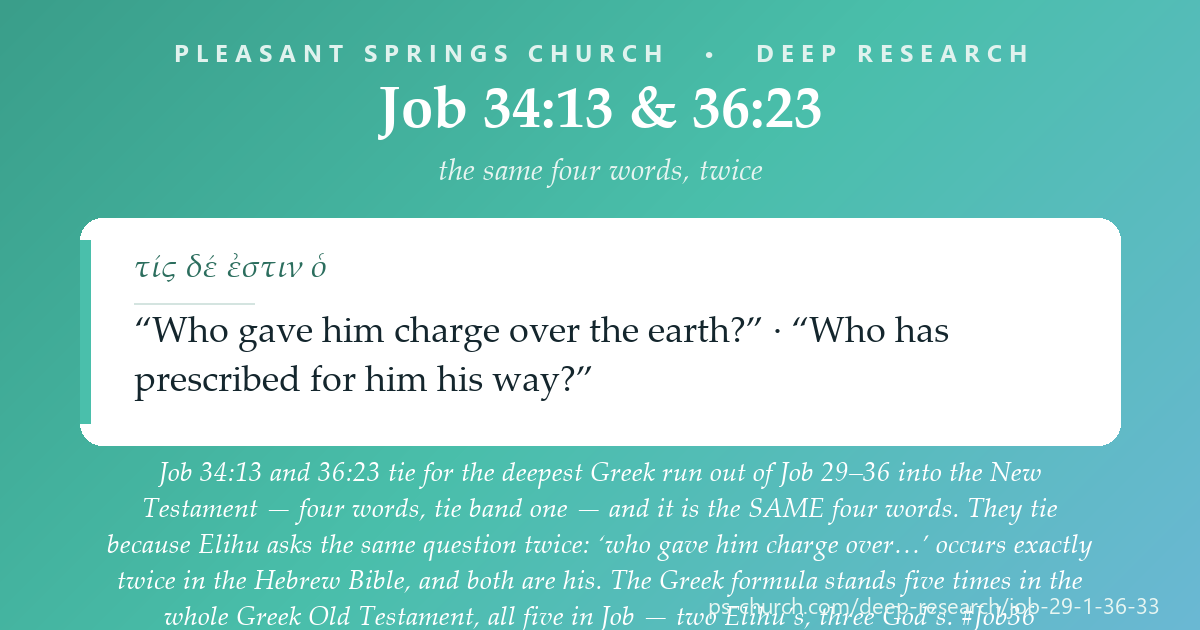
“To appoint, muster, put in charge.” The phrase מִי־פָקַד עָלָיו, ‘who gave him charge over…,’ occurs exactly twice in the Hebrew Bible — Job 34:13 and Job 36:23. Both are Elihu’s, and they are the beam this page rests on: six verses of these eight chapters reach the four-word ceiling into the New Testament, and two of them reach it on the same four Greek words — because they are the two verses where Elihu says the same Hebrew sentence twice.
Counted here, not assumed:
- “And Job answered and said” occurs nine times (3:2, 6:1, 9:1, 12:1, 16:1, 19:1, 21:1, 23:1, 26:1) and never again without an object — at 40:3 and 42:1 the narrator writes “and Job answered the Lord and said.” Job’s last two speeches to the friends open with a different formula.
- “The words of Job are ended” occurs once in the Hebrew Bible — 31:40. It is not a formula. It is a full stop.
- Seventeen of the forty verses of chapter 31 begin with ʾim — 5, 7, 9, 13, 16, 19, 20, 21, 24, 25, 26, 29, 31, 33, 36, 38, 39. No other chapter in these eight comes close: 33 has four, 35 has two, 30, 34 and 36 have one each, and 29 and 32 have none.
- “I was eyes to the blind” occurs once (29:15). And in Greek the genitive χωλῶν, “of the lame,” occurs exactly once in the whole Greek Old Testament held here — this verse — and exactly once in the Greek New Testament — John 5:3, the crowd of invalids at the pool. Job 29:15 and John 5:3 share exactly one word (τυφλῶν), so the machine certifies nothing here. The count is offered as a count.
- “Where is God my Maker” occurs once (35:10). The consonantal string איה stands 43 times in the Hebrew Bible, but six of those are the falcon (Job 28:7) or the name Aiah (2 Samuel 3:7; 21:8, 21:10, 21:11; 1 Chronicles 1:40): the interrogative אַיֵּה stands 37 times, and this is its only occurrence in Elihu’s mouth.
- The Greek διπλοΐς, the “double cloak” Job’s justice is compared to at 29:14, occurs nine times in the Greek Old Testament held here — and six of the nine are in 1 Kingdoms (LXX 2:19, 15:27, 24:5, 24:6, 24:12, 28:14 = ESV 1 Samuel 2:19, 15:27, 24:4, 24:5, 24:11, 28:14). Three of the six are Samuel’s robe, including the one the woman at Endor sees, and three are the corner of Saul’s robe that David cut off. The Hebrew at 29:14 has two garments, a robe and a turban; the Greek has one.
Four internal twins, six runs into the New Testament, and the two that tie.
Greek against Greek: the CATSS FORM column against MorphGNT’s normalised word, both lowercased, accents and breathings dropped, final sigma folded, filtered to Greek letters. Contiguous runs of whole word forms, never lemmas. Hebrew against Hebrew: consonants only, every qere read. Exhaustive and deterministic; nothing sampled.
What does the passage measure against the Greek New Testament?
The frame first. Across the 239 CATSS rows of Job 29–36 screened against all 7,927 verses of the Greek New Testament: 219 reach two consecutive words, 86 reach three, 6 reach four, and nothing reaches five. For scale, the whole book of Job has 1,083 rows, of which 50 reach four and three reach five — 1:8, 2:3 and 13:16, all three with a tie band of one, so none of them is deeper than the others. The one worth a second look is 13:16 against Philippians 1:19, τοῦτό μοι ἀποβήσεται εἰς σωτηρίαν — Paul gives no citation formula there and this page does not supply one. Either way it stands outside this passage. Inside Job 29–36 the ceiling is four, and this page will now argue that not one of the six is contact.
All six, with their tie bands:
- 34:13 — run 4, band 1, 1 John 5:5, τίς δέ ἐστιν ὁ
- 36:23 — run 4, band 1, 1 John 5:5, τίς δέ ἐστιν ὁ — the same four words
- 35:10 — run 4, band 1, Acts 17:24, ὁ θεὸς ὁ ποιήσας
- 35:16 — run 4, band 1, Acts 8:32, ἀνοίγει τὸ στόμα αὐτοῦ
- 31:10 — run 4, band 1, Luke 1:18, καὶ ἡ γυνή μου
- 35:5 — run 4, band 3, Mark 16:19 / Luke 15:18 / Luke 15:21, εἰς τὸν οὐρανὸν καί
Now the screens that dissolve them, one at a time.
τίς δέ ἐστιν ὁ occurs five times in the 30,348 verse units of Greek Old Testament held here, and all five are in Job: 34:13, 36:23, 38:6, 38:28 and 39:5. In the Greek New Testament it occurs once, at 1 John 5:5. It is a Greek interrogative frame — “and who is the one who…?” — and 1 John 5:5 is not quoting anything.
Two of the five are Elihu’s and three are God’s. Elihu at 34:13 and 36:23; the voice out of the whirlwind at 38:6 (who laid its cornerstone?), 38:28 (who begets the drops of dew?) and 39:5 (who set the wild donkey free?). Two chapters before God speaks, Elihu is already asking in God’s grammar. Whether that is the translator’s ear or the book’s design, this page does not say.
And underneath the Greek there is a Hebrew repetition. מִי־פָקַד עָלָיו — “who gave him charge over…” — occurs exactly twice in the whole Hebrew Bible: Job 34:13 and Job 36:23. So two of the six verses that reach the four-word ceiling reach it on the same words because Elihu repeats himself, and the Greek reproduces the repetition with a formula of its own. The tie is a fact about Job, not a fact about 1 John.
Job 35:16 shares four consecutive Greek words with Acts 8:32, tie band 1 — ἀνοίγει τὸ στόμα αὐτοῦ. On the numbers that is as strong as anything in the passage. It is worth nothing.
Screened across the whole Greek Old Testament held here, that four-word string occurs twice: Isaiah 53:7 and Job 35:16. In the Greek New Testament it occurs once: Acts 8:32 — which is the Ethiopian eunuch’s scroll, and which explicitly quotes Isaiah 53:7. The four words came into Acts from Isaiah. Job is a bystander.
And in Job the sentence means the reverse. Isaiah’s servant does not open his mouth; Elihu’s Job opens his mouth in vanity. A run of four with a tie band of one, and the two verses are opposites. This is what the shelf means when it says a run finds verbatim contact and not allusion.
ὁ θεὸς ὁ ποιήσας, “the God who made,” occurs four times in the Greek Old Testament held here — Isaiah 42:5, 43:1, 44:2, and Job 35:10 — and once in the Greek New Testament: Acts 17:24, Paul at the Areopagus, “the God who made the world and everything in it.”
Three of the four Old Testament occurrences are Isaiah’s. So the run of four between Job 35:10 and Acts 17:24 is not evidence that Paul had Job in mind; it is a creator-formula that Greek Isaiah uses three times and Greek Job once. The page names the resonance — a question nobody asks (“where is God my Maker?”) answered in a city full of altars — and states plainly that the measurement does not establish it.
And the last two of the six dissolve on sight. Job 31:10 and Luke 1:18 share καὶ ἡ γυνή μου, “and my wife” — Job is swearing a self-curse and Zechariah is telling Gabriel his wife is old. Job 35:5 reaches four with a tie band of three, on εἰς τὸν οὐρανὸν καί, which stands in 25 verses of the Greek Old Testament and 3 of the New. That is what a formula looks like when the band is doing its job.
And inside the book itself? Four twins, and only two of them survive translation.
Four places in this passage repeat something said earlier in Job. The Hebrew run and the Greek run are not the same size, and in two cases they point in opposite directions.
Two twins the machine ranks highest are formulas; the twin that matters most rhetorically measures one. That asymmetry is the page’s finding, and it is why the shelf reports the band beside every run.
- Job 30:29 ↔ Isaiah 34:13 — Hebrew run 2, band 1 (לִבְנוֹת יַעֲנָה); Greek run 1 (σειρήνων). The same two creatures, in the same order, in both languages — and no run screen would rank it. Job says he has become the ruin that Isaiah describes.
- Job 29:14 ↔ Isaiah 59:17 — ἐνεδύσατο δικαιοσύνην, “he put on righteousness,” occurs once in the Greek Old Testament held here, at Isaiah 59:17, where the wearer is the Lord. Job 29:14 has the same verb in the pluperfect. The run is one — δικαιοσύνην — because the verb form differs and nothing can join it. Ephesians 6:14’s θώρακα τῆς δικαιοσύνης occurs once in the Greek New Testament and not once as that exact string in the Greek Old Testament held here.
- Job 34:14–15 — if he should gather to himself his spirit and his breath, all flesh would perish together. Reported without a claim: the vocabulary is Genesis 2:7 and Psalm 104:29, and the page does not turn a shared idea into a measured connection.
- Job 36:15 — the Hebrew’s “he delivers the afflicted by their affliction” is not what Rahlfs prints (see Stage 2). Any New Testament comparison drawn from this verse has to say which column it is standing on.
What this page could not check, what it got wrong on the first pass, and where it is weakest.
This section exists so that nothing above has to be taken on trust. Everything it says is a limit.
What was NOT consulted, and what could not be checked:
- No critical apparatus was consulted for the Hebrew. The text is the Masoretic text as printed in the editions on this disk — Sefaria’s Miqra according to the Masorah. Every count above is a count of that edition, and a different edition could differ by a letter.
- Ziegler’s Göttingen Iob was not consulted. The Greek here is Rahlfs via the CATSS digitization, which carries no Aristarchian signs. That is why the “Old Greek Job is a sixth shorter” claim could not be tested: the text we hold has the Hexaplaric supplements silently in it. The measured ratio — Greek 1.62 words per Hebrew word across the book, 1.60 across this passage — is therefore a measurement of Rahlfs, not of the Old Greek, and it should not be quoted as evidence either way.
- 11QtgJob (11Q10) was not read. The Qumran Aramaic Targum reaches into these chapters and is the oldest witness to them outside the Hebrew. It is not on this disk and nothing on this page is checked against it.
- The Peshitta, the Vulgate and the Targum were not collated. Only three columns were compared, and where the Greek and the Hebrew part company — 29:6, 30:1, 35:10, 36:15 — no fourth witness was brought in to break the tie.
- The ancient Near Eastern texts in Stage 2 were not read in the original. Ludlul bēl nēmeqi, the Babylonian Theodicy and the Sumerian “Man and his God” are cited by their ANET pages from an index, not from the tablets. They are offered as a formal resemblance, and specifically not as a source.
- The Elihu composition question is not settled here and this page does not pretend to settle it. It reads the received text, in which Elihu stands where he stands. The fullest case against him is in the companion study on Job 32–37.
Where this page is weakest:
- The Balaam comparison is the softest thing on the page. The verbs are different — Balaam lifts up his māšāl, Job adds to take up his — and the count of nine is a count of a construction, not of a formula. If you want to say the two are unrelated, nothing measured here stops you. What is not soft is the negative: the book used “and Job answered” nine times and then stopped.
- The τίς δέ ἐστιν ὁ finding is a finding about a translator’s habit. Five occurrences, all in one book, is a strong number — but it is strong evidence that Greek Job likes this frame, which is a smaller claim than “Elihu anticipates God.” The Hebrew underneath the five is not one phrase: 34:13 and 36:23 share מִי־פָקַד עָלָיו, but 38:6, 38:28 and 39:5 do not. The Greek unifies what the Hebrew does not. Both halves are printed above.
- The “in days” hinge is three data points. Sixteen occurrences in the Hebrew Bible and three in Job is a real concentration, but three is three. It is offered as a reading of the seam and not as proof of a design.
- No Hebrew-side screen was run against the whole Tanakh at depth. Chapters 29, 30, 34, 35 and 36 were screened verse by verse; chapters 31, 32 and 33 were not screened exhaustively against the Hebrew Bible for this page, because two companion studies already cover them. A reader who wants the full Hebrew picture of 31–33 will not get it here.
- The ESV is quoted under Crossway’s standing permission, not a licence, and the permission has a half-a-book ceiling. Measured across the whole shelf at the time this page was built, Job is quoted at 106 verses of 1,070 — 9.9%, against a ceiling of one half, and most of those rows quote a fragment rather than a whole verse, so the true figure is lower. The page says so because a study shelf is exactly the kind of work the permission excludes, and the honest position is to keep the exposure small and stated.
Bibliography, and where each was actually used:
- David J. A. Clines, Job 21–37 (WBC 18A) — consulted for the shape of 29–31 and the Elihu question; no count on this page is taken from it.
- Carol A. Newsom, The Book of Job — for chapter 29 as the performance of a lost social world, which is the reading behind the Audience panel.
- Norman Habel, The Book of Job (OTL) — for reading 29–31 as one legal document rather than three poems.
- Claude Cox, NETS Iob, from Ziegler — for what is Old Greek and what is Origen’s at 36:28. Used as a description, not as a text: the Greek printed on this page is Rahlfs.
- J. B. Pritchard (ed.), ANET (3rd ed.), pp. 434–437, 589–591, 596–604 — page references only, from an index; the texts themselves were not read for this page.
What a man misses when he has lost everything, and the prayer nobody prays.
Name what you learned, why it matters, and one concrete response.
What should we carry away — and do?
- What Job misses is his usefulness. Read chapter 29 again and count what he actually mourns. Not the herds, not the servants, not the house. The blind man who used his eyes. The lame man who used his feet. The stranger whose case he investigated. The young men who stood up when he came. He is grieving the loss of being needed, which is a grief nobody warns you about.
- He is willing to be examined line by line. Seventeen sworn “if” clauses covering what he looked at, what he thought when an enemy fell, and who slept outside his door. Then he signs it. The confidence is not that he is sinless; it is that he will let the list be read out.
- The best line in Elihu is a negative. None says, ‘Where is God my Maker, who gives songs in the night?’ The complaint is not that God is absent but that nobody asks for him — people cry out under oppression, Elihu says, and cry to the wrong address. Three times in the Hebrew Bible somebody has songs: David, a pilgrim, and a man in the dark who never thought to ask.
- And the young man is worth listening to even when he is insufferable. Elihu takes seventeen verses to explain why he is entitled to speak, prosecutes a broken man, and then says the one thing nobody else in the book manages. Being right and being kind are separate achievements. The book gives him neither a rebuke nor a commendation, and leaves him standing there.
- One concrete response. Write your own chapter 29 — five sentences beginning “when…” about a season you would go back to. Then read what you wrote and see whether what you miss is what you had or what you were for.
Job 36:26 · to share
Hebrew (Masoretic) + Greek (Rahlfs) + ESVEvery Deep Research page traces its passage across the whole sweep — the Old Testament, the Second-Temple world between the testaments (historical witnesses, not Scripture), and the New Testament. Follow the thread:
Pleasant Springs Church — Deep Research
Research method after Michael S. Heiser’s Bible Research Method (examine dictionaries → ancient literature → important words → textual connections → academic publications → share), with the Pleasant Springs “Author & Audience” foundation. Scripture set in the Hebrew, the Greek editions named on each page and the ESV (Old Testament), and the Greek New Testament and the ESV (New Testament), per the practice of Pleasant Springs Church. Job 29–36 research grounded in Clines (WBC), Newsom, Habel (OTL), and NETS Iob (tr. Cox) from Ziegler. Text: Hebrew from the Masoretic text as printed in the edition consulted — Sefaria’s Miqra according to the Masorah; no critical apparatus was consulted for the Hebrew. Greek from Rahlfs’s Septuaginta (CATSS digitization), which carries no Aristarchian signs. ⚠️ VERSE NUMBERING — there is no offset in this passage. Masoretic, CATSS and ESV run chapter for chapter and verse for verse across all 237 verses of Job 29:1–36:33; the only difference is two lettered Greek plus-lines at 36:28a–b. Across the book the Masoretic Job has 1,070 verses and the CATSS Greek 1,083 verse units. Counted rather than asserted, over all 23,204 Masoretic verse units: “and Job answered and said” nine times (3:2, 6:1, 9:1, 12:1, 16:1, 19:1, 21:1, 23:1, 26:1) and never again without an object (40:3 and 42:1 read and Job answered the Lord and said); “Job again took up his māšāl and said” exactly twice (27:1, 29:1) against Balaam’s seven (Numbers 23:7, 23:18, 24:3, 24:15, 24:20, 24:21, 24:23); “the words of Job are ended” once; מִי־פָקַד עָלָיו exactly twice (34:13, 36:23); לְיָמִים sixteen times in the Hebrew Bible, three in Job (30:1, 32:4, 32:6) and none elsewhere in the book; וְעַתָּה 272 times, eight in Job, three in chapter 30, the only chapter in the book with three (42 has two); זְמִרוֹת three times (2 Samuel 23:1, Psalm 119:54, Job 35:10); seventeen verse-initial ʾim clauses in chapter 31. Over the 30,348 verse units of CATSS Greek held here (the Odes excluded from the screen, since Ode 9 is Luke 1 and Ode 13 is Luke 2 and ten more Odes are second copies of passages already counted): προοίμιον three times, all in Job (25:2, 27:1, 29:1); τίς δέ ἐστιν ὁ five times, all in Job (34:13, 36:23, 38:6, 38:28, 39:5) and once in the Greek New Testament (1 John 5:5); ὁ θεὸς ὁ ποιήσας four times (Isaiah 42:5, 43:1, 44:2, Job 35:10) and once in the New Testament (Acts 17:24); ἀνοίγει τὸ στόμα αὐτοῦ twice (Isaiah 53:7, Job 35:16) and once in the New Testament (Acts 8:32, which quotes Isaiah); χωλῶν once in each Testament (Job 29:15; John 5:3). Runs are reported with their tie bands and no direction of influence is asserted anywhere. Across 239 CATSS rows of Job 29–36 against 7,927 verses of the Greek New Testament: 219 reach two, 86 reach three, six reach four, nothing reaches five — and the page argues that none of the six is contact, printing Acts 8:32 against Job 35:16 as its own counter-example. ⚠️ A claim that could not be tested is reported as untested: the shortness of the Old Greek of Job is invisible in Rahlfs, which prints the Hexaplaric supplements — measured, the Greek runs 1.62 words per Hebrew word across the book and 1.60 across this passage, with no low outlier in the passage. The divergence at 36:15 is stated rather than smoothed, and the structure diagram is labelled a sequence with a hinge and explicitly not a chiasm, because the text supplies no centre.
Scripture quotations marked ESV are from the ESV® Bible (The Holy Bible, English Standard Version®), © 2001 by Crossway, a publishing ministry of Good News Publishers. ESV Text Edition: 2016. Used by permission. All rights reserved. The ESV text may not be quoted in any publication made available to the public by a Creative Commons license, and the ESV may not be translated in whole or in part into any other language. www.esv.org
|
Did this study bless you today? 💚 Give to Support PS Church100% of gifts go to the General Fund — thank you. |