Nobody interrupts him again. With Bildad reduced to six verses and Zophar silent, Job speaks for five uninterrupted chapters — and there is not a single imperative in any of them. Nobody is telling anybody to do anything any more. He swears he will not concede: till I die I will not put away my integrity — using a word that occurs four times in the whole book, twice in heaven and from his wife, twice here. Then comes a poem unlike anything around it: men sink shafts into rock, overturn mountains by the roots, dam the sources of rivers and bring hidden things to light — and then, but where shall wisdom be found? The deep says it is not in me; the sea says it is not with me; no gold buys it. Then he remembers the city gate, the young men stepping aside, and the reason for it: I was eyes to the blind and feet to the lame. Then and now — three times — the mockery of men who chew saltwort in the desert. And finally seventeen sworn self-curses covering what he looked at, what he thought in secret, and whom he failed to help, closing with a signature and a demand: let the Almighty answer me. See the method →
Job 27:1–31:40 (selections)
Hebrew · Greek (Rahlfs) · ESVFirst he refuses to concede (27): far be it from me to say that you are right; till I die I will not put away my integrity from me. Then the poem (28), which is unlike anything around it: calm, impersonal, and structured by a refrain. Men sink shafts into rock, cut channels, overturn mountains by the roots, and bring hidden things to light — but where shall wisdom be found? The deep says it is not in me; the sea says it is not with me; it cannot be bought for gold or weighed against sapphire. Then the memory (29): the city gate, the young men stepping aside, princes falling silent — I was eyes to the blind and feet to the lame. Then the present (30): mocked by the sons of men he would not have set with his sheepdogs, men who chew saltwort in the desert.
And then the oath. Chapter 31 is the most sustained ethical self-examination in the Old Testament — seventeen conditional self-curses, every one of them opening its verse: if I have walked with falsehood… if my heart has been enticed… if I have rejected the cause of my servant… if I have withheld anything the poor desired… if I have made gold my trust… It ends with a legal demand: here is my signature — let the Almighty answer me.
⚠️ One word brackets this passage against the prologue. Tummāh, integrity, occurs exactly four times in the book of Job. Two are in the prose prologue: God says he still holds fast his integrity (2:3), and his wife says do you still hold fast your integrity? (2:9). The other two are here — at 27:5, where Job swears he will not let it go, and at 31:6, where he asks God to weigh him and know my integrity. The word God used of him, and his wife used against him, is the word he now refuses to surrender.
⚠️ And this is the only covenant Job ever makes. Bərîṯ occurs twice in the whole book — here at 31:1, where Job cuts one with his own eyes, and at 40:28, where God asks whether Leviathan will make a covenant with you. The Greek agrees exactly: διαθήκη twice, in the same two verses. In a book with no Sinai, no law and no Israel, the one covenant a man makes is with his eyes — and the only other is God’s sarcasm about a sea-monster.
⚠️ The refrain differs by exactly one word — and the Greek flattens it. Hebrew 28:12 and 28:20 are seven words each and differ in one: wisdom is found (timmāṣēʾ) in the first, wisdom comes (tāḇōʾ) in the second. Rahlfs uses the same verb in both — and then varies something the Hebrew keeps constant. Each tradition holds steady where the other moves.
⚠️ And at 28:18 the translator simply gave up. Faced with gāḇîš — a stone-name so rare it appears almost nowhere else — he transliterated it rather than translating: γαβις. In the same verse he read mešeḵ ḥoḵmāh, “the price of wisdom,” as an imperative: ἕλκυσον σοφίαν, “draw out wisdom.” The lapidary vocabulary of chapter 28 defeated the oldest translation we have.
The Shape of the Passage
SequenceChapter 28 sits inside all this like a room with a different temperature. It is calm, impersonal and beautifully built, and it uses a divine title found nowhere else in the book. Many scholars therefore read it as an editorial interlude rather than as Job’s speech; others defend it as his. This page reads the received text, in which it is Job’s, and reports the argument. Either way its function is plain: between a man refusing to concede and a man swearing seventeen oaths, somebody observes that wisdom cannot be mined, bought or located — which is precisely what the friends have spent twenty-five chapters assuming they possess.
And the oath is the legal move the whole book has been building toward. Job has wanted a hearing since chapter 9; he has wanted an arbiter, a witness, a redeemer. Chapter 31 stops asking and files the document: seventeen sworn denials and a signature. Then he stops talking, and the next voice is a stranger’s.
The dialogue ended in exhaustion — six verses from Bildad and nothing from Zophar. What follows is the longest speech in the book, and nobody answers it.
Author
He gives Job the floor and then takes the argument away from him. Chapter 28 does not answer the friends and does not defend Job; it simply observes that wisdom is not a commodity. Coming where it does, it disqualifies the entire preceding debate — not by refuting either side but by noting that neither had access to what they were both claiming.
He builds chapter 29 and chapter 30 as mirror images. Chapter 29 opens with a wish and five time-clauses about the past; chapter 30 turns three times on and now. The same man, the same city, the same gate — and the sons of the men he pitied are spitting at him. The symmetry is deliberate and it is the cruellest thing in the book after the prologue.
And he lets Job finish with a legal instrument rather than a prayer. Seventeen sworn denials, each inviting a specific curse if false, and then a signature demanding an answer. Job does not end by submitting. He ends by filing.
Audience
People who have been respected and then were not. Chapters 29 and 30 are about status as much as suffering — the gate, the seat, the silence when he spoke, and then the mockery of people with nothing. Scripture takes the loss of standing seriously enough to give it two chapters.
People who wanted an ethics that went past behaviour. Job’s oath covers what he looked at (31:1), what he thought in secret (31:27), and whether he rejoiced at an enemy’s ruin (31:29). It is an examination of the interior life a thousand years before the Sermon on the Mount, and the page notes the resemblance without making a claim about it.
And people who have run out of people to talk to. No imperative for nine chapters. Job is not in a debate any more; he is making a statement for the record, which is what you do when the room has stopped answering.
Orient on mining, on oaths of clearance, and on the chapter 28 question.
Search by topic: mining and metallurgy in the ancient Near East; gemstones of the Bible; oath and self-imprecation; negative confession; wisdom personified; the fear of the Lord; city gate and judicial assembly.
Which articles are relevant?
- Anchor Bible Dictionary — “Mining,” “Jewels and Precious Stones,” “Oath,” “Wisdom,” “Gate,” “Curse.”
- Dictionary of the OT: Wisdom, Poetry & Writings (IVP) — “Job 28,” “Job 29–31,” “Wisdom,” “Fear of the Lord,” “Ethics,” “Oaths.”
- NIDOTTE / TDOT — תֻּמָּה (tummāh, integrity), בְּרִית (bərîṯ, covenant), חׇכְמָה (ḥoḵmāh), יִרְאַת (yirʾaṯ, fear).
- On the Greek — NETS Iob, which shows that 27:13–20 is Old Greek while 27:21–23 is Origen’s.
Bibliography surfaced:
- David J. A. Clines, Job 21–37 (WBC) — on chapter 28 and on the oath.
- Carol A. Newsom, The Book of Job — particularly good on chapter 28's placement.
- Norman Habel, The Book of Job (OTL) — on chapters 29–31 as a legal instrument.
Real mines, real oaths, and a chapter that may not belong to Job.
First the mining, which is technically accurate. Then the oath form. Then the honest state of the chapter 28 question.
Which parallels shed light on these chapters?
Job 28:1–11 is the most detailed description of mining in the Hebrew Bible, and it is accurate. Shafts sunk far from habitation; miners suspended and swinging away from human feet; fire used to break rock; channels cut through stone; the sources of rivers dammed so the workings stay dry. Egyptian copper and turquoise mines in the Sinai, and the Egyptian gold-mine map now in Turin, describe the same industry. The poem’s force depends on that realism: human beings can reach anything — and cannot reach this.
The oath of chapter 31 has a recognisable ancient form. A conditional self-curse — if I have done X, then let Y happen to me — is how a defendant cleared himself where evidence was unavailable; Exodus 22:10–11 legislates for exactly that, and 1 Kings 8:31–32 has Solomon pray about it. Job is not making a moral inventory. He is executing a legal procedure, and 31:35’s here is my mark is the signature at the foot of it.
Comparison with Egypt is often made here and should be made carefully. The “negative confession” of the Egyptian Book of the Dead (spell 125) is also a list of denials — I have not stolen, I have not killed, I have not defrauded. But the settings differ sharply: the Egyptian text is spoken by the dead before divine judges to secure passage, while Job’s is spoken by a living man demanding a hearing he has been denied. The genre resemblance is real; the situation is not.
- Exodus 22:10–11; 1 Kings 8:31–32; Numbers 5:19–22 — the oath of clearance in Israelite practice. The legal form behind Job 31.
- The Egyptian Book of the Dead, spell 125 (Egyptian — a witness, not Scripture) — the “negative confession.” Compare the form; do not equate the situations.
- Proverbs 8; Sirach 24; Baruch 3:9–4:4 (the latter two Apocrypha — witnesses, not Scripture in our confession) — wisdom sought, hidden, and finally located. Job 28 asks the question these texts answer, and answers it far more austerely.
- Deuteronomy 30:11–14 — it is not in heaven… neither is it beyond the sea. The same geography of searching, with the opposite conclusion.
The question is real and the page reports it rather than settling it. Four things are observable.
(1) The tone does not match. Chapters 27 and 29–31 are first-person, agitated, and legal. Chapter 28 is impersonal, serene, and has no I in it until the closing verse. Nothing else in Job sounds like it.
(2) It uses a divine title found nowhere else in the book. 28:28 has ʾăḏōnāy, the Lord. Counted across all 1,070 verses: a consonantal search returns three hits, and two are false positives — 3:19 is his master (a slave’s owner) and 38:6 is its bases, the sockets of the earth’s foundation. 28:28 is the only place in Job where the divine title occurs, and in a book that otherwise reaches for Shaddai and Eloah that is conspicuous.
(3) It answers a question nobody in the chapter asked, and its conclusion — the fear of the Lord, that is wisdom — is the standing formula of Proverbs 1:7 and 9:10, not the language of the dialogue.
(4) But no manuscript separates it. Every Hebrew and Greek witness has it exactly where it stands, inside Job’s speech. The interlude theory is a literary judgement, not a text-critical finding, and this page reads the received text while saying that many careful readers hear a second voice here.
A related caution about chapter 27. Verses 13–23 describe the fate of the wicked in terms that sound like Zophar — 27:13 nearly repeats 20:29 — and this has prompted reconstructions assigning them to him, repairing the missing third speech. Again, no manuscript supports it. And a detail worth having: the Greek makes the overlap tighter than the Hebrew does, with seven identical words against the Hebrew’s four.
A word that brackets the book, the only covenant, and seventeen conditions.
Trace tummāh at 2:3, 2:9, 27:5, 31:6 — four verses, and they hold the book together. Then count the if clauses in chapter 31.
“Integrity, completeness.” Four occurrences in the whole book, and they frame it. Two in the prose prologue — God’s he still holds fast his integrity (2:3), and his wife’s do you still hold fast your integrity? (2:9). Two here — till I die I will not put away my integrity (27:5) and let him weigh me… that God may know my integrity (31:6). The word spoken over him in heaven and thrown at him by his wife is the one he will not surrender. Rahlfs renders it ἀκακία at 2:3, 27:5 and 31:6 — and has no counterpart for it at all at 2:9.
“Covenant.” Twice in the entire book of Job, and the Greek agrees exactly. Here, where Job cuts one with his own eyes — and at 40:28, where God asks whether Leviathan will make a covenant with you. In a book with no Sinai, no law and no Israel, the only covenant a human being makes is a private undertaking about where he looks, and the only other mention is God’s sarcasm about a monster.
“The Lord.” The only occurrence of this divine title in Job — and it carries much of the weight of the argument that chapter 28 is an editorial interlude. A consonantal search returns three hits, and two must be discarded: 3:19 is his master (an owner) and 38:6 is its bases (sockets). Only 28:28 is the divine name. The Greek does not render it as a name at all, using θεοσέβεια — godliness — for the whole phrase fear of the Lord.
“If.” Seventeen of them in chapter 31, every one opening its verse, one per verse — nearly twice the density of any other chapter in Job. Each introduces a conditional self-curse: if I have done this, then let that be done to me. Rahlfs multiplies them, producing twenty-eight εἰ clauses from the seventeen. This is legal drafting, not moral reverie.
A precious stone — crystal, or possibly alabaster. So rare that the Greek translator did not translate it: he wrote it out in Greek letters, γαβις. Transliteration is what a translator does when he has run out of options, and chapter 28’s lapidary vocabulary defeated him more than once — in the same verse he took the price of wisdom to be an imperative, draw out wisdom.
“Saltwort” — a salty desert plant eaten only in extremity. A hapax legomenon: it occurs once in the entire Hebrew Bible. So does pirḥaḥ, “brood, rabble,” eight verses later (30:12). Job’s description of the men now mocking him reaches for words nobody else in Scripture ever needed — which is itself a comment on how far outside ordinary society they live.
Counted here, not assumed:
- No imperative occurs in Job 23–31. Nine consecutive chapters, over two hundred verses. The last command in the dialogue is Eliphaz’s in chapter 22, and Job’s last to anyone was at 21:5. Nobody is asking anybody to do anything any more.
- Tummāh occurs exactly four times in Job — 2:3, 2:9, 27:5, 31:6 — and nowhere else in the book. Two in the prologue, two here.
- Bərîṯ occurs exactly twice in Job — 31:1 and 40:28 — and the Greek matches exactly, with διαθήκη in those two verses and no others.
- Chapter 31 has seventeen if clauses, all verse-initial, one per verse. Rahlfs turns them into twenty-eight.
- The divine title ʾăḏōnāy occurs once in Job, at 28:28. A naive consonantal search returns three — 3:19 (“his master”) and 38:6 (“its bases”) are false positives and must be excluded.
- 27:13–20 is Old Greek; only 27:21–23 is Origen’s. So the passage that sounds like Zophar was in the earliest translation, in Job’s mouth.
- Two hapax legomena in chapter 30 — mallûaḥ (saltwort, 30:4) and pirḥaḥ (brood, 30:12), each occurring once in the whole Hebrew Bible.
A question Proverbs answers, an oath Israel legislated, and an ethic of the interior.
Read Job 28 and then Proverbs 8 — the same question, two very different answers. Then read Job 31 beside Exodus 22:10–11.
Which cross-references matter?
- Job 28:28 and Proverbs 1:7; 9:10; Psalm 111:10. The fear of the Lord is the beginning of wisdom. Job 28 ends on the standing formula of the wisdom tradition — which is one reason many readers hear a different voice in the chapter.
- Job 28 beside Proverbs 8 and Deuteronomy 30:11–14. Proverbs has wisdom calling aloud in the street; Deuteronomy insists the word is not in heaven or beyond the sea but very near. Job 28 says it is inaccessible — not in the deep, not in the sea, not purchasable at any price. Three canonical answers to one question, and the page does not blend them.
- Exodus 22:10–11; 1 Kings 8:31–32; Numbers 5:19–22 → Job 31. The oath of clearance as legal procedure. Job is not confessing; he is swearing, and inviting the specified curse if he lies.
- Job 31:1 and Matthew 5:28. A covenant with the eyes, and everyone who looks… has already committed adultery in his heart. The page notes that Job’s oath already reaches past behaviour to the gaze and to the secret thought (31:27), and leaves the connection for the reader to see.
- Job 29:12–16 beside Isaiah 1:17 and James 1:27. The fatherless, the widow, the blind, the lame. Job’s account of his own righteousness is almost entirely about what he did for people with no standing.
- Job 31:35 and Job 19:23–24. Oh that my words were written… engraved in the rock, and now here is my signature. The wish of chapter 19 becomes the legal act of chapter 31.
One chapter that may not belong, and one that may belong to somebody else.
Clines and Newsom on chapter 28. Then four open questions.
Commentaries & studies:
- David J. A. Clines, Job 21–37 (WBC) — the fullest treatment of both the chapter 28 question and the oath.
- Carol A. Newsom, The Book of Job — on chapter 28 as a deliberate change of voice rather than an accident.
- Norman Habel, The Book of Job (OTL) — on chapters 29–31 as a single legal document.
- NETS Iob (tr. Cox), from Ziegler — for what in chapter 27 is Old Greek and what is Origen’s.
Four things reported as unsettled:
- Whether chapter 28 is Job’s speech. Its tone, its serenity, its unique divine title and its Proverbs-style conclusion all point away from him; every manuscript points to him. This page reads the received text and reports the argument.
- Whether Job 27:13–23 belongs to Zophar. It sounds like the friends and nearly repeats 20:29. No ancient witness redistributes it — and the Greek makes the overlap tighter, not looser.
- What gāḇîš and several other stones in 28:16–19 actually are. The translations vary because the words are rare; the oldest Greek transliterated one of them rather than translate it.
- Whether the Egyptian “negative confession” is a real parallel to chapter 31. The form is similar and the setting is not — one is spoken by the dead to secure passage, the other by a living man demanding a trial. Reported as a resemblance, not an equation.
What cannot be mined, and what will not be surrendered.
Name what you learned, why it matters, and one concrete response.
What should we carry away — and do?
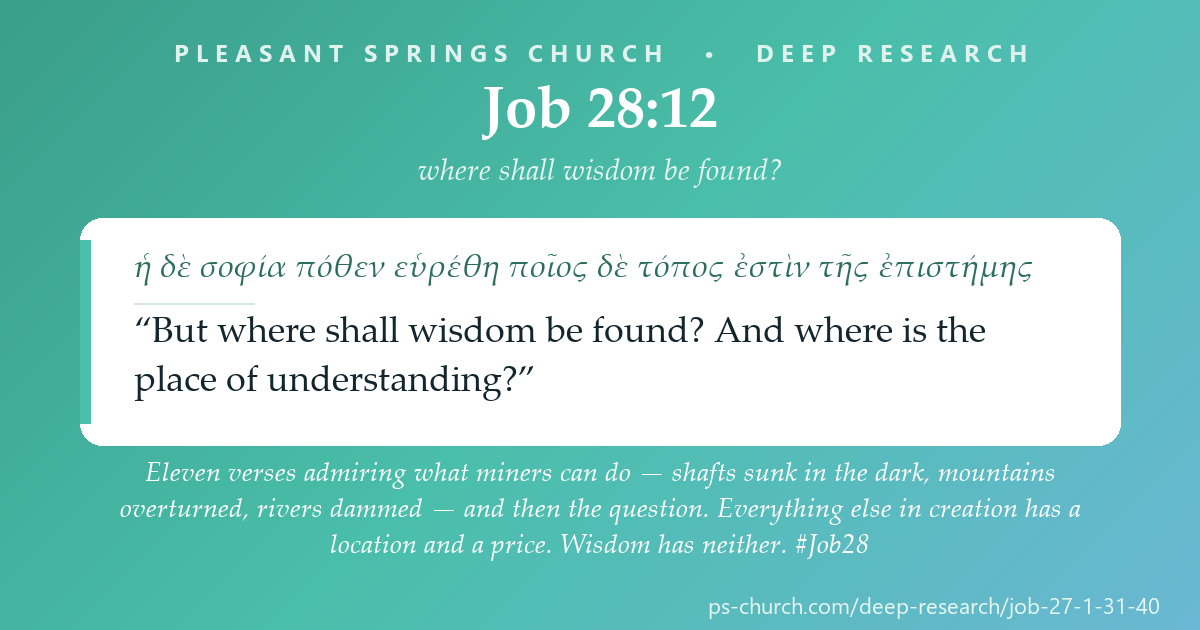
- Human beings can reach anything except the one thing they need. Chapter 28 spends eleven verses admiring what miners achieve — shafts in the dark, mountains overturned, rivers dammed — precisely to make the failure land: wisdom has no seam, no market price and no address. Everything else in creation can be located.
- The word Job will not surrender is the word God used of him. Integrity occurs four times in the book: twice in heaven and from his wife, twice from Job himself. He does not know God said it. He holds on to it anyway, which is the whole answer to the question asked in chapter 1.
- His ethics reach further than his behaviour. The oath covers what he looked at, what he thought in private, and whether he was glad when an enemy fell. He also counts as sin the things he failed to do — the poor not helped, the traveller not housed. It is a startlingly modern conscience, and it is the oldest such list we have.
- One concrete response. Job 31 is not a devotional exercise; it is seventeen specific, checkable claims about how he treated people with no power over him — servants, widows, orphans, strangers, the poor. Write three of your own, in that form, and see whether you would sign them.
Job 28:12 · to share
Hebrew + Greek (Rahlfs) + ESVEvery Deep Research page traces its passage across the whole sweep — the Old Testament, the Second-Temple world between the testaments (historical witnesses, not Scripture), and the New Testament. Follow the thread:
Pleasant Springs Church — Deep Research
Research method after Michael S. Heiser’s Bible Research Method (examine dictionaries → ancient literature → important words → textual connections → academic publications → share), with the Pleasant Springs “Author & Audience” foundation. Scripture set in the Hebrew, the Greek editions named on each page and the ESV (Old Testament), and the Greek New Testament and the ESV (New Testament), per the practice of Pleasant Springs Church. Job 27–31 research grounded in Clines (WBC), Newsom, Habel (OTL), and NETS Iob (tr. Cox) from Ziegler. Text: Hebrew from the Masoretic text as printed in the editions consulted — Sefaria’s Miqra according to the Masorah, cross-checked against the Leningrad-based OSHB for morphology; no critical apparatus was consulted for the Hebrew. Greek from Rahlfs’s Septuaginta (CATSS digitization), which carries no Aristarchian signs. ⚠️ The chapter 28 question is reported at length and left open. Four observations are given — the tone, the absence of first person until the last verse, the unique divine title, and the Proverbs-style conclusion — against the decisive counter-fact that no manuscript separates it. The page states that the interlude theory is a literary judgement, not a text-critical finding, and reads the received text. ⚠️ The ʾăḏōnāy count was checked rather than repeated: a consonantal search of all 1,070 verses returns three hits, and two are false positives — 3:19 “his master” and 38:6 “its bases” — so 28:28 is genuinely the only occurrence of the divine title in Job, and the page says how that was established. Job 27:13–23 is reported as disputed, with the notes that no ancient witness redistributes it and that the Greek makes the overlap with Zophar’s 20:29 tighter than the Hebrew does; also that 27:13–20 is Old Greek and only 27:21–23 is Origen’s. Counted rather than asserted: no imperative anywhere in Job 23–31 (nine chapters, over 200 verses); tummāh exactly four times in the book (2:3, 2:9, 27:5, 31:6), with Rahlfs rendering it ἀκακία at three and having no counterpart at 2:9; bərîṯ exactly twice (31:1, 40:28) with the Greek matching exactly; seventeen verse-initial ʾim clauses in chapter 31, which Rahlfs expands to twenty-eight; and two Hebrew-Bible hapaxes in chapter 30. That the translator transliterated gāḇîš as γαβις rather than translating it, and read “the price of wisdom” as an imperative, is reported as evidence that chapter 28’s lapidary vocabulary defeated the oldest translation. The Egyptian “negative confession” is offered as a formal resemblance and explicitly not an equation, since the settings differ. Job 31:1 is set beside Matthew 5:28 with the texts stated and no typological claim made, per the house position: what the text says, what the New Testament itself draws, and what we see from this side of the cross — with the seeing left to the reader.
Scripture quotations marked ESV are from the ESV® Bible (The Holy Bible, English Standard Version®), © 2001 by Crossway, a publishing ministry of Good News Publishers. ESV Text Edition: 2016. Used by permission. All rights reserved. The ESV text may not be quoted in any publication made available to the public by a Creative Commons license, and the ESV may not be translated in whole or in part into any other language. www.esv.org
|
Did this study bless you today? 💚 Give to Support PS Church100% of gifts go to the General Fund — thank you. |