The second friend does not ask permission. Bildad opens by calling Job’s words a great wind, and by his fourth verse has explained ten dead children: if your children sinned against him, he has delivered them into the hand of their transgression. His premise is impeccable — does God pervert justice? is Abraham’s own question — and the deduction from it is the cruellest sentence anyone says in this book. Job answers by trying to think like a lawyer, and discovering that the law cannot help him. He grants the premise immediately, then takes the process apart: no summons can be served, no answer would come, and though I am blameless, my own mouth would condemn me. Then the flattest thing anyone says in Scripture about how the world runs: he destroys both the blameless and the wicked — using, without knowing it, the exact word God twice used of him. And then the sentence the whole book turns on: there is no arbiter between us, who might lay his hand on us both. Not a verdict he wants, but a referee. The Hebrew says there is none. The Greek of that same verse says: would that there were — and reaches for the word the New Testament will use for a mediator. See the method →
Job 8:1–10:22 (selections)
Hebrew · Greek (Rahlfs) · ESVJob’s reply is the first place in the book where he tries to think like a lawyer, and it is also where he works out that the law will not help him. He grants the premise at once — truly I know that it is so — and then asks the question that undoes it: how can a mortal be in the right with God? (9:2). What follows is a legal process imagined and dismantled piece by piece: he could not answer one of a thousand (9:3); God is not a man he could summon (9:32); even if he were innocent his own mouth would condemn him (9:20); and if he washed himself with snow, God would plunge him back into the pit (9:30–31).
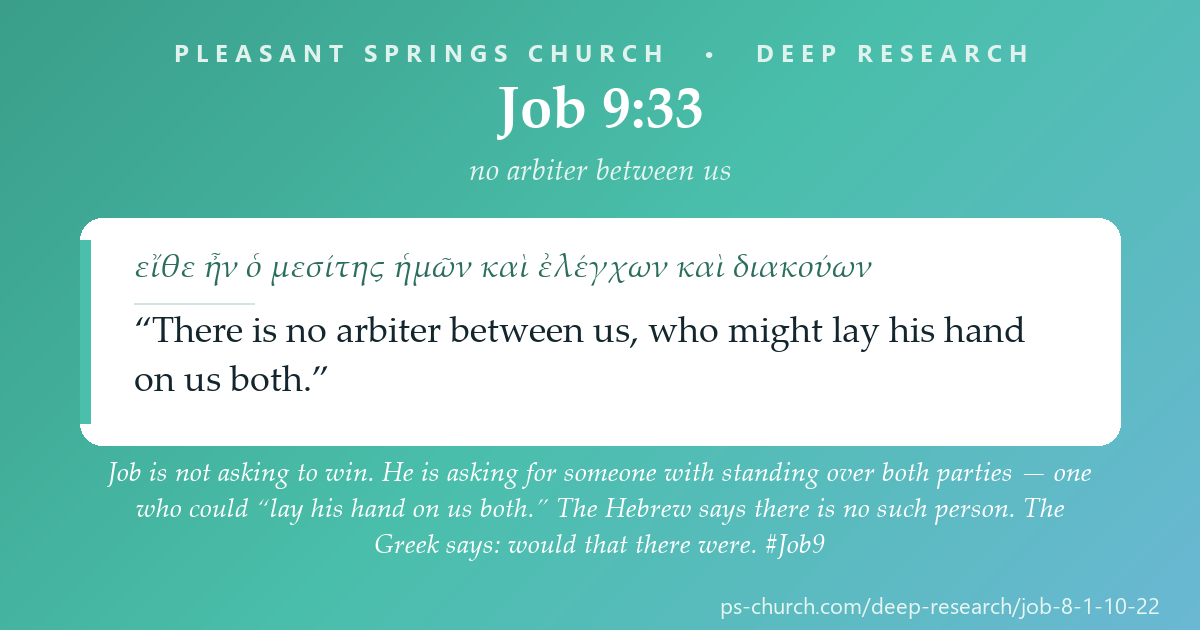
Then the sentence the whole book turns on. There is no mōḵîaḥ — no arbiter, no umpire, nobody with standing between them — who might lay his hand on us both (9:33). And in chapter 10 the lawsuit turns into something else entirely: not argument but address. Your hands fashioned and made me… you poured me out like milk… and then, in the middle of the accusation, without warning: you have granted me life and steadfast love (10:12).
⚠️ At 9:33 the Hebrew denies and the Greek wishes. The Hebrew is a flat statement of non-existence: lōʾ yēš, “there is not.” Rahlfs has εἴθε ἦν — εἴθε is a wish particle, and with the imperfect it makes a counterfactual: “would that our mediator existed.” There is no negative anywhere in the Greek verse. And the noun Rahlfs reaches for is μεσίτης — which occurs exactly once in the whole Greek book of Job, here, and which is the word the New Testament uses at 1 Timothy 2:5 and three times in Hebrews. This page reports what each text says and leaves the seeing to the reader.
What lies behind the difference is unsettled, and one letter wide. Hebrew lōʾ (“not”) and lû (“would that”) differ by a single character. Three things are worth knowing and none of them settles it: lōʾ yēš is otherwise unattested as a construction — Hebrew normally negates existence with ʾayin; Job himself says lû yēš at 16:4; and this very interchange is recorded inside this book, at 13:15 and 41:4, where the written text has lōʾ and the reading tradition has lō. The Masoretes flagged nothing at 9:33 and the Hebrew stands as printed. The two readings are set side by side here and not harmonised.
⚠️ And at 9:22 the Greek removes the scandal. The Hebrew has Job say God destroys tām wərāšāʿ — the blameless and the wicked — and tām is the exact word God used of Job in 1:8 and 2:3. Rahlfs reads μέγαν καὶ δυνάστην ἀπολλύει ὀργή: “wrath destroys the great and the mighty.” Three changes at once — the blameless become the powerful, the moral pair becomes a social one, and the subject shifts from God to an impersonal wrath. The translator had the word for “blameless” and had just used it two verses earlier, at 9:20. That makes the change look deliberate; a differing Hebrew text cannot be excluded, and the page says so.
Counts. Job 8, 9, 10 = 22, 35, 22 in both columns — seventy-nine verses either way, with no lettered labels. But four half-lines here (9:15b, 9:24b, 9:24c, 10:4b) are marked in the critical editions as Origen’s supplement, absent from the Old Greek and supplied to match the Hebrew — and the file used here carries no marks to show it.
The Shape of the Passage
SequenceEverything converges on 9:33, and what is missing there is specific. Not comfort, not vindication, not even an answer — a mōḵîaḥ, someone with the authority to lay a hand on both parties at once. The word occurs in exactly three verses of Job, and the sequence is worth having in view: 9:33, where Job says there is none; 32:12, where Elihu observes that none of the friends produced one; and 40:2, where it is God’s own word for the man who would arraign him. The book asks for an arbiter, notes that none arrived, and gives the term back to God.
And then chapter 10 does something the diagram cannot show. Job stops making a case and starts talking to the person he is making it against — which is what he did at 7:7, and what he will do for the rest of the book.
Behind this stands Eliphaz’s night vision and the moment Job stopped addressing his friends. Bildad is answering a man who has already left the conversation.
Author
He escalates by making the second friend blunter, not louder. Bildad’s speech is shorter than Eliphaz’s and better organised: an axiom, an appeal to tradition, two illustrations, a conclusion. The cruelty is in the logic, not the tone. 8:4 is a conditional — if your children sinned — and it is still the worst sentence anyone says to Job in the whole book.
He lets Job build the case for the other side. Job 9 is the most sustained piece of legal reasoning in the Old Testament, and every step of it is conceded to the opposition: God is just, God is strong, no one can answer him. Job loses the argument on purpose and arrives somewhere the argument could not reach.
And he plants a word here that he will collect twice more. The arbiter Job says does not exist at 9:33 is mentioned again by Elihu at 32:12 — who notes that none of the three produced one — and finally by God at 40:2, of the man who would correct him. Three occurrences, thirty chapters apart, and the last one is spoken from the whirlwind.
Audience
People who have been given a reason for a death. Bildad’s explanation of the ten children is doctrinally tidy and the reader knows it is false, because the reader was in the room in chapter 1. The book is showing what it costs to be right about God in general and wrong about a person in particular.
People who know the courts are not for them. Job’s complaint at 9:32–33 is procedural, and anyone who has been on the wrong end of an institution recognises it: the other party is also the judge, and there is nobody above him to appeal to. What Job wants is not a verdict but a referee.
And people who can hold two things at once. Chapter 10 accuses God of hunting him like a lion and, four verses later, thanks him for life and steadfast love — in the same speech, without retraction. The book does not treat that as inconsistency. It treats it as prayer.
Orient on legal procedure, on the mediator, and on retribution as a system.
Search by topic: lawsuit / rib pattern; legal procedure in Israel; arbiter and mediator; retribution theology; tradition and the elders; Rahab and the sea; constellations in the OT; creation hymns.
Which articles are relevant?
- Anchor Bible Dictionary — “Job, Book of,” “Law (OT),” “Mediator,” “Rahab,” “Astronomy,” “Retribution.”
- Dictionary of the OT: Wisdom, Poetry & Writings (IVP) — “Job 4–27,” “Bildad,” “Legal Language,” “Retribution,” “Creation Theology,” “Wisdom Tradition.”
- NIDOTTE / TDOT — יָכַח (yāḵaḥ, decide / reprove — the root of mōḵîaḥ), רִיב (rîḇ, legal dispute), צָדַק (ṣāḏaq), תָּם (tām), עַכָּבִישׁ (ʿakkāḇîš, spider).
- On the Greek — the NETS introduction to Iob, and its account of the gradient of omission: the Old Greek is only about four per cent shorter through chapter 15, rising steeply later. These chapters are in the shallow part of that gradient, which is why the counts match.
Bibliography surfaced:
- David J. A. Clines, Job 1–20 (WBC) — on 9:33 and the legal metaphor.
- Carol A. Newsom, The Book of Job — on why Job’s legal imagination matters more than his conclusions.
- C. L. Seow, Job 1–21 (Illuminations) — on the text of 9:33 and the lōʾ/lû question.
How a lawsuit worked, why there was no court above the king, and a translator who could not choose.
First the legal world Job is reasoning inside. Then the three Greek words used for one Hebrew one at 9:33.
Which parallels shed light on these chapters?
Israelite justice happened in the gate, and it needed a third party. Disputes were settled before the elders at the city gate, with witnesses and a mōḵîaḥ — one who reproves, decides, arbitrates. The word is not primarily “umpire”: outside Job it is the man who brings a rebuke in the gate (Amos 5:10; Isaiah 29:21), or the wise reprover of Proverbs 9:7, 25:12 and 28:23. “Arbiter” is an extension of the sense, drawn from Job’s own “between us”, and this page says so rather than smuggling it in.
And the ancient world had no answer to Job’s procedural problem. A subject could appeal to the king; there was no appeal against the king. Job’s difficulty is that his opponent is also the bench — which is why 9:32 is a statement about ontology, not about courage: he is not a man, as I am, that I might answer him.
Bildad’s appeal to the ancestors is the standard warrant of the wisdom tradition. Inquire of bygone ages… for we are but of yesterday and know nothing (8:8–9). The same move underlies Deuteronomy 32:7 (“ask your father, and he will show you”) and Eliphaz at 15:18. It is a good epistemology, and it is exactly what fails here, because nothing in the inherited tradition covers the case the reader has already watched being set up.
The marsh plants are Egyptian. Gōmeʾ is papyrus — the reed of Moses’ basket — and ʾāḥû is a loanword from Egyptian, used of the reeds in Pharaoh’s dream (Genesis 41:2). The second friend argues from Nile botany, in a book set in Uz.
- Amos 5:10; Isaiah 29:21; Proverbs 9:7, 25:12, 28:23 — every other biblical occurrence of mōḵîaḥ outside Job. Read these before deciding what Job is asking for; the reprover in the gate is the default sense.
- Deuteronomy 32:7; Job 15:18 — the appeal to the fathers as the warrant for wisdom, which is what Bildad is doing at 8:8–10.
- Genesis 41:2, 18 (the reeds of Pharaoh’s dream) — the Egyptian loanword ʾāḥû that Bildad uses at 8:11.
- Mesopotamian “righteous sufferer” texts (Akkadian — witnesses, not Scripture) — where the sufferer’s remedy is ritual and confession, never litigation. Job’s instinct to sue is not the regional norm, and that is worth noticing.
Job 9:33 in Hebrew is eight words and turns on two of them: lōʾ yēš, “there is not.” What does not exist is a mōḵîaḥ — and the second half of the verse tells you what he would do if he existed: yāšēṯ yāḏō ʿal-šənênû, lay his hand on us both.
Rahlfs differs in four ways at once, and they compound. (1) The modality flips. εἴθε ἦν — a wish particle with the imperfect, the standard counterfactual — and there is no negative anywhere in the Greek verse. Denial becomes longing. (2) The single Hebrew participle becomes three Greek roles: μεσίτης (mediator), ἐλέγχων (the standard root for yāḵaḥ), and διακούων — a technical term for giving both sides a full hearing. The translator could not settle on one equivalent and used three. (3) The Greek adds a possessive: ὁ μεσίτης ἡμῶν, our mediator. (4) And the hand disappears. There is no hand-laying in the Greek at all — the most tactile image in the verse is Hebrew-only.
What lies behind it cannot be settled from these witnesses. Hebrew lōʾ and lû differ by one letter. In favour of the Greek having read “would that”: lōʾ yēš is otherwise unattested as a construction (Hebrew negates existence with ʾayin), Job uses lû yēš at 16:4, and the very same interchange is recorded twice inside this book — at 13:15 and 41:4 the written consonants are lōʾ and the reading tradition says lō. Against it: the Masoretes flagged nothing here, and the received Hebrew is a coherent and characteristically bleak line. The page prints both and chooses neither.
And one word deserves to be named without being pressed. μεσίτης occurs once in the entire Greek book of Job — here. It is the word of 1 Timothy 2:5 and of Hebrews 8:6, 9:15 and 12:24. This page states that and stops. What the Hebrew says is that there is no such person; what the Greek says is that Job wished there were. Neither text says who he would be.
A word that appears three times in the book, a preposition Job changes, and one line of tenderness.
Trace mōḵîaḥ at 9:33, 32:12 and 40:2 — the whole arc is three verses. Then read 9:20–22 and notice which word Job repeats three times.
“One who decides, reproves, arbitrates” — hiphil participle of yāḵaḥ. It occurs in exactly three verses of Job, and the arc is the point. At 9:33 Job says there is none. At 32:12 Elihu observes that none of the three friends produced one. At 40:2 it is God’s own word, from the whirlwind, for the man who would correct him: shall a faultfinder contend with the Almighty? Outside Job the word means the reprover in the gate (Amos 5:10; Isaiah 29:21; Proverbs 9:7), so “umpire” is an inference from Job’s “between us,” not the lexical default.
“Blameless.” Job picks up the word God used of him and turns it into an accusation. In three consecutive verses: though I am blameless, my own mouth would condemn me (9:20); I am blameless; I regard not myself (9:21); and then he destroys both the blameless and the wicked (9:22). He does not know that God has twice called him this. The reader does — which is why 9:22 is unbearable in a way Job cannot feel. And it is precisely this word that disappears from the Greek at 9:22.
“With God.” Job is quoting Eliphaz and changing one preposition. At 4:17 the night vision asked whether a mortal could be righteous min God; here Job asks whether he can be righteous ʿim God — with him, alongside him, in a case against him. The shift moves the question from status to procedure, which is what the next thirty verses are about. Rahlfs tracks the change: ἐναντίον κυρίου at 4:17, παρὰ κυρίῳ here.
“To contend at law, bring a suit.” The legal spine of these two chapters. If one wished to contend with him, he could not answer one of a thousand (9:3); and at 10:2 Job asks God to tell him why you contend against me. The same root drives the prophetic lawsuit form (Micah 6:1–2; Hosea 4:1). Job is not asking for sympathy. He is asking for disclosure of the charge.
“Spider.” The godless man’s confidence is a spider’s house — he leans on it and it does not stand. A caution worth stating: the Greek has ἀράχνη here and again at 27:18, where the Hebrew has no spider at all (it has a moth). The spiders are not in one-to-one correspondence between the columns, so the image is doing different work in each tradition.
“Steadfast love, covenant loyalty.” Its only occurrence in these three chapters, and it is in the middle of an accusation. Job has just said God hunts him like a lion (10:16) and will say he wishes he had never been born — and here, without transition or retraction: life and ḥeseḏ you did with me, and your pəquddāh — your visitation, your oversight — kept my spirit. The book does not treat this as contradiction. Rahlfs tracks it closely: ἔλεος and ἐπισκοπή.
Counted here, not assumed:
- Verse counts: Job 8, 9, 10 = 22, 35, 22 in both columns — seventy-nine either way, and no lettered labels. These chapters sit in the shallow part of the Old Greek’s omission gradient (about four per cent through chapter 15, rising steeply thereafter), which is why the columns match here and will not always.
- But four half-lines here are Origen’s supplement, not Old Greek — 9:15b, 9:24b, 9:24c and 10:4b are marked with the asterisk in the critical editions, meaning the Old Greek lacked them and they were supplied to match the Hebrew. The file used for this page carries no such marks, so nothing here should be read as evidence about the Old Greek’s length. A fifth, 9:3b, is disputed between editors.
- Divine names. God is named nine times in these chapters — ʾēl five, śadday twice, ʾəlōah twice — and never by the divine name. That is the norm for Job’s poetic dialogue, not a feature of this speech. Rahlfs renders them four different ways, including turning śadday at 8:3 into the epithet the one who made all things.
- 9:22 is the only verse in these chapters where the Greek runs shorter than the Hebrew, and the words it loses are the ones that matter.
A missing arbiter, a God who walks on the sea, and the same hands in two psalms.
Read 9:33 and then 16:19–21 and 19:25–27 — Job says three different things about whether anyone stands between. Then read 10:8–12 beside Psalm 139.
Which cross-references matter?
- Job 9:33 → Job 16:19–21 → Job 19:25–27. Job does not say one thing about the mediator; he says three. Here there is none. At 16:19 even now, behold, my witness is in heaven. At 19:25 I know that my Redeemer lives. The page reports the sequence and does not flatten it — whether these are development, contradiction, or a man saying different things at different depths is argued, and the book does not adjudicate.
- Job 9:33 and 1 Timothy 2:5; Hebrews 8:6, 9:15, 12:24. The Greek of 9:33 uses μεσίτης, which is the New Testament’s word for a mediator between God and men — and it occurs only here in Greek Job. Stated as a fact about vocabulary. The Hebrew says there is no such person; the Greek says Job wished there were; neither says who. The seeing is left to the reader, per the method.
- Job 9:8 (“who alone… trampled the waves of the sea”) and Mark 6:48. A real conceptual link and a much weaker verbal one — the page notes the image and does not claim a quotation.
- Job 9:9 and 38:31–32; Amos 5:8. The Bear, Orion and the Pleiades. Job names the constellations to say God is unanswerable; God names the same ones back to him from the whirlwind.
- Job 10:8–12 beside Psalm 139:13–16 and Jeremiah 1:5. The same fashioning — hands, knitting, the womb — and opposite conclusions drawn from it. The psalm finds it comforting that God knew him before he was formed; Job finds it grounds for a complaint: you made me, and now you destroy me? The vocabulary is shared; the theology is not.
- Job 8:3 and Deuteronomy 32:4; Genesis 18:25. Does God pervert justice? Bildad’s axiom is Abraham’s (“shall not the Judge of all the earth do what is just?”). The premise is impeccable. The deduction from it kills ten children twice.
Where the text is uncertain, and where the theology is.
Clines and Seow on 9:33. Then four open questions.
Commentaries & studies:
- David J. A. Clines, Job 1–20 (WBC) — the fullest treatment of the legal metaphor and of what Job is actually asking for at 9:33.
- C. L. Seow, Job 1–21 (Illuminations) — on the lōʾ/lû question and the versions.
- Carol A. Newsom, The Book of Job — on the legal imagination as a moral resource rather than a rhetorical device.
- Claus Westermann, The Structure of the Book of Job — for the lament form underlying chapter 10.
Four things reported as unsettled:
- Whether 9:33 originally read “not” or “would that.” One letter apart; the Greek clearly read the second; the Masoretic tradition transmits the first without comment. Both are printed here.
- Whether the Greek at 9:22 reflects a different Hebrew text or a deliberate change. The translator had the word for “blameless” and used it two verses earlier, which makes the substitution look chosen — but a differing source text cannot be excluded, and the page does not claim to know a translator’s motive.
- What mōḵîaḥ means here — reprover, arbiter, or umpire. The lexical default is the first; Job’s “between us” pushes toward the second. The Greek translator declined to choose and gave three words.
- Whether Job 9:22 is Job’s considered theology or his despair talking. It is the flattest denial of retribution in the Bible, spoken by a man the narrator has certified. The book neither endorses nor corrects it, and at 42:7 God says Job — not the friends — spoke rightly of him.
A referee, not a verdict.
Name what you learned, why it matters, and one concrete response.
What should we carry away — and do?
- Bildad’s premise is true and his conclusion is monstrous. Does God pervert justice? — no, and Abraham said so first. Everything after that in his speech is deduction, and the deduction is applied to ten fresh graves. Sound doctrine plus a confident inference is how most harm gets done in a hospital corridor.
- What Job asks for is not a verdict but a referee. Somebody with standing over both parties, who could lay his hand on us both. He is not asking to win. He is asking for the case to be heard at all — and he says plainly that no such person exists.
- He accuses God and thanks him in the same speech. You have granted me life and steadfast love sits four verses from you hunt me like a lion, with no retraction and no explanation. Scripture does not treat that as inconsistency to be tidied up. It treats it as what praying under pressure actually sounds like.
- One concrete response. Notice the shape of chapter 10: Job stops arguing about God and starts speaking to him — and the moment he does, the tenderness gets in. If you have been building a case, try addressing the person instead.
Job 9:33 · to share
Hebrew + Greek (Rahlfs) + ESVEvery Deep Research page traces its passage across the whole sweep — the Old Testament, the Second-Temple world between the testaments (historical witnesses, not Scripture), and the New Testament. Follow the thread:
Pleasant Springs Church — Deep Research
Research method after Michael S. Heiser’s Bible Research Method (examine dictionaries → ancient literature → important words → textual connections → academic publications → share), with the Pleasant Springs “Author & Audience” foundation. Scripture set in the Hebrew, the Greek editions named on each page and the ESV (Old Testament), and the Greek New Testament and the ESV (New Testament), per the practice of Pleasant Springs Church. Job 8–10 research grounded in Clines (WBC), Seow (Illuminations), Newsom and Westermann. Text: Hebrew from the Masoretic text as printed in the editions consulted — Sefaria’s Miqra according to the Masorah; no critical apparatus was consulted. Greek from Rahlfs’s Septuaginta (CATSS digitization). ⚠️ The standing caution for this book applies — Rahlfs is Origen’s filled-out text and the CATSS file carries no asterisks, so the page writes “Rahlfs” throughout, never “the Old Greek.” Counted in both columns: Job 8, 9, 10 = 22, 35, 22 — seventy-nine verses either way, with no lettered labels. The page states that these chapters sit in the shallow part of the Old Greek’s omission gradient (roughly four per cent through ch. 15) and that four half-lines here — 9:15b, 9:24b, 9:24c, 10:4b — are asterisked in the critical editions as Origen’s supplement, absent from the Old Greek, with a fifth (9:3b) disputed between editors; the file used carries no marks to show any of this. ⚠️ 9:33 is reported as a modality difference, not a nuance: the Hebrew lōʾ yēš is a flat denial; Rahlfs’s εἴθε ἦν is a counterfactual wish with no negative anywhere in the verse. Four further differences inside that verse are itemised — three Greek words for one Hebrew participle, an added possessive, and the complete absence of the hand-laying image from the Greek. The lōʾ/lû question is presented with evidence on both sides (the construction otherwise unattested; lû yēš at Job 16:4; the same interchange recorded at Job 13:15 and 41:4 — against the Masoretes flagging nothing here) and left open. That μεσίτης occurs once in Greek Job and is the New Testament’s word is stated as a fact about vocabulary, with no typological claim attached, per the house position. ⚠️ 9:22 is reported as the sharpest divergence in the span and the only verse where the Greek runs shorter: MT’s tām wərāšāʿ becomes μέγαν καὶ δυνάστην and the subject shifts from God to an impersonal ὀργή. The page notes that the translator used ἄμεμπτος two verses earlier at 9:20 — which makes the change look deliberate — while stating that a differing Hebrew source cannot be excluded and declining to claim knowledge of a translator’s motive. mōḵîaḥ is traced through its three occurrences in Job (9:33, 32:12, 40:2) and its sense outside Job is given as the reprover in the gate, with “umpire” flagged as an interpretive extension rather than the lexical default. Job’s three different statements about a mediator (9:33, 16:19–21, 19:25–27) are set out without being harmonised. The Job 9:8 / Mark 6:48 link is given as conceptual and explicitly not claimed as a quotation. Second-Temple material is tagged as witnesses, never levelled with Scripture. Typology is handled per the house position: what the text says, what the New Testament itself draws, and what we see from this side of the cross — with the seeing left to the reader.
Scripture quotations marked ESV are from the ESV® Bible (The Holy Bible, English Standard Version®), © 2001 by Crossway, a publishing ministry of Good News Publishers. ESV Text Edition: 2016. Used by permission. All rights reserved. The ESV text may not be quoted in any publication made available to the public by a Creative Commons license, and the ESV may not be translated in whole or in part into any other language. www.esv.org
|
Did this study bless you today? 💚 Give to Support PS Church100% of gifts go to the General Fund — thank you. |