The first friend to speak is the gentle one. Eliphaz asks permission before he starts, and gives four verses of praise that are entirely sincere — you have strengthened the weak hands; your words have upheld him who was stumbling. Then two words turn the speech: but now. And then he tells Job what happened to him one night: a word smuggled to his ear, a scrap of it caught, dread, his bones shaking, the hair of his flesh standing up — and something that stood still which he could not identify. On that he builds a doctrine he will repeat for two chapters, and which God will reject by name in 42:7. What makes it hard is that Eliphaz is not a heretic: happy is the one whom God reproves (5:17) is quoted approvingly in Hebrews. The book is not warning against bad theology but against true theology applied to the wrong man. Job answers with the sharpest image in the book — friends like a wadi, loud with meltwater and gone in the heat, so the caravans that trusted it die ashamed. And then he does something easy to miss: he addresses his friends for nine verses, spends seven speaking to nobody, and at 7:7 says “Remember” to somebody else. He never turns back. See the method →
Job 4:1–7:21 (selections)
Hebrew · Greek (Rahlfs) · ESVThe vision account is four verses long and every detail is strange. A word was stolen to me (4:12) — the verb is the ordinary one from “you shall not steal,” in the passive; and what his ear caught was a šēmeṣ, a scrap, a whisper. Dread came; his bones shook; the hair of his flesh stood up. Something stood still, and he could not identify it. On that he builds a doctrine that he will repeat for two chapters and that God will reject by name in 42:7.
Job answers — and the shape of his answer is the surprise of the passage. He addresses his friends for nine verses (6:21–29), goes seven verses speaking to nobody at all, and at 7:7 says zəḵōr, “Remember,” to someone else entirely. He never turns back. The rest of the book’s dialogue happens over the friends’ heads.
⚠️ At 4:16 the two columns say the opposite of each other, and it is the hinge of the whole speech. The Hebrew has one negative, and it attaches to recognise: “I could not recognise its appearance — a form was before my eyes.” Something was there; Eliphaz could not identify it. Rahlfs carries a second negative into the next clause and cancels the form outright: οὐκ ἦν μορφὴ πρὸ ὀφθαλμῶν μου — “there was no form before my eyes, but only a breeze and a voice.” The subject flips too, from “it stood” to “I stood up.” One text has a witness who saw something he could not name; the other has a witness who saw nothing. And the difference cannot be Origen’s supplement — asterisked material was added to bring the Greek into line with the Hebrew, and this contradicts it. Whether it reflects a different Hebrew text or a translator resolving the strangeness is unsettled.
⚠️ The Greek’s word for what he did hear is the Elijah word. αὔρα occurs three times across the twenty-five Septuagint books held here, and every one of them renders Hebrew dəmāmāh: here, at 3 Kingdoms 19:12 — Elijah at Horeb, φωνὴ αὔρας λεπτῆς, the still small voice — and at Psalm 106[107]:29. Both μορφή and αὔρα occur only here in Greek Job.
⚠️ Verse counts and two real divergences. Counted in both columns: Job 4 = 21, Job 5 = 27, Job 6 = 30, Job 7 = 21 — ninety-nine verses either way, with no lettered labels anywhere in these chapters. But numbering parity is not textual parity. 5:23 is a genuine minus: the Hebrew’s “for with the stones of the field is your covenant” has no Greek counterpart — nine Hebrew words become five, and the word for “stone” appears nowhere in Greek Job 5. 4:12 is a large plus running the other way: seven Hebrew words become twenty-four, and the Greek adds a whole accusation before the vision even starts — if there had been any true word in your speeches, none of these evils would have met you. In the Greek, Eliphaz attacks first and then tells the dream.
The Shape of the Passage
Parallel panelsThe Masoretic tradition treats each speech as a single unbroken paragraph — paragraph marks fall at 3:26, 5:27 and 7:21 and nowhere in between, and that agrees exactly across the Aleppo-based and Leningrad-based texts. So every internal seam above is argued from particles, vocatives and person-shifts, not handed over by the tradition. That the markers are silent here is a choice, not a limitation: elsewhere in Job they cut clean through the middle of a speech.
The one seam that is not interpretation is the turn at 7:7. It is morphology. Job uses second-person plural forms in exactly nine verses (6:21–29); then seven verses with no second-person form at all; then from 7:7 an unbroken run of second-person singular. What the grammar proves is that the addressee changed. It does not prove who the new addressee is — chapter 7 never names God. That it is God is inferred from what is said to him: a guard set over the Sea, Psalm 8 turned inside out, and the request to have sin taken away. The inference is near-universal, and it is still an inference.
Behind this stands the prologue and Job’s first lament — and the fact that the reader knows why this is happening and nobody in the room does.
Author
He makes the first friend the reasonable one. Eliphaz is courteous, asks permission before speaking, praises Job sincerely, and says things that are true elsewhere in Scripture. This is a deliberate and difficult choice. A crude opponent would let the reader off; a gracious one who is nevertheless wrong forces the reader to work out where the wrongness enters — and it is not in the propositions.
He gives the vision to the wrong man and lets it say something true. The one claimed revelation in the book outside the whirlwind comes to a friend, not to Job — and its content, that no mortal is pure before God, is not obviously false; Eliphaz will repeat it at 15:14 and Bildad at 25:4. The problem is not the doctrine. It is that it is being used to explain a specific man’s specific pain, which the reader already knows it does not explain.
And he lets Job stop talking to them. The most telling structural fact in the passage is that Job argues with his friends for nine verses out of fifty-one and then addresses God for the rest. The writer has Job give up on the conversation in his very first reply, and everything that follows in the dialogue is, in a sense, a formality.
Audience
People who have been comforted badly. Every reader recognises 6:15–20 — the stream that runs loud when you do not need it and is dry gravel when you do. Job does not accuse his friends of cruelty. He accuses them of not being there, which is a more common failure and a harder one to answer.
People who have said Eliphaz’s lines themselves. “Happy is the one whom God reproves” (5:17) is echoed approvingly in Proverbs 3:11–12 and quoted in Hebrews 12:5–6. The book is not warning against a heresy; it is warning against saying a true thing to the wrong person at the wrong time, which no amount of doctrinal accuracy protects you from.
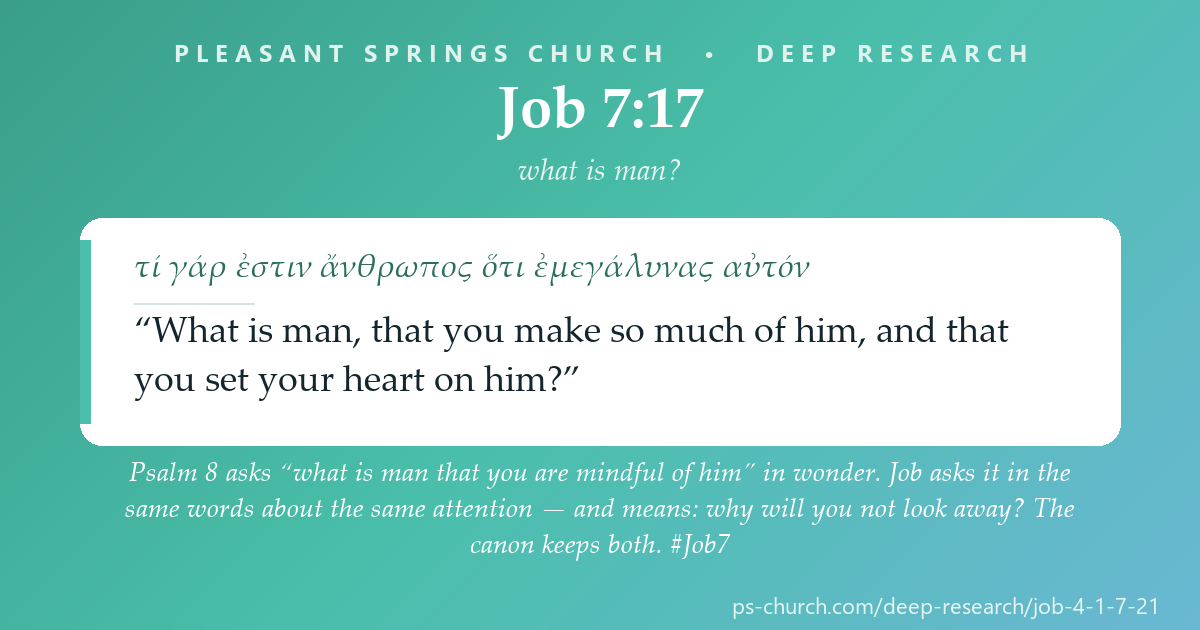
And people who needed to hear 7:17 said out loud. Psalm 8 asks “what is man that you are mindful of him” in wonder. Job asks the same question about the same attention and means: why will you not look away? The canon keeps both.
Orient on dreams and revelation, on retribution, and on the lament tradition.
Search by topic: dreams and visions in the ANE; incubation; theophany; retribution theology; Teman and Edomite wisdom; lament; friendship; wadi / nahal; Resheph; Sheol; Psalm 8.
Which articles are relevant?
- Anchor Bible Dictionary — “Dreams,” “Vision,” “Teman,” “Retribution,” “Resheph,” “Sheol,” “Wadi.”
- Dictionary of the OT: Wisdom, Poetry & Writings (IVP) — “Job 4–27,” “Eliphaz,” “Retribution,” “Lament,” “Friendship,” “Theophany,” “Suffering.”
- NIDOTTE / TDOT — גָּנַב (gānaḇ, steal), שֶׁמֶץ (šēmeṣ, whisper), תְּמוּנָה (təmûnāh, form), דְּמָמָה (dəmāmāh), נַחַל (naḥal, wadi), רֶשֶׁף (rešep).
- On the Greek — the NETS introduction to Iob. Keep its warning in view: our printed Greek is Origen’s composite and the CATSS file carries no asterisks.
Bibliography surfaced:
- David J. A. Clines, Job 1–20 (WBC) — the fullest treatment of 4:17’s preposition, and he argues the comparative sense is not live here at all.
- Carol A. Newsom, The Book of Job: A Contest of Moral Imaginations — on why the friends are given good arguments.
- C. L. Seow, Job 1–21 (Illuminations) — text-critical detail and reception history.
Night revelations, a stream that lies, and a translator who cancelled a vision.
First the ANE background to a message received in the dark. Then the wadi, which is a fact of geography before it is a figure of speech.
Which parallels shed light on these chapters?
Revelation at night was a recognised channel, and it had rules. Across the ancient Near East, dreams and night visions were a standard mode of divine communication — and in Israel’s own Scriptures the deep sleep, the dread and the darkness cluster together: Abram at Genesis 15:12 has tardēmāh fall on him with “a dread and great darkness,” and Eliphaz at 4:13 uses the same verb and the same noun. The vocabulary is orthodox. What Eliphaz does with the content is the question.
And the language of 4:16 is the language of Sinai. Təmûnāh — “form” — occurs only here in Job, and its home is Deuteronomy 4: “you heard a voice of words but saw no form, only a voice” (4:12), and again at 4:15. Rahlfs does not preserve the word-link (Deuteronomy uses ὁμοίωμα, Job μορφή) but it preserves the sentence shape exactly — saw / and there was no [form] / ἀλλ᾽ ἤ / a voice / heard, including the rare ἀλλ᾽ ἤ. In Greek, Eliphaz’s night is narrated in the words of Horeb.
The wadi is not a metaphor to anyone who has lived in that country. A naḥal runs hard with snow-melt and winter rain, then vanishes. Caravans plan routes around water that is on the map; 6:19–20 has the caravans of Tema and Sheba look for it, count on it, and be ashamed because they had trusted. Job’s charge is not that his friends are cruel but that they are seasonal.
- Genesis 15:12; Deuteronomy 4:12, 15; 1 Kings 19:11–13 — not external witnesses but the biblical night-revelation passages Job 4 is written against. The Elijah link is carried by the Greek: αὔρα renders dəmāmāh at Job 4:16 and at 3 Kingdoms 19:12, and in the twenty-five Septuagint books held here it occurs three times and never renders anything else.
- Psalm 119:120 — my flesh bristles from dread of you, pairing the two rare words of Job 4:14–15 (sāmar and paḥaḏ) in one line. The verb sāmar occurs three times in the whole Hebrew Bible.
- Mesopotamian incubation and dream texts (Akkadian — witnesses, not Scripture) — for the convention of a message received in the night and reported as authoritative. Useful for showing that Eliphaz’s form of appeal was normal.
- Teman (material and biblical evidence) — an Edomite site, and Edom had a reputation for wisdom (Jeremiah 49:7; Obadiah 8). The first man to answer Job is a foreign sage, which fits a book with no Israelites in it.
Job 4:16, Hebrew. yaʿămōḏ wəlōʾ-ʾakkîr marʾēhû; təmûnāh ləneģeḏ ʿênāy — “it stood still, and I could not recognise its appearance; a form was before my eyes.” There is exactly one negative in the verse and it governs ‘recognise.’ The clause about the form is not negated. Something was there. Eliphaz could not say what.
Job 4:16, Rahlfs. ἀνέστην καὶ οὐκ ἐπέγνων· εἶδον, καὶ οὐκ ἦν μορφὴ πρὸ ὀφθαλμῶν μου, ἀλλ᾽ ἢ αὔραν καὶ φωνὴν ἤκουον — “I stood up and did not recognise; I looked, and there was no form before my eyes, but only a breeze and a voice.” A second negative has entered, and it deletes the form. The subject changes as well: the Hebrew’s it stood; the Greek’s I stood up.
Why this is not a trivial variant. Eliphaz’s authority for everything he says rests on this night. In the Hebrew he is a man who saw something real and could not identify it — unsettling, and just credible enough. In the Greek he saw nothing at all, and is left quoting a voice out of a draught. The doctrine is identical; the standing of the witness is not.
And it cannot be Origen’s supplement. Asterisked material was added to bring the shorter Greek into agreement with the Hebrew — so a clause that flatly contradicts the Hebrew cannot have come from there. Whether it reflects a different Hebrew text, or a translator smoothing a strange verse, is not settled, and this page does not settle it.
A word that was stolen, a scrap, a form from Sinai, and one imperative that redirects the book.
Read 4:12 beside 26:14 — the same rare word for “whisper.” Then count second-person forms through chapters 6 and 7 and watch the addressee change.
“Was stolen.” Pual of the ordinary verb of the eighth commandment — the same root as “you shall not steal” and of Joseph’s “I was indeed stolen” (Genesis 40:15). Not “a word came to me” but a word was smuggled to me. Eliphaz says himself that his revelation arrived by irregular means — and then treats it as decisive.
“A whisper, a scrap, a faint trace.” What his ear took was not the word but a shred of it. The noun occurs twice in Job and nowhere else in the book — here, and at 26:14, where Job says of God’s ways: behold, these are but the outskirts of his ways, and how small a whisper do we hear of him! The same rare word measures what any human being can know of God — and Eliphaz builds four verses of doctrine on it. The page reports the parallel and leaves the irony to the reader.
“Form, likeness.” Once in Job, and its home is Sinai: Deuteronomy 4:12 and 4:15 (“you saw no form”), the second commandment at Exodus 20:4, and Numbers 12:8, where Moses alone beholds the təmûnāh of the Lord. Eliphaz is claiming, in Sinai vocabulary, an experience the Torah reserves — and the Greek, as printed, takes it away from him.
“A hush” — or possibly “a low sound.” The word is contested and this page does not settle it. The root has to do with stilling and falling quiet, which favours silence; but the standard lexicon offers “a whisper, or low sound” specifically for this verse, and the Greek translators are witnesses on the sound side — αὔρα is a breeze, something felt and heard. Its most famous occurrence is 1 Kings 19:12, where it is bound in a construct chain (qōl dəmāmāh daqqāh, “a still small voice”); here the two nouns are simply joined by and, which is a different construction — “a hush, and a voice.”
The preposition min on “God,” and at least three readings are live. Comparative: “can a mortal be more righteous than God?” — grammatically possible, though Clines argues the idea is not live here at all. Locative: “righteous before God.” Agentive: “can a mortal be acquitted by God?” — which is how the JPS translation takes it. Rahlfs chooses the second, ἐναντίον κυρίου, and does the same at 32:2 and 35:2. But that is a translator’s habit, not proof: ἐναντίον is his stock divine-presence tag, used thirty-nine times in Greek Job. And in the second half of the verse the Greek loses God altogether — ἀπὸ τῶν ἔργων αὐτοῦ, “from his works.”
“Sons of rešep” — rendered “sparks” in most English versions (“as the sparks fly upward”). Rešep is the ordinary word for flame or pestilence and also the name of a Canaanite plague-and-fire god known from Ugarit and Egypt. Whether the phrase here is simply “flames,” or a fossilised mythological expression, is argued; the page reports the range. Either way Eliphaz’s claim is that trouble is native to the human condition — which is true, and which explains nothing about Job.
“Remember.” One imperative, second person singular — and the book turns on it. Before it, Job’s second-person forms are all plural and confined to nine verses (6:21–29); after it, they are all singular, nineteen of them, to the end of the chapter. He is no longer talking to his friends, and he never talks to them again in this speech. Note what the grammar does not settle: chapter 7 never names God. That the new addressee is God is inferred from what is said — and it is an inference, however unanimous.
Counted here, not assumed:
- Verse counts agree exactly: 21, 27, 30, 21 — ninety-nine either way, with no lettered labels in these chapters. But numbering parity is not textual parity, and this page prints two places where the texts genuinely differ.
- 5:23 is a real minus. The Hebrew’s “for with the stones of the field is your covenant” has no Greek counterpart — nine Hebrew words become five, the Greek keeping the connective and dropping the clause. Checked: the word for “stone” occurs nowhere in Greek Job 5, so the line has not been relocated.
- 4:12 is a large plus, running the other way. Seven Hebrew words become twenty-four. The Greek prefixes a whole accusation the Hebrew has no counterpart for — if there had been any true word in your speeches, none of these evils would have met you — so that in Greek Eliphaz accuses Job before he reports the vision, where the Hebrew lets the vision do the accusing.
- The turn at 7:7 is morphological, not impressionistic. Twenty second-person plural forms in nine verses (6:21–29); then seven verses with no second-person form at all (6:30–7:6); then an unbroken run of singular from 7:7. There is no plural form anywhere in chapter 7.
- And chapter 7 names no deity. Not ʾəlōah, śadday, ʾēl, ʾəlōhîm or the divine name — though chapter 6 has four such occurrences. The identification of Job’s new addressee is an inference from content, and the page says so.
One New Testament quotation, one psalm turned inside out, and a doctrine God later rejects.
Read Psalm 8:3–4 aloud, then Job 7:17–19. Then read 5:17 beside Hebrews 12:5–6 and ask what changed.
Which cross-references matter?
- Job 5:13 → 1 Corinthians 3:19 — the only verse of Job quoted in the New Testament. Paul introduces it with it is written. The wording is split, and the page reports it precisely rather than tidily: at the noun Paul stands closer to the Hebrew — his πανουργίᾳ αὐτῶν answers bəʿorəmām in both word and suffix, where Rahlfs has φρονήσει and no suffix; but at the verb Rahlfs is the closer of the two, since καταλαμβάνω is the standard Greek equivalent of Hebrew lāḵaḏ and Paul’s δρασσόμενος is nowhere used for it. Note too that Paul’s stem is not foreign to Greek Job — the cognate adjective stands one verse earlier at 5:12.
- Psalm 8:4 → Job 7:17–19 — the same question, inverted. The Hebrew opens identically, word for word: māh-ʾənōš kî, “what is man that…” Then the psalm says you remember him; Job says you magnify him. The psalm marvels that God attends to us. Job is asking to be left alone — and two verses later says so outright: how long will you not look away from me? (7:19). Whether Job is quoting the psalm or both draw on a common formula is argued; the verbal overlap is not.
- Job 4:7 (“who that was innocent ever perished?”) against the prologue — and against 42:7. The reader has already been told, twice by God, that Job is blameless. And at the end God tells Eliphaz by name: you have not spoken of me what is right. The book supplies its own verdict on this speech, which is why the page does not have to.
- Job 5:17–18 beside Proverbs 3:11–12, Hebrews 12:5–6, Deuteronomy 32:39 and Hosea 6:1. “He wounds and he binds up” is affirmed elsewhere in Scripture and quoted approvingly in the New Testament. Here it is said to the wrong man about the wrong situation. The lesson is not that the doctrine is false but that true doctrine can be misapplied — a harder lesson, and the one the book is actually teaching.
- Job 4:12–16 beside Genesis 15:12, Deuteronomy 4:12 and 1 Kings 19:11–13. The deep sleep and dread of Abram; the voice with no form at Horeb; the sound of a low whisper to Elijah. Eliphaz’s night is narrated in the vocabulary of Israel’s genuine theophanies — which is exactly what makes it hard to assess.
- Job 7:9–10 (“he who goes down to Sheol does not come up”) beside Job 19:25–27. The same man will later say I know that my Redeemer lives. The page reports the tension and does not resolve it; Job says different things at different depths, and the book lets him.
What is disputed, and what the book itself settles.
Clines on 4:17; Newsom on why the friends argue well. Then four open questions.
Commentaries & studies:
- David J. A. Clines, Job 1–20 (WBC) — the fullest discussion of 4:17’s preposition, and he denies the comparative reading is live.
- Carol A. Newsom, The Book of Job — on the friends as serious moral thinkers rather than foils.
- C. L. Seow, Job 1–21 (Illuminations) — on the text of 4:16 and 5:23.
- On the Greek: Homer Heater, A Septuagint Translation Technique in the Book of Job.
Four things reported as unsettled:
- What 4:16 originally said. The Hebrew has a form; the Greek denies one. The Greek cannot be Origenic supplement, since that was added to agree with the Hebrew. Whether a different Hebrew text or a translator’s smoothing lies behind it is not decidable from these witnesses.
- What min means at 4:17 — comparative, locative, or agentive. Three readings are live and major translations divide. The Greek settles it one way but is one witness with a known habit.
- What dəmāmāh means. Silence, or a low sound. The root favours the first; the lexica and the Greek translators lean to the second. The page reports both.
- Whether Job 7:17 quotes Psalm 8. The overlap is exact and the inversion is pointed, but direction of dependence between a psalm and a wisdom poem of uncertain date cannot be established from the wording alone.
A true thing said to the wrong person, and a friend who ran dry.
Name what you learned, why it matters, and one concrete response.
What should we carry away — and do?
- Eliphaz is not a heretic. That is the point. He is courteous, he praises Job sincerely, and much of what he says is repeated approvingly elsewhere in Scripture. The book is not warning us off bad theology; it is warning us off good theology deployed as an explanation of somebody else’s pain. That is far more difficult, and no amount of doctrinal precision protects you.
- He built four verses of doctrine on a scrap he admits he could not identify. A word smuggled to him; a whisper of it caught; a form he could not recognise. The same rare word for “whisper” turns up later measuring how little any of us hear of God (26:14). Certainty and evidence are not the same size here.
- The wadi is the most quoted verse in the passage for a reason. Not cruelty — seasonality. Loud when the water is easy, gone in the heat, and the caravans that counted on it die of the disappointment. Job’s complaint is that his friends were reliable right up until they were needed.
- One concrete response. Job stops talking to his friends after nine verses. If someone you are trying to comfort has stopped talking to you and started talking past you, that is information — and the answer is almost never a better argument. Go back to what the friends did right in 2:13: seven days, on the ground, saying nothing.
Job 7:17 · to share
Hebrew + Greek (Rahlfs) + ESVEvery Deep Research page traces its passage across the whole sweep — the Old Testament, the Second-Temple world between the testaments (historical witnesses, not Scripture), and the New Testament. Follow the thread:
Pleasant Springs Church — Deep Research
Research method after Michael S. Heiser’s Bible Research Method (examine dictionaries → ancient literature → important words → textual connections → academic publications → share), with the Pleasant Springs “Author & Audience” foundation. Scripture set in the Hebrew, the Greek editions named on each page and the ESV (Old Testament), and the Greek New Testament and the ESV (New Testament), per the practice of Pleasant Springs Church. Job 4–7 research grounded in Clines (WBC), Newsom, Seow (Illuminations) and Heater on the Greek. Text: Hebrew from the Masoretic text as printed in the editions consulted — Sefaria’s Miqra according to the Masorah, cross-checked against its Ta’amei Hamikra edition and, for paragraph markers, against the Leningrad-based OSHB; no critical apparatus was consulted. Greek from Rahlfs’s Septuaginta (CATSS digitization). ⚠️ The standing caution for this book applies: Rahlfs is Origen’s filled-out text, the CATSS file carries no asterisks to separate Old Greek from Theodotionic supplement, and so the page writes “Rahlfs” throughout and never “the Old Greek.” Counted in both columns: Job 4, 5, 6, 7 = 21, 27, 30, 21 — ninety-nine verses either way, with no lettered labels; the page states explicitly that numbering parity is not textual parity and prints two real divergences. ⚠️ 4:16 is reported as a contradiction rather than smoothed: the Hebrew has one negative, governing “recognise,” leaving a form was before my eyes; Rahlfs carries a second negative into that clause — there was no form — and flips the subject. The page notes this cannot be Origenic supplement, since asterisked material was added to agree with the Hebrew, and names the cause as unsettled. 5:23 is reported as a genuine minus (the covenant-with-stones colon absent from the Greek, verified by checking that the word for “stone” occurs nowhere in Greek Job 5, so it was not relocated), and 4:12 as a large plus (seven Hebrew words to twenty-four, the Greek adding an accusation before the vision). The turn at 7:7 is established morphologically — twenty second-person plural forms across nine verses (6:21–29), seven verses with no second-person form, then an unbroken singular run with no plural anywhere in chapter 7 — while the page states plainly that the grammar establishes that the addressee changed, not who it is, since chapter 7 names no deity; the identification is flagged as a near-universal inference from content. Masoretic paragraph markers are reported as agreeing exactly across the Aleppo- and Leningrad-based texts (3:26, 5:27, 7:21) and as therefore supplying no internal seam, so every seam in the diagram is argued from particles and person-shifts. 1 Corinthians 3:19 is reported as a split agreement: Paul closer to the Hebrew at the noun (πανουργίᾳ αὐτῶν for bəʿorəmām), but Rahlfs closer at the verb, since καταλαμβάνω is the conventional equivalent of lāḵaḏ and δράσσομαι is not — with the note that Paul’s stem already stands in Greek Job at 5:12. The αὔρα count is scoped to the twenty-five Septuagint books held here and not upgraded to a whole-corpus claim. Four questions are named as unsettled: the original reading at 4:16, the force of min at 4:17 (three live readings, with the note that Rahlfs’s consistency reflects a translator’s habit rather than an exegetical decision, and that the Greek loses God entirely in the verse’s second colon), the meaning of dəmāmāh, and the direction of dependence between Job 7:17 and Psalm 8. Eliphaz’s doctrine is measured against the book’s own verdict at 42:7 rather than against the page’s opinion. Typology is handled per the house position: what the text says, what the New Testament itself draws, and what we see from this side of the cross — with the seeing left to the reader.
Scripture quotations marked ESV are from the ESV® Bible (The Holy Bible, English Standard Version®), © 2001 by Crossway, a publishing ministry of Good News Publishers. ESV Text Edition: 2016. Used by permission. All rights reserved. The ESV text may not be quoted in any publication made available to the public by a Creative Commons license, and the ESV may not be translated in whole or in part into any other language. www.esv.org
|
Did this study bless you today? 💚 Give to Support PS Church100% of gifts go to the General Fund — thank you. |