The third friend is the one who says God is going easy on him. Zophar tells Job that God exacts of you less than your guilt deserves (11:6) — and in the same breath asks the magnificent question can you find out the deep things of God?, which Paul will one day ask in worship and which Zophar uses to shut a suffering man up. Job answers with the only real sarcasm in the book — no doubt you are the people, and wisdom will die with you — and then makes the cleverest move in the cycle: the friends keep citing inherited tradition, so Job tells them to ask the animals, who know it too. Everyone already knows God is sovereign. That was never the question. He calls them plasterers of lies and worthless physicians, and asks them to be quiet so he can speak to God directly. Then comes the most quoted sentence in the book — and the written Hebrew and the spoken Hebrew disagree about what it means: though he slay me, I will not hope, or though he slay me, in him I will hope. The tradition kept both. And chapter 14 ends the cycle not with an argument but with a question: there is hope for a tree, because a felled stump will sprout at the scent of water — but if a man dies, shall he live again? See the method →
Job 11:1–14:22 (selections)
Hebrew · Greek (Rahlfs) · ESVJob answers with the only outright sarcasm in the book — no doubt you are the people, and wisdom will die with you (12:2) — and then does something clever. The friends keep appealing to inherited tradition, so Job tells them to ask the animals, who will say the same thing (12:7–9): everyone knows God is sovereign; the question is what that fact is worth to a man in pain. He calls them plasterers of lies and worthless physicians (13:4), and asks them to stop talking so he can address God directly.
Then chapter 14, which is one of the saddest things in Scripture. There is hope for a tree — cut it down and it sprouts; the scent of water is enough (14:7–9). But a man lies down and does not rise. And out of that comes the question the Old Testament does not answer: if a man dies, shall he live again?
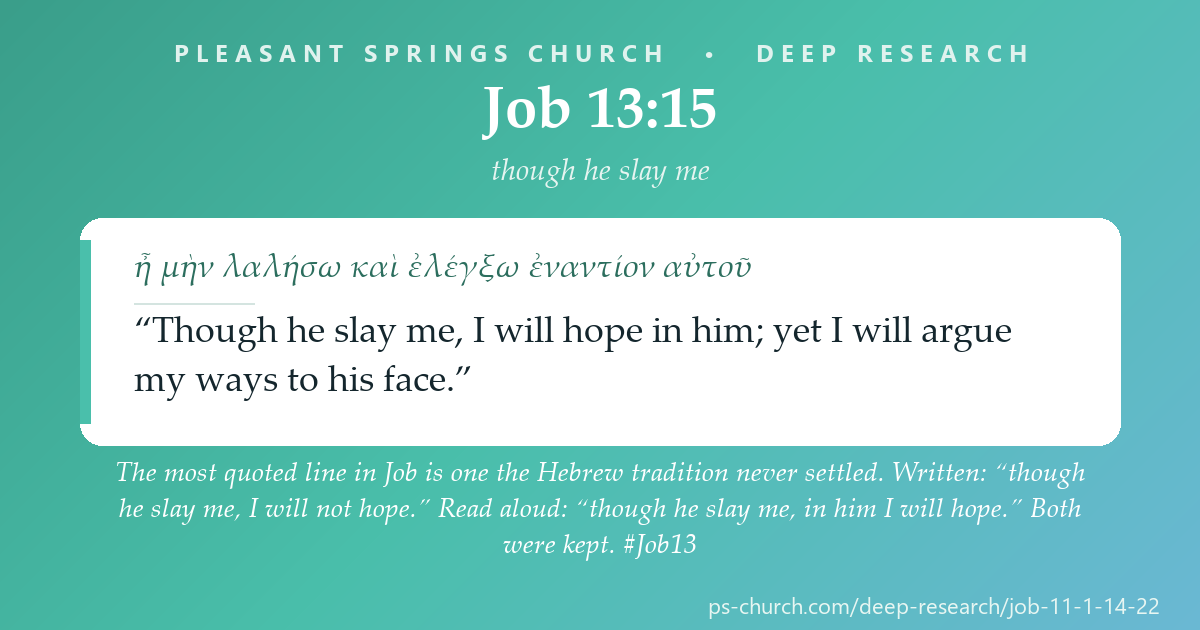
⚠️ 13:15 is the one verse in this book where the Hebrew disagrees with itself. It carries a ketiv/qere — a place where what is written and what is read aloud differ. The written consonants are לא, “not”: though he slay me, I will not hope. The reading tradition says לוֹ, “in him”: though he slay me, in him I will hope. One letter, and the verse means opposite things. The Masoretes pointed and accented the qere, and put the verse’s main pause directly on the disputed verb.
The Greek casts no vote — and that is worth stating carefully. Rahlfs has no hope-word here at all: “though the Mighty One overpower me — since he has already begun — I will surely speak and argue before him.” Two facts pull opposite ways. The translator knew the verb: he renders the identical Hebrew form with ὑπομένω at 6:11 and again at 14:14. But his ἐπεὶ καὶ ἦρκται sits in exactly the slot the hope-verb occupies, and may render the same consonants read as a different root, “begin” rather than “wait.” Either way: “the Greek supports the qere” is over-claiming, and so is “the Greek drops the clause.”
There is a control case, and there the Greek does vote. The identical lōʾ/lō pair occurs again at Job 41:4 — and Rahlfs reads οὐ σιωπήσομαι, “I will not be silent,” which is the ketiv. And the two standard Masoretic editions do not even agree on how many such places there are in Job: the Aleppo-based text marks two, the Leningrad-based text marks three.
⚠️ At 14:14 the Greek answers a question the Hebrew leaves open. The Hebrew has the interrogative particle: hăyîḥyeh — “shall he live again?” Rahlfs has no question at all: ἐὰν γὰρ ἀποθάνῃ ἄνθρωπος ζήσεται — “for if a man dies, he shall live” — and closes with I will wait until I come into being again. One text asks; the other replies.
⚠️ And at 12:6 the Greek turns a protest into a warning. The Hebrew is Job’s complaint that the world is not just: the tents of robbers are at peace, and those who provoke God are secure. Rahlfs reads: “let no one who is wicked trust that he will be held guiltless… as if there will be no scrutiny of them.” The observation becomes an admonition, and Job stops saying the thing he actually said. This is not Origen’s work: it is in the older layer of the Greek.
The Shape of the Passage
SequenceWhat Job does with the tradition is the cleverest move in the cycle. The friends argue from inherited wisdom; so Job tells them to ask the animals, who know it too (12:7–9). He is not denying their doctrine. He is saying it is common knowledge and settles nothing — and then he demonstrates the point by singing a hymn to divine power in which every act is a demolition.
And chapter 14 changes the register entirely. The legal vocabulary drops away and what is left is horticulture and grief: a tree has tiqwāh, hope, because water will reach it again; a man has a fixed term and a watchman. The question at 14:14 is not rhetorical and Job does not answer it. Neither does anyone else for a long time — which is precisely why the ancient Greek translator could not resist answering it for him.
This closes the first dialogue cycle. All three friends have now spoken and Job has answered each — and since 7:7 he has been addressing God over their heads.
Author
He saves the harshest friend for last and gives him the best line. Zophar is the one who says God is going easy on Job — and also the one who asks can you find out the deep things of God?, a question the whirlwind will spend four chapters answering in the affirmative-by-example. The friends are not given bad material. They are given good material and the wrong patient.
He lets Job win the argument about tradition without denying it. 12:7–9 is not a rejection of inherited wisdom; it is the observation that inherited wisdom here is too widely known to be an answer. Even the birds have it. That is a more devastating reply than contradiction would be.
And he ends the cycle on a question rather than a claim. Chapter 14 could have asserted something about death; instead it asks, and then imagines what it would be like if the answer were yes: you would call, and I would answer you. The book is at its most moving when it is at its least certain.
Audience
People who have been told they are getting off lightly. 11:6 is the logical end of retribution theology: if suffering is deserved, then any suffering short of total ruin is mercy. The reader knows it is false, and knows Zophar has no way of knowing that.
People for whom death was the end of the argument. The Old Testament says very little about life after death, and Job 14 is where the silence is felt hardest — a man who wants his case heard, and who can see that the court will adjourn before it sits. The tree is not a metaphor of comfort. It is the contrast that makes the grief precise.
And people who would recognise 13:15 either way round. Whether it reads I will hope in him or I will not hope, the second half of the verse does not change: yet I will argue my ways to his face. Both readings end in the same determination, which may be why the tradition preserved both.
Orient on ketiv/qere, on Sheol, and on the limits of wisdom.
Search by topic: ketiv and qere; Masoretic text and the Masoretes; Sheol; death and afterlife in the OT; retribution; wisdom’s limits; lament; the divine name in Job.
Which articles are relevant?
- Anchor Bible Dictionary — “Masoretic Text,” “Qere-Kethib,” “Sheol,” “Death,” “Resurrection (OT),” “Wisdom.”
- Dictionary of the OT: Wisdom, Poetry & Writings (IVP) — “Job 4–27,” “Zophar,” “Death,” “Afterlife,” “Hope,” “Retribution,” “Animals.”
- NIDOTTE / TDOT — יָחַל (yāḥal, wait / hope), תִּקְוָה (tiqwāh, hope — and also “cord”), חֲלִיפָה (ḥălîpāh, relief / renewal), תּוּשִׁיָּה (tûšiyyāh, sound wisdom).
- On the Greek — NETS Iob. It prints Origen’s asterisks, which the CATSS file does not, and that turns out to matter here (see below).
Bibliography surfaced:
- David J. A. Clines, Job 1–20 (WBC) and Job 21–37 — on 13:15 and on chapter 14.
- C. L. Seow, Job 1–21 (Illuminations) — the fullest treatment of the ketiv/qere and of the versions.
- Carol A. Newsom, The Book of Job — on 12:7–9 and the use of the tradition.
What a ketiv/qere is, what the Greek layers are, and why a tree is not a comfort.
First the mechanics of the written-versus-read text, since the study turns on one. Then the single most important methodological correction in this passage.
Which parallels shed light on these chapters?
A ketiv/qere is not a scribal error and not a correction. It is a place where the tradition preserves two readings at once: the consonants that must be written, and the word that must be said aloud. The Masoretes did not choose — they transmitted both, writing one and vocalising the other. There are roughly 27 of them in Job in the Aleppo-based text. 13:15 is the most consequential in the book, because the two readings are theological opposites.
And the two standard printed Hebrew editions do not agree on how many lōʾ/lō pairs Job has. The Aleppo-based text marks two (13:15 and 41:4); the Leningrad-based text marks three, adding 6:21. This is worth knowing before anyone says “the Masoretic Text reads…” — there is more than one printed Masoretic text, and here they differ.
The tree image is agricultural fact, not sentiment. Many Mediterranean species — olive, terebinth, oak — coppice: cut the trunk and the stump throws new shoots. Job knows this and uses it against himself: at the scent of water it will bud (14:9), but a man lies down and does not rise till the heavens are no more. The tree is in the passage to make the contrast sharper, not softer.
- Isaiah 6:13 and 11:1 — the stump that is holy seed, and the shoot from the stump of Jesse. The same coppicing image, used for hope where Job uses it for despair. The page notes the shared picture and draws no further conclusion.
- Psalm 88 — the one psalm that ends in darkness with no turn to praise. The nearest thing in the Psalter to Job 14.
- Ecclesiastes 3:19–21; Psalm 6:5; 88:10–12; Isaiah 38:18 — the Old Testament’s characteristic reticence about the dead. Job 14:14 is a question asked inside that reticence, not against it.
- Daniel 12:2 — the clearest Old Testament resurrection statement, and much later. Job 14 does not know it, and the page does not import it.
- The Book of Common Prayer burial office — “Man that is born of a woman hath but a short time to live…” is Job 14:1–2, read over English graves for nearly five centuries. Reception history, reported as such.
The printed Greek of Job is a composite, and until now this library has only been able to say so in general terms. For this passage the layers can actually be separated, because the critical editions mark Origen’s supplements with an asterisk — and the file used for the Greek column here carries no asterisks at all.
Sixteen half-lines in Job 11–14 are asterisked, and five whole verses are Origen’s work: 12:9, 12:21, 12:23, 14:18 and 14:19. So where Rahlfs and the Hebrew both show ninety-five verses across these four chapters, the Old Greek had about ninety.
And one of those five matters a great deal. Job 12:9 is the only verse in the whole poetic dialogue that uses the divine name — that the hand of the Lord has done this — and the Greek renders it with κυρίου. That agreement is not a translator’s witness. The verse did not exist in the Old Greek at all; the Greek line is third-century editorial work supplying what the Hebrew had. Anyone citing Greek 12:9 as evidence about the translator is citing Origen.
What survives this test is the material this study is built on. 13:15, 13:16 and 14:14 are not asterisked — they are Old Greek. So the question turned into a statement at 14:14, and the vanished hope-verb at 13:15, are genuinely the ancient translator’s, and can be reported as such.
A general caution follows. Rahlfs’s verse counts match the Hebrew in forty-one of Job’s forty-two chapters — including the chapters where the Old Greek omitted most heavily. That is a property of the edition, not a fact about the translator, and no page in this library should treat matching counts as evidence about the Old Greek.
A word the tradition could not settle, a tree’s hope, and two insults.
Read 14:7 and 14:14 together and notice the same verb does the work twice — the tree sprouts again, and Job waits for his sprouting again.
The written text and the spoken text, and they are opposites. The consonants are lōʾ, “not” — though he slay me, I will not hope. The reading tradition supplies lō, “in him” — though he slay me, in him I will hope. The Masoretes pointed and accented the second and preserved the first. The verse’s main pause falls on the disputed verb itself. English versions divide: the older Jewish and King James traditions read the qere; the 1985 Jewish Publication Society translation reads the ketiv and footnotes the other.
“I will wait, hope.” The same form stands at both of this passage’s great cruxes — at 13:15 (where the tradition disputes whether it is negated) and at 14:14 (all the days of my service I would wait, till my renewal come). It is not optimism: it is holding a position. Rahlfs renders it ὑπομένω at 6:11 and 14:14 — and has no equivalent for it at all at 13:15, which is one of the reasons that verse is so hard to adjudicate.
“Hope” — and also, from the same root, “cord” (it is Rahab’s scarlet cord in Joshua 2). Job gives it to the tree and takes it from himself. There is hope for a tree (14:7); but at 17:15 where then is my hope? and at 19:10 my hope he has pulled up like a tree. The same image, reversed, six chapters later.
“Relief, change, renewal” — from a root meaning to pass on or be replaced, and the same verb used two verses earlier of the tree that sprouts again (yaḥălîp, 14:7). Job asks whether a man gets what a tree gets. The word is used elsewhere of relief troops taking their turn — which fits the military metaphor of “all the days of my service” in the same verse.
“Sound wisdom, competence, the thing that works.” A wisdom word, largely confined to Job and Proverbs. Zophar uses it of the secrets of wisdom that would show Job how lightly he is being treated — and Job throws it back at 12:16, where tûšiyyāh belongs to God along with the deceived and the deceiver.
“Plasterers of lies.” The verb is what you do to a wall — smear, daub, whitewash over a crack (compare Ezekiel 13:10–12, where prophets whitewash a flimsy wall). Paired with rōpəʾê ʾəlil, “physicians of nothingness” — the word for worthless idols. Job’s charge is not that his friends are unkind but that they are covering something up, and calling it treatment.
Counted here, not assumed:
- Verse counts: Job 11, 12, 13, 14 = 20, 25, 28, 22 in both columns. But that match proves nothing about the Old Greek — Rahlfs matches the Hebrew’s counts in forty-one of Job’s forty-two chapters, including the most heavily abbreviated ones, because it is the filled-out text.
- Sixteen half-lines here are Origen’s supplement, and five verses are wholly his: 12:9, 12:21, 12:23, 14:18, 14:19. The Old Greek of these four chapters had about ninety verses, not ninety-five. 13:15, 13:16 and 14:14 are not asterisked and are genuinely old.
- 12:3 and 12:4 are real minuses. At 12:3 the Hebrew has three cola and the Greek renders one; at 12:4 a three-part verse becomes a single line, and Job’s first-person I have become a laughingstock becomes a third-person statement about a righteous man.
- 11:2 has an Old Greek plus with no Hebrew counterpart — εὐλογημένος γεννητὸς γυναικὸς ὀλιγόβιος, “blessed is the short-lived one born of woman.” And Job opens chapter 14 with the identical phrase (βροτὸς γὰρ γεννητὸς γυναικὸς ὀλιγόβιος). In the Greek, Zophar calls the short-lived blessed, and Job throws the words back at him three chapters later.
- The two printed Masoretic editions differ on how many lōʾ/lō ketiv-qere pairs Job contains — two in the Aleppo-based text, three in the Leningrad-based text.
A second New Testament quotation, a tree in Isaiah, and a question left open.
Read 14:7–12 and then Isaiah 6:13 — the same felled tree, opposite conclusions. Then read 14:14–15 slowly.
Which cross-references matter?
- Job 13:16 → Philippians 1:19. Paul writes this will turn out for my deliverance — and the Greek of Job 13:16 reads τοῦτό μοι ἀποβήσεται εἰς σωτηρίαν. If the wording matches, this is a second New Testament use of Job, after 5:13 at 1 Corinthians 3:19. Paul does not introduce it as a quotation, so whether he is citing Job or reaching for a familiar phrase is arguable — but the words are the words of Greek Job, and Paul was writing from prison awaiting a verdict.
- Job 14:7–9 beside Isaiah 6:13 and 11:1. The felled tree that sprouts. Job uses it to say that a man is worse off than timber; Isaiah uses it for the survival of a people and the coming of a king. The image is shared and the direction is opposite; the page notes both and does not join them.
- Job 14:14 beside Ecclesiastes 3:19–21, Psalm 88 and Daniel 12:2. Job asks a question the Old Testament mostly does not answer, and Daniel — centuries later — answers it. Job 14 does not know that answer, and reading it back into the verse removes the grief the chapter is made of.
- Job 12:9 and Isaiah 41:20. Nearly the same clause — the hand of the Lord has done this. Job 12:9 is the only verse in the poetic dialogue to use the divine name. Whether it quotes Isaiah, or both draw on a stock phrase, is argued.
- Job 11:7–9 beside Romans 11:33–34 and Isaiah 40:13. Can you find out the deep things of God? Paul asks the same thing in praise; Zophar asks it as a put-down. Identical content, opposite use — the recurring lesson of the friends’ speeches.
- Job 13:4 and Ezekiel 13:10–12. Whitewashing a wall that will not stand. Both texts use the image of covering a structural fault with a finish.
One verse the tradition itself could not settle.
Seow and Clines on 13:15. Then four questions left open.
Commentaries & studies:
- C. L. Seow, Job 1–21 (Illuminations) — the fullest account of the 13:15 ketiv/qere and of what the versions do with it.
- David J. A. Clines, Job 1–20 (WBC) — on chapter 14 and on the legal frame.
- Carol A. Newsom, The Book of Job — on 12:7–9 as a critique of the friends’ epistemology rather than of their doctrine.
- NETS Iob (tr. Claude Cox) — essential here, because it prints the asterisks that show which Greek lines are Origen’s.
Four things reported as unsettled:
- Whether 13:15 reads “not” or “in him.” The Hebrew tradition itself transmits both and the Masoretes declined to choose. The Greek casts no usable vote. Modern translations divide, including within the same Jewish translation tradition. This page prints both and chooses neither.
- What the Greek of 13:15 is doing with the hope-verb. Either the translator dropped it, or he read the same consonants as a different root meaning “begin.” Both are defensible and the page reports the two.
- Whether Philippians 1:19 is quoting Job. The Greek words are identical; Paul supplies no citation formula. Deliberate quotation, unconscious echo, or common idiom cannot be distinguished from the wording alone.
- What Job means at 14:14. Whether the question expects the answer “no,” or is a genuine open question, or is a wish he does not dare state, is argued. What is not arguable is that the Hebrew asks and the Greek answers — and that the answer is the translator’s, not Job’s.
A verse that means two things, and a question nobody answers.
Name what you learned, why it matters, and one concrete response.
What should we carry away — and do?
- The most quoted line in Job is a line the Hebrew tradition could not settle. Written: I will not hope. Read aloud: in him I will hope. And the tradition kept both, side by side, for two thousand years rather than tidying one away. That is worth sitting with before anyone insists on a single reading of anything.
- Notice what does not change between the two readings. The second half of the verse is the same either way: yet I will argue my ways to his face. Whether Job hopes or has stopped hoping, he is still going to speak to God. The determination survives the doubt.
- Zophar’s great question is deployed as a weapon. Can you find out the deep things of God? is true, magnificent, and here used to shut a suffering man up. Paul asks the same thing in Romans 11 and it is worship. The words are identical; what differs is who is being silenced.
- One concrete response. Job 14 does not resolve. It asks whether the dead live, imagines what it would be like if they did — you would call, and I would answer you; you would long for the work of your hands — and then goes back to grief. If you are waiting on something unresolved, notice that Scripture gives you a chapter for it, and does not hurry you out of it.
Job 13:15 · to share
Hebrew + Greek (Rahlfs) + ESVEvery Deep Research page traces its passage across the whole sweep — the Old Testament, the Second-Temple world between the testaments (historical witnesses, not Scripture), and the New Testament. Follow the thread:
Pleasant Springs Church — Deep Research
Research method after Michael S. Heiser’s Bible Research Method (examine dictionaries → ancient literature → important words → textual connections → academic publications → share), with the Pleasant Springs “Author & Audience” foundation. Scripture set in the Hebrew, the Greek editions named on each page and the ESV (Old Testament), and the Greek New Testament and the ESV (New Testament), per the practice of Pleasant Springs Church. Job 11–14 research grounded in Seow (Illuminations), Clines (WBC), Newsom, and NETS Iob (tr. Cox). Text: Hebrew from the Masoretic text as printed in the editions consulted — Sefaria’s Miqra according to the Masorah, cross-checked against the Leningrad-based OSHB; no critical apparatus was consulted. Greek from Rahlfs’s Septuaginta (CATSS digitization). ⚠️ A methodological correction this page carries and earlier pages could not: because NETS prints Origen’s asterisks and the CATSS file does not, the Greek layers can be separated here. Sixteen half-lines in Job 11–14 are asterisked and five verses are wholly Origen’s — 12:9, 12:21, 12:23, 14:18, 14:19 — so the Old Greek of these chapters had about ninety verses where Rahlfs and the Hebrew both show ninety-five. The page states plainly that Job 12:9, the only verse in the poetic dialogue carrying the divine name, did not exist in the Old Greek, and that its Greek/Hebrew agreement is third-century editorial work rather than a translator’s witness. It also states that 13:15, 13:16 and 14:14 are NOT asterisked and are therefore genuinely Old Greek. A general caution is drawn from this and applies across the Job set: Rahlfs’s verse counts equal the Hebrew’s in forty-one of forty-two chapters, including the most heavily abbreviated, so matching counts are a property of the edition and are not evidence about the Old Greek. ⚠️ 13:15 is presented as a ketiv/qere — written לא (“not”), read לוֹ (“in him”) — with the note that the Masoretes pointed and accented the qere while preserving the ketiv, and that the verse’s main accentual pause falls on the disputed verb. The Greek is reported as casting no usable vote: it has no hope-word, though the translator renders the identical Hebrew form with ὑπομένω at 6:11 and 14:14, and his ἐπεὶ καὶ ἦρκται may render the same consonants read as “begin”; both possibilities are stated and neither adopted. Job 41:4 is given as a control, where the same ketiv/qere occurs and Rahlfs does vote — for the ketiv. That the two standard printed Hebrew editions disagree on how many such pairs Job contains (two against three) is reported rather than smoothed. English versions are reported as divided, including within the same Jewish translation tradition. ⚠️ 14:14 is reported as a modality difference: the Hebrew carries the interrogative particle and asks; Rahlfs has no question and states that the man shall live. 12:6 is reported as a case where Job’s protest becomes a moral warning in Greek — and, being unasterisked, is the older translator’s work, not Origen’s. Real minuses at 12:3 and 12:4 and an Old Greek plus at 11:2 are quoted in both columns, with the observation that the Greek plus at 11:2 uses the phrase Job himself opens chapter 14 with. The Philippians 1:19 link is stated with its limit — Paul supplies no citation formula, so quotation, echo and common idiom cannot be distinguished. Daniel 12:2 is explicitly not read back into Job 14. Typology is handled per the house position: what the text says, what the New Testament itself draws, and what we see from this side of the cross — with the seeing left to the reader.
Scripture quotations marked ESV are from the ESV® Bible (The Holy Bible, English Standard Version®), © 2001 by Crossway, a publishing ministry of Good News Publishers. ESV Text Edition: 2016. Used by permission. All rights reserved. The ESV text may not be quoted in any publication made available to the public by a Creative Commons license, and the ESV may not be translated in whole or in part into any other language. www.esv.org
|
Did this study bless you today? 💚 Give to Support PS Church100% of gifts go to the General Fund — thank you. |