The second cycle opens and the courtesy is gone. The Eliphaz who asked permission before speaking now tells Job that your own mouth condemns you, asks whether he was the first man born and listened in on the council of God, and repeats his night vision as settled doctrine. Nothing new has been argued since chapter 5 — only the tone has collapsed. Job answers that they are miserable comforters, and then describes God for four verses as an animal and a soldier: he has torn me in his wrath… he set me up as his target… he breaks me breach upon breach. And then, with no preparation and no explanation, the sentence this study is named for. Six chapters ago Job said flatly that there is no arbiter between us. Here: even now, behold, my witness is in heaven, and he who testifies for me is on high — said twice, the second time in Aramaic. He does not withdraw the earlier statement, and nineteen verses later he is calling the pit his father. This study also does something the earlier ones could not: it separates the two layers of the Greek, and finds that nearly a quarter of what the Septuagint prints in chapter 17 was added three centuries after the translation was made. See the method →
Job 15:1–17:16 (selections)
Hebrew · Greek (Rahlfs) · ESVJob’s reply is the angriest thing he has said. They are miserable comforters (16:2). And God — described for four verses as an animal and a soldier — has torn me in his wrath and hated me; he has gnashed his teeth at me… he set me up as his target (16:9–12).
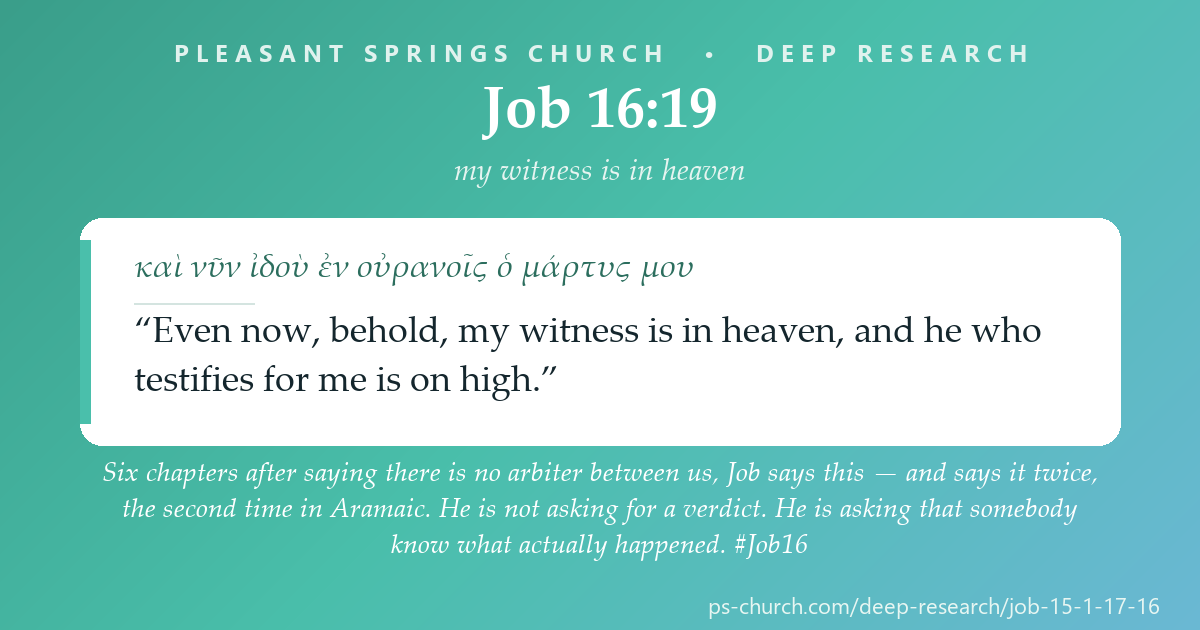
And then, without preparation, the sentence this study is named for. Six chapters earlier Job said there was no arbiter between us, nobody with standing to lay a hand on both parties. Here: even now, behold, my witness is in heaven, and he who testifies for me is on high (16:19). He does not explain the change and he does not withdraw the earlier statement. This page reports the sequence and does not harmonise it.
⚠️ For the first time in this library, the Greek can be separated into its two layers — and the result changes what may be said. The printed Greek of Job is a composite: an Old Greek translation that was substantially shorter, filled out by Origen from Theodotion and marked with asterisks. The file used for the Greek column here carries no asterisks at all, so it looks like a continuous parallel text. Read against the critical editions, 101 of the 847 Greek words in these three chapters — 11.9% — are Origen’s supplement, not the ancient translation.
And the rate nearly triples across the three chapters: Job 15 — 8.0%; Job 16 — 10.7%; Job 17 — 22.7%. Nearly a quarter of what the Greek prints in chapter 17 was added three centuries after the translation. Five whole verses have no Old Greek behind them at all — 15:10, 15:27, 16:8, 17:4 and 17:12.
⚠️ One of those five carries a reading that gets quoted. At 16:8 the Hebrew kaḥăšî can mean my leanness or my lie, and the Greek’s τὸ ψεῦδός μου is often cited as the ancient translator choosing the second. He did not: the whole verse is asterisked. The Old Greek went straight from 16:7 to 16:9. Anyone citing that reading is citing Origen’s column, not the Septuagint. Part of 16:21 is supplement too.
⚠️ But 16:19 is not asterisked. The witness in heaven is genuinely old Greek — and the translator reaches for two words where the Hebrew has two: ὁ μάρτυς μου and ὁ συνίστωρ μου, “my witness” and “my co-knower.”
⚠️ Two places where the same consonants were simply read differently. At 15:23 the Hebrew has the wanderer asking ʾayyēh, “where?” — the Greek read the same letters as ʾayyāh, the bird, and produced γυψίν: he has been allotted as food for vultures. And at 15:11 Eliphaz’s gentle question — are the comforts of God too small for you? — becomes in Greek a flat accusation: “you have been scourged for but few of your sins.” The Greek Eliphaz says Job is being punished too lightly. Neither is asterisked; both are the old translator.
The Shape of the Passage
Parallel panelsAnd 16:19 does not belong to either movement. It arrives between an image of unavenged blood and a return to the grave, and it is gone by the next chapter. Job says there is a witness in heaven, wishes that witness would argue his case, and then goes back to talking about worms. Read against 9:33 — where he said flatly that no arbiter exists — and against 19:25, where he will go further still, this is the middle term of a sequence the book never resolves. The page sets the three side by side and leaves them there.
One structural note from the Hebrew tradition: the Masoretic section markers fall at the end of chapter 15 and the end of chapter 17, and nowhere between — so chapters 16 and 17 are a single unbroken section in both the Aleppo-based and the Leningrad-based texts. Job’s reply is one speech, and the seams above are argued from particles and person-shifts, not handed over by the tradition.
The first cycle ended with a question about whether the dead live. The second begins with a friend telling Job his own mouth has convicted him.
Author
He shows the friends getting worse, and he shows it structurally. Eliphaz’s first speech opened with four verses of sincere praise; his second opens by asking whether a wise man answers with wind. Nothing new has been argued in between. The deterioration is not intellectual but relational — which is what happens to people who keep defending a position against someone who will not accept it.
He gives Job the vision back as a weapon. 15:14 restates 4:17 almost exactly — what is man, that he can be pure? — but where the first version was a whisper from an unidentifiable form, this one is a settled premise, and Bildad will repeat it a third time at 25:4. A doctrine that arrived by night has become the party line.
And he plants 16:19 where it will do the most damage to a tidy reading. Job has said there is no arbiter; he will later say his Redeemer lives; here he says his witness is in heaven — and then, within twenty verses, that the pit is his father. The writer refuses to make Job consistent, and every attempt to harmonise these three statements loses what the book is doing.
Audience
People who have said something true about God and then had to live with what it implies. Eliphaz’s 15:14–16 is not false. God does not put trust in his holy ones; the heavens are not pure in his sight. The question the book keeps asking is what follows from that, and Eliphaz’s answer — therefore this man is guilty — does not follow.
People who have wanted a witness more than a verdict. 16:19 is not a claim about vindication. It is a claim that somebody knows what actually happened — which is what people who have been misrepresented want first, before justice and often instead of it.
And people who can hold 16:19 and 17:14 in one week. My witness is in heaven, and then I say to the pit, you are my father. The book puts them eighteen verses apart and does not apologise.
Orient on the heavenly witness, the hexapla, and the imagery of divine hostility.
Search by topic: witness (legal); blood that cries out; goʾel and avenger of blood; Origen’s Hexapla; Theodotion; Aristarchian signs; lament; divine warrior; Sheol.
Which articles are relevant?
- Anchor Bible Dictionary — “Witness,” “Blood,” “Hexapla,” “Theodotion,” “Septuagint,” “Divine Warrior,” “Sheol.”
- Dictionary of the OT: Wisdom, Poetry & Writings (IVP) — “Job 4–27,” “Eliphaz,” “Witness,” “Violence,” “Lament.”
- NIDOTTE / TDOT — עֵד (ʿēḏ, witness), שָׂהֵד (śāhēḏ — an Aramaic word for witness), מֵלִיץ (mēlîṣ, interpreter / intercessor), כַּחַשׁ (kaḥaš, leanness / lying).
- On the Greek — essential for this study: NETS Iob (tr. Claude Cox), which prints Ziegler’s asterisks. Without it the two layers of the Greek cannot be told apart, and the CATSS file used for the Greek column here carries none.
Bibliography surfaced:
- David J. A. Clines, Job 1–20 (WBC) — on 16:18–21 and the witness.
- C. L. Seow, Job 1–21 (Illuminations) — on the text of chapter 17, which is difficult in Hebrew as well as in Greek.
- Carol A. Newsom, The Book of Job — on why the friends escalate.
- Joseph Ziegler, Septuaginta XI.4: Iob (Göttingen 1982) — the critical edition behind the asterisk data used here.
Blood that cries out, a witness who knows, and how to tell two Greeks apart.
First the legal and cultic background to 16:18–19. Then the single most consequential methodological point in the Job set.
Which parallels shed light on these chapters?
“O earth, cover not my blood” is a legal formula, not a poetic flourish. Unabsorbed blood cries from the ground in Genesis 4:10; Israel’s law requires spilled blood to be covered (Leviticus 17:13) and treats uncovered blood as an unsettled claim (Isaiah 26:21; Ezekiel 24:7–8). Job is speaking as a murder victim whose case is still open — which is why the next line is about a witness.
And the witness word is doubled, with one half in Aramaic. Hebrew ʿēḏ is paired with śāhēḏ, which is the ordinary Aramaic word for a witness — it appears in Genesis 31:47, in the Aramaic name Laban gives the heap of stones. Job reaches across a language boundary for the second half of the line, and the Greek follows him with two different nouns: μάρτυς and συνίστωρ, “witness” and “co-knower.”
The violence imagery is that of the divine warrior, turned around. In the prophets God breaks out against enemies; here the same verbs land on a man who has just said there is no violence in his hands. Job is not saying God is unjust in general. He is saying he has been treated as an enemy, and the vocabulary is borrowed from passages where that treatment is deserved.
- Genesis 4:10; Leviticus 17:13; Isaiah 26:21; Ezekiel 24:7–8 — blood that is not covered and will not be quiet. The background to Job 16:18.
- Genesis 31:47 — the Aramaic śāhăḏûṯāʾ beside the Hebrew galʿēḏ, both meaning “heap of witness.” The same Aramaic root Job uses at 16:19.
- Lamentations 3:10–12 — God as a bear lying in wait, a lion in hiding, an archer whose arrows find the speaker. The closest parallel in Scripture to Job 16:9–13, and also written by a sufferer who does not stop addressing him.
- Origen’s Hexapla (third century — a scholarly edition, not Scripture) — six columns, in which the shorter Greek of Job was filled out from Theodotion and the additions marked with an asterisk. Everything this page says about which Greek is old depends on those marks, transmitted through Ziegler’s edition.
This is the first study in this library able to separate the two layers of Greek Job, and the result is large enough to change what may be claimed.
The situation. The Old Greek of Job was substantially shorter than the Hebrew. Origen filled the gaps from Theodotion’s later, more literal version and marked every addition with an asterisk. That filled-out text is what passed into the great codices and into modern editions — and the digitised file used for the Greek column on these pages carries no asterisks at all. It presents Old Greek and third-century supplement as one seamless text.
The numbers for this passage. Of 847 Greek words in Job 15–17, 101 — 11.9% — are asterisked supplement. But the distribution is not even, and the trend is the finding: Job 15, 8.0%; Job 16, 10.7%; Job 17, 22.7%. Nearly a quarter of what the Greek prints in chapter 17 was not there when the book was translated. Twelve segments are marked in all; five whole verses have no Old Greek behind them — 15:10, 15:27, 16:8, 17:4, 17:12.
Why it matters here specifically. Commentaries sometimes note that “the Septuagint reads my lie” at 16:8, resolving a genuine Hebrew ambiguity (kaḥăšî can be my leanness or my lie). The Old Greek translator made no such choice: the entire verse is asterisked, and the Old Greek ran from 16:7 straight to 16:9. The reading is Origen’s column. Part of 16:21 — and a son of man for his neighbour — is supplement as well.
And what survives the test is what this study is built on. 16:19 is not asterisked. The witness in heaven is in the oldest Greek there is, and so are the readings at 15:11 and 15:23. The page prints those as the ancient translator’s and flags the others as Origen’s.
An Aramaic witness, a word that means two things, and a bird that used to be a question.
Read 16:19 aloud and notice it says the same thing twice in two languages. Then read 15:23 in both columns and see how one word became a vulture.
“My witness — and my witness.” Two words for the same thing, and the second is Aramaic. Ṣāhēḏ occurs only here in the entire Hebrew Bible; its home is Aramaic, where it is the ordinary term (Genesis 31:47, in the name Laban gives the heap). Job reaches into another language to say it twice. Rahlfs follows with two distinct nouns: μάρτυς, witness, and συνίστωρ — literally one who knows along with.
“My intercessors” or “my scorners” — the word is genuinely double. The root gives both interpreter (it is the word for Joseph’s translator at Genesis 42:23) and mocker. English versions split, and the immediate context — my eye pours out tears to God — can support either. Rahlfs has no mediator-noun here at all, reading instead may my petition reach the Lord, and before him may my eye drip. That is a rendering, not an omission — the line is present and full. The same root returns at 33:23, where Elihu speaks of an angel who is a mēlîṣ.
“My leanness” or “my lie.” The noun covers both emaciation and deception, and the verse can mean my gauntness rises up and testifies against me or my lie testifies against me. The ambiguity is real and old. But the Greek is no help: although Rahlfs reads τὸ ψεῦδός μου, the whole verse is Origen’s supplement and the Old Greek did not render 16:8 at all. Citing “the LXX” here cites the third century, not the second BC.
“Where?” — the wanderer’s question as he looks for bread. The Greek translator read the identical consonants as ʾayyāh, a bird of prey (the unclean bird of Leviticus 11:14), and produced γυψίν: he has been allotted as food for vultures. This is the clearest teaching case in the passage that manuscript difference is usually about vowels and word-division, not about anyone altering anything — unpointed Hebrew simply admitted both.
“In his holy ones.” A place where the two standard printed Hebrew Bibles handle the text differently. The Leningrad-based edition marks a ketiv/qere here; the Aleppo-based edition files no note and simply prints the consonants with a plural vocalisation. Both traditions end up reading a plural, and Rahlfs agrees (κατὰ ἁγίων) — but the editions disagree about how to record it, which is worth knowing before anyone says “the Masoretic Text reads…” as though there were only one.
“Comforters of trouble” — comforters who are trouble, or who produce it. The phrase has entered English as “miserable comforters” and the Hebrew is harsher: ʿāmāl is toil, misery, the thing they were supposed to be relieving. They have become the disease they came to treat.
Counted here, not assumed:
- Verse counts: Job 15, 16, 17 = 35, 22, 16 in both columns — seventy-three either way, no lettered labels. But that is parity of verse labels in a Greek text whose numbering was aligned to the Hebrew editorially. It is a numbering fact, not a textual one, and it is fully compatible with a materially shorter Old Greek — which is exactly what is found here.
- 101 of 847 Greek words in this passage are Origen’s supplement — 11.9% — distributed 8.0% in chapter 15, 10.7% in chapter 16, and 22.7% in chapter 17. Twelve marked segments; five whole verses with no Old Greek: 15:10, 15:27, 16:8, 17:4, 17:12.
- 16:19 is NOT asterisked, and neither are 15:11, 15:23, 16:16 or 17:14. Those are the ancient translator. 16:8 and part of 16:21 are.
- The ketiv/qere count in this passage depends on which Hebrew edition you open — two in the Aleppo-based text (15:22, 16:16), four in the Leningrad-based text (adding 15:15, 15:31). Book-wide the smaller set is a subset of the larger. Whether the difference reflects the underlying Masorah or uneven markup is unsettled.
- Masoretic section markers fall at 15:35 and 17:16 only, in both traditions — so chapters 16 and 17 form one unbroken section and every internal seam is an interpretive act.
Three things Job says about a mediator, and none of them cancel each other.
Read 9:33, then 16:19, then 19:25 — in that order, at one sitting. Then notice 17:15 asks “where then is my hope?” nineteen verses after 16:19.
Which cross-references matter?
- Job 9:33 → 16:19–21 → 19:25–27 — the sequence, unharmonised. There is no arbiter between us (9:33). Even now, my witness is in heaven (16:19). I know that my Redeemer lives (19:25). Job says three different things, and the book does not tell you which is his settled view. Development, contradiction, or a man speaking from different depths — all three are argued, and this page declines to choose.
- Job 16:18 and Genesis 4:10. O earth, cover not my blood — Abel’s blood cries from the ground. Job is claiming the standing of a murder victim whose case has not been heard.
- Job 16:9–14 and Lamentations 3:10–12. God as bear, lion, archer. Two biblical sufferers using the same imagery of divine hostility — and both keep praying.
- Job 15:14 beside 4:17 and 25:4. The same doctrine three times: Eliphaz’s vision, Eliphaz’s argument, and finally Bildad’s six-verse fragment. The friends’ case does not develop; it repeats.
- Job 16:19 and Romans 1:9; 2 Corinthians 1:23; 1 Thessalonians 2:5. Paul repeatedly calls God witness to what only he can verify. The same legal instinct: when no human court can establish the fact, the appeal is to the one who was there. The page states the shared idiom and draws no further conclusion.
- Job 16:20 and 33:23. The disputed mēlîṣ — intercessor or scorner — returns in Elihu’s mouth as an angel who declares a man’s uprightness. The book keeps circling a figure it never quite produces.
What the asterisks change, and four things left open.
Ziegler and NETS for the Greek layers; Clines and Seow for the Hebrew.
Commentaries & studies:
- Joseph Ziegler, Septuaginta XI.4: Iob (Göttingen 1982), and NETS Iob (tr. Cox), which prints his asterisks. Indispensable for any claim about “what the Septuagint says” in Job.
- David J. A. Clines, Job 1–20 (WBC) — on the witness passage and on the mēlîṣ.
- C. L. Seow, Job 1–21 (Illuminations) — on chapter 17, which is textually difficult in Hebrew as well.
- Carol A. Newsom, The Book of Job — on the escalation of the second cycle.
Four things reported as unsettled:
- Who the witness in heaven is. God himself, a third party, or a personification of Job’s own cry — all are argued, and the verse does not say. Reading it as one thing because a later text supplies a candidate is exactly what this library does not do.
- Whether məlîṣay at 16:20 means intercessors or scorners. The root supports both; the versions divide; Rahlfs sidesteps it entirely by rendering the colon without a mediator-noun.
- Whether 16:8 means “my leanness” or “my lie.” A real Hebrew ambiguity — and the Greek cannot break the tie, because the verse is not in the Old Greek at all.
- Whether the ketiv/qere difference between the printed Hebrew editions reflects the underlying Masorah or uneven modern markup. The smaller set is a proper subset of the larger, and the editor of the smaller has a category for exactly this phenomenon and applies it inconsistently elsewhere in Job. Reported, not resolved.
A witness, before a verdict.
Name what you learned, why it matters, and one concrete response.
What should we carry away — and do?
- What Job asks for is not vindication but a witness. Somebody who knows what actually happened. That is the first thing anyone wants who has been misrepresented — before justice, and often instead of it. He asks for it in two languages in one line.
- He says it and then loses hold of it. Nineteen verses after my witness is in heaven, he is calling the pit his father and asking where then is my hope? Scripture does not present faith here as a position held steadily. It presents it as something that surfaces and submerges in the same speech.
- Eliphaz has stopped listening and started scoring. Nothing new has been argued since chapter 5 — but the tone has collapsed, because he is defending a position against someone who will not accept it. That is the ordinary trajectory of an argument between people who love each other, and the book is unusually precise about it.
- One concrete response. Job 16:5 is the one verse where he says what he would do if the roles were reversed: I would strengthen you with my mouth, and the solace of my lips would assuage your pain. He is describing the friend he wishes he had. Be that one.
Job 16:19 · to share
Hebrew + Greek (Rahlfs) + ESVEvery Deep Research page traces its passage across the whole sweep — the Old Testament, the Second-Temple world between the testaments (historical witnesses, not Scripture), and the New Testament. Follow the thread:
Pleasant Springs Church — Deep Research
Research method after Michael S. Heiser’s Bible Research Method (examine dictionaries → ancient literature → important words → textual connections → academic publications → share), with the Pleasant Springs “Author & Audience” foundation. Scripture set in the Hebrew, the Greek editions named on each page and the ESV (Old Testament), and the Greek New Testament and the ESV (New Testament), per the practice of Pleasant Springs Church. Job 15–17 research grounded in Clines (WBC), Seow (Illuminations), Newsom, and Ziegler’s Göttingen Iob as presented in NETS. Text: Hebrew from the Masoretic text as printed in the editions consulted — Sefaria’s Miqra according to the Masorah, cross-checked against the Leningrad-based OSHB; no critical apparatus was consulted for the Hebrew. Greek from Rahlfs’s Septuaginta (CATSS digitization). ⚠️ This study separates the two layers of Greek Job for the first time in this library. The CATSS file carries no Aristarchian signs and so presents Old Greek and Origen’s supplement as one continuous text; read against the critical edition, 101 of the 847 Greek words in this passage — 11.9% — are asterisked Theodotionic supplement, distributed 8.0% / 10.7% / 22.7% across chapters 15, 16 and 17, with five whole verses having no Old Greek behind them: 15:10, 15:27, 16:8, 17:4, 17:12. The asterisk data is attributed to Ziegler via NETS and flagged as one remove from the apparatus itself. The page states the consequence explicitly: the widely-cited Greek reading “my lie” at 16:8 is Origen’s column, not the Septuagint — the Old Greek ran from 16:7 to 16:9 — and part of 16:21 is supplement as well; while 16:19, 15:11, 15:23 and 17:14 are NOT asterisked and are reported as the ancient translator’s. Verse-count parity (35/22/16 in both columns) is explicitly described as a numbering fact rather than a textual one, since Rahlfs’s versification is editorially aligned to the Hebrew and is compatible with a materially shorter Old Greek. 15:11 and 15:23 are printed as substitutions: Eliphaz’s question about the comforts of God becomes an accusation that Job has been under-punished, and the wanderer’s “where?” (ʾayyēh) is read as the bird (ʾayyāh) and rendered “vultures” — given as the clearest case that manuscript difference is usually about vowels and word-division. ⚠️ The ketiv/qere count is reported as edition-dependent — two in the Aleppo-based text, four in the Leningrad-based text — with the note that the smaller set is a proper subset of the larger and that whether the difference reflects the underlying Masorah or uneven markup is unsettled. Masoretic section markers are reported as falling only at 15:35 and 17:16 in both traditions, so chapters 16–17 are one unbroken section and every internal seam in the diagram is an interpretive act. Job’s three statements about a mediator (9:33, 16:19, 19:25) are set side by side and deliberately NOT harmonised, and the identity of the witness is named as unsettled. That śāhēḏ at 16:19 is a hapax and an Aramaic word is reported, with Genesis 31:47 cited. Typology is handled per the house position: what the text says, what the New Testament itself draws, and what we see from this side of the cross — with the seeing left to the reader.
Scripture quotations marked ESV are from the ESV® Bible (The Holy Bible, English Standard Version®), © 2001 by Crossway, a publishing ministry of Good News Publishers. ESV Text Edition: 2016. Used by permission. All rights reserved. The ESV text may not be quoted in any publication made available to the public by a Creative Commons license, and the ESV may not be translated in whole or in part into any other language. www.esv.org
|
Did this study bless you today? 💚 Give to Support PS Church100% of gifts go to the General Fund — thank you. |