Bildad has stopped arguing and started describing. His second speech contains six different Hebrew words for a trap in three verses — one of them found nowhere else in the Bible — and marches its victim off to the king of terrors. It also contains no commands at all: he and Zophar are the only friends in the whole dialogue who tell Job to do nothing, because they have given up addressing him and are now describing a type. Job answers with the most famous sentence in the book — and it is worth noticing where it sits. Immediately before it he says God has wronged him and that even small children despise him; immediately after it he warns his friends of judgment. “I know that my Redeemer lives” is shouted in the middle of a quarrel, and the word he uses is not a devotional title but a legal office: the kinsman who buys back your land, marries your widow, and avenges your blood. Then Zophar describes a man vomiting up his wealth, and Job ends the cycle by refusing to argue at all — why do the wicked live, reach old age, and grow mighty in power? The friends have a theory; Job has a window. And under all of it lies a textual finding this library could not have made until now: the oldest Greek of “I know that my Redeemer lives” contains no redeemer, no flesh, and no seeing God. See the method →
Job 18:1–21:34 (selections)
Hebrew · Greek (Rahlfs) · ESVJob’s reply contains the most famous sentence in the book, and it arrives directly after a wish that his words could be written down permanently — engraved in the rock forever with an iron pen and lead (19:24). Then: I know that my Redeemer lives, and at the last he will stand upon the earth.
Zophar answers with the most physical speech in the dialogue — a man swallows wealth and God makes him vomit it up (20:15). And Job closes the cycle by refusing to argue at all. He simply reports what anyone can see: why do the wicked live, reach old age, and grow mighty in power? Their children dance; their houses are safe; they die comfortable. The friends have a theory; Job has a window.
⚠️ The ancient Greek of 19:25–27 has no redeemer in it. This is the strongest textual finding in the book, and it cannot be waved away as Origen’s later filling, because 19:25, 26 and 27 carry no asterisk — they are Old Greek, a genuine ancient witness. Set the columns side by side:
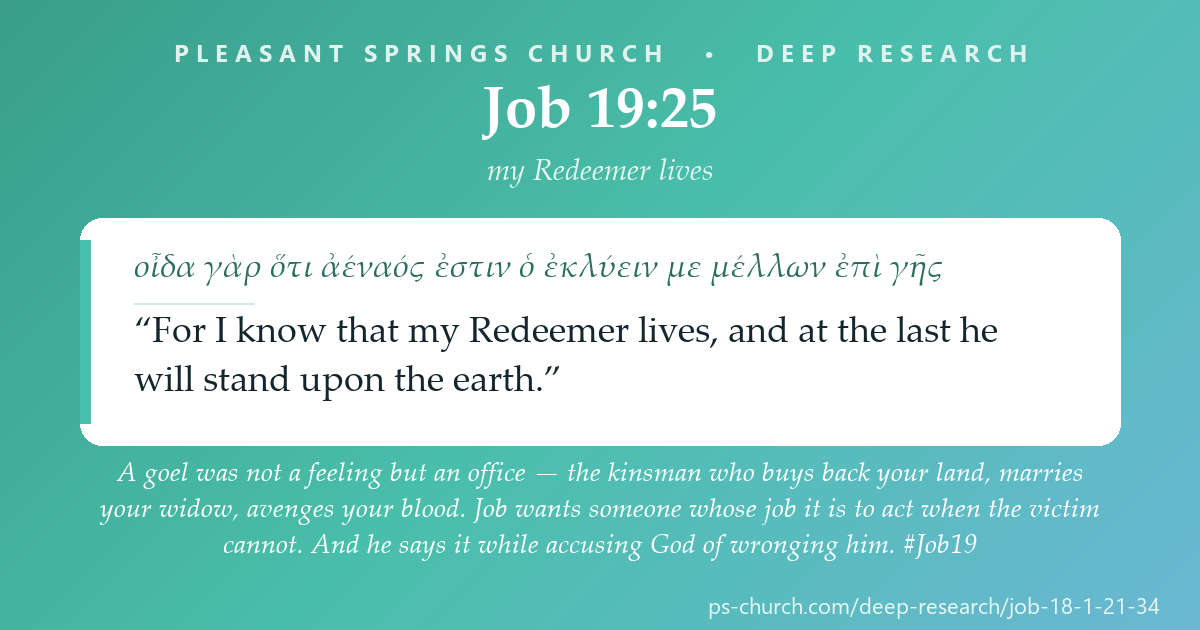
19:25. Hebrew: I know that my gōʾēl lives. Greek: οἶδα γὰρ ὅτι ἀέναός ἐστιν ὁ ἐκλύειν με μέλλων ἐπὶ γῆς — “I know that he who is about to release me is everlasting upon the earth.” There is no redemption word and no kinship word in the Greek at all — not λυτρωτής, not ἀγχιστεύς. Only a participle meaning “the one about to loose me.”
19:26 — and this is the sharper half. Hebrew: and after my skin has been thus destroyed, from my flesh I shall see God. Greek: ἀναστήσαι τὸ δέρμα μου τὸ ἀνατλῶν ταῦτα — “may he raise up my skin, which has endured these things.” Three things happen at once. The Greek has no word for flesh, no word for God, and no verb of seeing; and ἀναστήσαι is an optative — a wish, not a statement. Where the Hebrew declares, the Greek hopes.
⚠️ And the Hebrew itself is genuinely difficult — this page will not pretend otherwise. The verse’s main verb, niqqəpû, occurs twice in the whole Hebrew Bible: here and at Isaiah 10:34, where it is about felling timber. It is third-person plural with no stated subject, and its apparent object is feminine singular. And the decisive preposition — mibbəśārî — can mean from within my flesh or apart from my flesh, which reverses the verse. The identical pointed form occurs only one other time in the Bible: four verses earlier, at 19:22, where it plainly means of my flesh. That does not settle 19:26, and this page does not settle it either.
The Shape of the Passage
Parallel panelsAnd Job wins the argument in chapter 21 by declining to have it. The friends reason from a principle; Job reports observations. The wicked are not cut off — they are comfortable, and they die comfortable. He also quotes Bildad directly: Bildad said the lamp of the wicked is put out (18:5–6), and Job asks how often is the lamp of the wicked put out? (21:17), recombining the same three words into a question. The verb occurs only four times in the book, and two of them are Bildad’s.
The Redeemer verse sits at the exact centre of all this, and it is worth noticing what surrounds it: an accusation that God has wronged him, a complaint that even children despise him, and a threat of judgment against his friends. It is not a serene confession. It is shouted from the middle of a quarrel.
The second cycle began with a witness in heaven asserted and then lost hold of. It ends with a Redeemer asserted and a window opened.
Author
He marks the friends’ collapse grammatically. Bildad in chapter 18 and Zophar in chapter 20 issue no commands at all — the only friend speeches in the dialogue with zero imperatives. Everyone before them told Job to do something. These two have given up on him as a person and are simply describing a type, and the change is countable rather than impressionistic.
He puts the book’s most confident sentence in its angriest chapter. 19:25 is not surrounded by calm. It comes after Job says God has wronged him, closed a net around him, stripped his glory, and turned his family against him — and it is followed by a threat that his friends will face judgment. The confession is a shout, not a settlement.
And he lets Job end the cycle with data. Chapter 21 abandons argument for observation: go and look. The friends have a system that predicts the wicked suffer, and Job simply reports that they do not — which is the one move their system has no answer to, and the cycle stops dead.
Audience
People who have watched the wrong people flourish. Job 21 is the oldest sustained statement of that grievance in Scripture, and it is not corrected anywhere in the book. Psalm 73 walks the same road and arrives somewhere; Job 21 just stops, and the canon lets it.
People who have wanted something on the record. 19:23–24 — carved in rock with an iron pen and filled with lead — is a request for permanence, made by a man who expects to die unvindicated. He got it, in a form he could not have imagined, which is an irony the book does not point out.
And people who would have understood a goʾēl as a job description. To an Israelite the word meant something specific: the relative who buys back your land, marries your widow, or hunts down your killer. Job is not reaching for a metaphor. He is naming an office, and asserting that someone holds it.
Orient on the kinsman-redeemer, on Sheol’s vocabulary, and on the Hexapla.
Search by topic: goʾel / kinsman-redeemer; avenger of blood; cities of refuge; levirate; Mot and the firstborn of Death; king of terrors; retribution; Hexapla and Theodotion; resurrection in the OT.
Which articles are relevant?
- Anchor Bible Dictionary — “Redeemer (OT),” “Avenger of Blood,” “Mot,” “Death,” “Resurrection (OT),” “Hexapla.”
- Dictionary of the OT: Wisdom, Poetry & Writings (IVP) — “Job 4–27,” “Redeemer,” “Afterlife,” “Retribution,” “Death.”
- NIDOTTE / TDOT — גָּאַל (gāʾal, redeem — the legal core), נָקַף (nāqap I, strip / fell), בַּלָּהוֹת (ballāhōṯ, terrors), מַלְכֹּדֶת (malḵōḏeṯ — a hapax).
- On the Greek — NETS Iob and Ziegler. Indispensable here: they establish that 19:25–27 is Old Greek and that six verses of chapter 21 are not.
Bibliography surfaced:
- David J. A. Clines, Job 1–20 (WBC) — the fullest treatment of 19:25–27 and its grammar.
- C. L. Seow, Job 1–21 (Illuminations) — on the text and reception of the Redeemer verse.
- Carol A. Newsom, The Book of Job — on chapter 21 as a counter-empirical argument.
A legal office, a Canaanite death-god, and six verses that are not ancient.
First what a goʾēl actually was. Then the two layers of the Greek, which matter more in this passage than anywhere else in the book.
Which parallels shed light on these chapters?
A goʾēl was a role in family law, not a religious title. He is the nearest male relative, and he has duties: buy back land the family has lost (Leviticus 25:25), marry a childless widow (Ruth 3–4), and — as goʾēl haddām, the redeemer of blood — hunt down and execute a kinsman’s killer (Numbers 35:19; Deuteronomy 19:6–12). The office exists because a dead man cannot prosecute his own case. Job, who has just asked the earth not to cover his blood, is asking for exactly that officer.
And the word is not native to this book. The root occurs 105 times in the Hebrew Bible and only twice in Job — at 3:5 and here. The participle goʾēl occurs 46 times in the Bible and once in Job. The exact form goʾălî, “my redeemer,” occurs twice in the whole Bible — here and Psalm 19:14. Job reaches outside his own vocabulary for it.
Bildad’s death imagery may be older than Israel. The firstborn of Death (18:13) and the king of terrors (18:14) are each unique in Scripture, and both sound like personifications: Ugaritic texts know Mōtu, Death, as a god with a household. Whether Bildad is using live mythology or a dead metaphor is argued, and this page does not decide. What is observable is what the Greek does with it: the king of terrors becomes ἀνάγκη αἰτίᾳ βασιλικῇ — distress by a royal legal charge. A mythological figure has become a court summons.
- Leviticus 25:25; Numbers 35:19; Deuteronomy 19:6–12; Ruth 3–4 — the goʾēl in operation: land, widow, and blood. Read these before reading Job 19:25, because they are what the word meant to anyone who heard it.
- Ugaritic Baal Cycle (Canaanite — a witness, not Scripture) — for Mōt as a personified Death with a realm and appetite, the likeliest background to “the firstborn of Death.”
- Psalm 73 — the same grievance as Job 21, taken to a resolution Job 21 never reaches. The canon contains both.
- b. Bava Batra 16a (rabbinic — a witness, not Scripture) — where Rava says that Job denied the resurrection of the dead. The oldest Jewish reading of this material runs directly against the familiar Christian one, and the page reports that rather than hiding it.
The critical question had to be settled before anything could be said: is the Greek of 19:25–27 Old Greek, or is it Origen’s third-century filling from Theodotion? It is Old Greek. In the whole of Job 19 only two half-lines are asterisked — part of 19:24 and part of 19:28 — and verses 25, 26 and 27 carry no asterisk at all. So what follows is a genuine ancient witness, not a late repair.
19:25. Hebrew: I know that my redeemer lives, and at the last he will stand upon the dust. Greek: “I know that he who is about to release me is everlasting upon the earth.” No redemption word. No kinship word. The translator uses a participle of ἐκλύω — to loosen, set free, undo.
19:26. Hebrew: and after my skin has been thus destroyed, from my flesh I shall see God. Greek: “May he raise up my skin, which has endured these things; for from the Lord these things have been accomplished for me.” The Greek contains no word for flesh, no word for God, and no verb of seeing — and its verb is an optative, the mood of wishing. The Hebrew declares; the Greek hopes.
Why this must be reported rather than smoothed. The Hebrew of 19:26 is one of the hardest verses in the book — its main verb appears twice in the entire Bible, it has no stated subject, its object does not agree with it, and its key preposition can mean either from within or apart from the flesh. Faced with that, the oldest translation we possess produced something quite different, and the oldest Jewish commentary on the passage concluded that Job was denying resurrection. None of that decides what the Hebrew means. But a page that printed only the familiar English would be concealing the fact that the verse has been read in opposite directions for two thousand years.
A legal office, a verb attested twice, and a lamp thrown back.
Read Leviticus 25:25 and Numbers 35:19 before Job 19:25. Then read 18:5–6 and 21:17 together and hear the quotation.
“My redeemer” — and it is a legal office. The goʾēl is the nearest kinsman: he buys back forfeited land, marries the childless widow, and as redeemer of blood executes a relative’s killer. The root occurs 105 times in the Hebrew Bible and only twice in Job; this exact form occurs twice in the whole Bible (here and Psalm 19:14). Job is naming an office and asserting that someone holds it. The Greek has no redemption or kinship word here at all — only ὁ ἐκλύειν με μέλλων, “the one about to release me.”
The main verb of the crux, and it occurs twice in the entire Hebrew Bible — here and Isaiah 10:34, where it is used of felling timber. The whole sense of the line rests on a single external attestation. Worse: it is third-person plural with no stated subject, and its apparent object zōʾṯ is feminine singular. Any confident translation of 19:26 is supplying more than the Hebrew gives.
“From my flesh” — or “apart from my flesh,” which reverses the verse. Hebrew min can mark vantage point (seeing God while still in the body) or privation (seeing God once out of it). The identical pointed form occurs exactly twice in the Bible, and both are in this speech: at 19:22 — are you not satisfied with my flesh? — where it plainly means of/from. That is suggestive and it is not decisive, and this page leaves the question open.
“Trap.” A hapax legomenon — it occurs nowhere else in the Hebrew Bible — and it is the sixth of six distinct trap-words Bildad packs into three verses (18:8–10): net, mesh, bird-trap, noose, cord, snare. The Old Greek had only two of them. The other four in the printed Greek were supplied later by Origen — so the density that makes the Hebrew passage so claustrophobic is a Hebrew effect the earliest translation did not reproduce.
“The firstborn of Death.” This phrase and king of terrors in the next verse each occur exactly once in the whole Hebrew Bible. Both read like personifications, and Canaanite texts know Death as a god with a household — though whether Bildad means live mythology or a dead metaphor is argued. The Greek dissolves both: the king of terrors becomes ἀνάγκη αἰτίᾳ βασιλικῇ, distress under a royal legal charge.
“To be extinguished” — of a lamp. Four occurrences in the whole book, and Job throws two of them back at Bildad. Bildad: the light of the wicked is put out… his lamp above him is put out (18:5–6). Job: how often is the lamp of the wicked put out? (21:17) — the same three words recombined into one clause and turned into a question. He is not refuting the doctrine in the abstract. He is quoting the man who said it.
Counted here, not assumed:
- Verse counts: Job 18, 19, 20, 21 = 21, 29, 29, 34 in both columns. As everywhere in Job, that parity says nothing about the Old Greek — the printed Greek is Origen’s filled-out text.
- 19:25–27 is NOT asterisked — it is Old Greek. In all of Job 19 only two half-lines are Origen’s (part of 19:24 and part of 19:28). So the Greek’s very different reading is an ancient witness, not a late repair.
- But six consecutive verses of chapter 21 ARE Origen’s — 21:28–33, the largest continuous supplement in this passage. The Old Greek of Job 21 runs from 21:27 straight to 21:34, so Job’s closing evidence — ask the travellers, the wicked spared on the day of calamity, the honoured funeral — was not in the earliest translation. The much-quoted “what is the Almighty, that we should serve him?” (21:15) is asterisked too.
- 19:4a is a Greek PLUS with no Hebrew counterpart — fourteen words, unasterisked, so the translator’s own: “to have spoken a word that ought not to have been; and my words wander and are not in season.” The standard parser merges it invisibly into 19:4.
- Bildad 18 and Zophar 20 contain zero imperatives. Counted across the dialogue: Eliphaz 4 has one, Eliphaz 5 three, Bildad 8 two, Zophar 11 three, Eliphaz 15 one — and then nothing. Job’s two replies here carry ten between them.
The office behind the word, the psalm that answers chapter 21, and a rabbi who read it the other way.
Read Job 21 and then Psalm 73 — the same complaint, and one of them resolves.
Which cross-references matter?
- Leviticus 25:25; Numbers 35:19; Ruth 4:1–10 → Job 19:25. Land, blood, widow. The goʾēl is the man who acts when you cannot act for yourself — which is precisely Job’s situation, and why the word arrives four verses after he asks the earth not to cover his blood.
- Job 9:33 → 16:19 → 19:25 — the third and boldest statement. No arbiter; then a witness in heaven; now a redeemer who will stand on the dust. The page sets the three side by side and does not harmonise them, here as in the previous studies.
- Job 21 beside Psalm 73 and Jeremiah 12:1–2. The same grievance — the wicked prosper — in three places. Psalm 73 resolves it in the sanctuary; Jeremiah gets an answer; Job 21 simply stops. The canon keeps all three.
- Job 21:17 quoting Job 18:5–6. Lamp, wicked, extinguished — three words Bildad used, returned as a question. The verb occurs four times in the book and two of them are Bildad’s own.
- b. Bava Batra 16a (rabbinic — a witness, not Scripture) — Rava concludes from this material that Job denied the resurrection of the dead. Reported because it is the oldest surviving Jewish reading of the passage, and because a page that gave only the familiar reading would be presenting one tradition as though it were the only one.
- Job 19:23–24 and Isaiah 30:8; Jeremiah 17:1. Words cut into rock, engraved with iron. Job wants a record that outlasts him — the request of a man who expects to die without vindication.
- No New Testament quotation. Checked mechanically: across all 1,325 Greek words of Job 18–21 there is no shared five-word sequence with any New Testament book, and the only shared four-word strings are stock function-word runs. The familiar use of 19:25 at funerals comes through Handel and the Prayer Book, not through the New Testament.
One verse, four difficulties, and no resolution offered.
Clines and Seow on 19:25–27. Then four open questions, of which the first is the hardest in the book.
Commentaries & studies:
- David J. A. Clines, Job 1–20 (WBC) — the most thorough grammatical treatment of 19:25–27 available in English.
- C. L. Seow, Job 1–21 (Illuminations) — on the text and on the long reception history of the Redeemer verse.
- Carol A. Newsom, The Book of Job — on chapter 21 as evidence rather than argument.
- NETS Iob (tr. Cox), from Ziegler — the source for which lines here are Old Greek and which are Origen’s.
Four things reported as unsettled:
- What Job 19:26 says. Four independent difficulties compound: a main verb attested twice in the Bible; no stated subject; an object that does not agree; and a preposition that can mean from within or apart from the flesh. Whether Job expects to see God in the body, out of the body, or in this life at all cannot be settled from the Hebrew, and the oldest Greek read it differently again.
- Who the goʾēl is. God himself, a heavenly third party, or a human vindicator — all are argued. The verse does not say, and Job has already described God as the attacker three chapters earlier.
- Whether Bildad’s “firstborn of Death” is live mythology. The phrase is unique; Canaanite parallels exist; whether they are being invoked or merely fossilised is argued.
- Whether chapter 21 is Job’s considered position. It is the flattest empirical denial of retribution in Scripture, spoken by the man God later says spoke rightly. The book neither endorses nor corrects it.
A confession shouted in the middle of a quarrel.
Name what you learned, why it matters, and one concrete response.
What should we carry away — and do?
- The most confident sentence in Job sits in its angriest chapter. Before it: God has wronged me… my breath is strange to my wife… even young children despise me. After it: a warning that his friends will face judgment. “I know that my Redeemer lives” is not the calm after the storm. It is said in the storm, by a man who also thinks God has wronged him.
- He is asking for an officer, not a feeling. A goʾēl buys back land, marries the widow, avenges the blood. Job wants somebody whose job it is to act when the victim cannot — which is a far more concrete hope than the English word “redeemer” now carries.
- And the verse is harder than its familiarity suggests. Its main verb occurs twice in the whole Bible; the oldest Greek has no redeemer in it; the oldest Jewish reading takes it as a denial of resurrection. None of that makes it less true. It makes it less tame — and reading it honestly means holding what we do not know about it.
- One concrete response. Chapter 21 is Job telling his friends to go and look out of the window. If your account of how God runs the world cannot survive contact with what you actually observe, the account needs the work, not the observation.
Job 19:25 · to share
Hebrew + Greek (Rahlfs) + ESVEvery Deep Research page traces its passage across the whole sweep — the Old Testament, the Second-Temple world between the testaments (historical witnesses, not Scripture), and the New Testament. Follow the thread:
Pleasant Springs Church — Deep Research
Research method after Michael S. Heiser’s Bible Research Method (examine dictionaries → ancient literature → important words → textual connections → academic publications → share), with the Pleasant Springs “Author & Audience” foundation. Scripture set in the Hebrew, the Greek editions named on each page and the ESV (Old Testament), and the Greek New Testament and the ESV (New Testament), per the practice of Pleasant Springs Church. Job 18–21 research grounded in Clines (WBC), Seow (Illuminations), Newsom, and NETS Iob (tr. Cox) from Ziegler’s Göttingen edition. Text: Hebrew from the Masoretic text as printed in the editions consulted — Sefaria’s Miqra according to the Masorah, cross-checked against the Leningrad-based OSHB for morphology; no critical apparatus was consulted for the Hebrew. Greek from Rahlfs’s Septuaginta (CATSS digitization), which carries no Aristarchian signs. ⚠️ The central textual finding was checked before anything was built on it: Job 19:25, 26 and 27 are NOT asterisked — the only Origenic material in all of Job 19 is part of 19:24 and part of 19:28 — so the Greek here is a genuine Old Greek witness and cannot be dismissed as later filling. The page then reports what that witness says: at 19:25 the Greek has no redemption or kinship word at all (ὁ ἐκλύειν με μέλλων, “the one about to release me”), and at 19:26 it has no word for flesh, no word for God and no verb of seeing, with its main verb ἀναστήσαι in the optative — a wish where the Hebrew states. The Hebrew’s own difficulty is reported at equal length rather than smoothed: niqqəpû occurs twice in the entire Hebrew Bible (here and Isaiah 10:34, of felling timber), is 3rd-person plural with no stated subject, and takes a feminine singular object; and mibbəśārî admits both a vantage-point and a privative sense, which reverse the verse. That the identical pointed form occurs only at 19:22, where the sense is plain, is given as suggestive but not decisive. The page adjudicates none of it, and reports b. Bava Batra 16a — where Rava concludes Job denied the resurrection — as a rabbinic witness, never levelled with Scripture, precisely so that one reading is not presented as the only one. ⚠️ Six consecutive verses of chapter 21 (21:28–33) are asterisked, the largest continuous Origenic block in the passage, so the Old Greek ran from 21:27 to 21:34 and Job’s closing evidence was absent from it; 21:15 is asterisked as well. 19:4a is reported as an unasterisked Old Greek plus of fourteen words with no Hebrew counterpart, which the standard parser merges invisibly. The goʾēl is presented as a legal office with its distribution counted (105× in the Hebrew Bible, twice in Job; the suffixed form twice in the whole Bible). That Bildad’s and Zophar’s second speeches contain zero imperatives is counted across the dialogue rather than asserted. The absence of any New Testament quotation was established mechanically by n-gram comparison and is stated as a fact with no inference attached. Typology is handled per the house position: what the text says, what the New Testament itself draws, and what we see from this side of the cross — with the seeing left to the reader.
Scripture quotations marked ESV are from the ESV® Bible (The Holy Bible, English Standard Version®), © 2001 by Crossway, a publishing ministry of Good News Publishers. ESV Text Edition: 2016. Used by permission. All rights reserved. The ESV text may not be quoted in any publication made available to the public by a Creative Commons license, and the ESV may not be translated in whole or in part into any other language. www.esv.org
|
Did this study bless you today? 💚 Give to Support PS Church100% of gifts go to the General Fund — thank you. |