Out of arguments, Eliphaz finally invents some crimes. For twenty-one chapters the friends have reasoned from a principle without naming a single offence; now he names them — you stripped the naked of their clothing… you gave no water to the weary… you sent widows away empty. The reader knows every word is false, and it is the only specific accusation anyone makes in the entire book. Job answers in two movements. First he goes looking — oh, that I knew where I might find him! — forward, backward, left, right, and nobody is home. Then he does something nobody expects: he agrees the crimes are real. Chapter 24 catalogues them — boundary stones moved, the orphan's donkey driven off, the widow's ox taken in pledge, the poor lying naked in the cold — every one of them a statute Eliphaz had just accused him of breaking. And it ends: yet God charges no one with wrong. Against that there is nothing to say. Bildad manages six verses. Zophar never speaks again. Count them and the collapse is a curve: Eliphaz 48, 35, 30 verses; Bildad 22, 21, 6; Zophar 20, 29, nothing at all. See the method →
Job 22:1–26:14 (selections)
Hebrew · Greek (Rahlfs) · ESVJob’s answer is in two movements, and the second is unexpected. First he goes looking: oh, that I knew where I might find him! — forward, backward, left, right, and nobody is home (23:3–9). Then he concedes the crimes are real. Chapter 24 catalogues them in detail — men move boundary stones, drive off the orphan’s donkey, take the widow’s ox in pledge, leave the poor naked without covering in the cold. These are the very statutes Eliphaz accused him of breaking. Job agrees they are broken constantly, and asks why the God who wrote them does nothing: from out of the city the dying groan… yet God charges no one with wrong (24:12).
And then the argument runs out of breath, measurably. Bildad rises and produces six verses — a compressed repeat of the doctrine Eliphaz first claimed from a night vision in chapter 4 and restated in chapter 15. Zophar never speaks again at all. Count the speeches and the collapse is a curve: Eliphaz 48, 35, 30 verses; Bildad 22, 21, 6; Zophar 20, 29, nothing.
⚠️ The Origenic load is heavy here, and very uneven. These chapters sit in the band where the Old Greek was shortest, and the measurement bears it out: 19 of the 92 verses are wholly Origen’s supplement and 28 are touched by it — about a fifth wholly, and almost a third in part. But it is not spread evenly: chapter 25 has none at all, chapter 23 has one verse, and chapter 26 has seven of its fourteen verses wholly supplied (26:5–11). Half of Job’s closing hymn on God’s power was not in the oldest Greek.
⚠️ The fourfold search is only twofold in the Old Greek — and it is not even about direction. The Hebrew of 23:8–9 searches forward, backward, left, right: four compass points, nobody there. The Greek of 23:8 reads “I shall go to what is first and I am no more; and as for the last things, what do I know?” — a search through time, not space. And 23:9, which carries the left and the right, is asterisked: it is not Old Greek at all. The famous fourfold sweep exists in the Hebrew and, in the Greek, only after Origen restored half of it.
⚠️ And Job’s last line here reaches back seventeen chapters. The word šēmeṣ — a whisper, a scrap — occurs exactly twice in the book of Job, and both times beside the word for “word.” At 4:12 Eliphaz said his ear caught a šēmeṣ of a word, and built four verses of doctrine on it. Here Job closes: how small a šēmeṣ of a word do we hear of him. The same rare noun measures Eliphaz’s certainty and the limit of all human knowledge of God. And the link is Hebrew-only — the Greek renders the two with unrelated words, and its 26:14 wording is itself asterisked.
The Shape of the Passage
SequenceAnd the collapse is prepared by what Job does in chapter 24. The friends have one move: suffering proves guilt. Job takes their own legal vocabulary — the pledge law, the widow, the orphan, the boundary stone — and turns it outward. Yes, these crimes happen. They happen constantly, and nobody is punished. Against that there is nothing to say, and Bildad says almost nothing.
Two structural facts worth noticing. Chapter 22 contains seven imperatives, five of them in Eliphaz’s closing appeal — his last attempt to get Job to do something. Chapters 23, 24, 25 and 26 contain none at all. Nobody is telling anybody to do anything any more. And the book’s own summary of the friends’ position is now spoken three times by three men (4:17, 15:14, 25:4) — a doctrine that began as a whisper in the dark has become a refrain.
The second cycle ended with Job looking out of the window and reporting that the wicked prosper. The third begins with the only specific accusation anyone makes in the book.
Author
He lets the argument fail rather than refuting it. There is no rebuttal scene, no moment where Job wins. The friends simply have less and less to say until one of them says six verses and the other says nothing. A writer who wanted to defeat the retribution doctrine could have staged a demolition; this one lets it run down, which is both more realistic and more damning.
He makes Eliphaz invent evidence at exactly the right moment. Twenty-one chapters without a single named offence, and then a list. It is what an argument does when its premise is unfalsifiable and its conclusion is fixed — if the suffering proves the sin, the sin can be supplied afterwards. The reader, who was in the room in chapter 1, watches it happen.
And he gives Job the harder answer. Job could have denied the charges. Instead chapter 24 concedes that such crimes are committed daily and asks why heaven is quiet about them. He moves the case from his own innocence to God’s administration, which is a far more dangerous place to stand and the reason the friends cannot follow him there.
Audience
People who have been accused of something invented. 22:6–9 is the moment the argument stops being theological and becomes slander — and it is done by the gentlest of the three, in the same breath as an offer of peace. Both halves of that are true to life.
People who have gone looking and found nothing. 23:8–9 is four directions and an empty house. It is not doubt that God exists; it is the experience of a God who cannot be located when you most need an address.
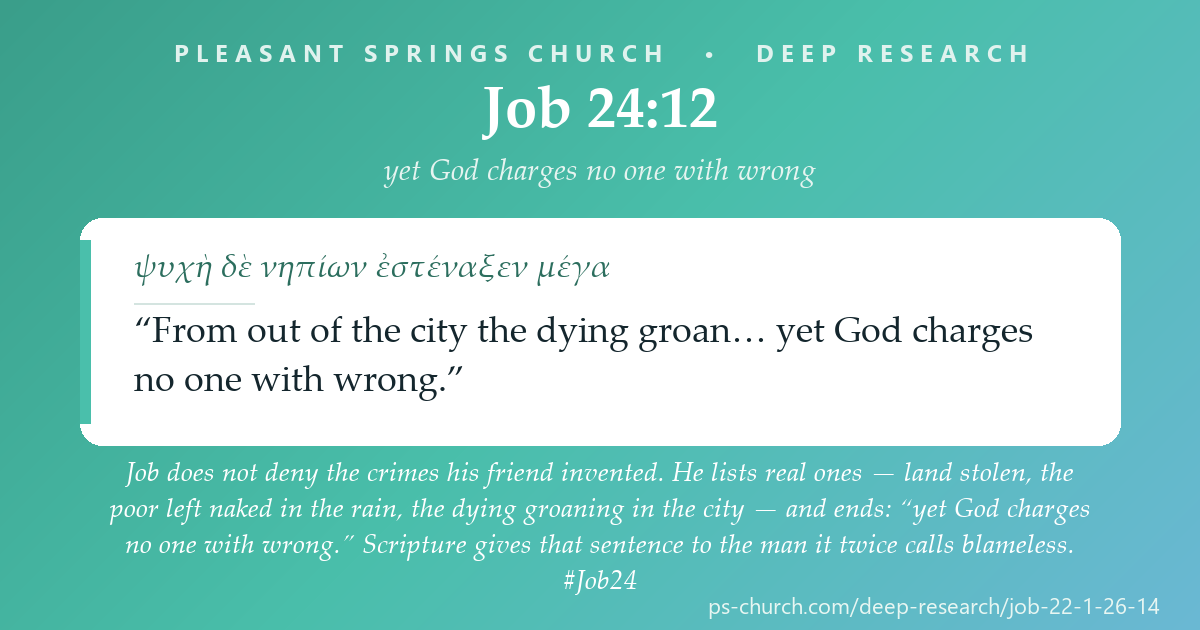
And people who read the news. Chapter 24 is a list of ordinary injustices — land stolen, the poor left in the rain, the dying groaning in the city — followed by six words that carry the whole book: yet God charges no one with wrong. Scripture puts that complaint in the mouth of the man it has twice certified as blameless.
Orient on pledge law, on the hiddenness of God, and on the state of chapter 24.
Search by topic: pledge and surety law; gleaning and the poor; widow and orphan in Israelite law; boundary stones; hiddenness of God; theodicy; Hexapla; Job — text-critical problems of chapters 24–27.
Which articles are relevant?
- Anchor Bible Dictionary — “Pledge,” “Poor,” “Widow,” “Orphan,” “Landmarks,” “Theodicy,” “Hexapla.”
- Dictionary of the OT: Wisdom, Poetry & Writings (IVP) — “Job 4–27,” “Ethics,” “Poverty,” “Theodicy,” “Hiddenness of God.”
- NIDOTTE / TDOT — חָבַל (ḥāḇal, take in pledge), אַלְמָנָה (ʾalmānāh, widow), גְּבוּל (gəḇûl, boundary), שֶׁמֶץ (šēmeṣ, whisper — twice in Job and nowhere else).
- On the Greek — NETS Iob and Ziegler, which are what make the asterisk figures below possible. These chapters carry the heaviest Origenic load in the book so far.
Bibliography surfaced:
- David J. A. Clines, Job 21–37 (WBC) — on chapter 24 and on the third-cycle problem.
- C. L. Seow, Job 1–21 (Illuminations) — for the earlier cycles; and any recent commentary for the reconstruction debate.
- Carol A. Newsom, The Book of Job — on why the dialogue ends by exhaustion.
The law Eliphaz quotes, the law Job quotes back, and a chapter people keep rearranging.
First the pledge legislation, because both speeches are built out of it. Then the honest state of chapter 24 and of the third cycle.
Which parallels shed light on these chapters?
Eliphaz’s invented charges are drafted straight out of Torah. Taking a garment in pledge and not returning it before nightfall is prohibited at Exodus 22:26–27 and Deuteronomy 24:12–13; taking a widow’s garment in pledge is forbidden outright at Deuteronomy 24:17. Withholding water from the weary and bread from the hungry violates the whole tenor of Deuteronomy 15. He is not making up a random list; he is reciting a charge sheet — which is what makes it so effective and so false.
And Job answers with the same statute book. Chapter 24 is a catalogue of the identical offences: they remove landmarks (24:2) — Deuteronomy 19:14 and the curse of Deuteronomy 27:17; they take the widow’s ox in pledge (24:3) — Deuteronomy 24:17 again; they lie all night naked, without clothing (24:7) — the very garment law Eliphaz invoked. Job is not denying the law exists. He is reporting that it is broken in daylight and nothing happens.
Chapter 24 is genuinely hard, and the difficulty should be named accurately. Its Hebrew is obscure in places and its speaker seems to shift; many scholars have proposed rearranging chapters 24–27, assigning parts of them to Bildad or to Zophar to repair the missing third speech. Those are reconstructions, not manuscript evidence — no Hebrew manuscript transmits any of them. This page reads the received text as it stands and says so. Worth noting too: the Masoretic tradition records only two ketiv/qere in these five chapters, so the difficulty is one of sense rather than of transmission.
- Exodus 22:26–27; Deuteronomy 24:6, 12–13, 17; Deuteronomy 19:14; 27:17 — the pledge, garment, widow and boundary laws that both Eliphaz and Job are quoting. Read these first; both speeches are unintelligible without them.
- Psalm 10; Habakkuk 1:2–4; Jeremiah 12:1–2 — the same complaint elsewhere: the wicked prosper and God appears not to act. Job 24 is the longest and most concrete version of it in Scripture.
- 11QtgJob (11Q10) (Qumran — material evidence, a witness not Scripture) — the Aramaic Targum does cover this passage, with readings attested across chapters 22–26. One of the very few places in Job where a pre-Christian translation other than the Greek survives.
- Origen’s Hexapla (third century — a scholarly edition, not Scripture) — the source of the asterisked material measured below, which in these chapters is unusually heavy.
These five chapters sit in the part of Job where the Old Greek was shortest, and the measurement confirms it. Of the 92 verses in 22:1–26:14, 19 are wholly Origen’s third-century supplement and 28 are touched by it — roughly a fifth entirely, and nearly a third in part.
But the distribution is the interesting part, because it is wildly uneven:
— Chapter 22: 8 of 30 verses wholly supplied.
— Chapter 23: 1 of 17.
— Chapter 24: 3 of 25.
— Chapter 25 — Bildad’s six verses — none at all.
— Chapter 26: 7 of 14, and they run consecutively, 26:5–11.
That last figure is worth pausing on. Job’s closing hymn — the dead trembling beneath the waters, Sheol naked before him, the north stretched over the void, the earth hung upon nothing — is half absent from the oldest Greek. The famous line about hanging the earth on nothing is in that block. Anyone citing “the Septuagint” for it is citing Origen.
And one small thing the Greek does that the Hebrew does not. At 25:4 Bildad asks whether a mortal can be δίκαιος before the Lord; but across Greek Job the adjective ἄμεμπτος — blameless — is used both of Job by the narrator and by God (1:1, 1:8, 2:3) and by the friends in their rhetorical questions (4:17, 15:14, 22:3, 22:19). In Greek the friends keep asking whether anyone can be the very thing God has already called Job. The Hebrew does not make that link — it uses tām of Job but different words in the questions. The connection is the translator’s, and it is reported here as his rather than as the author’s.
A whisper that returns, a pledge law used twice, and six words that indict heaven.
Read 4:12 and 26:14 together — the same rare noun, seventeen chapters apart. Then read 24:12 beside 1:22 and notice which word Job has borrowed.
“A whisper, a scrap, a faint trace.” It occurs exactly twice in the book of Job and nowhere else in the Hebrew Bible — and both times beside dāḇār, “word.” Eliphaz at 4:12: my ear received a whisper of it — and he built four verses of doctrine on that scrap. Job here: how small a whisper of a word do we hear of him. The same rare noun measures one man’s certainty and the whole human limit. The Greek loses the link entirely, rendering the two with unrelated words.
“To take in pledge.” The legal hinge of both speeches. Eliphaz: you have taken pledges from your brothers for nothing (22:6). Job: they take the widow’s ox in pledge… they take a pledge against the poor (24:3, 9). The same verb, the same statute (Deuteronomy 24:6, 17) — used once to accuse Job of a crime he did not commit, and then by Job to describe crimes that are committed every day without consequence.
“Widow.” The word occurs six times in Job — and 22:9 is the only occurrence in any friend’s mouth in the entire book. Every other one is Job’s: he will say he made the widow’s heart sing (29:13) and that he never let her eyes fail (31:16). The one time a friend mentions widows, it is to invent a crime against them.
“Forward and backward.” In Hebrew these are compass directions — east and west, with left and right (north and south) following in 23:9, so the search covers all four quarters. But both words also mean before and after in time, and that is how the Greek took them: εἰς πρῶτα and ἐπ᾽ ἐσχάτοις, the first things and the last things. The Hebrew searches the horizon; the Greek searches history. And the verse carrying left and right is asterisked, so the Old Greek had no four-directional sweep at all.
“They move boundary stones.” The first crime in Job’s catalogue, and it carries a curse. Deuteronomy 19:14 forbids it; Deuteronomy 27:17 puts it among the twelve curses pronounced from Mount Ebal — cursed be anyone who moves his neighbour’s landmark. Job opens with an offence Israel formally cursed, and then observes that the curse does not seem to be operating.
“Yet God charges no one with wrong.” Six Hebrew words at the centre of the chapter, and the sharpest sentence Job speaks. The noun tiplāh — “unseemliness, impropriety” — is the same one the narrator used at 1:22 when he certified that Job did not charge God with wrong. The word that acquitted Job in chapter 1 is now the word Job uses of God’s inaction. The page reports the echo and draws no conclusion from it.
Counted here, not assumed:
- The collapse of the third cycle, in verses. Eliphaz: 48, 35, 30. Bildad: 22, 21, 6. Zophar: 20, 29, none. Every friend’s speech shortens across the three rounds, and the last two do not finish.
- 19 of 92 verses here are wholly Origen’s supplement; 28 are touched. Very unevenly: chapter 25 has none, chapter 23 has one, and chapter 26 has seven of fourteen (26:5–11) — so half of Job’s closing hymn, including “he hangs the earth on nothing,” is absent from the oldest Greek.
- 23:9 — the left and the right of the fourfold search — is asterisked, and the Old Greek of 23:8 searches first things and last things rather than compass points. The fourfold sweep is a Hebrew feature.
- Imperatives: chapter 22 has seven, five of them in Eliphaz’s closing appeal. Chapters 23, 24, 25 and 26 have none. After 22:24 nobody in this passage tells anybody to do anything.
- šēmeṣ occurs twice in Job (4:12, 26:14) and nowhere else in the Hebrew Bible, both times with dāḇār. The Greek does not preserve the link, and its 26:14 rendering is asterisked material.
- Only two ketiv/qere occur in all five chapters (24:6 and 26:12) — so chapter 24’s notorious difficulty is a problem of sense, not of transmission.
A charge sheet from Deuteronomy, and a complaint the canon keeps.
Read Deuteronomy 24:10–22 and then Job 22:6–9 and Job 24:2–12 in succession. The same statutes, used to accuse and then to indict.
Which cross-references matter?
- Deuteronomy 24:6, 12–13, 17 → Job 22:6–9 → Job 24:2–11. The same body of pledge law, quoted twice for opposite purposes — by Eliphaz to manufacture a charge, and by Job to show the law is broken daily and unavenged. This is the sharpest structural link in the passage.
- Deuteronomy 19:14; 27:17 → Job 24:2. Moving a boundary stone is not merely wrong; it is one of the twelve curses of Ebal. Job opens his catalogue with a formally cursed act, and observes that the curse is not landing.
- Job 24:12 and Job 1:22. The narrator said Job did not charge God with wrong (tiplāh); Job now says God charges no one with wrong — the same noun. The echo is exact in Hebrew; the page reports it without deciding whether it is deliberate.
- Job 25:4 beside 4:17 and 15:14. The friends’ whole case, stated three times by three men: a night vision, an argument, and finally a six-verse fragment. Nothing has been added to it in twenty-one chapters.
- Job 24 beside Psalm 10, Habakkuk 1:2–4 and Jeremiah 12:1–2. The prosperity of the violent and the silence of heaven. Habakkuk gets an answer; Job 24 does not — and the canon preserves both.
- No New Testament quotation of Job 22–26. Checked mechanically; the closest candidates — Job 22:9 beside Luke 1:53, Job 26:6 beside Hebrews 4:13 — are stock Greek-Old-Testament idiom rather than citation, and both Job verses sit inside asterisked material anyway.
The third-cycle problem, and why this page does not solve it.
Clines on chapters 24–27. Then four open questions.
Commentaries & studies:
- David J. A. Clines, Job 21–37 (WBC) — the fullest treatment of the third-cycle problem and of chapter 24’s difficulties.
- Carol A. Newsom, The Book of Job — argues the breakdown is meaningful rather than accidental.
- NETS Iob (tr. Cox), from Ziegler — the source of the asterisk data, which matters more in these chapters than anywhere earlier in the book.
- On 11QtgJob — the Qumran Aramaic Targum, which covers this passage and is one of the few pre-Christian witnesses to Job outside the Greek.
Four things reported as unsettled:
- Whether the third cycle is damaged or deliberate. Bildad’s six verses and Zophar’s silence have prompted many reconstructions reassigning parts of chapters 24–27. No Hebrew manuscript supports any of them. This page reads the received text and treats the collapse as meaningful — while stating plainly that others read it as damage.
- What chapter 24 means in places. Parts of the Hebrew are genuinely obscure, and the speaker appears to shift. Only two ketiv/qere occur in the whole passage, so this is a difficulty of sense rather than of transmission.
- Whether Job 24:12 deliberately echoes 1:22. The same rare noun, used of Job’s restraint and then of God’s inaction. Striking, and not demonstrable.
- What the Old Greek of Job 26 looked like. Half the chapter is Origen’s. What the translator originally had between 26:4 and 26:12 cannot be recovered from the witnesses available here.
When an argument runs out, and what it does on the way.
Name what you learned, why it matters, and one concrete response.
What should we carry away — and do?
- When the argument failed, it turned to invention. Twenty-one chapters without a single specific charge, and then a detailed list of crimes Job did not commit — delivered by the gentlest friend, in the same speech as an offer of peace. An unfalsifiable premise with a fixed conclusion will eventually supply its own evidence.
- Job’s answer was not to defend himself. He conceded that such crimes happen, listed them in detail, and asked why heaven is quiet. He moved the case from his own innocence to God’s administration — and no friend followed him there. Chapter 24 is still the most uncomfortable chapter in the book.
- The book lets the conversation die rather than winning it. Six verses, and then nothing. Some arguments do not end in agreement or refutation; they end in exhaustion, and Scripture records one of them at full length.
- One concrete response. Job’s last word here is that everything anyone knows of God is a whisper of a word — the same rare term Eliphaz used of the scrap he built his whole case on. Before deploying what you know about God against someone who is suffering, weigh how much of it is a whisper.
Job 24:12 · to share
Hebrew + Greek (Rahlfs) + ESVEvery Deep Research page traces its passage across the whole sweep — the Old Testament, the Second-Temple world between the testaments (historical witnesses, not Scripture), and the New Testament. Follow the thread:
Pleasant Springs Church — Deep Research
Research method after Michael S. Heiser’s Bible Research Method (examine dictionaries → ancient literature → important words → textual connections → academic publications → share), with the Pleasant Springs “Author & Audience” foundation. Scripture set in the Hebrew, the Greek editions named on each page and the ESV (Old Testament), and the Greek New Testament and the ESV (New Testament), per the practice of Pleasant Springs Church. Job 22–26 research grounded in Clines (WBC), Newsom, and NETS Iob (tr. Cox) from Ziegler’s Göttingen edition. Text: Hebrew from the Masoretic text as printed in the editions consulted — Sefaria’s Miqra according to the Masorah, cross-checked against the Leningrad-based OSHB for morphology; no critical apparatus was consulted for the Hebrew. Greek from Rahlfs’s Septuaginta (CATSS digitization), which carries no Aristarchian signs. ⚠️ The Origenic load is measured rather than estimated: 19 of these 92 verses are wholly asterisked supplement and 28 are touched — chapter 22, 8 of 30; chapter 23, 1 of 17; chapter 24, 3 of 25; chapter 25, none at all; and chapter 26, seven of fourteen (26:5–11), so the page states plainly that half of Job’s closing hymn, including “he hangs the earth on nothing,” is absent from the oldest Greek. 23:9 is asterisked, and the Old Greek of 23:8 reads the search as temporal (first things / last things) rather than spatial — so the fourfold compass sweep is a Hebrew feature that the Greek acquired only through Origen. The collapse of the third cycle is counted, not asserted: Eliphaz 48/35/30 verses, Bildad 22/21/6, Zophar 20/29/none; and imperatives are counted too — seven in chapter 22, five of them in Eliphaz’s closing appeal, and zero in chapters 23–26. Reconstructions that reassign parts of chapters 24–27 to Bildad or Zophar are reported as proposals with no manuscript support, and the page states that it reads the received text as it stands. That chapter 24’s difficulty is one of sense rather than transmission is supported by the count of only two ketiv/qere in all five chapters. šēmeṣ is verified as occurring exactly twice in Job (4:12, 26:14) and nowhere else in the Hebrew Bible, with the note that the Greek does not preserve the link and that its 26:14 wording is itself asterisked. The ἄμεμπτος connection — the Greek friends questioning whether anyone can be the very thing God calls Job — is reported as the translator’s, not the author’s, since the Hebrew uses different words. The 24:12 / 1:22 echo of tiplāh is reported as striking and not demonstrable. 11QtgJob is confirmed as covering this passage and tagged as a witness, never levelled with Scripture. The absence of any New Testament quotation was checked mechanically, with the near-candidates named and dismissed. Typology is handled per the house position: what the text says, what the New Testament itself draws, and what we see from this side of the cross — with the seeing left to the reader.
Scripture quotations marked ESV are from the ESV® Bible (The Holy Bible, English Standard Version®), © 2001 by Crossway, a publishing ministry of Good News Publishers. ESV Text Edition: 2016. Used by permission. All rights reserved. The ESV text may not be quoted in any publication made available to the public by a Creative Commons license, and the ESV may not be translated in whole or in part into any other language. www.esv.org
|
Did this study bless you today? 💚 Give to Support PS Church100% of gifts go to the General Fund — thank you. |