A fourth speaker stands up, and the book never explains him. Elihu is not among the friends who came in chapter 2. He is not mentioned in the epilogue. And when God finally rebukes the comforters by name, Elihu is not among them — he is neither condemned nor commended, and God never addresses him at all. His name occurs five times in the book, every one inside his own six chapters. Job never answers him. He is also the most self-conscious speaker in Scripture: seventeen consecutive verses pass before he makes a single argument, all of them about why a young man is entitled to speak — he waited, he deferred, and his belly is like wine that has no vent. And then he speaks for six chapters, longer than God does. But he is not a fool, and this page will not caricature him. He says the one thing none of the three ever managed: that suffering may be instruction rather than sentence — that God delivers the afflicted by their affliction, and opens their ear by adversity. It is a better theology than the friends reached, it is affirmed elsewhere in Scripture, and it still does not explain what the reader saw in chapter 1. He ends describing a storm gathering — and in the very next verse, God speaks out of one. See the method →
Job 32:1–37:24 (selections)
Hebrew · Greek (Rahlfs) · ESVHe is also, by some distance, the most self-conscious speaker in Scripture. Seventeen consecutive verses pass before he makes a single argument — 32:6–22 is entirely about why a young man is entitled to speak: he waited, he deferred, he listened, he is full of words, his belly is like wine that has no vent, he will not show partiality, he does not know how to flatter. And then he speaks for six chapters — longer than God does.
But he is not a fool, and the page will not caricature him. He says something none of the three ever managed: that suffering can be instruction rather than sentence — God opens the ears of men and warns them in dreams, and delivers the afflicted by their affliction (33:14–30; 36:15). He is the first person in the book to suggest that Job’s pain might be doing something rather than paying for something. And he ends by describing a storm gathering — thunder, ice, whirlwind, golden splendour out of the north — and in the very next verse God speaks out of it.
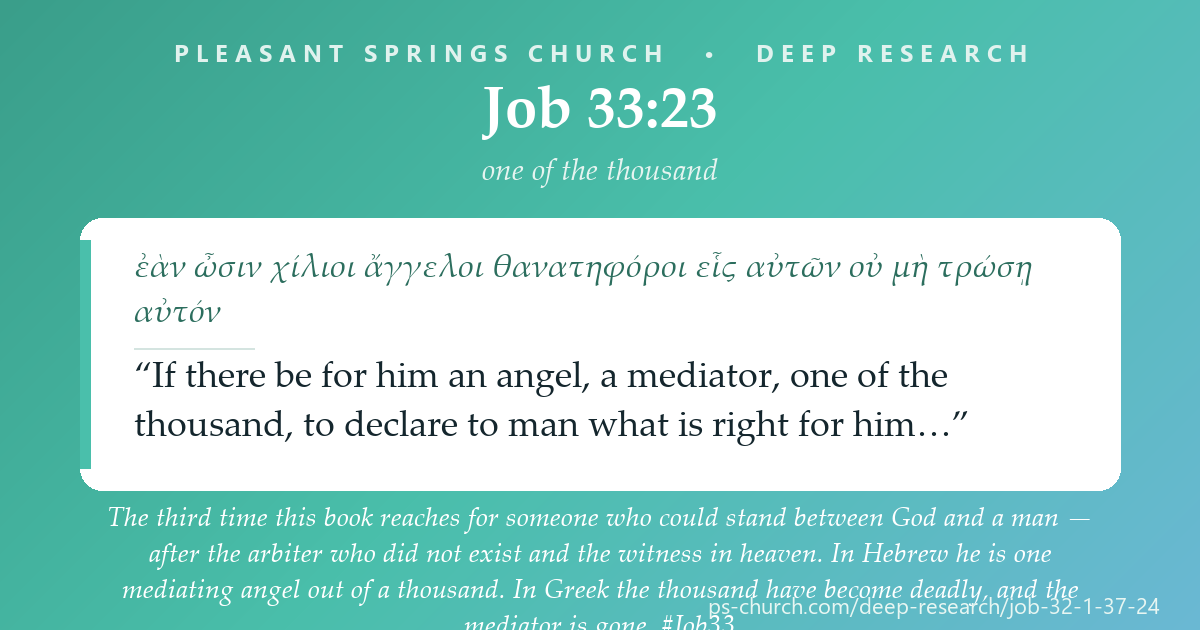
⚠️ At 33:23 the Hebrew has one mediating angel and the Greek has a thousand deadly ones. This is the largest single divergence in Elihu’s speeches. The Hebrew reads: if there be for him an angel, a mediator (mēlîṣ), one of a thousand, to declare to man what is right for him. Rahlfs reads: ἐὰν ὦσιν χίλιοι ἄγγελοι θανατηφόροι, εἷς αὐτῶν οὐ μὴ τρώσῃ αὐτόν — “if there be a thousand death-bearing angels, not one of them shall wound him.” The mediator has vanished and the thousand have become the threat. The Hebrew offers an advocate; the Greek offers protection from executioners.
⚠️ And in one place the Greek prints the same Hebrew verse twice. Rahlfs carries two lettered plus-verses at 36:28a and 36:28b which have no Hebrew counterpart in that position. But 36:28b — “at all these things is your mind not amazed, nor your heart moved from its place?” — is the old translator’s own free rendering of what the Hebrew numbers as 37:1, “at this also my heart trembles and leaps out of its place.” Origen, finding no literal equivalent at 37:1, supplied one there as well. So the same Hebrew line stands twice in the printed Greek — once loosely and in the second person, once closely and in the first. The doublet is an artefact of the Hexapla, not of the translator.
⚠️ A smaller change with a large effect. At 33:4 the Hebrew says the breath of the Almighty gives me life — the language of Genesis 2:7. The Greek says ἡ διδάσκουσά με, “teaches me.” In Greek, Elihu’s claim is not that God made him but that God is instructing him — which is exactly the authority he needs for the six chapters that follow.
The Shape of the Passage
SequenceAgainst Elihu belonging: he is absent from the list of friends in 2:11; absent from the epilogue; and absent from God’s rebuke in 42:7–9, where the three are named. His name occurs five times in the book — 32:2, 32:5, 32:6, 34:1, 36:1 — and every one is inside his own section. Job never answers him. God never mentions him.
For Elihu belonging: his speeches sit exactly where the book needs a bridge; he introduces the one idea the three never reach, that suffering may instruct; and his closing storm is the storm God arrives in. A tested claim, and an honest correction: the vocabulary overlap between his hymn and chapter 38 is real for rare words — šaḥaq, “clouds,” occurs five times in Job and four of them are Elihu’s, the fifth is 38:37 — but as a bulk statistic it does not hold: measured against control chapters the overlap is indistinguishable. And Elihu never once uses the word the narrator uses for the whirlwind God actually arrives in.
This page reads the received text, in which Elihu is part of the book, and states plainly that many careful readers think otherwise.
Job finished with a signature and the words the words of Job are ended. Then, before God answers, somebody else stands up.
Author
He introduces Elihu in prose, which he has not done since chapter 2. The dialogue has run for twenty-nine chapters on bare speech formulas; now the narrator stops, gives a genealogy, and says twice in one verse that the man is angry. Whoever wrote 32:1–5 wanted this speaker introduced properly, which is either careful authorship or a careful insertion.
He makes the length of the preamble the joke. Seventeen verses on why he is qualified to speak, including the complaint that he is bursting. The book has considerable fun at his expense — and then lets him say the most useful thing anyone has said since chapter 2.
And he never resolves him. No answer from Job, no verdict from God, no mention in the epilogue. Elihu is the only major speaker in the book who is simply left standing there, and that silence is either the strongest argument that he was added later or the subtlest thing in the book.
Audience
People who have been the youngest in the room. Elihu’s whole preamble is about the authority to speak when you are not the senior person present, and his answer — it is the spirit in a man… that makes him understand (32:8) — is not a bad one.
People for whom “punishment” was the only available category. Three friends have said suffering is payment. Elihu says it can be a message: God opens the ear by adversity. That is a genuinely different proposal, and it is closer than anything the three said to what the reader knows from chapter 1.
And people who need to be told that a good idea is not the same as the right word. Elihu is often right and never comforting. He explains Job to Job for six chapters, and Job does not reply — which may be the most eloquent thing in the section.
Orient on Elihu, on discipline, and on the mediating angel.
Search by topic: Elihu; Buz and Buzite; interpolation and redaction in Job; discipline and chastisement; angel as intercessor; theophany and storm; the Hexapla.
Which articles are relevant?
- Anchor Bible Dictionary — “Elihu,” “Buz,” “Job, Book of” (on the composition question), “Angel,” “Theophany,” “Discipline.”
- Dictionary of the OT: Wisdom, Poetry & Writings (IVP) — “Elihu,” “Job 32–37,” “Suffering,” “Angels,” “Storm.”
- NIDOTTE / TDOT — מוּסָר (mûsār, discipline / instruction), מֵלִיץ (mēlîṣ, interpreter / mediator), שַׁחַק (šaḥaq, clouds), נְשָׁמָה (nəšāmāh, breath).
- On the Greek — NETS Iob, which is what makes the 36:28 / 37:1 doublet visible at all.
Bibliography surfaced:
- David J. A. Clines, Job 21–37 (WBC) — the fullest treatment of the Elihu question.
- Carol A. Newsom, The Book of Job — argues Elihu functions as a reader-surrogate rather than an intrusion.
- Norman Habel, The Book of Job (OTL) — on the placement of the speeches.
- NETS Iob (tr. Cox), from Ziegler — for the asterisked material in chapters 36–37.
The case for and against Elihu, stated fairly, and a doublet made in the third century.
The composition question first, with the countable evidence on both sides. Then the textual curiosity at 36:28.
Which parallels shed light on these chapters?
Elihu is the most disputed section of Job, and the dispute is old. The observable facts are these. He is absent from 2:11, where the three friends are named and come. He is absent from 42:7–9, where God rebukes those three by name and has them offer sacrifice. His own name occurs five times, all within his own section. Job never answers him. God never mentions him.
But the case for him is not weak. His speeches sit exactly where the book needs something between a man who has stopped talking and a God about to speak. He introduces an idea the three never reached — that affliction may open the ear rather than settle an account — and it is nearer to what the reader knows than anything the friends said. And his closing chapter describes a storm arriving, immediately before God speaks from one.
A lead worth testing, and it partly failed. It is often said that Elihu’s hymn anticipates the whirlwind speeches by vocabulary. At the level of rare words that is true — šaḥaq, “clouds,” occurs five times in Job, four in Elihu and once at 38:37; several other nouns pair only these two blocks. But as a general statistic it does not hold: the proportion of vocabulary his hymn shares with chapter 38 is indistinguishable from what control chapters share. And he never once uses the word the narrator uses for the whirlwind God actually arrives in. The page reports both halves.
- Genesis 22:21 — Buz, brother of Uz, son of Nahor. Elihu’s tribe and Job’s country are named as brothers in Abraham’s family; Jeremiah 25:23 knows Buz as a real place. He is a foreigner among foreigners, like everyone else in this book.
- Proverbs 3:11–12; Deuteronomy 8:5; Hebrews 12:5–11 — suffering as mûsār, a father’s discipline. Elihu’s central idea is elsewhere affirmed in Scripture; the question the book raises is whether it fits this case.
- 11QtgJob (11Q10) (Qumran — material evidence, a witness not Scripture) — the Aramaic Targum reaches into the Elihu chapters. So the speeches stood in the tradition well before the Christian era, whatever their origin.
- Testament of Job 43 (Second-Temple pseudepigrapha — a witness, not Scripture) — where Elihu is treated far more harshly than in Job itself, and is denounced in a hymn. Later readers found his silence in the epilogue as odd as modern ones do, and filled it in.
Rahlfs carries two extra verse-units in chapter 36 — 36:28a and 36:28b — which have no Hebrew counterpart where they stand. The standard parsing tool merges both into 36:28 invisibly; read by full label they are distinct.
36:28a: ὥραν ἔθετο κτήνεσιν, οἴδασιν δὲ κοίτης τάξιν — “he appointed a season for the cattle, and they know the order of their rest.” Nothing in the Hebrew corresponds to it anywhere.
36:28b: ἐπὶ τούτοις πᾶσιν οὐκ ἐξίσταταί σου ἡ διάνοια, οὐδὲ διαλλάσσεταί σου ἡ καρδία ἀπὸ σώματος — “at all these things is your mind not amazed, nor your heart moved from the body?”
And that is the interesting one, because the Hebrew does have a verse about a heart moved from its place — it is 37:1: “at this also my heart trembles and leaps out of its place.” The old translator rendered it freely, in the second person, and placed it at the end of chapter 36. Origen, comparing Greek to Hebrew centuries later, found no literal equivalent standing at 37:1 — and supplied one there under asterisk: καὶ ταύτης ἐταράχθη ἡ καρδία μου καὶ ἀπερρύη ἐκ τοῦ τόπου αὐτῆς.
So the printed Greek now contains the same Hebrew line twice — once loosely and in the second person at 36:28b, once closely and in the first person at 37:1. It is not a scribal blunder. It is the visible seam of a third-century editorial method, and it is one of the clearest illustrations in the book of why “the Septuagint says” is a dangerous sentence in Job.
A mediator who disappears in Greek, a word for discipline, and a name confined to six chapters.
Read 9:33, 16:19 and 33:23 together — three attempts at a figure who stands between. Then count where Elihu’s name appears.
“Interpreter, mediator” — the same word Job used at 16:20, where it is ambiguous between intercessor and mocker. Here it is clear: an angel, a mediator, one of a thousand, to declare to man what is right for him. This is the third mediator-figure in the book — after the arbiter Job said did not exist (9:33) and the witness he said was in heaven (16:19). And Rahlfs does not have him at all: the Greek reads a thousand death-bearing angels, none of whom shall wound the man. The advocate becomes an executioner squad the man is spared from.
“Discipline, instruction, correction.” Elihu’s central category, and the book’s only real alternative to punishment. God opens the ears of men and terrifies them with warnings (33:16); he opens their ear to instruction (36:10). Five occurrences in Job, and Eliphaz used it first at 5:17. A detail worth having: Rahlfs renders Eliphaz’s occurrence normally but does not carry the word through at either of Elihu’s — so the Greek reader does not see Elihu’s idea as a single recurring theme.
“The breath of the Almighty.” Twice, and both are Elihu’s claim to authority: it makes them understand (32:8) and it gives me life (33:4) — the second echoing the breath of Genesis 2:7. Rahlfs uses the identical formula at both verses, πνοὴ δὲ παντοκράτορος ἡ διδάσκουσα, “the breath of the Almighty is what teaches” — harmonising the two and replacing “gives me life” with “teaches me.” The Genesis link is lost, and Elihu’s warrant becomes instruction rather than creation.
“Clouds, the high skies.” Five occurrences in the whole book — four of them Elihu’s, and the fifth is in God’s speech at 38:37. This is the strongest form of the claim that Elihu’s hymn prepares for the whirlwind: at the level of rare words the link is real. As a bulk statistic it is not — see the structure note above — and the page reports both.
“My God is he.” The name occurs five times in the book, and every one is inside his own six chapters. He is not in the list of friends at 2:11; he is not in the epilogue; and at 42:7 God names Eliphaz and rebukes him and his two friends — a count that does not include Elihu. The page reports the absences precisely because they are the strongest evidence in the argument, and reports the counter-case too.
Counted here, not assumed:
- Elihu speaks longer than God does. His own words run to 157 verses; the divine speeches are shorter. And 32:6–22 — seventeen consecutive verses — contains no argument at all, only justification for speaking.
- His name occurs five times, all inside his own section (32:2, 32:5, 32:6, 34:1, 36:1). Absent from 2:11 and from the epilogue; not among those rebuked at 42:7.
- 36:28a and 36:28b are Old Greek pluses with no Hebrew counterpart in position — and 36:28b is the old translator’s rendering of what the Hebrew numbers 37:1, which Origen then supplied a second time under asterisk. The same Hebrew verse stands twice in the printed Greek. The standard parser merges both plus-verses invisibly.
- šaḥaq occurs five times in Job — four Elihu, one God (38:37). But the bulk vocabulary overlap between his hymn and chapter 38 is indistinguishable from control chapters, so the “anticipation” claim holds only for rare words. Tested and reported both ways.
- Two grammatical reversals between the columns: the single second-person singular imperative in Elihu’s preamble (32:10) is plural in Greek, and the only plural imperative in chapters 36–37 (37:2) is singular in Greek.
Three mediators, a doctrine of discipline, and a storm about to break.
Read 33:14–30 and then Hebrews 12:5–11 — the same idea, and ask what changed.
Which cross-references matter?
- Job 9:33 → 16:19 → 33:23 — the three mediator figures. Job says there is no arbiter; then that his witness is in heaven; and now Elihu proposes an angel who declares to a man what is right. The book circles a figure it never produces, and the page sets all three side by side without harmonising them.
- Job 33:19–30; 36:8–15 beside Deuteronomy 8:5, Proverbs 3:11–12 and Hebrews 12:5–11. Suffering as a father’s discipline. Elihu’s idea is affirmed elsewhere in Scripture and quoted approvingly in the New Testament — the question is whether it applies here, and the reader of chapter 1 knows it does not explain Job’s case.
- Job 33:4 and Genesis 2:7. The breath of God giving life. The Hebrew carries the link; the Greek replaces “gives me life” with “teaches me” and loses it.
- Job 37:22 and Job 38:1. Elihu’s golden splendour out of the north, and then the Lord answered Job out of the whirlwind. Whether Elihu is describing the theophany arriving or merely happens to end on weather is argued — and it is worth knowing that he never uses the narrator’s word for that whirlwind.
- Genesis 22:21; Jeremiah 25:23 — Buz, Elihu’s tribe, a brother of Uz in Abraham’s family and a real place in Jeremiah’s oracle. He is placed as carefully as everyone else in this book: outside Israel.
- No secure New Testament quotation of Job 32–37. The most-cited candidate — Romans 11:35 beside Job 35:7 — does not survive word-by-word comparison with the Greek of Job. Reported as a fact, with nothing inferred.
The most disputed section of the book, reported and not resolved.
Clines and Newsom take opposite views; both are worth reading. Then four open questions.
Commentaries & studies:
- David J. A. Clines, Job 21–37 (WBC) — the fullest survey of the Elihu question and its history.
- Carol A. Newsom, The Book of Job — argues the speeches are integral and function as a reader-surrogate.
- Norman Habel, The Book of Job (OTL) — on placement and on the storm hymn.
- NETS Iob (tr. Cox), from Ziegler — without it the 36:28 / 37:1 doublet is invisible.
Four things reported as unsettled:
- Whether the Elihu speeches are original. The absences from 2:11, from the epilogue and from God’s rebuke are real and checkable. So is the observation that the speeches bridge the dialogue and the theophany, and that the Qumran Targum already contains them. This page reads the received text and states that the question is open.
- Whether Elihu is right. God neither commends nor condemns him. His central idea is affirmed elsewhere in Scripture — and the reader knows it does not account for what happened in chapter 1. Both of those are true at once.
- What lies behind the Greek at 33:23. One mediating angel becomes a thousand death-bearing ones. Whether the translator read a different Hebrew text or reinterpreted this one cannot be settled from the witnesses available here.
- Whether the storm hymn anticipates chapter 38. True for rare vocabulary, not true as a general statistic, and complicated by the fact that Elihu never uses the narrator’s word for the whirlwind. The claim needs the qualification.
Right, and unanswered.
Name what you learned, why it matters, and one concrete response.
What should we carry away — and do?
- He has the best idea in the book so far, and it changes nothing. Suffering may be a message rather than a sentence — God opens the ear by adversity. It is a genuinely better theology than the three friends managed, and Job still does not answer him. Being right is not the same as being useful to someone in pain.
- Seventeen verses of qualifications before a single argument. The book lets us watch a man establish his standing at length, and then makes the point by having nobody respond. The preamble is the longest thing about him that anyone remembers.
- God neither rebukes him nor commends him. When the verdict comes at 42:7 it names Eliphaz and his two friends. Elihu is simply left standing there — the only major speaker in the book who receives no answer at all.
- One concrete response. Elihu waited, listened, and was sure he had something the older men had missed — and he did. Then he talked for six chapters. If you are certain you have seen what everyone else has missed, the useful question is not whether you are right but whether the person in front of you can receive it yet.
Job 33:23 · to share
Hebrew + Greek (Rahlfs) + ESVEvery Deep Research page traces its passage across the whole sweep — the Old Testament, the Second-Temple world between the testaments (historical witnesses, not Scripture), and the New Testament. Follow the thread:
Pleasant Springs Church — Deep Research
Research method after Michael S. Heiser’s Bible Research Method (examine dictionaries → ancient literature → important words → textual connections → academic publications → share), with the Pleasant Springs “Author & Audience” foundation. Scripture set in the Hebrew, the Greek editions named on each page and the ESV (Old Testament), and the Greek New Testament and the ESV (New Testament), per the practice of Pleasant Springs Church. Job 32–37 research grounded in Clines (WBC), Newsom, Habel (OTL), and NETS Iob (tr. Cox) from Ziegler. Text: Hebrew from the Masoretic text as printed in the editions consulted — Sefaria’s Miqra according to the Masorah, cross-checked against the Leningrad-based OSHB for morphology; no critical apparatus was consulted for the Hebrew. Greek from Rahlfs’s Septuaginta (CATSS digitization), which carries no Aristarchian signs. ⚠️ The Elihu question is reported, not settled. The evidence against his originality is stated and was checked: absent from the friends’ list at 2:11, absent from the epilogue, and not among those God rebukes at 42:7; his name occurs five times, all inside his own section (32:2, 32:5, 32:6, 34:1, 36:1). The evidence for it is stated too — the speeches bridge dialogue and theophany, they introduce the book’s only real alternative to the retribution doctrine, and 11QtgJob already contains them. The page reads the received text and says the question is open. ⚠️ A commissioned lead was tested and partly refuted, and the refutation is printed: the claim that Elihu’s storm hymn anticipates chapter 38 by vocabulary holds for rare words — šaḥaq occurs five times in Job, four Elihu and one at 38:37 — but fails as a bulk statistic, since the lemma overlap with chapter 38 is indistinguishable from control chapters; and Elihu never uses the narrator’s word for the whirlwind. ⚠️ 33:23 is reported as the largest divergence in the section: the Hebrew’s single malʾāḵ mēlîṣ, an angel-mediator one of a thousand, becomes in Rahlfs a thousand death-bearing angels none of whom shall wound the man — with the cause named as unsettled. ⚠️ 36:28a and 36:28b are reported as Old Greek pluses which the standard parser merges invisibly, and 36:28b is identified as the old translator’s free rendering of what the Hebrew numbers 37:1, which Origen then supplied a second time under asterisk — so the same Hebrew line stands twice in the printed Greek, once in the second person and once in the first. That doublet is presented as an artefact of the Hexapla rather than a scribal error. The 32:8 / 33:4 harmonisation is reported, including that Rahlfs replaces “gives me life” with “teaches me” and loses the Genesis 2:7 link. That mûsār is rendered normally for Eliphaz at 5:17 but not carried through at either of Elihu’s uses is noted. The absence of any secure New Testament quotation was checked word by word, with the Romans 11:35 candidate named and dismissed. Typology is handled per the house position: what the text says, what the New Testament itself draws, and what we see from this side of the cross — with the seeing left to the reader.
Scripture quotations marked ESV are from the ESV® Bible (The Holy Bible, English Standard Version®), © 2001 by Crossway, a publishing ministry of Good News Publishers. ESV Text Edition: 2016. Used by permission. All rights reserved. The ESV text may not be quoted in any publication made available to the public by a Creative Commons license, and the ESV may not be translated in whole or in part into any other language. www.esv.org
|
Did this study bless you today? 💚 Give to Support PS Church100% of gifts go to the General Fund — thank you. |