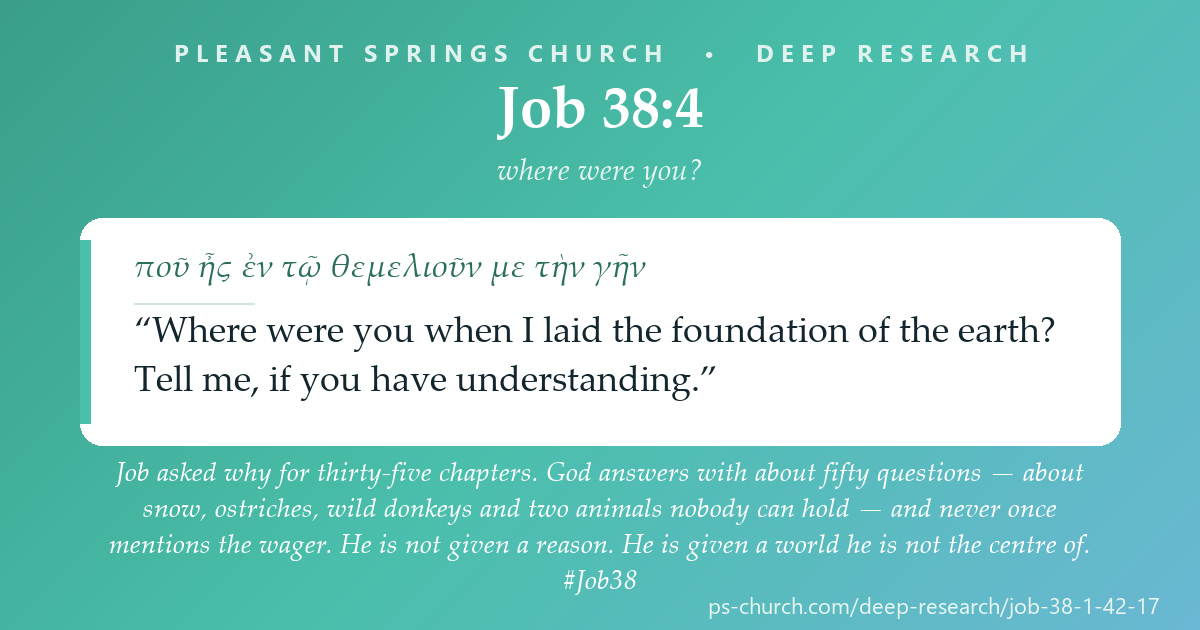
God finally speaks, and does not answer the question. He does not explain the suffering, defend his justice, or say that Job was being tested. He never mentions the accuser at all — verified: the satan appears nowhere in these five chapters, in either text. Instead he asks questions, about fifty of them: where were you when I laid the foundation of the earth? Have you entered the storehouses of the snow? Who has let the wild donkey go free? Do you give the horse his might? Rain falls on land where nobody lives; the ostrich forgets her eggs because God did not give her wisdom; two enormous animals cannot be held by anyone. Almost nothing in the tour is useful, and that appears to be the point. One question is not about nature — will you condemn me that you may be justified? — the two verbs the whole book has been arguing over, in a single line. Job answers twice; the second time in a verse whose Hebrew has been read in opposite directions for two thousand years. And then God says the friends were wrong and Job was right — the man who said God destroys the blameless and the wicked alike. Everything is restored when he prayed for his friends. He never learns why. See the method →
Job 38:1–42:17 (selections)
Hebrew · Greek (Rahlfs) · ESVAnd one of the questions is not about nature at all. At 40:8 the whole book’s legal argument arrives in a single line: will you even put me in the wrong? Will you condemn me that you may be justified? Those are the two central verbs of the entire dialogue in one verse — and it is the only occurrence of mišpāṭ, judgement, in the whole speech.
Job answers twice. The first time he puts his hand over his mouth (40:4–5). The second time he says something that has been translated in opposite directions for two thousand years. Then, in prose, God says the friends were wrong and Job was right — and gives Job back everything, twice over, with three named daughters who inherit alongside their brothers.
⚠️ 42:6 is one of the most disputed verses in the Hebrew Bible, and the Greek makes the choice the Hebrew refuses. The Hebrew is five words: ʿal-kēn ʾemʾas wəniḥamtî ʿal-ʿāpār wāʾēper. The verb ʾemʾas is transitive and has no stated object — “therefore I reject —” what? Myself? My words? My case? And niḥamtî ʿal can mean repent of, be comforted concerning, or change my mind about. So the verse has been read as “I despise myself and repent in dust and ashes” and as “I retract, and am comforted concerning dust and ashes” — a confession, or a consolation about the human condition. Rahlfs supplies the missing object: ἐφαύλισα ἐμαυτόν, “I disparaged myself,” and adds I consider myself dust and ashes. The oldest translation we have made the interpretive decision, and this page does not.
⚠️ The Hebrew ends at 42:17. The Greek does not. Rahlfs carries five further verse-units — 42:17a–e, about 150 words — with no Hebrew counterpart at all, and they do four remarkable things. (a) They state that “it is written that he will rise again with those whom the Lord raises up” — an explicit resurrection, in a book whose Hebrew never gets past the question at 14:14. (b) They claim to be “translated from the Syriac book.” (c) They identify Job with Jobab of the Edomite king-list in Genesis 36, make him fifth from Abraham through Esau, and give him a wife, a son and a throne. (d) They promote his three friends to royalty — Eliphaz king of the Temanites, Bildad tyrant of the Sauchaeans, Zophar king of the Minaeans. None of this is in the Hebrew, and it is tagged here as addition — a witness, not Scripture in our confession.
⚠️ And the Greek repeatedly makes these chapters more Greek. It imports Tartarus twice (40:20, 41:24) — a term from Greek cosmology with no Hebrew basis. It gives Behemoth and Leviathan the same label, twice, in words the Hebrew does not have: made to be mocked at by the angels. And at 42:14 it renames Job’s third daughter “Horn of Amaltheia” — the horn of the goat that suckled Zeus. The Hebrew calls her Keren-happuch, “horn of eye-paint.”
The Shape of the Passage
Parallel panelsAnd Job’s final speech is built out of God’s own words handed back. 42:3 repeats 38:2 almost exactly — who is this that hides counsel without knowledge? — and 42:4 repeats 38:3. He has nothing of his own left to say and quotes the questions instead.
The verdict at 42:7 is the hardest sentence in the book. The friends defended God’s justice for twenty-five chapters and are told they were wrong. Job accused God of destroying the blameless and the wicked alike (9:22) and is told he spoke rightly. Whatever “speaking rightly” means here, it does not mean saying only correct things about God. A curious footnote: the Greek translator had already removed 9:22 — the very sentence Job is commended for.
Elihu ended describing a storm gathering in the north. The next verse is God speaking out of one. This study completes Job.
Author
He refuses the explanation he has spent forty chapters making us want. The reader knows the answer — we were in the room in chapter 1 — and the one thing God does not do is give it to Job. That is the boldest decision in the book: it means the story cannot end in understanding, only in encounter.
He answers a moral question with zoology. Snow, lightning, the wild ass, the ostrich, the war-horse, two monsters. Almost nothing in the speech is about human beings at all, and nothing in it is useful. The world God shows Job is one in which Job is not the centre — which turns out to be the consolation, though nobody says so.
And he ends by vindicating the man who said the wrong things. 42:7 is deliberately uncomfortable: the orthodox are rebuked and the complainer is commended. The book will not let correct theology be the criterion, and it says so in prose so that nobody can miss it.
Audience
People who wanted a reason and were given a presence. Job asks why for thirty-five chapters. He never gets an answer — and he stops asking. Whatever happened to him in the storm, the book presents it as sufficient without presenting it as an explanation.
People who have prayed for someone who wronged them. The restoration turns on a hinge easy to miss: the Lord restored the fortunes of Job when he had prayed for his friends (42:10). The men who tormented him for twenty-five chapters need his intercession to be forgiven, and he gives it.
And people who would notice the daughters. Three names recorded, seven sons unnamed, and an inheritance among their brothers — which was not the ordinary practice. The book ends by quietly doing something the law did not require.
Orient on theophany, on Behemoth and Leviathan, and on the epilogue.
Search by topic: theophany; whirlwind; Behemoth; Leviathan; chaos monsters; creation and wisdom; inheritance and daughters; qesitah; the Hexapla; Job in later tradition.
Which articles are relevant?
- Anchor Bible Dictionary — “Theophany,” “Behemoth,” “Leviathan,” “Rahab,” “Inheritance,” “Weights and Measures” (for the qesitah).
- Dictionary of the OT: Wisdom, Poetry & Writings (IVP) — “Job 38–42,” “Theophany,” “Creation,” “Behemoth and Leviathan,” “Repentance.”
- NIDOTTE / TDOT — מָאַס (māʾas, reject — the verb of 42:6), נִחַם (niḥam, repent / be comforted), מִשְׁפָּט (mišpāṭ), סְעָרָה (səʿārāh, whirlwind).
- On the Greek — NETS Iob, and any introduction that discusses the Greek appendix at 42:17, which is one of the most substantial additions to any book of the Greek Old Testament.
Bibliography surfaced:
- David J. A. Clines, Job 38–42 (WBC) — the fullest treatment of 42:6 and of the two beasts.
- Carol A. Newsom, The Book of Job — on why the divine speeches answer by reframing.
- Norman Habel, The Book of Job (OTL) — on the structure of the speeches.
- NETS Iob (tr. Cox), from Ziegler — for the appendix and the asterisked material.
Two beasts, a numbering trap, and a Greek ending that keeps going.
First a caution about identifying the animals. Then a numbering difference that will mislead anyone who does not know it. Then the appendix.
Which parallels shed light on these chapters?
Behemoth and Leviathan are described at length and identified nowhere. Behemoth eats grass, has bones like bronze tubes, and stands unmoved when a river rages; Leviathan has scales like shields, breathes fire and smoke, and cannot be taken with a hook. Hippopotamus and crocodile are the usual proposals; others read them as chaos-creatures from the older mythological repertoire — Leviathan is a sea-dragon at Isaiah 27:1 and Psalm 74:14, and Job himself invoked him at 3:8. The book does not say, and this page does not choose. What is observable is the disproportion: God spends more words on these two animals than on any other subject in his speeches.
⚠️ A numbering trap that will catch anyone comparing translations. The Hebrew chapter 40 has 32 verses; English has 24. The Hebrew runs the first eight verses of the Leviathan poem at the end of chapter 40, where English begins chapter 41. So MT 40:25 = ESV 41:1 (“can you draw out Leviathan with a fishhook?”) and MT 41:1–26 = ESV 41:9–34 — an offset of eight, within chapter 41 only. There is no offset before MT 40:25, and none after chapter 41. Verified by content, not assumed from verse totals.
And the Greek keeps going after the Hebrew stops. The Hebrew ends: and Job died, an old man, and full of days. Rahlfs then adds about 150 further words — the resurrection notice, the claim to come from a Syriac source, the identification with Jobab of Edom, a genealogy from Esau making Job fifth from Abraham, and royal titles for all three friends. It is one of the largest single additions anywhere in the Greek Old Testament, and it turns a book that carefully avoided placing Job in Israel’s family tree into a book that places him in it.
- Isaiah 27:1; Psalm 74:14; Psalm 104:26; Job 3:8 — every other mention of Leviathan in the Hebrew Bible. Five occurrences in total, two of them in Job. In Isaiah and Psalm 74 he is a monster God defeats; in Psalm 104 he is something God made to play with.
- Genesis 36:31–35 — the Edomite king-list the Greek appendix draws on to identify Job with Jobab. Read it beside 42:17b–e and the borrowing is unmistakable.
- Genesis 33:19; Joshua 24:32 — the only other occurrences of the qəśîṭāh, the unit of value Job’s visitors bring at 42:11. Three occurrences in the whole Hebrew Bible, all concerning land, burial or restitution — and the Greek does not render it as money at all, but as “one ewe-lamb.”
- Numbers 27:1–11 — the daughters of Zelophehad, who inherit only because there are no sons. Job’s daughters inherit among seven living brothers, which the law did not require.
- Ugaritic Baal Cycle (Canaanite — a witness, not Scripture) — for Litanu, the twisting serpent, the closest external parallel to Leviathan.
Job 42:6 is five Hebrew words, and almost every one of them is contested.
The verb. ʾemʾas is transitive — it takes an object — and there is no object in the verse. “Therefore I reject…” what? Most English versions supply myself. Others supply my words, or my case, or read the verb absolutely as I retract.
The second verb. niḥamtî ʿal can mean repent of, but the same construction elsewhere means be comforted concerning and change one’s mind about.
The last phrase. ʿal-ʿāpār wāʾēper, “on/concerning dust and ashes.” If on, Job repents while sitting in ashes. If concerning, he is comforted about the human condition itself — dust and ashes being what Abraham called himself at Genesis 18:27.
So the range of defensible translations is very wide: from “I despise myself and repent in dust and ashes” to “I retract, and am comforted concerning dust and ashes.” One is a man abasing himself; the other is a man consoled about being human.
And the oldest translation made the call. Rahlfs supplies the missing object outright — ἐφαύλισα ἐμαυτόν, “I disparaged myself” — and then adds a clause the Hebrew does not have: I consider myself dust and ashes. Every English Bible you have read at this verse is choosing, and the Greek chose first. This page prints both columns and declines.
A verb with no object, two legal terms in one line, and a daughter renamed after a Greek myth.
Read 38:2 and 42:3 side by side, then 38:3 and 42:4. Job’s last speech is largely God’s own words returned.
“I reject / despise.” A transitive verb with no stated object — the central difficulty of the book’s most-quoted confession. Translators supply myself, my words, or read it absolutely as I retract. Rahlfs supplies “myself” (ἐφαύλισα ἐμαυτόν). The supplying is an interpretation, however ancient, and this page marks it as one.
“Judgement” and “be in the right.” The two verbs the entire dialogue has fought over, placed in a single line by God: will you annul my judgement? Will you condemn me that you may be justified? Job holds a remarkable share of the second across the whole Hebrew Bible — roughly two in five occurrences of the verb are in this book. And 40:8 is the only place in the divine speeches where mišpāṭ occurs at all. God asks the legal question once, and then goes back to animals.
An archaic unit of value. Three occurrences in the entire Hebrew Bible — Genesis 33:19 (Jacob buys land at Shechem), Joshua 24:32 (Joseph is buried in that land), and here. All three concern land, burial or restitution, and all three are patriarchal in flavour — part of the archaic colouring that places Job outside Israel’s history. The Greek does not treat it as money at all, rendering it one ewe-lamb.
“Horn of eye-paint” — the third daughter’s name, from the black cosmetic used around the eyes. Her sisters are Jemimah (dove) and Keziah (cassia). These are the only children named in the book; the seven sons are not. And Rahlfs renames her “Horn of Amaltheia” — the horn of the goat that suckled Zeus, the cornucopia of Greek myth. A Hebrew cosmetic becomes a classical allusion.
“Whirlwind, storm.” The word the narrator uses for what God speaks out of, twice, at the head of each divine speech. Worth noting from the previous study: Elihu spends two chapters describing a gathering storm and never once uses this word. Note also that 38:1 carries a ketiv/qere — one of eight in these five chapters.
Counted here, not assumed:
- The satan appears nowhere in Job 38–42 — zero occurrences in Hebrew and zero in Greek across all 146 verses. God never mentions the wager and never explains the suffering.
- God answers almost entirely in questions — on the order of fifty interrogative markers across the divine speeches, concentrated in chapters 38–39.
- Job’s final speech quotes God back. 42:3 reproduces 38:2 with a single verb changed, and 42:4 reproduces 38:3. Verified by comparing the underlying word sequences, not by impression.
- ⚠️ The Leviathan numbering offset: MT chapter 40 has 32 verses against English’s 24, so MT 40:25 = ESV 41:1 and MT 41:1–26 = ESV41:9–34 — an offset of eight inside chapter 41 only. Confirmed by checking that MT 40:25 is the fishhook verse.
- Eight ketiv/qere occur in these chapters — 38:1, 38:12, 39:12, 40:6, 41:4, 42:2, 42:10, 42:16 — including two on load-bearing words in the epilogue.
- The Greek adds a lifespan the Hebrew never gives. MT: Job lived 140 years after this. Rahlfs: 170 years after the plague, and a total of 248 — a figure with no Hebrew basis at all.
- Tartarus appears twice in Greek Job (40:20, 41:24) — a Greek cosmological term with no Hebrew counterpart, imported into the beast descriptions.
A verdict that reverses the argument, and daughters who inherit.
Read 42:7 slowly, then go back to 9:22 and ask what “spoken rightly” can mean.
Which cross-references matter?
- Job 42:7 against Job 9:22 and against the friends’ speeches. The friends defended God’s justice and are rebuked; Job accused God of destroying the blameless and the wicked alike and is commended. Whatever “spoken rightly” means, it cannot mean saying only true things about God — and the page states that as the difficulty it is. A curiosity worth recording: the Greek translator had already removed 9:22, the very sentence at issue.
- Job 38:4–7 beside Proverbs 8:22–31 and Psalm 104. Creation recited as interrogation, as delight, and as praise. Job 38 is the only one of the three that is a cross-examination.
- Job 40:15–41:26 beside Psalm 104:26 and Isaiah 27:1. Leviathan as a plaything God formed, and as a fleeing serpent God will punish. Five occurrences in the Hebrew Bible, two of them in Job — and Job invoked him first, at 3:8, when he wanted his birth-night cursed.
- Job 42:10 — the hinge of the restoration. The Lord restored the fortunes of Job when he had prayed for his friends. The men who accused him require his intercession, and receive it. Compare Matthew 5:44 and Luke 23:34; the page states the texts and leaves the seeing to the reader.
- Job 42:15 beside Numbers 27:1–11 and Numbers 36. Zelophehad’s daughters inherit because there is no son. Job’s daughters inherit among seven living brothers — more than the law provided.
- Job 42:11 and Genesis 33:19; Joshua 24:32. The three occurrences of the qəśîṭāh, all archaic, all about land or burial.
- James 5:11 — the only New Testament mention of Job — and it points precisely here: you have seen the end of the Lord, i.e. how the story finished. The word is endurance, not patience, as noted in the first study of this book.
Four things this book does not settle, and neither does this page.
Clines and Newsom on the divine speeches and on 42:6.
Commentaries & studies:
- David J. A. Clines, Job 38–42 (WBC) — exhaustive on 42:6 and on the two beasts.
- Carol A. Newsom, The Book of Job — on the divine speeches as a reframing rather than an answer.
- Norman Habel, The Book of Job (OTL); John E. Hartley, Job (NICOT).
- NETS Iob (tr. Cox), from Ziegler — for the appendix and the asterisked material.
Four things reported as unsettled:
- What Job 42:6 says. A transitive verb with no object and a preposition that can mean in or concerning. The defensible range runs from self-abasement to consolation about the human condition, and the Greek settles it in one direction. This page prints both and chooses neither.
- What Behemoth and Leviathan are. Hippopotamus and crocodile, or chaos-creatures, or both at once. The text describes and does not identify.
- What “you have not spoken of me what is right” means at 42:7. That the friends are condemned and Job commended is plain; why is argued — honesty over accuracy, direct address over speech about God, or something else. The page states the difficulty and does not dissolve it.
- Where the Greek appendix came from. It claims a Syriac source and draws on Genesis 36. Whether it reflects a real tradition or is a learned construction cannot be settled from the witnesses available here — and either way it is an addition, not Scripture in our confession.
An answer that is not an explanation.
Name what you learned, why it matters, and one concrete response.
What should we carry away — and do?
- God never tells him why. Not once. The accuser is never mentioned; the wager is never explained; Job dies without knowing what the reader knew in chapter 1. The book’s answer to undeserved suffering is not information. Whatever Job received in the storm, it was not a reason.
- He is shown a world that is not about him. Rain on land where no one lives; an ostrich God made foolish on purpose; a wild donkey who scorns the city; two animals nobody can hold. Nothing in the tour is useful, and that appears to be the point.
- And the man who said the wrong things is the one commended. The friends defended God correctly for twenty-five chapters and were wrong; Job accused him and was right. Job talked to God; they talked about him — which may be the difference, and the book does not spell it out.
- One concrete response. Everything turns back at 42:10 — the Lord restored his fortunes when he prayed for his friends. Pray for the person who explained your suffering to you badly. In this book, that is where the restoration starts.
Job 38:4 · to share
Hebrew + Greek (Rahlfs) + ESVEvery Deep Research page traces its passage across the whole sweep — the Old Testament, the Second-Temple world between the testaments (historical witnesses, not Scripture), and the New Testament. Follow the thread:
Pleasant Springs Church — Deep Research
Research method after Michael S. Heiser’s Bible Research Method (examine dictionaries → ancient literature → important words → textual connections → academic publications → share), with the Pleasant Springs “Author & Audience” foundation. Scripture set in the Hebrew, the Greek editions named on each page and the ESV (Old Testament), and the Greek New Testament and the ESV (New Testament), per the practice of Pleasant Springs Church. Job 38–42 research grounded in Clines (WBC), Newsom, Habel (OTL), Hartley (NICOT), and NETS Iob (tr. Cox) from Ziegler. This study completes the book of Job (10 of 10). Text: Hebrew from the Masoretic text as printed in the editions consulted — Sefaria’s Miqra according to the Masorah, cross-checked against the Leningrad-based OSHB; no critical apparatus was consulted for the Hebrew. Greek from Rahlfs’s Septuaginta (CATSS digitization), which carries no Aristarchian signs. ⚠️ The chapter-division trap is stated exactly and was verified by content rather than inferred from totals: MT Job 40 has 32 verses against English’s 24, so MT 40:25 = ESV 41:1 (confirmed to be the fishhook verse) and MT 41:1–26 = ESV 41:9–34 — an offset of eight within chapter 41 only, with no offset before or after. ⚠️ 42:6 is presented as genuinely unsettled: ʾemʾas is transitive with no stated object, and niḥamtî ʿal admits repent, be comforted, and change one’s mind about — so the defensible range runs from self-abasement to consolation concerning the human condition. The page reports that Rahlfs supplies the missing object (ἐφαύλισα ἐμαυτόν) and adds a clause the Hebrew lacks, and declines to choose. ⚠️ The Greek appendix at 42:17a–e is quoted and tagged — about 150 words with no Hebrew counterpart, asserting Job’s resurrection, claiming a Syriac source, identifying him with Jobab of the Genesis 36 Edomite king-list, making him fifth from Abraham, and giving the three friends royal titles — an addition, a witness and not Scripture in our confession. Verified counts: the satan appears nowhere in 38–42 in either text (0 of 146 verses); God answers overwhelmingly in questions; Job’s final speech reproduces 38:2 and 38:3 almost exactly at 42:3 and 42:4, checked by word sequence; eight ketiv/qere occur in these chapters; the qəśîṭāh occurs three times in the whole Hebrew Bible; and the Greek gives a lifespan the Hebrew never states (170 more years and a total of 248, against MT’s 140). Hellenising features of the Greek are reported as such: Tartarus imported twice (40:20, 41:24), Behemoth and Leviathan both labelled made to be mocked by the angels, and the third daughter renamed “Horn of Amaltheia” after the goat of Greek myth. The difficulty of 42:7 is stated rather than smoothed — the orthodox are rebuked and the complainer commended — with the note that the Greek translator had already removed 9:22, the sentence at issue. Behemoth and Leviathan are described and deliberately not identified. Typology is handled per the house position: what the text says, what the New Testament itself draws, and what we see from this side of the cross — with the seeing left to the reader.
Scripture quotations marked ESV are from the ESV® Bible (The Holy Bible, English Standard Version®), © 2001 by Crossway, a publishing ministry of Good News Publishers. ESV Text Edition: 2016. Used by permission. All rights reserved. The ESV text may not be quoted in any publication made available to the public by a Creative Commons license, and the ESV may not be translated in whole or in part into any other language. www.esv.org
|
Did this study bless you today? 💚 Give to Support PS Church100% of gifts go to the General Fund — thank you. |