Zophar speaks for twenty-nine verses and is never heard from again. Job answers by looking out of the window and reporting that the wicked are doing fine. Eliphaz answers by repeating two of Job's own clauses back at him and drawing the opposite conclusion. Job looks for God and finds nobody home. And then Bildad stands up and says six verses. This page asked one question of that stretch and answered it by counting: how much of it is new? Screened against the whole Hebrew Bible, the deepest verbatim tie in all 141 verses is not a friend quoting Scripture — it is five consecutive words at Job 25:4 that occur in exactly one other verse anywhere: Job 9:2, where Job said them first. Bildad's speech is 44 Hebrew words, the shortest in the dialogue by more than a factor of two, and 80% of its word-forms have already been used earlier in the book — a rate nothing in chapters 1 to 24 comes near. The friends do not lose the argument. They stop being able to make a new sentence. See the method →
Job 20:1–25:6 (selections)
Hebrew (Masoretic) · Greek (Rahlfs) · ESV⚠️ And the counter-example belongs beside it. The three-times refrain the commentaries usually trace from Eliphaz — 4:17, 15:14, 25:4 — does not measure like a refrain. Against 4:17 Bildad’s verse shares one word. Against 15:14 it shares two (יְלוּד אִשָּׁה). Against Job 9:2 it shares five. Verbally, the friends’ closing formula is Job’s, not Eliphaz’s.
Zophar closes the same way, and Job takes that line too. Zophar’s final sentence — this is the wicked man’s portion from God (20:29) — runs four consecutive words, band 1, with Job 27:13, where it is Job speaking. In the Greek column the same two verses share seven words. Two of the three friends end on a line that also stands in Job’s own mouth somewhere in this book, and the page reports the overlap without deciding who is quoting whom.
The reciprocal pair in the middle is the same phenomenon, running the other way. At 21:14 Job quotes the wicked saying depart from us; at 22:17 Eliphaz says the wicked are those who said to God, depart from us — three consecutive words, band 1. Two verses later the same thing happens again: Job’s the counsel of the wicked is far from me (21:16) reappears at 22:18. Eliphaz’s third speech is built out of Job’s second. Both links are Hebrew-only — in Greek the first measures 0 and the second 2.
The Shape of the Passage
Sequence — with the measured quotations drawn on itWhat the arrows show is a conversation that has stopped generating sentences. Of the 17 rows in this passage that reach a run of three or more with a tie band of 1 — that is, deep and unique — 15 point back into the book of Job itself. Only two point anywhere else in the Hebrew Bible: 21:5 shares hand on mouth with Micah 7:16, and 21:17 shares the lamp of the wicked is put out with Proverbs 24:20. These men are no longer drawing on a common stock of proverbs. They are drawing on each other.
And the effect concentrates at the end. Across the whole passage, 57 of the 141 verses share no two consecutive words with any other verse in the Hebrew Bible — Job’s diction is largely its own. Chapter 25 has none. Every one of Bildad’s six verses matches something.
Two neighbouring studies overlap this passage and take it from other angles: 18:1–21:34 reads Job 21 as the answer to Bildad, and 22:1–26:14 reads the third cycle as a collapse. This page asks a narrower question and answers it with counts: how much of what is said here is new?
Author
He wrote the friends running out of material, and he wrote it precisely. The last speech any friend gives is 44 Hebrew words and 80% of its word-forms have already appeared earlier in the book. That is not an impression; it is a rate, and no six-verse window anywhere in chapters 1 to 24 reaches it — the highest before Bildad speaks is Job 2:1–6 at 72%. A writer producing filler would not have made the filler this exact.
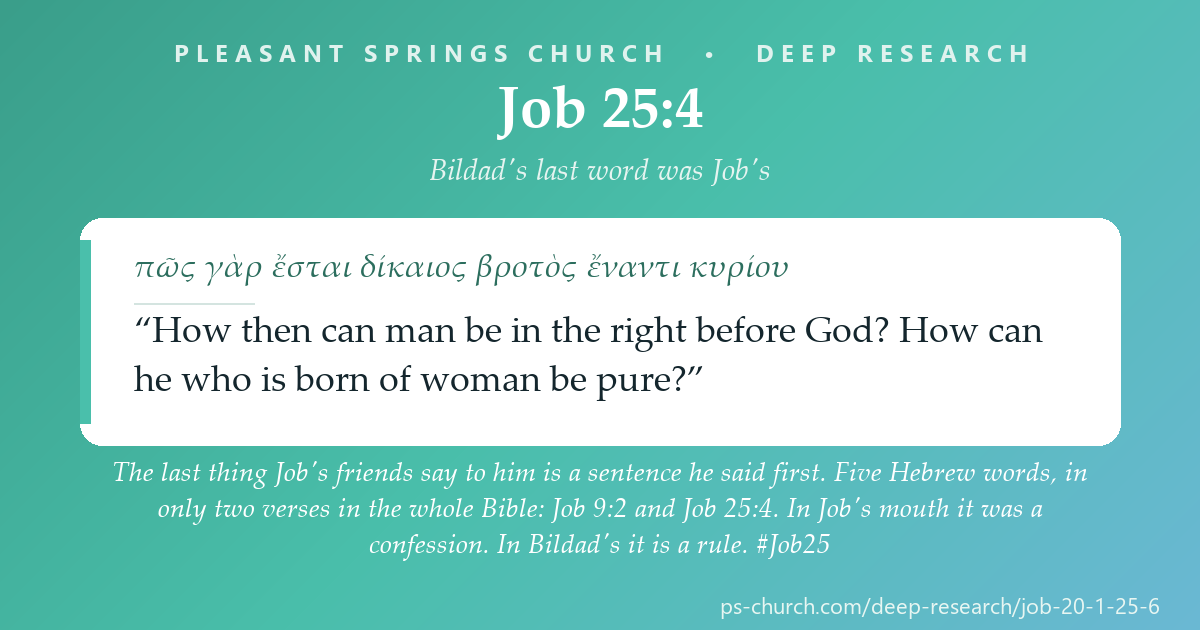
He put the friends’ best line in Job’s mouth first. How can a man be in the right before God? is the sentence the whole retribution argument rests on. Job says it in chapter 9 as a complaint — I know it is so; how then can a man be right with God? — and Bildad says it in chapter 25 as a doctrine. The same five Hebrew words, and they occur nowhere else in Scripture. Whether that is design or memory is not measurable; the identity is.
And he let the friends echo without answering. Eliphaz repeats two of Job’s clauses back at him in chapter 22 and draws the opposite conclusion from them. Quoting somebody accurately and hearing them are different operations, and this book knows the difference well enough to stage it.
Audience
People who have been on the receiving end of a settled position. Zophar’s last speech is an unbroken 29 verses on what happens to the wicked, addressed to a man the reader has watched be declared blameless twice. It is not stupid. It is simply not about him, and it is delivered anyway.
People who have heard their own words used against them. 21:14 and 22:17 are the same three words in two mouths. Job reported what the wicked say; Eliphaz repeats it as though Job had said it about himself. Everyone who has been quoted back to themselves knows exactly what that feels like.
And people who have watched a conversation die. Not in a shout — in six verses of material everyone in the room has already heard. Scripture keeps the transcript of an argument that ended because one side had nothing left to put in a sentence.
Orient on the third cycle, on retribution theology, and on the Greek of Job.
Search by topic: retribution / act-consequence; Job — the third cycle problem; wisdom dialogue; Septuagint of Job; Hexapla and Origen; ‘born of a woman’; maggot and worm as images of mortality.
Which articles are relevant?
- Anchor Bible Dictionary — “Job, Book of,” “Retribution,” “Wisdom Literature,” “Hexapla,” “Septuagint.”
- Dictionary of the OT: Wisdom, Poetry & Writings (IVP) — “Job 4–27,” “Retribution,” “Speech Cycles,” “Septuagint of Job.”
- NIDOTTE / TDOT — צָדַק (ṣādaq, be in the right), זָכָה (zāḵāh, be clean), אֱנוֹשׁ (ʾənōš, mortal), חֵלֶק (ḥēleq, portion).
- On the Greek — NETS Iob (tr. Cox) and Ziegler’s Göttingen edition, for the shape of Old Greek Job and for which lines Origen supplied. Neither is on this disk; the Greek printed here is Rahlfs, which carries no Aristarchian signs — see Stage 5.
Bibliography surfaced:
- David J. A. Clines, Job 21–37 (WBC) — on chapters 21–25 and the third-cycle problem.
- C. L. Seow, Job 1–21 (Illuminations) — for chapters 20 and 21.
- Carol A. Newsom, The Book of Job: A Contest of Moral Imaginations — on the dialogue as a contest of voices rather than a debate with a winner.
A line the synagogue still prays, a Greek Job with its own vocabulary, and a chapter that is short one verse.
Read Job 9:2 first, then Job 25:4. Then read the Greek of 22:21 beside the Hebrew and see how far apart two columns of the same verse can stand.
Which parallels shed light on these chapters?
Bildad’s second line is prayed every day in synagogues. עֹשֶׂה שָׁלוֹם בִּמְרוֹמָיו — he makes peace in his high places (25:2) — is the phrase that closes the Kaddish and stands at the head of the hymn Oseh Shalom. The exact two-word sequence occurs twice in the Hebrew Bible, here and at Isaiah 45:7, where the ESV renders those same two words I make well-being and the sentence continues and create calamity. The liturgy took the half-verse; the book of Job gave it to the friend who is about to stop speaking. And it is not in the Greek column at all — Rahlfs reads ὁ ποιῶν τὴν σύμπασαν ἐν ὑψίστῳ, who makes the whole universe in the highest, with no word for peace.
Greek Job speaks a dialect of its own. The word this translator uses for a human being at the crucial moments is βροτός — an epic, Homeric word for mortal, the kind of vocabulary that belongs to hexameter poetry rather than to a Bible translation. Across the 30,348 Greek Old Testament verse units a run screen sees here, βροτός occurs seventeen times, and all seventeen are in Job. It occurs nowhere in the Greek New Testament. Whoever put Job into Greek was writing for readers who knew Greek poetry.
Chapter 23 is short one verse in the Greek and long one rendering. CATSS/Rahlfs Job 23 carries seventeen rows against seventeen Hebrew verses, but the numbers do not line up: there is no row numbered 23:14, and 23:15 appears twice — as 23:15 and as 23:15a — in two quite different renderings of the same Hebrew line (διὰ τοῦτο ἐπ᾽ αὐτῷ ἐσπούδακα and ἐπὶ τούτῳ ἀπὸ προσώπου αὐτοῦ κατασπουδασθῶ). That doubling is the classic signature of Hexaplaric supplementation — a later rendering set beside the older one — but Rahlfs carries no asterisks, so this page cannot say from files on this disk which row is Old Greek. It reports what the file shows and stops there.
- Job 9:2 → Job 25:4. Read them in that order once and the page’s whole argument is visible. Job: truly I know that it is so; how then can a man be in the right before God? Bildad, sixteen chapters later, verbatim.
- Deuteronomy 19:14; 27:17; Deuteronomy 24:12–13, 17 — the boundary and pledge laws behind Job’s catalogue in chapter 24. Treated at length on the 22:1–26:14 study.
- Isaiah 45:7 beside Job 25:2 — the only other עֹשֶׂה שָׁלוֹם in the Hebrew Bible, and the one that adds and create calamity.
- 11QtgJob (11Q10) (Qumran — material evidence, a witness and not Scripture) — the Aramaic Targum covers this stretch of the dialogue. It is not held on this disk and was not consulted; it is named so that a reader knows a pre-Christian non-Greek witness exists.
- Origen’s Hexapla (third century — a scholarly edition, not Scripture) — the framework within which the 23:15/23:15a doublet is normally explained.
The Hebrew of Eliphaz’s appeal is הַסְכֶּן־נָא עִמּוֹ וּשְׁלָם — come to terms with him, and be at peace, which the ESV renders agree with God, and be at peace. Rahlfs has γενοῦ δὴ σκληρός, ἐὰν ὑπομείνῃς — become hard, then; if you endure, your fruit will be in good things.
These are not two shades of one sentence. One counsels submission; the other counsels toughness. This page does not say which is prior, does not say the translator misread anything, and does not harmonise them. It prints both columns and lets the reader see that the most famous line of pastoral advice in Eliphaz’s mouth is not the same advice in the Greek.
The same caution applies at 25:2, at 20:29 and at 22:17 — three more places in this short passage where the columns diverge substantially. The house rule holds throughout: never argue from one text while printing the other.
Five words that occur twice, a phrase that occurs three times, and an epic word for a human being.
Every count below was produced by an exhaustive search of the corpora named beside it — 23,204 Masoretic verse units, and the Greek Old Testament files on this disk. Nothing was sampled.
“How then can a mortal be in the right with God?” Five consecutive Hebrew words that occur in exactly two verses in the whole Hebrew Bible — Job 9:2, where Job says it, and Job 25:4, where Bildad says it. It is the deepest unique run anywhere in Job 20:1–25:6 and it is the last substantive thing a friend says in the book. Reported as an identity; no direction of borrowing is claimed.
“Born of a woman.” Three occurrences in the Hebrew Bible, all of them in Job — Job at 14:1 (man born of woman is of few days and full of trouble), Eliphaz at 15:14, and Bildad here. So both halves of Bildad’s central verse are already in the book: the first clause is Job’s from chapter 9, the second uses a phrase Job coined in chapter 14.
“This is the portion.” Zophar’s closing verdict formula, and his last words in the book. The two-word opening occurs three times in the Hebrew Bible; the four-word run זֶה חֵלֶק־אָדָם רָשָׁע occurs twice, here and at Job 27:13 — where Job is speaking. In Greek the two verses share seven consecutive words. Many scholars have proposed that 27:13–23 was originally Zophar’s third speech; that is a reconstruction with no manuscript support, and this page reports the overlap only.
“He makes peace.” Exactly two occurrences in the Hebrew Bible, and they pull in opposite directions: Bildad’s he makes peace in his high heaven, and Isaiah’s line about forming light and creating darkness — where the ESV renders the very same two Hebrew words “I make well-being” rather than “I make peace,” and the sentence continues and create calamity; I am the Lord, who does all these things. The phrase is the seed of the synagogue’s Oseh Shalom. The Greek column of Job 25:2 has no word for peace in it at all.
“Mortal.” An epic Greek word — Homer’s word for a human being as opposed to a god. Across the 30,348 Greek Old Testament verse units this shelf screens, it occurs seventeen times, and every one of them is in Job (4:17; 9:2; 10:4, 22; 11:12; 14:1, 10; 15:14; 25:4; 28:4, 13; 32:8, 21; 33:12; 34:15; 36:25, 28). It occurs zero times in the Greek New Testament. The Greek Job is the one book in this corpus that talks about people the way Greek poetry does.
“Born of a woman.” The Greek adjective γεννητός occurs five times in the whole Greek Old Testament screened here, and all five are in Job. In the Greek New Testament it occurs exactly twice: Matthew 11:11 and Luke 7:28, where Jesus says that among γεννητοῖς γυναικῶν none has arisen greater than John the Baptist. ⚠️ The run screen measures zero between them, because the forms differ (γεννητὸς γυναικός against γεννητοῖς γυναικῶν). The contact is at the level of the word, not the form, and no direction is asserted.
“Overseer.” Where the Hebrew of 20:29 ends and the heritage decreed for him by God (מֵאֵל), Rahlfs ends παρὰ τοῦ ἐπισκόπου — from the Overseer. The noun’s form-set occurs seventeen times in the Greek Old Testament files searched here — one of them, Esther 2:11, is almost certainly the participle rather than the noun. Of the remaining sixteen, fourteen are human supervisors — of temple repairs, of army units, of a city, of Levites, of a treasury. Two are God: Job 20:29 and Wisdom 1:6. In the New Testament the word is a church office (Acts 20:28; Philippians 1:1; 1 Timothy 3:2; Titus 1:7) and once a title of Christ — the Shepherd and Overseer of your souls (1 Peter 2:25). Reported as a lexical fact about two corpora, not as a line of descent.
“Come to terms; be of use to.” The verb behind ‘agree with God, and be at peace.’ Rahlfs’s Greek at this verse is γενοῦ δὴ σκληρός, become hard — an entirely different instruction. The page prints both and adjudicates neither, because the shelf’s rule is never to argue from the Hebrew while showing the Greek, or the reverse.
Counted here, not assumed:
- Bildad’s third speech is 44 Hebrew words — the shortest in the dialogue by more than a factor of two. Every figure in this line counts the whole chapter unit, the narrator’s ‘then X answered and said’ included; Bildad’s own words are 40 of the 44. The next shortest unit is Job 26 at 101. Across the three rounds, in Hebrew words: Eliphaz 355 → 262 → 211; Bildad 167 → 143 → 44; Zophar 149 → 209 → nothing.
- ⚠️ So the ‘collapse’ is not monotonic, and the page says so. Zophar’s second speech is 40% longer than his first, not shorter. Two speakers shrink steadily; the third gets louder and then disappears. A tidy curve would have been easier to write and would not have been true.
- 80% of Bildad’s 44 words are forms already used earlier in Job — only nine of the word-forms in chapter 25 are new to the book. Compare chapter 20 at 44%, chapter 22 at 58%, chapter 23 at 59%, chapter 24 at 47%. Measured against all 1,065 six-verse windows in Job, 25:1–6 ranks 23rd; twenty-one of the twenty-two windows above it lie in chapters 33–42, where the stock of used words is far larger, and the twenty-second is Job 25:3–26:2 at 80.0%, four of whose six verses are Bildad’s own. Nothing in chapters 1–24 reaches it — the highest is Job 2:1–6 at 72%.
- The deepest run in the passage is 5, at 25:4, band 1, against Job 9:2. Against the friends’ own earlier statements of the same doctrine it measures 1 (Job 4:17) and 2 (Job 15:14).
- 17 rows reach a run of 3+ with a tie band of 1. Fifteen of them point back into Job. The two exceptions are 21:5 (Micah 7:16) and 21:17 (Proverbs 24:20).
- 57 of the 141 verses share no two consecutive words with any other verse in the Hebrew Bible. Per chapter: 20 — 15 of 29; 21 — 15 of 34; 22 — 10 of 30; 23 — 6 of 17; 24 — 11 of 25; 25 — 0 of 6.
- ⚠️ One run the eye sees and the screen does not. At 21:16 Job writes עֲצַת and at 22:18 Eliphaz writes וַעֲצַת — the same noun with a conjunction. The screen therefore returns 3, not 4, because it compares whole consonantal forms and folds nothing on the Hebrew side. Runs are a floor, not a ceiling.
- Greek-to-Hebrew word ratio, 20:1–25:6: 1.59, against 1.62 for the whole book. No signal. These chapters are neither compressed nor expanded relative to Job as a whole in the printed Greek — and see Stage 5 for why that measurement cannot speak to the famous shortness of the Old Greek.
Fifteen arrows that point inward, two that point out, and a New Testament screen that finds nothing.
Read Job 9:2, then 25:4. Then 20:29, then 27:13. Then 21:14–16 followed immediately by 22:17–18. Four pairs, eight verses, and the shape of the whole passage.
Which cross-references matter?
- Job 9:2 → Job 25:4. Five consecutive words, tie band 1, and the only two places in the Hebrew Bible where the sequence occurs. In Greek the same pair runs five as well (πῶς γὰρ ἔσται δίκαιος βροτός), so this is one of the few links here that survives translation intact.
- Job 20:29 → Job 27:13. Four consecutive words in Hebrew, band 1; seven in Greek. Zophar’s last sentence and a sentence of Job’s four chapters later. The overlap is measured; who is quoting whom is not, and this page does not guess.
- Job 21:14 → Job 22:17 and Job 21:16 → Job 22:18. Three words each, band 1 each. Eliphaz’s third speech reuses two clauses from Job’s preceding one. Both links vanish in Greek — the pair screens measure 0 and 2 there.
- Job 15:15 → Job 25:5. Three words, band 1: are not clean in his eyes. Eliphaz said it of the heavens; Bildad says it of the stars. One noun changed.
- Job 31:19 → Job 24:7. Four words, band 1: without clothing, and no covering. Job uses the phrase in chapter 24 of what the wicked do to the poor, and in chapter 31 in the oath where he swears he never did it.
- ⚠️ No New Testament quotation of Job 20–25. Screened mechanically. All 141 CATSS rows against all 7,927 verses of the Greek New Testament: 126 reach two, 46 reach three, four reach four, and nothing reaches five. The four fours are printed below so that they cannot be mistaken for citations.
The page’s own counter-examples — four runs of four that mean nothing:
- Job 20:7 ↔ Mark 6:49 — run 4, band 1. οἱ δὲ ἰδόντες αὐτόν. In Job, those who had seen the wicked man ask where is he?; in Mark, the disciples see Jesus on the water and think he is a ghost. A tie band of 1 means the run is unique in the corpus. It does not mean the run is meaningful.
- Job 21:10 ↔ Revelation 12:2 — run 4, band 1. ἐν γαστρὶ ἔχουσα καί. In Job it is a cow that does not miscarry; in Revelation it is the woman clothed with the sun, crying out in labour. Four identical words, band 1, and no relation whatever.
- Job 22:26 ↔ Matthew 14:19 / Mark 6:41 / Mark 7:34 / Luke 9:16 — run 4, band 4. ἀναβλέψας εἰς τὸν οὐρανόν. This one at least describes the same gesture — and the band of 4 is exactly why it should be read as a stock phrase for looking up to heaven rather than as contact.
- Job 23:2 ↔ Luke 6:6 — run 4, band 1. καὶ ἡ χεὶρ αὐτοῦ. Job: his hand is heavy on my groaning. Luke: the man in the synagogue whose right hand was withered. Nothing.
- Held against those four, the γεννητός link is the interesting case — and the screen cannot see it. Job 25:4 and Matthew 11:11 share a rare adjective and its noun, in different cases. Every run measurement between them is zero. This is the clearest example on the page of why a run figure is evidence of contact and never evidence of its absence.
What was not consulted, what could not be checked, and where this page is weakest.
Named first, because the honesty of the rest depends on it.
Commentaries & studies named but not quoted:
- David J. A. Clines, Job 21–37 (WBC) — the standard treatment of the third-cycle problem, of chapter 24’s difficulties, and of the proposals to reassign 27:13–23 to Zophar. Not on this disk. Named, not consulted.
- C. L. Seow, Job 1–21 (Illuminations) — for Zophar’s speech and Job’s reply. Not consulted.
- Carol A. Newsom, The Book of Job — on the dialogue ending by exhaustion rather than by defeat. Not consulted.
- NETS Iob (tr. Cox) and Ziegler’s Göttingen Iob — the only sources that would let this page say which lines of the Greek are Origen’s. Neither is held here.
Six things this page cannot do, stated plainly:
- It cannot separate Old Greek from Origen’s supplement. The Greek printed here is Rahlfs, via CATSS, and Rahlfs carries no Aristarchian signs. Old Greek Job is famously about a sixth shorter than the Hebrew; this page’s measured Greek-to-Hebrew ratio of 1.59 says nothing about that, because it is measuring the completed text. Where a neighbouring study gives asterisk counts, those come from Ziegler and NETS — not from files on this disk, and not from this page.
- It cannot say who quoted whom. Job 9:2 and Job 25:4 are identical for five words. That is a fact about the text. Whether the author gave Bildad Job’s line deliberately, whether both draw on a stock formula now lost, or whether the transmission produced it, is not decidable from anything measurable here, and the page never says ‘Bildad quotes Job’ as a claim about the author’s intent — only as a description of two verses.
- The 80% figure has a known bias and the page has tried to control for it, not remove it. Later text always reuses more, because more has been said; and short samples are noisier than long ones. The control was to rank 25:1–6 among all 1,065 six-verse windows in the book and to report that twenty-one of the twenty-two windows above it lie in chapters 33–42 — the twenty-second being Job 25:3–26:2, which is mostly Bildad’s own six verses read again. That is a real control and it is not a perfect one — a longer speech at the same point in the book might have scored lower simply by being longer.
- It did not check the third-cycle reconstructions. Many scholars reassign parts of chapters 24–27 to Bildad or Zophar, partly on the strength of the very 20:29 / 27:13 overlap this page measures. No Hebrew manuscript supports any of those rearrangements, and this page reads the received text as it stands. It does not claim that reading is right; it claims only that it is what was measured.
- The Qumran Aramaic Targum was not consulted. 11QtgJob covers this stretch and is one of the very few pre-Christian witnesses to Job outside the Greek. It is not held on this disk. Any conclusion here about the Hebrew of these chapters is a conclusion about the Masoretic text alone.
- The Greek Old Testament scope, stated once. The corpus on disk is 64 CATSS files holding 30,637 verse units, of which 30,348 are what a run or lexeme screen actually sees, the Odes being excluded as a liturgical anthology of material counted elsewhere (Odes 9 is Luke 1, Odes 13 is Luke 2, and ten more repeat Exodus 15, Deuteronomy 32, 1 Samuel 2, Habakkuk 3, Isaiah 26, Jonah 2, Daniel 3 twice, Isaiah 5 and Isaiah 38; the Prayer of Manasseh repeats nothing, the morning hymn only a few borrowed lines, and both go out with the rest). Every Greek count on this page is against the 30,348. Until 2026-09-24 this item began ‘One tooling infelicity’ and warned that the tools’ own scope line said “35 files”; the tools were corrected on 2026-09-20 and now print the 63 files screened of the 64 held. It also said the morning hymn repeats nothing: measured on 2026-09-24, eight of its 46 lines share eight or more consecutive words with Psalms 89, 118, 142 and 144 in the Greek numbering (English 90, 119, 143 and 145) or with Daniel 3.
What it means when the last thing said is the first thing said.
Name what you learned, why it matters, and one concrete response.
What should we carry away — and do?
- The argument did not lose. It ran out of sentences. Six verses, forty-four words, four fifths of them already used. Nobody in this book is refuted; the friends simply stop having anything to put in a sentence, and Scripture keeps the transcript at full length rather than tidying it into a victory.
- Bildad’s closing doctrine was Job’s opening complaint. How can a man be in the right before God? — Job asked it in chapter 9 as a man who has already lost, and Bildad returns it in chapter 25 as a rule. The same true sentence is a confession in one mouth and a weapon in the other. That is not a difference of theology. It is a difference of position.
- Quoting somebody accurately is not the same as hearing them. Eliphaz gets Job’s words right at 22:17–18 — three words each, exact — and draws the opposite conclusion from them. Accuracy of citation is no evidence at all of having listened.
- One concrete response. Before the next time you answer someone in trouble, ask what fraction of what you are about to say they have already heard from you. Bildad’s figure was four fifths. If yours is close, the honest thing may be the thing this book does next — stop talking.
Job 9:2 and Job 25:4 · to share
Hebrew · Greek (Rahlfs) · ESVEvery Deep Research page traces its passage across the whole sweep — the Old Testament, the Second-Temple world between the testaments (historical witnesses, not Scripture), and the New Testament. Follow the thread:
Pleasant Springs Church — Deep Research
Research method after Michael S. Heiser’s Bible Research Method (examine dictionaries → ancient literature → important words → textual connections → academic publications → share), with the Pleasant Springs “Author & Audience” foundation. Scripture set in the Hebrew, the Greek editions named on each page and the ESV (Old Testament), and the Greek New Testament and the ESV (New Testament), per the practice of Pleasant Springs Church. VERSE NUMBERING — Job. There is no offset, and this was derived from the files on this disk rather than taken from a table. Masoretic Job and CATSS/Rahlfs Job both run to forty-two chapters, and across the six chapters of this study the verse totals agree exactly — 29, 34, 30, 17, 25 and 6 in both columns — so every reference on this page means the same verse in the Hebrew, the Greek and the English. Two local wrinkles are visible in the files and are named rather than smoothed. (1) CATSS chapter 23 has no row numbered 23:14, and carries 23:15 twice (23:15 and 23:15a) as two unrelated renderings of the same Hebrew line — the classic signature of Hexaplaric supplementation, though Rahlfs carries no Aristarchian signs and this page therefore does not say which row is Old Greek. (2) Fourteen rows in the whole of CATSS Job carry a letter (2:9a–e, 19:4a, 23:15a, 36:28a–b, 42:17a–e); those letters are Rahlfs’s editorial subdivisions, and the Greek manuscripts have no verse numbers at all. The ESV follows the Masoretic numbering throughout; that agreement is standard and was not derived here. Text: Hebrew from Sefaria’s Miqra according to the Masorah with markup, section markers and the paseq stripped; no critical apparatus was consulted for the Hebrew. Greek from Rahlfs’s Septuaginta (CATSS digitization). The measurements: the Hebrew screen ran all 141 verses of 20:1–25:6 chapter by chapter against the 39-book Masoretic corpus of 23,204 verse units minus the source chapter itself (23,175 targets for chapter 20; 23,198 for chapter 25), reading the qere, stripping points and cantillation, folding final letter-forms and treating maqqef as a separator; a row reported as zero shares no two consecutive words with any other verse. The Greek screen ran the same 141 CATSS rows against all 7,927 verses of the Greek New Testament (MorphGNT), applying that edition’s own spelling equivalences — ou/ouk/ouch, ek/ex, the movable nu — so runs are higher than figures published on this shelf before 30 August 2026. Lexical counts are exhaustive over the Greek Old Testament corpus on disk: 64 CATSS files, 30,637 verse units held, of which 30,348 are what a screen sees, the Odes being excluded as a liturgical anthology of material already counted elsewhere. Every run on this page is printed with its tie band, and four runs of four against the New Testament are printed specifically as counter-examples so that the others are not read as more than they are. The 80% reuse figure for chapter 25 was controlled by ranking it among all 1,065 six-verse windows in the book (rank 23; nothing in chapters 1–24 exceeds it), and the residual bias — later text reuses more — is stated in Stage 5 rather than hidden. No direction of influence is asserted between texts: Job 9:2 and Job 25:4 are reported as two verses that share five words, not as a claim about who borrowed, and the same discipline governs 20:29 / 27:13. Where the page says Eliphaz picks up two clauses from chapter 21, that is the order in which the book itself sets the speeches down, not a claim about sources. The literary shape is labelled a sequence, because that is what it is — no chiasm is claimed, and the arrows on the diagram are measured runs rather than literary conjecture. Clines, Seow, Newsom, NETS Iob, Ziegler and 11QtgJob are named but were not consulted; they are not held on this disk, which is why this page gives no asterisk figures of its own. Typology is handled per the house position: what the text says, what the New Testament itself draws, and what we see from this side of the cross — with the seeing left to the reader.
Scripture quotations marked ESV are from the ESV® Bible (The Holy Bible, English Standard Version®), © 2001 by Crossway, a publishing ministry of Good News Publishers. ESV Text Edition: 2016. Used by permission. All rights reserved. The ESV text may not be quoted in any publication made available to the public by a Creative Commons license, and the ESV may not be translated in whole or in part into any other language. www.esv.org
|
Did this study bless you today? 💚 Give to Support PS Church100% of gifts go to the General Fund — thank you. |