Four speeches: Job answers Eliphaz, Bildad speaks, Job answers Bildad, Zophar speaks. One hundred and fifty verses of argument about whether a suffering man can be in the right before God. And before a word of this page was written, those 150 verses were screened against the whole Hebrew Bible. Fifty-six of them share no two consecutive words with any other verse in Scripture — and nine run consecutively, Job 6:11 to 6:19. The prose frame of the same book does the opposite: chapters 1, 2 and 42 produce not one such verse and repeat themselves thirteen words at a stretch. The deepest contact anywhere in the six chapters is five words, and it is Job’s own question coming back at him out of Bildad’s mouth sixteen chapters later. Against the Greek New Testament nothing here reaches five at all — and 1 Corinthians 3:19, the one place the New Testament says it is quoting Job, measures three. See the method →
Job 6:1–11:20 (selections)
Hebrew · Greek (CATSS / Rahlfs, Ἰώβ) · ESVWhat this page measured before it wrote anything. These 150 verses were screened verse by verse against the whole Masoretic corpus, with single-word matches not counted. Fifty-six of them share no two consecutive words with any other verse in the Hebrew Bible — and nine of the fifty-six run consecutively, 6:11 to 6:19. Meanwhile the prose frame of the same book — chapters 1, 2 and 42, fifty-two verses — produces not one, and reaches a run of thirteen, because the prose repeats itself word for word. Two kinds of Hebrew, in one book, measured on one screen.
⚠️ Versification: there is no offset inside this scope, and that is a measured statement. In the Septuagint the book is Ἰώβ (Iōb). Counted in all three columns, Job 6 = 30, Job 7 = 21, Job 8 = 22, Job 9 = 35, Job 10 = 22 and Job 11 = 20 — 150 verses either way, and every reference on this page means the same verse in Hebrew, Greek and English. That is not true of the book as a whole. The CATSS Greek Job carries fourteen lettered verse units the Hebrew has no number for — 2:9a–e (the long speech given to Job’s wife), 19:4a, 23:15a, 36:28a–b and 42:17a–e (the appendix that identifies Job with Jobab) — so Greek Job 2 has 18 units against the Hebrew’s 13. None of the fourteen falls inside chapters 6–11.
⚠️ But numbering parity is not textual parity, and in Job it is very far from it. The Greek Job printed here is shorter in substance and longer in wording than the Hebrew at almost every turn, and the rows above show it: a clause the Hebrew does not have at 6:4, a different noun at 8:13, a man walking on water at 9:8, different stars at 9:9, and at 11:6 a sentence that says the opposite of the Hebrew about Job’s guilt. Every one of those is printed in both columns and adjudicated in neither.
The Shape of the Passage
Sequence — four speeches, alternatingThese six chapters straddle three studies already on this shelf: Job 4:1–7:21, Job 8:1–10:22 and Job 11:1–14:22. This page deliberately takes the round of speeches as one unit, because the unit is where the measurement lives — and because chapters 6 and 11 had no verse quoted anywhere on the shelf until now. No verse printed in the codex above is printed on any of those three pages; 5:13, 7:17, 8:4, 9:22, 9:33 and 10:12 belong to them and are deliberately left there.
Author
Whoever wrote this wrote two kinds of Hebrew, and the difference can be measured. The prose that opens and closes the book repeats itself: Job 1:8 and 2:3 share thirteen consecutive words, 1:6 and 2:1 share eleven, and not one verse of chapters 1, 2 or 42 fails to share two consecutive words with something else in the Hebrew Bible. The poetry does the reverse. Across chapters 3–41 the deepest run anywhere is 5, and 423 of 1,018 verses come out at zero. The frame is written in the common stock of biblical narrative; the dialogue is written in a vocabulary and a phrasing that appear almost nowhere else.
He gives his speakers formulas and then gives them nothing else in common. Each of the four speeches here opens with the same shape of sentence — and X answered and said — and 11:1 measures 4 against the whole Bible for no reason except that Job 20:1 is the only other verse that introduces Zophar. Below the formulas, the speeches share strikingly little wording with each other or with anything else.
And he lets Job speak better than the friends. That is not a devotional judgement here; it is where the zeros fall. Job’s two speeches in this round produce 45 of the 56 isolated verses; Bildad and Zophar together produce 11. The friends talk in sentences the rest of the Bible also says. Job does not.
Audience
People who already knew the argument the friends are making. Bildad does not defend retribution; he assumes it and appeals to precedent — inquire of bygone ages, consider what the fathers have searched out (8:8). That only works on hearers for whom “the fathers” is an authority and for whom the doctrine is already the furniture of the room. The book is written to people who hold the friends’ position.
People who could hear a legal metaphor without having it explained. Chapters 9 and 10 run on courtroom language — answering, contending, summoning, an arbiter who might lay his hand on both, a case laid out, a plea. Job’s complaint is not that God is absent but that God cannot be subpoenaed. That is a specific and sophisticated grievance and the text never pauses to gloss it.
And people who would feel the last line. Zophar closes the round by telling a man who has lost ten children that the wicked have no way of escape and that their hope is the breathing out of the soul (11:20). Nothing in the text softens it. The audience is expected to notice that a true doctrine has just been said to the wrong man, and to be left sitting with that for twenty-one more chapters.
Orient on the dialogue cycles, on the three friends and their homelands, on Sheol and the shade of the dead, on Shaddai and Eloah, and on the Old Greek of Job.
Search by topic: Job, book of; the dialogue cycles; Eliphaz, Bildad, Zophar; Teman, Shuah, Naamah; retribution theology; Sheol; Rahab and Leviathan; Shaddai; Eloah; the Old Greek of Job; Hexapla and the asterisk; wisdom literature; lament.
Which articles are relevant?
- The dialogue cycles. Job 3–27 runs as three rounds in which each friend speaks and Job answers. This page covers the second half of the first round — Job’s reply to Eliphaz, Bildad’s speech, Job’s reply to Bildad, and Zophar’s speech — and the round is the natural unit, because the four speech-formulas are the only structural markers the Hebrew supplies.
- The three friends and their places. Eliphaz is a Temanite, Bildad a Shuhite, Zophar a Naamathite. All three places sit east or south-east of Israel, and the book is careful to set itself outside Israel altogether — Uz, not Judah. No Israelite institution appears anywhere in these six chapters: no temple, no law, no covenant, no exodus.
- Sheol. 7:9 is one of the sharpest statements of the older view in the Hebrew Bible — he who goes down to Sheol does not come up. Every dictionary treatment will set it beside Job 14:14 and 19:25 and note the tension. This page prints 7:9 and does not resolve it; Job 18:1–21:34 handles 19:25.
- Rahab and Leviathan. 9:13 has the helpers of Rahab bowing beneath God. Rahab here is not the woman of Jericho but a sea-power of ancient Near Eastern imagination, named again at Job 26:12, Psalm 89:10 and Isaiah 51:9. The Greek does not use the name at all — it writes κήτη, sea-monsters.
- Shaddai and Eloah. Two divine names that are rare in the Hebrew Bible and common in Job. Both are counted in Stage 3, with their denominators.
- The Old Greek of Job, and the asterisk. Every article on Septuagint Job will say that the original Greek translation was substantially shorter than the Hebrew, and that Origen filled the gaps from Theodotion and marked the additions with asterisks. The Greek column on this page is the filled-in text, not the Old Greek, and Stage 5 says what follows from that.
The wadi, the shuttle, the courtroom, the constellations — and one measurement that shows what a Greek translator does with a foreign sky.
Job is the least parochial book in the Hebrew Bible: no Israel, no law, no temple. That makes the surrounding literature genuinely comparative rather than merely decorative — but it also means the parallels are of theme, and theme is exactly what a run screen cannot see. Both halves of that are said here.
What does the surrounding world contribute?
- The treacherous wadi is a desert fact before it is a metaphor. 6:15–20 is one sustained image: streams dark with ice in winter, gone in the heat, caravans turning aside to find nothing and being ashamed. Travellers on the Arabian routes — Tema and Sheba are both named in 6:19 — navigated by seasonal water. Job is not saying his friends are unkind; he is saying they are a dry riverbed on a route where people die.
- The lawsuit against a god has neighbours, and they are not close ones. The Mesopotamian poem usually called Ludlul bēl nēmeqi (“I will praise the lord of wisdom”) and the so-called Babylonian Theodicy both stage a sufferer arguing about undeserved affliction, the second of them as a dialogue with a friend. They are read here as evidence that the question was asked across the ancient Near East, not as sources, and no wording comparison between them and Job was attempted, because the corpora on this disk do not hold them.
- The constellations, and what a translator does when the sky changes languages. Hebrew Job names עָשׁ, כְּסִיל and כִּימָה at 9:9, and the same names return at 38:31–32. כִּימָה occurs in exactly three verses of the Hebrew Bible — Amos 5:8, Job 9:9 and Job 38:31 — and the Greek does something different with each. At Job 9:9 it gives Πλειάδα, ἕσπερον, ἀρκτοῦρον. At Job 38:31 it gives Πλειάδος and Ὠρίωνος. And at Amos 5:8 it deletes the star names entirely, rendering the whole clause ποιῶν πάντα καὶ μετασκευάζων — “who makes all things and transforms them.” Three verses, three treatments.
- The weaver’s shuttle, and a translator who did not keep it. 7:6 is the best-known image in these chapters in English — my days are swifter than a weaver’s shuttle. The Greek does not have a loom in it. It reads ἐλαφρότερος λαλιᾶς, “lighter than talk.” A reader of the Greek Bible in the first century did not know this famous line.
- Josephus does not retell Job, and no ancient Jewish retelling of these chapters was used here. The Testament of Job exists and is a genuinely interesting first-hand witness to how the book was read, but it is not held on this disk and is not cited as though it were.
Two divine names that live in this book, one word that runs through all four speeches, and three Greek words that occur almost nowhere else.
Every count below is over the corpora held on this disk and is stated with its denominator. Where a count folds a homograph in — as the consonants of Šadday and tiqwāh both do — the homographs are named and subtracted in the open, not smoothed away.
The divine name the ESV renders the Almighty. Counted across the Masoretic corpus as a standalone consonantal form with an optional prefixed letter, and with the homographs excluded by hand — the sin-dotted śāday, “field,” and the six places where the same consonants mean breasts — it stands 48 times in the Hebrew Bible, and 31 of those are in Job. Nearly two thirds of the Bible’s uses of this name are inside one book, and five of them are in these six chapters. The Greek does not settle on a rendering. Across those five it gives κύριος twice (6:4, 6:14), ὁ τὰ πάντα ποιήσας once (8:3) and παντοκράτωρ twice (8:5, 11:7). παντοκράτωρ occurs 16 times in Greek Job.
The singular of Elohim, and the other name that concentrates in this book. Counted the same way — standalone form plus an optional prefixed letter — it occurs 53 times in the Masoretic corpus and 41 of them are in Job. Eight of the forty-one are inside these six chapters. The remaining twelve are scattered thinly across Deuteronomy 32, Isaiah, Habakkuk, Proverbs, four Psalms, Daniel, Nehemiah and 2 Chronicles. It is not a poetic ornament; it is close to being Job’s word for God.
Hope — and the thread that runs through all four speeches. Counted with prefixes and suffixes it occurs 36 times, in 35 verses of the Hebrew Bible, of which two (Joshua 2:18 and 2:21, the scarlet cord) are a homograph and are disclosed rather than folded in. Thirteen of the remaining thirty-four occurrences are in Job, spread over twelve verses — 17:15 carries it twice — and five of the thirteen are in these six chapters: Job asks God to grant his hope (6:8) and says his days end without it (7:6); Bildad says the godless man’s hope perishes (8:13); Zophar says Job will have hope (11:18) and that the wicked man’s hope is a dying breath (11:20), the last line of the round. The Greek carries ἐλπίς at exactly those five verses and at no other verse in chapters 6–11. Five for five, in both columns.
“Sea-monsters” — what the Greek writes where the Hebrew has עֹזְרֵי רָהַב, the helpers of Rahab. κῆτος occurs 12 times in the 30,348 screened Greek Old Testament verse units held here. Three of the twelve are in Job, and all three stand where the Hebrew names a mythic sea-power — Leviathan at 3:8, Rahab at 9:13 and Rahab again at 26:12. Four more are in Jonah, of the great fish. In the Greek New Testament the word occurs exactly once: Matthew 12:40, “three days and three nights in the belly of the great fish.”
“Mediator.” The Greek of Job 9:33 reads εἴθε ἦν ὁ μεσίτης ἡμῶν, “would that there were our mediator.” That is the only occurrence of the word in the whole 30,348-unit Greek Old Testament held here. It occurs six times in the Greek New Testament — Galatians 3:19, 3:20, 1 Timothy 2:5, Hebrews 8:6, 9:15 and 12:24. The run between Job 9:33 and 1 Timothy 2:5 is 1: they share the noun and nothing else, and that is the whole of the measurable contact. The verse itself is printed and treated on Job 8:1–10:22 and is not duplicated here.
Arcturus, the bear-guard — one of the three heavenly bodies the Greek names at 9:9, beside Πλειάς and ἕσπερος. It occurs exactly once in the entire Greek Old Testament held here, and Job 9:9 is it. Πλειάς occurs twice, both in Job (9:9 and 38:31). Ὠρίων occurs twice, at Job 38:31 and Isaiah 13:10 — which means the Greek gives כְּסִיל a different identification at 9:9 than at 38:31. The page reports that and does not try to decide which star anybody meant.
Three things reported rather than tidied:
- The homograph problem is real and it changes the numbers. Searching the consonants שדי with an optional prefixed letter across the Masoretic corpus returns 79 occurrences in 79 verses. Twenty-five of those are śāday, “field,” distinguishable only by the sin dot; six more are ordinary nouns spelled the same way — šāday, “breasts,” at Ezekiel 23:21, Psalm 22:10 and Song of Songs 1:13, 8:1 and 8:10, and ləšad, “sap,” at Psalm 32:4. 79 − 25 − 6 = 48, and 48 is the published figure. A page that reported 79 would not be wrong about its search; it would be wrong about the word.
- The Greek renders one Hebrew name three ways inside six chapters — κύριος, ὁ τὰ πάντα ποιήσας, παντοκράτωρ — and there is no obvious rule behind the choices. That is an observation about the two columns as printed. It is not a claim that a translator was careless, or that the Hebrew in front of him read differently, and this page makes neither.
- The hope-word count is the only structural claim on this page, so here is exactly what it is. תִּקְוָה stands at 6:8, 7:6, 8:13, 11:18 and 11:20 and nowhere else in chapters 6–11; ἐλπίς stands at the same five Greek verses and nowhere else. It is a vocabulary count, not a chiasm, and the diagram above labels it as such. Note also what it does not do: it skips Job’s second speech entirely. Chapters 9 and 10 contain no hope-word at all.
Fifty-six verses that match nothing, nine of them consecutive, one run of five that goes round in a circle inside Job, and a walking-on-water verse that measures one.
Three screens produced every figure below. Hebrew: consonantal word forms against the 23,204 verse units of the Masoretic corpus, contiguous runs only, single-word matches NOT counted — so a 0 on this page means “shares no two consecutive words with any other verse,” not “shares nothing”. Every verse reported at 0 below does share individual words. Greek Old Testament: over 30,348 screened verse units of the 64 CATSS files held here (30,637 in total; the Odes are excluded). Greek New Testament: against all 7,927 verses of the SBLGNT via MorphGNT, with MorphGNT’s own spelling equivalences applied (ou/ouk/ouch, ek/ex, the movable nu) — so these figures run HIGHER than anything published on this shelf before 30 August 2026 and must not be compared with it. Tie band is printed beside every run.
Which cross-references matter?
- Fifty-six of 150 verses share no two consecutive words with any other verse in the Hebrew Bible. Screened chapter by chapter against the whole Masoretic corpus: Job 6, 17 of 30; Job 7, 7 of 21; Job 8, 6 of 22; Job 9, 12 of 35; Job 10, 9 of 22; Job 11, 5 of 20. That is 37.3% of the passage. For scale, the same screen puts Genesis 30 at 7.0%, Judges 5 — the Song of Deborah, old poetry — at 16.1%, Isaiah 53 at 16.7%, Exodus 15 at 18.5%, and Isaiah 40 at 25.8%. Job’s dialogue is written in language the rest of the Bible does not use.
- And nine of the fifty-six run consecutively: Job 6:11 to 6:19. Nine verses in a row, every one of them at zero — from what is my strength, that I should wait? through the whole simile of the treacherous wadi to the caravans of Tema look, the travelers of Sheba hope. There is no comparable stretch anywhere else in the passage; the next longest is four.
- The counter-measurement, printed against the paragraph above. Job 6 is not the most isolated chapter in Job. On the same screen Job 18 runs 61.9%, Job 29 60.0% and Job 4 57.1%, all above Job 6’s 56.7%. And the passage as a whole, at 37.3%, sits below the average for Job’s poetry, which is 423 of 1,018 verses, 41.6%. This scope is not exceptional inside its own book; the book is exceptional inside the Bible. The page prints the ranking rather than the flattering slice of it.
- The frame does the exact opposite, and that is the finding. Chapters 1, 2 and 42 — 52 verses of prose — produce zero isolated verses on the same screen, and reach a run of 13, tie band 1: Job 1:8 against Job 2:3, עבדי איוב כי אינ כמהו בארצ איש תמ וישר ירא אלהימ וסר מרע. Job 1:6 against 2:1 runs 11, band 1. The prose repeats itself verbatim; the poetry repeats nothing, including itself. One book, one screen, two entirely different results.
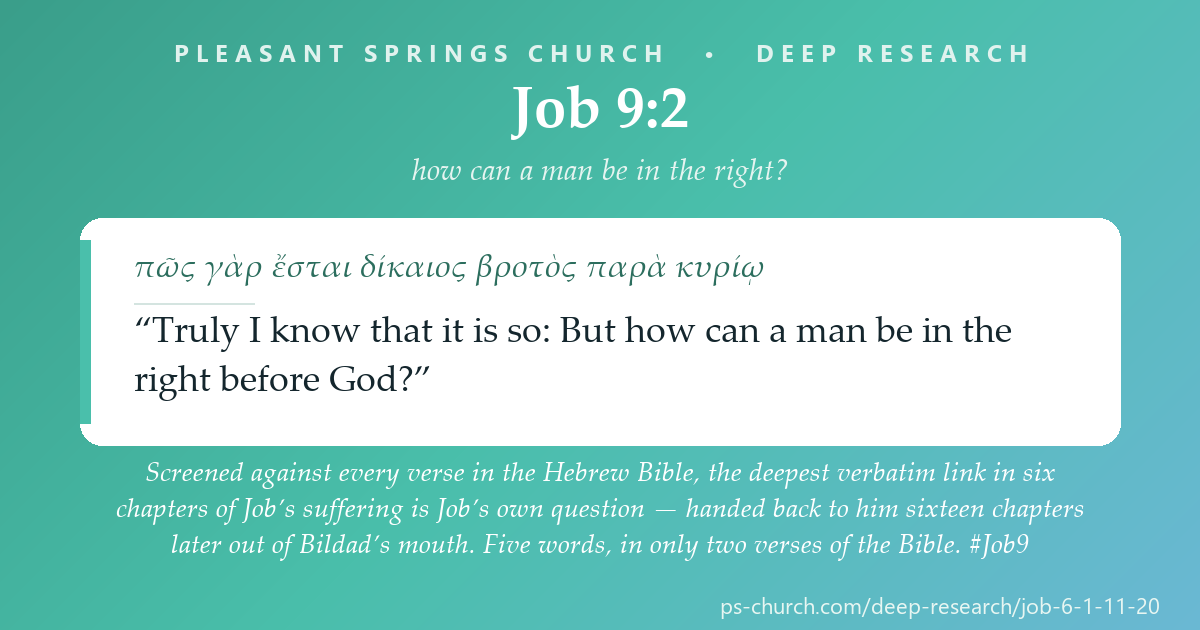
- Job 9:2 → Job 25:4 — run 5, tie band 1, and reciprocal. This is the deepest verbatim contact anywhere in these 150 verses, and the only one that gets past 4. Job asks וּמַה־יִּצְדַּק אֱנוֹשׁ עִם־אֵל, “how can a man be in the right before God?” Screened against the whole Hebrew Bible it has exactly one partner at that depth: Job 25:4, Bildad’s six-verse last speech, sixteen chapters later. And the relation runs both ways — screened independently, Job 25:4’s unique deepest partner in the whole Hebrew Bible is Job 9:2, also 5, also band 1. Those two words together, יצדק אנוש, occur in two verses of the Hebrew Bible and no others. No direction is asserted: the page does not claim Bildad is quoting Job, or that an editor built the echo. It reports that the only deep link in the passage points inside its own book.
- Against the whole Greek New Testament, nothing in these 150 verses reaches five. The Greek of Job 6–11 was screened against all 7,927 SBLGNT verses with the new spelling fold applied. 144 rows reach 2, 61 reach 3, 7 reach 4, and nothing goes further. The seven fours, with bands: 11:5 → Luke 1:19 (band 1, λαλησαι προσ σε και), 6:30 → Acts 26:26 (band 1), 6:4 → Galatians 6:17 and Philippians 1:20 (band 2, εν τω σωματι μου), 6:6 → 2 Corinthians 4:3 (band 1), 7:1 (band 8, the stock επι τησ γησ και), 7:21 → Luke 19:23 (band 1) and 9:28 → Romans 7:18 (band 1). Every one of the seven is a coincidence.
- And here is the number that puts all seven in their place. 1 Corinthians 3:19 is the one place in the New Testament that says out loud it is quoting Job — for it is written, “He catches the wise in their craftiness” — and the verse it quotes is Job 5:13. Measured against the Greek of Job 5:13, that citation runs 3: σοφουσ εν τη. Seven accidental runs in this passage are deeper than the New Testament’s one declared quotation of this book. Paul is not working from this Greek text at all. Read every four on this page in that light.
- The walking-on-water verse measures 1, and the page prints it because it is the first thing anyone will ask. Greek Job 9:8 has God περιπατῶν ὡς ἐπ' ἐδάφους ἐπὶ θαλάσσης — walking on the sea as on a pavement — where the Hebrew has him treading on the sea’s heights. Against Matthew 14:25 the run is 1, the participle περιπατων. Against Mark 6:48 it is 1. Against John 6:19 it is 1. The image is unmistakable and the verbatim contact is nothing. This is the whole lesson of the shelf in one row: a run screen finds shared words, and shared words are not the same thing as a shared picture.
- The Greek side is just as isolated as the Hebrew, measured independently. The 150 Greek verse units of Job 6–11 were screened against the 29,265 screened Greek Old Testament verse units that are not Job. The maximum is 5, reached twice: 10:7 against Isaiah 43:13 (band 1, εστιν ο εκ των χειρων) and 7:16 against Isaiah 28:28 (band 1, ου γαρ εισ τον αιωνα). Both are stock. Twenty rows reach 4, and the widest band among them is 43 — 7:1’s επι τησ γησ και. The next widest is 26, 11:19’s και ουκ εσται ο, which matches twenty-six verses across Deuteronomy, Isaiah, Jeremiah, Ezekiel, Daniel, Proverbs and the Twelve. Two corpora, two languages, the same answer: this passage does not share wording with anything.
- The four speech-formulas are the only place the passage runs deep for a reason. וַיַּעַן אִיּוֹב וַיֹּאמַר at 6:1 and 9:1 runs 3 at tie band 8 — the formula stands in nine verses in all, Job 3:2, 6:1, 9:1, 12:1, 16:1, 19:1, 21:1, 23:1 and 26:1, so each of these two measures against the other eight. וַיַּעַן בִּלְדַּד at 8:1 runs only 2 at band 2, and the two are 18:1 and 25:1 — and the reason it stops at 2 is a spelling: the Masoretic Text writes Shuhite plene at 8:1 (השוחי) and defective at 18:1 and 25:1 (השחי), so a screen that compares word forms cuts the four-word formula in half. 11:1 runs 4 at band 1, and the single partner is Job 20:1 — the only other verse in the Bible that introduces Zophar the Naamathite. Turn-taking is the one thing in these chapters that is written in reusable language.
- Bildad sounds like Proverbs and the measurement says so. 8:13 — such are the paths of all who forget God — runs 3 at tie band 1 against the whole Hebrew Bible, and its one partner is Proverbs 1:19. Zophar does the same at 11:18, which runs 3 at band 1 against Proverbs 19:18, כי יש תקוה. The friends talk in sentences the wisdom books also use. Job’s chapters are where the zeros are.
- Two more coincidences, printed because they are instructive. The four Greek words at Job 11:5, λαλησαι προσ σε και, are Zophar wishing that God would open his lips and speak to Job. The same four words, tie band 1, stand at Luke 1:19 — Gabriel to Zechariah, I was sent to speak to you and bring you this good news — and at 2 Samuel 7:20 in the Greek (band 1), David praying in the tent. Three men, three situations, one four-word string, and nothing whatever connecting them.
What was consulted, what was not, what could not be checked, and where this page is weakest.
The commentaries first. Then, at length, the limits — because a page built on measurement is worth exactly what its scope statement is worth, and this one has a large limit sitting under its whole Greek column.
Commentaries & studies:
- David J. A. Clines, Job 1–20 (WBC) — the standard technical treatment of these chapters, and the fullest philological notes in English.
- Marvin H. Pope, Job (Anchor Bible) — on the Ugaritic and wider Northwest Semitic background, and on Rahab and the sea-powers.
- Norman C. Habel, The Book of Job (OTL) — on the legal metaphor that controls chapters 9 and 10.
- C. L. Seow, Job 1–21 (Illuminations) — the fullest available treatment of the text-critical situation and of the history of interpretation.
- Claude E. Cox and the work on Old Greek Job — the specialist literature on what the original Greek translator did and did not translate, and on the Hexaplaric supplement. Nothing on this page substitutes for it, and the limitation below is exactly the thing that literature exists to fix.
- Homer Heater, A Septuagint Translation Technique in the Book of Job — on the Greek translator’s habit of supplying material from elsewhere in Scripture. That habit is visible in several of the rows above and is not analysed here.
What this page could not check, and where it is weakest:
- The Greek column is not the Old Greek, and this is the biggest limitation on the page. The Greek translation of Job made in antiquity was substantially SHORTER than the Hebrew — the usual estimate in the literature is about a sixth — and Origen filled the missing lines from Theodotion, marking them with asterisks. Rahlfs prints the filled-in text, the CATSS file on this disk carries no asterisks, and this page therefore cannot tell Old Greek from supplement. Every sentence above that says “the Greek reads” means “the eclectic printed text as digitized by CATSS reads,” and where a divergence is noted — 6:4, 8:13, 9:8, 9:9, 11:6, 11:20 — the page cannot say whether the line is original Greek, Theodotionic, or something else again.
- And the tool this shelf uses cannot detect that shortness, which is worth saying plainly. Counting normalised word forms, Greek Job has 13,561 to the Hebrew’s 8,379, a ratio of 1.618. That looks like expansion and it is not evidence of anything: measured the same way, Genesis runs 1.570, Proverbs 1.603, Amos 1.551, Ecclesiastes 1.520 and Psalms 1.770. The ratio is dominated by the fact that Greek writes with separate articles and particles where Hebrew fuses prefixes and suffixes. The famous abridgement of Old Greek Job is a fact about lines of poetry, and this page did not measure it, could not measure it with these tools, and does not claim to have measured it.
- The zero count depends on decisions in the normaliser, and a different edition would move it. The Hebrew is one printed edition (Sefaria’s Miqra according to the Masorah), read with the qere, cantillation and vowel points stripped, final letters folded to medial, and maqqef treated as a word separator rather than a weld. That last decision matters: Job’s poetry is thick with maqqef, and welding hyphenated pairs into single tokens would change which verses come out at zero. Plene and defective spelling cuts runs too, and this page prints a worked example: Bildad’s four-word introduction measures 2 rather than 4 purely because Shuhite is spelled השוחי at 8:1 and השחי at 18:1 and 25:1. The 56 is a figure produced by a stated procedure, not a property of the text in the abstract.
- Isolation of wording is not isolation of thought, and the page must not be read as saying it is. Job 6:11–19 shares no two consecutive words with anything — and it is about abandonment, thirst, disappointed hope and the failure of friends, which the Psalms and the Prophets are about constantly. A zero on this screen means the sentences were not built out of the same phrases. It does not mean the passage stands outside the Bible’s thought-world, and every verse reported at zero shares individual words with hundreds of others.
- No critical apparatus was consulted. No BHS or BHQ apparatus, no Göttingen Job, no Qumran Job (4QJob, 11QtgJob), no Peshitta, no Vulgate, no Targum. Where this page says the two columns differ — and it says so six times — it is comparing two printed editions on one hard disk, and nothing more. A reader who needs the manuscript evidence should go to Ziegler’s Göttingen edition and to Seow.
- The reciprocal 9:2 / 25:4 result is a measurement, not an explanation. The two verses are each other’s unique deepest partner in the Hebrew Bible at run 5, band 1. That is compatible with Bildad echoing Job, with Job echoing a saying Bildad also knew, with a later editor shaping the third cycle, and with coincidence in a small vocabulary. The measurement cannot distinguish those and this page does not try. It is also worth saying that Job 25 is one of the most disputed chapters in the book — many scholars think the third cycle has been disarranged — and nothing here bears on that question either way.
- The dating and composition questions are named and left open. When Job was written; whether the prose frame and the poetry come from one hand; whether the Elihu speeches are an addition; whether chapters 24–27 have been disturbed. Every one of these is live in the literature, none of them was settled here, and no measurement on this page turns on any of them. The prose-versus-poetry contrast measured in Stage 4 is consistent with several accounts of the book’s composition and adjudicates between none of them.
- The Mesopotamian comparisons in Stage 2 were not measured at all. Ludlul bēl nēmeqi and the Babylonian Theodicy are not held on this disk in any language, so no run screen touched them. They are cited as evidence that the question was ancient and widespread, which is all a reader should take from them here.
- No direction of influence is asserted anywhere on this page — not between Job 9:2 and Job 25:4, not between Greek Job 9:8 and the Gospels, not between Job 11:5 and Luke 1:19 or 2 Samuel 7:20, and not between the Hebrew and Greek columns where they differ. Where the Greek says the opposite of the Hebrew about Job’s guilt (11:6), both are printed and neither is corrected.
- What the zeros mean, stated once more because it is the page’s headline. The Hebrew screen was run with single-word matches NOT counted, so a 0 means “shares no two consecutive words with any other verse in the Masoretic corpus.” It does not mean “shares nothing.” The Greek New Testament screen was run the other way, with the unigram fallback on, which is why no row there comes out below 1.
A man whose grief could not be said in anyone else’s words, and three friends who had plenty of words to hand.
Name what you learned, why it matters, and one concrete response.
What should we carry away — and do?
- Real grief does not come out in quotations. Fifty-six of these 150 verses share no two consecutive words with any other verse in the Hebrew Bible, and nine of them run straight through the middle of Job’s first answer. Meanwhile the tidy prose that opens the book repeats itself thirteen words at a time. The parts of Scripture written in borrowed phrases are the parts where nothing is being suffered.
- The friends are quotable and Job is not, and that is the argument of the book in a measurement. Bildad reaches Proverbs 1:19 and Zophar reaches Proverbs 19:18, each at run 3, tie band 1. Job’s chapters produce 45 of the 56 verses that match nothing. Being able to say the right sentence is not the same as being right, and this book spends thirty-nine chapters on the difference.
- Job 9:2 comes back to him out of Bildad’s mouth. How can a man be in the right before God? Job asks it as a complaint. Sixteen chapters later Bildad says the same five words as a rebuke, and they are the only two verses in the Bible that contain them. Your honest question, repeated back at you as a lecture, is one of the more recognisable griefs in Scripture — and the book puts it there without comment.
- A picture is not a link. The Greek of Job 9:8 has God walking on the sea as on a pavement. Every reader thinks of Matthew 14. Measured, the two verses share one word. Any chart of Old Testament parallels will show you that connection and will not tell you it is one word deep. Ask, every time, whether the shared words are doing the same work — and remember that the New Testament’s one declared quotation of Job measures 3.
- One concrete response. Zophar ends this round by telling a bereaved man that God is letting him off lightly. It is doctrine, it is delivered confidently, and it is aimed at the wrong person. This week, when someone tells you what they are going through, answer without a formula — no verse, no principle, no explanation of what it is for. Say something that only fits them. If it comes out sounding like nothing else you have ever heard, you are in the right chapter.
Job 9:2 · to share
Hebrew + Greek (CATSS / Rahlfs) + ESVEvery Deep Research page traces its passage across the whole sweep — the Old Testament, the Second-Temple world between the testaments (historical witnesses, not Scripture), and the New Testament. Follow the thread:
Pleasant Springs Church — Deep Research
Research method after Michael S. Heiser’s Bible Research Method (examine dictionaries → ancient literature → important words → textual connections → academic publications → share), with the Pleasant Springs “Author & Audience” foundation. Scripture set in the Hebrew, the Greek editions named on each page and the ESV (Old Testament), and the Greek New Testament and the ESV (New Testament), per the practice of Pleasant Springs Church. Job 6–11 research grounded in Clines (WBC), Pope (Anchor), Habel (OTL) and Seow (Illuminations), with every figure on the page re-derived locally. Book name: in the Septuagint the book is Ἰώβ (Iōb). Text: Hebrew from the Masoretic Text (Sefaria, Miqra according to the Masorah), qere read; Greek from Rahlfs’s Septuaginta (CATSS digitization), printed without editorial punctuation and with proper names unaccented; English ESV. ⚠️ Versification — there is NO offset inside this page’s scope, and that was counted rather than assumed. Job 6, 7, 8, 9, 10 and 11 carry 30, 21, 22, 35, 22 and 20 verses in the Masoretic column, in the CATSS column and in the ESV alike — 150 either way — so every reference on this page means the same verse in all three. That is not true of the book as a whole: the Greek carries fourteen lettered verse units the Hebrew has no number for (2:9a–e, 19:4a, 23:15a, 36:28a–b, 42:17a–e), and none of them is in chapters 6–11. Numbering parity is not textual parity, and six real divergences between the columns are printed above and adjudicated in none. Measurement: Hebrew runs were taken against the 23,204 verse units of the Masoretic corpus, consonantal word forms only, contiguous only, never lemmas, with single-word matches NOT counted — so a 0 on this page means ‘shares no two consecutive words with any other verse’ and not ‘shares nothing’; 56 of the 150 verses come out at 0, and every one of them does share individual words. Maqqef was treated as a word separator and never as a weld, which is a decision that affects the count. Greek Old Testament figures are over 30,348 screened verse units of the 64 CATSS files held here (30,637 in total; the Odes are excluded, because two of them are Luke 1 and Luke 2 and ten more are second copies of passages already counted), of which 29,265 are not Job. Greek New Testament runs were taken against all 7,927 verses of the SBLGNT via MorphGNT, with MorphGNT’s own spelling equivalences applied (ou/ouk/ouch, ek/ex, the movable nu) — so these figures run higher than anything published on this shelf before 30 August 2026 and must not be compared with it. Tie bands are printed beside every run. ⚠️ The page’s central figure is printed with its own counter-examples beside it: Job 6’s 56.7% isolation rate is lower than Job 18 (61.9%), Job 29 (60.0%) and Job 4 (57.1%), and this scope’s 37.3% is below the 41.6% average of Job’s poetry as a whole. ⚠️ The Greek column is NOT the Old Greek. The original Greek Job was substantially shorter than the Hebrew and Origen supplied the missing lines from Theodotion under the asterisk; Rahlfs prints the filled text and the CATSS file carries no asterisks, so this page cannot tell Old Greek from supplement and does not pretend to. The word-count ratio between the two columns (1.618) does not detect that shortness and is not offered as evidence of anything — Genesis measures 1.570 and Psalms 1.770 on the same screen. No critical apparatus, no Qumran Job, no Göttingen edition and no versions were consulted. No direction of influence is asserted anywhere on this page. The literary structure printed above is labelled a sequence, because four alternating speeches are a sequence; the only bracket claimed is the five occurrences of תִּקְוָה / ἐλπίς at 6:8, 7:6, 8:13, 11:18 and 11:20, which was counted in both columns. Typology is handled per the house position.
Scripture quotations marked ESV are from the ESV® Bible (The Holy Bible, English Standard Version®), © 2001 by Crossway, a publishing ministry of Good News Publishers. ESV Text Edition: 2016. Used by permission. All rights reserved. The ESV text may not be quoted in any publication made available to the public by a Creative Commons license, and the ESV may not be translated in whole or in part into any other language. www.esv.org
|
Did this study bless you today? 💚 Give to Support PS Church100% of gifts go to the General Fund — thank you. |