We came to these two chapters expecting the New Testament to be all over them. 1 Chronicles 3 carries sixteen kings from Solomon to Josiah, and Matthew 1 runs the same royal line in the same order — leaving three of them out — so we screened the Greek of all seventy-nine verses against all 7,927 verses of the Greek New Testament to see how deep the contact went. The king list measures nothing. Every verse of 1 Chronicles 3:10–14 tops out at a run of two with a tie band of three, and the three verses tied with it at that depth are Matthew 7:9, Matthew 22:45 and Luke 15:25. The deepest run in the whole passage is somewhere else entirely: five words, tie band 1, at 2:4 against Matthew 1:3 — and both of those verses name Tamar. The reason turned out to be sitting in the grammar all along. Chapter 2 says hōlîd, “fathered,” twenty-six times in the Hebrew and ἐγέννησεν thirty times in the Greek. Chapter 3 does not say it once in either column. The kings are not begotten; they are stacked — his son, his son, his son, seventeen times — and Matthew’s genealogy, built entirely out of “fathered,” has nothing there to meet. This study works 1 Chronicles 2:1–3:24 in Hebrew, Septuagint and ESV, with the places where the two columns flatly disagree printed and left standing. See the method →
1 Chronicles 2:1–3:24 (selections)
Hebrew (Masoretic) · Greek (CATSS / Rahlfs, Paraleipomenon A) · ESVThat is not a stylistic curiosity. It is the reason for the strangest number this page measured. Screen the Greek of all seventy-nine verses here against all 7,927 verses of the Greek New Testament and the deepest run in the passage is five words at 2:4 against Matthew 1:3 — τὸν Φαρες καὶ τὸν Ζαρα, tie band 1, no other New Testament verse comes near it. Three more runs of three, all tie band 1, all against Matthew 1, sit at 2:10, 2:11 and 2:12. And chapter 3 — the chapter that carries the very kings Matthew names one by one — never rises above two, and where its king-list verses (3:10–14) reach two the tie band is three — Matthew 7:9, Matthew 22:45 and Luke 15:25. Not one verse of Matthew’s king-list is the deepest partner of any verse in 1 Chronicles 3 at a run of two or more.
The verses that touch the New Testament are the ones where Chronicles says ‘fathered.’ The deepest of them all names a woman.
The book, the name, and the numbering — counted, not assumed. In the Septuagint this book is 1 Paraleipomena, “things omitted” — Παραλειπομένων Αʹ (Paraleipomenōn A). In Greek this book is Paraleipomenon A, Παραλειπομένων Αʹ, “of the things left out” — a librarian’s name that misjudges the book. ⚠️ There is no verse-number offset in this passage, and that was derived rather than assumed: the Masoretic Text and the CATSS Greek both give 1 Chronicles 2 fifty-five verses and 1 Chronicles 3 twenty-four, and the ESV agrees with both. Every reference on this page means the same verse in all three columns. (Book-wide the Greek is thirteen verses shorter than the Hebrew — 930 against 943 — but twelve of the thirteen are in chapter 1 and the thirteenth is 16:24, all of them outside this passage. See 1 Chronicles 1–9.)
⚠️ Where the Hebrew and the Greek here disagree about a fact, both are printed and neither is fixed. David’s second son is Daniel in the Hebrew of 3:1, Chileab in the Hebrew of 2 Samuel 3:3, Δανιηλ in Greek Chronicles and Δαλουια in Greek Samuel. Solomon’s mother is Bath-shua daughter of Ammiel in the Hebrew of 3:5, Bath-sheba daughter of Eliam in 2 Samuel 11:3, and Βηρσαβεε in both Greek columns with two different fathers. And at 3:19 the Hebrew makes Zerubbabel the son of Pedaiah while the Greek makes him the son of Shealtiel. Chronicles and Samuel–Kings are not harmonised on this page, and neither are the Hebrew and the Greek.
The Shape of the Passage
Sequence, in two movements — not a chiasmThese two chapters sit inside the nine-chapter genealogy studied at 1 Chronicles 1:1–9:44. Behind them stand Genesis 38, Ruth 4, 2 Samuel and 2 Kings 25. In front of them stands a province with a rebuilt altar, a modest temple, a Persian governor, and no king.
Author
Anonymous, and writing well after the exile. The book never names him. The tradition at b. Bava Batra 15a credits “the genealogy of Chronicles” to Ezra, which is a tradition worth knowing and not a colophon. The best internal evidence for the date is in this very passage: 3:19–24 carries David’s line several generations past Zerubbabel, who was active around 520 BC. How many generations depends on how 3:21 is read — and the Hebrew and the Greek of that verse do not agree, which Stage 5 sets out rather than settling.
He is not inventing; he is selecting. 2:3 reproduces seven consecutive words of Genesis 38:7 and then abbreviates the eighth clause. 2:10–12 is the Perez-to-Jesse line of Ruth 4:18–22, verbatim in places. 3:1–9 is the Hebron-and-Jerusalem son list of 2 Samuel 3 and 5, reordered. He is working with documents in front of him and choosing what to carry.
And he keeps writing after every other book has stopped. Kings ends with Jehoiachin eating at a Babylonian table. Chronicles takes Jehoiachin’s name at 3:17 and keeps going — Shealtiel, Pedaiah, Zerubbabel, Hananiah, Shecaniah, Shemaiah, Neariah, Elioenai, and seven brothers ending with Anani. That is why these verses measure as they do. Nine of the twenty-four verses in chapter 3 share no two consecutive words with any other verse in the Hebrew Bible, and 3:15 through 3:22 do so eight verses running. There is nothing to share them with. He is past the end of everyone else’s page.
Audience
People for whom a name was a legal instrument. In Persian-period Yehud, descent decided whether a man could serve as a priest, whether a family had a claim on a field, whether one belonged to the assembly. Ezra 2:62 and Nehemiah 7:64 record men put out of the priesthood because “these sought their registration among those enrolled in the genealogies, but they were not found there.” A list like this one is not background reading. It is the register.
And people who needed to know the house of David still existed. There had been no king for generations and there would not be one again. Chapter 3 does not argue that the monarchy will be restored; it simply refuses to stop the list. Sixteen kings, then an exile, then names hardly anyone outside this chapter has ever heard — only Hattush at 3:22 turns up elsewhere, at Ezra 8:2, “of the sons of David, Hattush” — and the line is still being written down.
Twenty-two women are named in these seventy-nine verses. Counted by hand from the columns above: Bath-shua, Tamar, Zeruiah, Abigail, Azubah, Jerioth, Ephrath, Abijah, Atarah, Abihail, Ephah, Maacah, Achsah, then Ahinoam, Abigail, Maacah, Haggith, Abital, Eglah, Bath-shua, Tamar and Shelomith. A Canaanite wife, a daughter-in-law who played the prostitute, a Geshurite princess, a woman given in marriage to an Egyptian slave, and a sister who is named and never explained. The Chronicler had no obligation to name any of them. Matthew, opening his Gospel with the same line, names four and leaves the fifth as “the wife of Uriah” — the woman 1 Chronicles 3:5 calls Bath-shua, daughter of Ammiel.
Orient on genealogy as a form, on the tribe of Judah, on the house of David after the exile, and on the province these lists were compiled in.
Search by topic: genealogy; Judah (tribe); Jerahmeel; Caleb; Kenites; Rechabites; David, sons of; Bathsheba; Zerubbabel; Shealtiel; Jehoiachin / Jeconiah; Davidic dynasty; Yehud; Persian period; levirate marriage; herem / devoted thing; maʿal.
Which articles are relevant?
- Anchor Bible Dictionary — “Genealogy,” “Judah (tribe),” “Jerahmeel,” “Caleb,” “Kenites,” “Rechabites,” “Zerubbabel,” “Shealtiel,” “Jehoiachin,” “Bathsheba.” The Zerubbabel and Shealtiel articles are the ones to read before Stage 5.
- Dictionary of the OT: Historical Books (IVP) — “Genealogies,” “David,” “Chronicles, Books of,” “Historiography, Old Testament.” The genealogies article is what turns a list of names from an obstacle into evidence.
- NIDOTTE / TDOT — יָלַד (yālaḏ, hiphil hōlîd, to father), בֵּן (bēn, son), מַעַל (maʿal, breach of faith), חֵרֶם (ḥērem, devoted thing), אַסִּיר (ʿassîr, prisoner).
- On the Greek — the NETS introduction to 1 Supplements (Paraleipomenon A), which describes the character of this translation. It is where a reader should go before deciding what the divergences catalogued on this page mean.
Bibliography surfaced:
- Gary N. Knoppers, 1 Chronicles 1–9 (Anchor Yale) — an entire volume on this unit, and the fullest treatment of chapters 2–3 anywhere; Sara Japhet, I & II Chronicles (OTL); Ralph W. Klein, 1 Chronicles (Hermeneia), strongest on the text-critical problems in 3:19–24; H. G. M. Williamson, 1 and 2 Chronicles (NCBC).
- Robert R. Wilson, Genealogy and History in the Biblical World — the comparative study that established the linear/segmented distinction used in Stage 2. (A critical scholar; the analysis of form is taken, and the rest is weighed.)
What these lists were for, what a daughter-heiress marriage meant, and what the later witnesses did with chapter 3.
First the form — segmented lists that branch and linear lists that legitimate, and why chapter 2 is one and chapter 3 the other. Then the marriage in 2:34–35, which is a legal arrangement the Torah legislates for. Then the reception, where the interesting witness is a silence.
Which parallels shed light on this passage?
Two genealogical forms, and the Chronicler switches between them at the chapter break. Robert Wilson’s comparative work on Mesopotamian king lists, Ugaritic material and living tribal genealogies made the standard distinction: a segmented genealogy branches (A had three sons, and the first had four) and exists to map how whole groups are related; a linear genealogy runs one line deep and exists to legitimate the man at the end of it. 1 Chronicles 2 is segmented and 1 Chronicles 3 is linear, and the grammar follows the form exactly: twenty-six “fathered”s where the list is spreading, and not one where it is descending. That is measurable and it is on this page’s own columns.
2:34–35 is a legal arrangement, not an anecdote. Sheshan has daughters and no sons. He gives a daughter to Jarha, his Egyptian slave, and the line continues through them. Numbers 27:1–11 and 36:1–12 legislate for exactly this problem — the daughters of Zelophehad inherit, on condition they marry within the tribe. Ancient Near Eastern law codes handle the same situation: Mesopotamian adoption and inheritance documents record slaves manumitted and married into a household to keep a patrimony intact. What Chronicles then does with this arrangement is its own: it gives Jarha’s descendants twelve generations of “fathered” (2:36–41), against the six that carry the line from Ram to Jesse. An Egyptian slave’s line gets twice the space of the line to David. That is a fact about the text and this page does not pretend to know why.
And the Kenites at the end of chapter 2 are outsiders too. 2:55 ends the chapter with “the clans of the scribes who lived at Jabez” and identifies them as Kenites of the house of Rechab. The Kenites are Midianite-related (Judges 1:16; 4:11), not Israelites by descent; the Rechabites are the tent-dwelling teetotal clan Jeremiah 35 holds up as a reproach to Judah. The genealogy of Judah closes on a family of scribes who were not born into Judah at all.
- Josephus, Antiquities (Second-Temple — a witness, not Scripture) — and the witness here is an absence. Josephus retells this whole history for a Greek-reading public and does not reproduce these genealogies; he takes the narrative up at Saul’s death. A Roman-era historian writing for outsiders found the lists unusable. The Chronicler wrote them anyway, which tells you who he was writing for.
- Matthew 1:1–17 and Luke 3:23–38 (Scripture) — the two later writers who did the same thing with the same material, and did it differently. Matthew runs forward from Abraham and uses ἐγέννησεν throughout; Luke runs backward and uses no verb at all. Stage 4 reports what the run screen measured between them and 1 Chronicles 2–3.
- b. Bava Batra 14b–15a (rabbinic-era — a witness, not Scripture) — places Chronicles last among the Writings and credits the genealogy to Ezra. Both are traditions about the book, reported as such.
- Targum of Chronicles (rabbinic-era Aramaic — a witness, not Scripture) — a translation that cannot leave a bare name bare, and supplies identifications the Hebrew does not make. Worth reading to watch an ancient translator find the silence of a list intolerable.
- Numbers 27:1–11; 36:1–12; Jeremiah 35 (Scripture) — the daughters’ inheritance law behind 2:34–35, and the Rechabites behind 2:55.
In seventy-nine verses of names, exactly two men are judged — and both are inside the first seven verses.
Er is the first: “Er, Judah’s firstborn, was evil in the sight of the Lord, and he put him to death” (2:3). Those seven Hebrew words stand identically in Genesis 38:7 — the deepest verbatim contact anywhere in these two chapters with anywhere else in the Hebrew Bible, run of seven, tie band 1. And then the run stops, because Chronicles abbreviates: Genesis says “and the Lord put him to death,” Chronicles says “and he put him to death.”
Achar is the second, four verses later: “Achar, the troubler of Israel, who broke faith in the matter of the devoted thing” (2:7). Joshua 7 calls him Achan; Chronicles respells the name so that it is the verb עוֹכֵר, “troubling.” And the phrase אֲשֶׁר מָעַל, “who broke faith,” occurs in only four verses of the Hebrew Bible — Ezekiel 17:20, Ezekiel 18:24, this verse, and 1 Chronicles 10:13, where Saul dies of it. The word that will end Saul’s life and, at 2 Chronicles 36:14, burn Jerusalem, enters this book here — in a genealogy, seven verses in.
And the Greek does not carry it. At 2:7 Rahlfs has ὃς ἠθέτησεν εἰς τὸ ἀνάθεμα, “who set at nought the devoted thing”; at 9:1 and 10:13 it has ἀνομία, “lawlessness.” Two different Greek words for one Hebrew one, so the thread the Hebrew stitches is invisible in the Greek column. This page argues from the Hebrew and prints what the Greek actually does with it.
One verb that is everywhere and then nowhere, two syllables that replace it, and a name that means “prisoner.”
Count hōlîd and bənō across the two chapters rather than asserting a difference in feel — the counts are given below and can be checked against the columns above. Then maʿal at 2:7, which is where the word that governs the whole book first appears.
The hiphil of יָלַד, “to cause to bear” — ESV “fathered,” older versions “begat.” It is the engine of chapter 2 and it is absent from chapter 3. Counted on the Masoretic text held here: twenty-six occurrences in 1 Chronicles 2 (both spellings, הוֹלִיד and הֹלִיד), and zero in 1 Chronicles 3. The Greek does the same thing independently: ἐγέννησεν thirty times in chapter 2, zero times in chapter 3. Two translators, one decision.
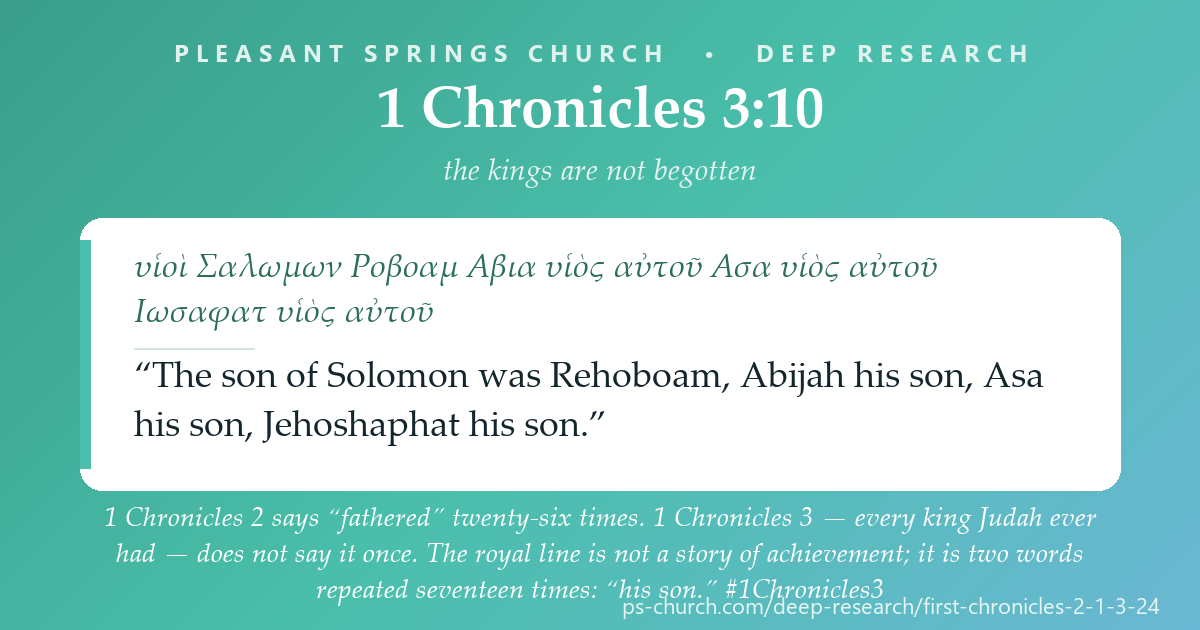
“His son” — two syllables, no verb, and the entire construction of the royal line. Rehoboam, Abijah his son, Asa his son, Jehoshaphat his son… seventeen times down through Josiah and on past Jeconiah. The Greek matches with υἱὸς αὐτοῦ, twenty-two times in the chapter. Nothing is being done in these verses; the kings are simply stacked. This is the grammatical fact behind the page’s central measurement: Matthew’s genealogy is built entirely out of ἐγέννησεν, and where Chronicles has no ἐγέννησεν there is nothing for Matthew to touch.
“Daughter of Shua” — or Bath-shua as a name; the Hebrew does not say which and the versions disagree. The name שׁוּעַ occurs in only four verses of the Hebrew Bible: Genesis 38:2, Genesis 38:12, and these two. (The screen folds vowels, so it also returns Isaiah 32:5 and Job 30:24, 34:19 — a different word, šōaʿ, “noble,” excluded by eye.) At 2:3 she is Judah’s Canaanite wife and the mother of the son the Lord put to death. At 3:5 she is David’s wife and the mother of Solomon. The Greek reads the identical two Hebrew words two different ways — ἐκ τῆς θυγατρὸς Σαυας at 2:3, a patronymic; τῇ Βηρσαβεε at 3:5, harmonising her to the Bathsheba of 2 Samuel.
“Who broke faith.” Not a general word for sin: in the Torah maʿal is the term for sacrilege, violating what is holy (Lev 5:15; Num 5:6–7), and it is what Achan does with the devoted things at Joshua 7:1. The exact two-word sequence occurs in four verses of the Hebrew Bible — Ezekiel 17:20, Ezekiel 18:24, 1 Chronicles 2:7 and 1 Chronicles 10:13. (The phrase screen returns six hits; Genesis 1:7 and Psalm 148:4 are the unrelated מֵעַל, “above,” which the consonantal screen cannot distinguish, and were excluded by eye.)
“Prisoner.” “The sons of Jeconiah, the captive: Shealtiel his son.” It is the only word in these seventy-nine verses that names what happened in 587, and it is attached to a king’s name like a title. The Greek column does not have it as a word at all — Rahlfs has Ιεχονια-ασιρ, welded into the name, as though the man were called Jeconiah-assir. Some English versions do the same. The Hebrew is ambiguous and this page prints the ambiguity rather than resolving it.
Anani — the last name in the last verse, and the final descendant of David named anywhere in the Old Testament. He does nothing. Nothing is said about him. The name is built on עָנָן, “cloud,” which the Targum and some later readers could not resist connecting to the one who comes “with the clouds of heaven” — a homily, not a reading, and named here as a homily. What the text does is simpler and stranger: it ends the royal line of Israel on a man with no story.
Three things reported rather than tidied:
- Achar or Achan. Joshua 7 spells the name עָכָן; 1 Chronicles 2:7 spells it עָכָר, which makes it identical to the participle ʿōkēr, “troubling,” that stands beside it. Whether that is a variant tradition, a deliberate respelling for the pun, or both, this page does not say — and it does not say which came first.
- Salma or Salmon. The Hebrew of 2:11 reads שַׂלְמָא (Salma); the Greek reads Σαλμων, and Matthew 1:4–5 has Σαλμών. Ruth 4:20–21 has both spellings in consecutive verses. A small thing, printed because it is one of the places where the Greek column of this page agrees with the New Testament and the Hebrew column does not.
- Zeruiah and Abigail. The Hebrew calls them וְאַחְיֹתֵיהֶם, “their sisters” — plural. The Greek has the singular ἀδελφὴ αὐτῶν and then names two of them. Neither text explains whose daughters they are, and 2 Samuel 17:25 calls Abigail the daughter of Nahash and Zeruiah her sister, rather than making either a daughter of Jesse. That difficulty is old, it is unresolved, and it is left unresolved here.
What the run screens actually found — including the runs this page prints against itself.
Two screens, stated with their scope and their tie bands. Greek side: all 79 verses of CATSS 1 Chronicles 2–3 against all 7,927 verses of the Greek New Testament (MorphGNT), contiguous runs of whole word forms, never lemmas, with each edition’s own spelling equivalences applied — ou/ouk/ouch, ek/ex, the movable nu. Hebrew side: the same 79 verses against every other verse of the 23,204-unit Masoretic corpus held here. Both screens are exhaustive and deterministic; nothing is sampled.
Greek against the New Testament — and the tie band beside every run:
The whole distribution first, so nothing is cherry-picked. Of the seventy-nine verses, seventy reach a run of two, nine reach three, one reaches five, and nothing reaches six.
The single deepest run in the passage: 2:4 against Matthew 1:3, five words, tie band 1. τὸν Φαρες καὶ τὸν Ζαρα — “Perez and Zerah.” No other verse in the Greek New Testament reaches five against anything in these two chapters. Both verses name Tamar. What that is and is not: the measurement finds verbatim contact, not allusion or citation, and it does not tell you which way anything ran. Matthew 1:3 is plainly working the same line of descent Chronicles works, and the shared five words are two proper names with their articles and a conjunction. It is a real contact and it is a small one.
Three runs of three, all tie band 1, all against Matthew 1: 2:10 → Mt 1:4 (ἐγέννησεν τὸν Αμιναδαβ), 2:11 → Mt 1:4 (ἐγέννησεν τὸν Σαλμων), 2:12 → Mt 1:5 (ἐγέννησεν τὸν Ιεσσαι). Every one of them is “fathered” plus a name.
And now the finding this page was built on. 1 Chronicles 3:10–14 lists Rehoboam, Abijah, Asa, Jehoshaphat, Joram, Ahaziah, Joash, Amaziah, Azariah, Jotham, Ahaz, Hezekiah, Manasseh, Amon and Josiah. Matthew 1:7–11 runs the same line and names twelve of those fifteen — it goes straight from Joram to Uzziah and leaves out Ahaziah, Joash and Amaziah. The deepest run between them is nothing at all. Each of those five verses tops out at a run of two with a tie band of three, and the three verses tied at that depth are Matthew 7:9, Matthew 22:45 and Luke 15:25 — the shared two words being υἱὸς αὐτοῦ, “his son.” Not one verse of Matthew’s king-list is the deepest partner of any verse in 1 Chronicles 3 at a run of two or more. Twelve kings in common, and no measurable verbatim contact, because Chronicles never says ‘fathered’ in that chapter and Matthew never says anything else.
A run without its tie band is misleading, and a tie band of 1 is not by itself evidence of contact. Three rows from this very passage make the point, and they are printed here rather than left out.
2:1 reaches three with a tie band of 5. τῶν υἱῶν Ισραηλ, “of the sons of Israel” — tied across Luke 1:16, Acts 5:21, Romans 9:27, Hebrews 11:22 and Revelation 2:14. That is a formula, not a contact, and its depth of three is the same depth as the Matthew 1:4 runs above. The band is the whole difference.
2:24 reaches three with a tie band of 14. καὶ ἡ γυνή, “and the woman” — eleven of the fourteen tied verses share that trigram; the other three reach three by other formulas. Pure boilerplate.
2:23 reaches three with a tie band of 1 — against Matthew 9:35. The shared words are καὶ τὰς κώμας, “and the villages.” Chronicles is listing Kenath and its sixty villages in Gilead; Matthew is describing Jesus going through all the cities and villages. Tie band 1, and it means nothing whatever. This is why the shelf prints the band and then still looks at the verse.
Hebrew against the rest of the Hebrew Bible:
The deepest: 2:3 against Genesis 38:7, run of seven, tie band 1. וַיְהִי עֵר בְּכוֹר יְהוּדָה רַע בְּעֵינֵי יְהוָה — seven consecutive words identical, and no other verse in the Masoretic corpus reaches them. The run terminates exactly where Chronicles shortens the sentence.
Then 3:2 against 2 Samuel 3:3, run of six, tie band 1 — בֶּן־מַעֲכָה בַּת־תַּלְמַי מֶלֶךְ גְּשׁוּר, “the son of Maacah, the daughter of Talmai king of Geshur.” And here is the thing worth noticing: that same verse of 2 Samuel, in its first half, calls David’s second son Chileab, where 1 Chronicles 3:1 calls him Daniel. The deepest verbatim agreement in chapter 3 sits one clause away from a flat disagreement about a name. Both are printed in the codex above.
And the measurement that surprised us. Eighteen of the seventy-nine verses report a run of zero — a zero has no tie band, because nothing in the corpus reaches it — and on this screen a zero means this verse shares no two consecutive words with any other verse in the Hebrew Bible. It does not mean it shares no words; every one of these verses shares individual words. In chapter 3 the figure is nine of twenty-four, and 3:15 through 3:22 report zero eight verses running — Josiah’s sons, Jehoiakim’s, Jeconiah the captive, Shealtiel, Pedaiah, Zerubbabel and the generations after.
Is that remarkable, or is it just what genealogies do? We ran the controls. Same screen, same settings, same corpus:
- Genesis 5, the line from Adam — 0 of 32 verses report zero.
- Genesis 11:10–26, Shem to Abram — 0 of 17.
- Ruth 4:18–22, Perez to David — 0 of 5.
- 1 Chronicles 10, narrative — 0 of 14.
- 1 Chronicles 1, quarried from Genesis — 6 of 54.
- 1 Chronicles 2–3 — 18 of 79, and chapter 3 alone 9 of 24.
Every genealogy we screened outside Chronicles has a partner somewhere for every single verse, and 1 Chronicles 1 — the one control that reports any zeros at all — reports six. The plain reason is not mysterious and the page will not dress it up: these verses are made almost entirely of proper names that occur nowhere else, because nobody else had occasion to write them down. That is exactly the point. The Chronicler is writing past the last page of every other book in the canon.
- Genesis 38 — Judah, Bath-shua, Er, Onan, Tamar, Perez and Zerah. 1 Chronicles 2:3–4 compresses the whole chapter into two verses and reproduces seven of Genesis 38:7’s words exactly.
- Ruth 4:18–22 — the ten-name line from Perez to David. On the Hebrew screen 1 Chronicles 2:10 measures a run of four against Ruth 4:19 and 4:20 (tie band 2 — those two verses and no others), and 2:12 a run of four against Ruth 4:21 alone (tie band 1). Ruth ends on this genealogy; Chronicles builds on it.
- Exodus 1:1–4 — the Hebrew of 1 Chronicles 2:1 shares four consecutive words with Exodus 1:2 (tie band 1), and the Greek of 1 Chronicles 2:1 opens with six words identical to Greek Exodus 1:1: ταῦτα τὰ ὀνόματα τῶν υἱῶν Ισραηλ. The Hebrew of 1 Chronicles 2:1 has no word for “names.” Scope note: CATSS Exodus is on this disk but sits outside the mapped book table used by the standard screen, so this figure was measured by reading the file directly and is not part of the 30,348-unit corpus screen.
- 2 Samuel 3:2–5 and 5:13–16 — the same two son-lists, with the Chileab / Daniel difference at 3:3.
- 1 Chronicles 10:13 — Saul dies “for his breach of faith,” the same two-word Hebrew phrase as 2:7. The word that governs the whole book enters it in this genealogy.
- Ezra 3:2; Nehemiah 12:1; Haggai 1:1; Matthew 1:12; Luke 3:27 — every one of them calls Zerubbabel the son of Shealtiel. 1 Chronicles 3:19 in Hebrew calls him the son of Pedaiah, and 1 Chronicles 3:19 in Greek calls him the son of Shealtiel. Both columns are printed above. This page does not choose between them and does not assert which is prior.
- 2 Kings 25:27–30 — where Jehoiachin eats at a Babylonian king’s table and the Old Testament’s history stops. 1 Chronicles 3:17 takes the same man’s name and keeps writing for eight more verses.
The scholarship, and then — at length — everything this page could not check and every place it is weak.
Knoppers, Japhet, Klein and Williamson on the unit; Wilson on the form. Then the limits, which are the part of this section that matters most.
Commentaries & studies:
- Gary N. Knoppers, 1 Chronicles 1–9 (Anchor Yale) — the standard treatment of exactly this unit, and the first place to go on the Judah lists and their relation to the Greek.
- Sara Japhet, I & II Chronicles (OTL) and The Ideology of the Book of Chronicles — the influential argument that the Chronicler is a theologian with a coherent position rather than an editor with scissors.
- Ralph W. Klein, 1 Chronicles (Hermeneia) — the fullest technical treatment of 3:17–24, which is where the text-critical problems in this passage are concentrated.
- H. G. M. Williamson, 1 and 2 Chronicles (NCBC) and his article work on the Davidic genealogy, which is the standard entry point to the dating argument summarised below.
- Robert R. Wilson, Genealogy and History in the Biblical World — the comparative study behind Stage 2’s linear/segmented distinction. (A critical scholar; the analysis of form is taken as such.)
What this page could NOT check, and where it is weakest:
- ⚠️ The Greek is Rahlfs in the CATSS digitization, and nothing else was consulted. No manuscript was examined, no apparatus was opened, and the Lucianic and Antiochene traditions — which matter a great deal for Chronicles — were not consulted at all. When this page says “the Greek,” it means this one edition of the Greek. Every divergence catalogued here is a divergence between two printed editions on one hard disk.
- ⚠️ No Qumran evidence was checked. 4QChron exists, and it is small. This page did not look at it and cannot tell you whether it bears on 3:19 or 3:21.
- ⚠️ The generation count in 3:21 — and the date of the whole book — is left open, because this page’s own two columns disagree. The Hebrew of 3:21 gives four bare “the sons of X” phrases (Rephaiah, Arnan, Obadiah, Shecaniah) whose relation to what precedes is simply not stated. The Greek of the same verse turns all four into υἱὸς αὐτοῦ, “his son” — a single descending line. Counting Zerubbabel to Anani on the Greek gives ten generations; the Hebrew cannot be counted at all without first making a decision the text does not make, and published counts of six, seven and eleven all exist. The standard argument for dating Chronicles runs through this count. This page reports the divergence and declines to date the book from it.
- ⚠️ The count of twenty-two named women is a hand count, not a machine one. It was made by reading the seventy-nine verses and listing the women; it is not the output of any screen, and a reader who counts differently (over whether Ephrath at 2:19 and Ephrathah at 2:50 are the same, for instance) is not wrong. Check it against the text.
- ⚠️ A zero on the Hebrew screen is a narrow claim and is easy to over-read. It means “no two consecutive word forms shared with any other verse in the 23,204-unit Masoretic corpus held here.” It is not a claim about vocabulary, about style, or about inspiration. The controls above are printed precisely so the figure can be calibrated rather than admired — and the explanation for it is prosaic: unique proper names.
- ⚠️ The Greek OT corpus screened is 30,348 verse units, not the 30,637 held. The 64 CATSS files on disk hold 30,637 units, but run screens exclude the Odes, because the Odes are not independent text: Ode 9 is Luke 1 and Ode 13 is Luke 2 copied into a Greek Old Testament manuscript, and ten more Odes are second copies of Exodus 15, Deuteronomy 32, 1 Samuel 2, Habakkuk 3, Isaiah 26, Jonah 2, Daniel 3, Isaiah 5 and Isaiah 38. Counting them would let a passage match itself. The screened number is the one this page states.
- ⚠️ The New Testament screen finds verbatim contact and nothing else. It cannot see allusion, structural imitation, or a writer thinking about a text without quoting it. Matthew’s decision to organise his genealogy around the deportation to Babylon may well be the deepest debt this passage is owed by the New Testament, and it would register on this screen as nothing at all.
- ⚠️ Direction of influence is never asserted here, and could not be established if it were. Chronicles and Genesis 38 share seven words; the Greek of Chronicles 2:1 and the Greek of Exodus 1:1 share six. Which text is drawing on which, or whether both draw on a third thing, is not something a run length can tell you.
- ⚠️ The ESV column here was typed, not fetched. No ESV API key has ever been issued to this site; the English is set by hand against the Hebrew and Greek columns, and readers should check it against a printed ESV rather than trusting this page for exact wording.
Interpretation notes worth keeping:
- Pedaiah or Shealtiel — not settled and not settleable from here. The usual harmonisation is a levirate marriage: Shealtiel died childless, Pedaiah his brother raised up seed to him, and Zerubbabel is legally Shealtiel’s and biologically Pedaiah’s. That is a proposal, and Scripture does not state it. It is reported here as a proposal.
- The relation of the Chronicles son-lists to 2 Samuel is disputed. Whether Chronicles used our Samuel, a different Hebrew Samuel, or an independent source is argued in every commentary listed above and is not resolved. What is a datum is that the two disagree at 3:1 about a name and that the disagreement runs through the Greek of both books too.
- Whether the genealogies are original to Chronicles — disputed. Some have argued chapters 1–9 are a later addition to a narrative that began at chapter 10. The maʿal link between 2:7 and 10:13, measured on this page, is one small argument that they belong — and it is offered as an argument, not as proof.
- The “Anani” messianic reading is homiletic. Connecting the last name of the Davidic line to עָנָן, “cloud,” and thence to Daniel 7:13 is a sermon on the verse, not a report of it, and this page keeps the two apart.
What a list of names is doing, and what to do with the fact that yours is in one somewhere.
Name what you learned, why it matters, and one concrete response.
What should we carry away — and do?
- The kings are not begotten. Chapter 2 is full of men fathering sons; chapter 3, which holds every king Judah ever had, does not use the word once. The royal line is not a story of achievement. It is a wire — his son, his son, his son — running from a throne, through a fire, into a province with no king. And it does not break. That is the whole argument of the chapter and it is made entirely by grammar.
- The measurement said something we did not expect, and we let it choose the page. We went looking for the place where Chronicles touches Matthew, and assumed it would be the king list, because that is where the same royal names stand in the same order. It is not. The king list measures nothing. The deepest contact in seventy-nine verses is five words in the one verse that names Tamar. If you only ever take one habit from this shelf, take that one: measure first, and then write what you found.
- Notice who is in the line. A Canaanite wife. A daughter-in-law who tricked her father-in-law. A man whose name means “trouble” and who broke faith. An Egyptian slave who married his master’s daughter and got twice as many generations as the line to David. A clan of scribes who were Kenites and not Israelites at all. The genealogy of the Messiah is not a clean document, and nobody who compiled it was pretending otherwise.
- Read the disagreements honestly. On this one page the Hebrew and the Greek differ about the name of David’s second son, the name of Solomon’s mother’s father, and the father of Zerubbabel. All three are printed. A faith that needs those hidden is not being protected; it is being kept small.
- One concrete response. Write out your own line as far back as you can go — names only, no stories. Then look at the last name you can reach, and notice that you know nothing about that person except that without them you would not exist. That is what Anani is in 1 Chronicles 3:24. Then read the list again and see how many of the people in it are there only because somebody bothered to write them down.
1 Chronicles 3:10–11 · to share
Hebrew (Masoretic) + Greek (CATSS / Rahlfs, Paraleipomenon A) + ESVEvery Deep Research page traces its passage across the whole sweep — the Old Testament, the Second-Temple world between the testaments (historical witnesses, not Scripture), and the New Testament. Follow the thread:
Pleasant Springs Church — Deep Research
Research method after Michael S. Heiser’s Bible Research Method (examine dictionaries → ancient literature → important words → textual connections → academic publications → share), with the Pleasant Springs “Author & Audience” foundation. Scripture set in the Hebrew, the Greek editions named on each page and the ESV (Old Testament), and the Greek New Testament and the ESV (New Testament), per the practice of Pleasant Springs Church. 1 Chronicles 2–3 research grounded in Knoppers (Anchor Yale, a full volume on this unit), Japhet (OTL), Klein (Hermeneia) and Williamson (NCBC), with Wilson on genealogical form. Text & numbering: Hebrew from the Masoretic Text (Sefaria, Miqra according to the Masorah); Greek from Rahlfs’s Septuaginta, Paraleipomenon A (Παραλειπομένων Αʹ), in the CATSS digitization, printed without editorial punctuation and with proper names unaccented; English ESV, set by hand. Versification: derived from the files on this disk rather than taken from a table — the Masoretic Text and the CATSS Greek both give 1 Chronicles 2 fifty-five verses and 1 Chronicles 3 twenty-four, and the ESV agrees, so there is no verse-number offset anywhere in this passage and every reference means the same verse in all three columns. (Book-wide the Greek runs 930 verses to the Hebrew’s 943; twelve of the thirteen absences are in chapter 1 and the thirteenth is 16:24, all outside this passage.) Measurements: the Greek screen ran all 79 CATSS rows against all 7,927 verses of the Greek New Testament (MorphGNT), contiguous runs of whole word forms and never lemmas, with each edition’s own spelling equivalences applied; the Hebrew screen ran the same 79 rows against every other verse of the 23,204-unit Masoretic corpus, where a reported zero means “shares no two consecutive words” and not “shares no words.” The tie band is printed beside every run on this page, and three runs are printed specifically as counter-examples — 2:1 (three, band 5, a formula), 2:24 (three, band 14, boilerplate) and 2:23 (three, band 1, against Matthew 9:35, and meaningless). The Greek OT corpus screened here is 30,348 verse units, not the 30,637 held in 64 CATSS files, because run screens exclude the Odes. ⚠️ Divergences are printed, not harmonised: 3:1 (Hebrew Daniel against 2 Samuel 3:3 Chileab, and Greek Δανιηλ against Greek Δαλουια); 3:5 (Bath-shua daughter of Ammiel against 2 Samuel 11:3 Bath-sheba daughter of Eliam, with both Greek columns reading Βηρσαβεε and disagreeing about the father); 2:15 (David the seventh son against the eight of 1 Samuel 16); and above all 3:19, where the Hebrew makes Zerubbabel the son of Pedaiah and the Greek makes him the son of Shealtiel, agreeing with Ezra 3:2, Haggai 1:1 and Matthew 1:12 against the Hebrew of this verse. Direction of influence is never asserted. Stage 5 states at length what was not consulted — no manuscripts, no apparatus, no Lucianic or Antiochene witnesses, no Qumran — and leaves the generation count at 3:21, and therefore the date of the book, open, because this page’s own two columns do not agree about it. Second-Temple and rabbinic witnesses (Josephus; b. Bava Batra; the Targum of Chronicles) are read as witnesses and never levelled with Scripture. Typology is handled per the house position: what the text says, what the New Testament itself draws, and what we see from this side of the cross — and the reader is left to do the seeing.
Scripture quotations marked ESV are from the ESV® Bible (The Holy Bible, English Standard Version®), © 2001 by Crossway, a publishing ministry of Good News Publishers. ESV Text Edition: 2016. Used by permission. All rights reserved. The ESV text may not be quoted in any publication made available to the public by a Creative Commons license, and the ESV may not be translated in whole or in part into any other language. www.esv.org
|
Did this study bless you today? 💚 Give to Support PS Church100% of gifts go to the General Fund — thank you. |