A king dies in Ammon and David sends men to
say he is sorry. The dead king’s son is told the condolence party is a spy ring, so he shaves them,
cuts their clothes off at the hip and sends them home — and by the end of the chapter thirty-two
thousand chariots are drawn up against Israel and Joab is fighting on two fronts at once. That is
1 Chronicles 19. In front of it, chapter 18 is a catalogue: Philistia,
Moab, Zobah, Damascus, Edom, and the silver and gold and bronze off all of them carried back and dedicated to
the Lord.
These two chapters are the most closely paralleled prose in the book, and this study measures
that rather than asserting it. Every one of their 36 verses shares at least three consecutive Hebrew words
with 2 Samuel 8 or 2 Samuel 10; the two deepest runs are tied at twelve, and both of them are about an
embassy — one delegation blessed, one shaved. Then the four places the copy comes apart, which is where
the interest is: a four-word refrain that occurs in exactly four verses of the Hebrew Bible and exactly four
in the 30,348 Greek verse units screened here; the one verse out of 36 whose deepest match is not its own twin in Samuel, and it is
the verse about David’s sons; and a sentence that the Greek 2 Reigns carries and the Masoretic
2 Samuel does not. Plus the deepest New Testament run in the passage, which is an accident, printed first so
that nothing else is over-read.
See the method →
1 Chronicles 18:1–19:19 (selections)
Hebrew · Greek (Rahlfs, Paraleipomenon A) · ESVWhat was measured. These 36 verses stand beside 2 Samuel 8 and 2 Samuel 10, and the overlap was screened word by word against the whole Masoretic corpus rather than assumed. Every one of the 36 shares at least three consecutive consonantal words with a verse of 2 Samuel 8 or 10. Twenty-one reach five; eleven reach six; two reach twelve. And the two that reach twelve are both about an embassy — 18:10, the delegation from Hamath that comes to bless, and 19:5, the delegation from Ammon that comes home shaved. Tie band 1 on each: no third verse in the Hebrew Bible comes near either.
⚠️ Numbering. In the Septuagint this book is 1 Paraleipomena, “things omitted” — Παραλειπομένων Αʹ (Paraleipomenōn A). Chapters 18 and 19 are numbered alike in Hebrew, Greek and English. Verse counts are 17 and 19 in all three columns, with nothing missing from Rahlfs and nothing extra — counted against both corpora on disk, not assumed. There is no versification offset in this passage. Where the Masoretic Hebrew and the Greek say different things — and at 18:8, 18:13 and 19:6 they do — both are printed and neither is corrected into the other.
What this page does not claim. It never says which of these two books copied the other, or that either did. A run screen finds shared word forms; it cannot see a hand. Where a difference between Chronicles and Samuel is reported, it is reported as a difference and left there.
The Shape of the Passage
Sequence — two panelsBehind these chapters stands the promise of chapter 17, which refused David a temple and gave no reason. In front of them stands 22:8, which finally gives one: “you have shed much blood.” These two chapters are the blood.
Author
He is writing beside another text, and he is not hiding it. Whatever the relationship between this book and Samuel — and this page does not claim to know it — the plain fact a reader can check is that every verse of these two chapters has a near twin in 2 Samuel 8 or 10, in order, with the shared stretches running as long as twelve consecutive words. A writer this close to another text is not trying to replace it. He is putting the same account in front of a different congregation.
And the places he is not close are therefore worth reading. The screen finds them without being told where to look. One verse in 36 has its deepest match somewhere other than its own counterpart — and it is 18:17, the verse about David’s sons, where Samuel says they were priests and this book says they were the chief officials at the king’s side. Whatever else is going on there, it is not carelessness.
He is building the temple out of a war. Chapter 18 lists what was taken and then says twice what was done with it: dedicated, consecrated, set apart. At 18:8 his text carries a line the Masoretic Samuel does not have — that the bronze became the sea and the pillars. He is telling a congregation that the metal in their sanctuary has a history, and that David won it before Solomon shaped it.
Audience
A small province with no army, reading about thirty-two thousand chariots. The first readers of this book had no chariots and no Edom and no tribute from Damascus. Nothing in chapter 18 was available to them. It is a memory of a scale they did not have — and the Chronicler tells it anyway, because his subject is not military policy but the house that got built out of the proceeds.
People who knew what it was to be humiliated by a foreign court. Chapter 19 is a story about envoys sent in good faith and sent back mutilated. A community living under somebody else’s administration, whose representatives went to a distant capital and came back with whatever answer they were given, would not have needed that explained. The detail the story lingers on is not the battle. It is the king telling shamed men to sit down at Jericho until they can be seen again.
And people who had to decide what to do when the odds were two-sided. Joab’s speech at 19:12–13 is the practical centre of the passage: make a plan, cover each other, and then leave the outcome where it belongs. It is quoted in Jewish and Christian devotion far more than the wars around it, and the reason is that it is the only part of these two chapters a person without an army can actually use.
Orient on David’s Aramean and Transjordanian wars, on Zobah and Ammon, on envoys, beards and tribute.
Search by topic: David (wars of); Zobah; Hadadezer; Aram / Syria; Damascus; Ammon; Rabbah; Hanun; Nahash; Aram-naharaim; Maacah; Edom; Valley of Salt; chariotry; tribute; messenger / envoy; beard; Cherethites and Pelethites; Joab; Abishai; hesed.
Which articles are relevant?
- Anchor Bible Dictionary — “David,” “Zobah,” “Hadadezer,” “Aram (place),” “Damascus,” “Ammon,” “Hanun,” “Maacah,” “Edom,” “Chariots,” “Cherethites,” “Messenger,” “Beard.”
- Dictionary of the OT: Historical Books (IVP) — “Chronicler’s History,” “David,” “Warfare,” “Aram, Arameans,” “Ammon, Ammonites,” “Non-Israelite Nations.”
- NIDOTTE / TDOT — חֶסֶד (ḥesed), מִנְחָה (minḥāh, tribute/offering), שָׁלַח (šālaḥ, send), כָּלַם (kālam, be humiliated), חָזַק (ḥāzaq, be strong), יָשַׁע (yāšaʿ, save/give victory), הִקְדִּישׁ (hiqdîš, consecrate).
- On the Greek — the NETS introductions to 1 Supplements (Παραλειπομένων Αʹ) and to 2 Reigns, which is where the question of the recensional history of the Greek Samuel–Kings text is set out. This page uses that literature for orientation only; see the limits in Stage 5.
Bibliography surfaced:
- Gary N. Knoppers, 1 Chronicles 10–29 (Anchor Yale); Sara Japhet, I & II Chronicles (OTL); Ralph W. Klein, 1 Chronicles (Hermeneia); H. G. M. Williamson, 1 and 2 Chronicles (NCBC).
- On the Arameans: Wayne T. Pitard, Ancient Damascus, and K. Lawson Younger Jr., A Political History of the Arameans. (Critical scholarship, read for the historical geography and the inscriptions, and weighed.)
Why shaving an envoy was an act of war, what tribute meant, and how big a chariot force actually was.
First the world: the legal inviolability of messengers, the beard as adult standing, stripping as the standard humiliation of captives, and the real numbers behind Aramean chariotry. Then Josephus, who retells both chapters and adds a motive the Bible does not give.
Which parallels shed light on these chapters?
An envoy’s body was legally untouchable, and everyone knew it. The Amarna correspondence — fourteenth-century letters between Egypt and its neighbours — is full of complaints about messengers detained, delayed or robbed, and the complaints are made in the language of treaty violation, not of bad manners. Hanun did not insult David’s men. He committed an act of war on their persons and then sent the evidence home walking. 19:6 says the Ammonites afterwards understood exactly what they had done.
The beard and the hem were both marks of standing. Across the Near East the beard signalled adult free status; Assyrian palace reliefs show captives stripped and shaved as a matter of routine, and Isaiah 20:4 describes the same treatment in so many words — captives led away “with buttocks uncovered.” The hem of a garment was also a legal thing: at Mari a hem could be impressed in clay as a signature. Cutting a man’s robe off at the hip attacked his identity at both ends. Israelite law protects the beard for its own reasons (Leviticus 19:27; 21:5), which is a different point and is not the one being made here.
Tribute was a category, not a gift. Minḥāh in 18:2 and 18:6 is the standing term for the annual delivery a subject state owed — the same institution the Assyrian royal annals list city by city. It is also, in the Levitical system, the word for the grain offering. The Chronicler is not punning on that; the word simply covers both, and Stage 3 says so rather than making a sermon of it.
And thirty-two thousand chariots is a very large number. For scale, the Kurkh Monolith of Shalmaneser III (853 BC) credits the whole western coalition at Qarqar — a dozen kingdoms together — with about four thousand chariots, of which two thousand are assigned to Ahab of Israel. That inscription is roughly a century and a half later than the events here and describes a different war; it is cited for the order of magnitude of a real Levantine chariot force and for nothing else. Note also that the Assyrian record names a king of Damascus called Hadad-ezer (Adad-idri) — the same royal name as the Zobahite king in chapter 18, and a different man. The name was in use; the identification is not being made.
- Amarna letters (EA) (ancient Near Eastern diplomatic correspondence — a witness, not Scripture) — for the protected status of messengers and the standard complaints when it was breached. Cited for the practice, not for any contact with this text.
- Assyrian palace reliefs; the Kurkh Monolith of Shalmaneser III (royal propaganda — witnesses, not Scripture) — for the shaving and stripping of prisoners, and for the size of real chariot forces in the Levant. Later than these events and about other wars.
- The Tel Dan stele (ninth century BC, Aramaic — a witness, not Scripture) — an Aramean king boasting of killing kings of Israel and of the “house of David.” It is the earliest extra-biblical occurrence of that dynastic name. It says nothing about the wars in these chapters and is cited only because the antagonists in this passage are Arameans and the stele is an Aramean voice.
- Josephus, Antiquities 7.5.1–7.6.3 (§§96–129) (Second-Temple — a witness, not Scripture) — he retells both chapters, and he supplies a motive the biblical text withholds: he explains at length why Hanun’s advisers suspected the embassy. Worth reading as a first-century writer filling a gap the narrative leaves open, and worth noticing that the gap is real.
- Herodotus 2.36 (Greek, fifth century BC — a witness, not Scripture) — on Egyptians shaving and other peoples growing beards, as external confirmation that beard customs were understood as ethnic and status markers. Marginal, and cited as marginal.
The finding first. Screened word by word against the whole Masoretic corpus, the deepest verbatim runs in 1 Chronicles 18–19 are two verses tied at twelve consecutive consonantal words, each with a tie band of 1 — that is, no third verse in the Hebrew Bible comes anywhere near either of them.
18:10 — twelve words shared with 2 Samuel 8:10: to ask him of his welfare and to bless him, because he had fought against Hadadezer and struck him, for a man of wars… An embassy arrives from Hamath with gold and silver and bronze, and it comes to bless.
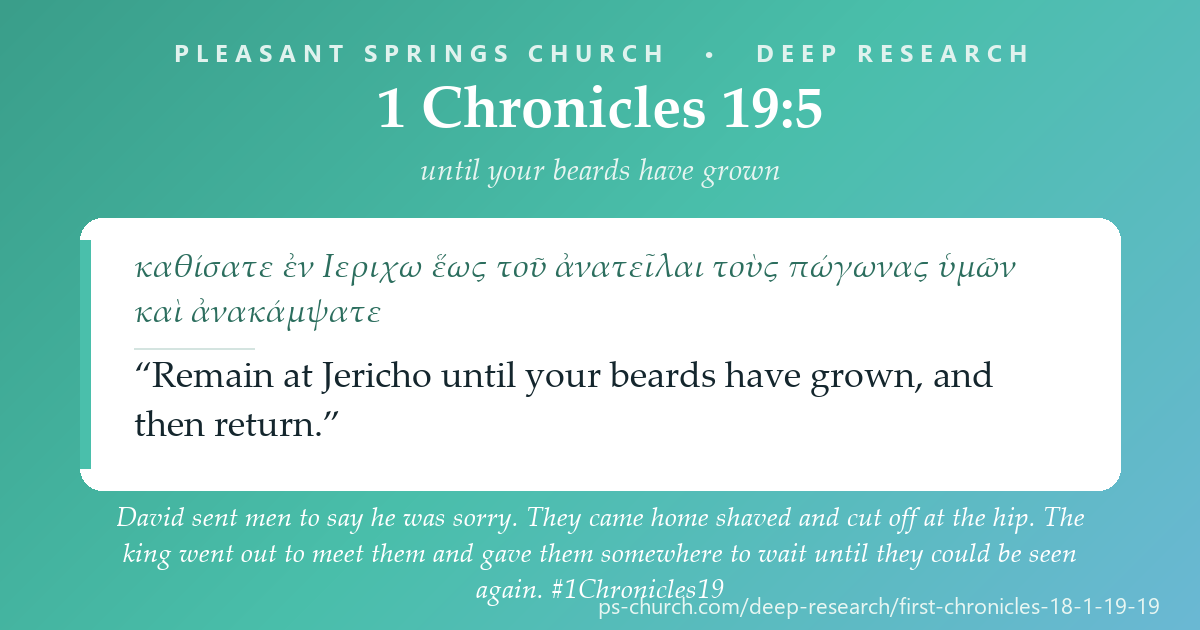
19:5 — twelve words shared with 2 Samuel 10:5: and he sent to meet them, for the men were greatly humiliated, and the king said, remain at Jericho until… An embassy comes home from Ammon shaved and half-dressed, and the king goes out to meet it.
What that is and is not. It is not evidence that the two verses were written to be read together; a screen cannot see intention. It is a fact about the surface of the text: the two places where these chapters and 2 Samuel run longest together are both scenes of a delegation. Read them side by side and the passage acquires a shape it does not announce — one king honours another’s messengers, one king mutilates them, and the wars in both chapters follow from how the messengers were treated. That reading is offered as a reading. The twelve, the twelve, and the two tie bands of 1 are the measurement.
One word for loyalty that started a war, one for the shame that followed it, and a verb of sending that runs the whole second chapter.
Read ḥesed in 19:2 and then read what Hanun’s advisers say about it in 19:3. Then count the occurrences of šālaḥ through chapter 19 — there are seven — and notice what the last one turns into.
“Steadfast love, loyalty, covenant kindness.” The reason David gives for the embassy: “I will do ḥesed with Hanun… for his father did ḥesed with me.” The word covers both ends of a relationship — the generosity and the obligation it creates — and here it is doing diplomatic work: a debt between houses, honoured across a generation. The whole war starts because that word was not believed. The Greek renders it ἔλεος, “mercy,” which is the Septuagint’s usual choice and is why the New Testament’s eleos carries so much Hebrew freight.
“Humiliated, disgraced, put to shame” — niphal participle of kālam. Not embarrassment; the loss of public face, the state of a man who cannot be seen. It is the word the prophets use of a nation shamed before the nations. The Greek has ἠτιμωμένοι, “dishonoured, stripped of timē.” David’s response addresses exactly that and nothing else: not vengeance first, but Jericho, and a wait, and then come back.
“To send.” The verb appears eight times in these two chapters — once in chapter 18, seven times in chapter 19 — and it drives the whole plot: David sends comfort, the counsellors ask whether David has really sent comforters, Hanun sends the men away, David sends to meet them, Ammon sends silver, David sends Joab, Aram sends beyond the river. Chapter 19 is a chapter about what people do with the messengers they are sent. Counted, not estimated. And the last verb of that shape in the chapter is not šālaḥ but šālam — וַיַּשְׁלִימוּ, “they made peace” (19:19). Whether anyone was meant to hear that is not something a screen can tell you.
“Tribute” — and, in Leviticus, “grain offering.” One word for what a conquered people carries to a king and for what a worshipper carries to God. The Greek here does not press it: Paraleipomenon has δῶρα, “gifts,” where 2 Reigns has ξένια, “guest-gifts.” The theological point in the chapter is not made by the word but by what David does with the goods: 18:11, he consecrates them (hiqdîš) to the Lord.
“And the Lord saved / gave victory to” — hiphil of yāšaʿ, the root behind yəšûʿāh, “salvation,” and behind the names Joshua and Jesus. It carries the refrain that brackets the middle of chapter 18. In the Greek of Chronicles it is an imperfect — ἔσῳζεν, “kept saving” — where 2 Reigns has the aorist ἔσωσεν, “saved,” at both of its matching verses. That is a translator’s aspect choice, made consistently in each book, and it is reported here as an observation about the Greek and not as an argument about the Hebrew. The same root returns at 19:12 (“then I will save you”) and 19:19 (“Aram was not willing to save Ammon”).
“Be strong, and let us strengthen ourselves.” An imperative followed by a cohortative — Joab tells Abishai to be strong and then includes himself in the effort. The pairing is the standard Hebrew charge before a hard thing: Joshua 1:6–9, and later in this same book at 22:13 and 28:20, where David says it to Solomon about building the temple. The Greek does something a translation has to do: it renders the first word ἀνδρίζου, “be a man, play the man” — the same verb it uses at Joshua 1 and at Deuteronomy 31, and the verb behind Paul’s ἀνδρίζεσθε in 1 Corinthians 16:13.
“The first ones, the chief ones.” 1 Chronicles 18:17 says David’s sons were hāriʾšōnîm — the chief officials — ləyad hammelek, “at the king’s hand.” 2 Samuel 8:18 says they were כֹּהֲנִים, kōhənîm, priests. The Greek of Chronicles reads οἱ πρῶτοι διάδοχοι τοῦ βασιλέως, “the king’s first successors”; the Latin has primi ad manum regis, and Jerome’s Samuel keeps sacerdotes erant. The Greek 2 Reigns 8:18 held here does not say “priests” either — Rahlfs reads καὶ υἱοὶ Δαυιδ αὐλάρχαι ἦσαν, “and David’s sons were court officers.” So the Hebrew and the Latin of Samuel keep the difference and the Greek of Samuel does not. What the difference means is argued in the commentaries and is not settled here.
Two things here reported rather than tidied:
- The numbers differ between the accounts, and this page does not reconcile them. 1 Chronicles 18:4 has David take 1,000 chariots, 7,000 horsemen and 20,000 foot; 2 Samuel 8:4 has 1,700 horsemen and 20,000 foot and does not mention the thousand chariots in the same terms. 1 Chronicles 19:18 has David kill 7,000 chariot crews and 40,000 foot soldiers; 2 Samuel 10:18 has 700 chariot crews and 40,000 horsemen. The standing uncertainty about אֶלֶף (ʾelep — “thousand,” or a military unit of unspecified size) applies here as everywhere and is unsettled. The figures are printed; no arithmetic is performed on them.
- The Greek and the Hebrew do not always agree about who was ashamed. At 19:6 the Hebrew has the Ammonites realising they had made themselves a stench to David; the Greek has ᾐσχύνθη λαὸς Δαυιδ — “the people of David were put to shame.” Similarly at 18:13 the Hebrew puts the garrisons “in Edom” and the Greek puts them ἐν τῇ κοιλάδι, “in the valley.” Both columns are printed as they stand. Which reading is older is a question about a Hebrew manuscript nobody here has.
The parallel measured verse by verse, the four places it comes apart, and the New Testament run that means nothing.
Every verse of 1 Chronicles 18–19 was screened against the whole Masoretic corpus, and every verse of Paraleipomenon A 18–19 against the whole Greek New Testament. The runs below are contiguous whole word forms, never lemmas, and every one carries its tie band.
What the Hebrew screen found:
The parallel is not approximate. Screened against the 23,204-verse Masoretic corpus held here — every verse of the Hebrew Bible outside the source chapter — all 36 verses of 1 Chronicles 18–19 have a verse of 2 Samuel 8 or 2 Samuel 10 inside their tie band, with one exception; and for 28 of the 36 the deepest match in the entire Hebrew Bible lies only in those two chapters. The distribution of deepest runs, verse by verse: nine reach three, six reach four, ten reach five, five reach six, three reach seven, one reaches nine, and two reach twelve. Nothing falls below three. A run of 0 on this screen would mean a verse sharing no two consecutive words with anything else in the Hebrew Bible; there are none here.
And the alignment holds in order. 1 Chronicles 18:1–11 tracks 2 Samuel 8:1–11 verse for verse; 19:1–6 tracks 2 Samuel 10:1–6; from 19:8 to 19:15 the two run one verse apart (19:8 beside 10:7, 19:15 beside 10:14) and then re-synchronise at 19:16–19 beside 10:16–19. The offsets open and close where each book adds or compresses a sentence — which is what the screen is good for, and is as far as it goes.
- The two twelves. 1 Chronicles 18:10 with 2 Samuel 8:10, and 1 Chronicles 19:5 with 2 Samuel 10:5. Both tie band 1. Both about an embassy. See the Stage 2 panel.
- The nine. 1 Chronicles 18:15 with 2 Samuel 8:16, tie band 1 — the cabinet list: “and Joab son of Zeruiah over the army, and Jehoshaphat son of Ahilud recorder.” A roster of names is exactly the kind of material that copies verbatim, and it should be read as less remarkable than the twelves, not more.
- The formulas, printed as formulas. 1 Chronicles 19:7 reaches only three, and four of the five verses tied at that depth are not in Samuel at all: שְׁנַיִם וּשְׁלֹשִׁים אֶלֶף, “thirty-two thousand,” shared with Numbers 1:35, 2:21, 26:37 and 31:35. The fifth is 2 Samuel 10:6. Tie band 5. That is a number, not a quotation. 1 Chronicles 19:18 likewise reaches three with a tie band of 4. A page that prints its twelves without printing these would be misleading.
The four places the copy comes apart — measured, not selected:
- (1) 18:17 — the one verse in 36 whose deepest match is not its own counterpart. Its deepest run in the whole Hebrew Bible is four words, tie band 2, shared with 1 Kings 4:4 (and Benaiah son of Jehoiada over…) and 2 Samuel 20:23 (…son of Jehoiada over the Cherethites). Its run with 2 Samuel 8:18 is only three, because 2 Samuel 8:18 has no עַל. That is a coincidence of one Hebrew preposition and nothing more — but the verse it lands on is the one that ends differently: “David’s sons were priests” (2 Sam 8:18) against “David’s sons were the chief officials at the king’s side” (1 Chr 18:17). The screen was not told to look for that verse. It surfaced it.
- (2) 18:8 — the sentence the Greek 2 Reigns has and the Hebrew 2 Samuel does not. In Hebrew this is one of the weakest rows in the chapter: three words shared with 2 Samuel 8:8, because 1 Chronicles carries a whole extra clause — with it Solomon made the bronze sea and the pillars and the vessels of bronze — that the Masoretic 2 Samuel 8:8 lacks. In Greek the same two verses share ten consecutive words, ἐποίησεν Σαλωμων τὴν θάλασσαν τὴν χαλκῆν καὶ τοὺς στύλους καὶ — because the Greek 2 Reigns 8:8 has the clause. Three witnesses, and they do not line up the obvious way: Masoretic 2 Samuel lacks it; Greek 2 Reigns has it; the Vulgate’s 2 Samuel, made from Hebrew, lacks it (tulit rex David æs multum nimis, and stop); the Vulgate’s Chronicles has it. The place where Chronicles looks most like an addition in Hebrew is the place where a Greek manuscript tradition says it is not one. This page draws no conclusion about which text is prior — it prints the four witnesses and stops.
- (3) 19:13 — Joab’s speech, and why the run stops at six. 1 Chronicles 19:13 and 2 Samuel 10:12 are the same sentence. The shared run is six words and then it breaks, at וַיהוָה. Two things differ, and both are tiny. The verb let us strengthen ourselves has a cohortative ה here (wənitḥazzəqāh) and not there (wənitḥazzaq) — the two-word sequence ḥăzaq wənitḥazzəqāh occurs in exactly one verse of the Hebrew Bible and ḥăzaq wənitḥazzaq in exactly one other. And the last three words are in a different order: and the Lord will do what is good in his eyes (2 Sam 10:12) against and the Lord — what is good in his eyes — will do (1 Chr 19:13). Both Greek translations reproduce their own side’s word order, and so does the Latin: 2 Reigns κύριος ποιήσει τὸ ἀγαθόν and Vulgate Dominus autem faciet quod bonum est; Paraleipomenon κύριος τὸ ἀγαθὸν ἐν ὀφθαλμοῖς αὐτοῦ ποιήσει and Vulgate Dominus autem, quod in conspectu suo bonum est, faciet. Three independent translators, each following the Hebrew in front of him. That does not tell us which order is older. It does tell us the difference is older than any of the three translations.
- (4) 18:6 and 18:13 — the refrain, and how rare it is. בְּכֹל אֲשֶׁר הָלָךְ — “in all that he went” — occurs in exactly four verses of the Hebrew Bible: 2 Samuel 8:6, 2 Samuel 8:14, 1 Chronicles 18:6 and 1 Chronicles 18:13. Its Greek equivalent, ἐν πᾶσιν οἷς ἐπορεύετο, occurs in exactly four verse units of the 30,348 screened — and they are the same four places. In both books the four words bracket the same block: the bronze, the foreign embassy, and the dedication of the spoil. The bracket is in both books and it survives translation intact. One small variation inside it: 18:6 has lədāwîd where 18:13 and both Samuel verses have ʾeṯ-dāwîd.
What the New Testament screen found — and the counter-example this page prints:
Every verse of Paraleipomenon A 18–19 was screened against all 7,927 verses of the Greek New Testament, with MorphGNT’s own spelling equivalences applied (ou / ouk / ouch, ek / ex, the movable nu), so a run is not cut at a word the two editions merely spell differently. The result, in the tool’s own words: “Across the 36 CATSS rows against 7,927 verses of the Greek New Testament: all 36 reach two, 21 reach three, 6 reach four, 1 reach six, and nothing reaches seven.”
Nothing in these two chapters is quoted anywhere in the New Testament, and the measurement agrees. The single deepest run is six words at 1 Chronicles 19:15, tie band 1, against Mark 14:16: καὶ ἦλθον εἰς τὴν πόλιν καί — “and they came into the city, and…” In Chronicles it is a defeated army shutting a gate behind it. In Mark it is two disciples walking in to prepare the Passover. It is a coincidence of ordinary narrative Greek and it means nothing at all, and it is printed here first, before the runs that might be worth something, so that no reader mistakes a depth of six for a citation.
The four-word runs behind it are the same kind of thing: καὶ πάντα τὰ σκεύη at 18:10 against Hebrews 9:21 (tie band 1), τοῦ θεοῦ ἡμῶν καί at 19:13 against 2 Thessalonians 1:12, 2 Peter 1:1 and Revelation 12:10 (tie band 3), and καὶ ἦλθον εἰς τό at 19:7 against Mark 5:1 (tie band 1), and two more of the same order — 19:2 against Matthew 10:35 and 19:9 against Acts 14:4, both tie band 1. Formulas, all of them. The honest report on this passage is that its New Testament contact is nil.
- Where the passage genuinely reaches forward, it does so by theme and not by words. Joab’s “be strong” at 19:13 is rendered ἀνδρίζου, the same imperative the Greek uses at Joshua 1:6 and Deuteronomy 31:6–7 and that Paul uses at 1 Corinthians 16:13, ἀνδρίζεσθε. That is a shared Septuagint idiom, not a quotation of this verse, and the measurement does not and cannot show otherwise. It is listed as a lexical observation.
- 2 Samuel 8 and 2 Samuel 10 — read them beside these chapters with both columns open. That is the primary cross-reference and everything above is a measurement of it.
- 1 Chronicles 20:1 — the Ammonite war does not end at 19:19. It resumes at the fall of Rabbah, in the chapter where this book keeps the opening line of 2 Samuel 11 and leaves out the story it introduces. That page covers it.
- 1 Chronicles 17:8 — “…cut off all your enemies from before you.” Chapter 18 begins immediately after that promise and reads like its receipt: the nations of 17:8 are the nations of 18:1–13, in a list.
- 1 Chronicles 22:8 and 28:3 — the verdict these chapters supply the evidence for. “You have shed much blood and have waged great wars.” Note that neither verse calls the wars sinful, and 18:6 and 18:13 have just called them victories God gave. The page that handles that tension is 18:1–22:19.
The standard literature, the questions that are genuinely open, and an explicit list of what this page could not check.
Knoppers, Japhet, Klein and Williamson on the unit; Pitard and Younger on the Arameans. Then the limits — which on this passage are unusually important, because the interesting finding is a textual one and the tools here are not textual-critical tools.
Commentaries & studies:
- Gary N. Knoppers, 1 Chronicles 10–29 (Anchor Yale) — the fullest recent treatment of the Samuel parallels in these chapters, including the Greek and Qumran evidence.
- Sara Japhet, I & II Chronicles (OTL) — on the war catalogue as a theological structure and on 18:8 as part of the book’s temple-building programme.
- Ralph W. Klein, 1 Chronicles (Hermeneia) — the technical notes on the numbers and on the relationship of the Chronicles text to the Greek and Qumran forms of Samuel.
- H. G. M. Williamson, 1 and 2 Chronicles (NCBC) — concise, and good on why the Chronicler keeps the wars at all.
- Wayne T. Pitard, Ancient Damascus; K. Lawson Younger Jr., A Political History of the Arameans — for Zobah, Aram-naharaim, Maacah and the shape of the Aramean polities. (Critical historiography; used for geography and inscriptions, and weighed.)
- Dominique Barthélemy, Les devanciers d’Aquila; Emanuel Tov, Textual Criticism of the Hebrew Bible — the standard entry points to the recensional history of the Greek Reigns text and to the Qumran Samuel scrolls. Named because this page’s central finding sits squarely in their territory and it did not have their tools.
⚠️ What this page could NOT check — and where it is weakest:
- No Qumran text was consulted, because none is held here. 4QSama is the single most important witness to the question this page raises — it has repeatedly shown Chronicles agreeing with a Hebrew Samuel that is not the Masoretic one — and it is not on disk. Everything said above about 18:8 is said from the Masoretic Hebrew, the Rahlfs Greek and the Vulgate only. NOT VERIFIABLE FROM LOCAL CORPORA.
- The Greek here is Rahlfs, not a critical edition. The CATSS files are a digitisation of Rahlfs’s Septuaginta: no apparatus, no Göttingen readings, no Lucianic or Antiochene text, no Old Latin. The recensional history of Greek Samuel–Kings — the kaige question, where the boundaries of the recensional sections fall, and what any of it implies for 2 Reigns 8 and 10 — cannot be settled from what is on this disk, and this page does not try. When Stage 4 says “the Greek 2 Reigns has the clause,” that means Rahlfs’s text has it, and no more.
- The Vulgate readings are from a Clementine-tradition text, not a critical Vulgate. They are used as a fourth witness of convenience, and their weight in a textual argument is correspondingly limited. For 18:8 the Latin is doing real work in the argument, which is exactly why the limitation is stated here rather than buried.
- No Peshitta, no Targum, no Josephus in Greek was screened. Josephus is cited from the standard English of the Antiquities for content only; his text was not run through any screen.
- The commentaries above were not consulted at first hand for this page. They are named as the standard literature on the passage so that a reader can go further, and no claim on this page rests on any of them. Every number here comes from the corpora on disk and can be re-derived.
- The English is hard-set in the builder. No ESV API key has ever been issued to this site, so the ESV text in the codex was typed from the printed edition rather than machine-verified against Crossway’s. The Hebrew and Greek columns are generated from the corpora and can be regenerated; the English cannot be, and that is the weakest link in the codex.
- What remains genuinely open. Whether these chapters and 2 Samuel 8 and 10 stand in a relationship of dependence in either direction, or both draw on a common source, is not decided here and is not decidable by a run screen. Whether the extra clause at 18:8 was lost in the Masoretic 2 Samuel or added in Chronicles is exactly the kind of question 4QSama speaks to and this page cannot. Why 2 Samuel 8:18 calls David’s sons priests — and whether 1 Chronicles 18:17 is interpreting that, correcting it, or reading a different Hebrew — is argued in every commentary listed and is not resolved on this page.
What a king does with shamed men, what Joab says before a battle he might lose, and where the metal went.
Name what you learned, why it matters, and one concrete response.
What should we carry away — and do?
- “Remain at Jericho until your beards have grown.” The men had been disgraced doing their job. The king did not tell them to get over it, and he did not parade them as a grievance. He gave them a place to be out of sight and time to become themselves again, and he went out to meet them first. Shame needs somewhere to sit and something to wait for. Both are practical, and both are in the verse.
- The war began because kindness was assumed to be a trick. David sent ḥesed; Hanun’s advisers told him it was reconnaissance; and the whole two-front catastrophe of chapter 19 follows from that reading of a good act. Somebody in your life is currently being told that your kindness has an angle. And somebody is telling you that about someone else’s.
- “May the Lord do what seems good to him.” Joab is not being pious. He has just divided his army, given half to his brother, and agreed a plan for whichever of them collapses first. The sentence comes after the planning, not instead of it — and apart from the dedication of the spoil at 18:11 it is the only thing said about God in either chapter that is not a victory report.
- One concrete response. Think of the last time you were embarrassed doing something right. Now find the person in your church or family who is in that position this month, and do the two things David did: go out to meet them, and give them somewhere to wait. Do not make a speech about it.
1 Chronicles 19:13 · to share
Hebrew + Greek (Rahlfs, Paraleipomenon A) + ESVEvery Deep Research page traces its passage across the whole sweep — the Old Testament, the Second-Temple world between the testaments (historical witnesses, not Scripture), and the New Testament. Follow the thread:
Pleasant Springs Church — Deep Research
Research method after Michael S. Heiser’s Bible Research Method (examine dictionaries → ancient literature → important words → textual connections → academic publications → share), with the Pleasant Springs “Author & Audience” foundation. Scripture set in the Hebrew, the Greek editions named on each page and the ESV (Old Testament), and the Greek New Testament and the ESV (New Testament), per the practice of Pleasant Springs Church. 1 Chronicles 18–19 research grounded in Knoppers (Anchor Yale), Japhet (OTL), Klein (Hermeneia) and Williamson (NCBC), with Pitard and Younger on the Arameans. Book name: in the Septuagint this book is Paraleipomenon A, Παραλειπομένων Αʹ; the Hebrew title is דִּבְרֵי הַיָּמִים. Text & numbering: Hebrew from the Masoretic Text (Sefaria, Miqra according to the Masorah), cantillation retained; Greek from Rahlfs’s Septuaginta (CATSS digitisation), printed without editorial punctuation and with proper names unaccented; English ESV. Chapters 18 and 19 are numbered alike in Hebrew, Greek and English and the verse counts match exactly — 17 and 19 — with nothing missing from Rahlfs and nothing extra; counted against both corpora on disk, not assumed. There is no versification offset in this passage. Measurements. The Hebrew screen ran every verse of 1 Chronicles 18–19 against the whole 23,204-verse Masoretic corpus held here, minus the source chapter itself; runs are contiguous whole consonantal word forms, never lemmas and never roots, with the qere read, cantillation and vowel points removed, final letters folded and maqqef treated as a word separator. A row of 0 on that screen would mean a verse sharing no two consecutive words with any other verse in the Hebrew Bible; none of these 36 is such a row. The Greek New Testament screen ran every verse of Paraleipomenon A 18–19 against all 7,927 verses of the SBLGNT via MorphGNT, with the edition’s own spelling equivalences applied (ou / ouk / ouch, ek / ex, the movable nu), so figures here are higher than any run figure published on this shelf before 30 August 2026 and were re-measured rather than copied. Phrase counts on the Greek side were exhaustive over 30,348 verse units — the 30,637 units of the 64 CATSS files held, less the Odes, which are excluded from run screens because they are second copies of material already counted elsewhere (Ode 9 is Luke 1, Ode 13 is Luke 2, and ten more repeat Exodus 15, Deuteronomy 32, 1 Samuel 2, Habakkuk 3, Isaiah 5, Isaiah 26, Isaiah 38, Jonah 2 and Daniel 3). Every run on this page is reported with its tie band. ⚠️ Direction of influence is never asserted. The page says that 1 Chronicles 18–19 and 2 Samuel 8 and 10 share material, where, and how much; it does not say which is prior, that either writer saw the other, or that both drew on something older. Differences are printed, not reconciled: the extra clause at 18:8 (present in Chronicles in Hebrew, Greek and Latin; present in the Greek 2 Reigns 8:8; absent from the Masoretic and Vulgate 2 Samuel 8:8); “priests” against “chief officials at the king’s side” at 2 Samuel 8:18 / 1 Chronicles 18:17; the reordered clause in Joab’s speech at 2 Samuel 10:12 / 1 Chronicles 19:13; and the chariot and casualty figures, on which no arithmetic is performed and the unsettled question of אֶלֶף is named as unsettled. MT/LXX divergences inside the passage are disclosed rather than smoothed — 18:13 (“in Edom” against ἐν τῇ κοιλάδι) and 19:6 (a stench to David against “the people of David were shamed”). Limits are stated in Stage 5 and are load-bearing: no Qumran text is held here, so 4QSama — the most important witness to the 18:8 question — could not be checked; the Greek is Rahlfs and not a critical edition, so nothing is claimed about the recensional history of Greek Reigns; the Vulgate readings come from a Clementine-tradition text; the commentaries named were not consulted at first hand and no claim rests on them; and the ESV column was typed from the printed edition because no ESV API key has ever been issued to this site. The literary structure is labelled a sequence in two panels and not a chiasm, because that is what the text is; the one bracket called an inclusio is a four-word phrase counted in both corpora, and the envelope in Panel II is offered explicitly as a reading rather than a count. Second-Temple and later witnesses (Josephus, the Amarna letters, Assyrian reliefs, the Kurkh Monolith, the Tel Dan stele, Herodotus) are read as witnesses and never levelled with Scripture. Typology is handled per the house position: what the text says, what the New Testament itself draws, and what we see from this side of the cross — with the seeing left to the reader.
Scripture quotations marked ESV are from the ESV® Bible (The Holy Bible, English Standard Version®), © 2001 by Crossway, a publishing ministry of Good News Publishers. ESV Text Edition: 2016. Used by permission. All rights reserved. The ESV text may not be quoted in any publication made available to the public by a Creative Commons license, and the ESV may not be translated in whole or in part into any other language. www.esv.org
|
Did this study bless you today? 💚 Give to Support PS Church100% of gifts go to the General Fund — thank you. |