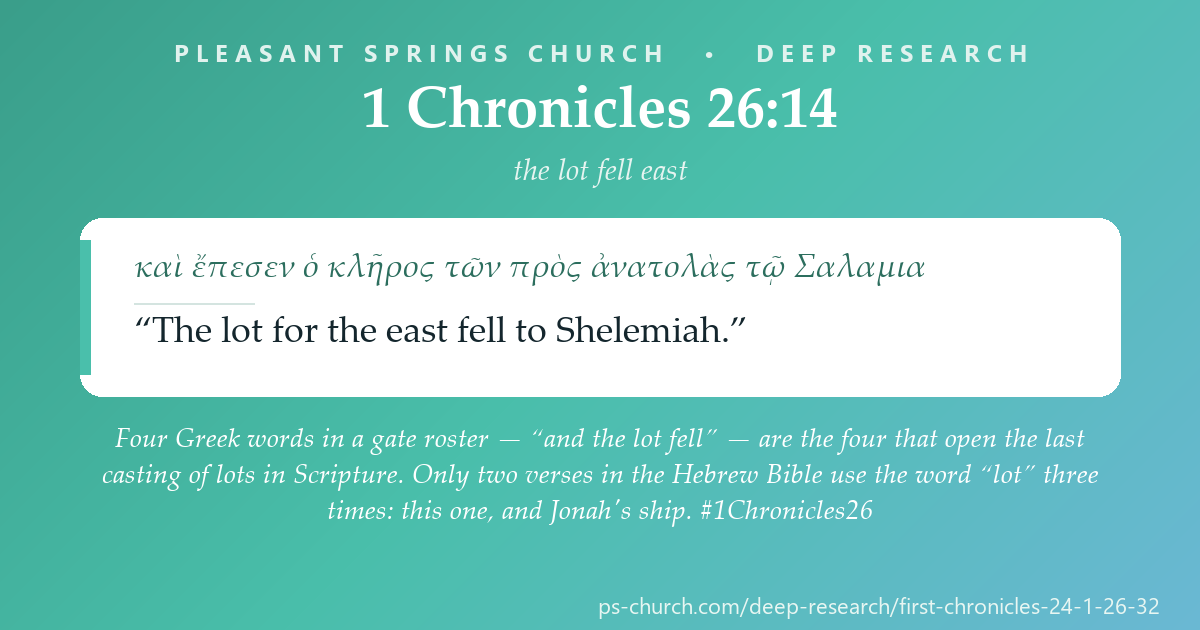
These are the chapters most Bible-reading plans quietly skip: twenty-four priestly courses, twenty-four choirs, and ninety-odd doorkeepers assigned gate by gate. So they were measured before they were written about, and the measurement chose the subject. Chapter 24 opens on the deepest Hebrew run in all three chapters — five consecutive words shared with Exodus 28:1, the four sons of Aaron — and then the very next verse runs four into Numbers 3:4, the day two of those four died childless. The whole twenty-four-course system exists because half of the founding priesthood left no line. Then the lot: the word appears nine times in these three chapters, three times over in a single verse, 26:14 — and only three verses in the entire Hebrew Bible use it three times — this one, Jonah 1:7 and Leviticus 16:8, the two goats. In Greek that same verse opens with four words, καὶ ἔπεσεν ὁ κλῆρος, which are the four words that open the last casting of lots in Scripture, Acts 1:26. The verse in these chapters that reaches furthest is a note about who got the east gate. And because depth alone proves nothing, the page prints its own counter-examples beside it: three other rows in these chapters reach the same depth of four, on nothing more than “and his brothers.” See the method →
1 Chronicles 24:1–26:32 (selections)
Hebrew · Greek (Rahlfs, Paraleipomenon A) · ESVStart where the chapter starts. Run 1 Chronicles 24 against the whole Masoretic corpus and the deepest row in all three chapters is the very first one: 24:1 shares five consecutive words with Exodus 28:1 and with 1 Chronicles 5:29 — Aaron, Nadab and Abihu, Eleazar and Ithamar, tie band 2. The next verse runs four, tie band 1, into Numbers 3:4: and Nadab and Abihu died before. So the chapter of the twenty-four priestly courses opens by naming Aaron’s four sons and then, in the next breath, recording that two of them died childless. The whole rota exists because half of the founding priesthood left no line. The system is built on a subtraction, and the text says so in its first two verses.
Then the lot. גּוֹרָל (gōrāl) occurs 77 times in the Masoretic corpus — 73 spelled full, גורל, and four defectively, גרל; 13 of those are in 1 Chronicles and nine of the thirteen fall inside these three chapters — 24:5, 24:7, 24:31, 25:8, 25:9, 26:13 and three times over in 26:14. That last figure is the one worth stopping on: exactly three verses in the Hebrew Bible carry the word three times — Leviticus 16:8, 1 Chronicles 26:14 and Jonah 1:7 (Leviticus spells one of its three defectively, גֹּרָלוֹת), and the Hebrew screen pairs 26:14 with Jonah on its own. The deepest thing 26:14 shares with anything is two words, band 2, and it is two different pairs: וַיִּפֹּל הַגּוֹרָל, “and the lot fell,” with Jonah 1:7, and הִפִּילוּ גּוֹרָלוֹת, “they cast lots,” with Nehemiah 11:1.
In Greek the same verse goes further. Screened against all 7,927 verses of the Greek New Testament, 26:14 runs four words with Acts 1:26 — καὶ ἔπεσεν ὁ κλῆρος, tie band 1, the opening of the last casting of lots in Scripture, the choosing of Matthias. Across the 30,348 screened verse units of the CATSS Greek files held here — the 30,637 units of the 64 files, less the Odes — that four-word sequence occurs three times — 1 Chronicles 26:14, Esther 3:7, Jonah 1:7 — and once in the Greek New Testament. Four times in the whole Greek Bible we hold.
⚠️ And now the counter-example, because it is printed here on purpose. Four is also the deepest anything in these chapters reaches in Greek, and eight rows reach it. Three of those eight reach four on καὶ οἱ ἀδελφοὶ αὐτοῦ — “and his brothers” — matching Matthew 12:46, Matthew 13:55, Mark 3:31 and Luke 8:19 with a tie band of 4. Another, 26:10, runs four with a band of 1 into Luke 15:20, αὐτὸν ὁ πατὴρ αὐτοῦ, the father running to meet the prodigal. Nobody thinks a Merarite gate roster is quoting that parable. Depth alone proves nothing. What makes 26:14 worth printing is not that it reaches four but that the four words are a fixed formula for one specific act, that the formula is rare in the corpus, and that Acts 1:26 is performing the act. And even then: 1 Chronicles 26:14 is not the Greek Old Testament verse closest to Acts 1:26. Jonah 1:7 is, at five — καὶ ἔπεσεν ὁ κλῆρος ἐπὶ. This page is reporting the second-best match and saying so.
The text and the numbering. In the Septuagint this book is 1 Paraleipomena, “things omitted” — Παραλειπομένων Αʹ (Paraleipomenōn A). There is no versification offset anywhere in this passage. Chapters 24, 25 and 26 carry 31, 31 and 32 verses in the Masoretic Text and 31, 31 and 32 in Rahlfs — counted in both columns, not assumed. Across the whole book the counts differ in only two chapters, neither of them here: chapter 1 (Masoretic 54, Rahlfs 42) and chapter 16 (Masoretic 43, Rahlfs 42).
⚠️ Where the two columns say different things. They are flagged row by row above rather than smoothed: a Greek plus at 24:2 and another at 24:3; “officers of the Lord” against “officers of God” at 24:5; ἔλαβον against וַיַּפִּילוּ at 24:31 with an untranslated αρααβ beside it; Αβιασαφ for אָסָף at 26:1; a second half of 26:14 in which Rahlfs reads “sons of Ioas” for “his son,” adds a name, and has nothing for “a shrewd counsellor”; only one of the two men of 26:16 and a different gate name there; and at 26:18 a Hebrew word that occurs twice in the Bible and both times in that verse, against a Greek word that describes people taking turns.
The Shape of the Passage
Sequence — not a chiasmBehind these chapters stands Numbers 3–4, where Levi is given its charge and the death of Nadab and Abihu is recorded; and Joshua 18, where a lot at Shiloh divides a country. In front of them stands a priest of the eighth course, holding a censer, drawn by lot (and the companion page on 23–27).
Author
He puts the loss first. A writer building a case for the legitimacy of the priesthood could have opened chapter 24 with the courses. Instead he opens with four names and then kills two of them: “Nadab and Abihu died before their father and had no children.” The Hebrew measurement shows the wording is shared as he does it — five words held in common with Exodus 28:1, then four with Numbers 3:4; which text stands behind which this substrate cannot measure. He is not inventing an institution; he is showing you the wound it grew around.
He is obsessed with the lot, and the obsession is a policy. Nine of the thirteen occurrences of גּוֹרָל in his book fall in these three chapters. He does not say “David appointed”; he says the lot came out, the lot fell, they cast lots — small and great alike. For a writer this committed to David’s authority, that is a striking amount of decision-making handed to a procedure that removes the king from the room.
And he will not compress the doorkeepers. Nineteen verses on who stands at which gate, including a word (26:18) that nobody since has been able to translate. He kept it because it was in his source and because the men on the doors were, to him, staff of the house of God in exactly the sense the priests were. The doorkeepers get nineteen verses; the entire reign and death of Saul got fourteen.
Audience
People who could find their own name. The twenty-four courses were a live institution in the Second Temple period, and Luke can still date an angel’s visit by naming one — “a priest named Zechariah, of the division of Abijah” (Luke 1:5), the eighth lot at 24:10. To the first readers this was not history. It was the rota, and a man could put his finger on his week.
People with almost nothing left to be head of. No king, no army, no independence — a temple, a wall and a rota. These chapters hand such a community a picture of a whole society organised outward from a house: priests, singers, doorkeepers, treasurers, and a magistrate in Gilead who answers “for everything pertaining to God and for the affairs of the king.” The only part of that picture they still possessed was the part at the centre — and the text tells them the centre is what organises the rest.
And people who might have expected to negotiate. In a small province where a handful of families held whatever status remained, the drumbeat of by lot, small and great alike, his younger brother alike, is not decoration. The exact phrase כַּקָּטֹן כַּגָּדוֹל occurs three times in the Hebrew Bible — a fourth reverses the two words at 2 Chronicles 31:15 — and its first occurrence in canonical order is Moses charging judges not to be partial (Deuteronomy 1:17). Here the same courtroom phrase stands over a duty roster; direction is not asserted.
Orient on the priestly courses, the gatekeepers, the temple treasuries and the casting of lots.
Search by topic: priests and priesthood; courses / divisions (mishmarot); Eleazar and Ithamar; Nadab and Abihu; Zadok and Ahimelech; Abijah (priestly division); gatekeepers / doorkeepers; Obed-edom; temple gates; Shallecheth; parbar; temple treasuries; lot (casting of); Urim and Thummim.
Which articles are relevant?
- Anchor Bible Dictionary — “Priests and Levites,” “Priestly Divisions,” “Nadab,” “Abihu,” “Abijah,” “Gatekeepers,” “Obed-edom,” “Temple, Jerusalem,” “Treasury,” “Lots.”
- Dictionary of the OT: Historical Books (IVP) — “Levites, Priests,” “Temple, Jerusalem,” “State Officials,” “Chronicler’s History,” “Genealogies.”
- NIDOTTE / TDOT — גּוֹרָל (gōrāl, lot), מַחְלֹקֶת (maḥlōqeṯ, division), מִשְׁמָר (mišmār, watch, guard-post), שֹׁעֵר (šōʿēr, gatekeeper), אוֹצָר (ʾōṣār, treasury), and the entry (or the shrug) on פַּרְבָּר (parbār).
- On the Greek — the NETS introduction to 1 Supplements, and Muraoka or LSJ on ἐφημερία, διαίρεσις, παστοφόριον and διαδέχομαι, which are the four Greek words doing the most work in this passage.
Bibliography surfaced:
- Gary N. Knoppers, 1 Chronicles 10–29 (Anchor Yale); Sara Japhet, I & II Chronicles (OTL); Ralph W. Klein, 1 Chronicles (Hermeneia); H. G. M. Williamson, 1 and 2 Chronicles (NCBC).
- On the courses as a working institution into the first century: the relevant sections of Emil Schürer, The History of the Jewish People in the Age of Jesus Christ (rev. Vermes–Millar), on the twenty-four mishmarot.
- On the gatekeepers specifically: J. W. Wright and the standard treatments of 1 Chronicles 26 in the commentaries above — there is no monograph on doorkeepers to match Kleinig on the singers, which is itself worth noticing.
What a rota was for, what a lot was for, and what a gate was for.
First the world: rostered sanctuary staff are an ordinary ancient institution, and the lot is an ordinary ancient decision procedure. Then the specific: a temple gate is a legal boundary, and the man on it is not a caretaker.
Which parallels shed light on these chapters?
Large sanctuaries ran on rotas, and their paperwork looks like this. Babylonian temple archives from Uruk and Sippar record prebends — the inherited right and duty to serve on named days — together with rosters, income shares and personnel lists by office. Egyptian temples ran on phyles serving by turn. The twenty-four courses are an instance of a widespread institutional form. What is distinctive is not that Israel had a rota. It is how places on it were assigned.
The lot was a decision procedure, not a game. In the Old Testament it divides land (Joshua 18:10, where the lot and the word divisions stand in a single verse), identifies a guilty party (Joshua 7:14–18; 1 Samuel 14:41–42), assigns a scapegoat (Leviticus 16:8), and here fixes a duty roster. Proverbs 16:33 states the theology without flinching: “The lot is cast into the lap, but its every decision is from the Lord.” Outside Israel the same instrument turns up as pure divination — and Esther 3:7 shows what it looks like from the other side, Haman casting pur to find a good day for a massacre.
A temple gate is a legal boundary, and a doorkeeper is a magistrate of it. The men in chapter 26 are not janitors. They decide who crosses a line that has ritual consequences, they hold keys to storerooms containing dedicated property, and 26:12 puts them in duties “corresponding to their chief men… just as their brothers did, ministering in the house of the Lord” — the same verb of service used of the priests. Ancient temple complexes everywhere had such officers; what is unusual is a national scripture that names them, counts them, and records which gate each family drew.
- Josephus, Antiquities 7.14.7 (§§363–367); Life 1–2 (Second-Temple — a witness, not Scripture) — David’s organisation of the priests into twenty-four courses retold, and Josephus identifying his own descent by course. Cited from the standard reference; no Greek text of Josephus is held in this substrate and nothing here is quoted verbatim from him.
- Luke 1:5, 8 — not an external witness but the New Testament’s own use of this system: ἐξ ἐφημερίας Ἀβιά, “of the division of Abijah,” and then ἐν τῇ τάξει τῆς ἐφημερίας αὐτοῦ, “in the order of his division.” The eighth lot of 24:10, named a thousand years later.
- m. Tamid 5:1–6; m. Taanit 4:2; m. Middot 1:1–9 (rabbinic-era — witnesses, not Scripture) — the mishmarot as a working rota, the daily lot for the day’s tasks, and the watch posts of the temple gates described as an operating system. Not held locally; cited from the standard editions, not measured.
- Babylonian temple prebend records (Uruk, Sippar); Egyptian temple phyles (ancient Near Eastern administrative documents — witnesses, not Scripture) — for the institutional form only. Nothing about the biblical text is being proved from them.
The doorway of the sanctuary is where Scripture keeps putting its hardest scenes. It is where Aaron and his sons are washed (Exodus 29:4), where the Levites stand between the people and the holy things (Numbers 3:38), where Eli sits when the ark is taken (1 Samuel 4:18), where Jeremiah is told to preach (Jeremiah 7:2), where a psalmist would rather be a doorkeeper than dwell in the tents of wickedness (Psalm 84:10), and where a tax collector stands far off and will not lift his eyes (Luke 18:13).
1 Chronicles 26 is the staffing plan for that place. East, north, south, the storehouse, and the road that goes up on the west — six at the east, four at the north, four at the south, two and two at the storehouse, and at the colonnade a number and a word nobody can translate.
What this page will not do is turn that into an allegory. The Chronicler is not writing about the door of the heart. He is writing down who was on the east gate, and the reason the list is moving is that he thought it mattered enough to write down.
A word counted, a courtroom phrase in a roster, and a word nobody can translate.
Count gōrāl across the corpus and then across the passage, and the concentration is the finding. Then run the exact phrase kaqqāṭōn kaggādōl and see where it comes from. Then read 26:18 and admit defeat.
“Lot.” 77 occurrences in the Masoretic corpus — 73 spelled full, four defectively; 13 in 1 Chronicles; nine of those thirteen inside 24:1–26:32. And 26:14 carries it three times — which puts that verse in a set of three. Only Leviticus 16:8, 1 Chronicles 26:14 and Jonah 1:7 use the word three times in one verse (Leviticus by way of the defective גֹּרָלוֹת beside two full spellings), and the Hebrew run screen independently pairs 26:14 with Jonah: the deepest thing 26:14 shares with anything in the Hebrew Bible is two words, tie band 2, and it is two different pairs — וַיִּפֹּל הַגּוֹרָל, “and the lot fell,” with Jonah 1:7, and הִפִּילוּ גּוֹרָלוֹת, “they cast lots,” with Nehemiah 11:1. The Greek is κλῆρος, from which English gets clergy.
“Small as great.” Three occurrences of this exact sequence in the whole Hebrew Bible: Deuteronomy 1:17, 1 Chronicles 25:8, 1 Chronicles 26:13 — Deuteronomy spelling the second word defectively, כַּגָּדֹל — and a fourth with the two words reversed, כַּגָּדוֹל כַּקָּטָן, at 2 Chronicles 31:15, over the distribution of food to priests in their courses. The first in canonical order is Moses charging the judges: “You shall not be partial in judgment. You shall hear the small and the great alike.” Twice here it stands over a duty roster, and both times it governs the casting of a lot. Direction is not asserted; the shared wording is. The Greek is κατὰ τὸν μικρὸν καὶ κατὰ τὸν μέγαν.
“Watch corresponding to watch.” The phrase occurs twice in the Hebrew Bible: here and Nehemiah 12:24, where it describes choirs answering each other at the dedication of the wall. The same three words cover a guard rota and an antiphon — posts set opposite posts, voices set opposite voices. מִשְׁמָר is the root behind the later name for the priestly courses, the mishmarot; its sense is both a duty you keep and a post you hold. Greek: φυλακὴ κατέναντι φυλακῆς.
Two occurrences in the entire Hebrew Bible, and both of them are in this one verse. Nobody knows what it means. The ESV guesses “colonnade”; older versions guessed “suburb,” “precinct,” “court,” “Parbar” left as a proper name. A related plural, פַּרְוָרִים, appears once at 2 Kings 23:11 for something on the west side of the temple. Rahlfs did not translate it as a place at all but as people: διαδεχομένους, “those relieving one another.” The page prints the ESV, prints the Greek, and does not adjudicate.
“Course, division, term of service.” The Greek word for a priestly rota — and it is a Chronicler’s word to a startling degree. It occurs 23 times across the 30,348 screened verse units of Greek Old Testament held here, and every single one is in Chronicles, Ezra–Nehemiah or 1 Esdras. (Greek Exodus, Leviticus, Numbers and Joshua are inside that screen and return zero; so do the Odes, the one file the screen withholds, searched separately.) In the Greek New Testament it occurs exactly twice, Luke 1:5 and Luke 1:8. The vocabulary Luke reaches for to place Zechariah in the sanctuary comes from one corner of the Greek Bible, and this is the corner.
“And the lot fell.” A fixed four-word formula. Across the 30,348 screened verse units of the CATSS Greek files held here — the 30,637 units of the 64 files, less the Odes, searched separately and returning zero — it occurs three times — 1 Chronicles 26:14, Esther 3:7, Jonah 1:7 — and in the Greek New Testament exactly once, Acts 1:26, the choosing of Matthias. Four occurrences in the whole Greek Bible we hold: a gatekeeper’s roster, a genocidal dice-throw, a storm at sea, and the replacement of an apostle. Direction of influence is not asserted and cannot be measured; what is measured is that a rare formula for one specific act appears in all four.
Three things here reported rather than tidied:
- The one-letter difference at 24:31. The Hebrew of 24:31 and of 25:8 uses the same verb, וַיַּפִּילוּ, “and they cast.” Rahlfs prints καὶ ἔλαβον καὶ αὐτοὶ κλήρους at 24:31 (“they too took lots”) and καὶ ἔβαλον καὶ αὐτοὶ κλήρους at 25:8 (“they too cast lots”). Same frame, one letter apart. Whether that is a Greek translator’s choice, a scribe’s slip in either direction, or a different Hebrew in front of him, this page cannot determine and does not guess.
- The untranslated word at 24:31. Rahlfs carries πατριάρχαι αρααβ where the Hebrew has אָבוֹת הָרֹאשׁ, “the head fathers.” αρααβ is not a Greek word; it is Hebrew in Greek letters. It is a small, visible reminder that the Greek column is a translation with seams in it and not a second original.
- Two names that do not match at 26:1. The Hebrew makes Meshelemiah “of the sons of Asaph”; Rahlfs reads Αβιασαφ, Ebiasaph — a Korahite name, and 1 Chronicles 9:19 runs a comparable line through Ebiasaph son of Korah. Both readings are printed. Whether the Greek preserves an older Hebrew or resolves a hard one is exactly the kind of question this substrate cannot answer, and it is left open.
Where the runs actually landed — including the ones that mean nothing.
Two screens were run. Hebrew: chapters 24, 25 and 26 screened one chapter at a time — 31, 31 and 32 rows — each against every other verse of the 39-book Masoretic corpus (23,204 verse units, so 23,173, 23,173 and 23,172 targets), contiguous consonantal word forms, no unigram fallback, so a row at 0 shares no two consecutive words with any other verse in the Hebrew Bible. Greek: the same 94 rows as CATSS forms against all 7,927 verses of the Greek New Testament, with MorphGNT’s spelling equivalences applied on both sides.
What the Hebrew screen returned:
Distribution over the 94 rows: 14 rows at zero, 31 at two, 44 at three, four at four, and one at five. Nothing goes deeper than five anywhere in three chapters.
The one row at five is 24:1, tie band 2 — אהרן נדב ואביהוא אלעזר ואיתמר, matching Exodus 28:1 and 1 Chronicles 5:29. The four rows at four are 24:2 (band 1, Numbers 3:4 — וימת נדב ואביהוא לפני), 24:26 (band 1, 1 Chronicles 23:21), 26:20 (band 1, 1 Chronicles 28:12) and 26:32 (band 1, 1 Chronicles 12:38). Three of those four stay inside the book. Only 24:2 reaches out of it, and it reaches to the day Aaron’s two eldest sons died.
Then the fourteen zeros, and where they sit. Six are in chapter 24 (verses 8, 9, 10, 11, 21, 22); eight are in chapter 26 (verses 2, 3, 4, 15, 18, 19, 23, 25); and chapter 25 has none at all. The reason chapter 25 has none is that its lot-list repeats a formula — his sons and his brothers, twelve — twenty-four times over, and the formula ties every verse to every other. The chapters people call repetitive contain the least repeated text in this passage, and the chapter that looks most varied is the one with no unique verse in it.
One of those zeros is 24:10 — “the seventh to Hakkoz, the eighth to Abijah” — four Hebrew words that share no consecutive pair with any other verse in the Hebrew Bible. It is also the verse that names the division Luke 1:5 names; the contact is a shared name, not a run, and no direction is claimed. Another is 26:18, the parbār verse: a verse with an untranslatable word in it turns out to share no two consecutive words with anything.
⚠️ And a caveat this page owes on its own count. Screen the three chapters one at a time, which is what the phrase “any other verse in the Hebrew Bible” requires, and the answer is fourteen zeros. Screen all 94 rows at once with the whole passage pulled out of the target pool, and it is fifteen — because 1 Chronicles 25:8 has exactly one two-word partner in the entire Hebrew Bible, and that partner is 1 Chronicles 26:13 (ויפילו גורלות, “and they cast lots,” tie band 1). The singers’ lot verse and the gatekeepers’ lot verse are, at that depth, each other’s only company in Scripture. Fourteen is the figure printed above because it answers the question actually asked; fifteen is what you get by asking a different one. Both are given so that neither can be quoted as the other.
What the Greek screen returned — with its own counter-examples:
Across the 94 rows against 7,927 Greek New Testament verses: 83 reach two, 57 reach three, eight reach four, and nothing reaches five. Eight rows are tied at the top. Here is the whole top band, printed in full so that nobody has to take the page’s word for which of them matters:
- 26:14 run 4, band 1 → Acts 1:26 — καὶ ἔπεσεν ὁ κλῆρος. A fixed formula for casting a lot, in a verse about casting a lot, matching the last casting of a lot in Scripture. This is the one the page builds on.
- 26:8 run 4, band 1 → Revelation 6:11 — καὶ οἱ ἀδελφοὶ αὐτῶν, “and their brothers.” Formula.
- 26:26, 26:30, 26:32 run 4, band 4 → Matthew 12:46, Matthew 13:55, Mark 3:31, Luke 8:19 — καὶ οἱ ἀδελφοὶ αὐτοῦ, “and his brothers.” Three separate rows in a gatekeeper roster reach exactly the depth 26:14 reaches, on a phrase that means nothing more than what it says. Print this next to the Acts run or the Acts run is being oversold.
- 26:10 run 4, band 1 → Luke 15:20 — αὐτὸν ὁ πατὴρ αὐτοῦ, the father who saw the prodigal and ran. A tie band of 1 — the strongest kind of band — on a match that is pure accident. This is the clearest demonstration on the page that a low band is not by itself evidence of anything.
- 26:27 run 4, band 1 → 1 Peter 4:17 — τοῦ οἴκου τοῦ θεοῦ, “the house of God.” A shared subject, not a shared text.
- 26:29 run 4, band 1 → Galatians 6:16 — ἐπὶ τὸν Ισραηλ τοῦ. The words either side of the run make two different sentences. Coincidence.
And the honest ceiling on the finding. Jonah 1:7 shares five consecutive Greek words with Acts 1:26 — καὶ ἔπεσεν ὁ κλῆρος ἐπί — where 1 Chronicles 26:14 shares four, because 26:14 continues τῶν πρὸς ἀνατολάς and Jonah, like Acts, continues with a person’s name. If anything in the Greek Old Testament is standing behind Acts 1:26, the measurement points at Jonah before it points here. The page reports 26:14 because it is the verse under study, not because it won.
Which cross-references matter?
- Exodus 28:1 · Numbers 3:2–4 · Leviticus 10:1–2 — the four sons of Aaron, and then two of them. This is the material 24:1–2 is holding, at five words and four words respectively. The twenty-four courses are the shape a priesthood took after a loss.
- Deuteronomy 1:17 — “you shall hear the small and the great alike”, the first in canonical order of only three occurrences of that exact sequence; the other two stand over a roster at 25:8 and 26:13, and a fourth reverses the two words at 2 Chronicles 31:15. Priority is not asserted.
- Joshua 18:10 — “And Joshua cast lots for them in Shiloh before the Lord. And there Joshua apportioned the land to the people of Israel, to each his portion.” Joshua 18:10 is the only verse in the Hebrew Bible that holds גורל and the noun מַחְלֹקֶת, divisions, together; Joshua 19:51 pairs the lot with the verb to divide instead. The vocabulary that hands out a country is the vocabulary that hands out a work rota.
- Luke 1:5, 8 — ἐξ ἐφημερίας Ἀβιά. The eighth lot at 24:10, and the Greek word for a course, both from this world. ⚠️ Note the honest limit: the measured contact here is a proper name and a technical noun, not a run. The Greek run screen puts 24:10 nowhere near the top band. The connection is real and it is lexical, not verbatim.
- Acts 1:23–26 · Jonah 1:7 · Esther 3:7 · Proverbs 16:33 — the four other places the falling lot appears, and the sentence that says what Israel thought it was. See Jonah, Esther and Acts 1.
- Nehemiah 12:24 · Nehemiah 11:1 — watch corresponding to watch, and a lot cast to decide who would live in Jerusalem. The two other places in Scripture that use this passage’s two rarest administrative phrases. See Nehemiah 8–13.
- 1 Chronicles 23:25–26 · 27:24 — the companion page on 23:1–27:34: the Levites told they need not carry any more, and the census that was never entered in the records. This study sits inside that one and does not repeat its verses.
What was consulted, what was not, what could not be checked, and where this page is weakest.
The commentaries first; then, at length, the limits. This section is the reason the rest of the shelf can be trusted, so it is not thinned.
Commentaries & studies:
- Gary N. Knoppers, 1 Chronicles 10–29 (Anchor Yale) — the fullest treatment of the relationship between these lists and the institutions of the Chronicler’s own day.
- Sara Japhet, I & II Chronicles (OTL) — on the internal logic of the four allotment panels and on the gatekeepers as a Levitical order rather than a servant class.
- Ralph W. Klein, 1 Chronicles (Hermeneia) — the technical work on the text of chapters 24 and 26, the Greek pluses, and the state of the name lists.
- H. G. M. Williamson, 1 and 2 Chronicles (NCBC) and his articles on whether parts of 23–27 are secondary — see the dispute noted below.
- Emil Schürer, The History of the Jewish People in the Age of Jesus Christ (rev. Vermes–Millar) — on the twenty-four mishmarot continuing into the first century, which is what makes Luke 1:5 datable at all.
⚠️ What this page did NOT consult, and could not check:
- None of the commentaries above were read for this page. They are named because they are where a reader should go next, and because every historical claim on this page that is not a measurement is standard and uncontroversial. Every number here was produced locally and can be reproduced; nothing here is a number taken from a book.
- No ESV API key exists for this project. The English column was typed from the printed ESV and checked by eye, not fetched and verified programmatically. That is a real weakness in the transcription, and it applies to every English cell above.
- The Qumran mishmarot calendars (4Q320–330) are not held here and were not consulted. They are the single most relevant body of evidence for whether the twenty-four names in chapter 24 were a live list in the Second Temple period, and this page has measured none of it. The same goes for the synagogue inscriptions from Caesarea and elsewhere that preserve course lists.
- No text of Josephus or of the Mishnah is held in this substrate. Both are cited above from standard references, and neither is quoted verbatim or measured. They are witnesses named, not witnesses examined.
- The Greek phrase and lexeme screens run over 30,348 verse units — the 30,637 units of the 64 CATSS files held here, less the Odes. The Odes are excluded from run screens on purpose, because they are duplicates: Ode 9 is Luke 1 and Ode 13 is Luke 2 copied into a Greek Old Testament manuscript, and ten more are second copies of Exodus 15, Deuteronomy 32, 1 Samuel 2, Habakkuk 3, Isaiah 26, Jonah 2, Daniel 3, Isaiah 5 and Isaiah 38. Counting them would have counted the same Greek twice. For the two claims on this page that depend on a corpus-wide negative — ἐφημερία and καὶ ἔπεσεν ὁ κλῆρος — the Odes were searched directly and separately as well, and both came back zero there too. Greek Exodus, Leviticus, Numbers and Joshua are inside the screened corpus, not outside it. Take every other count on this page as a count of the 30,348 screened units.
- The cross-corpus runs apply MorphGNT’s own spelling equivalences (ou/ouk/ouch, ek/ex, the movable nu) on both sides. That makes the figures on this page higher than those on any page built before 30 August 2026. Do not compare a run figure here with a run figure on an older page without re-measuring both.
- Direction of influence is not asserted anywhere on this page and cannot be measured by anything in this substrate. That 1 Chronicles 26:14 and Acts 1:26 share four words is a fact about two texts. It is not a claim that Luke had this verse open.
⚠️ Where this page is weakest:
- The central finding rests on four words of very ordinary Greek. And, fell, the, lot. Its tie band of 1 is a band within the Greek New Testament only — it says the phrase occurs once there, not that it is rare in Greek. The corpus counts given above (three in the Greek Old Testament held here, one in the Greek New Testament) are the real measure of its rarity, and they are counts of what we hold, not of Greek.
- Jonah 1:7 beats it. Stated plainly in Stage 4 and repeated here because it is the fact most likely to be forgotten when the page is quoted.
- Whether all of chapters 23–27 is original to the book is genuinely disputed. A long-standing argument holds that some of these lists are later additions, partly on the way 28:1 resumes from 23:2. Others defend the whole. This page treats the chapters as they stand, notes the argument, and builds nothing on either answer.
- How far the lists reflect David’s time and how far the Chronicler’s is not settled. That the courses were live in the Second Temple period is documented; that they were established in this form under David is the book’s claim. Most historians read the lists as reflecting later practice traced back to David. Claim and caution are both reported and neither is adopted.
- The literary structure above is derived from the text’s own closing formulas (24:19; 24:31; 25:8–31; 26:19) and is labelled a sequence, because that is what it is. No chiasm has been constructed here. If a commentary offers a concentric reading of 26:1–19, this page has not seen it and has not used it.
- The numbers are neither converted nor defended. 4,000 gatekeepers at 23:5; 93 named in chapter 26; 2,700 and 1,700 officers at 26:30–32. The standing question about אֶלֶף (ʾelep, “thousand” or a military unit) applies here as elsewhere and is not settled.
A system built around a loss, a roster nobody could negotiate, and a door worth naming names over.
Name what you learned, why it matters, and one concrete response.
What should we carry away — and do?
- The institution begins with the deaths. Chapter 24 could have opened with twenty-four courses. It opens with four sons and then two graves. The most organised chapter in the book starts by telling you what it is organised around the absence of. If your church has a structure, it almost certainly grew around something that went wrong, and pretending otherwise makes the structure harder to love.
- Nobody negotiated their slot. Priests, Levites, singers, gatekeepers — four rosters, four castings of lots, and twice the phrase Moses gave to judges: small and great alike. The lot was not superstition. It was a deliberate removal of the decision from the people with the most to gain — including the king. Ask what in your own church runs on lot-like fairness and what runs on who knows whom.
- Somebody wrote down who was on the east gate. Nineteen verses on doorkeepers, at the same level of detail as the priests, including a word about the west side that has defeated every translator for two thousand years. The Chronicler kept it anyway. He did not think the visible jobs were the real ones.
- One concrete response. This week, name out loud one person in your congregation whose work is structural and invisible — the one who unlocks, counts, sets out, locks up — and thank them by name, in front of someone else. That is precisely what 1 Chronicles 26 does, at length, and it is the reason we still have their names.
1 Chronicles 26:14 · to share
Hebrew + Greek (Rahlfs, Paraleipomenon A) + ESVEvery Deep Research page traces its passage across the whole sweep — the Old Testament, the Second-Temple world between the testaments (historical witnesses, not Scripture), and the New Testament. Follow the thread:
Pleasant Springs Church — Deep Research
Research method after Michael S. Heiser’s Bible Research Method (examine dictionaries → ancient literature → important words → textual connections → academic publications → share), with the Pleasant Springs “Author & Audience” foundation. Scripture set in the Hebrew, the Greek editions named on each page and the ESV (Old Testament), and the Greek New Testament and the ESV (New Testament), per the practice of Pleasant Springs Church. 1 Chronicles 24–26 research grounded in Knoppers (Anchor Yale), Japhet (OTL), Klein (Hermeneia) and Williamson (NCBC), with Schürer (rev. Vermes–Millar) on the later history of the courses — all named as where to go next; none of them was read for this page, and every figure printed here was produced locally and is reproducible. Book name: in the Septuagint this book is Paraleipomenon A, Παραλειπομένων Αʹ; the Hebrew titles it דִּבְרֵי הַיָּמִים. Text & numbering: Hebrew from the Masoretic Text (Sefaria, Miqra according to the Masorah), section markers stripped; Greek from Rahlfs’s Septuaginta (CATSS digitization), printed without editorial punctuation and with proper names unaccented; English ESV. ⚠️ Versification: there is no offset anywhere in this passage. Chapters 24, 25 and 26 carry 31, 31 and 32 verses in the Masoretic Text and 31, 31 and 32 in Rahlfs — counted in both columns, not assumed; across the whole book the counts differ only at chapter 1 (Masoretic 54, Rahlfs 42) and chapter 16 (Masoretic 43, Rahlfs 42), neither of them in this study. Measurement scope: the Hebrew screen ran chapters 24, 25 and 26 one chapter at a time (31, 31 and 32 rows) against every other verse of the 39-book Masoretic corpus — 23,204 verse units, so 23,173, 23,173 and 23,172 targets — contiguous consonantal forms, without unigram fallback — so a row at 0 means it shares no two consecutive words with any other verse, not that it shares no word; the page also prints what happens to that count if the whole passage is pulled out of the target pool at once (fifteen, not fourteen). The Greek screen ran the same 94 rows against all 7,927 verses of the Greek New Testament (SBLGNT via MorphGNT), with MorphGNT’s spelling equivalences (ou/ouk/ouch, ek/ex, movable nu) applied on both sides — which makes these figures higher than those on any page built before 30 August 2026; do not compare across that line. Corpus-wide Greek phrase and lexeme counts are over 30,348 screened verse units (of the 30,637 held in 64 files; the Odes are excluded from run screens as duplicates — Ode 9 is Luke 1, Ode 13 is Luke 2, and ten more are second copies of Exodus 15, Deuteronomy 32, 1 Samuel 2, Habakkuk 3, Isaiah 26, Jonah 2, Daniel 3, Isaiah 5 and Isaiah 38). The two corpus-wide negatives this page depends on (ἐφημερία; καὶ ἔπεσεν ὁ κλῆρος) were additionally searched in the Odes, the one file the screen withholds, and returned zero there too (Greek Exodus, Leviticus, Numbers and Joshua are inside the screened corpus, not outside it). Every run is printed with its tie band, and the page prints its own counter-examples: three rows reach the same depth of four as 26:14 on καὶ οἱ ἀδελφοὶ αὐτοῦ, one reaches four with band 1 against Luke 15:20 by pure accident, and Jonah 1:7 reaches five with Acts 1:26 where 1 Chronicles 26:14 reaches four. Direction of influence is nowhere asserted. MT/LXX differences are flagged, not smoothed: Greek pluses at 24:2 and 24:3; ἔλαβον at 24:31 against ἔβαλον at 25:8 for the same Hebrew verb; an untranslated αρααβ at 24:31; Αβιασαφ for אָסָף at 26:1; and פַּרְבָּר at 26:18, a word occurring twice in the Bible and both times in that verse, against a Greek rendering that describes people rather than a structure. The literary structure is labelled a sequence because it is one — four allotment panels closed by their own summary formulas, then two panels stepping inward and outward from the door. No chiasm has been constructed. The English is the ESV, typed and checked by eye; no ESV API key exists for this project, and that is stated as a weakness rather than hidden. Second-Temple and rabbinic witnesses are named and never levelled with Scripture, and the Qumran mishmarot calendars — the most relevant evidence for chapter 24 — are not held here and were not consulted. Typology is handled per the house position: what the text says, what the New Testament itself does with it, and what we see from this side of the cross — with the seeing left to the reader.
Scripture quotations marked ESV are from the ESV® Bible (The Holy Bible, English Standard Version®), © 2001 by Crossway, a publishing ministry of Good News Publishers. ESV Text Edition: 2016. Used by permission. All rights reserved. The ESV text may not be quoted in any publication made available to the public by a Creative Commons license, and the ESV may not be translated in whole or in part into any other language. www.esv.org
|
Did this study bless you today? 💚 Give to Support PS Church100% of gifts go to the General Fund — thank you. |