The book opens on a drinking party that runs a hundred and eighty days, and the first thing that happens is that a queen refuses to be brought out and displayed. She is deposed by law. Then a Jewish girl is taken — the verb is passive — into a harem, and becomes queen while hiding who she is. A man descended from Agag is promoted, is not bowed to by a son of Kish, and decides to kill a nation; he rolls a Persian die to pick the month and draws the twelfth, which is the only reason anyone lives. And then the question that outlived the empire: “who knows whether you have not come to the kingdom for such a time as this?” — asked, not asserted. She fasts three days, does not pray as far as the narrator will say, and answers “if I perish, I perish.” Esther is the only book in the Hebrew Bible that never names God — no YHWH, no Elohim, not once in 167 verses, counted rather than assumed. There is no prayer, no temple, no law, no miracle: only an unbroken run of coincidences that mean everything or nothing depending on what the reader supplies. The Greek translator could not bear it, and added eighty-nine verses in which Mordecai and Esther pray aloud and God is named outright. And at 5:4, four Hebrew words begin with the letters י ה ו ה. See the method →
Esther 1:1–5:14 (selections)
Hebrew · Greek (Rahlfs) · ESVThen a Jewish girl is taken — the verb is passive and there is no suggestion she volunteered — into a harem, spends a year in cosmetics, and becomes queen while concealing who she is. Her cousin uncovers an assassination plot and is not rewarded. A man descended from Agag is promoted, is not bowed to, and decides to kill not one man but a whole people. He casts pûr, the lot, to choose the month — and gets the twelfth, which is the only reason anybody survives, because it leaves eleven months for the reversal.
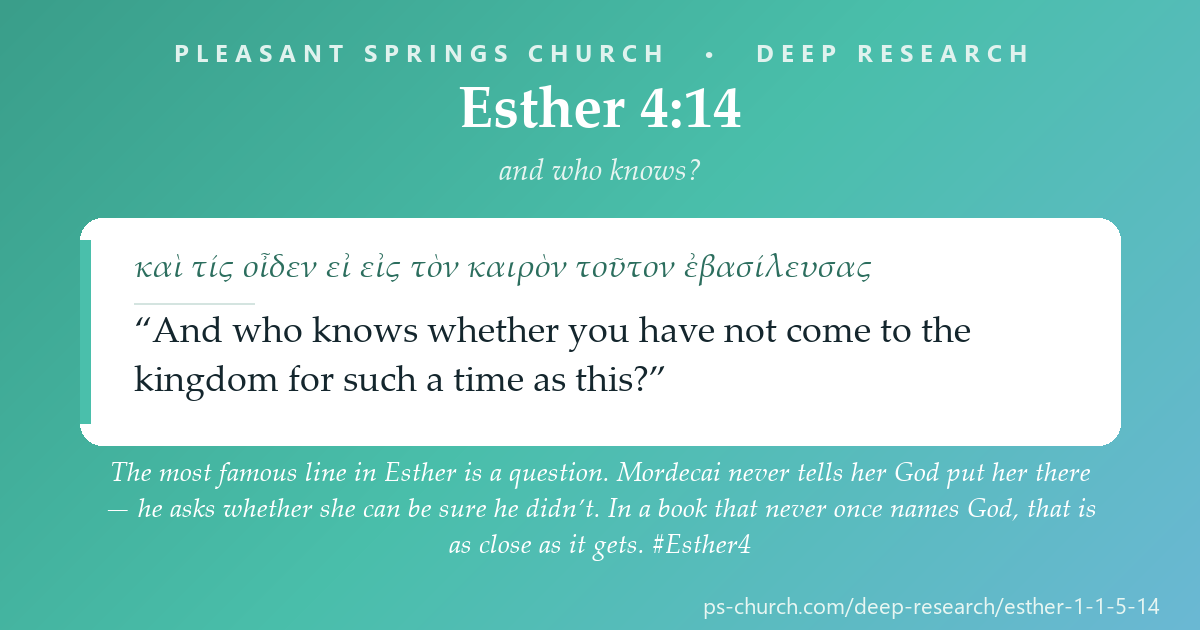
And then chapter 4, where the book stops being a court comedy. Mordecai’s message is not an appeal to Esther’s courage; it is a warning that her palace address will not save her, coupled with an extraordinary confidence that rescue will come from another place whether she acts or not. The famous line is a question, not a statement: “who knows whether you have not come to the kingdom for such a time as this?” She answers with a three-day fast — and no mention of prayer — and the flattest sentence in Scripture: “if I perish, I perish.”
⚠️ God is never named in the Hebrew of this book — counted, not assumed. Across all 167 verses of Masoretic Esther there is no YHWH, no Elohim, no Adonai, no Shaddai: zero occurrences of each. It is the only book in the Hebrew Bible of which that is true. There is no prayer, no sacrifice, no covenant, no law, no Jerusalem and no temple. The nearest the book comes is Mordecai’s “from another place” (mimmāqōm ʾaḥēr, 4:14) — and whether that is a reverent circumlocution or simply means “from somewhere else” is argued below and not settled here.
⚠️ The Greek translator did not leave it that way. Rahlfs contains six large Additions, conventionally lettered A–F, carrying 89 verses that have no Hebrew counterpart at all — counted in the CATSS text, where they appear under lettered labels (1:1a–r, 3:13a–g, 4:17a–z, 5:1a–5:2b, 8:12a–x, 10:3a–l). They add a prophetic dream, the full text of both decrees, and long prayers in which Mordecai and Esther name God outright and repeatedly. Four of the six fall inside these chapters. In the Roman Catholic and Orthodox canons these are Scripture; in the Protestant canon they are Apocrypha — witnesses, not Scripture, and they are labelled that way every time they appear on this page.
⚠️ And three verses of the Hebrew are absent from the Greek — 4:6, 9:5 and 9:30 (MT 167 verses against 164 in the canonical chapters). Counted against both columns. Only 4:6 falls in this study.
The Shape of the Passage
SequenceThe delay at 5:8 is the hinge nobody can explain. Esther has the sceptre, the king’s open offer of half the kingdom, and Haman in the room. She asks for another dinner. The narrator gives no reason. And in the gap she opens, Haman builds a gallows and the king cannot sleep — which is where the reversal begins. The book never says that anything but coincidence is at work. That restraint is the point, and it is why the Greek could not tolerate it.
Behind this book stands the exile that 2 Chronicles 36 ends on and the return that Ezra 1 begins — and the large majority who did not go back. Esther is about them.
Author
He is the most disciplined narrator in the Old Testament. He never editorialises, never moralises, and never tells you what God is doing. Vashti is deposed, a girl is taken, a genocide is scheduled and a man builds a gallows in his garden, and the narrator declines every opportunity to comment. What he does instead is arrange coincidences — the lot falls eleven months out, the king cannot sleep, the chronicle falls open at the right page — and let the reader draw the conclusion he refuses to state.
He is funny, and the humour is load-bearing. A hundred and eighty days of showing off; an empire-wide memo instructing husbands to be in charge; a man asked how to honour someone and assuming it must be himself; a fifty-cubit pole. Persian power is drawn as enormous, procedural and stupid — and for readers with no army, that is not entertainment, it is nerve.
And he knows the Hebrew Bible well enough to expect you to. Mordecai is "son of Kish, a Benjaminite" (2:5); Haman is "the Agagite" (3:1). Kish is Saul’s father and Agag is the Amalekite king Saul failed to kill (1 Samuel 15). The author states both pedigrees and connects them for you exactly never.
Audience
Jews who stayed. Not the returnees of Ezra and Nehemiah but the diaspora — living under a foreign king, with no temple in reach, holding jobs at the gate of a pagan palace. The book is set entirely outside the land and mentions Jerusalem only as a place people were once carried away from (2:6).
People for whom the danger was plausible. Haman’s speech in 3:8 is the oldest surviving version of a very durable accusation: a people "scattered abroad and dispersed," whose "laws are different from those of every other people," and who therefore should not be tolerated. The narrator gives it in full and lets it stand.
And people who needed a reason to keep a festival nobody commanded. Purim is not in the Law of Moses. It has no sacrifice, no sanctuary and no divine instruction — it is named after a Persian word for a pagan lottery. The book exists partly to explain why a feast God never ordered is worth keeping, and that question is the reason Esther’s place in the canon was debated longer than that of almost any other book.
Orient on the Persian court, on the Additions, and on the canonical argument.
Search by topic: Esther, book of; Additions to Esther; Ahasuerus / Xerxes I; Susa; Achaemenid court; Purim; pur and lot-casting; Amalek and Agag; diaspora; Alpha text of Esther; canon — disputed books.
Which articles are relevant?
- Anchor Bible Dictionary — “Esther, Book of,” “Esther, Additions to,” “Purim,” “Ahasuerus,” “Susa,” “Persia, History of,” “Amalek,” “Lots, Casting of.”
- Dictionary of the OT: Historical Books (IVP) — “Esther, Book of,” “Persian Empire,” “Diaspora Judaism,” “Feasts and Festivals,” “Humor,” “Providence.”
- NIDOTTE / TDOT — פּוּר (pûr, lot — a loanword), גּוֹרָל (gōrāl, lot), מָקוֹם (māqōm, place), רֶוַח (rewaḥ, relief, breathing space).
- On the Greek — the NETS introduction to Esther, which prints two Greek texts: the Old Greek (Rahlfs’s oʹ) and the shorter, divergent Alpha text. Both contain the Additions.
Bibliography surfaced:
- Carey A. Moore, Esther (AB) and Daniel, Esther and Jeremiah: The Additions (AB) — still the standard entry point to the Additions specifically.
- Jon D. Levenson, Esther (OTL) — and unusually, he comments on the Greek Additions alongside the Hebrew, which most commentaries do not.
- Adele Berlin, Esther (JPS) — strongest on the book as comedy and on Persian court convention.
The Achaemenid court, lot-casting, and a translator who could not stand the silence.
First the Persian material the book gets conspicuously right. Then the harder question: what the Additions are, and how to handle them honestly from a Protestant canon.
Which parallels shed light on these chapters?
The Persian detail is accurate in ways an outsider would not bother to invent. Herodotus independently describes the Achaemenid court deliberating twice — once drunk and once sober; the system of mounted couriers; the king’s register of benefactors; and Xerxes’ own temper and appetites. The book knows that Susa has a citadel distinct from the city, that decrees go out “to each province in its own script and to each people in its own language,” and that an unsummoned approach to the king is capital. Whatever else is argued about this book, the writer knew the Persian court.
Casting lots to fix a date was ordinary practice. The Hebrew glosses its own loanword — “they cast pûr, that is, the lot” (3:7) — because pûr is Akkadian, not Hebrew: pūru, a die or lot. Inscribed clay dice have been excavated at Assyrian sites, used to allocate the year’s eponym. Haman uses a pagan randomiser to pick the month, and it hands him the last one. The narrator reports this without a flicker.
And the Greek translator added the religion the Hebrew withholds. The six Additions supply a prophetic dream and its interpretation (A and F), the verbatim text of both royal decrees (B and E), and — the substantial ones — prayers by Mordecai and Esther (C) and a rewritten, heightened throne-room scene in which Esther faints and God changes the king’s heart (D). Where the Hebrew has Esther fast and say nothing, the Greek has her pray for twenty-four verses.
- Herodotus, Histories 1.133; 3.31; 7.35–37; 8.98; 9.108–113 (Greek historian — a witness, not Scripture) — deliberation drunk and sober, the royal road couriers, and Xerxes’ conduct. He names Xerxes’ queen as Amestris, not Vashti or Esther, which is the sharpest historical difficulty in the book and is not resolved here.
- Assyrian pūru dice (material evidence) — inscribed lot-cubes used to select the annual eponym, one of which survives from the reign of Shalmaneser III. The direct background to 3:7.
- The Additions to Esther, A–F (Greek, Apocrypha — witnesses, not Scripture in our confession; canonical in Roman Catholic and Orthodox Bibles) — 89 verses with no Hebrew counterpart. Addition F ends with a colophon dating the translation and naming who brought it to Egypt, which is rare and valuable evidence for how a Greek biblical book travelled.
- The Alpha text (AT) of Esther (Greek — a witness) — a second, shorter and materially different Greek Esther, surviving in a handful of manuscripts. Its existence means there is no single “the Greek Esther.”
- Josephus, Antiquities 11.6 (Second-Temple — a witness, not Scripture) — he retells Esther including the Additions, which tells you which Greek text he had.
- Qumran (material evidence) — Esther is the only book of the Hebrew Bible with no copy among the Dead Sea Scrolls. Whether that reflects rejection, the community’s calendar, or the accidents of survival cannot be determined from an absence, and this page draws no conclusion from it.
At 5:4 Esther says: “Let the king and Haman come today to the feast.” In Hebrew that is four words — yābōʾ hammeleḵ wəhāmān hayyōm — and their initial letters are י ה ו ה: YHWH. The letters are bolded in the Hebrew column above.
What can be verified. The four words are in that order in the Masoretic Text; their initials do spell the Tetragrammaton; and the same phenomenon occurs at three other points, each of which was checked here rather than taken on report. The pattern is more orderly than the claim usually made for it: at 5:4 (Esther’s invitation) and 1:20 (Memucan’s decree) it is the initial letters of four words; at 7:7 (Haman begging for his life) and 5:13 (Haman’s complaint) it is the final letters. And the direction tracks the speaker: forward in Esther’s words at 5:4 and at Haman’s fall in 7:7, and backwards in the mouths of Memucan at 1:20 and Haman at 5:13. Several medieval Hebrew manuscripts write these letters larger or differently to mark them, so the tradition of noticing this is old and is a fact about manuscripts, not a modern invention.
What cannot be verified. Whether the author did it on purpose. Four-word sequences are common and Hebrew has a small alphabet; coincidence is a live option and honest commentators say so. This page reports the acrostic as observable and its intent as unproven.
What is certain is what happened to it in Greek. Look at the middle row above. Rahlfs does not merely lose the initials — it is a different sentence, opening with a clause the Hebrew does not have at all: ἡμέρα μου ἐπίσημος σήμερόν ἐστιν, “today is my special day.” An acrostic is the one feature of a text that no translation into any language can carry. If it is there on purpose, then the book hides the divine name in a form that survives only in Hebrew — which would be an exceptionally good joke in a book about a queen who hides who she is.
A loanword, an ambiguity, a question, a passive verb and an old grudge.
Read 4:14 as the interrogative it is. Then read 2:8 and notice the voice of the verb. Then read 3:1 beside 2:5 and see what the author declines to say out loud.
“Lot, die.” A foreign word, and the text says so — “they cast pûr, that is, the lot,” glossing it with the ordinary Hebrew gōrāl because readers would not know it. From Akkadian pūru. The festival is named after it — Purim, the plural — which means the Jewish feast of deliverance is named for the pagan dice that were rolled to schedule their destruction. Compare Proverbs 16:33, which the book pointedly does not quote.
“From another place.” The closest this book comes to naming God, and it is genuinely ambiguous. Māqōm means simply “place” — but in later Jewish usage ha-Māqōm, “the Place,” becomes a standard reverent substitute for the divine name. Whether that usage is already present here or is being read back is disputed and this page does not decide it. The Greek has ἄλλοθεν, “from elsewhere” — equally noncommittal.
“And who knows?” The most famous sentence in the book is a question, and English quotation usually drops that. Mordecai does not tell Esther that God raised her up for this moment; he asks whether she can be sure he did not. The same phrase carries the same load in Jonah 3:9 and Joel 2:14 — who knows, God may yet relent. It is hope without a guarantee, which is exactly the theological register of this book.
“And if I perish, I perish.” A resolve formula — compare Jacob at Genesis 43:14, “if I am bereaved of my children, I am bereaved.” It is not confidence and it is not despair. It is a decision taken without knowing the outcome, which is what the book means by courage. Note what is not in the verse: she calls a fast, and neither she nor the narrator mentions prayer. Addition C exists because a later reader found that unbearable.
“And she was taken.” A passive. The same verb is used of the round-up of all the young women in 2:8. The text nowhere presents Esther’s entry into the harem as a career move or an act of faith; it presents it as something done to her. Readers who find the beginning of this book uncomfortable are reading it correctly — the narrator supplies no reassurance, here or anywhere.
“The Agagite.” Set against Mordecai “son of Kish, a Benjaminite” (2:5). Agag is the Amalekite king Saul spared and Samuel executed (1 Samuel 15), and Kish is Saul’s father — so the book quietly stages a rematch of a war Israel was told to finish centuries earlier, and notes at 9:10, 15 and 16 that this time they took no plunder, which is precisely what Saul did wrong. The connection is never stated. Every pedigree needed to make it is.
Three things here counted rather than assumed:
- Zero divine names in Hebrew Esther. Searching the consonantal text of all 167 verses returns no YHWH, no Elohim, no Adonai, no Shaddai. (Naive substring searches turn up apparent hits for אל and יה; on inspection these are the preposition “to” and letter-sequences inside ordinary words, not divine names. Reported because the raw count is misleading and someone repeating the search will hit it.)
- 89 Greek verses with no Hebrew counterpart, in six lettered blocks — A (18 verses at 1:1a–r), B (7 at 3:13a–g), C (24 at 4:17a–z), D (8 at 5:1a–5:2b), E (21 at 8:12a–x), F (11 at 10:3a–l). Four of the six — A, B, C and D, 57 verses — fall within this study.
- Three Hebrew verses absent from the Greek: 4:6, 9:5 and 9:30 (MT 167; canonical Greek chapters 164). Only 4:6 — Hathach going out to Mordecai in the square — falls in these chapters.
An unfinished war, a question asked elsewhere, and a hiddenness the New Testament never resolves.
Read 1 Samuel 15 before Esther 3. Then read 4:14 beside Jonah 3:9 and Joel 2:14 — the same “who knows”, the same refusal to presume.
Which cross-references matter?
- 1 Samuel 15 → Esther 3:1; 9:10, 15, 16 — the war Saul left unfinished. Saul spares Agag and takes plunder; Samuel says obedience is better than sacrifice and Saul loses the kingdom. Here a son of Kish faces an Agagite — and three times the narrator specifies that the Jews laid no hand on the plunder. Exodus 17:16 said the war with Amalek would run “from generation to generation.”
- Esther 4:14 beside Jonah 3:9 and Joel 2:14 — “who knows?” in all three. None of them claims to have read God’s mind; each acts anyway. This is a recognisable biblical posture and Esther is its clearest narrative case.
- Esther 3:7 and Proverbs 16:33 — “the lot is cast into the lap, but its every decision is from the Lord.” Esther never quotes it. The lot simply falls on the month furthest away, and the story needs every one of those eleven months. The reader is left to supply Proverbs, or not.
- Esther 2:6 and 2 Chronicles 36:20 — Mordecai is introduced by way of the deportation. The one time Jerusalem appears in this book, it is as the place these people were carried away from.
- Genesis 43:14 → Esther 4:16 — Jacob’s “if I am bereaved, I am bereaved” and Esther’s “if I perish, I perish.” Same construction, same act of releasing an outcome one cannot control.
- Deuteronomy 31:18 — and the honest limit of this study. “I will surely hide my face in that day.” The rabbis connected the hiddenness of God in Esther with that verse, hearing ʾastîr (“I will hide”) in the name Esther (b. Ḥullin 139b). That is a wordplay in a later tradition, not a claim the book makes, and it is offered here as a witness to how Jewish readers wrestled with the silence — not as the book’s own theology.
- The New Testament never quotes or alludes to Esther. Stated as a fact, not a verdict — nothing follows from it about the book’s authority, and this page draws no inference.
Where the scholarship agrees, where it does not, and what a Protestant reader does with the Additions.
Moore, Levenson and Berlin. Then five live questions — and on four of them the honest answer is that the evidence does not settle it.
Commentaries & studies:
- Carey A. Moore, Esther (AB) and Daniel, Esther and Jeremiah: The Additions (AB) — the second volume is the reason to go to Moore; few commentaries treat the Additions at length.
- Jon D. Levenson, Esther (OTL) — comments on the Hebrew and the Greek Additions together, which makes the divergence visible rather than filed away in an appendix.
- Adele Berlin, Esther (JPS) — reads the book as comedy and burlesque, and is persuasive that missing the humour distorts the theology.
- David J. A. Clines, The Esther Scroll — on the relationship between the Masoretic text, the Old Greek and the Alpha text.
Interpretation notes worth keeping:
- The genre and historicity — not settled. Positions run from straightforward history through a historical novella set in a well-observed court to festival legend. The strongest specific difficulty is external: Herodotus names Xerxes’ queen as Amestris and knows no Vashti and no Esther. That the book’s Persian colour is accurate is agreed; that accuracy does not by itself settle genre, and this page does not pretend the question is closed.
- Why God is unnamed — argued, not known. Proposals: deliberate theological art, so that providence is shown rather than asserted; discretion in a book destined to be read aloud at a drunken festival; the secularity of diaspora court tales; a scroll that could be carried in a pagan empire. The text gives no reason and the page reports the options without choosing.
- The 5:4 acrostic — observable, intent unproven. Set out in full above.
- The Additions — a canon question, stated plainly. They are certainly later than the Hebrew and were composed in Greek (except possibly B and E). Roman Catholic and Orthodox Bibles print them as Scripture; Protestant Bibles class them as Apocrypha. This library reads them as valuable early witnesses to how Jews of the Greek period understood Esther, and does not treat them as Scripture — while noting that they are quoted here precisely because they show a reader reacting to the same silence a modern reader notices.
- Esther’s own canonicity was debated. Its absence from Qumran, and rabbinic discussion of whether the scroll “defiles the hands,” are matters of record. Luther’s hostility to it is also a matter of record. The book’s place in the canon was settled by the church and the synagogue, not by the absence of controversy, and pretending there was none is not honest.
A God who is never mentioned and never absent.
Name what you learned, why it matters, and one concrete response.
What should we carry away — and do?
- The book withholds what we most want it to say. No divine name, no prayer, no miracle — and an unbroken chain of coincidences that only mean something if you supply the missing term. Esther is Scripture’s training exercise in reading providence without a caption, which is the condition most of us live in most of the time.
- “Who knows?” is the honest form of the sentence. Mordecai does not tell Esther that God put her there. He asks whether she can be sure he did not, warns her that her position will not save her, and says deliverance will come regardless. She acts on a question, not a promise.
- The beginning of this book is not edifying, and it is not meant to be. A girl is taken; the verb is passive; nobody in the story protests. The narrator neither excuses it nor denounces it. God works through a situation he plainly did not endorse — and the book’s refusal to tidy that up is one of the most adult things in the Old Testament.
- One concrete response. Think of the last thing that “happened to work out.” Esther’s narrator would report it exactly as you would — and then arrange it next to two more, and wait. Write down three, and see what the sequence looks like on paper.
Esther 4:14 · to share
Hebrew + Greek (Rahlfs) + ESVEvery Deep Research page traces its passage across the whole sweep — the Old Testament, the Second-Temple world between the testaments (historical witnesses, not Scripture), and the New Testament. Follow the thread:
Pleasant Springs Church — Deep Research
Research method after Michael S. Heiser’s Bible Research Method (examine dictionaries → ancient literature → important words → textual connections → academic publications → share), with the Pleasant Springs “Author & Audience” foundation. Scripture set in the Hebrew, the Greek editions named on each page and the ESV (Old Testament), and the Greek New Testament and the ESV (New Testament), per the practice of Pleasant Springs Church. Esther 1–5 research grounded in Moore (AB, including his volume on the Additions), Levenson (OTL), Berlin (JPS) and Clines. ⚠️ The central textual fact of this book is counted, not repeated: a search of the consonantal Masoretic text across all 167 verses returns zero occurrences of YHWH, Elohim, Adonai and Shaddai. The page also reports that naive substring searches produce false positives for אל and יה — the preposition “to” and sequences inside ordinary words — so that a reader repeating the check is not misled. Text: Hebrew from the Masoretic Text; Greek from Rahlfs’s Septuaginta (CATSS digitization), printed without editorial punctuation and with proper names unaccented; English ESV. ⚠️ The six Additions (A–F) are present in the Greek and counted: 89 verses with no Hebrew counterpart, under lettered labels (A = 1:1a–r, 18 v; B = 3:13a–g, 7 v; C = 4:17a–z, 24 v; D = 5:1a–5:2b, 8 v; E = 8:12a–x, 21 v; F = 10:3a–l, 11 v). Four — A, B, C and D, 57 verses — fall inside this study. They are tagged Apocrypha at every appearance: witnesses, not Scripture in our confession, while the page states plainly that Roman Catholic and Orthodox Bibles receive them as canonical. The existence of a second, divergent Greek Alpha text is noted, so that no reader takes “the Greek Esther” to be one thing. ⚠️ Three Hebrew verses are absent from the canonical Greek chapters — 4:6, 9:5 and 9:30 (MT 167, Greek 164); only 4:6 falls here. Counted against both columns, not assumed. The acrostic at 5:4 is reported with its limits stated: the four initial letters do spell the Tetragrammaton and some medieval manuscripts mark them, but authorial intent is named as unproven, and the page shows that the Greek of 5:4 is a different sentence that could not carry it in any case. Historicity is left open, with the strongest external difficulty stated rather than minimised — Herodotus names Xerxes’ queen as Amestris. Esther’s absence from Qumran is reported as an absence, with the explicit note that no conclusion can be drawn from it. The rabbinic wordplay linking Esther to ʾastîr of Deuteronomy 31:18 is cited as later reflection, never as the book’s own claim. That the New Testament never quotes Esther is stated as a fact with no inference attached. The Saul/Agag background is presented as the author presents it — two pedigrees supplied and the connection left unmade. Typology is handled per the house position: what the text says, what the New Testament itself draws, and what we see from this side of the cross — with the seeing left to the reader.
Scripture quotations marked ESV are from the ESV® Bible (The Holy Bible, English Standard Version®), © 2001 by Crossway, a publishing ministry of Good News Publishers. ESV Text Edition: 2016. Used by permission. All rights reserved. The ESV text may not be quoted in any publication made available to the public by a Creative Commons license, and the ESV may not be translated in whole or in part into any other language. www.esv.org
|
Did this study bless you today? 💚 Give to Support PS Church100% of gifts go to the General Fund — thank you. |