The book of Esther opens with a party and
closes with a receipt. Chapter 1: 127 provinces, a hundred and eighty days of showing off the wealth of the
kingdom, then seven days of drinking in the palace garden for everybody in the capital, great and small
— and one rule, which is that there is no rule. Then the king sends seven named officials to fetch his
wife so the guests can look at her, and gets back a single Hebrew verb:
wattəmāʾēn, “and she refused.” Eleven verses later
the empire has written a decree that cannot be repealed. Chapter 10 is three verses long: a tax, an archive
reference, and one sentence about a Jew who ended up second in rank.
These were the last two chapters of Esther that no study on this shelf had quoted.
What the measurement turned up was not guessable. Esther names its empire as a pair exactly five
times, and both the Hebrew and the Greek do it at the same five verses — and each reverses the order
exactly once, at a different verse. And the eight Hebrew words that close the book —
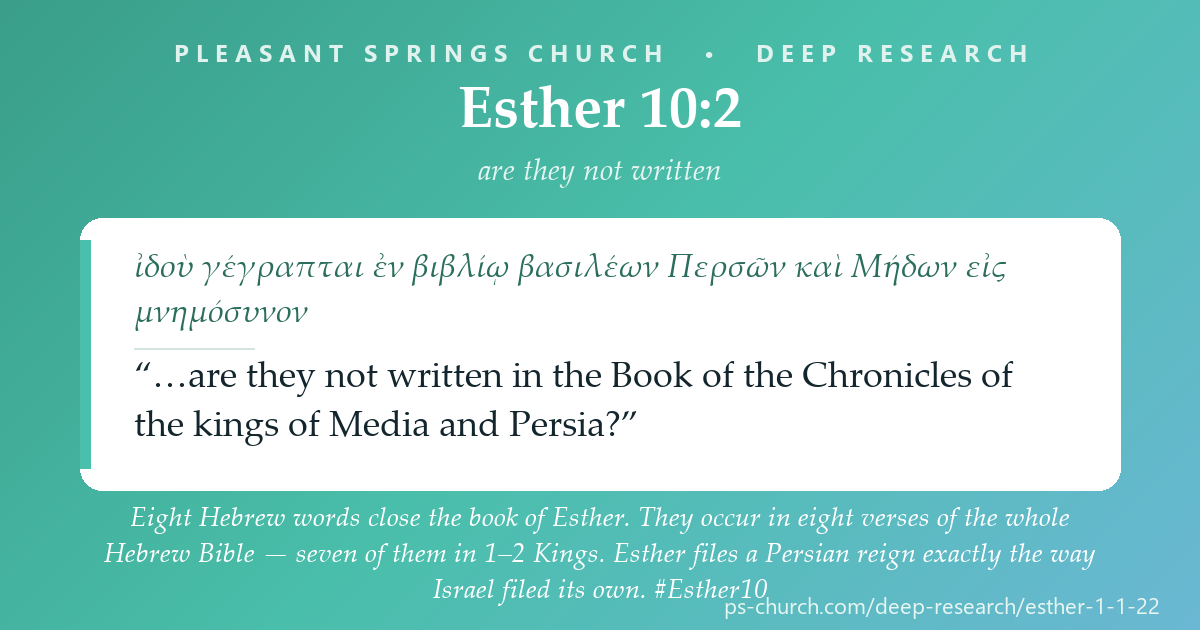
are they not written in the Book of the Chronicles of the kings of… — occur in eight
verses of the whole Hebrew Bible. Seven of them are in 1–2 Kings.
See the method →
Esther 1:1–22 · 10:1–3
Hebrew (MT) · Greek (CATSS / Rahlfs) · ESVBetween them the Hebrew never once names God — the Greek does, twice inside chapter 1 alone, at Rahlfs 1:1h and 1:1l — and the Hebrew never quotes the Law and never mentions the temple, prayer or sacrifice. It names Jerusalem exactly once, at 2:6, as the city Mordecai’s family was carried away from. What it does instead is name the empire — and the measurement of that naming is where this page starts.
⚠️ The empire is named as a pair exactly five times in Esther, and both columns do it at the same five verses: 1:3, 1:14, 1:18, 1:19 and 10:2. The Hebrew names Persia or Media nowhere else in the book; the Greek names the Persians three more times, all inside Addition E (8:12k, 8:12o, 8:12u), and the Medes nowhere else. And each column reverses the order exactly once — at a different verse. The Hebrew says Pāras ûMāḏay, Persia and Media, four times in chapter 1, and then Māḏay ûPārās, Media and Persia, in 10:2. Rahlfs’s Greek says Περσῶν καὶ Μήδων at 1:3, 1:14, 1:18 and at 10:2, and puts the Medes first only at 1:19 — the verse where the law is invoked. Both texts flip once; neither flips where the other does. Counted here over the whole Masoretic corpus and the whole Greek Old Testament held here, not taken from a commentary.
⚠️ Direction of influence is not asserted anywhere on this page. That the Greek reads six days at 1:5 where the Hebrew reads seven is a difference between two texts. Which came first, and why, is not something this measurement can decide, and it is not claimed.
⚠️ Addition A (1:1a–1:1r) and Addition F (10:3a–10:3l) both fall inside these two chapters — 17 Greek units before 1:1s and 11 after 10:3, none of them with any Hebrew counterpart. They are read here as Apocrypha — witnesses, not Scripture in our confession, and they are canonical in Roman Catholic and Orthodox Bibles. They are described in the first Esther study and the second; they are not quoted here.
The Shape of the Passage
Inclusio around a single refusal — not a chiasmChapter 10 stands outside the shape altogether. It does not answer chapter 1; it closes the scroll in the cadence of a different book — see the codex note at 10:2.
These are the last two chapters of Esther that no study on this shelf had quoted. With them, the book is covered end to end.
Author
He opens with an inventory and closes with a receipt. The first chapter is a catalogue — provinces, days, colours, metals, stones, seven names of eunuchs, seven names of princes — and the last chapter is a tax note and an archival cross-reference. Nothing in either place is said to be from God, and nothing is said not to be. The author writes like a court clerk and lets the arrangement carry the argument.
He is willing to be funny at the empire’s expense. A king who displays his wealth for six months, then drinks for a week, then sends seven senior officials to fetch his wife so the guests can look at her, is refused in one word, and responds by legislating for every married couple in 127 provinces. The joke is not stated. It is simply reported in sequence and left there.
And he ends the book in a borrowed voice. The formula at 10:2 is the one the books of Kings use to close a reign. Measured against the whole Masoretic corpus, those eight words occur in eight verses; seven are in Kings and the eighth is this one. Whatever else the last verse-but-one is doing, it files a Persian king exactly the way Israel’s kings were filed.
Audience
People who lived inside the machine being described. A reader who has ever waited on an imperial decision knows why chapter 1 spends six verses on furniture: the point of the display is that you are meant to be impressed, and the point of the story is what it costs when one person is not.
Readers who would hear the law-language and flinch. דָּת, dāṯ, is a Persian loanword. It appears 20 times in Esther and, in the whole Hebrew Bible, otherwise only in Daniel and Ezra — plus the disputed qere אֵשׁ דָּת at Deuteronomy 33:2. All three books that use it freely are set under Persian administration. In chapter 1 it enters twice in opposite directions: a drinking rule that compels nobody (1:8) and a marriage decree that cannot be repealed (1:19). The second kind is what nearly kills them all in chapter 3, and what cannot be cancelled in chapter 8.
And people for whom the last three verses were the normal case. The book does not end with a return, a rebuilt temple or a restored throne. It ends with a tax still being collected, an empire still running, and a Jew inside its administration seeking the good of his people. For a diaspora readership that is not an anticlimax. It is the address.
Orient on the Achaemenid court, on the word for law, and on where the Greek numbering goes.
Search by topic: Ahasuerus / Xerxes I; Susa — palace and citadel; satrapy and province; Persian royal banquets; dat — law as loanword; Vashti; Additions to Esther A and F; the regnal formula in Kings.
Which articles are relevant?
- Anchor Bible Dictionary — “Esther, Book of,” “Ahasuerus,” “Susa,” “Persia, History and Religion of,” “Satrap,” “Vashti,” “Esther, Additions to.”
- Dictionary of the OT: Historical Books (IVP) — “Esther, Book of,” “Persian Empire,” “Banquets,” “Non-Israelite Written Sources,” “Historiography, Old Testament.”
- NIDOTTE / TDOT / HALOT — דָּת (dāṯ, decree, law — a Persian loanword), מְדִינָה (məḏînāh, province), מִשְׁתֶּה (mišteh, drinking-feast), מָאֵן (māʾēn, to refuse).
- On the Greek — the NETS introduction to Esther, for how Rahlfs numbers the Additions. This matters immediately: because Addition A occupies 1:1a–1:1r, there is no verse numbered 1:1 in the Greek at all, and the Hebrew’s opening verse is Rahlfs’s 1:1s.
- On the closing formula — any article on the Deuteronomistic History and its regnal notices, since Esther 10:2 uses that formula and is the only verse outside Kings that does.
Bibliography surfaced:
- Jon D. Levenson, Esther (OTL) — the standard careful commentary; good on the book’s framing and on the Greek versions.
- Adele Berlin, Esther (JPS) — the best treatment of chapter 1 as comedy, and of the banquet motif.
- Carey A. Moore, Esther (AB) and Daniel, Esther and Jeremiah: The Additions (AB).
- Pierre Briant, From Cyrus to Alexander — not a commentary, a history of the Achaemenid empire; the place to check what the book’s administrative furniture actually corresponds to.
A royal banquet, a queen who says no, and the two Additions that bracket this study.
First the Persian court as outside sources describe it. Then Vashti, without either modernising her or dismissing her. Then the versification, which is not a footnote here but the first thing a reader of the Greek runs into.
Which parallels shed light on these chapters?
The banquet is the empire’s standard instrument, and outsiders described it the same way. Herodotus has Xerxes assembling the leading Persians to plan the Greek campaign (7.8), which commentators place around the third year of his reign — the year Esther 1:3 gives; he also reports the Persian habit of deliberating twice over, drunk and sober (1.133). None of that makes Esther a chronicle — Herodotus names Xerxes’ queen as Amestris, not Vashti or Esther, and the 127 provinces do not match the roughly twenty satrapies of the Persian administrative lists. The book is telling a story in a real setting, and the setting is drawn accurately enough that the mismatches are worth noticing rather than explaining away.
Vashti is given one verb and no speech. The narrator does not say why she refused, does not praise her, does not condemn her, and never mentions her again except as a precedent (2:1, 2:4, 2:17). Every account of her motive is supplied by the reader — ancient Jewish tradition supplied several, and so does modern writing. What is in the text is that a woman said no to an imperial summons and the empire responded by legislating. The book does not tell you what to think about that, and this page will not either.
And the Greek reader meets this chapter in a different order. Addition A comes first: Mordecai’s dream of two dragons and the eunuchs’ plot, seventeen verses numbered 1:1a–1:1r. Only then does the Hebrew’s first verse arrive, as 1:1s. The effect is that a Greek reader knows there is a conflict coming before the party starts; a Hebrew reader does not. Addition F closes the book after 10:3 with the dream decoded and the colophon.
- Herodotus, Histories 1.133; 7.8; 9.108–113 (Greek historian — a witness, not Scripture) — Persian feasting and deliberation, the assembly in Xerxes’ third year, and the court intrigues involving Amestris. The last of these is the strongest reason not to read Esther as court chronicle.
- Daniel 6:8, 12, 15 (ESV; Masoretic 6:9, 6:13, 6:16) and Ezra 7:26 — the other two Hebrew-Bible books that use דָּת. In Daniel the law of the Medes and Persians is what traps Darius; in Esther 1:19 it is what disposes of Vashti and, at 8:8, what cannot save the Jews without a second decree.
- Addition A, 1:1a–1:1r (Greek, Apocrypha — a witness, not Scripture in our confession) — the dream and the first plot, standing where the Hebrew has nothing. Because of it there is no Greek verse 1:1.
- Addition F, 10:3a–10:3l (Greek, Apocrypha — a witness) — the dream interpreted, plus the colophon naming Lysimachus as translator. Eleven units after the Hebrew book has ended.
- 1 Kings 15:7; 16:14; 22:39; 2 Kings 10:34; 12:20; 13:8; 15:21 — not background but the measured partners of Esther 10:2. These seven verses and Esther 10:2 are the eight places in the Hebrew Bible carrying that eight-word formula. Direction of influence is not asserted.
Counted, not remembered. Across the 23,204 verse units of the Masoretic corpus held here, the pair Pāras ûMāḏay — “Persia and Media” — occurs in four verses, and all four are Esther 1 (1:3, 1:14, 1:18, 1:19). The reverse, Māḏay ûPārās, occurs in four verses too: Daniel 6:9, 6:13, 8:20 (Masoretic numbering; ESV 6:8, 6:12, 8:20) — and Esther 10:2. Those five are the only times Esther names the empire as a pair; it names neither Persia nor Media anywhere else.
Now the Greek, over the 30,348 verse units of the Greek Old Testament screened here (64 CATSS files; the Odes are excluded from a run screen, because Ode 9 is Luke 1, Ode 13 is Luke 2, and ten more Odes are second copies of passages already counted in Exodus, Deuteronomy, 1 Samuel, Habakkuk, Isaiah, Jonah and Daniel). Περσῶν καὶ Μήδων occurs in five verses: 1 Maccabees 1:1 and Esther 1:3, 1:14, 1:18 and 10:2. Μήδων καὶ Περσῶν occurs in six: five in Daniel — and Esther 1:19.
So both columns name the pair five times, at the same five verses, and each reverses the order exactly once — at a different verse. The Hebrew keeps Persia first through chapter 1 and puts Media first in the archive note that closes the book. The Greek keeps Persia first through chapter 1 and in the closing note, and puts the Medes first only in 1:19, the verse where the law is written — which is the order Daniel uses of that same law, in both languages.
That is the whole finding, and it is the whole claim. Nothing here says the Greek translator was reading Daniel, or that the Hebrew of 10:2 is late, or that either order means anything in particular. It says that a distribution which looks accidental is in fact perfectly regular in each text and different between them, and that this is checkable in ten seconds by anyone with the two corpora.
A loanword for law, a verb of refusal, and the formula that files a Persian king like a Judahite one.
Read 1:8 and 1:19 together and notice that the same word does opposite work. Then read 10:2 beside 1 Kings 22:39 and hear whose sentence it is.
“Persia and Media” / “Media and Persia.” Five namings in the book, four one way and one the other, and the odd one out is the second-to-last verse. In the Hebrew Bible outside Esther the reversed order belongs to Daniel — Masoretic 6:9, 6:13, 8:20, which is ESV 6:8, 6:12, 8:20. The Greek reverses at 1:19 instead, and keeps Persia first at 10:2. Neither order is evaluated here; the distribution is simply reported.
“Are they not written in the Book of the Chronicles…?” Eight words, eight verses in the whole Hebrew Bible, seven of them in 1–2 Kings. The shorter core sēp̱er diḇrê hayyāmîm ləmalḵê — “the book of the chronicles of the kings of” — occurs 34 times: 33 in Kings, and this one. Esther’s last chapter closes a Persian reign with the cadence Israel used to close its own.
“Decree, law” — a Persian loanword. 20 occurrences in Esther; in the rest of the Hebrew Bible it appears only in Daniel and Ezra, plus the disputed qere אֵשׁ דָּת at Deuteronomy 33:2. Four of the twenty are in chapter 1, and the first and last of those four are opposites: 1:8, drinking kaddāṯ with ʾên ʾōnēs, “no compulsion”; 1:19, a dāṯ written so that it cannot pass. The book introduces its central instrument twice, in both directions, before anyone is in danger.
“And she refused.” This exact pointed form occurs twice in the Hebrew Bible: Exodus 4:23, where the Lord says to Pharaoh and you refused to let him go, and here. Different person and gender, identical letters and vowels. It is a one-word tie, not a run — the Hebrew screen finds no two consecutive words shared between the verses — and it is printed here as a coincidence worth seeing, not as an allusion.
“Beautiful to look at.” Four verses in the Hebrew Bible: Genesis 26:7 (Rebekah), 2 Samuel 11:2 (Bathsheba), Esther 1:11 (Vashti) and Esther 2:3 (the girls collected for the king). Esther 1:11 and Genesis 26:7 share the full three-word phrase kî ṭōḇaṯ marʾeh and are the only two verses in the corpus that do — a run of three with a tie band of one. What the phrase is used for in each place is left to the reader.
“Province.” 63 occurrences in the Hebrew Bible; 39 of them in Esther — 59 if the four Aramaic determined forms in Daniel and Ezra are set aside. Six are in chapter 1, and their placement is the chapter’s frame: one in the opening clause (127 provinces) and three in the closing verse (to all the provinces of the king, province by province). The chapter begins and ends on the same administrative noun.
Counted here rather than assumed:
- “Seven” five times in Hebrew Esther 1; three times in the Greek. The Hebrew has šeḇaʿ at 1:1 (in the number 127), 1:5 (seven days), 1:10 twice (the seventh day; the seven eunuchs) and 1:14 (the seven princes). Rahlfs has ἑπτά or ἑβδόμη only at 1:1s and twice at 1:10. At 1:5 the Greek reads ἓξ, six. At 1:14 it does not count the princes at all — it names three men and stops. Reported as a difference between two texts; neither is corrected by the other here.
- There is no verse numbered Esther 1:1 in the Greek. Chapter 1 in Rahlfs runs to 39 units — 1:1a to 1:1s, then 1:2 to 1:22 — against 22 in the Hebrew. Chapter 10 runs to 14 units against 3. 53 Greek units stand over 25 Hebrew verses in this study.
- The Hebrew’s opening clause recurs verbatim once in the whole Bible, inside Esther. Esther 1:1 shares a run of seven consecutive words with Esther 8:9 — from India to Cush, a hundred and twenty-seven provinces — with a tie band of one. Nothing else in the corpus comes near it. The Greek does the opposite: it drops “to Ethiopia” at 1:1s and keeps the phrase at 3:12, 3:13a, 8:9 and 8:12b — three of those four with the article, ἀπὸ τῆς Ἰνδικῆς, and 3:12 without it.
- The 1:20 acrostic, verified rather than repeated. The initial letters of הִיא וְכָל־הַנָּשִׁים יִתְּנוּ read backwards spell יהוה, and they are bolded in the codex above. A screen of every four-word window in Esther found exactly four such sites and no others: 1:20 (initials, reversed), 5:4 (initials, forward), 5:13 (finals, reversed), 7:7 (finals, forward) — which is precisely the set the medieval scribal tradition marks. Whether that is design is a separate question, and the numbers for it are in Stage 5.
- Zero for the New Testament. Across the 7,927 verses of the Greek New Testament there is no Εσθηρ, no Μαρδοχαῖος, no Ἀρταξέρξης, no Αμαν, no Susa and no Purim. The only word in the corpus built on the root Περσ- is Περσίδα — Persis, a woman greeted in Romans 16:12. The Medes stand once, at Acts 2:9, and the corpus does carry other Persian loanwords — γάζα at Acts 8:27, ἀγγαρεύω at Matthew 5:41, παράδεισος at Luke 23:43.
Where these two chapters touch the rest of Scripture, and where the measurement says they do not.
Every figure below was produced by the same two screens: Hebrew against the 23,204 verse units of the Masoretic corpus, and Greek against the 7,927 verses of the Greek New Testament, contiguous runs of whole word forms, never lemmas. The tie band is printed with every run.
Which cross-references matter?
- Esther 10:2 → 1 Kings 15:7; 16:14; 22:39; 2 Kings 10:34; 12:20; 13:8; 15:21 — a run of 8, tie band 7, and every one of the seven ties is in Kings. This is the deepest measured contact anywhere in this study. Neither text is said to be quoting the other. What is measured is that the formula which files the reigns of Israel and Judah is used once more, at the end of a Persian story, of a Persian archive.
- Esther 1:1 → Esther 8:9 — a run of 7, tie band 1. The book’s opening description of the empire returns word for word at the moment the counter-decree goes out to that same empire, and nowhere else in Scripture.
- Esther 1:16 → Esther 9:20 — a run of 5, tie band 1: which are in all the provinces of King Ahasuerus. Memucan’s complaint and Mordecai’s Purim letter address the identical jurisdiction in identical words.
- Esther 1:19 → Esther 3:9; 5:4; 8:5; 9:13; Nehemiah 2:5; 2:7 — a run of 4, tie band 6: ʾim ʿal hammeleḵ ṭōḇ, “if it please the king.” Print this one against the others: a band of six means the phrase is a court formula, not a signal. It is the same depth as several runs elsewhere on this shelf that carry no weight at all.
- Esther 1:11 → Genesis 26:7 — a run of 3, tie band 1: kî ṭōḇaṯ marʾeh. Only two verses in the Hebrew Bible carry it. A run of three is short, and short runs are cheap; a band of one is what makes this one worth printing at all, and even then it proves contact of vocabulary, not of intent.
- Esther 1:12 → Exodus 4:23 — one word, not a run. Wattəmāʾēn occurs twice in the Hebrew Bible, and the Hebrew screen finds no two consecutive words shared between the two verses. Printed as a curiosity and labelled as one.
- Esther 10:1 → Isaiah 11:11; Isaiah 24:15 — counted. ʾiyyê hayyām, “coastlands of the sea,” stands in exactly three verses of the Hebrew Bible: Isaiah 11:11, where the remnant is gathered from them, Isaiah 24:15, where the coastlands are told to glorify the Lord, and Esther 10:1, where they are how far the tax reaches. Two words is not a run of any depth, and it is printed as a curiosity rather than a connection.
- Jeremiah 29:7 → Esther 10:3 — seek the welfare of the city where I have sent you, and a Jew in a Persian ministry seeking the good of his people. Treated at length in the previous Esther study.
And the counter-example this page prints against itself:
The deepest contact between these chapters and the entire Greek New Testament is four words, and every instance of it is a formula. Screening all 53 Greek units of Esther 1 and 10 — Additions included — against the 7,927 verses of the Greek New Testament: 52 rows reach two, 47 reach three, 12 reach four, and nothing reaches five.
The most tempting of the twelve is Esther 1:21, καὶ ἤρεσεν ὁ λόγος — “and the word pleased” — against Acts 6:5, καὶ ἤρεσεν ὁ λόγος ἐνώπιον παντὸς τοῦ πλήθους, “and what they said pleased the whole gathering,” a run of 4 with a tie band of 1. It looks like a citation. It is not one. It is a Septuagintal idiom for an assembly agreeing, and Luke writes Septuagint Greek. We print it here precisely so that the other eleven fours are not read as more than they are.
The rest are what a band tells you to expect: Esther 1:1s against Luke 9:28, μετὰ τοὺς λόγους τούτους (band 1 in the New Testament, band 11 in the Greek Old Testament, nine of them outside Esther); Esther 1:10 against Hebrews 4:4, τῇ ἡμέρᾳ τῇ ἑβδόμῃ (band 1) — which is the seventh day of creation meeting the seventh day of a drinking party; Esther 1:20 against Matthew 16:28, ἐν τῇ βασιλείᾳ αὐτοῦ (band 1); and Esther 10:3 against Acts 23:27, ὑπὸ τῶν Ἰουδαίων καί (band 1). Four ordinary Greek words in a row will happen. The New Testament does not cite Esther, the measurement agrees with that, and no page on this shelf should pretend otherwise.
What was consulted, what was not, and the four places this page is weakest.
The commentaries first. Then the honest ledger: this section exists to say what the page could not check.
Commentaries & studies:
- Jon D. Levenson, Esther (OTL) — the frame chapters, and the relation of the Hebrew to both Greek versions.
- Adele Berlin, Esther (JPS) — chapter 1 read as comedy, and the banquet structure of the whole book.
- Carey A. Moore, Esther (AB) and Daniel, Esther and Jeremiah: The Additions (AB) — for Additions A and F and the Greek numbering.
- David J. A. Clines, The Esther Scroll — on the endings, and on whether the book once stopped short of chapter 10.
- Karen H. Jobes, The Alpha-Text of Esther — the second Greek Esther, which this page has not measured; see the limits below.
Where this page is weak — stated plainly:
- The acrostic numbers are suggestive and nothing more, and here is why. Screening every four-word window in the Masoretic corpus — 239,555 windows — for initials or finals spelling יהוה forwards or backwards returns 120 hits, about one window in two thousand. Esther contains 2,579 such windows, so the expected count at the corpus-wide rate is 1.29. Esther has four. On a Poisson model that is p ≈ 0.042. But four different rules were tested, and they were chosen after the fact because tradition points at those four verses — which is exactly the situation in which a p-value near 0.05 should not be trusted. The honest statement is: the sites are real, the rate is about three times background, and intent remains unproven.
- The Alpha-text was not consulted. There are two Greek Esthers. This page measured only the B-text as Rahlfs prints it, via the CATSS digitization. The Alpha-text (L-text) differs materially in chapter 1 and even more at the end of the book, and every Greek figure on this page would need restating against it. That work was not done here.
- No Qumran, no Old Latin, no Josephus collation. Esther is the one book of the Hebrew Bible with no fragment at Qumran, so there is nothing to compare there — but the Old Latin and Josephus’ paraphrase (Ant. 11.6) both preserve variant material for these chapters and were not screened. The Vulgate was not compared either.
- The six-days reading at 1:5 was not traced through the manuscripts. This page reports what the CATSS/Rahlfs text held here says, and states that it differs from the Masoretic Text. It does not report which uncials read ἓξ, whether Rahlfs’ apparatus records a variant, or whether the difference is translational, scribal or exegetical. That is a real gap and it sits directly under one of the page’s printed findings.
- The historicity question is left open, not settled. The 127 provinces do not match the Achaemenid satrapy lists; Herodotus names a different queen; no Persian source knows a Jewish queen or a vizier called Mordecai. Scholars range from historical novella to substantially historical and this page takes no position, because nothing it measured bears on the question.
- What the runs do and do not show. The screens find verbatim contact between word forms. They do not find allusion, they do not find quotation of sense, and they say nothing whatever about which text is prior. A run of 8 with a band of 7 is a strong signal that a fixed formula is in use. It is not evidence that the author of Esther had a scroll of Kings open.
A party, a refusal, a law that cannot be repealed, and a receipt.
Name what you learned, why it matters, and one concrete response.
What should we carry away — and do?
- The book opens by showing you what power looks like when it has nothing to do. Six months of display, a week of drinking, and the only rule in the room is that nobody has to follow any rules. Eleven verses later the same court produces a law that can never be repealed — because one person declined an invitation.
- Vashti gets one verb. The narrator will not tell you what to think about her, and neither will this page. What the text gives you is a refusal with no speech attached and an empire that could not absorb it. Sit with the fact that the whole rescue in this book runs through a vacancy created by somebody saying no.
- The last chapter files a Persian king the way Kings filed Israel’s. Eight words, seven of the eight parallels in 1–2 Kings. The scroll closes in a borrowed cadence, and the last thing it records is not a rescue but a tax. Empires keep going. That is not despair; it is the setting in which the last verse happens.
- And the last verse is a job description. Second in rank, seeking the good of his people and speaking peace to all his seed. One concrete response: pick the institution you are actually inside — work, school, a family, a town — and name one specific good you can seek in it this month without leaving it.
Esther 10:2 · to share
Hebrew + Greek (Rahlfs) + ESVEvery Deep Research page traces its passage across the whole sweep — the Old Testament, the Second-Temple world between the testaments (historical witnesses, not Scripture), and the New Testament. Follow the thread:
Pleasant Springs Church — Deep Research
Research method after Michael S. Heiser’s Bible Research Method (examine dictionaries → ancient literature → important words → textual connections → academic publications → share), with the Pleasant Springs “Author & Audience” foundation. Scripture set in the Hebrew, the Greek editions named on each page and the ESV (Old Testament), and the Greek New Testament and the ESV (New Testament), per the practice of Pleasant Springs Church. Esther 1 and 10 researched against the corpora held locally, with Levenson (OTL), Berlin (JPS), Moore (AB) and Clines in view. This study covers the last two chapters of Esther that no page on this shelf had quoted, and completes the book. Text: Hebrew from the Masoretic Text (Sefaria, Miqra according to the Masorah); Greek from Rahlfs’s Septuaginta in the CATSS digitization, printed without editorial punctuation and with proper names unaccented; English ESV. ⚠️ Versification is stated, not skipped. The Masoretic Text and the ESV agree exactly across both chapters — 1:1–22 and 10:1–3, no offset. The Greek does not: there is no verse numbered Esther 1:1 in Rahlfs at all. Addition A occupies 1:1a–1:1r, so the Hebrew’s opening verse is numbered 1:1s, and Addition F occupies 10:3a–10:3l. Greek chapter 1 therefore runs to 39 units against the Hebrew’s 22, and Greek chapter 10 to 14 against 3 — 53 Greek units over 25 Hebrew verses. ⚠️ Every run on this page is printed with its tie band. The deepest is Esther 10:2, a run of 8 with a band of 7, and all seven ties are in 1–2 Kings; the four-word core occurs 34 times, 33 of them in Kings. Direction of influence is nowhere asserted, here or anywhere else on the page. The name-order finding — five pair-namings in each column at the same five verses, each column reversing exactly once and at a different verse — was counted over the 23,204 verse units of the Masoretic corpus and the 30,348 verse units of the Greek Old Testament that a run screen sees (64 CATSS files; the Odes are excluded because Ode 9 is Luke 1, Ode 13 is Luke 2, and ten further Odes duplicate passages already counted elsewhere). Cross-corpus runs apply MorphGNT’s own spelling equivalences, so figures here are not comparable with pages written before 30 August 2026. ⚠️ The page prints its own counter-example — Acts 6:5 against Esther 1:21, a run of four with a band of one that looks like a citation and is a Septuagintal idiom — so that the other eleven fours are not overread. The structural diagram is labelled an inclusio with a pivot and explicitly not a chiasm, with the asymmetry of the two flanking panels stated in the diagram’s own footnote. ⚠️ The 1:20 acrostic was screened, not repeated from report: four sites in Esther, and the corpus-wide base rate (120 hits in 239,555 four-word windows; expected 1.29 in Esther against 4 observed; p ≈ 0.042 on a Poisson model, with four post-hoc rules) is printed in Stage 5 so the reader can discount it properly. Additions A and F are tagged Apocrypha — witnesses, not Scripture in our confession, with the plain acknowledgement that Roman Catholic and Orthodox Bibles receive them as canonical; they are not quoted here. Stage 5 names four things this page could not check: the Alpha-text, the Old Latin and Josephus, the manuscript basis of the six-day reading at 1:5, and the historicity question. Typology is handled per the house position: what the text says, what the New Testament itself draws, and what we see from this side of the cross — with the seeing left to the reader.
Scripture quotations marked ESV are from the ESV® Bible (The Holy Bible, English Standard Version®), © 2001 by Crossway, a publishing ministry of Good News Publishers. ESV Text Edition: 2016. Used by permission. All rights reserved. The ESV text may not be quoted in any publication made available to the public by a Creative Commons license, and the ESV may not be translated in whole or in part into any other language. www.esv.org
|
Did this study bless you today? 💚 Give to Support PS Church100% of gifts go to the General Fund — thank you. |