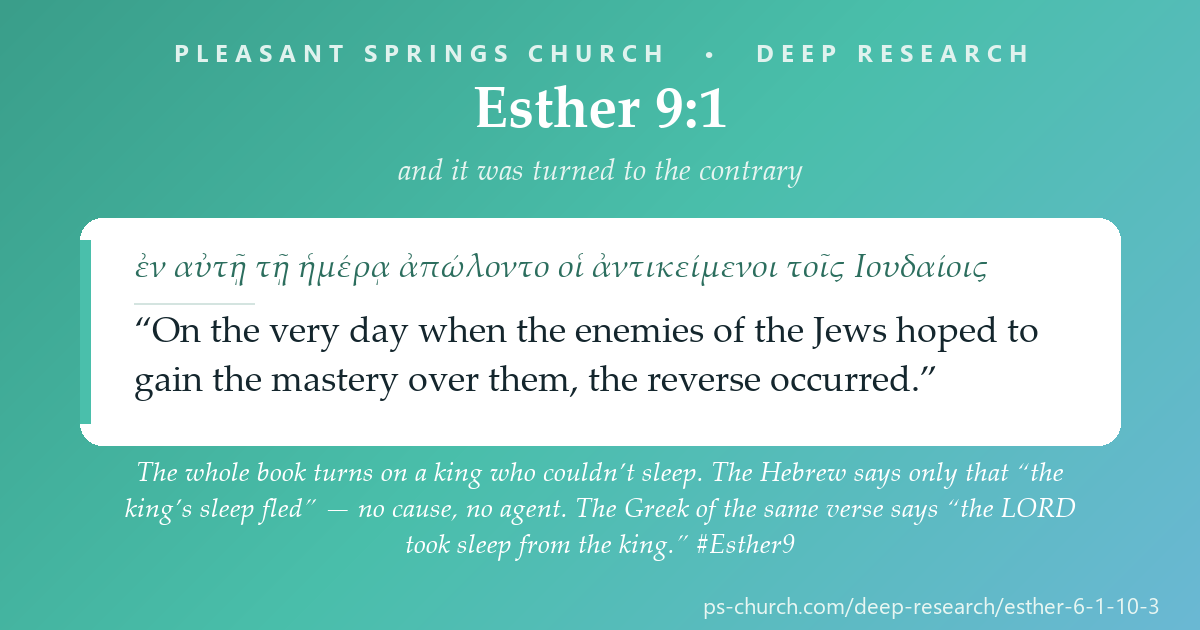
Haman has the pole up and is walking to the palace to ask permission to use it. That night the king cannot sleep, sends for the court chronicle — the dullest document in the building — and hears the one entry nobody ever acted on. So Haman walks in and is asked what should be done for the man the king delights to honour; he assumes it must be himself, specifies the maximum, and is ordered to lead Mordecai’s horse through the square shouting the honours he designed for his own head. From there nothing stops. He is taken from Esther’s second banquet to the pole he built. The signet ring passes to Mordecai. And then the problem the book cannot wave away: a Persian decree cannot be revoked (8:8) — so the first one stands to the end, and is answered by a second. At 9:1 the Hebrew names what has happened in two words: wənahăpōḵ hûʾ, “and it was turned to the contrary.” Three times the narrator stops to say they took no plunder — which is exactly what Saul failed to do with the Amalekites — and never once tells you why that matters. And in 6:1 the Hebrew says only that the king’s sleep fled. No cause. No agent. The Greek of that same verse says: “but the Lord removed sleep from the king.” See the method →
Esther 6:1–10:3 (selections)
Hebrew · Greek (Rahlfs) · ESVFrom there it does not stop. He is taken from Esther’s second banquet straight to execution — on the pole he built — and the king’s anger subsides. Mordecai receives the signet ring taken back from Haman. And then the book raises the one problem it cannot magic away: a Persian decree cannot be revoked, not even by the king who signed it (8:8). The answer is not cancellation but counter-decree, in the same irreversible form — and the terrible arithmetic of chapter 9 follows from a law that could not be unwritten.
And three times the narrator stops to say that they took no plunder (9:10, 15, 16), which is exactly what Saul failed to do with the Amalekites in 1 Samuel 15. The book still refuses to connect them for you.
⚠️ The single most striking difference between the columns is in the first line above. The Hebrew of 6:1 is impersonal and deliberately so: nāḏəḏāh šənaṯ hammeleḵ, “the king’s sleep fled.” No agent. No cause. Rahlfs supplies both: ὁ δὲ κύριος ἀπέστησεν τὸν ὕπνον ἀπὸ τοῦ βασιλέως — “but the Lord removed sleep from the king.” This is not one of the Additions; it is the canonical verse, rewritten. At the exact hinge of a book whose Hebrew never names God, the Greek names him. The translator understood the story perfectly — and could not leave the reader to draw the conclusion.
⚠️ The remaining two Additions fall here — E (8:12a–x, 21 verses: the text of the counter-edict, which calls Haman a Macedonian and speaks of “the all-ruling God”) and F (10:3a–l, 11 verses: Mordecai’s dream from Addition A interpreted, plus a colophon). With A–D in the previous study, that is all 89 Greek verses with no Hebrew counterpart. Apocrypha — witnesses, not Scripture in our confession, and canonical in Roman Catholic and Orthodox Bibles.
⚠️ Two Hebrew verses here are absent from the Greek: 9:5 and 9:30. 9:5 is the summary of the killing (“the Jews struck all their enemies with the sword”) and 9:30 is the sending of letters “with words of peace and truth.” MT 167 verses against 164 in the canonical Greek chapters; the third, 4:6, fell in the previous study. Counted against both columns.
The Shape of the Passage
ConcentricAnd the pivot is an accident. Not a prophet, not an angel, not a plague — a king who cannot sleep and asks for the dullest reading matter in the palace. The Hebrew declines to say why. That refusal is the book’s entire theological method, and the Greek translator broke it in nine words.
This is the last study in the Historical Books — the shelf that began with Joshua crossing into the land ends with a Jew running a Persian ministry and a festival that no law of Moses commands.
Author
He builds the entire reversal on a man who cannot sleep, and then says nothing. Every other biblical writer would have added three words. This one writes "the king’s sleep fled" — an impersonal verb with no subject — and moves on. The Greek translator added the three words (see the codex above), which tells you both how obvious the inference is and how deliberately the Hebrew withholds it.
He is a structural writer. The second half inverts the first item by item, and he flags it himself with wənahăpōḵ hûʾ at 9:1. He also lets the comedy do the moral work: the funniest scene in the Old Testament — Haman describing his own dream honours and then having to lead the horse — is also the moment the plot becomes unstoppable.
And he does not clean up chapter 9. The number of dead is given. The second day in Susa is requested by Esther and granted. The narrator neither celebrates it nor apologises for it — he reports it, notes three times that no plunder was taken, and moves to the founding of a feast. Readers who find that hard are not misreading; the text supplies no comfort, and this page will not invent any.
Audience
A minority with no army, reading about a law that could not be repealed. The device at 8:8 is the sharpest thing in the book: the danger is not lifted, it is counterbalanced. The original decree stands to the end. For readers whose legal position was permanently precarious, that is the realistic version of deliverance — not the threat withdrawn, but the means to survive it.
People being handed a festival and told why it counts. Purim has no altar, no pilgrimage and no divine command — its founding documents are two letters from a queen and a civil servant. Its practices are food, gifts to the poor, and portions sent to one another (9:22). It is a feast of mutual provision, established by people rather than revealed, and the book takes the trouble to argue for it.
And people who would notice the last three verses. The book does not end with the rescue. It ends with a tax, an imperial chronicle, and Mordecai second in rank — seeking the good of his people and speaking peace to all his seed. No return, no temple, no king of Judah. Diaspora life continues, and a Jew is in the room where decisions are made.
Orient on Persian law, on Purim, and on the two remaining Additions.
Search by topic: irrevocable law of the Medes and Persians; royal signet and sealing; impalement and crucifixion in Persia; Purim — origins and observance; herem and plunder; Additions to Esther E and F; colophon; Ptolemaic dating.
Which articles are relevant?
- Anchor Bible Dictionary — “Esther, Book of,” “Esther, Additions to,” “Purim,” “Crucifixion” (on Persian impalement), “Seal, Signet,” “Amalek,” “Colophon.”
- Dictionary of the OT: Historical Books (IVP) — “Esther, Book of,” “Persian Empire,” “Feasts and Festivals,” “Violence,” “Retribution.”
- NIDOTTE / TDOT — הָפַךְ (hāpaḵ, to overturn), נָדַד (nāḏaḏ, to flee — of sleep), בִּזָּה (bizzāh, plunder), מָנוֹת (mānōṯ, portions).
- On the Greek — the NETS introduction to Esther, especially on the colophon at the end of Addition F, which is one of the very few places a Septuagint book dates and attributes its own translation.
Bibliography surfaced:
- Carey A. Moore, Esther (AB) and Daniel, Esther and Jeremiah: The Additions (AB).
- Jon D. Levenson, Esther (OTL) — particularly good on chapter 9 and on the reversal structure.
- Adele Berlin, Esther (JPS) — on the comedy of chapter 6 and on Purim.
- On the violence of chapter 9, read the primary text and 1 Samuel 15 before reaching for any commentary; the arguments only make sense once the Amalek background is in view.
A law that cannot be repealed, a pole in a garden, and a translation that dates itself.
First the Persian legal machinery the plot depends on. Then chapter 9, stated plainly rather than managed. Then the colophon, which is a genuinely unusual piece of evidence.
Which parallels shed light on these chapters?
The irrevocable decree is the engine of the second half. “An edict written in the king’s name and sealed with the king’s ring cannot be revoked” (8:8). Daniel 6:8, 12 and 15 say the same of the law of the Medes and Persians, and Diodorus Siculus records a Persian king unable to undo his own sentence. Whether Achaemenid practice was really this rigid is debated — it may be a literary convention about absolute monarchy rather than constitutional fact — but the book treats it as binding, and the whole shape of chapters 8 and 9 depends on it. The Jews are never saved by the first decree being cancelled.
The ‘gallows’ was almost certainly a stake. The Hebrew is ʿēṣ, simply “wood, tree,” fifty cubits high — about seventy-five feet, which is comically impossible as a scaffold and is part of the joke about Haman’s self-regard. Persian practice, described by Herodotus, was impalement or exposure of the body. Addition E in the Greek uses ἐσταυρῶσθαι — the verb later used of crucifixion — of Haman at the gates of Susa.
And chapter 9 has to be stated, not managed. Seventy-five thousand in the provinces, eight hundred in Susa over two days, and Haman’s ten sons hanged after death. Two things are worth having in view, neither of which is a justification. First, the counter-decree (8:11) is worded as permission to defend — “to gather and defend their lives” — against an attack scheduled by a law still in force. Second, the triple insistence that they took no plunder (9:10, 15, 16) points straight at 1 Samuel 15, where taking plunder from Amalek is exactly Saul’s sin. The narrator is drawing a line under an old story. That the account remains disturbing is not a failure of reading.
- Daniel 6:8, 12, 15 — the same convention of the unalterable Medo-Persian law, in a book set in the same empire, used to trap a king into destroying a man he wants to save.
- Herodotus, Histories 3.125; 3.159; 7.194 (Greek historian — a witness, not Scripture) — Persian impalement, and Xerxes pardoning a man he had ordered killed. Note that Herodotus’ Xerxes does reverse himself, which is one reason the absoluteness of 8:8 is questioned.
- 1 Samuel 15:3, 9, 19–23 — not an external witness but the passage chapter 9 keeps gesturing at. Saul spares Agag and takes the spoil; Samuel says obedience is better than sacrifice. Here: an Agagite’s house, and three times no hand on the plunder.
- Addition E, 8:12a–x (Greek, Apocrypha — a witness, not Scripture in our confession) — the counter-edict in full. It calls Haman a Macedonian rather than an Agagite, appeals to “the all-ruling God,” and reports Haman impaled at the gates of Susa. The Greek has quietly changed the villain’s ethnicity, which relocates the story into a later political world.
- Addition F, 10:3a–l, with the colophon at 10:3l (Greek, Apocrypha — a witness) — Mordecai’s dream from Addition A is now decoded, and then the book dates itself: “in the fourth year of the reign of Ptolemy and Cleopatra, Dositheus, who said he was a priest and a Levite, and Ptolemy his son brought the preceding Letter of Purim… which Lysimachus son of Ptolemy, of those in Jerusalem, had translated.” A Septuagint book that names its translator, its couriers and its regnal year is extremely rare, and it is why Greek Esther can be dated with more confidence than most.
Hebrew 6:1 has no subject. Nāḏəḏāh šənaṯ hammeleḵ — “the king’s sleep fled.” The verb nāḏaḏ is what birds do; sleep flits away and nobody is said to have driven it. In a book with no God, no prayer and no miracle, the entire reversal is triggered by a grammatically agentless event.
Rahlfs writes: ὁ δὲ κύριος ἀπέστησεν τὸν ὕπνον ἀπὸ τοῦ βασιλέως — “but the Lord removed the sleep from the king.” Not an Addition. The canonical verse, with an agent inserted at precisely the point where the Hebrew refuses one. Two theologies of the same event, printed side by side above, and the difference is the whole argument about how this book works.
And the Hebrew has its own way of putting God at that moment — if it is doing it at all. At 7:7, Haman begging for his life, the final letters of four consecutive words — kî ḵāləṯāh ʾēlāyw hārāʿāh, “that harm was determined against him” — spell יהוה, bolded in the codex above. Checked here rather than taken on report, along with the three others: 5:4 initials forward, 1:20 initials backwards, 5:13 finals backwards, 7:7 finals forward. The pattern is orderly — forward in Esther’s invitation and at Haman’s collapse, backwards in the mouths of Memucan and Haman. Whether it is intentional remains unproven, and a small alphabet makes coincidence a live option; but the distribution is a fact about the text, and medieval scribes who enlarged these letters had noticed it long before anyone could run the search.
Two words that name the book, a clause repeated three times, and the last line of the Historical Books.
Read 9:1 in Hebrew and notice that the reversal is announced, not implied. Then count the plunder clause — 9:10, 9:15, 9:16 — and read 1 Samuel 15:9.
“And it was overturned” — literally and the reverse, it. A niphal of hāpaḵ, the verb used of Sodom being overthrown (Genesis 19:25) and of God turning a curse into a blessing (Deuteronomy 23:5; Nehemiah 13:2). Two words that name the entire structure of the book, placed at its exact centre of gravity. Jewish tradition made the phrase the theme of Purim: the day that was turned.
“The king’s sleep fled.” Nāḏaḏ is used of birds and fugitives — something that flits away. There is no agent in the Hebrew clause, and the book’s whole reversal hangs off it. Rahlfs supplies the agent: ὁ κύριος ἀπέστησεν τὸν ὕπνον, “the Lord removed the sleep.” The clearest single instance in Scripture of a translator resolving an ambiguity the author created on purpose.
“But they laid no hand on the plunder.” Three times, verbatim. When a narrator this economical repeats a clause three times in seven verses, it is doing work. The permission granted at 8:11 explicitly included taking spoil; they declined the part of the decree that matched Saul’s failure (1 Samuel 15:9, 19). The connection is never spelled out. It is spelled out three times in the negative.
“Tree, wood, pole.” Not “gallows” in the modern sense — Persian practice was impalement or exposure. Fifty cubits is roughly seventy-five feet, absurd for an execution and entirely in character for Haman. Addition E renders his death with ἐσταυρῶσθαι. The reversal is stated flatly: “So they hanged Haman on the tree that he had prepared for Mordecai.”
“Sending of portions.” The defining practice of Purim, alongside mattānōṯ lāʾeḇyōnîm, “gifts to the poor.” The same instruction given at Nehemiah 8:10 — send portions to anyone who has nothing prepared. Two festivals founded a generation or two apart, in the same period, both defined by making sure nobody eats alone.
“Seeking the good of his people.” The last line of the book, and of the Historical Books as a whole: Mordecai “seeking the good of his people and speaking peace to all his seed.” The verb dāraš is the same one used of Ezra setting his heart to seek the Law. Compare Jeremiah 29:7 — seek the welfare of the city where I have sent you. That is what the last verse of the shelf describes a man doing.
Counted here rather than assumed:
- Greek 6:1 names God; Hebrew 6:1 does not. Rahlfs opens the verse ὁ δὲ κύριος ἀπέστησεν τὸν ὕπνον ἀπὸ τοῦ βασιλέως. This is the canonical verse, not an Addition. The Greek Esther is not simply the Hebrew plus six insertions — it is theologically rewritten in places, and this is the clearest case.
- Two Hebrew verses absent from the Greek here: 9:5 and 9:30. 9:5 summarises the killing; 9:30 sends letters “with words of peace and truth.” With 4:6 in the previous study, that is all three of the MT’s 167 against 164 canonical Greek verses.
- Additions E (21 verses) and F (11 verses) complete the set of 89, and F carries the colophon naming Lysimachus as translator and Dositheus and Ptolemy as those who brought the book to Egypt, in the fourth year of a Ptolemy and Cleopatra.
- The 7:7 acrostic verified. Final letters of כִּי כָלְתָה אֵלָיו הָרָעָה spell יהוה forwards. Together with 5:4 (initials, forward), 1:20 (initials, backwards) and 5:13 (finals, backwards). Observable; intent unproven.
An old war closed out, a city whose welfare is to be sought, and a shelf that ends.
Read 1 Samuel 15 and then Esther 9:10, 15, 16. Then read Jeremiah 29:7 beside Esther 10:3 — the instruction and, four hundred years later, a man doing it.
Which cross-references matter?
- 1 Samuel 15 → Esther 7:10; 9:10, 15, 16 — the closing of a very old account. Saul spares the Agagite and takes the plunder, and loses the kingdom. A descendant of Kish executes the Agagite and takes nothing — stated three times. Exodus 17:16 had said the war with Amalek would last “from generation to generation.”
- Esther 6:1 and Genesis 41; Daniel 2; 6:18 — the sleepless or dreaming pagan king through whom a Jew in exile is raised. In Genesis and Daniel God is named as the source; in Hebrew Esther he is not, and the Greek could not resist supplying him.
- Esther 8:8 and Daniel 6:8, 12, 15 — the law that cannot be revoked, in both books used to corner a king who wishes he could. Neither man is rescued by the law being changed.
- Esther 9:22 and Nehemiah 8:10, 12 — two festivals of the same era, and both are defined by sending portions to those who have nothing prepared. Joy that is measured by who is included in the meal.
- Jeremiah 29:4–7 → Esther 10:3 — “build houses… seek the welfare of the city where I have sent you.” The last verse of Esther describes Mordecai seeking the good of his people and speaking peace — the letter to the exiles, carried out.
- Proverbs 26:27; Psalm 7:15–16 → Esther 7:10 — “whoever digs a pit will fall into it”; “he makes a pit… and falls into the hole that he has made.” Esther does not quote either. It just hangs Haman on Haman’s pole and lets the reader hear them.
- Where the shelf ends. The Historical Books opened with Israel crossing into the land under Joshua. They close with a Jew at a Persian desk, a festival no law commanded, and an empire still collecting tribute. The land is not the last word; faithfulness outside it is.
The violence of chapter 9, the reliability of 8:8, and what the colophon buys us.
Moore, Levenson and Berlin again. Then four questions — and this page does not pretend the hardest of them has a comfortable answer.
Commentaries & studies:
- Jon D. Levenson, Esther (OTL) — the fullest careful treatment of chapter 9 and of the reversal structure, and he does not minimise the difficulty.
- Carey A. Moore, Daniel, Esther and Jeremiah: The Additions (AB) — the place to read Additions E and F, and the colophon, properly.
- Adele Berlin, Esther (JPS) — on chapter 6 as farce, and on Purim’s development.
- David J. A. Clines, The Esther Scroll — on the endings, and on whether chapters 9–10 belong to the book’s earliest form.
Interpretation notes worth keeping:
- Chapter 9 — the hardest thing in the book, and no tidy answer is offered here. What can be said: the counter-decree is framed as defence against a standing order to annihilate; the Jews take no plunder, three times noted, against the Amalek background; and the narrator neither celebrates nor condemns. What should not be said is that any of that dissolves the difficulty. Readers across the centuries, Jewish and Christian, have found this chapter hard, and the honest position is to hold the text and the discomfort together rather than resolve one with the other.
- Whether Persian law was genuinely irrevocable — doubted. The convention appears in Esther and Daniel, and Diodorus preserves something like it; but Herodotus shows Xerxes reversing himself, and many historians read 8:8 as a literary device about absolute power rather than constitutional fact. Nothing in the reading of the book depends on settling it, since the plot simply takes it as given.
- Whether chapters 9–10 are original — argued. Clines and others hold that the book once ended earlier and that the Purim material was added to ground the festival; the Alpha text’s ending differs materially. This page reads the received Hebrew text as it stands and notes the question.
- What the colophon is worth. Because Addition F names a regnal year, a translator and two couriers, Greek Esther is one of the few Septuagint books whose translation can be dated within a generation or so — though which Ptolemy and Cleopatra is itself disputed, with proposals ranging across the second and first centuries BC. A firm-looking datum that is firmer in form than in result.
A sleepless night, a reversal, and the last verse of the Historical Books.
Name what you learned, why it matters, and one concrete response.
What should we carry away — and do?
- The hinge of the whole book is a man not sleeping. No angel, no prophet, no voice — a bored king and a dull chronicle. The Hebrew refuses to say who was behind it and the Greek could not bear the silence. Both reactions are in your Bible, printed above, and the difference between them is worth sitting with.
- The first decree is never cancelled. Deliverance here does not mean the threat is withdrawn; it means the means to stand is given while the danger remains on the books. That is a more recognisable shape of rescue than the one we usually pray for.
- They took nothing. Three times. The permission was there in writing, and they declined it — closing out, deliberately and silently, the failure that cost Saul a kingdom. Restraint that nobody would have noticed is the one thing the narrator makes sure you notice.
- The book ends on someone seeking the good of his people. Not on the rescue, not on a return, but on a Jew in a foreign administration doing Jeremiah 29:7 — seeking the welfare of the city he was sent to. One concrete response: name the “city” you have been sent to, and one specific good you could seek in it this month.
Esther 9:1 · to share
Hebrew + Greek (Rahlfs) + ESVEvery Deep Research page traces its passage across the whole sweep — the Old Testament, the Second-Temple world between the testaments (historical witnesses, not Scripture), and the New Testament. Follow the thread:
Pleasant Springs Church — Deep Research
Research method after Michael S. Heiser’s Bible Research Method (examine dictionaries → ancient literature → important words → textual connections → academic publications → share), with the Pleasant Springs “Author & Audience” foundation. Scripture set in the Hebrew, the Greek editions named on each page and the ESV (Old Testament), and the Greek New Testament and the ESV (New Testament), per the practice of Pleasant Springs Church. Esther 6–10 research grounded in Levenson (OTL), Moore (AB, including the Additions volume), Berlin (JPS) and Clines. This study completes Esther, and with it the Historical Books. Text: Hebrew from the Masoretic Text; Greek from Rahlfs’s Septuaginta (CATSS digitization), printed without editorial punctuation and with proper names unaccented; English ESV. ⚠️ The headline textual finding is stated in both columns rather than summarised: at 6:1 the Hebrew is agentless — “the king’s sleep fled” — while Rahlfs reads ὁ δὲ κύριος ἀπέστησεν τὸν ὕπνον ἀπὸ τοῦ βασιλέως, “but the Lord removed sleep from the king.” This is the canonical verse, not an Addition, and the page states plainly that Greek Esther is theologically rewritten in places and not merely the Hebrew plus six insertions. ⚠️ Additions E (8:12a–x, 21 verses) and F (10:3a–l, 11 verses) fall here, completing the 89 Greek verses with no Hebrew counterpart; they are tagged Apocrypha — witnesses, not Scripture in our confession at every appearance, with the plain acknowledgement that Roman Catholic and Orthodox Bibles receive them as canonical. That Addition E changes Haman from an Agagite to a Macedonian is reported. ⚠️ Two Hebrew verses here are absent from the Greek — 9:5 and 9:30 (with 4:6 in the previous study; MT 167 against 164 canonical Greek verses), counted against both columns. The 7:7 acrostic was verified computationally, not repeated from report — the final letters of כי כלתה אליו הרעה spell the Tetragrammaton forwards — along with the other three sites (5:4 initials forward, 1:20 initials reversed, 5:13 finals reversed); intent is named as unproven and coincidence left open. Chapter 9 is not managed. The page states what can be said — the counter-decree is framed as defence against a standing order, and the threefold refusal of plunder answers 1 Samuel 15 — and then states explicitly that none of it dissolves the difficulty, declining to resolve the discomfort on the reader’s behalf. The irrevocability of Persian law (8:8) is reported as doubted, with Herodotus’ counter-evidence named. Whether chapters 9–10 belonged to the book’s earliest form is reported as argued; the received Hebrew text is read as it stands. The colophon is presented as unusually valuable and as less decisive than it looks, since which Ptolemy and Cleopatra is disputed. That the New Testament never cites Esther is stated as a fact with no inference drawn. Typology is handled per the house position: what the text says, what the New Testament itself draws, and what we see from this side of the cross — with the seeing left to the reader.
Scripture quotations marked ESV are from the ESV® Bible (The Holy Bible, English Standard Version®), © 2001 by Crossway, a publishing ministry of Good News Publishers. ESV Text Edition: 2016. Used by permission. All rights reserved. The ESV text may not be quoted in any publication made available to the public by a Creative Commons license, and the ESV may not be translated in whole or in part into any other language. www.esv.org
|
Did this study bless you today? 💚 Give to Support PS Church100% of gifts go to the General Fund — thank you. |