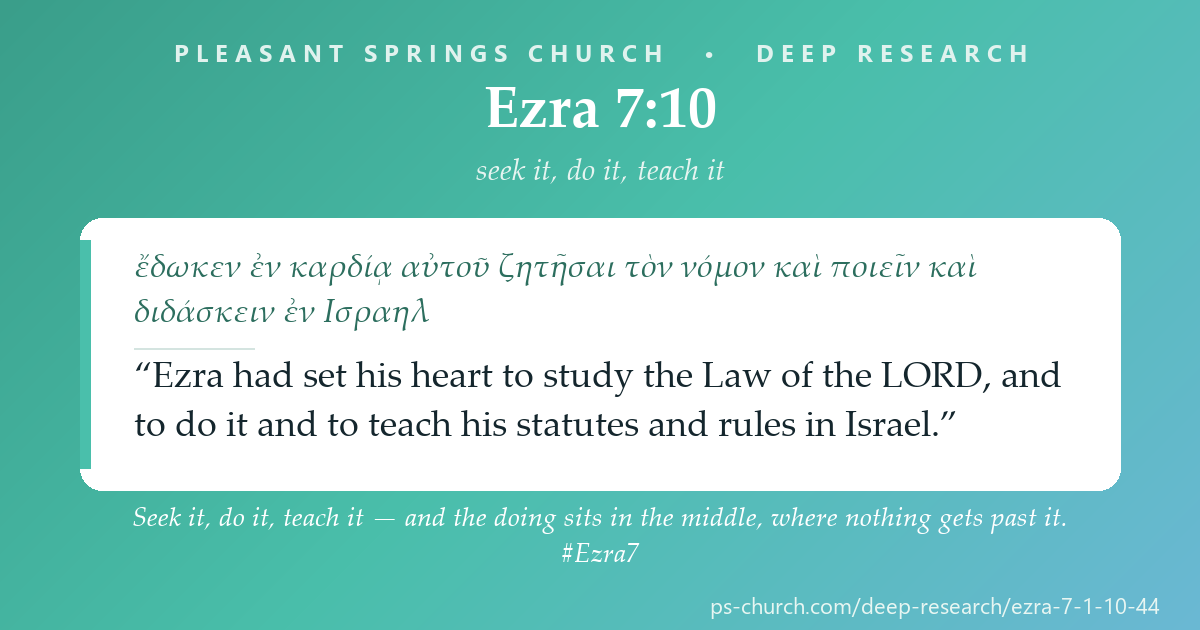
The man the book is named for arrives in chapter 7, about sixty years after chapter 6, and is introduced with one sentence that has shaped how the church thinks about study ever since. 7:10 has three infinitives in a deliberate order: Ezra set his heart to seek the Law, and to do it, and to teach it. The doing sits in the middle, where nothing gets past it. And the verb for seek is dāraš — the word Saul died for not doing. Then a journey: a Persian commission, a fortune in silver, four months of bandit country — and no armed escort, because Ezra had already told the king that God looks after those who seek him and “I was ashamed to ask.” He arrives, hears that the community has intermarried with the peoples of the land, tears his clothes, sits appalled until the evening offering, and prays a confession that asks for nothing at all. And then chapter 10, in the rain — the hardest chapter in the book, which this page prints without endorsing and without explaining away. God does not speak in it, no prophet appears, and the narrator gives no verdict. The last verse is a sentence nobody can translate with confidence. See the method →
Ezra 7:1–10:44 (selections)
Hebrew & Aramaic · Greek (Rahlfs, 2 Esdras) · ESVAnd the verb for seek is dāraš — the word Saul died for not doing, the word that measured Asa’s forty-one years. Here it is applied to a book.
Then a journey. Artaxerxes gives him a letter, a commission, and an extraordinary quantity of silver and gold for the temple. Ezra assembles the travellers at the river Ahava, notices there are no Levites among them and sends back for some, and proclaims a fast — because he has already told the king that God looks after people who seek him, and now feels he cannot ask for an armed escort. 8:22 is one of the most honest sentences in Scripture: I was ashamed. Four months of bandit country, a fortune in the baggage, and no soldiers, because of something he had said.
He arrives, and within days is told that the returned community — including priests and Levites — has intermarried with the surrounding peoples. He tears his clothes, pulls hair from his head and beard, and sits appalled until the evening sacrifice. Then he prays. The prayer asks for nothing at all. It is confession from beginning to end, in the first person plural, from a man who had only just arrived.
And then chapter 10, which this page will print and will not tidy.
Text and numbering. In Greek, Ezra and Nehemiah are one book, 2 Esdras (Ἔσδρας Βʹ); Ezra 7–10 correspond to 2 Esdras 7–10 one to one, and the ten-chapter offset only begins at Nehemiah. Verse counts — 28, 36, 15, 44 — match Rahlfs exactly, with nothing absent. Counted against both columns, not assumed.
⚠️ 7:12–26 is Aramaic. As in 4:8–6:18, the language switches for the quoted imperial document — Artaxerxes’ letter of commission — and switches back at 7:27, where Ezra begins speaking in the first person. The seam between the emperor’s Aramaic and Ezra’s Hebrew is also the seam where the memoir begins.
⚠️ The last verse of the book is textually difficult. 10:44 carries a ketiv/qere (written נשאי, read נָשְׂאוּ), and its final clause — wəyēš mēhem nāšîm wayyāśîmû bānîm — is genuinely obscure in Hebrew; translations render it “and some of them had wives by whom they had children,” while others follow the Greek of 1 Esdras 9:36, “and they sent them away with their children.” The book ends on a sentence nobody is sure of, and this page says so rather than choosing silently.
The Shape of the Passage
SequenceBehind these chapters stand the return and the finished house of Ezra 1–6, and roughly sixty years of silence between chapter 6 and chapter 7. In front of them stands a wall, and a public reading of the Law that Ezra himself will conduct.
Author
Part of this is a memoir. At 7:27 the book stops saying “Ezra” and starts saying “I,” and stays in the first person through chapter 9. Chapter 10 reverts to third person. Whatever the compilation history, the effect is that the most exposed material — the shame at 8:22, the torn garment, the prayer — is in Ezra’s own voice, and the mass proceeding of chapter 10 is not.
He counts and weighs everything. Twelve priests, the silver and gold weighed into their hands by item, and weighed out again on arrival “within three days” with the whole inventory recorded (8:24–34). This is a man carrying other people’s money across a continent and documenting it. It is also, quietly, why we can believe him about the escort.
And he does not tell you what to think about chapter 10. There is no “and the Lord commanded,” no “and it was good in the eyes of the Lord,” no closing verdict of any kind. The proposal comes from Shecaniah, not from God; Ezra acts on it; and the book stops in the middle of a list. That silence is a fact about the text, and this page treats it as one.
Audience
A community trying to work out what it was. After the exile the question was not merely religious but existential: what makes someone part of this people? Descent, or covenant, or both? Chapter 2 excluded priests who could not document their line. Chapter 9–10 confronts households formed with the peoples of the land. These are the same question from two directions, and the community reading it had not settled it.
People for whom this was not theoretical. The families named in 10:18–43 were the ancestors of the readers. Naming them — starting with the priests — is not a rhetorical device; it is a public record with descendants who could read it.
And people who needed a model of study that did not stop at study. 7:10 is the verse the community built its life around: seek the Law, do it, then teach it. Nehemiah 8 will show the same man doing exactly that in front of the whole city, with Levites “giving the sense so that the people understood the reading.”
Orient on the scribe, on Persian commissions, on the marriage laws, and on the composition of the book.
Search by topic: Ezra (person); scribe (sopher); Artaxerxes I; Persian imperial authorisation; satrapy Beyond the River; river Ahava; Levites; intermarriage in the Old Testament; Deuteronomy 7; the holy seed; divorce; Malachi; Ezra memoir.
Which articles are relevant?
- Anchor Bible Dictionary — “Ezra (person),” “Scribe,” “Artaxerxes,” “Marriage,” “Divorce,” “Intermarriage,” “Beyond the River,” “Ezra, Book of.”
- Dictionary of the OT: Historical Books (IVP) — “Ezra and Nehemiah, Books of,” “Marriage,” “Ethnicity,” “Law,” “Prayer.”
- NIDOTTE / TDOT — דָּרַשׁ (dāraš, seek/study), סוֹפֵר (sōpēr, scribe), בּוֹשׁ (bōš, be ashamed), מַעַל (maʿal, breach of faith), זֶרַע (zeraʿ, seed/offspring), יָצָא (hōṣîʾ, put away).
- On the Greek — the NETS introduction to 2 Esdras; and note the very different form of this material in 1 Esdras 8–9, which ends with the public reading of the Law rather than a list.
Bibliography surfaced:
- H. G. M. Williamson, Ezra, Nehemiah (WBC); Joseph Blenkinsopp, Ezra–Nehemiah (OTL); Lester L. Grabbe, Ezra–Nehemiah; and for the marriage crisis specifically, the extended treatments in Williamson and Blenkinsopp. (Critical scholarship; the historical and philological work is used, and the conclusions are weighed.)
- Before reading any of them on chapter 10, read Ezra 9–10, Nehemiah 13:23–27 and Malachi 2:10–16 in one sitting. The three passages do not say the same thing, and that is the beginning of reading this honestly.
What a Persian commission was, what a scribe was, and how the ancient retellings handled chapter 10.
First the world: imperial authorisation of local law, the office of scribe, and the documented reality of mixed marriage in the province. Then the honest work on chapter 10.
Which parallels shed light on these chapters?
Persia did authorise local law codes, and the commission in chapter 7 looks like one. The Passover Papyrus from Elephantine shows a Persian official conveying instructions about Jewish festival observance; the Demotic Chronicle records Darius ordering the collection and codification of Egyptian law. Artaxerxes’ letter, empowering Ezra to appoint judges who know “the laws of your God” and to enforce them Beyond the River (7:25–26), fits a documented imperial practice: a stable province is one governed by its own law, ratified by the empire.
A sōpēr was an official, not a scholar in a study. The word means writer, secretary, records-officer — a senior administrative post throughout the Near East. Ezra is both: 7:6 calls him “a scribe skilled in the Law of Moses,” and 7:12 has the king address him as “scribe of the Law of the God of heaven,” which reads like a title in the Persian service. He carries a portfolio, not just a conviction.
And mixed marriage in the province is documented outside the Bible. The Elephantine papyri record Jewish men in Persian Egypt marrying Egyptian women, with contracts and property arrangements. Whatever one concludes about chapter 10, the situation it describes was ordinary across the diaspora, and the community in Judah was small — a few tens of thousands — surrounded by populations it had every practical reason to marry into.
- The Elephantine papyri (Aramaic legal and administrative documents — witnesses, not Scripture) — marriage contracts including mixed marriages, and the Passover Papyrus showing Persian involvement in Jewish observance.
- The Demotic Chronicle (Egyptian document — a witness, not Scripture) — Darius ordering the codification of Egyptian law, the closest documented parallel to the commission of Ezra 7:25–26.
- 1 Esdras 8–9 (Second-Temple Greek, Apocrypha — a witness, not Scripture in our confession) — the same material, but it does not end with the list: it runs on into the public reading of the Law that our Bibles place at Nehemiah 8. A different editorial judgment about where this story stops, made in antiquity.
- Josephus, Antiquities 11.5.1–5 (§§120–158) (Second-Temple — a witness, not Scripture) — he follows 1 Esdras, and so ends Ezra’s story with the reading of the Law and a feast rather than with the register of offenders.
This is the hardest chapter in Ezra, and a study that hurries past it is not worth reading.
What the text says. The officials report that the people, the priests and the Levites have not separated from the peoples of the lands, and that “the holy seed has mixed itself” (9:1–2). Ezra tears his clothes, sits appalled, and prays a confession. Shecaniah, not Ezra, then proposes a covenant to put away the foreign wives “and those born of them,” and tells Ezra to act. Ezra makes the leaders swear. The assembly meets in the rain, agrees, asks for time, and commissioners examine the cases over three months. A list of names follows — beginning with priests — and the book ends.
What the text does not say. God does not speak in chapter 10. There is no command, no oracle, no prophet, and no narratorial approval — no “and it was right in the eyes of the Lord.” The law Ezra cites (9:1, 11–12; cf. Deuteronomy 7:1–4) forbids contracting such marriages; it does not prescribe dissolving existing ones, and it says nothing about the children. The proposal is human, and the text presents it as human: “let it be done according to the Law” is Shecaniah’s sentence, not God’s.
And Scripture elsewhere pulls hard the other way. Malachi, in this same period, condemns the man who is faithless to the wife of his youth and speaks of God hating divorce (2:14–16). Nehemiah meets the identical problem a generation later and responds furiously — cursing, striking, pulling out hair, making them swear — but does not order the marriages dissolved (Nehemiah 13:23–27). And the canon itself contains Ruth, a Moabite in the royal line, and Rahab of Jericho.
What this page will not do. It will not present chapter 10 as a model to imitate, and it will not pretend the Bible is embarrassed by it either. The book reports what a frightened, tiny community did to preserve its identity, names the men who did it, and declines to bless it. Both halves of that matter. Scripture sometimes records without commending — as with Jephthah, or Gideon’s ephod — and the reader’s job is to notice the silence rather than fill it in either direction. The women and children are not given a single line in the chapter. That is worth sitting with.
Three infinitives in order, one verb of shame used twice, and the word Chronicles was built on.
Read 7:10 slowly and notice where doing sits. Then find bōštî at 8:22 and 9:6 — the same man, ashamed before an emperor and before God, for opposite reasons.
“To seek, inquire into, study.” The verb the whole Chronicles corpus is scored by — Saul died for not doing it, Asa was measured by it, Manasseh was heard when he did it — and here it takes the Law as its object. That is a real development: to seek God is now also to seek what he has said. Note the order of the three infinitives: liḏrōš (seek), wəlaʿăśōṯ (and to do), ûləlammēḏ (and to teach). The doing sits between the studying and the teaching, and nothing gets past it. The Greek is ζητῆσαι.
“I was ashamed.” The same verb twice, and the two occurrences are the frame of Ezra’s own account. 8:22: ashamed before a Persian king, because he had said out loud that God protects those who seek him and could not now ask for cavalry. 9:6: ashamed before God, “ashamed and blush to lift my face to you.” The Greek uses αἰσχύνομαι in both places, so the link survives translation.
“Scribe, secretary, records-officer.” Not primarily a scholar: in the Old Testament a sōpēr is a senior official (2 Sam 8:17; 2 Kgs 22:3, where Shaphan the scribe is the man who receives the found book). 7:12 has Artaxerxes address Ezra by what reads like a formal Persian title. The office and the vocation coincide — and it is the same word behind the later “scribes” of the Gospels.
“Breach of faith.” The word Chronicles built its whole account on — Judah exiled for it, Saul dead for it, Uzziah struck for it — is the word used of the marriages here, five times. Whatever a modern reader makes of the response, the writer is classifying this as sacrilege, not as a social preference, and doing so in the vocabulary of the books that come before. That is the internal logic; it is not, by itself, an endorsement of chapter 10.
“The holy seed.” A phrase found here and, in a different sense, at Isaiah 6:13. It is the language that makes chapter 9 so uncomfortable to modern ears, and it is worth being precise about what it does: it applies to Israel the vocabulary of things set apart — the same root as the holy vessels and the holy place. The category is cultic before it is ethnic, which is why Ruth the Moabite and Rahab of Jericho are not counter-examples to the principle so much as evidence about how it worked.
“To bring out, send away, put away.” The verb of the covenant Shecaniah proposes. It is not the ordinary term for divorce (šillaḥ, “send away,” as in Deuteronomy 24:1 and Malachi 2:16), and commentators differ over whether the difference is significant. The page reports the vocabulary and does not build on it.
Two things here reported rather than tidied:
- The last verse of the book is obscure. 10:44 has a ketiv/qere and a final clause — wəyēš mēhem nāšîm wayyāśîmû bānîm — that does not construe smoothly. English versions give “and some of them had wives by whom they had children”; others follow 1 Esdras 9:36, “and they put them away together with their children.” The two readings differ over whether the chapter ends with the children being sent away or merely noted. That is not a small difference, and it is genuinely unresolved.
- Where Ezra’s story ends depends on which book you read. Our Ezra stops at the register. 1 Esdras carries straight on into the public reading of the Law — the material our Bibles place at Nehemiah 8 — and ends with the people weeping, then feasting, and being told “the joy of the Lord is your strength.” Josephus follows that arrangement. Two ancient editors, two decisions about where to stop, and the difference changes the impression the story leaves.
The law Ezra cites, the passages that pull against chapter 10, and the reading of the Law to come.
Read Deuteronomy 7 and then Ezra 9:1–2 — and notice exactly what the law forbids and what it does not. Then read Nehemiah 13 and Malachi 2 before forming a view of chapter 10.
Which cross-references matter?
- Deuteronomy 7:1–4 (cf. Exodus 34:11–16) → Ezra 9:1–2, 11–12 — the law Ezra invokes. It prohibits making such marriages, and gives a reason: “they would turn away your sons from following me.” It does not legislate for marriages already contracted, and it says nothing about children. Ezra 9:11–12 quotes it as though from “your servants the prophets,” blending several texts — a paraphrase, not a citation.
- Nehemiah 13:23–27 — the same problem, a different response. Nehemiah confronts men married to women of Ashdod, Ammon and Moab, curses them, strikes some, pulls out their hair, and makes them swear not to give their children in marriage — and he cites Solomon as the warning. He does not order existing marriages dissolved. Two leaders, one generation apart, on the same issue, doing different things.
- Malachi 2:10–16 — contemporary, and pulling the other way. It condemns marrying “the daughter of a foreign god” and being faithless to “the wife of your youth… your companion and your wife by covenant,” and speaks of God hating divorce (2:16 — a verse whose Hebrew is itself difficult). Both halves of Malachi 2 are in the Bible.
- Ruth and Joshua 6:25 → Matthew 1:5 — a Moabite and a Canaanite of Jericho, both in the genealogy of David and of Christ. The canon that contains Ezra 9–10 also contains Ruth, and Matthew names both women. This page sets them side by side and does not resolve the tension for the reader.
- Ezra 7:10 → Nehemiah 8:1–8 — seek, do, teach. Nehemiah 8 is Ezra doing the third thing: standing on a wooden platform from early morning until midday, reading, with Levites “giving the sense, so that the people understood the reading.” The job description of 7:10 is fulfilled two books later — and in 1 Esdras it follows immediately.
- Ezra 8:22 and 2 Chronicles 16:7–9 — Ezra will not ask for an escort because of what he has said about God; Asa hired Syria and was told “the eyes of the Lord run to and fro… to give strong support to those whose heart is whole toward him.” The same theology, one man acting on it and one not.
Where the scholarship agrees, where it does not, and what this page leaves open.
Williamson, Blenkinsopp and Grabbe. Then four live questions — and on all four the honest answer is that the text does not settle it.
Commentaries & studies:
- H. G. M. Williamson, Ezra, Nehemiah (WBC) — the standard treatment, careful on the Aramaic commission and on the composition of chapters 7–10.
- Joseph Blenkinsopp, Ezra–Nehemiah (OTL) — strong on the Persian setting of the commission and on the social dynamics behind the marriage crisis.
- Lester L. Grabbe, Ezra–Nehemiah — on the historical questions and on the relationship between Ezra and 1 Esdras.
- On chapter 10 specifically: read the extended discussions in Williamson and Blenkinsopp, and read them after Ezra 9–10, Nehemiah 13 and Malachi 2. The secondary literature is more useful when the three primary passages are already in view.
Interpretation notes worth keeping:
- The date of Ezra’s mission — genuinely disputed. “The seventh year of Artaxerxes” (7:7) gives 458 BC if Artaxerxes I, or 398 BC if Artaxerxes II — which would put Ezra after Nehemiah. Arguments run both ways and neither is demonstrable. This page follows the canonical order without claiming it settles the chronology.
- Whether chapter 10 is approved by the text — and the answer matters. The absence of divine speech, of prophetic endorsement and of any narratorial verdict is not disputed; what is disputed is what to make of it. Some read the silence as tacit approval, others as deliberate withholding. This page reports the silence as a fact and declines to convert it into either a commendation or a condemnation.
- What happened to the women and children. The text does not say. Proposals include return to their families of origin with support, or destitution. Scripture is silent, and the silence is itself the most uncomfortable thing in the chapter.
- 10:44 and the ending. The Hebrew is obscure and 1 Esdras reads differently; whether Ezra originally ended here at all is bound up with the question of where Nehemiah 8 belongs.
The order of the three verbs, the cost of what you say out loud, and a silence to sit with.
Name what you learned, why it matters, and one concrete response.
What should we carry away — and do?
- Seek, do, teach — in that order. 7:10 puts obedience between study and instruction, and there is no route from the first to the third that goes around the second. Anyone who teaches Scripture should read that verse about once a month.
- He was ashamed to ask for soldiers. Ezra had told a Persian king what God was like, and then had to travel four months through bandit country without an escort because of it. What you say about God in public becomes a bill you have to pay in private. He paid it.
- He prayed before he did anything. Torn clothes, sitting appalled until the evening sacrifice, and then a prayer that asks for nothing — no relief, no strategy, no vindication. Only then does anyone act. Notice how rarely that is the order.
- One concrete response. Chapter 10 gives the women and children not one line. Sit with that for five minutes before deciding what you think about it — and then ask who, in a decision you are currently part of, is not being quoted.
Ezra 7:10 · to share
Hebrew + Greek (Rahlfs, 2 Esdras) + ESVEvery Deep Research page traces its passage across the whole sweep — the Old Testament, the Second-Temple world between the testaments (historical witnesses, not Scripture), and the New Testament. Follow the thread:
Pleasant Springs Church — Deep Research
Research method after Michael S. Heiser’s Bible Research Method (examine dictionaries → ancient literature → important words → textual connections → academic publications → share), with the Pleasant Springs “Author & Audience” foundation. Scripture set in the Hebrew, the Greek editions named on each page and the ESV (Old Testament), and the Greek New Testament and the ESV (New Testament), per the practice of Pleasant Springs Church. Ezra 7–10 research grounded in Williamson (WBC), Blenkinsopp (OTL) and Grabbe. Book name and numbering: in the Septuagint Ezra and Nehemiah are one book, 2 Esdras (Ἔσδρας Βʹ); Ezra 7–10 = 2 Esdras 7–10 one to one, and the ten-chapter offset begins only at Nehemiah. Text: Hebrew and Aramaic from the Masoretic Text — 7:12–26 is Aramaic, the quoted commission, with Hebrew resuming at 7:27 where the first-person memoir begins; Greek from Rahlfs’s Septuaginta (CATSS digitization), printed without editorial punctuation and with proper names unaccented; English ESV. Verse counts (28, 36, 15, 44) match Rahlfs exactly with nothing absent — counted against both columns, not assumed. ⚠️ 10:44, the last verse of the book, is textually difficult: a ketiv/qere, and a final clause that does not construe smoothly; English versions read “and some of them had wives by whom they had children,” while 1 Esdras 9:36 supports “they put them away with their children.” The two readings differ over whether the children were sent away, and the page states the difficulty rather than choosing silently. ⚠️ Chapter 10 is handled with deliberate restraint. The page states what the text says; states plainly that God does not speak in the chapter, no prophet appears, and no narratorial verdict is given; notes that the law cited (Deuteronomy 7:1–4) forbids contracting such marriages but does not prescribe dissolving existing ones or address the children; notes that the proposal is Shecaniah’s, not God’s; and sets beside it Nehemiah 13:23–27, where the same problem meets a furious but different response that does not dissolve marriages, and Malachi 2:10–16, which condemns both foreign marriage and faithlessness to the wife of one’s youth. Ruth and Rahab are set alongside without resolving the tension. The page explicitly declines to present chapter 10 as a model, and equally declines to condemn beyond what the text does, on the principle that Scripture sometimes records without commending; it notes that the women and children are given no voice in the chapter. The date of Ezra’s mission (Artaxerxes I, 458 BC, or Artaxerxes II, 398 BC, which would place Ezra after Nehemiah) is reported as disputed and undecided; the page follows the canonical order without claiming it settles the chronology. 1 Esdras is named as Apocrypha — a witness, not Scripture in our confession, and its different ending (running on into the reading of the Law that our Bibles place at Nehemiah 8) is reported, along with the fact that Josephus follows it. Elephantine and Demotic Chronicle material is cited for administrative and social practice only. Typology is handled per the house position: what the text says, what the New Testament itself draws, and what we see from this side of the cross — with the seeing left to the reader.
Scripture quotations marked ESV are from the ESV® Bible (The Holy Bible, English Standard Version®), © 2001 by Crossway, a publishing ministry of Good News Publishers. ESV Text Edition: 2016. Used by permission. All rights reserved. The ESV text may not be quoted in any publication made available to the public by a Creative Commons license, and the ESV may not be translated in whole or in part into any other language. www.esv.org
|
Did this study bless you today? 💚 Give to Support PS Church100% of gifts go to the General Fund — thank you. |