This book begins by finishing a sentence. 2 Chronicles ends mid-decree — “let him go up” — and stops. Ezra 1:3 completes it: to Jerusalem, which is in Judah, and rebuild the house of the Lord. What follows is not triumphant. Fifty thousand people go up; some cannot prove their descent and are barred from the priesthood until a priest with Urim and Thummim can rule, which is to say indefinitely. They build the altar before the foundation, and the narrator says why — “for fear was on them because of the peoples of the lands.” When the foundation is finally laid and the priests sing the line the temple has always sung, the old men who had seen the first house weep so loudly that nobody can tell the weeping from the shouting. Then the work stops for about sixteen years. It restarts because two prophets begin preaching, and it survives an imperial audit because a clerk in a fortress at Ecbatana still had Cyrus’s memorandum on file. This study also takes seriously something most readers never notice: from 4:8 this book is not in Hebrew — it is in Aramaic, the language the imperial paperwork was actually filed in. See the method →
Ezra 1:1–6:22 (selections)
Hebrew & Aramaic · Greek (Rahlfs, 2 Esdras) · ESVWhat follows is not triumphant. About fifty thousand people go up. Some cannot prove their descent and are excluded from the priesthood until a priest with Urim and Thummim can rule — which is to say, indefinitely. They build the altar before the foundation, in the seventh month, and the narrator says why: “for fear was on them because of the peoples of the lands” (3:3). The sacrifices restart on a bare platform in a ruined city because they were frightened.
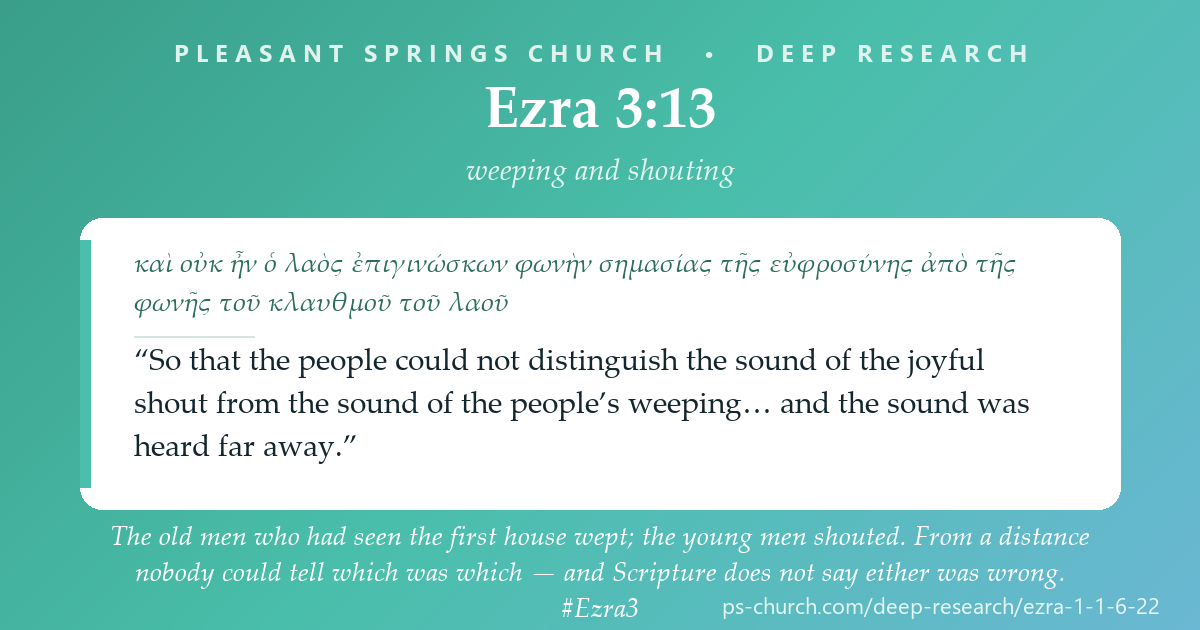
Then the foundation is laid, and the priests sing the line the temple has always sung — his steadfast love endures for ever — and something happens that nobody plans. The old men who had seen the first house wept aloud, and the young shouted for joy, and the two sounds could not be told apart. The narrator does not say which was right.
Then the work stops for roughly sixteen years. It restarts because two prophets start preaching, and it survives an imperial audit because a clerk in a fortress at Ecbatana still had Cyrus’s original memorandum on file.
Three things about this book’s text that most readers never meet.
⚠️ In Greek, Ezra and Nehemiah are one book: 2 Esdras (Ἔσδρας Βʹ), numbered continuously. Ezra 1–10 correspond to 2 Esdras 1–10 one to one — but Nehemiah 1 is 2 Esdras 11, and the offset of ten runs to the end. That matters for the next studies and is stated here once. There is also a separate Greek book called 1 Esdras (Ἔσδρας Αʹ), covering 2 Chronicles 35–36, Ezra, and Nehemiah 8 in a different order; it is Apocrypha — a witness, not Scripture in our confession, and it is not the book printed here.
⚠️ From 4:8 this book is not in Hebrew. Ezra 4:8–6:18 is written in Aramaic — the administrative language of the Persian empire — and so is 7:12–26. The Hebrew column above shows it: bānayin, maṣləḥîn, ṭaʿam, ʾəlāh are Aramaic forms, not Hebrew ones. The switch is not random: it begins exactly where the official correspondence begins and ends where it ends. The documents are quoted in the language they were filed in.
⚠️ Verse counts. Ezra 1–6 has 11, 70, 13, 24, 17 and 22 verses in the Masoretic Text, and Rahlfs matches exactly, with nothing absent. Counted against both columns, not assumed. One difference of wording worth noting at 6:14: where the Aramaic has the elders “prospering” (maṣləḥîn), Rahlfs reads οἱ Λευῖται, “and the Levites.”
The Shape of the Passage
InclusioBehind this book stands the last verse of 2 Chronicles, which it completes, and Jeremiah’s seventy years, which 1:1 says are now up. In front of it stand a wall, a reading of the law, and a crisis about marriage.
Author
He works from documents, and he shows them to you. This book quotes: Cyrus’s proclamation, an inventory of temple vessels, a register of returnees, a hostile letter to Artaxerxes and the reply, Tattenai’s report to Darius, and the memorandum found at Ecbatana. Much of it is reproduced in the language it was written in. Whatever else the compiler is doing, he is not asking to be taken on trust — he is putting the file on the table.
He is candid about how unimpressive it was. An altar built out of fear. A foundation greeted with as much grief as gladness. Priests who could not prove they were priests. Sixteen years of stopped work. A temple finished only because a foreign administration paid for it out of tax revenue. None of that is hidden, and the contrast with the golden numbers of 2 Chronicles 3–4 is not softened.
And chapter 4 is not in chronological order. The correspondence at 4:6–23 concerns Ahasuerus and Artaxerxes — kings who reigned well after Darius — and it is placed inside the account of a stoppage under Darius. The compiler has grouped the material by theme (opposition to building) rather than by date, and then returned to the thread at 4:24. This is worth knowing before concluding that the book is confused; the same instinct arranged 1 Chronicles 11–12.
Audience
People for whom the register was a legal document. Chapter 2 is not padding. In a community where descent decided whether you could serve as a priest or claim a field, a list of who came back was the founding charter — and 2:59–63 records the people it excluded. This is the world the Chronicler’s nine chapters of names were written for.
People who had to work with an empire. The temple is authorised, audited, and then funded by Persia. There is no embarrassment about this in the text: 6:14 puts “the decree of the God of Israel” and “the decree of Cyrus and Darius and Artaxerxes” in the same sentence, without apology and without confusion about which one is doing the deeper work.
And people who remembered something better. 3:12 is the most human verse in the book: the men old enough to have seen the first house wept when they saw the footprint of the second. The text does not tell them to cheer up. It records both sounds and says they were indistinguishable at a distance — which is as good a description of that generation as anything written.
Orient on the return, on Persian administration, on the second temple, and on the Aramaic of the book.
Search by topic: Ezra (Book of); return from exile; Cyrus; Sheshbazzar; Zerubbabel; Jeshua / Joshua the high priest; Persian empire administration; satrapy Beyond the River; Tattenai; Ecbatana; Biblical Aramaic; Urim and Thummim; second temple; Haggai; Zechariah; 1 Esdras.
Which articles are relevant?
- Anchor Bible Dictionary — “Ezra, Book of,” “Cyrus,” “Sheshbazzar,” “Zerubbabel,” “Persia, History of,” “Beyond the River,” “Ecbatana,” “Aramaic Language,” “Temple, Jerusalem (Second),” “Esdras, First Book of.”
- Dictionary of the OT: Historical Books (IVP) — “Ezra and Nehemiah, Books of,” “Exile and Restoration,” “Persia, Persians,” “Aramaic Language,” “Temple.”
- NIDOTTE / TDOT — עוּר (hēʿîr, stir up), עָלָה (ʿālāh, go up), יָסַד (yāsaḏ, lay a foundation), גּוֹלָה (gōlāh, the exile / the returned community), טְעֵם (Aramaic ṭəʿēm, decree).
- On the Greek — the NETS introduction to 2 Esdras (Esdras B), and its account of the relationship between 2 Esdras and 1 Esdras — two quite different Greek treatments of this material.
Bibliography surfaced:
- H. G. M. Williamson, Ezra, Nehemiah (WBC); Joseph Blenkinsopp, Ezra–Nehemiah (OTL); Sara Japhet, From the Rivers of Babylon to the Highlands of Judah; Lester Grabbe, A History of the Jews and Judaism in the Second Temple Period. (Critical scholarship; the documentary and historical work is what is used here, and the conclusions are weighed.)
- On the Aramaic: any standard grammar of Biblical Aramaic will set out the section boundaries; the point for a reader without the languages is simply to know that the switch is there and where it falls.
A Persian policy in writing, an empire that kept its paperwork, and the languages of the file.
First the world: Achaemenid repatriation policy, provincial administration, and the archives. Then the honest question of what the external documents establish about Ezra 1 and 6.
Which parallels shed light on these chapters?
Restoring displaced peoples and their sanctuaries was declared Persian policy. The Cyrus Cylinder presents Cyrus returning gods to their cities and settling people back in their homes — framed throughout as the will of Marduk, whose favour he claims. It does not mention Judah or Jerusalem. What it establishes is the policy, not this decree, and this page says so rather than presenting the Cylinder as a confirmation of Ezra 1.
The empire really did work this way, and Ezra 5–6 reads like it. Tattenai, the governor Beyond the River, is a documented Persian official; the procedure in chapter 5 — a provincial officer queries a project, sends a written report, requests a search of the royal records — matches Achaemenid administrative practice as it appears in the Persepolis Fortification Tablets and the Elephantine papyri. The Elephantine archive is particularly useful: a Jewish garrison in Egypt petitioning the Persian authorities for permission to rebuild their temple, in Aramaic, with reference to earlier authorisations. Same empire, same language, same procedure, same problem.
And the archive at Ecbatana is a realistic detail. 6:1–2 has Darius order a search “in Babylon… in the house of the archives where the documents were stored,” and the scroll turns up not there but in the fortress at Ecbatana in Media — which was Cyrus’s summer capital, and therefore exactly where a memorandum from his first year might have ended up. The narrative does not make the point; it simply reports the address.
- The Cyrus Cylinder (Persian royal inscription — a witness, not Scripture) — the repatriation policy, framed under Marduk. Cited for the policy; it does not mention Judah and is not the decree of Ezra 1.
- The Elephantine papyri (Aramaic documents of a Jewish community in Persian Egypt — witnesses, not Scripture) — petitions to rebuild a temple, correspondence with Jerusalem and with Persian officials, in the same administrative Aramaic as Ezra 4–6. The closest thing we have to the paperwork behind this book.
- The Persepolis Fortification Tablets (Achaemenid administrative records — witnesses, not Scripture) — for the bureaucracy: rations, authorisations, and the keeping of records.
- 1 Esdras (Second-Temple Greek, Apocrypha — a witness, not Scripture in our confession) — a different Greek arrangement of this material, including the famous “contest of the three bodyguards” which has no counterpart in Ezra. Worth knowing about precisely because it shows how freely the material could be rearranged.
- Josephus, Antiquities 11.1–5 (§§1–158) (Second-Temple — a witness, not Scripture) — he retells the return, and follows 1 Esdras rather than Ezra at several points, which is itself informative about which version he had.
Two features of this book confuse readers, and both have the same explanation: it is a dossier.
The language. Ezra 1:1–4:7 is Hebrew. Ezra 4:8–6:18 is Aramaic. Then Hebrew resumes, and 7:12–26 is Aramaic again. The boundaries are not arbitrary: the Aramaic begins at the first quoted imperial letter and ends when the last one is finished with. Aramaic was the administrative language of the Persian empire — the language those documents were actually written in — and the compiler reproduces them rather than translating. It is the ancient equivalent of quoting the correspondence verbatim in an appendix.
The chronology. Chapter 4 runs: opposition under Cyrus and Darius (4:1–5), then a complaint under Ahasuerus (4:6), then a long exchange under Artaxerxes (4:7–23) — both of whom reigned after Darius — and then 4:24 returns to “the work on the house of God in Jerusalem… until the second year of the reign of Darius.” Read as a timeline this is incoherent. Read as a file on ‘opposition to building,’ it is perfectly orderly: the compiler gathers every instance he has, across reigns, and then resumes the narrative.
What this page does not do is pretend the difficulty is not there, or resolve it by rearranging the text. It reports the arrangement, gives the thematic explanation that most commentators accept, and notes that the same compiler’s instinct — group by subject, not by date — is visible in Chronicles too.
One verb for an emperor and a migrant, a word for the community, and an Aramaic noun for a decree.
Read hēʿîr twice in 1:1 and 1:5 and notice it is the same action. Then find ṭəʿēm in 6:14 — God’s decree and Persia’s, in one sentence, with the same noun.
“Stirred up, roused, awakened.” The book opens with it twice: the Lord stirred up the spirit of Cyrus king of Persia, and then stirred up the spirits of the heads of families to go. The same verb for the emperor and for the emigrants — the decree and the response are both attributed to the same action. The Greek is ἐξήγειρεν.
“And let him go up.” The word Chronicles ends on, picked up here and completed with a destination. It is the standard verb for pilgrimage to Jerusalem and for the exodus, and in these books it becomes the technical term for the return — the people are those who came up (2:1). The Greek ἀναβήσεται.
“The exile” — and by extension the exiles, the community formed by it. “The sons of the gōlāh” becomes this book’s name for the returned people, even long after the return. They kept the name of the thing that had happened to them, and 6:21 shows how membership worked: the Passover was eaten by the sons of the exile and by everyone who separated himself from uncleanness “to seek the Lord.”
“They laid the foundation.” The word the whole of chapter 3 turns on, and the object of both the shouting and the weeping. Note 3:6: the offerings began “but the foundation of the temple of the Lord was not yet laid.” Worship restarted before the building did, which is the theological order this book insists on.
Aramaic: “decree, command, official order.” This is the administrative word that runs through the whole imperial section — who gave the order, by whose ṭəʿēm. And 6:14 uses it of God and of Persia in the same clause: they finished “from the ṭəʿēm of the God of Israel and from the ṭəʿēm of Cyrus and Darius and Artaxerxes.” One noun, two authorities, no embarrassment.
“Urim and Thummim.” Those who could not document their priestly descent were excluded “until there should be a priest to consult Urim and Thummim.” The last mention of the instrument in the historical books, and the sentence quietly says it was not available. The exclusion was therefore indefinite — and the text states the rule and the hardship without resolving either.
Two things here reported rather than tidied:
- Sheshbazzar and Zerubbabel. 1:8 and 5:14–16 credit Sheshbazzar, “the prince of Judah,” with receiving the vessels and laying the foundation; 3:8–11 credits Zerubbabel and Jeshua. Proposals include that they are the same man under two names, that Sheshbazzar was an older relative or predecessor, or that the accounts preserve two traditions. Scripture does not say, and this page reports the two names rather than merging them.
- Chapter 4 groups by theme, not date. 4:6 concerns Ahasuerus and 4:7–23 concerns Artaxerxes — both later than the Darius of 4:24. See the insight in Stage 2. The arrangement is deliberate, not confused, but it is an arrangement, and a reader following a timeline needs to be told.
The sentence completed, the prophets who restarted the work, and a refrain still being sung.
Read 2 Chronicles 36:22–23 and Ezra 1:1–3 as one paragraph, because they are one. Then read Haggai 1 beside Ezra 4:24–5:2 and the sixteen years acquire a voice.
Which cross-references matter?
- 2 Chronicles 36:22–23 → Ezra 1:1–3 — the same decree, and Ezra finishes the sentence. Chronicles stops at “let him go up”; Ezra continues “to Jerusalem, which is in Judah, and rebuild the house.” In the Hebrew arrangement the Old Testament ends on the unfinished clause and this book completes it.
- Jeremiah 25:11–12; 29:10 → Ezra 1:1 — “that the word of the Lord by the mouth of Jeremiah might be fulfilled.” The seventy years that 2 Chronicles 36:21 said the land was owed are now stated to be up.
- Haggai 1:1–15; 2:1–9 and Zechariah 4:6–10 → Ezra 4:24–5:2 — the two prophets named in 5:1, and what they actually said. Haggai: “Is it a time for you yourselves to dwell in your panelled houses, while this house lies in ruins?” And Haggai 2:3 speaks directly to the men of Ezra 3:12: “Who is left among you who saw this house in its former glory? How do you see it now? Is it not as nothing in your eyes?” Zechariah 4:10: “who has despised the day of small things?”
- Ezra 3:11 and 1 Chronicles 16:34; 2 Chronicles 5:13; 7:3; 20:21 — “for he is good, for his steadfast love endures for ever toward Israel.” Sung at the tent, at the temple’s dedication, marching at an invading army — and now over a foundation that made half the crowd cry. Same line, fourth occasion.
- Ezra 2 and Nehemiah 7:6–73 — substantially the same register, with numerous differences in the numbers. Both are printed in their own books; the differences are real and are not harmonised here.
- Ezra 6:21 and Isaiah 56:3–8 — the Passover eaten by the returned exiles and by everyone who separated himself from the uncleanness of the nations “to seek the Lord.” The criterion is seeking, and Isaiah had promised exactly that to the foreigner who joins himself to the Lord.
Where the scholarship agrees, where it does not, and what stays open.
Williamson, Blenkinsopp, Japhet and Grabbe. Then four live questions — and on three the honest answer is that the evidence does not settle it.
Commentaries & studies:
- H. G. M. Williamson, Ezra, Nehemiah (WBC) — the standard English-language commentary, and particularly careful on the Aramaic documents and their authenticity.
- Joseph Blenkinsopp, Ezra–Nehemiah (OTL) — strong on the Persian setting and on the composition of the book.
- Sara Japhet, From the Rivers of Babylon to the Highlands of Judah — collected essays, including on the relationship between Chronicles and Ezra–Nehemiah.
- Lester L. Grabbe, A History of the Jews and Judaism in the Second Temple Period — for the imperial context. (A critical historian; the documentary work is used and the conclusions are weighed.)
Interpretation notes worth keeping:
- The authenticity of the Aramaic documents — much discussed, and the consensus has moved. Older scholarship treated the letters and decrees as later compositions; comparison with the Elephantine papyri and other Achaemenid material has persuaded many that they reflect genuine chancellery style and formulae, whatever their transmission history. This page reports them as the book presents them and notes that the question is live rather than closed.
- Sheshbazzar and Zerubbabel — unresolved. See Stage 3.
- The relationship of Ezra–Nehemiah to Chronicles — no longer assumed. The old view that one “Chronicler” wrote all of it has been substantially abandoned since Japhet and Williamson; the shared decree at the seam is now more often read as a deliberate link than as proof of common authorship. Reported as the state of the question.
- 1 Esdras. A different Greek arrangement of this material, with material Ezra lacks. It is Apocrypha — a witness, not Scripture in our confession; it is named here because Josephus follows it, which affects how his retelling should be used.
An altar built out of fear, two sounds at once, and a file nobody threw away.
Name what you learned, why it matters, and one concrete response.
What should we carry away — and do?
- They built the altar because they were frightened. 3:3 says it plainly: they set it on its site “for fear was on them because of the peoples of the lands,” and offered burnt offerings on it morning and evening. Fear drove them to worship rather than away from it, and the narrator reports the motive without apology.
- Worship restarted before the building did. 3:6: the offerings began “but the foundation of the temple was not yet laid.” Whatever else needed doing, that did not wait for premises.
- Both sounds were right. The old men wept because they remembered; the young shouted because something was finally happening. The text does not correct either, and says they could not be told apart from a distance. A congregation containing both is not a congregation with a problem.
- One concrete response. Somebody in a Persian records office kept a memorandum for about twenty years, and a temple got built because of it. Do the unglamorous, filing-cabinet thing this week — the note, the record, the boring maintenance nobody will thank you for. It is the kind of faithfulness this chapter turns on.
Ezra 3:13 · to share
Hebrew + Greek (Rahlfs, 2 Esdras) + ESVEvery Deep Research page traces its passage across the whole sweep — the Old Testament, the Second-Temple world between the testaments (historical witnesses, not Scripture), and the New Testament. Follow the thread:
Pleasant Springs Church — Deep Research
Research method after Michael S. Heiser’s Bible Research Method (examine dictionaries → ancient literature → important words → textual connections → academic publications → share), with the Pleasant Springs “Author & Audience” foundation. Scripture set in the Hebrew, the Greek editions named on each page and the ESV (Old Testament), and the Greek New Testament and the ESV (New Testament), per the practice of Pleasant Springs Church. Ezra 1–6 research grounded in Williamson (WBC), Blenkinsopp (OTL), Japhet and Grabbe. Book name and numbering: in the Septuagint, Ezra and Nehemiah are one continuous book, 2 Esdras (Ἔσδρας Βʹ, also called Esdras B), numbered straight through. Ezra 1–10 = 2 Esdras 1–10 one to one, but Nehemiah n = 2 Esdras n+10, and that offset is stated here and will be restated on the Nehemiah pages. The separate Greek book 1 Esdras (Ἔσδρας Αʹ) is a different arrangement of this material and is Apocrypha — a witness, not Scripture in our confession; it is named because Josephus follows it, which bears on how his retelling is used. Text: Hebrew and Aramaic from the Masoretic Text — Ezra 4:8–6:18 is in Aramaic, not Hebrew (as is 7:12–26), and the page states this rather than letting a reader assume otherwise; the boundaries coincide with the quoted imperial correspondence. Greek from Rahlfs’s Septuaginta (CATSS digitization), printed without editorial punctuation and with proper names unaccented; English ESV. Verse counts for Ezra 1–6 (11, 70, 13, 24, 17, 22) match Rahlfs exactly with nothing absent — counted against both columns, not assumed; a wording difference at 6:14 (Aramaic “prospering” against Greek “and the Levites”) is noted. ⚠️ Chapter 4 is arranged thematically, not chronologically — 4:6 concerns Ahasuerus and 4:7–23 Artaxerxes, both later than the Darius of 4:24 — and the page states the difficulty plainly, gives the thematic explanation most commentators accept, and does not resolve it by rearranging the text. ⚠️ Sheshbazzar and Zerubbabel are reported as the book reports them, with the proposals named and none adopted. The Cyrus Cylinder is cited for Achaemenid policy only: it is framed under Marduk, does not mention Judah, and is not the decree of Ezra 1. The Elephantine papyri and Persepolis Fortification Tablets are cited for administrative practice and language. The question of the Aramaic documents’ authenticity is reported as live rather than closed, with the note that comparison with Elephantine has moved the consensus. The old assumption of common authorship with Chronicles is reported as substantially abandoned. Second-Temple witnesses (1 Esdras; Josephus, Ant. 11) are read as witnesses and never levelled with Scripture, and Apocrypha is tagged non-canonical at first mention. Typology is handled per the house position: what the text says, what the New Testament itself draws, and what we see from this side of the cross — with the seeing left to the reader.
Scripture quotations marked ESV are from the ESV® Bible (The Holy Bible, English Standard Version®), © 2001 by Crossway, a publishing ministry of Good News Publishers. ESV Text Edition: 2016. Used by permission. All rights reserved. The ESV text may not be quoted in any publication made available to the public by a Creative Commons license, and the ESV may not be translated in whole or in part into any other language. www.esv.org
|
Did this study bless you today? 💚 Give to Support PS Church100% of gifts go to the General Fund — thank you. |