Ezra 10 is the chapter people skip. It is also a chapter this shelf can read twice in Greek: Rahlfs prints it as 2 Esdras 10, and a second, independent Greek book, 1 Esdras, tells the same story at 8:88–9:36. Both are on this disk in full. So the obvious question could be asked as a measurement instead of an argument: how much do the two Greek Ezras actually say the same way? The answer is seven consecutive words, once, at verse 11 — and the run stops dead on the word foreign. One of them writes ἀλλοτρίων, which means belonging to someone else; the other writes ἀλλογενῶν, which means of another race. Then the last verse: three texts, three endings. The Hebrew says the women had borne children. The Greek row says the men begot sons from them. 1 Esdras says they sent them away with their children. The two Greek endings share exactly two words. And against Deuteronomy 7 — the law the whole chapter is enforcing — Ezra 10’s deepest run is one word. See the method →
Ezra 10:1–44 (selections)
Hebrew (Masoretic) · Greek (CATSS, Rahlfs’ Septuaginta, 2 Esdras) · ESV★ And this chapter can be read twice in Greek. 1 Esdras runs parallel to most of Ezra — its version of the register of Ezra 2 stands at 1 Esdras 5 — and both Greek versions of this chapter are held here in full. Their deepest verbatim agreement anywhere in the chapter is seven consecutive words, at verse 11 — and it stops at the word foreign. Stage 2 has the measurement.
The Shape of the Passage
Sequence — a dated file, not a chiasmThe book changes voice at 10:1 and the change is countable. Chapter 9 is a first-person memoir and never once uses the name Ezra. Chapter 10 is a third-person report and uses it six times. Whoever assembled the book left the seam showing.
Author
Two voices, and the join is at the chapter break. Ezra 9:1–15 is I: I tore my garment… I fell upon my knees… O my God, I am ashamed. Ezra 10:1 begins while Ezra prayed, and the rest of the chapter is about him rather than by him. Counted on the consonantal text: the name עֶזְרָא occurs 0 times in chapter 9 and 6 times in chapter 10 (10:1, 2, 5, 6, 10, 16; the עֲזַרְאֵל of 10:41 is a different name, Azarel, and is not counted).
And one word of the first person survives into chapter 10 — in the Greek. At 10:15 the Greek row reads μετ’ ἐμοῦ, with me, where the Hebrew has a third-person plural verb. The page does not say which is prior. It reports that the two consonantal forms differ by a single letter and that the columns disagree about whether anybody objected.
Audience
A small province, and a number the book itself supplies. Ezra 2:64 puts the returned assembly at 42,360. The roll in 10:18–43 names 111 men. That is the scale of what is described — not a policy applied to a nation, but a list of households in and around one town, read out in a square in the rain.
The threat the chapter believes it is under is disappearance. Ezra 9:14 has already asked whether God would be angry until you consumed us, so that there should be no remnant, nor any to escape. That is the fear the chapter is written out of. Reporting the fear is not the same as endorsing the remedy, and this page does neither — it prints what the three texts say and where they stop agreeing.
Orient on the Persian province, on 1 Esdras, and on what the word foreign is doing here.
Search by topic: Ezra, book of; Esdras, books of; Yehud; intermarriage; endogamy; holy seed; maʿal (unfaithfulness); assembly (qahal); mixed marriage in the Second Temple period.
Which articles are relevant?
- Anchor Bible Dictionary — “Ezra, Book of,” “Esdras, First Book of,” “Marriage (OT),” “Foreigner.”
- Dictionary of the OT: Historical Books (IVP) — “Ezra and Nehemiah, Books of,” “Marriage and Divorce,” “Ethnicity,” “Persian Period.”
- NIDOTTE — נָכְרִי, מָעַל, יָשַׁב (hiphil), בָּדַל, גֶּשֶׁם.
- Commentary on the New Testament Use of the Old Testament (Beale & Carson) — on 1 Corinthians 7:12–16, which is the New Testament passage most often set against this chapter.
Settle the numbering — nothing to convert inside Ezra, two things to convert outside it
Within the book, the three columns agree verse for verse.
| ch 1–5 | ch 6–10 | total | |
|---|---|---|---|
| Masoretic | 11 / 70 / 13 / 24 / 17 | 22 / 28 / 36 / 15 / 44 | 280 |
| CATSS Greek (2 Esdras 1–10) | 11 / 70 / 13 / 24 / 17 | 22 / 28 / 36 / 15 / 44 | 280 |
| ESV | 11 / 70 / 13 / 24 / 17 | 22 / 28 / 36 / 15 / 44 | 280 |
The Hebrew and the Greek columns were counted off the files on this disk, not copied from a table; no ESV file of Ezra is held here, and the ESV row is the standard Masoretic division. So every reference on this page means the same verse in all three columns.
Outside the book, two conversions are needed and both catch people out.
| if you read | the Greek calls it |
|---|---|
| Ezra 1–10 | 2 Esdras 1–10 (same chapter and verse numbers) |
| Nehemiah 1–13 | 2 Esdras 11–23 (add ten to the chapter) |
| Ezra 10:1–5 | 1 Esdras 8:88–92 |
| Ezra 10:6–44 | 1 Esdras 9:1–36 |
The mapping was checked verse by verse against both Greek files: 1 Esdras 8:88 is Ezra 10:1 (while Ezra prayed… there gathered to him) and 1 Esdras 9:36 is Ezra 10:44 (all these…). Thirty-nine verses of Ezra 10 correspond to thirty-six of 1 Esdras 9, because 1 Esdras compresses the roll of names.
1 Esdras is not Scripture on this shelf. It is quoted here the way Josephus or Sirach is quoted — as a witness to how the story was told in Greek, and because it is the only other continuous Greek account of this chapter held on this disk. Josephus retells the same events in Antiquities 11 and was not consulted (stage 5).
Two Greek Ezras, measured against each other — and three endings to one book.
How much do the two Greek versions of this chapter actually agree?
All 44 rows of 2 Esdras 10 were screened against all 55 rows of 1 Esdras 9. This is Greek against Greek, both from CATSS, with the same normalisation on both sides.
| depth of agreement | rows of 2 Esdras 10 reaching it |
|---|---|
| at least 1 word | 41 of 44 |
| at least 2 words | 31 |
| at least 3 words | 15 |
| at least 4 words | 3 |
| 7 words | 1 — verse 11 |
★ And the deepest agreement in the chapter breaks off on the word foreign.
2 Esdras 10:11: … ἀπὸ λαῶν τῆς γῆς καὶ ἀπὸ τῶν γυναικῶν τῶν ἀλλοτρίων
1 Esdras 9:9: … ἀπὸ τῶν ἐθνῶν τῆς γῆς καὶ ἀπὸ τῶν γυναικῶν τῶν ἀλλογενῶν
Seven words identical — τῆς γῆς καὶ ἀπὸ τῶν γυναικῶν τῶν — and the run is fenced at both ends by a lexical choice: peoples against nations at the front, another’s against of another race at the back. The one place the two Greek Ezras say the same thing at length is the place where they stop being able to say the same thing at all.
What this does not show. Nothing here says which Greek version is earlier, or that either translator saw the other, or that either is closer to the Hebrew. Two translations of related Semitic material will diverge in vocabulary as a matter of course. What is reportable is where they diverge, and it is at the word the whole chapter turns on.
The two words for foreign, counted
The split is total, and it runs across whole books.
| book | ἀλλότριος (another’s) | ἀλλογενής (of another race) |
|---|---|---|
| Greek Ezra (2 Esdras 1–10) | 7 — all seven in chapter 10 | 0 |
| 1 Esdras | 1 | 11 |
| Greek New Testament | 13 verses | 1 verse |
All seven occurrences of ἀλλότριος in the Greek Ezra fall in this one chapter (10:2, 10, 11, 14, 17, 18, 44). 1 Esdras never uses that word for the women; it uses ἀλλογενής, which is a word about descent, eleven times across 8:66–9:36.
★ And ἀλλογενής occurs exactly once in the Greek New Testament. Luke 17:18 — οὐχ εὑρέθησαν ὑποστρέψαντες δοῦναι δόξαν τῷ θεῷ εἰ μὴ ὁ ἀλλογενὴς οὗτος, Was no one found to return and give praise to God except this foreigner? The word 1 Esdras uses eleven times for the women who were sent away is the word the New Testament uses once, for the one leper who came back. Screened over all 7,927 verses of the Greek New Testament: one hit, and that is it. This is a word count, not a citation, and the page does not make it one. Neither writer is quoting the other and no direction of influence is claimed.
⚠️ Not measured here. The same word ἀλλογενῆ is reported to stand on the stone barrier inscriptions from the Jerusalem temple, warning outsiders not to pass. Those inscriptions are not among the texts held on this disk and were not checked. They are named because a reader will meet the claim elsewhere, and flagged because this page did not verify it.
Three texts, three endings, and the two Greek endings share two words
Ezra 10:44 is the last verse of the book, and it is difficult in the Hebrew — difficult enough that the Masoretes flag the first verb with a ketiv and a qere.
| text | how the book ends |
|---|---|
| Masoretic Hebrew | כׇּל־אֵלֶּה נָשְׂאוּ נָשִׁים נׇכְרִיּוֹת וְיֵשׁ מֵהֶם נָשִׁים וַיָּשִׂימוּ בָּנִים “All these had taken foreign women, and there were among them women who had borne children.” — the ESV: and some of the women had even borne children |
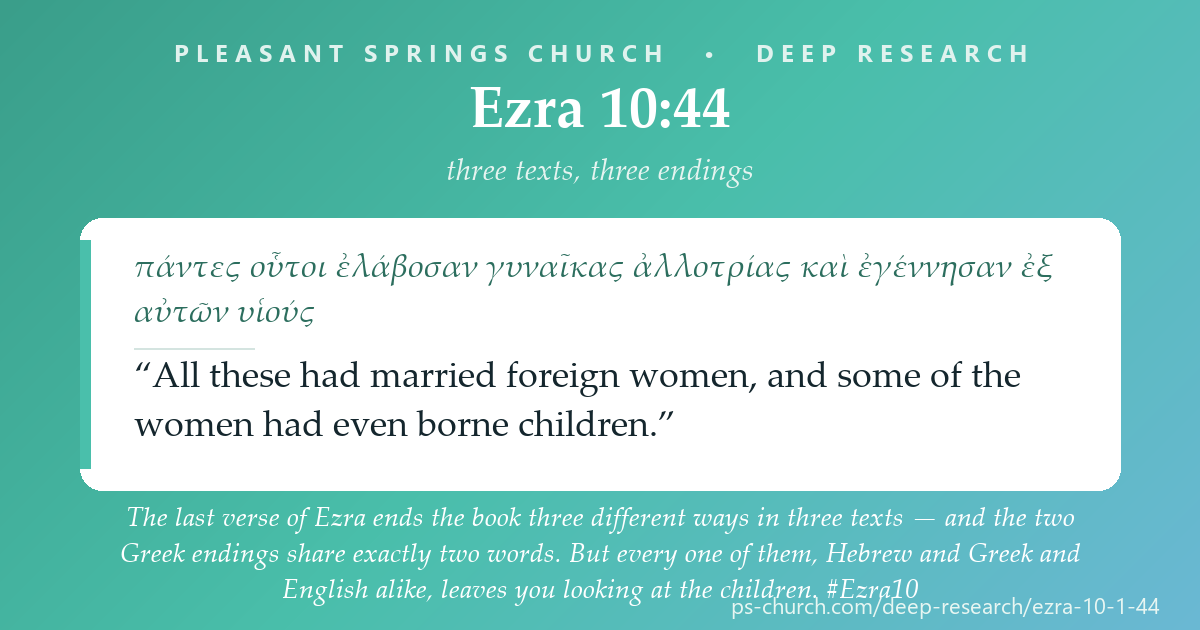
| Greek Ezra (2 Esdras 10:44) | πάντες οὗτοι ἐλάβοσαν γυναῖκας ἀλλοτρίας καὶ ἐγέννησαν ἐξ αὐτῶν υἱούς “All these took foreign wives, and they begot sons from them.” |
| 1 Esdras 9:36 | πάντες οὗτοι συνῴκισαν γυναῖκας ἀλλογενεῖς καὶ ἀπέλυσαν αὐτὰς σὺν τέκνοις “All these had taken wives of another race, and they sent them away with their children.” |
Measured: the two Greek endings agree on two consecutive words — πάντες οὗτοι, all these — and on nothing else. Different verb for the marrying, different word for the women, and a completely different last clause. One text ends with children born; the other ends with children sent away.
What can and cannot be said about that. What can be said: the Hebrew does not report the outcome, and 1 Esdras does. What cannot be said from these files: which reading is older, whether 1 Esdras is interpreting a difficult Hebrew clause or preserving a different one, or what actually happened to the women and children. No critical apparatus was consulted for either text.
The one thing all three do. Every column ends the book on the children. The last word of the Hebrew is בָּנִים; of the Greek row, υἱούς; of 1 Esdras, τέκνοις; of the ESV, children. They disagree about what happened to them and agree about who the book is left looking at.
The same fast, told twice in Greek, sharing one word
Ezra 10:6 is the fasting verse. Both Greek versions have it:
2 Esdras 10:6: ἄρτον οὐκ ἔφαγεν καὶ ὕδωρ οὐκ ἔπιεν
1 Esdras 9:2: ἄρτου οὐκ ἐγεύσατο οὐδὲ ὕδωρ ἔπιεν
Longest shared run: one word. Different case for the bread, a different verb for the not-eating, a different negation. The two verses do share οὐκ, ὕδωρ and ἔπιεν — but no two of them stand together, in that order, in both. This is the same sentence about the same man on the same night, and as word forms the two have no two consecutive words in common. It is the clearest demonstration on this page of what a run measurement can and cannot see: the screen finds verbatim contact, not meaning.
A verb that means settle, a noun that means trespass, and a refrain counted in both columns.
Twelve occurrences in the Hebrew Bible; seven of them are in this chapter (10:2, 10, 11, 14, 17, 18, 44). Of the remaining five, two are Solomon (1 Kings 11:1, 11:8), two are Nehemiah 13 (26, 27) — and one is Genesis 31:15, where Leah and Rachel say their own father counts them as נָכְרִיּוֹת.
The chapter’s word for taking a wife — a causative of to sit / to dwell, not the ordinary לָקַח. Screened across the whole Masoretic corpus, the construction hiphil of ישב + נָשִׁים occurs seven times: five in Ezra 10 and two in Nehemiah 13. Nowhere else. The Greek follows it with καθίζω, to seat.
10:2, 10:6, 10:10. Not a marriage word. It is the term Leviticus 5:15 uses for misappropriating what is holy, and it governs the guilt offering of 10:19. The Greek row renders it ἀσυνθετέω, to break an agreement; 1 Esdras 9:7 has ἀνομέω, to act lawlessly.
Seven times in Ezra 10 — and ῥῆμα seven times in the Greek row, in the same seven verses (10:4, 5, 9, 12, 13, 14, 16). “This matter” is what the chapter calls itself, from the moment Shecaniah hands it to Ezra to the moment the commission sits down to examine it.
10:9, 10:13 — the only two verses in the book that mention weather, and they are ten verses apart in the same scene. The Greek row does not keep the plural: χειμών at 10:9 and χειμερινός at 10:13, words that mean storm and wintry at once.
The name that is missing from chapter 9
Counted on the consonantal text of both chapters:
| occurrences of עֶזְרָא | voice | |
|---|---|---|
| Ezra 9 | 0 | first person — I tore my garment… I fell on my knees |
| Ezra 10 | 6 | third person — while Ezra prayed… then Ezra arose |
The two chapters are one continuous scene — 10:1 picks up the prayer of 9:6–15 mid-motion — and the narrator changes person across the join. The page reports the seam and does not theorise about it; whether it marks a source, a compiler, or a stylistic convention is not a question a word count can answer.
Two roots, one spelling, one verse
Ezra 10:14 contains הַהֹשִׁיב and לְהָשִׁיב. Strip the vowels and they are the same four consonants.
The first is the hiphil of ישב, to settle — everyone in our cities who has settled foreign women. The second is the hiphil of שוב, to turn back — until the fierce wrath of our God is turned back from us. Nehemiah 13:27 uses the identical consonantal form להשיב in the first sense.
The Greek row has to choose and does: ἐκάθισεν for the one, ἀποστρέψαι for the other. Whether the Hebrew is playing on it is not something a screen can decide, and this page does not claim it is. What is checkable is that the forms coincide, in this verse, once.
A coincidence worth naming and not building on
In Ezra 9:3 and 9:5 Ezra the priest tears his בֶּגֶד, his garment. In Malachi 2 — the same century, the same complaint — the verb used five times for the faithlessness that chapter is about — once of a man against his brother (2:10), then of Judah (2:11) and of the wife of a man’s youth (2:14–16) — is בָּגַד, to deal treacherously (Malachi 2:10, 11, 14, 15, 16). Same three consonants.
They are treated as separate roots by the lexicons, and this page treats them that way. It is noted because a reader running the same search will find it, and will want to be told plainly that a shared consonantal skeleton is not an etymology.
The chapter shares almost nothing with the law it is enforcing — and six words with a fast on Sinai.
★ Ezra 10 against Deuteronomy 7: a deepest run of one word
Ezra 9:1–2 names five of the seven nations of Deuteronomy 7:1 — and three more besides — and speaks of a holy seed. Chapter 10 is the chapter that acts on it. Screened Hebrew against Hebrew, verse by verse:
| Ezra 10 against… | deepest shared run | what the words are |
|---|---|---|
| Deuteronomy 7 (the intermarriage law) | 1 word | כִּי — for |
| Exodus 34 (the other intermarriage law) | 6 words | לֶחֶם לֹא אָכַל וּמַיִם לֹא שָׁתָה — and it is at 34:28, not 34:16 |
| 1 Kings 11 (Solomon’s foreign wives) | 2 words | נָשִׁים נָכְרִיּוֹת, six times over |
| Nehemiah 13 (the same crisis, the other governor) | 3 words, once | אֲשֶׁר לֹא יָבוֹא at 10:8 / 13:1 — and it is about assembly membership, not about wives |
Ezra 10 does not quote Deuteronomy 7. It does not share a single two-word sequence with it. Deuteronomy 7:3 says you shall not intermarry with them; you shall not give your daughter to their son, nor take their daughter for your son. Ezra 10:3 says let us make a covenant with our God to put away all these wives and their children. The two verses share no word at all. The chapter invokes the Law — let it be done according to the Law, 10:3 — without reproducing any of it.
And the Nehemiah result is the one that should surprise a reader most. Ezra 10 and Nehemiah 13:23–27 are the pair every commentary sets side by side. Screened verse against verse across the whole of Nehemiah 13, they share twenty-one two-word sequences and one three-word run, and nothing longer. Only eight of the twenty-one are about the marriages: נָשִׁים נָכְרִיּוֹת six times, the definite הַנָּשִׁים הַנָּכְרִיּוֹת once (10:11 / 13:26) and הֹשִׁיבוּ נָשִׁים once (10:18 / 13:23). The other thirteen are formulas — בֵּית הָאֱלֹהִים nine times, עַל־זֹאת twice, בֶּן־אֶלְיָשִׁיב and אֲשֶׁר לֹא once each — and the three-word run is about something else. Two accounts of one crisis, and no shared sentence between them. They also do not do the same thing: Nehemiah 13:25 records a beating and an oath, and no wives being sent away.
The six words Ezra 10:6 shares with Sinai — and the counter-example
The deepest Hebrew run in the chapter is at 10:6, against 23,160 other verse units of the Masoretic corpus.
| row | deepest partner | run | tie band | the shared words |
|---|---|---|---|---|
| Ezra 10:6 | Exodus 34:28 | 6 | 1 | לֶחֶם לֹא אָכַל וּמַיִם לֹא שָׁתָה |
| Ezra 10:18 | Ezra 3:2 | 4 | 1 | יֵשׁוּעַ בֶּן־יוֹצָדָק וְאֶחָיו |
| Ezra 10:5 | Nehemiah 5:12 | 3 | 1 | לַעֲשׂוֹת כַּדָּבָר הַזֶּה |
| Ezra 10:16 | Genesis 45:21 and 6 others | 3 | 7 | וַיַּעֲשׂוּ כֵן בְּנֵי |
Exodus 34:28 is Moses on the mountain for forty days, neither eating bread nor drinking water, writing the words of the covenant on the tablets — the covenant renewal, after the golden calf. Ezra 10:3 proposes to cut a covenant, and the six words Ezra 10:6 uses for its fast are the six Exodus 34:28 uses for the man who wrote one. Which way that runs, if it runs either way, a screen cannot say and this page does not.
⚠️ And here is the counter-example this page owes the reader. A tie band of one makes that run look unique. It is unique as word forms and not as a sentence. Searched for the idea rather than the forms, five verses in the Hebrew Bible report that a man ate no bread and drank no water:
| verse | form | in the tie band? |
|---|---|---|
| Exodus 34:28 | third person — אָכַל…שָׁתָה | yes |
| Deuteronomy 9:9 | first person — אָכַלְתִּי…שָׁתִיתִי | no |
| Deuteronomy 9:18 | first person | no |
| 1 Samuel 30:12 | third person, but reordered — לֹא אָכַל לֶחֶם וְלֹא שָׁתָה מַיִם | no |
| Ezra 10:6 | third person | — |
Three of the four others are Moses; the fourth is an Egyptian slave abandoned sick in open country and found by David’s men. Two are outside the band only because Deuteronomy tells it in the first person, and 1 Samuel 30:12 only because it says the same thing in a different word order, and moves the waw — it reads 2 against Ezra 10:6. (The man of God of 1 Kings 13 is under a standing command not to eat bread or drink water, repeated through that chapter; it shares one word with Ezra 10:6.) The band of one is a fact about grammar, not about rarity of thought — and a page that printed the six-word run without this table would be overselling it.
The Greek New Testament screen: deepest run four, and two of the three land on one verse
All 44 CATSS rows of 2 Esdras 10 against all 7,927 verses of the Greek New Testament.
| row | deepest NT partner | run | tie band | the shared words |
|---|---|---|---|---|
| Ezra 10:5 | Luke 9:45 | 4 | 1 | τὸ ῥῆμα τοῦτο καί |
| Ezra 10:14 | Luke 9:45 | 4 | 1 | περὶ τοῦ ῥήματος τούτου |
| Ezra 10:10 | Luke 2:49 and 6 others | 4 | 7 | καὶ εἶπεν πρὸς αὐτούς |
| Ezra 10:12 | Luke 1:38, Luke 2:29 | 3 | 2 | τὸ ῥῆμά σου |
| Ezra 10:1 | 1 Peter 4:17 and 2 others | 3 | 3 | οἴκου τοῦ θεοῦ |
| Ezra 10:11 | Matthew 23:32 and 23 others | 3 | 24 | τῶν πατέρων ὑμῶν |
Across the 44 rows: 41 reach one, 37 reach two, 19 reach three, 3 reach four, and nothing reaches five.
Both of the chapter’s tie-band-of-one runs land on the same New Testament verse, and both are formulas. Luke 9:45 reads οἱ δὲ ἠγνόουν τὸ ῥῆμα τοῦτο… καὶ ἐφοβοῦντο ἐρωτῆσαι αὐτὸν περὶ τοῦ ῥήματος τούτου — it says this saying twice, in two different cases, which is exactly why it catches two different rows of a chapter whose own refrain is this matter. A formula meeting a formula. There is no connection here and the page asserts none.
⚠️ The counter-example is in the third line of the table. Ezra 10:10 reaches the same depth of four, and its band is seven — every one of them Luke, because καὶ εἶπεν πρὸς αὐτούς is Lukan boilerplate. Depth without a band is not evidence, which is why this shelf prints the band beside every run.
1 Corinthians 7:12–14, and what the measurement says about it
Paul’s instruction to a mixed marriage is the passage most readers reach for against this chapter, so this page measured the contact rather than assuming it.
1 Corinthians 7:12: εἴ τις ἀδελφὸς γυναῖκα ἔχει ἄπιστον, καὶ αὕτη συνευδοκεῖ οἰκεῖν μετ’ αὐτοῦ, μὴ ἀφιέτω αὐτήν — if any brother has a wife who is an unbeliever, and she consents to live with him, he should not divorce her. And 7:14 ends: ἐπεὶ ἄρα τὰ τέκνα ὑμῶν ἀκάθαρτά ἐστιν, νῦν δὲ ἅγιά ἐστιν — otherwise your children would be unclean, but as it is they are holy.
| pair | longest shared run |
|---|---|
| 2 Esdras 10:3 vs 1 Corinthians 7:12 | 1 word (καί) |
| 2 Esdras 10:44 vs 1 Corinthians 7:14 | 1 word (καί) |
| 1 Esdras 9:36 vs Matthew 19:9 | 1 word |
There is no verbal contact. None. The pairing is thematic, and the page says so plainly rather than dressing it as a link. What is true is that both passages end on the children of a mixed marriage, and say opposite things about them. What is not shown here is that Paul had this chapter in view. A run of one word is the same result you would get from any two Greek sentences picked at random.
Malachi 2:10–16 belongs in the same conversation and does not help either side tidily. It condemns marrying the daughter of a foreign god (2:11) and dealing faithlessly with the wife of your youth (2:14–15), in the same breath, in the same generation. Its verb for the offence is בָּגַד; Ezra 10’s is מָעַל. Two books facing one crisis with two different vocabularies for it.
Inside the list: where the columns quietly part
Twenty-six of the chapter’s forty-four verses are the roll of names, and three places in it can be seen to differ with no apparatus at all:
| verse | Hebrew | Greek row |
|---|---|---|
| 10:25 | וּמַלְכִּיָּה twice in one list | Μελχια…Ασαβια — the second becomes Hashabiah, which is what the ESV prints |
| 10:37–38 | וְיַעֲשָׂי — a man’s name, Jaasu | καὶ ἐποίησαν — and they did, a verb |
| 10:44 | וַיָּשִׂימוּ בָּנִים | καὶ ἐγέννησαν ἐξ αὐτῶν υἱούς |
The roll names 111 men — counted off the consonantal text, taking the name after each of the sons of formula as the family head, treating Kelaiah (that is, Kelita) in 10:23 as one man, and reading 10:38 as of the sons of Binnui: Shimei. Read 10:38 the other way — Bani, Binnui and Shimei as three men — and the total is 113. The page prints both because the verse is a known crux and a single number would be a false precision.
And eighteen of the forty-four rows — every one of them inside the roll — share no two consecutive words with any other verse in the Hebrew Bible. (On the Hebrew screen a zero means exactly that; the individual names do occur elsewhere.) Most of this chapter is text that exists nowhere else.
What was not consulted, what could not be checked, and where this page is weakest.
The limits of what is measured here
No critical apparatus was consulted, for any of the three texts. Not for the Hebrew, not for 2 Esdras, not for 1 Esdras. Where this page reports that the columns differ — 10:15, 10:25, 10:37–38, 10:44 — it is reporting what the printed editions on this disk say, and nothing about manuscript support, age or probability.
The relationship between 1 Esdras and 2 Esdras is a live scholarly question and this page does not enter it. Whether 1 Esdras preserves an older form of the material, or is a later reworking, or is a fragment of a lost longer work, has been argued in every direction for a century. The measurements here are indifferent to the answer: they say how much of the wording the two share, not which came first.
The 111 is soft in the third digit. The count depends on how 10:38 is read, on treating Kelaiah and Kelita as one man, and on the two Malchijahs of 10:25. The page gives the rule it counted by and the alternative figure. A reader who counts differently will get 112 or 113 and will not be wrong.
Ezra 10:15 is genuinely undecided. עָמְדוּ עַל־זֹאת can be read as opposition or as taking charge; the ESV takes it as opposition, and both Greek witnesses take it the other way. This page cannot settle it and does not pretend the Greek settles it either — a translator faced with an ambiguous idiom makes a choice, and a choice is not evidence about the Hebrew.
And the hardest limit is the one that is not textual at all. What happened to those women and those children after the first day of the first month is not in the Hebrew, is not in the Greek row, and is asserted in exactly one sentence of 1 Esdras. The book of Ezra does not tell us, and this page will not fill the gap.
What could not be checked at all
No Qumran material — no published Dead Sea manuscript preserves any part of Ezra 10, and none was consulted. No Targum (there is no classical Targum to Ezra–Nehemiah), no Syriac, no Vulgate, no Old Latin of 1 Esdras. No Josephus, whose Antiquities 11 follows 1 Esdras rather than the Hebrew at several points and which would be the obvious next witness to read. No Elephantine papyri, which are the closest documentary evidence for how a Judean community outside Jerusalem in this same century actually handled marriage.
No temple-barrier inscription (see stage 2). No rabbinic material. No archaeology of Persian-period Yehud, whose population estimates bear directly on the question of what 111 households meant.
And nothing on this page is an ethical judgement. The shelf’s job here was to measure what three texts say and where they stop saying the same thing. The chapter is reported without endorsement and without explaining it away, which is the same position the companion page on Ezra 7–10 takes.
Reading list
- H. G. M. Williamson, Ezra, Nehemiah (Word Biblical Commentary 16).
- Joseph Blenkinsopp, Ezra–Nehemiah: A Commentary (Old Testament Library).
- Lester L. Grabbe, Ezra–Nehemiah (Old Testament Readings).
- Zipora Talshir, I Esdras: From Origin to Translation (SBL Septuagint and Cognate Studies 47).
- Tamara Cohn Eskenazi, “Out from the Shadows: Biblical Women in the Postexilic Era,” JSOT 54 (1992).
- Katherine E. Southwood, Ethnicity and the Mixed Marriage Crisis in Ezra 9–10 (Oxford).
- None of these were consulted for the measurements on this page, which were run on the text files named in the footer.
The book stops, and it is still raining.
Where the book leaves you standing
The chapter opens with a crowd — men, women and children — gathering around a man lying face down in front of the house of God, and it ends twenty-six verses of names later with a sentence about children. In between it is dated four times and it rains through all of it.
Three things this page found that it did not expect to. One: the chapter shares no two-word sequence with Deuteronomy 7, the law it says it is obeying — and the deepest run it does have with the Torah is a fasting formula, six words long, from the covenant renewal after the golden calf. Two: where the two Greek versions of this chapter agree most deeply, seven words at verse 11, the run breaks off exactly on the word foreign — one says another’s, the other says of another race. Three: the last verse ends the book three different ways, and the two Greek endings have two words in common.
And then the thing they all do agree on. The Hebrew’s last word is בָּנִים. The Greek row’s is υἱούς. 1 Esdras ends σὺν τέκνοις. The ESV ends children. Whatever else the texts do with this chapter, not one of them lets you close the book without looking at the children.
This page closes the book of Ezra on this shelf. Chapters 1–6 are at Ezra 1:1–6:22 and 7–10 at Ezra 7:1–10:44; this study takes the last chapter on its own, because it needed three texts side by side and one of them is not in the Bible.
Every Deep Research page traces its passage across the whole sweep — the Old Testament, the Second-Temple world between the testaments (historical witnesses, not Scripture), and the New Testament. Follow the thread:
Pleasant Springs Church — Deep Research
Research method after Michael S. Heiser’s Bible Research Method (examine dictionaries → ancient literature → important words → textual connections → academic publications → share), with the Pleasant Springs “Author & Audience” foundation. Scripture set in the Hebrew, the Greek editions named on each page and the ESV (Old Testament), and the Greek New Testament and the ESV (New Testament), per the practice of Pleasant Springs Church. Ezra research grounded in Williamson (WBC), Blenkinsopp (OTL), Grabbe, Talshir on 1 Esdras and Southwood on Ezra 9–10. Text: Hebrew from the Masoretic text as printed in the edition consulted — Sefaria’s Miqra according to the Masorah, with the qere read at 10:2 and 10:44; no critical apparatus was consulted for the Hebrew. Greek from Rahlfs’ Septuaginta as digitized by CATSS — both 2 Esdras and 1 Esdras; Greek New Testament from the SBL edition via MorphGNT. The standing caution for this shelf applies: these pages say “the CATSS Greek row reads…” and never call a Greek reading early or late. ⚠️ VERSE NUMBERING. Masoretic Ezra, CATSS Greek Ezra and the ESV all run 11 / 70 / 13 / 24 / 17 / 22 / 28 / 36 / 15 / 44 = 280 verses, counted off the Hebrew and Greek files on this disk — no ESV file of Ezra is held here; there is no offset inside the book. Outside it there are two: the Greek calls this book 2 Esdras 1–10 and continues into Nehemiah as 2 Esdras 11–23 (add ten to a Nehemiah chapter), and the parallel in 1 Esdras runs Ezra 10:1–5 = 1 Esdras 8:88–92, Ezra 10:6–44 = 1 Esdras 9:1–36. ⚠️ The Hebrew measurement, in full. Hebrew against Hebrew, over 23,160 non-source verse units of the 39-book Masoretic corpus held here (23,204 in total, less the 44 rows of Ezra 10 itself). Markup stripped; the qere read; cantillation and vowel points removed; final letter-forms folded to medial; maqqef treated as a word separator and never as a weld. Contiguous runs of whole consonantal word forms, never lemmas and never roots. A row reported as 0 on this screen shares NO TWO CONSECUTIVE WORDS with any other verse; it may still share individual words — eighteen of the forty-four rows come back 0, and every one of them falls inside the roll of names at 10:18–43. Exhaustive and deterministic; nothing sampled, so no seed applies. ⚠️ The Greek measurements, in full. Greek against Greek. CATSS FORM column (cols 0–24), beta-code transliterated first; MorphGNT field 6, the normalised word. Both sides lowercased, accents and breathings dropped, final sigma folded, then filtered to Greek letters — the same filter applied to both corpora — and both Greek screens on this page, the New Testament one and the CATSS-against-CATSS one, apply the edition’s own spelling equivalences (ou / ouk / ouch, ek / ex, the movable nu), so figures on this page are higher than those on pages written before 30 August 2026 and should not be compared with them. Word forms, never lemmas. Corpora: the 44 CATSS rows of 2 Esdras 10 against 7,927 verses across 27 MorphGNT files, and against the 55 rows of 1 Esdras 9. The Greek Old Testament held here is 64 CATSS files, 30,637 verse units; a run screen sees 30,348, because the Odes are excluded — Ode 9 is Luke 1 and Ode 13 is Luke 2 copied into a Greek Old Testament manuscript, and ten more Odes are second copies of Exodus 15, Deuteronomy 32, 1 Samuel 2, Habakkuk 3, Isaiah 26, Jonah 2, Daniel 3, Isaiah 5 and Isaiah 38. ⚠️ Both of this chapter’s tie-band-of-one New Testament runs are formulas, and the page leads with that. Ezra 10:5 and 10:14 both reach four words into Luke 9:45, and both times the shared words are this word / this matter, which Luke 9:45 happens to say twice. Ezra 10:10 reaches the same depth of four with a tie band of seven, all of them Luke. ⚠️ Direction of influence is never asserted. Nothing here says which Greek Ezra is earlier, that either translator saw the other, that Luke or Paul is reading this chapter, or what produced any reading — including the with me at 10:15, the verb at 10:37–38, and the three endings at 10:44. Typology is handled per the house position: what the text says, what the New Testament itself draws, and what we see from this side of the cross — with the seeing left to the reader.
Scripture quotations marked ESV are from the ESV® Bible (The Holy Bible, English Standard Version®), © 2001 by Crossway, a publishing ministry of Good News Publishers. ESV Text Edition: 2016. Used by permission. All rights reserved. The ESV text may not be quoted in any publication made available to the public by a Creative Commons license, and the ESV may not be translated in whole or in part into any other language. www.esv.org
|
Did this study bless you today? 💚 Give to Support PS Church100% of gifts go to the General Fund — thank you. |