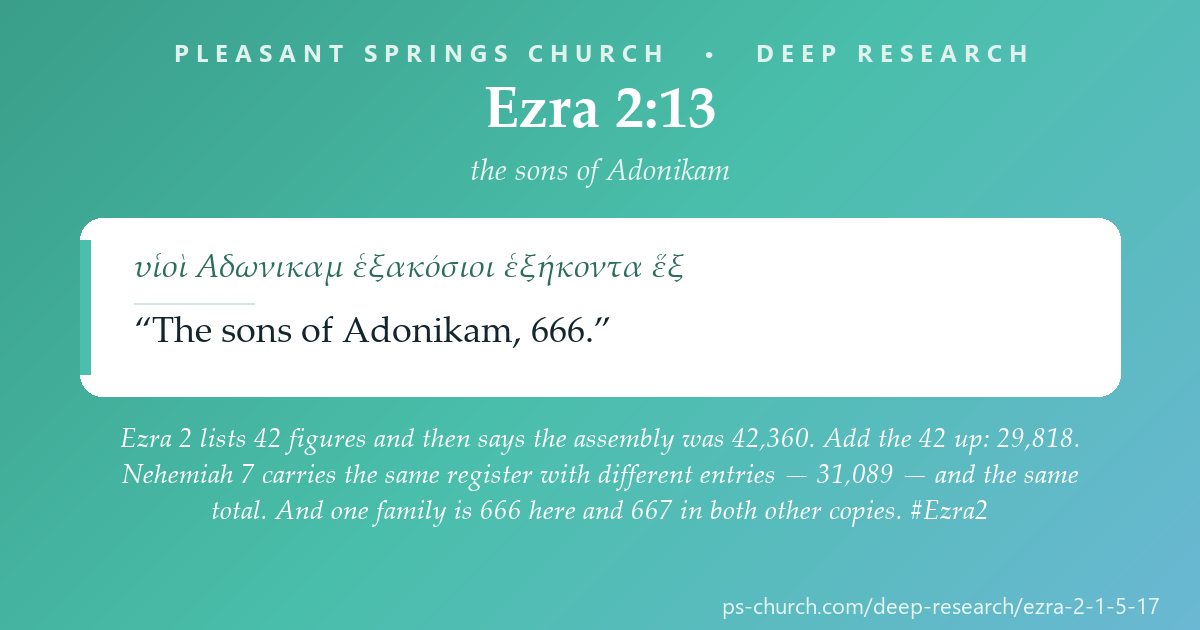
The longest chapter in Ezra is a list, and the list does not add up. Ezra 2:64 says the whole assembly was 42,360. The forty-two figures printed above it were parsed out of the Masoretic text for this page and added: they come to 29,818. The same register stands a second time at Nehemiah 7, where the forty figures come to 31,089 — and Nehemiah 7:66 closes with 42,360 as well. Three copies of one list, three different sets of entries, one grand total. Inside it, one family is counted 666 in Ezra 2:13 and 667 in both parallel copies — and across the 30,348 Greek Old Testament verse units screened here, Ezra 2:13 is the only one that carries Revelation 13:18’s three words in the same forms. This page prints that, and then prints carefully what it does not mean. See the method →
Ezra 2:1–5:17 (selections)
Hebrew & Aramaic · Greek (CATSS, Rahlfs’ Septuaginta, 2 Esdras) · ESV⚠️ But the Greek BOOK is numbered differently. In Greek, Ezra and Nehemiah are one continuous book, 2 Esdras (Ἔσδρας Βʹ). Ezra 1–10 = 2 Esdras 1–10, one to one; but Nehemiah n = 2 Esdras n+10. This page compares Ezra 2 with Nehemiah 7 repeatedly, and Nehemiah 7 is 2 Esdras 17.
⚠️ And there IS an offset in the chapter this page compares Ezra 2 with. Masoretic Nehemiah 7 has 72 verses; CATSS 2 Esdras 17 and the ESV both have 73. The extra line is the horses and the mules — ἵπποι ἑπτακόσιοι τριάκοντα ἕξ ἡμίονοι διακόσιοι τεσσαράκοντα πέντε, ESV Nehemiah 7:68 — which the Masoretic column here does not carry, though Ezra 2:66 does. From that point on, Masoretic Nehemiah 7:68–72 = ESV Nehemiah 7:69–73. The 72 and the 73 were counted off the Masoretic and CATSS files here and the seam was checked by content; the English side is the ordinary English versification, not a file on this disk.
The Shape of the Passage
Sequence — a register, then three more documents, with narrative between themThese four chapters are the least “authored” part of the book. A register, two letters and an imperial reply are quoted rather than composed, and one of the two letters is written by the community’s opponents. Whoever assembled Ezra–Nehemiah did not paraphrase them; the documents stand in the book in the language they were filed in.
Author
Anonymous, and visibly a compiler here. The book never names its writer. What can be seen from the text is a hand that copies documents in: a census register that also stands in Nehemiah 7, a hostile letter, a royal rescript, and a provincial governor’s report. The compiler leaves them in Aramaic.
Two prophets are named and not quoted. Haggai and Zechariah appear at 5:1 as the reason the work restarted, and nothing they said is reproduced. Haggai and Zechariah are on this shelf in their own right; this narrative simply points at them.
Audience
People who needed to prove who they were. The register is not decoration. Ezra 2:61–63 is about three priestly families who could not produce their genealogy and were put out of the priesthood until a priest with Urim and Thummim should arise. A list like this settles claims — to priesthood, to land, to a town.
And people under an imperial audit. Chapters 4 and 5 are about permission: who authorised this, what does the file say, and what will the king do when he reads it. The audience is a community whose right to build depends on a piece of paper in a foreign archive.
Orient on the register, on the Aramaic, and on the Persian kings this chapter names out of order.
Search by topic: Ezra, book of; Ezra–Nehemiah; golah list; Nehemiah 7; 1 Esdras; Biblical Aramaic; Aramaic language; Persia, Persian empire; Artaxerxes; Xerxes / Ahasuerus; Darius I; satrapy Beyond the River; Tattenai; Sheshbazzar; Zerubbabel; daric; Urim and Thummim; Nethinim; Tirshatha; genealogy and priesthood.
Which articles are relevant?
- Anchor Bible Dictionary — “Ezra, Book of,” “Ezra–Nehemiah, Books of,” “Esdras, First Book of,” “Aramaic Language,” “Persia, History of,” “Beyond the River,” “Sheshbazzar,” “Tattenai,” “Nethinim,” “Urim and Thummim,” “Weights and Measures.”
- Dictionary of the OT: Historical Books (IVP) — “Ezra and Nehemiah, Books of,” “Lists,” “Persian Period,” “Aramaic Language.”
- NIDOTTE — גאל (both of them), יחשׂ, קהל, אֻשַּׁיָּא.
- On the Greek — the NETS introduction to 2 Esdras (Esdras B), and its account of how 2 Esdras and 1 Esdras handle this same list differently.
- Grammars of Biblical Aramaic — Rosenthal, A Grammar of Biblical Aramaic; the Aramaic sections of Bauer–Leander. Named here as the standard tools for the seam measured in stage 3; neither was consulted.
Settle the numbering first — and there is nothing to settle in Ezra
The first two rows below were counted off the files on this disk. The third was not — no ESV Ezra or Nehemiah is held here, so the English row states the ordinary English versification and is the one line in this table that is not a measurement.
| chapters 1–10, verses each | total | |
|---|---|---|
| Masoretic Ezra | 11 / 70 / 13 / 24 / 17 / 22 / 28 / 36 / 15 / 44 | 280 |
| CATSS 2 Esdras 1–10 | 11 / 70 / 13 / 24 / 17 / 22 / 28 / 36 / 15 / 44 | 280 |
| ESV | 11 / 70 / 13 / 24 / 17 / 22 / 28 / 36 / 15 / 44 | 280 |
Identical, chapter for chapter and verse for verse. No conversion is needed anywhere in Ezra.
What does need saying is the book division and one chapter of Nehemiah. Greek has no book called Ezra: it has 2 Esdras, which is Ezra and Nehemiah run together. Ezra n = 2 Esdras n. Nehemiah n = 2 Esdras n+10. So the Nehemiah 7 this page keeps comparing Ezra 2 with is 2 Esdras 17 — and that chapter has 72 verses in the Masoretic column against 73 in CATSS and in the ESV. The line the Masoretic column does not carry is the horses and the mules. Masoretic Nehemiah 7:68–72 = ESV Nehemiah 7:69–73.
Practical consequence: a commentary discussing “Nehemiah 7:69” may be discussing the camels or the governor’s gift depending on which column it is counting in. Inside Ezra itself, no such care is needed.
Three copies of one list, four kings in the wrong order, and a language change that is a fact about the empire.
The same register, three times — and what its own arithmetic does
The register in Ezra 2 stands again in Nehemiah 7 and a third time in 1 Esdras 5. All three end with the same grand total. Neither of the two summed here reaches it.
The figures below were not copied from a commentary. The Hebrew numerals of Ezra 2:3–60 and Nehemiah 7:8–62 were parsed word by word out of the Masoretic text held here and summed for this page.
| copy | numbered entries | they sum to | the total it states | gap |
|---|---|---|---|---|
| Ezra 2:3–60 | 42 | 29,818 | 42,360 (2:64) | 12,542 |
| Nehemiah 7:8–62 | 40 | 31,089 | 42,360 (7:66) | 11,271 |
| 1 Esdras 5 (Greek; a witness, not Scripture on this shelf) | not summed here | — | 42,360 (5:41) | — |
The two Hebrew copies differ from each other by 1,271 in their own entries and agree to the digit in their totals. That is the shape of the problem, and it is the same in every printed Bible; nothing here depends on an emendation.
Some individual entries move between the copies, and one of them is famous for another reason.
| entry | Ezra 2 | Nehemiah 7 | 1 Esdras 5 |
|---|---|---|---|
| sons of Adonikam | 666 (2:13) | 667 (7:18) | 667 (5:14) |
| male and female singers | 200 (2:65) | 245 (7:67) | 245 (5:41) |
| male and female servants | 7,337 | 7,337 | 7,337 |
| the whole assembly | 42,360 | 42,360 | 42,360 |
What is not being claimed. The page does not say which copy is prior, that anyone miscopied anything, or that the total is wrong. It says the entries do not sum to the total in any of the three, and prints both numbers. Explanations offered in the literature — that the total counts people the list does not itemise, that it counts all twelve tribes and not only the families named, that numerals were transmitted in a notation that damages easily — are all arguments, and none of them can be tested from these files.
Four Persian kings in one chapter, and the last step goes backwards
Ezra 4 names four kings. Searched by name across the chapter, they fall in this order.
| verse | king named | reign |
|---|---|---|
| 4:3, 4:5 | כּוֹרֶשׁ Cyrus | 559–530 BC |
| 4:5 | דָּרְיָוֶשׁ Darius | 522–486 BC |
| 4:6 | אֲחַשְׁוֵרוֹשׁ Ahasuerus (Xerxes) | 486–465 BC |
| 4:7, 4:8, 4:11, 4:23 | אַרְתַּחְשַׁשְׂתְּא Artaxerxes | 465–424 BC |
| 4:24 | דָּרְיָוֶשׁ Darius, again | back to 522–486 BC |
Four of the five steps go forward and the fifth goes back about eighty years. 4:24 does not continue 4:23; it resumes 4:5. The two verses share three consecutive words — דריוש מלך פרס, Darius king of Persia — measured Hebrew against Aramaic, since 4:5 is in one language and 4:24 in the other. Everything between them is a dossier about later opposition, filed at the point in the narrative where opposition is the subject.
The regnal dates above come from standard Achaemenid chronology and no cuneiform source was consulted for this page. What was measured here is only the order of the names in the chapter and the three shared words at 4:5 and 4:24.
Aramaic was the language you wrote to a Persian king in
The book changes language at 4:8 and does not change back until 6:18, and it changes again for 7:12–26. That is not a curiosity; it is the administrative reality of the empire.
Imperial Aramaic was the chancery language of the Achaemenid administration from the Mediterranean to the Indus. Letters between a provincial official and the court were written in it. Ezra 4:7 says so out loud: וּכְתָב הַנִּשְׁתְּוָן כָּתוּב אֲרָמִית וּמְתֻרְגָּם אֲרָמִית — the letter was written in Aramaic and translated. And the Greek row notices it too: ἔγραψεν…γραφὴν Συριστὶ καὶ ἡρμηνευμένην, he wrote a document in Syrian, and translated.
The nearest comparable material outside the Bible is the Elephantine archive — fifth-century Aramaic papyri from a Judean garrison in Egypt, including a petition to the governor of Judah about rebuilding a temple. It is the closest thing there is to Ezra 4–5 in a documentary form. It was not consulted for this page and nothing here rests on it; it is named as the kind of evidence the historical questions are settled from, and as the reading a serious student should go to next.
Tattenai. A Babylonian tablet naming a Tattannu, governor of Beyond the River is frequently cited in the commentaries as external attestation of the man in Ezra 5:3. This page has not seen that tablet, has not checked the reading, and does not stake anything on it. It is recorded here as a claim in the literature, not as a finding.
1 Esdras, and Josephus
1 Esdras (Ἔσδρας Αʹ) is a separate Greek book covering roughly 2 Chronicles 35–36, Ezra, and Nehemiah 8, in a different order and with a long story about three young bodyguards that Ezra does not have. On this shelf it is a witness and not Scripture, and it is held in the CATSS files, which is why its copy of the register could be checked at all.
Josephus retells this period in Antiquities 11, and follows 1 Esdras rather than Ezra where the two differ. Josephus was not consulted for this page. He is named because a reader comparing the register in a Josephus translation is comparing a fourth text, not a third.
Two spellings of the word king that divide the book, a verb on the wrong homonym, and a title that occurs once.
28 occurrences in Ezra, first at 4:8 and last at 7:26, and not one outside that span. The Aramaic determined state does with a final א what Hebrew does with a prefixed article.
12 occurrences in Ezra — 4:3, then nothing until 7:6. The two spellings tile the book between them and never share a verse.
94 occurrences in Ezra, every one of them between 4:10 and 6:18 or between 7:12 and 7:26. The Hebrew equivalent אֲשֶׁר stands 23 times and never inside either block.
Ezra 2:62, of the priests who could not produce their genealogy. Hebrew has two verbs spelt גאל — redeem, act as kinsman and defile, pollute. The row’s ἠγχιστεύθησαν belongs to the first; the sense here is the second.
11 verses in the Hebrew Bible — seven in Ezra and four in Daniel 2, and nowhere else. At Ezra 5:11 alone it is extended: וְאַרְעָא, and earth.
Ezra 2:69. A Persian gold coin. The Greek row does not have a coin: it has μναῖ, minas — a weight.
Where the book stops being Hebrew, measured with two words
Everyone knows Ezra 4:8–6:18 and 7:12–26 are in Aramaic. This page did not take that on trust; it looked for the seam with a word count.
| form | language | occurrences in Ezra | where they fall |
|---|---|---|---|
| מַלְכָּא the king | Aramaic | 28 | 4:8 → 6:15, and 7:14 → 7:26. Nowhere else. |
| הַמֶּלֶךְ the king | Hebrew | 12 | 4:3, then 7:6, 7:7, 7:11, 7:27, 7:28, and chapter 8. Nowhere inside the Aramaic. |
| דִּי who, which | Aramaic | 94 | 4:10 → 6:18, and 7:12 → 7:26. Nowhere else. |
| אֲשֶׁר who, which | Hebrew | 23 | chapters 1, 2, 3, 7 (at 7:6, 7:11 and 7:27), 9 and 10. None inside either Aramaic block. |
Two words for the king, forty occurrences between them, and they never once cross. The last Hebrew הַמֶּלֶךְ before the seam is at 4:3; the first Aramaic מַלְכָּא is at 4:8; and in chapter 7 the two alternate at exactly the block edges — Hebrew at 7:11, Aramaic from 7:14, Hebrew again at 7:27.
Two honest limits on this measurement. First, מַלְכָּא resolves the opening seam to 4:8 but דִּי only reaches back to 4:10; the particles cannot by themselves decide whether the change happens at the start of 4:8 or partway through it. Second, the absence of אֲשֶׁר proves less than it looks — it is also absent from the whole of chapter 8, which is Hebrew. Absence of a common word from a short stretch of text is weak evidence; the positive distribution of מַלְכָּא and דִּי is the strong part.
Three words the Greek column did not translate
Three times in nine verses of chapter 2 a Hebrew word appears in the Greek row in Greek letters rather than in Greek.
| verse | Hebrew | the row | what happened |
|---|---|---|---|
| 2:62 | הַמִּתְיַחְשִׂים those enrolled by genealogy | οἱ μεθωεσιμ | the Hebrew word, spelt out |
| 2:69 | כׇּתְנֹת tunics | κοθωνοι | the Hebrew word, spelt out |
| 2:70 | הַנְּתִינִים the temple servants | οἱ ναθινιμ | the Hebrew word, spelt out |
And once the reverse happens. At 2:63 the Persian court title הַתִּרְשָׁתָא, the Tirshatha, is carried across as Αθερσαθα — but אוּרִים and תֻמִּים, which English Bibles leave as Urim and Thummim, are translated: τοῖς φωτίζουσιν καὶ τοῖς τελείοις, the ones that give light and the perfect ones. The row transliterates the Persian title and translates the priestly objects; English does the opposite.
Small differences between the columns, verse by verse
Collected here rather than scattered through the codex. None of them is adjudicated; both readings are printed and neither is called earlier or later.
| verse | Hebrew / Aramaic | the Greek row |
|---|---|---|
| 2:60 | three families — Delaiah, Tobiah, Nekoda — 652 | four — Δαλαια, Βουα, Τωβια, Νεκωδα — and the same 652 |
| 4:23 | they stopped them בְּאֶדְרָע וְחָיִל, by force and power | ἐν ἵπποις καὶ δυνάμει, with horses and power |
| 5:5 | the eye of their God was on the elders of the Jews | the eyes of God were on the captivity of Judah |
| 5:14 | Sheshbazzar, whom he made פֶּחָה, governor | Sheshbazzar the θησαυροφύλαξ, treasurer, over the treasury |
| 2:12 · 2:28 · 2:39 | 1,222 · 223 · 1,017 | 3,222 · 423 · 1,007 |
Those last three are the whole of the numeric disagreement in the register. All forty-two figures of Ezra 2 were parsed out of both columns and compared for this page. Thirty-nine of the forty-two agree exactly. The three that do not push the Greek column’s own itemised sum to 32,008 — which still does not reach 42,360 either.
The 666, the deepest overlap between the two registers, and four runs that are formulae.
Ezra 2:13 and Revelation 13:18
The measurement first, and then what it is worth.
Ezra 2:13 reads, entire: בְּנֵי אֲדֹנִיקָם שֵׁשׁ מֵאוֹת שִׁשִּׁים וְשִׁשָּׁה — υἱοὶ Αδωνικαμ ἑξακόσιοι ἑξήκοντα ἕξ — the sons of Adonikam, 666. Revelation 13:18 ends …ὁ ἀριθμὸς αὐτοῦ ἑξακόσιοι ἑξήκοντα ἕξ.
| question | answer |
|---|---|
| Greek Old Testament units screened | 30,348 (64 CATSS files, Odes excluded) |
| Units carrying ἑξακόσιοι ἑξήκοντα ἕξ contiguously, in these forms | 1 — 2 Esdras 2:13 |
| New Testament verses carrying it | 1 — Revelation 13:18 (tie band 1) |
| Verses in the Hebrew Bible that contain the number 666 | 3 — 1 Kings 10:14, 2 Chronicles 9:13, Ezra 2:13 |
| Of those, verses in which 666 counts people | 1 — Ezra 2:13 |
Now the counter-example, printed here so the finding above is not read as more than it is. 1 Kings 10:14 and 2 Chronicles 9:13 both say Solomon received 666 talents of gold in one year, and preachers have paired that with Revelation for centuries. Neither of them matches Revelation 13:18 on a contiguous run, and the reason is spelling, not meaning. Greek 1 Kings 10:14 has ἑξακόσια καὶ ἑξήκοντα ἓξ — a conjunction in the middle breaks the run. Greek 2 Chronicles 9:13 has the neuter ἑξακόσια because it is counting talents, where Revelation and Ezra both have the masculine ἑξακόσιοι because they are counting men. Ezra 2:13 is the unique match because of a gender ending and a missing and.
So what does the run of three actually establish? That two verses independently write the same number in the same ordinary way. Nothing on this page says Revelation is quoting Ezra, alluding to Ezra, or has Adonikam in view, and Revelation gives no citation signal — it says let the one who has understanding calculate, which is an instruction to compute, not to look something up. A run of three with a tie band of one is a real measurement and a small one. It is printed because it is true and because it is the kind of thing a reader will meet stated far more strongly elsewhere.
⚠️ A tooling check this finding needed, and passed. Since 30 August 2026 cross-corpus runs apply MorphGNT’s own spelling equivalences, one of which folds ἐξ to ἐκ. That fold also catches the numeral ἕξ, six, so this run is reported by the screen with εκ as its third word. Both underlying texts were read by eye to confirm that each genuinely has ἕξ and not the preposition. They do. Had either side read ἐξ, the run would have been an artefact and this section would not exist.
Ezra 2 against Nehemiah 7, verse by verse
Seventy verses measured Hebrew against Hebrew, contiguous word forms only.
| Ezra 2 | best partner in Nehemiah 7 | shared run | what is shared |
|---|---|---|---|
| 2:61 | 7:63 | 16 | the sons of Habaiah, Hakkoz and Barzillai, and the wife from Barzillai’s daughters |
| 2:65 | 7:67 | 14 | the servants and the 7,337 — and the run stops exactly where the number of singers changes |
| 2:1 | 7:6 | 10 | the people of the province whom Nebuchadnezzar carried away |
| 2:63 | 7:65 | 10 | the Tirshatha, the most holy food, and Urim and Thummim |
| 2:66 (the horses and the mules) | 7:13 | 3 | two words of a number, ארבעים וחמשה, and the section marker ס the edition prints after both verses — because the Masoretic Nehemiah 7 has no horses-and-mules line at all, so this verse has no real counterpart to match |
| 2:22 | 7:7 | 1 | one word: אנשי |
Distribution across all seventy verses: 2 verses share only one word; 4 share two; 18 share three; 13 share four; 10 share five; 5 share six; 7 share seven; 3 share eight; 1 shares nine; 5 share ten; one shares fourteen and one shares sixteen. Every verse of Ezra 2 has a partner in Nehemiah 7.
The deepest overlap in the whole comparison is the verse about the family whose record was lost. Ezra 2:61 and Nehemiah 7:63 hold sixteen consecutive words in common. The verse that follows in both copies says these men sought their registration among those enrolled in the genealogies, but they were not found there. The line about a document that could not be produced is the line the two documents agree on most exactly. The page reports that and does not build a doctrine on it.
⚠️ One thing to know before reading the distribution. The Masoretic edition on this disk prints the scribal section markers ס and פ inside the verse, and the shelf’s frozen normaliser counts them as tokens. Ezra 2 and Nehemiah 7 both carry one at the end of nearly every entry, so 34 of the 70 rows above end their shared run on a section marker rather than on a word and are one longer than a word-only count would make them. The four deepest rows — 16, 14, 10 and 10 — are not among them, and neither is the single-word row at 2:22.
Direction is not asserted. Nothing here says Nehemiah 7 copies Ezra 2, that Ezra 2 copies Nehemiah 7, or that both copy an archived original — all three are argued in the literature and none of them can be settled by a run screen.
Where these four chapters reach the Greek New Testament
124 CATSS rows — 2 Esdras 2–5 — against all 7,927 verses of the Greek New Testament. 84 reach two, 47 reach three, 16 reach four, 5 reach five, and nothing reaches six.
| row | deepest New Testament partner | run | tie band | the shared words |
|---|---|---|---|---|
| Ezra 5:14 | Revelation 9:20 | 5 | 1 | τὰ χρυσᾶ καὶ τὰ ἀργυρᾶ |
| Ezra 5:3 | Revelation 6:11 | 5 | 1 | καὶ οἱ σύνδουλοι αὐτῶν καί |
| Ezra 5:11 | Matthew 11:25, Luke 10:21 | 5 | 2 | τοῦ οὐρανοῦ καὶ τῆς γῆς |
| Ezra 3:2 | Mark 3:31, Luke 8:19 | 5 | 2 | καὶ οἱ ἀδελφοὶ αὐτοῦ καί |
| Ezra 3:9 | John 4:12, Mark 3:31 | 5 | 2 | καὶ οἱ υἱοὶ αὐτοῦ καί (John 4:12; Mark 3:31 ties on a different five, αὐτοῦ καὶ οἱ ἀδελφοὶ αὐτοῦ) |
Two of those five are worth something and two are formulae, and the page says which.
Ezra 3:2 and 3:9 are the counter-examples. And his brothers and and and his sons and are five-word runs made entirely of the commonest words in Greek. They are the deepest runs in these four chapters and they mean nothing at all. Print them beside the others or the others get over-read.
Ezra 5:14 is the one to look at twice. τὰ χρυσᾶ καὶ τὰ ἀργυρᾶ stands in five Greek Old Testament units and every one is about the same objects — the vessels Nebuchadnezzar carried out of the temple. Here they are being carried back; in Daniel 5 Belshazzar is drinking from them. In the New Testament the five words stand once, at Revelation 9:20, and they are not vessels at all: they are idols of gold and silver and bronze and stone and wood, which cannot see or hear or walk. The same five words, and the temple’s treasure has become the thing men worship instead. That is an observation about vocabulary. The page does not call it a quotation, and Revelation gives no signal that it is one.
Ezra 5:11 is the tightest of the three. τοῦ οὐρανοῦ καὶ τῆς γῆς stands in four Greek Old Testament units, and three of them are deuterocanonical — Epistle of Jeremiah 53, Tobit 7:17 and Tobit 10:14 — which are witnesses on this shelf and not Scripture. Ezra 5:11 is the only Scripture verse in the Greek Old Testament with the sequence, and it is the only verse in the Hebrew Bible that says God of heaven and earth in Aramaic. In the New Testament it stands twice, and the two are the same saying in two Gospels: I thank you, Father, Lord of heaven and earth. A tie band of 2 that is really a tie band of 1, and a phrase any two writers could reach independently.
Why the longest chapter has the shallowest contact
Screened separately, the three chapters this page quotes come out in the opposite order to their length.
| chapter | CATSS rows | reach 3 | reach 4 | reach 5 |
|---|---|---|---|---|
| Ezra 2 (the register) | 70 | 6 | 0 | 0 |
| Ezra 4 (the opposition) | 24 | 16 | 2 | 0 |
| Ezra 5 (the letter to Darius) | 17 | 14 | 10 | 3 |
Seventy verses of names and numbers do not reach four anywhere in the New Testament — and forty of those seventy do not reach even two. Seventeen verses of official Aramaic reach four ten times. The reason is not theological. Ezra 5 is built out of phrases the Greek Bible uses constantly — the house of God, the God of heaven, gold and silver — and Ezra 2 is built out of proper names and numerals, which are the least repeatable material there is. A run screen measures how ordinary a verse’s vocabulary is at least as much as it measures contact, and that is worth remembering every time one of these tables is read.
What was not consulted, what could not be checked, and where this page is weakest.
The limits of what was measured
The arithmetic is the strongest thing on this page and it is also the most easily misread. Two numeral parsers were written for this study — one for Hebrew, one for Greek — and they reproduce the two standard published sums for Ezra 2 and Nehemiah 7 exactly (29,818 and 31,089), which is the check that they work. But a numeral parser is a piece of software written for one page, not a frozen part of this shelf’s tooling, and it is not covered by the regression lock that guards every other figure here. The two totals agreeing with the standard figures is good evidence and it is not the same as a proof.
The Greek sum is reported with less confidence than the Hebrew, and deliberately so. Greek numerals share their spelling with common words — ἕξ with ἐξ, εἷς with εἰς — so an automatic parser over Greek is noisier than over Hebrew. The Greek figure quoted in stage 3 (32,008) was therefore not taken from the parser directly; it is the verified Hebrew sum adjusted by the three entries the two columns actually disagree about, each of which was read by eye.
The Aramaic is being screened by a Hebrew normaliser. The Masoretic corpus here is treated as one text; the tooling has no notion of a language boundary and folds Aramaic consonants exactly as it folds Hebrew ones. That is fine for the counting done in stage 3, which is lexical, and it means no morphological claim on this page rests on the tooling — the determined state, the construct, the participles are all read by eye from printed forms.
1 Esdras was used for three numbers and nothing else. Its copy of the register was read for Adonikam, the singers and the grand total. Its own entries were not summed and it was not screened against the New Testament, and it is in any case a witness on this shelf and not Scripture.
What could not be checked at all
No Hebrew or Greek critical apparatus — not BHS, not BHQ, not the Göttingen Septuagint, which for this book would matter, since the numerals are exactly the sort of reading that varies between manuscripts and Rahlfs prints one line of the tradition.
No Qumran material, and for this passage that is a named gap rather than a general one. 4QEzra (4Q117) preserves fragments of Ezra 4 and Ezra 5 — the very chapters this page measures. None of it was consulted. Any statement here about what the Hebrew and Aramaic of chapters 4 and 5 read is a statement about the Masoretic text as printed in the edition on this disk.
No Syriac, no Vulgate, no Old Latin, no Aquila, Symmachus or Theodotion. No Targum — and no Targum on Ezra–Nehemiah is held here in any case. No Elephantine papyri, no Persepolis tablets, no Babylonian tablet of Tattannu, no Achaemenid inscription. The regnal dates in stage 2 are the standard ones and were not derived here.
And one thing this page deliberately does not attempt. It does not reconcile 42,360 with 29,818. Every reconciliation on offer — that the total counts women, or the northern tribes, or people the list summarises rather than itemises, or that a numeral notation was damaged in transmission — is an argument from outside the text, and this shelf’s rule is that a page which cannot check something says so. The two numbers are printed side by side and left there.
Reading list
- H. G. M. Williamson, Ezra, Nehemiah (Word Biblical Commentary 16).
- Joseph Blenkinsopp, Ezra–Nehemiah (Old Testament Library).
- Sara Japhet, From the Rivers of Babylon to the Highlands of Judah — collected essays on the returns and the lists.
- Lester L. Grabbe, A History of the Jews and Judaism in the Second Temple Period, vol. 1 — on what the Persian-period sources will and will not support.
- Franz Rosenthal, A Grammar of Biblical Aramaic — the standard tool for the language of 4:8–6:18.
- Bezalel Porten and Ada Yardeni, Textbook of Aramaic Documents from Ancient Egypt — the Elephantine material in edition.
- None of these were consulted for the measurements on this page, which were run on the text files named in the footer.
A list of names, a number that will not balance, and a building that is not finished.
The census that Scripture kept anyway
Seventy verses of names. Parosh, Shephatiah, Arah, Pahath-moab, Elam, Zattu, Zaccai, Bani, Bebai, Azgad, Adonikam. Then the men of Bethlehem, of Netophah, of Anathoth, of Kiriath-arim; then the priests, the Levites, the singers, the gatekeepers, the temple servants; then the ones who came up out of Tel-melah and Tel-harsha and could not prove who their fathers were.
The figures do not balance, and the book keeps them. Nobody smoothed them. The entries sum one way in Ezra and another way in Nehemiah and the grand total is the same in both, and the compiler who set the two copies down in the same collection let that stand. It is not the behaviour of someone inventing a document. It is the behaviour of someone copying one.
And what the list is for is stated inside it. Three priestly families sought their registration among those enrolled in the genealogies, but they were not found there — and were put out of the priesthood until a priest should arise with Urim and Thummim. That priest is not recorded as arising. The register exists because in this community a name on a list was the difference between serving at the altar and standing at the back. Which is why the deepest agreement between the two copies falling on precisely that verse is worth a second look, even though it proves nothing.
Then the work stops for sixteen years, and the passage ends inside a letter. The last thing on this page is not a promise or a victory. It is a provincial governor quoting the builders back to the emperor: from that time until now it has been in building, and it is not yet finished — and then asking the archives whether these people are telling the truth. The answer is on the next page. What is on this one is the waiting.
This page closes the last dark chapters in Ezra. With chapters 2, 4 and 5 now quoted, and alongside Ezra 1:1–6:22 and Ezra 7:1–10:44, every one of the book’s ten chapters now has a verse quoted from it on this shelf. Ezra is complete.
Every Deep Research page traces its passage across the whole sweep — the Old Testament, the Second-Temple world between the testaments (historical witnesses, not Scripture), and the New Testament. Follow the thread:
Pleasant Springs Church — Deep Research
Research method after Michael S. Heiser’s Bible Research Method (examine dictionaries → ancient literature → important words → textual connections → academic publications → share), with the Pleasant Springs “Author & Audience” foundation. Scripture set in the Hebrew, the Greek editions named on each page and the ESV (Old Testament), and the Greek New Testament and the ESV (New Testament), per the practice of Pleasant Springs Church. Ezra research grounded in Williamson (WBC), Blenkinsopp (OTL), Japhet and Grabbe. Text: Hebrew and Aramaic from the Masoretic text as printed in the edition consulted — Sefaria’s Miqra according to the Masorah; no critical apparatus was consulted. Greek from Rahlfs’ Septuaginta as digitized by CATSS, book 2 Esdras; Greek New Testament from the SBL edition via MorphGNT. The standing caution for this shelf applies: these pages say “the CATSS Greek row reads…” and never call a Greek reading early or late. ⚠️ VERSE NUMBERING — there is no offset in Ezra. Masoretic Ezra and CATSS 2 Esdras 1–10 both run 11 / 70 / 13 / 24 / 17 / 22 / 28 / 36 / 15 / 44 = 280 verses, counted off the two files on this disk, and the ESV runs the same 280 on the ordinary English versification — no ESV Ezra or Nehemiah is held here, so the English column is stated, not measured. Every reference on this page means the same verse in all three columns. The Greek BOOK is numbered differently: Ezra n = 2 Esdras n, Nehemiah n = 2 Esdras n+10. And the chapter this page compares Ezra 2 with does carry an offset: Masoretic Nehemiah 7 has 72 verses where CATSS 2 Esdras 17 and the ESV have 73, the extra line being the horses and mules, so Masoretic Nehemiah 7:68–72 = ESV Nehemiah 7:69–73. The 72 and the 73 were counted off the Masoretic and CATSS files and the seam was checked by content. ⚠️ The arithmetic, in full. The Hebrew numerals of Ezra 2:3–60 and Nehemiah 7:8–62 were parsed out of the Masoretic text by a purpose-written parser and summed: 42 entries totalling 29,818 and 40 entries totalling 31,089. Both figures agree with the standard published sums, which is the check that the parser works. The parser is not part of this shelf’s frozen tooling and is not covered by its regression lock. The Greek itemised figure of 32,008 is the Hebrew sum adjusted by the three entries where the two columns disagree — 2:12, 2:28 and 2:39 — each read by eye, not taken from a parser. ⚠️ The Greek measurement, in full. Greek against Greek. CATSS FORM column (cols 0–24), beta-code transliterated first; MorphGNT field 6, the normalised word. Both sides lowercased, accents and breathings dropped, final sigma folded, then filtered to Greek letters — the same filter applied to both corpora. Word forms, never lemmas. Corpus: the 124 CATSS rows of 2 Esdras 2–5 against 7,927 verses across 27 MorphGNT files; phrase searches run over 30,348 Greek Old Testament verse units — the 64 CATSS files less the Odes, which are excluded because ten of them are second copies of poems already counted elsewhere and two of them are Luke 1 and Luke 2 copied into a Greek Old Testament manuscript. Exhaustive and deterministic; nothing sampled, so no seed applies. ⚠️ The ek/ex fold, and why it had to be checked here. Since 30 August 2026 cross-corpus runs apply MorphGNT’s own spelling equivalences — ou/ouk/ouch, ek/ex, the movable nu — so figures on this page are higher than any published here before that date and were re-measured rather than copied from a sibling. The ek/ex fold also folds the numeral ἕξ, six. The Ezra 2:13 / Revelation 13:18 run is reported by the screen with εκ as its third word; both texts were read by eye and both genuinely have ἕξ. The run is real. ⚠️ The Hebrew measurement. Hebrew against Hebrew over the 23,204 verse units of the 39-book Masoretic corpus; markup stripped, the qere read, cantillation and vowel points removed, final letter-forms folded to medial, maqqef treated as a separator. The tooling makes no distinction between Hebrew and Aramaic — it folds both alike — so every morphological statement on this page was read by eye from the printed forms and none of it rests on the normaliser. ⚠️ Direction of influence is never asserted. Nothing here says Revelation 13:18 is quoting or alluding to Ezra 2:13, that Nehemiah 7 copies Ezra 2 or the reverse, that either copy is prior to an archived original, or what produced any reading — including the transliterations at 2:62, 2:69 and 2:70, the verb from the other גאל at 2:62, the treasurer at 5:14, or the three numbers where the columns part. Typology is handled per the house position: what the text says, what the New Testament itself draws, and what we see from this side of the cross — with the seeing left to the reader.
Scripture quotations marked ESV are from the ESV® Bible (The Holy Bible, English Standard Version®), © 2001 by Crossway, a publishing ministry of Good News Publishers. ESV Text Edition: 2016. Used by permission. All rights reserved. The ESV text may not be quoted in any publication made available to the public by a Creative Commons license, and the ESV may not be translated in whole or in part into any other language. www.esv.org
|
Did this study bless you today? 💚 Give to Support PS Church100% of gifts go to the General Fund — thank you. |