The wall nearly failed, and not because of Sanballat. While the letters were arriving from outside, an outcry went up inside — and 5:1 is precise about who it was against: their Jewish brothers. There was a famine; people had mortgaged fields to buy grain, borrowed against them to pay the king’s tax, and then sold their children. “Our flesh is as the flesh of our brothers, our children are as their children” — and the creditors were the nobles whose sections of the wall are listed in chapter 3. Nehemiah is furious, holds a great assembly, gets an oath, and shakes out the fold of his garment as a curse. And then he puts his own accounts on the table: twelve years as governor without ever drawing the food allowance he was entitled to, no land bought while land was cheap, a hundred and fifty men fed daily at his own cost — and the reason given in four Hebrew words, “because of the fear of God.” Only then does the opposition get its chapter: four invitations to a meeting, answered four times with one sentence — “I am doing a great work and I cannot come down” — then a slander, then a prophet on the payroll. Fifty-two days later the wall was finished, and it is the enemies who say who did it. See the method →
Nehemiah 5:1–7:73 (selections)
Hebrew · Greek (Rahlfs, 2 Esdras) · ESVNehemiah says he was very angry, and then says something more unusual: “I took counsel with myself” (5:7). He held a great assembly, charged the nobles publicly, and got an oath out of them — then shook out the fold of his garment and said, “so may God shake out every man from his house” who does not keep it.
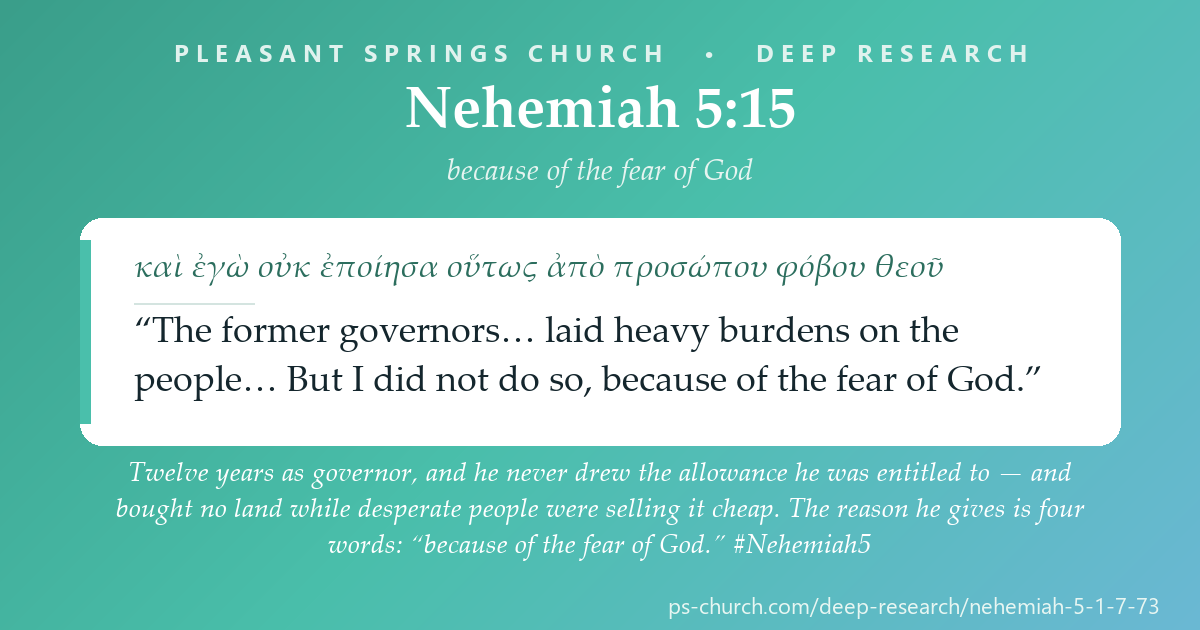
And then he puts his own accounts on the table. Twelve years as governor, and he never drew the food allowance he was legally entitled to — unlike “the former governors who were before me” — and he gives the reason in four Hebrew words: mippənê yirʾaṯ ʾəlōhîm, because of the fear of God (5:15). He fed a hundred and fifty men at his table daily, at his own cost, and did not buy land (5:16–18).
Only then does the external opposition get its chapter, and it comes four times: an invitation to meet in the plain of Ono, repeated four times, and answered four times with one sentence — “I am doing a great work and I cannot come down”; then an open letter accusing him of planning a coup; then a hired prophet urging him to hide in the temple — met with “should such a man as I flee?”; then prophets on retainer. Fifty-two days. And 6:16 says even the enemies worked out who had done it.
Text and numbering. Nehemiah n = 2 Esdras n+10, so these chapters are 2 Esdras 15–17. Chapters 5 and 6 have 19 verses each in the Masoretic Text and in Rahlfs, with nothing absent.
⚠️ Chapter 7 runs the other way from the usual pattern: the Greek has one verse more. The Masoretic Text gives Nehemiah 7 72 verses; both Rahlfs (2 Esdras 17) and the English have 73. The last Masoretic verse carries both the settling “in their towns” and the note about the seventh month that leads into chapter 8, and the Greek and English traditions divide it where the Hebrew does not. Counted against both columns, not assumed.
⚠️ The Greek of 6:11 is noticeably shorter. The Hebrew has three movements: “Should such a man as I flee? And who is there like me who would go into the temple and live? I will not go in.” Rahlfs has only the middle one — τίς ἐστιν ὁ ἀνήρ ὃς εἰσελεύσεται εἰς τὸν οἶκον καὶ ζήσεται — and drops both the opening question about fleeing and the closing refusal. The verse is the moral centre of the chapter in Hebrew, and a Greek reader gets substantially less of it.
⚠️ A smaller difference at 6:16. The Hebrew says the enemies fell greatly in their own eyes — they were humbled. The Greek supplies a subject: ἐπέπεσεν φόβος, “fear fell greatly in their eyes.” Humiliation in one column, dread in the other.
The Shape of the Passage
Parallel panelsBehind these chapters stand the wall begun and the four waves of opposition in Nehemiah 1–4, and the law on interest in Exodus, Leviticus and Deuteronomy. In front of them stand a public reading of that law and a set of reforms that will have to be made twice.
Author
He interrupts his own building narrative to deal with debt. Chapter 5 sits between the armed watch of chapter 4 and the finishing of the wall in chapter 6, and it is about money. That placement is an argument: the project was more endangered by its own creditors than by the surrounding provinces, and the writer arranges the material so a reader cannot miss it.
He publishes his expenses. 5:14–19 is a governor’s statement of account, volunteered: the allowance he did not take, the land he did not buy, the daily headcount at his table, and the animals it cost. He does not claim to be poor — a man feeding a hundred and fifty people a day is not poor — he claims not to have taken what he was owed, and he gives the reason as fear of God rather than generosity.
And he asks God to remember him — repeatedly. 5:19, and again at 13:14, 22 and 31. Some readers find it self-regarding. Read against 5:14–18 it is something else: a man who has deliberately forgone the payment and the property that would ordinarily be his record, asking the only remaining witness to keep the account.
Audience
People who had been on both sides of chapter 5. This is a small province; the creditors and the debtors were neighbours, and their grandchildren were the readers. Naming the practice without naming the individuals — unlike Ezra 10, which names them — lets the reform stand as a rule rather than a scandal.
People whose leaders were entangled with the opposition. 6:17–19 is the most quietly devastating passage here: the nobles of Judah were exchanging letters with Tobiah, because Tobiah’s son had married the daughter of a Judean noble and Tobiah himself was a son-in-law of Shecaniah. The opposition was family. That is the situation the community was still in.
And people who needed to know that the register mattered. Chapter 7 reproduces the list from Ezra 2 because the city was empty and the question “who belongs here?” had to be answered before anyone could be asked to move in. The chapter is the pivot from building a wall to filling a city — and it ends on the seventh month, which is where chapter 8 begins.
Orient on debt and interest law, on Persian provincial taxation, on the governor’s allowance, and on false prophecy.
Search by topic: debt; interest / usury; debt slavery; year of release; jubilee; Persian taxation and tribute; governor (pechah); provincial allowance; Ono; false prophets; Shemaiah; Elul; Tobiad family; the register of returnees.
Which articles are relevant?
- Anchor Bible Dictionary — “Debt,” “Interest,” “Slavery (OT),” “Sabbatical Year,” “Taxation,” “Governor,” “Tobiah,” “Ono,” “Prophecy, False.”
- Dictionary of the OT: Historical Books (IVP) — “Ezra and Nehemiah, Books of,” “Nehemiah,” “Debt,” “Poverty and Wealth,” “Persia, Persians,” “Prophets and Prophecy.”
- NIDOTTE / TDOT — נֶשֶׁךְ (nešeḵ, interest), צְעָקָה (ṣəʿāqāh, outcry), יִרְאַת אֱלֹהִים (yirʾaṯ ʾəlōhîm, the fear of God), מְלָאכָה (məlāʾḵāh, work), נָעַר (nāʿar, shake out), זָכַר (zāḵar, remember).
- On the Greek — the NETS introduction to 2 Esdras; and note the shorter form of 6:11 in Rahlfs, discussed above.
Bibliography surfaced:
- H. G. M. Williamson, Ezra, Nehemiah (WBC); Joseph Blenkinsopp, Ezra–Nehemiah (OTL); Lester L. Grabbe, Ezra–Nehemiah.
- On chapter 5 specifically, read Exodus 22:25–27, Leviticus 25:35–43 and Deuteronomy 15:1–11 and 23:19–20 first. The chapter is Nehemiah applying those texts, and the commentaries are more useful once the law is in view.
Debt slavery as normal practice, the tax that caused it, and what a governor was entitled to take.
First the world: interest rates, debt bondage and royal debt-remission across the ancient Near East, and the Persian tax that 5:4 blames. Then what Nehemiah’s refusal of the allowance actually cost him.
Which parallels shed light on these chapters?
Debt slavery was ordinary, legal and everywhere — which is why Israel’s law is unusual. Mesopotamian contracts show interest rates of twenty per cent on silver and up to a third on grain, with persons pledged as security; the Code of Hammurabi regulates it rather than forbidding it. And ancient kings periodically declared debt cancellations — the mīšarum edicts of Old Babylonian rulers, and the Edict of Ammi-ṣaduqa, which voids specified debts and releases pledged persons. Nehemiah’s assembly is doing something a Near Eastern ruler might do — but he does it by getting an oath from the creditors rather than by decree, and he grounds it not in royal prerogative but in the law and the fear of God.
The tax in 5:4 is the mechanism of the crisis. “We have borrowed money for the king’s tax on our fields and our vineyards.” Persian tribute was assessed on the province and payable in silver, and Judah was a small, poor district that had to convert produce into coin to meet it. In a famine year that is a debt spiral with a documented shape: a bad harvest, a fixed cash obligation, land pledged, then children. The Elephantine and Babylonian documents show Judeans elsewhere in exactly this economy.
And the governor’s allowance was real money. 5:15 says previous governors took “forty shekels of silver” along with food and wine — a maintenance levy on the province, which Persian officials were entitled to and the Persepolis records show being drawn as rations. Nehemiah’s refusal is not a gesture; it is twelve years of forgone income, at a time when he was also feeding a hundred and fifty people daily out of his own resources. See Money, Weights & Measures for what a shekel was.
- The Edict of Ammi-ṣaduqa and the Old Babylonian mīšarum edicts (Mesopotamian royal decrees — witnesses, not Scripture) — royal debt remission and release of pledged persons. Cited for the practice, and for the contrast: Nehemiah works by oath, not decree.
- The Code of Hammurabi (Babylonian law collection — a witness, not Scripture) — interest and debt pledge regulated as normal commerce. Useful for seeing what Israel’s prohibition of interest on a brother is prohibiting.
- The Persepolis Fortification Tablets; the Elephantine papyri (Achaemenid administrative records and Aramaic legal documents — witnesses, not Scripture) — for provincial rations and allowances, and for the debt economy Judeans lived in elsewhere in the empire.
- Josephus, Antiquities 11.5.7–8 (§§174–183) (Second-Temple — a witness, not Scripture) — his account of the completion of the wall. He gives the work two years and four months rather than fifty-two days, and omits the debt crisis of chapter 5 altogether.
Chapter 5 has two halves and one hinge. The first half is a public reform imposed on other people’s finances. The second half is Nehemiah’s own accounts. The reform would be unbearable without the disclosure, and he clearly knows it.
What he gave up. The governor’s allowance — food, wine, and forty shekels of silver — for twelve years. He also bought no land, at a moment when land was cheap because desperate people were mortgaging it. That second detail is easy to miss and is arguably the sharper one: the crisis in 5:1–5 was an opportunity, and the governor declined to take it.
The reason he gives. Not compassion, not example, not strategy: mippənê yirʾaṯ ʾəlōhîm, “because of the fear of God” (5:15). The same phrase recurs at 5:9 — “ought you not to walk in the fear of our God?” — and again in 7:2, where Hananiah is put in charge of Jerusalem because he “feared God more than many.” In this book the fear of God is a qualification for office and a constraint on expense accounts, which is a considerably more concrete thing than it usually sounds.
And a note on the interest itself. The law does not forbid all lending; it forbids taking nešeḵ from a brother in need (Exodus 22:25; Leviticus 25:35–37) and requires release in the seventh year (Deuteronomy 15:1–11). What the nobles were doing was lawful commerce anywhere else in the empire. Nehemiah’s charge is not that they broke the market but that they were not behaving like brothers — 5:5 puts it in terms of flesh and children, not of rates.
The word for a slave’s cry, the word that bites, and four words that explain an expense account.
Look up ṣəʿāqāh in Exodus 3 and then read Nehemiah 5:1. Then follow yirʾaṯ ʾəlōhîm through 5:9, 5:15 and 7:2 — it is attached to something concrete every time.
“Outcry, cry of distress.” A loaded word: it is the cry of Israel under Egyptian slavery (Exodus 3:7, 9), the cry of Sodom that reached God (Genesis 18:20–21), and the cry of the oppressed that God promises to hear (Exodus 22:23, in the very passage forbidding interest). By choosing it, the writer classifies what the nobles were doing as the thing Israel was rescued from. The Greek is κραυγή.
“Interest” — from a root meaning to bite. The law prohibits taking it from a fellow Israelite in need (Exodus 22:25; Leviticus 25:36–37; Deuteronomy 23:19–20), while permitting it from a foreigner — a distinction that makes the offence here specifically fraternal rather than economic. Nehemiah’s demand at 5:10–11 is that they abandon it and restore the pledged property and “the hundredth part of the money” already taken.
“The fear of God.” Three appearances, and in this book it is always attached to something measurable. 5:9: the nobles ought to walk in it — meaning, stop charging interest. 5:15: it is why Nehemiah did not draw his allowance. 7:2: it is why Hananiah gets command of the city. A qualification, a constraint, and a reason — never an atmosphere. The Greek is φόβος θεοῦ.
“The work.” The word Nehemiah answers everything with: “a great work I am doing… why should the work stop?” It is the same noun used of the craftsmanship of the temple and, in Genesis 2:2, of God’s finished work of creation. Its last appearance in this unit is at 6:16, in the enemies’ mouths: “this work was done by our God.” Nehemiah calls it his; his opponents correctly identify whose it was.
“I shook out.” He shakes out the fold of his garment — the pouch where a man carried money — as an enacted curse: “so may God shake out every man from his house and from his labour who does not keep this promise.” The verb is used of God shaking off Pharaoh’s army into the sea (Exodus 14:27) and of shaking out a garment to empty it. The sign is chosen to fit the sin: a money-pouch turned upside down.
“Remember for me” — the recurring prayer of the memoir. It is easy to hear as vanity until you read it immediately after 5:14–18. He has just recorded that he took no salary, bought no land, and paid for the table himself — which is to say he has deliberately destroyed the ordinary evidence of a successful career. The prayer asks the only remaining witness to keep the record.
Two things here reported rather than tidied:
- The Greek of 6:11 is shorter than the Hebrew. The Hebrew has “Should such a man as I flee? And who is there like me who would go into the temple and live? I will not go in.” Rahlfs keeps only the middle clause and drops both the question about fleeing and the flat refusal. This page prints both columns as they stand; the Hebrew is materially fuller at the chapter’s moral centre.
- The register of chapter 7 differs from Ezra 2 in many of its numbers, though the totals given at the end are close. Proposals include copying errors in one list or the other, different points of reckoning, or two counts taken at different times. The differences are real and this page does not reconcile them; both lists are printed in their own books. Note also that MT Nehemiah 7 has 72 verses where Rahlfs and the English have 73.
The law behind chapter 5, the cry God promised to hear, and a great work not to come down from.
Read Exodus 22:21–27, Leviticus 25:35–43 and Deuteronomy 15:1–11 before Nehemiah 5 — the chapter is those texts being enforced. Then read 5:14–19 beside 1 Corinthians 9 and 2 Corinthians 11.
Which cross-references matter?
- Exodus 22:21–27; Leviticus 25:35–43; Deuteronomy 15:1–11; 23:19–20 → Nehemiah 5:1–13 — the law being enforced. No interest from a brother in need; no permanent debt slavery; release in the seventh year; and, in Exodus 22:23, the promise that if the oppressed cry out (ṣāʿaq) God will hear. Nehemiah 5:1 uses that noun. The law anticipated the cry, and the chapter reports it happening.
- Exodus 3:7–9 → Nehemiah 5:1 — “I have heard their cry… I know their sufferings.” The word for what Israel did under Egyptian slavery is the word for what the poor of Jerusalem did under their own nobility, and the writer chose it.
- Nehemiah 5:14–19 → 1 Corinthians 9:3–18; 2 Corinthians 11:7–9; 1 Thessalonians 2:9 — a leader with a clear right to material support, deliberately not using it, and saying so on the record. Paul makes the identical move and the identical argument: the right exists, and he declines it so that nothing obstructs the work. This page notes the parallel of practice and does not claim Paul is citing Nehemiah.
- Nehemiah 6:10–13 and Deuteronomy 18:20–22; 1 Kings 13; Jeremiah 28 — a prophet who says the right-sounding thing for the wrong reason. Nehemiah’s test is not a sign but a judgment: God had not sent him, and the message would have made Nehemiah sin. Compare the man of God at Bethel who believed a lying colleague, and Hananiah against Jeremiah.
- Nehemiah 6:11 and Numbers 18:7; 2 Chronicles 26:16–21 — “who is there like me who would go into the temple and live?” Nehemiah is a layman, and he knows what happened to Uzziah. The trap was designed to make him either a coward or a trespasser.
- Nehemiah 7:6–73 and Ezra 2:1–70 — the same register, with numerous differences in the figures. Both are printed in their own books and are not harmonised here.
- Nehemiah 7:2 and Exodus 18:21; 2 Chronicles 19:9 — officers chosen because they fear God. Jethro’s advice to Moses, Jehoshaphat’s charge to the judges, and Hananiah’s appointment: the same criterion, three times, across a thousand years.
Where the scholarship agrees, where it does not, and what stays open.
Williamson, Blenkinsopp and Grabbe. Then four live questions — and on three the honest answer is that the evidence does not settle it.
Commentaries & studies:
- H. G. M. Williamson, Ezra, Nehemiah (WBC) — the standard treatment, and careful on the relationship between the two registers.
- Joseph Blenkinsopp, Ezra–Nehemiah (OTL) — strong on the economics of chapter 5 and on the Tobiad connections in 6:17–19.
- Lester L. Grabbe, Ezra–Nehemiah — on the historical questions, including the fifty-two days.
- On chapter 5 as social history: the discussions in Blenkinsopp and in standard treatments of Persian-period Judah. Read them after the biblical law, not instead of it.
Interpretation notes worth keeping:
- The chronological placement of chapter 5 — argued. The twelve years of 5:14 cover Nehemiah’s whole first term, which is longer than the wall took; many read 5:14–19 as a retrospective summary inserted here rather than as events of the fifty-two days. The text does not say, and the placement is deliberate either way — see the structure note.
- The fifty-two days (6:15) — and Josephus disagrees. Josephus gives two years and four months. Whether he had another source, was harmonising, or simply found the figure implausible is not recoverable. On the biblical figure itself see the previous study: the work described is repair of an existing circuit by the whole population in parallel, and the extent of Persian-period Jerusalem is archaeologically contested. This page reports the number and computes nothing from it.
- The two registers — unresolved. Ezra 2 and Nehemiah 7 differ in many individual figures while agreeing closely on the totals. No proposal accounts for all the variations.
- Whether the reform of chapter 5 held. Chapter 13 shows Nehemiah returning years later to find several reforms undone, and 6:17–19 already shows the nobility entangled with Tobiah. The book does not claim a permanent success, and readings that treat chapter 5 as a solved problem are reading past chapter 13.
The threat from inside, an expense account as evidence, and a sentence to keep for interruptions.
Name what you learned, why it matters, and one concrete response.
What should we carry away — and do?
- The wall was more endangered by its creditors than by its enemies. Sanballat could write letters. The nobles could break the community, and were doing so while their names stood on the sections they had repaired. The Chronicler’s successor puts chapter 5 before chapter 6 on purpose.
- He reformed other people’s money and then published his own. Twelve years, no allowance, no land bought while land was cheap, and a hundred and fifty fed daily at his own cost. The reason he gives is not compassion but the fear of God — which in this book is a constraint on an expense account before it is anything else.
- “I am doing a great work and I cannot come down.” Said four times, to four identical invitations, from people who wanted a meeting rather than an outcome. It is not a rule against meetings; it is a rule about knowing which one you are being invited to.
- One concrete response. Nehemiah declined to buy land while desperate people were selling it cheap. Find the one place this week where somebody else’s difficulty is quietly to your advantage — and don’t take it.
Nehemiah 5:15 · to share
Hebrew + Greek (Rahlfs, 2 Esdras) + ESVEvery Deep Research page traces its passage across the whole sweep — the Old Testament, the Second-Temple world between the testaments (historical witnesses, not Scripture), and the New Testament. Follow the thread:
Pleasant Springs Church — Deep Research
Research method after Michael S. Heiser’s Bible Research Method (examine dictionaries → ancient literature → important words → textual connections → academic publications → share), with the Pleasant Springs “Author & Audience” foundation. Scripture set in the Hebrew, the Greek editions named on each page and the ESV (Old Testament), and the Greek New Testament and the ESV (New Testament), per the practice of Pleasant Springs Church. Nehemiah 5–7 research grounded in Williamson (WBC), Blenkinsopp (OTL) and Grabbe. Book name and numbering: in the Septuagint Nehemiah is the second half of 2 Esdras (Ἔσδρας Βʹ), so Nehemiah n = 2 Esdras n+10 and these chapters are 2 Esdras 15–17. Text: Hebrew from the Masoretic Text; Greek from Rahlfs’s Septuaginta (CATSS digitization), printed without editorial punctuation and with proper names unaccented; English ESV. Chapters 5 and 6 have 19 verses each in both columns with nothing absent. ⚠️ Chapter 7 runs the opposite way to the usual pattern: the Masoretic Text has 72 verses where both Rahlfs and the English have 73 — the last Masoretic verse, carrying both the settlement in the towns and the note about the seventh month, is divided in the Greek and English traditions. Counted against both columns, not assumed. ⚠️ The Greek of 6:11 is materially shorter: the Hebrew has three movements (“should such a man as I flee?” / “who like me would go into the temple and live?” / “I will not go in”), and Rahlfs retains only the middle one, dropping both the question about fleeing and the refusal. The page prints both columns as they stand and notes that the Hebrew is fuller at the chapter’s moral centre. A smaller difference at 6:16: the Hebrew has the enemies falling in their own eyes (humiliation) where Rahlfs supplies φόβος, “fear fell” (dread). The two registers (Nehemiah 7:6–73 and Ezra 2) differ in many individual figures while agreeing closely on the totals; the differences are reported and not reconciled, and no proposal is presented as accounting for all of them. Chapter 5 is read against the law it enforces — Exodus 22:21–27, Leviticus 25:35–43, Deuteronomy 15:1–11 and 23:19–20 — and the page notes that the practice was lawful commerce elsewhere in the empire, so that the charge is specifically fraternal. Its chronological placement is reported as argued: the twelve years of 5:14 exceed the fifty-two days, and many read 5:14–19 as a retrospective summary. The fifty-two days is reported and nothing is computed from it; Josephus’s two years and four months is noted, as is the contested archaeology of Persian-period Jerusalem. The page also notes that chapter 13 shows several reforms undone, so chapter 5 is not presented as a solved problem. The parallel with Paul’s refusal of support is named as a parallel of practice, not as a citation. Mesopotamian debt-remission edicts, the Code of Hammurabi and Persian administrative records are cited for practice and contrast only. Typology is handled per the house position: what the text says, what the New Testament itself draws, and what we see from this side of the cross — with the seeing left to the reader.
Scripture quotations marked ESV are from the ESV® Bible (The Holy Bible, English Standard Version®), © 2001 by Crossway, a publishing ministry of Good News Publishers. ESV Text Edition: 2016. Used by permission. All rights reserved. The ESV text may not be quoted in any publication made available to the public by a Creative Commons license, and the ESV may not be translated in whole or in part into any other language. www.esv.org
|
Did this study bless you today? 💚 Give to Support PS Church100% of gifts go to the General Fund — thank you. |