A man in a palace asks after a city he has never seen, and the answer wrecks him: the wall is broken down and the gates are burned. He sits down and weeps, and then fasts and prays — and the dates in 1:1 and 2:1 quietly tell you for how long. About four months. Only in the last clause of chapter 1 does he mention, almost as an aside, that he is the emperor’s cupbearer — which is to say, in the room every day. Then the moment: the king notices his face, “and I was very much afraid”; and when the direct question comes, the narrative inserts five Hebrew words between question and answer — “so I prayed to the God of heaven”. What follows is a night ride round a ruin with nobody told, a wall repaired by perfumers and goldsmiths and merchants and Shallum and his daughters, and one entry that is not praise: the nobles of Tekoa, who “would not stoop to serve their Lord.” Then four escalating waves of opposition — mockery, armed conspiracy, exhaustion from inside, permanent threat — each met the same way. “We prayed to our God, and set a guard.” Not one or the other. See the method →
Nehemiah 1:1–4:23 (selections)
Hebrew · Greek (Rahlfs, 2 Esdras) · ESVThen the moment. The king notices his face; “I was very much afraid” (2:2). And when the direct question comes — “what are you requesting?” — the narrative does something almost unique in Scripture. Between the question and the answer it inserts five Hebrew words: “so I prayed to the God of heaven” (2:4). Four months of prayer, and then one more in the half-second before speaking.
What follows is not a building manual. He rides round the ruin at night with nobody told, says “let us rise up and build,” and is immediately mocked. Then chapter 3 — a section readers skip — which turns out to be a roll of honour of amateurs: the high priest, perfumers, goldsmiths, merchants, temple servants, the men of Jericho and Tekoa and Gibeon, and Shallum, “he and his daughters” (3:12). It also records the nobles of Tekoa, who “would not stoop to serve their Lord” (3:5) — the one criticism in the chapter.
Then four waves of opposition, escalating: mockery, conspiracy, exhaustion from within, and open threat. And each is met the same way. “We prayed to our God, and set a guard.” Not one or the other.
This book has two numbering problems, and both need saying. ⚠️ (1) In Greek, Nehemiah is the second half of 2 Esdras, and the chapters carry on from Ezra. Nehemiah n = 2 Esdras n+10. So Nehemiah 1 is 2 Esdras 11, Nehemiah 3 is 2 Esdras 13, and the offset holds to the end of the book. (Verified against both columns: 2 Esdras 13:1 is Nehemiah 3:1, the sheep gate.)
⚠️ (2) The Hebrew and English chapter divisions differ here by six verses. Masoretic Nehemiah 3 runs to verse 38, where English versions end chapter 3 at verse 32 and begin chapter 4. So MT 3:33 = ESV 4:1 (Sanballat’s anger), MT 3:38 = ESV 4:6 (“we built the wall… to half its height”), and MT 4:1–17 = ESV 4:7–23. Verses from these chapters are cited below by the Hebrew number with the English in brackets. This is a chapter-division difference, not a textual one.
⚠️ And two verses of Hebrew Nehemiah 3 are absent from Rahlfs. The Masoretic Text gives the chapter 38 verses; 2 Esdras 13 has 36. The two missing are 3:7, a builders’ entry naming Melatiah the Gibeonite and Jadon the Meronothite, and — more noticeably — 3:38, the well-loved “so we built the wall… for the people had a heart to work” (ESV 4:6). Counted against both columns, not assumed; the Greek column above prints the absence rather than quietly supplying the verse.
The Shape of the Passage
Sequence · escalating panelsBehind these chapters stand the return and the finished temple of Ezra 1–6 — a house standing in a city with no wall — and the stopped work of Ezra 4. In front of them stand a reading of the Law and a set of reforms.
Author
This is a memoir, and it reads like one. The first person runs from 1:1, and it includes the things a public account would leave out: that he wept, that he was “very much afraid” in front of the king, that he told nobody about the night ride, that he prayed mid-sentence. The most revealing verses in the book are the ones nobody would have known to record but him.
He prays in two registers and does not apologise for either. Chapter 1 is a long, formal prayer built out of Deuteronomy — confession, covenant, the promise about gathering from the farthest skies. 2:4 is five words in the space of a breath. And 3:36–37 [4:4–5] is a prayer against enemies so unsparing that many readers wish it were not there. The book records all three without ranking them.
And he keeps the credit distributed. Chapter 3 could have been one sentence — “the people built the wall.” Instead it is forty verses of names and sections, including trades that had no business on a construction site and one man’s daughters. Nehemiah is the governor; the chapter is not about him.
Audience
People whose city had no wall, which meant it was not a city. In the ancient world an unwalled settlement had no legal standing, no defence, and no future — it was a village with ruins in it. 1:3 is not sentimental; it is a statement about viability. And the temple had been standing for seventy years by then, which tells you how long the problem had been tolerated.
People who knew these families. Chapter 3 names roughly forty individuals and their sections. For readers a generation or two later, that list said which houses had built the wall they were standing on — and which one had not stooped.
And people permanently subject to hostile neighbours. Sanballat, Tobiah and Geshem are not cartoon villains; they are, on the best reconstruction, the governor of Samaria, an Ammonite official, and an Arab chieftain — the surrounding administration, with legitimate-looking channels and real power. The opposition in this book is bureaucratic before it is military, which is exactly the situation a small Persian province lived in.
Orient on Nehemiah’s office, on the walls and gates, on the opposition, and on the book’s numbering.
Search by topic: Nehemiah; cupbearer; Susa; Artaxerxes I; Persian provincial governors; Sanballat; Tobiah; Geshem; Samaria papyri; Elephantine; walls and gates of Jerusalem; Valley Gate; Dung Gate; Tower of Hananel; corvée and volunteer labour; 2 Esdras.
Which articles are relevant?
- Anchor Bible Dictionary — “Nehemiah,” “Cupbearer,” “Susa,” “Sanballat,” “Tobiah,” “Geshem,” “Jerusalem (Walls and Gates),” “Wadi Daliyeh,” “Esdras, Second Book of.”
- Dictionary of the OT: Historical Books (IVP) — “Ezra and Nehemiah, Books of,” “Nehemiah,” “Prayer,” “Jerusalem,” “Persia, Persians,” “Fortifications.”
- NIDOTTE / TDOT — פָּרַץ (pāruṣ, broken down), חָזַק (hḥezîq, repair / hold fast), מִשְׁמָר (mišmār, guard), פָּלַל (hiṯpallēl, pray), לֵב (lēḇ, heart), מְלָאכָה (məlāʾḵāh, work).
- On the Greek — the NETS introduction to 2 Esdras (Esdras B), which sets out the continuous numbering across Ezra and Nehemiah.
Bibliography surfaced:
- H. G. M. Williamson, Ezra, Nehemiah (WBC); Joseph Blenkinsopp, Ezra–Nehemiah (OTL); Lester L. Grabbe, Ezra–Nehemiah. (Critical scholarship; the historical and topographical work is used and the conclusions are weighed.)
- On the wall itself: any archaeological survey of Persian-period Jerusalem. The extent of the city in Nehemiah’s day is genuinely disputed and the estimates vary considerably — see Stage 5.
What a cupbearer was, who Sanballat and Tobiah actually were, and how fast a wall can go up.
First the world: the office Nehemiah held, and the documentary evidence that his opponents were real administrators with real jobs. Then the fifty-two days, honestly assessed.
Which parallels shed light on these chapters?
Cupbearer was a position of extraordinary access, not a serving job. The office appears across the Near East as a senior court post — the man who tasted the king’s wine had to be trusted absolutely, was physically closest to the monarch, and in Assyrian records the rab šāqê is a high official. Tobit 1:22 has Ahikar as cupbearer and keeper of the signet. 1:11 is therefore not a modest disclaimer but the explanation of the whole book: he was in the room, daily, and could not hide his face.
His opponents are documented people. Sanballat appears as governor of Samaria in the Elephantine papyri (a letter refers to the sons of Sanballat, governor of Samaria) and the family recurs in the Wadi Daliyeh papyri from Samaria. Tobiah’s name and family are plausibly connected with the later Tobiad dynasty in Ammon. Geshem the Arab fits the Qedarite chieftains attested in Arabian inscriptions. This is not a story of villains but of provincial politics — and it explains why the first attack in 2:19 is a legal accusation (“are you rebelling against the king?”) rather than a raid.
Fifty-two days is fast, and the text does not claim more than it says. 6:15 gives the figure. What chapter 3 describes is largely repair — the verb throughout is hḥezîq, to strengthen or make firm — on a circuit whose stones and lines were already there, with the whole population working in parallel on assigned sections. Understood as emergency consolidation of an existing ruin by a few thousand people working simultaneously, the figure is not extraordinary. Understood as building a wall from nothing, it would be. The text describes the former.
- The Elephantine papyri (Aramaic documents from Persian Egypt — witnesses, not Scripture) — including reference to the sons of Sanballat, governor of Samaria. External attestation of a named opponent.
- The Wadi Daliyeh papyri (Samaritan administrative documents — witnesses, not Scripture) — the Sanballat family in the Samarian governorship over several generations.
- Arabian and Assyrian inscriptions on Qedar (royal and votive inscriptions — witnesses, not Scripture) — for Geshem the Arab and the standing of an Arab chieftain in this period.
- Tobit 1:22 (Second-Temple, Apocrypha — a witness, not Scripture in our confession) — Ahikar as royal cupbearer, keeper of the signet and administrator. Cited for the standing of the office.
- Josephus, Antiquities 11.5.6–8 (§§159–183) (Second-Temple — a witness, not Scripture) — he retells Nehemiah’s mission, and gives the wall two years and four months rather than fifty-two days. A retelling, and a reminder that ancient readers also found the figure striking.
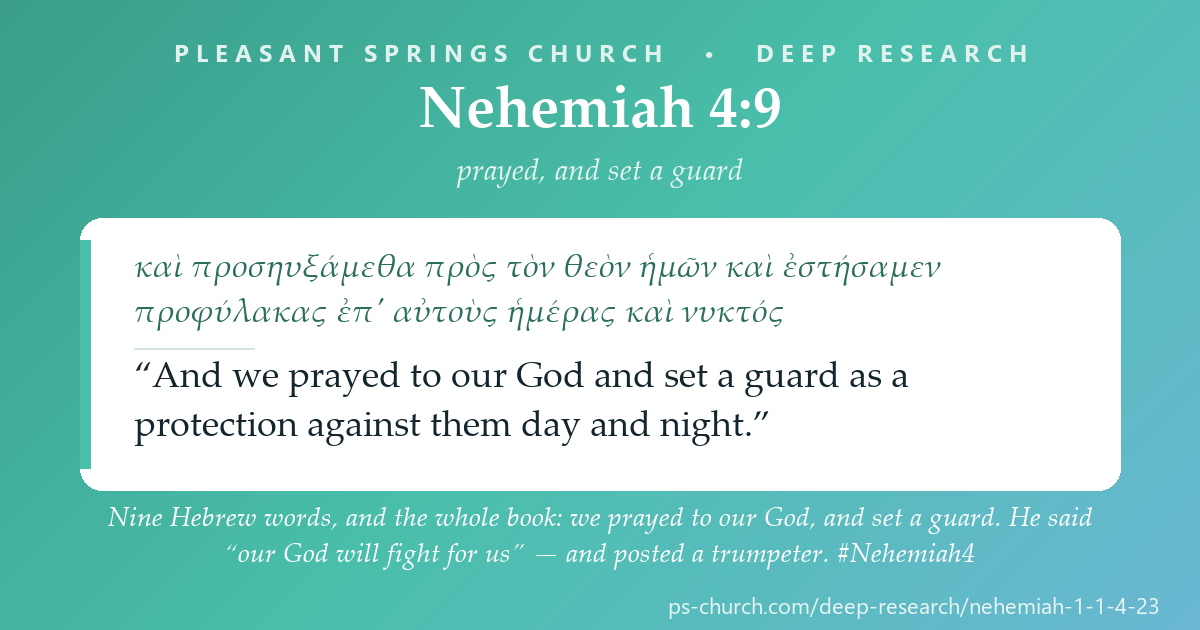
The pattern is exact and it is deliberate. Four times opposition comes, and four times the response is both spiritual and practical, in the same breath. 3:36 [4:4] — prayer. 4:3 [4:9] — “we prayed to our God, and set a guard… day and night.” 4:7–8 [4:13–14] — stationed families with swords, and “remember the Lord.” 4:14 [4:20] — a trumpeter posted, and “our God will fight for us.” Nobody in this book has to choose between trusting God and organising a rota.
And then there is 3:36–37 [4:4–5]. “Hear, O our God, for we are despised. Turn back their taunt on their own heads… Do not cover their guilt, and let not their sin be blotted out from your sight.” That is a prayer that God would not forgive someone. It belongs to the same family as the imprecatory psalms, and this page is not going to pretend it says something gentler.
Three things worth holding together. First, it is a prayer, not an action: Nehemiah hands the grievance over instead of acting on it, and then goes back to building. Second, the enemies here are trying to stop the work of God by fraud and force, and the prayer is public and unembarrassed about wanting them stopped. Third, the New Testament does not leave this where it stands: the same instinct meets “bless those who curse you,” and a man being stoned praying “do not hold this sin against them” (Acts 7:60). This page prints Nehemiah’s prayer, refuses to soften it, and refuses to make it the last word — because Scripture itself does not.
One verb for prayer in five registers, one for repair thirty-five times, and two words about daughters.
Count hiṯpallēl across these chapters and notice how differently each prayer behaves. Then count hḥezîq in chapter 3 — and notice it means reinforce, not build from scratch.
“To pray, intercede.” Five times in four chapters, in wildly different forms: a four-month fast, a formal covenant prayer, five words in the middle of a conversation with an emperor, an imprecation against enemies, and a corporate prayer paired with a night watch. The book’s theology of prayer is its variety. The Greek uses προσεύχομαι throughout, and at 2:4 keeps the abruptness exactly: καὶ προσηυξάμην, two words.
“Strengthened, made firm, repaired” — the drumbeat of chapter 3. Its root sense is not “build” but take hold of, hold fast, reinforce: they were consolidating a circuit that already existed. The same root gives Nehemiah’s own name for the strength of the workers failing (4:4 [4:10]) and, elsewhere in Scripture, the command “be strong” (ḥăzaq) given to Joshua and Solomon. The Greek varies its rendering; the Hebrew does not.
“Guard, watch, post.” The practical half of 4:3’s famous pairing. It is the same noun family as the mišmereṯ of the priestly courses in 1 Chronicles 23–26 — a duty you keep and a station you hold. The word does double duty in Scripture for temple service and for sentry duty, which is fitting in a book where the same people do both.
“Heart.” Three of the most important sentences in the unit turn on it. 2:12: “what my God had put into my heart to do” — and he told nobody. 3:38 [ESV 4:6]: the wall reached half its height “for the people had a heart to work” — and this is one of the two verses absent from Rahlfs. The Chronicler’s idiom for setting the heart to seek God (2 Chr 30:19) is being used here of manual labour.
“Broken down, breached.” The word in the report that starts everything, and the word Nehemiah sees for himself on the night ride. It is the same root as pāraṣ, the divine “breaking out” that named Perez-uzza and Baal-perazim. A breach in a wall is the standard Old Testament image for a people without protection, and it is what Tobiah’s joke about the fox depends on.
“Shallum… he and his daughters.” Two words that a copyist could easily have “corrected” to sons, and did not. A ruler of half the district of Jerusalem repaired his section with his daughters, and the record says so. The Greek keeps it — καὶ αἱ θυγατέρες αὐτοῦ. Set beside 3:5, where the nobles of Tekoa “would not stoop to serve their Lord,” the chapter is quietly making a point about who actually turns up.
Two things here reported rather than tidied:
- Two numbering systems, and both are in play. (a) In Greek, Nehemiah is the second half of 2 Esdras: Nehemiah n = 2 Esdras n+10. (b) The Masoretic Text ends chapter 3 at verse 38 where English versions end it at 32, so MT 3:33–38 = ESV 4:1–6 and MT 4:1–17 = ESV 4:7–23. Neither is a textual difference; both make references unreliable if unstated, so this page gives the Hebrew number with the English in brackets throughout.
- Two verses of Hebrew Nehemiah 3 are absent from Rahlfs — 3:7 (Melatiah the Gibeonite and Jadon the Meronothite, with the note about the jurisdiction of the governor Beyond the River) and 3:38 [ESV 4:6] (“so we built the wall… for the people had a heart to work”). The Masoretic chapter has 38 verses and 2 Esdras 13 has 36. The second of these is a much-quoted verse, and it is simply not in the Greek; the codex above prints the absence rather than supplying it.
The prayer built from Deuteronomy, the wall that was the point, and a hard prayer the New Testament answers.
Read Deuteronomy 30:1–5 before Nehemiah 1:8–9 — Nehemiah is quoting. Then read 3:36–37 [4:4–5] beside Psalm 69 and Acts 7:60, and let all three stand.
Which cross-references matter?
- Deuteronomy 30:1–5 (cf. 4:25–31) → Nehemiah 1:8–9 — “remember the word that you commanded your servant Moses: ‘If you are unfaithful, I will scatter you; but if you return to me… I will gather them from there.” Nehemiah prays Scripture back to God, naming the promise about “the farthest part of the heavens” — and he is praying it in Susa, about as far as an Israelite had ever been.
- 1 Kings 8:29–30 (2 Chronicles 6:20–21) → Nehemiah 1:6 — “let your ear be attentive… and your eyes open.” Nehemiah’s opening petition uses Solomon’s dedication language for a prayer made a thousand miles from the temple.
- Nehemiah 3:36–37 [ESV 4:4–5] and Psalm 69:22–28; Jeremiah 18:23 → Luke 6:28; Acts 7:60; Romans 12:19–21 — the imprecatory prayer, and the trajectory. Nehemiah asks that his enemies’ sin not be blotted out; Jeremiah prays similarly; the Psalms are full of it. And Jesus says bless those who curse you, Stephen prays for the men killing him, and Paul says leave vengeance to God. This page prints Nehemiah’s prayer as it stands and prints where the canon goes next, without collapsing either into the other.
- Nehemiah 1:11 and Genesis 40:1–23; Tobit 1:22 — the cupbearer. Joseph’s fellow-prisoner was Pharaoh’s; Ahikar held the office in Assyria (Apocrypha, a witness). The point is proximity: the office is the mechanism of the whole book.
- Nehemiah 2:8, 18; 2:20 — “the good hand of my God” and Ezra 7:6, 9, 28; 8:18, 22, 31 — the phrase both men use for the same thing. Two very different personalities, one idiom for why anything worked.
- Nehemiah 4 [ESV] and Ephesians 6:10–18 — a builder with a load in one hand and a weapon in the other; and armour described for people who are standing rather than advancing. The connection is a resonance and this page does not claim Paul is alluding to Nehemiah.
- Nehemiah 3:12 and Numbers 27:1–11; Judges 5:7 — Shallum’s daughters on the wall; Zelophehad’s daughters winning an inheritance ruling; Deborah. The Old Testament records women doing public work without commentary more often than is usually noticed.
Where the scholarship agrees, where it does not, and what stays open.
Williamson, Blenkinsopp and Grabbe. Then four live questions — and on three the honest answer is that the evidence does not settle it.
Commentaries & studies:
- H. G. M. Williamson, Ezra, Nehemiah (WBC) — the standard treatment; particularly careful on chapter 3 and on the relationship of the Nehemiah memoir to the rest of the book.
- Joseph Blenkinsopp, Ezra–Nehemiah (OTL) — strong on the Persian provincial setting and the identities of Sanballat, Tobiah and Geshem.
- Lester L. Grabbe, Ezra–Nehemiah — on the historical questions, including the size of Persian-period Jerusalem.
- On the topography: any recent survey of Persian-period Jerusalem archaeology, read with the awareness that the extent of the fifth-century city is contested and the estimates have moved considerably.
Interpretation notes worth keeping:
- The size of the city, and therefore of the task — disputed. Estimates of Persian-period Jerusalem’s population and extent vary widely, and the line of Nehemiah’s wall is debated on the ground. This affects how one assesses the fifty-two days, and the honest position is that the archaeology is contested rather than settled. This page describes what the text describes — repair of an existing circuit by the whole population working in parallel — and does not compute anything from it.
- The relative order of Ezra and Nehemiah — unresolved. See the previous study: whether Ezra’s mission precedes Nehemiah’s depends on which Artaxerxes is meant. The canonical order is followed here without claiming it settles the history.
- The Nehemiah memoir. That chapters 1–7 and parts of 12–13 derive from a first-person account is widely accepted; its original genre — a report to the king, a dedicatory memorial, a self-defence — is argued. Reported as a live question.
- Chapter 3 and the memoir. The building list is in the third person and reads like an archival document, which has led many to treat it as a source Nehemiah incorporated rather than composed. An observation about the material, not a judgment on its accuracy.
Four months, five words, a section each, and a prayer left unsoftened.
Name what you learned, why it matters, and one concrete response.
What should we carry away — and do?
- He prayed for four months and then asked for timber. The dates in 1:1 and 2:1 are about a third of a year apart, and when the moment came he had a specific request ready — duration, letters, materials, named officials. Prayer and preparation were the same activity.
- Five words, mid-sentence. “So I prayed to the God of heaven. And I said to the king…” There was no time to leave the room. Long prayer and instant prayer are the same man in the same chapter, and neither is presented as the real kind.
- “We prayed to our God, and set a guard.” Nine Hebrew words, and the whole book. He says “our God will fight for us” and posts a trumpeter. Anyone who has been told to choose between those two has been given a false choice by someone who was not reading this chapter.
- One concrete response. Chapter 3 is a list of people who each took one section — perfumers, goldsmiths, a man and his daughters — and the only person criticised would not stoop. Find out what section is next to you this week, and repair that. Not the whole wall.
Nehemiah 4:3 [ESV 4:9] · to share
Hebrew + Greek (Rahlfs, 2 Esdras) + ESVEvery Deep Research page traces its passage across the whole sweep — the Old Testament, the Second-Temple world between the testaments (historical witnesses, not Scripture), and the New Testament. Follow the thread:
Pleasant Springs Church — Deep Research
Research method after Michael S. Heiser’s Bible Research Method (examine dictionaries → ancient literature → important words → textual connections → academic publications → share), with the Pleasant Springs “Author & Audience” foundation. Scripture set in the Hebrew, the Greek editions named on each page and the ESV (Old Testament), and the Greek New Testament and the ESV (New Testament), per the practice of Pleasant Springs Church. Nehemiah 1–4 research grounded in Williamson (WBC), Blenkinsopp (OTL) and Grabbe. Book name and numbering — two systems, both stated: in the Septuagint Nehemiah is the second half of 2 Esdras (Ἔσδρας Βʹ), numbered continuously from Ezra, so Nehemiah n = 2 Esdras n+10 (verified: 2 Esdras 13:1 is Nehemiah 3:1). Separately, the Masoretic Text ends chapter 3 at verse 38 where English versions end it at 32, so MT 3:33–38 = ESV4:1–6 and MT 4:1–17 = ESV 4:7–23; verses are cited by the Hebrew number with the English in brackets. Both are chapter-division differences, not textual ones. Text: Hebrew from the Masoretic Text; Greek from Rahlfs’s Septuaginta (CATSS digitization), printed without editorial punctuation and with proper names unaccented; English ESV. ⚠️ Two verses of Hebrew Nehemiah 3 are absent from Rahlfs — 3:7 and 3:38 [ESV 4:6], the latter being the much-quoted “so we built the wall… for the people had a heart to work.” The Masoretic chapter has 38 verses, 2 Esdras 13 has 36; counted against both columns, not assumed, and the codex prints the absence rather than supplying the verse from elsewhere. ⚠️ The imprecatory prayer at 3:36–37 [ESV 4:4–5] is printed and not softened — it asks that the enemies’ sin not be blotted out — and the page sets beside it both its Old Testament family (Psalm 69; Jeremiah 18:23) and where the canon goes next (Luke 6:28; Acts 7:60; Romans 12:19–21), without collapsing either into the other and without making either the last word by itself. External attestation is taken narrowly: Sanballat is named as governor of Samaria in the Elephantine papyri and his family recurs in the Wadi Daliyeh documents, which establishes that the opponents were real provincial administrators — it does not corroborate the narrative’s events. The fifty-two days (6:15) is discussed honestly: the page notes that chapter 3’s verb is hḥezîq, “reinforce,” describing repair of an existing circuit by the whole population in parallel; that Josephus gives two years and four months instead; and that the extent of Persian-period Jerusalem is archaeologically contested, so the page computes nothing from the figure. The relative order of Ezra and Nehemiah is reported as unresolved. Tobit is tagged Apocrypha — a witness, not Scripture in our confession. The resonance with Ephesians 6 is named as a resonance and no allusion is claimed. Typology is handled per the house position: what the text says, what the New Testament itself draws, and what we see from this side of the cross — with the seeing left to the reader.
Scripture quotations marked ESV are from the ESV® Bible (The Holy Bible, English Standard Version®), © 2001 by Crossway, a publishing ministry of Good News Publishers. ESV Text Edition: 2016. Used by permission. All rights reserved. The ESV text may not be quoted in any publication made available to the public by a Creative Commons license, and the ESV may not be translated in whole or in part into any other language. www.esv.org
|
Did this study bless you today? 💚 Give to Support PS Church100% of gifts go to the General Fund — thank you. |