The last thing Ahaz did was shut the doors of the house of God. The first thing his son did was open them — “in the first year of his reign, in the first month” (29:3). What follows is the largest act of worship in the book: the temple cleansed, the Levites restored, and a Passover kept a month late with couriers sent to the northern tribes, who mostly laugh at them. Some come anyway, unqualified, and the king prays “may the good Lord pardon everyone who sets his heart to seek God” — and God heard him and healed the people. Then Manasseh: the king who did more evil than the nations, dragged to Babylon with hooks. And there he does exactly the two things God specified at the dedication — he sought the face of the Lord and humbled himself greatly — and is heard, and brought home. 2 Kings 21 reports none of it. Then Josiah, the book found in the rubble, another Passover, and the fire. And then two verses that stop mid-sentence: a Persian king telling the people of God to go up. In the Hebrew order the rabbis record, those are the last words of the Old Testament — and Ezra 1:3 finishes the sentence. See the method →
2 Chronicles 29:1–36:23 (selections)
Hebrew · Greek (Rahlfs, Paraleipomenon B) · ESVWhat follows is the largest single act of worship in the book. Hezekiah cleanses the temple, restores the Levites and the singers, and then keeps a Passover — late, in the second month, because the priests were not ready — and sends couriers to the northern tribes, who mostly laugh at them. Some come anyway. And many who come are not ritually qualified, so the king prays a prayer that is very hard to read narrowly: “may the good Lord pardon everyone who sets his heart to seek God… even though not according to the sanctuary’s rules of cleanness” (30:18–19). And the Lord heard Hezekiah and healed the people.
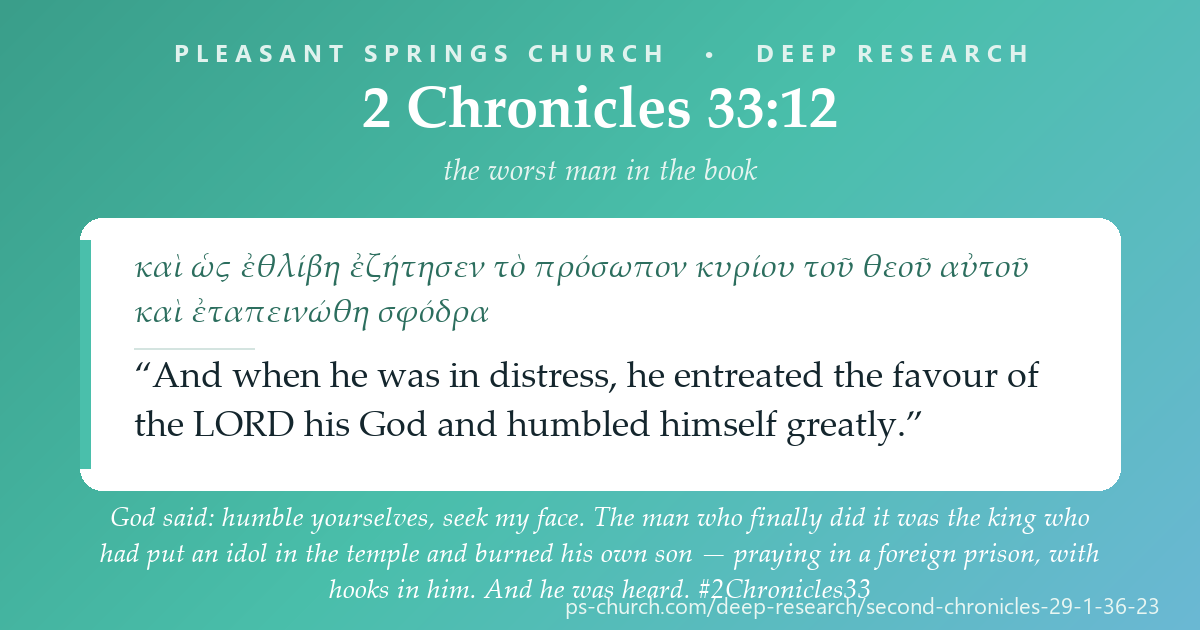
Then Manasseh — the king who did more evil than the nations, who put a carved image in the house of God. The Assyrians take him with hooks and bronze chains to Babylon. And there, 2 Chronicles says, he did precisely the two things God had specified at the dedication: he ḥillāh ʾeṯ-pənê — sought the face of the Lord — and wayyikkānaʿ məʾōḏ, humbled himself greatly. God “was moved by his entreaty” and brought him back to Jerusalem. 7:14 is not illustrated here; it is performed, clause by clause, by the worst man in the book. 2 Kings 21 reports none of it.
Then Josiah and the book found in the house; another Passover; and then the fire. And then two verses that do not belong to the story at all — a Persian king, decades later, telling the people of God to go home. In the order of the Hebrew Bible attested at b. Bava Batra 14b, where Chronicles stands last, these are the final words of the Old Testament: let him go up.
Text and numbering. In the Septuagint this book is 2 Paraleipomena, “things omitted” — Παραλειπομένων Βʹ (Paraleipomenōn B). Chapters 29–36 are numbered alike in Hebrew, Greek and English, and the verse counts match Rahlfs exactly — 36, 27, 21, 33, 25, 33, 27, 23 — with nothing absent from the Greek. Counted against both columns, not assumed.
⚠️ The single largest difference between Chronicles and Kings in either book is Manasseh. 2 Kings 21:1–18 gives him fifty-five years of unrelieved evil and no repentance whatever — and then explicitly names him as the reason Judah fell (2 Kings 23:26; 24:3). 2 Chronicles 33 gives the same catalogue of evil, and then the hooks, the prayer, the hearing, and the return. Both are Scripture. This page prints both and harmonises neither, and does not use one to explain the other away.
⚠️ The book ends mid-sentence, and that is not a defect. 36:23 stops at “let him go up” — Cyrus’s decree is cut off in the middle. The same decree runs on in Ezra 1:3: “…let him go up to Jerusalem, which is in Judah, and rebuild the house of the Lord.” Whatever the reason, the effect in the Hebrew arrangement is that the Old Testament closes on an unfinished imperative.
The Shape of the Passage
ConcentricBehind these chapters stand the terms of 7:14 and the shut doors of 28:24. In front of them stands a caravan going back up the road — and the books of Ezra and Nehemiah, which take up the same decree.
Author
He has been building to Manasseh for thirty chapters. The promise of 7:14 named four things: humble yourselves, pray, seek my face, turn. 33:12–13 reports three of them in the same order and the fourth in the verses that follow — he removed the foreign gods and restored the altar. The Chronicler is not merely recording a conversion; he is closing a loop he opened at the dedication of the temple, and he closes it on the man his own sources blamed for the exile.
He measures Amon by his father’s repentance. 33:23 is one of the quietest, sharpest verdicts in the book: Amon “did not humble himself before the Lord as Manasseh his father had humbled himself.” The standard set for the next generation is not the father’s record but the father’s repentance.
And he will not let Hezekiah off either. 32:25–26 records that Hezekiah’s heart was proud — the same idiom used of Uzziah in 26:16 — and that wrath came, and that he then humbled himself. The best king in the book needs the same verb as the worst.
Audience
People who were the answer to the last sentence. The Chronicler’s readers were the descendants of those who went up. 36:23 is not a prediction for them; it is their family history, and the book ends by handing them the decree that put them where they are.
People who needed to know that the worst case had already been tried. A community whose grandparents had been deported for national apostasy is being told that the man most responsible was heard when he prayed in Babylon. That is not a general encouragement; it is a precedent, and it is placed at the structural centre of the last eight chapters.
And people arguing about who counts. 30:18–20 has a king pray for worshippers who came to the Passover ritually unqualified, on the ground that they had set their heart to seek God, — and God heard him and healed them. For a post-exilic community with sharp disputes about purity and membership, that paragraph is doing something, and the Chronicler put it in.
Orient on Hezekiah’s reforms, on Sennacherib, on Manasseh under Assyria, and on the fall.
Search by topic: Hezekiah; Passover (second month); Sennacherib; Siloam tunnel; Lachish; Manasseh; Esarhaddon and Ashurbanipal; vassal kings summoned to Assyria; Josiah; Huldah; the Book of the Law; Neco; Megiddo; the exile; sabbath years; Cyrus; the Cyrus Cylinder.
Which articles are relevant?
- Anchor Bible Dictionary — “Hezekiah,” “Sennacherib,” “Siloam Inscription,” “Manasseh,” “Josiah,” “Huldah,” “Exile,” “Sabbatical Year,” “Cyrus,” “Persia.”
- Dictionary of the OT: Historical Books (IVP) — “Hezekiah,” “Manasseh,” “Josiah,” “Exile,” “Repentance,” “Chronicler’s History.”
- NIDOTTE / TDOT — כָּנַע (kānaʿ, humble oneself), חָלָה (ḥālāh pānîm, entreat the face), עָתַר (ʿāṯar, be entreated), מַרְפֵּא (marpēʾ, remedy), שַׁבָּת (šabbāṯ), עָלָה (ʿālāh, go up).
- On the Greek — the NETS introduction to 2 Supplements, and its notes on the closing chapters and the overlap with 1 Esdras.
Bibliography surfaced:
- Sara Japhet, I & II Chronicles (OTL); Raymond B. Dillard, 2 Chronicles (WBC); Ralph W. Klein, 2 Chronicles (Hermeneia); H. G. M. Williamson, 1 and 2 Chronicles (NCBC).
- On Manasseh: the discussion of 33:10–13 in any of the above, read alongside the treatment of 2 Kings 21 in a Kings commentary. The two portraits are the point.
A tunnel you can still walk, a vassal summoned to Assyria, and a Persian who put it in writing.
This is the stretch of Chronicles with the most external documentation of anywhere in the book. Take each item for exactly what it establishes — and notice what it does not.
Which parallels shed light on these chapters?
Hezekiah’s water works are visible and inscribed. 32:30 says he “closed the upper outlet of the waters of Gihon and directed them down to the west side of the city of David.” The Siloam tunnel runs some 533 metres under Jerusalem and can be walked today, and the Siloam Inscription found in it describes the two teams of diggers meeting in the middle. What that establishes: a major waterworks of that period. What it does not do by itself is date the tunnel to Hezekiah by name — the inscription names no king. The convergence with 32:30 is strong and widely accepted, and it is reported as convergence rather than proof.
Sennacherib left his own account, and it is instructive precisely where it differs. The Taylor Prism describes shutting Hezekiah up “like a bird in a cage” in Jerusalem, lists tribute, and enumerates captured Judean towns — and does not claim to have taken Jerusalem, which for an Assyrian royal inscription is a conspicuous silence. The Lachish reliefs from Nineveh show that siege in detail. Two accounts of the same campaign, each shaped by its writer, and this page sets them beside each other rather than using one to certify the other.
Assyrian kings did summon and detain vassals — and Manasseh is named in their records. Manasseh of Judah appears in the tribute lists of Esarhaddon and of Ashurbanipal, which are cited in this library’s work on 2 Kings 21–25 from the local scan of Pritchard’s ANET (pp. 291, 294). Vassals were summoned to Assyria, and Ashurbanipal is known to have restored a rebellious brother-king of Egypt to his throne. None of that documents Manasseh’s repentance, which is a theological report no inscription could confirm. It does mean the circumstances Chronicles describes are ordinary rather than invented.
And Cyrus published policies of this kind. The Cyrus Cylinder presents him restoring sanctuaries and returning displaced peoples and their gods — framed as the will of Marduk, not of the Lord. It is not the decree of 36:22–23 and does not mention Judah. What it shows is the policy. The Bible’s claim is that this policy was stirred up by God, which is a claim about agency, not archaeology.
- The Siloam Inscription and the Siloam tunnel (Hebrew monumental inscription and engineering works — witnesses, not Scripture) — the two teams of tunnellers meeting. Cited for the works of 32:30, with the observation that the inscription names no king.
- The Taylor Prism (Sennacherib’s annals); the Lachish reliefs (Assyrian royal propaganda — witnesses, not Scripture) — “like a bird in a cage,” the tribute, and the absence of any claim to have taken Jerusalem.
- Esarhaddon’s vassal list; Ashurbanipal Cylinder C (Assyrian royal inscriptions — witnesses, not Scripture; ANET 291, 294) — Manasseh of Judah named as a tributary king. Cited for circumstance, explicitly not as evidence of the repentance.
- The Cyrus Cylinder (Persian royal inscription — a witness, not Scripture) — Cyrus restoring sanctuaries and repatriating peoples under Marduk’s authority. Cited for the policy; it is not the decree of 36:22–23 and does not mention Judah.
- The Prayer of Manasseh (Second-Temple, Apocrypha / Pseudepigrapha — a witness, not Scripture in our confession) — a short penitential prayer composed to supply the words 33:13 says Manasseh prayed but does not record. It is a later composition, not the prayer itself, and this page names it as such.
- Josephus, Antiquities 10.3.2–10.4.5 (§§37–80) (Second-Temple — a witness, not Scripture) — he follows Chronicles rather than Kings on Manasseh, and gives him his repentance.
2 Kings. Fifty-five years. Rebuilt the high places, altars for Baal, an Asherah, the host of heaven in the two courts, his son burned, mediums and necromancers, “very much innocent blood.” No repentance is reported. And Kings twice names him as the reason for the exile: the Lord “did not turn from the burning of his great wrath… because of all the provocations with which Manasseh had provoked him” (2 Kings 23:26; cf. 24:3).
2 Chronicles. The same catalogue of evil — the Chronicler does not soften a line of it — and then hooks, chains, Babylon, and a man in distress who sought the face of God and humbled himself greatly, was heard, and was brought back to his throne. He then removed the foreign gods and restored the altar.
What this page does. It prints both and harmonises neither. It does not say Kings “omits” the repentance as though Chronicles were the baseline, and it does not say Chronicles “invents” it as though Kings were. Each book is telling the story it set out to tell: Kings is explaining why Jerusalem fell, and Chronicles is showing what happens when a man meets the terms of 7:14. Both explanations are in the Bible, and a reader who needs only one of them has decided something Scripture has not.
Two smaller cautions. The Prayer of Manasseh in some Bibles is a later composition supplying words the text does not give, and is not Scripture in our confession. And the rabbis argued publicly over whether Manasseh has a share in the world to come (m. Sanhedrin 10:2 against b. Sanhedrin 103a) — which is worth knowing as evidence of how hard this case was felt to be, and is not a ruling on it.
The verb that ends the book, the idiom that answers the promise, and a healing that ran out.
Track kānaʿ through 32:26, 33:12, 33:23 and 36:12 and you have the Chronicler’s verdict on the last century. Then put marpēʾ at 36:16 beside ʾerpāʾ at 7:14.
“And he humbled himself greatly.” The verb of 7:14, and this is its strongest occurrence in the book — intensified with məʾōḏ, and applied to the worst king. Track it across these chapters and the Chronicler’s whole scheme is visible: Hezekiah humbles himself (32:26); Manasseh humbles himself greatly (33:12); Amon does not humble himself “as Manasseh his father had humbled himself” (33:23); Zedekiah does not humble himself before Jeremiah (36:12) — and the book ends. The Greek uses ταπεινόω, “was made low.”
“He entreated the face of” — literally to soften or stroke the face. It is the idiom for appealing to a superior in person, used of Moses pleading for Israel (Exodus 32:11) and of the exiles in Zechariah 8:21–22. And it answers 7:14 exactly: God said seek my face (ḇiqqēš pānay), and 33:12 says Manasseh did. The Greek makes the link plainer than the Hebrew does — ἐζήτησεν τὸ πρόσωπον, “sought the face,” the same verb as 7:14’s ζητήσωσιν τὸ πρόσωπόν μου.
“Remedy, healing.” “They kept mocking the messengers of God… until the wrath of the Lord rose against his people, until there was no remedy.” It is from the same root as the promise: 7:14 ended “and I will heal (ʾerpāʾ) their land.” The book that opened the offer of healing closes by saying the point was reached where there was none — which is why the two verses after it matter so much.
“Her sabbaths.” “The land enjoyed its sabbaths. All the days that it lay desolate it kept sabbath, to fulfil seventy years.” The reference is to the sabbatical-year law of Leviticus 25:1–7 and the sanction of Leviticus 26:34–35, and to Jeremiah’s seventy years (Jeremiah 25:11; 29:10). The exile is described as the land taking rest it had been owed — a startling way to speak of a catastrophe, and characteristic of a writer who thinks in terms of what is due to God.
“And let him go up.” The last word of Chronicles, and — in the order attested at b. Bava Batra 14b — the last word of the Hebrew Bible. ʿālāh is the standard verb for pilgrimage to Jerusalem, for coming up out of Egypt, and for the return from exile (Ezra 1:3; 2:1). A jussive, addressed to whoever is willing. The Greek ἀναβήτω keeps the mood exactly.
“He has set his heart.” Hezekiah’s prayer is for “everyone who sets his heart to seek God… even though not according to the sanctuary’s rules of cleanness.” The same idiom judges Rehoboam, who “did evil, for he did not set his heart to seek the Lord” (12:14). The criterion is the same in the prayer and in the verdict — which is why the prayer is not a relaxation of standards but an appeal to the standard that mattered most.
Two things here reported rather than tidied:
- The book ends in the middle of a sentence. 36:23 breaks off at “let him go up,” and the decree continues in Ezra 1:3. Explanations differ — that Chronicles was deliberately closed with an open imperative; that the overlap marks a link between the books; that a scribe copied only as far as the point he needed. Nothing settles it, and the page reports the fact and the proposals. What is not in dispute is the effect: in the Hebrew arrangement the Old Testament ends on an unfinished command to go home.
- Chronicles and Kings differ on Josiah’s death as well as Manasseh’s life. 2 Kings 23:29 reports simply that Neco killed him at Megiddo; 2 Chronicles 35:20–24 has Neco send a message claiming divine commission, Josiah disguise himself and refuse to listen “to the words of Neco from the mouth of God,” and archers wound him. Both are printed here; neither is reconciled.
The promise being kept, the sabbaths being paid, and the decree that becomes another book.
Read 7:13–14 and then 33:12–13 side by side — clause for clause. Then Leviticus 26 and Jeremiah 25 before 36:21, and Ezra 1 immediately after 36:23.
Which cross-references matter?
- 2 Chronicles 7:14 → 33:12–13 — the promise and its clearest performance. God said: humble themselves, pray, seek my face, turn from their wicked ways; then I will hear, forgive, heal. 33:12–13 reports Manasseh entreating the face of the Lord, humbling himself greatly, praying, being heard — and 33:15–16 has him remove the foreign gods and restore the altar. Four conditions, in order, by the worst king in the book.
- 2 Kings 21:1–18; 23:26; 24:3 beside 2 Chronicles 33 — the two portraits. Kings gives no repentance and names Manasseh as the cause of the exile; Chronicles gives the same evil and then the hooks and the hearing. See the insight in Stage 2 for how this page handles it.
- 2 Chronicles 28:24 → 29:3 — Ahaz “shut the doors of the house of the Lord”; Hezekiah “in the first year of his reign, in the first month, opened the doors of the house of the Lord and repaired them.” Consecutive chapters, opposite verbs, same doors.
- Leviticus 25:1–7; 26:34–35, 43 and Jeremiah 25:11; 29:10 → 2 Chronicles 36:21 — the land keeping the sabbaths it was owed, for seventy years. The exile is read as the law’s own stated sanction being paid out, and as Jeremiah’s word being fulfilled.
- 2 Chronicles 36:22–23 → Ezra 1:1–3 — the same decree, and Ezra finishes the sentence. Chronicles stops at “let him go up”; Ezra 1:3 continues “…to Jerusalem, which is in Judah, and rebuild the house of the Lord.” The next study in this series begins there.
- 2 Chronicles 30:18–20 and 1 Samuel 16:7; Psalm 51:16–17 — a king asking God to accept worshippers who were ceremonially wrong but had set their hearts to seek him, and God hearing. “The Lord looks on the heart”; “a broken and contrite heart, O God, you will not despise.”
- 2 Chronicles 32:7–8 and 2 Kings 19; Isaiah 36–37 — “with him is an arm of flesh, but with us is the Lord our God, to help us and to fight our battles.” The same crisis is told three times in the Old Testament; Chronicles is much the shortest, and keeps the sentence.
Where the scholarship agrees, where it does not, and what closes the book.
Japhet, Dillard, Klein and Williamson. Then four live questions — and on three the honest answer is that the evidence does not settle it.
Commentaries & studies:
- Sara Japhet, I & II Chronicles (OTL) — on the Manasseh narrative and on the Chronicler’s ending.
- Raymond B. Dillard, 2 Chronicles (WBC) — particularly on the Hezekiah narrative as a deliberate counterpart to Solomon’s, and on the two-Passover structure.
- Ralph W. Klein, 2 Chronicles (Hermeneia) — the technical work on chapter 36 and on the relationship to Ezra 1 and 1 Esdras.
- H. G. M. Williamson, 1 and 2 Chronicles (NCBC) — on the ending and on whether 36:22–23 is original to the book.
Interpretation notes worth keeping:
- The historicity of Manasseh’s deportation — argued, and the argument is not what it is often said to be. No inscription records it, and none would be expected to. What the Assyrian records do show is that Manasseh was a tributary king, that vassals were summoned, and that Ashurbanipal restored at least one rebellious client to his throne. That establishes plausibility, not event, and this page claims no more.
- Whether 36:22–23 is original to Chronicles. The overlap with Ezra 1:1–3 and the mid-sentence break have led some to treat the verses as a later addition linking the books, and others to argue they are the Chronicler’s deliberate ending. Not settled; reported as such.
- The Chronicler’s Hezekiah is shaped like Solomon. A great assembly, a Passover of unprecedented scale, contributions in abundance, and “nothing like this in Jerusalem since Solomon” (30:26). That the parallel is deliberate is widely held and is an observation about arrangement, not a claim about what happened.
- The seventy years. How exactly Jeremiah’s figure is to be counted — from 605, from 597, from 586, to 538 or to 516 — has been computed several ways, and none is certain. The Chronicler states the fulfilment; he does not show his arithmetic, and neither does this page.
The first month of the first year, the worst man in the book, and a sentence left open.
Name what you learned, why it matters, and one concrete response.
What should we carry away — and do?
- He did it in the first month of the first year. Hezekiah inherited a shut temple and did not wait for a convenient season, a consultation or a mandate. The date is in the verse because it is part of the point.
- The clearest proof of the promise is the worst man in the book. If 7:14 had been demonstrated on Josiah it would prove that good men are heard. It is demonstrated on Manasseh — idols in the temple, a son in the fire, innocent blood — praying in a foreign prison with hooks in him. The Chronicler put that at the centre on purpose.
- Amon is measured against his father’s repentance, not his father’s sins. 33:23 is worth reading twice. What was available to Amon was not merely a bad example to avoid but a road back that somebody in his own house had already walked.
- One concrete response. The book ends on an unfinished imperative: let him go up — no object, no deadline, addressed to whoever is willing. Name the one thing you have been waiting for better conditions to begin, and do the first month of it this week.
2 Chronicles 33:12 · to share
Hebrew + Greek (Rahlfs, Paraleipomenon B) + ESVEvery Deep Research page traces its passage across the whole sweep — the Old Testament, the Second-Temple world between the testaments (historical witnesses, not Scripture), and the New Testament. Follow the thread:
Pleasant Springs Church — Deep Research
Research method after Michael S. Heiser’s Bible Research Method (examine dictionaries → ancient literature → important words → textual connections → academic publications → share), with the Pleasant Springs “Author & Audience” foundation. Scripture set in the Hebrew, the Greek editions named on each page and the ESV (Old Testament), and the Greek New Testament and the ESV (New Testament), per the practice of Pleasant Springs Church. 2 Chronicles 29–36 research grounded in Japhet (OTL), Dillard (WBC), Klein (Hermeneia) and Williamson (NCBC). This study completes 2 Chronicles, and with it the book of Chronicles. Book name: in the Septuagint this book is Paraleipomenon B, Παραλειπομένων Βʹ; the Hebrew title is דִּבְרֵי הַיָּמִים. Text & numbering: Hebrew from the Masoretic Text; Greek from Rahlfs’s Septuaginta (CATSS digitization of the Rahlfs text), printed without editorial punctuation and with proper names unaccented; English ESV. Chapters 29–36 are numbered alike in Hebrew, Greek and English and the verse counts match Rahlfs exactly (36, 27, 21, 33, 25, 33, 27, 23) with nothing absent from the Greek — counted against both columns, not assumed. ⚠️ Chronicles and Kings are not harmonised, and the largest difference in either book falls here: 2 Kings 21:1–18 reports no repentance for Manasseh and twice names him as the cause of the exile (23:26; 24:3), while 2 Chronicles 33 reports the same evil and then the deportation, the entreaty, the hearing and the return. Both are printed; neither is called the real one, and the page explicitly declines to describe Kings as “omitting” or Chronicles as “inventing.” Josiah’s death likewise differs (2 Kings 23:29 against 2 Chronicles 35:20–24) and is left standing. ⚠️ External evidence is taken narrowly. The Siloam Inscription names no king, so the convergence with 32:30 is reported as convergence, not proof. The Taylor Prism is set beside the biblical account as a second interested witness, with the observation that it does not claim the capture of Jerusalem. Esarhaddon and Ashurbanipal name Manasseh as a tributary (ANET 291, 294, per the local scan used elsewhere in this library), which establishes circumstance and explicitly not the repentance, which no inscription could confirm. The Cyrus Cylinder shows the policy, is framed under Marduk, does not mention Judah, and is not the decree of 36:22–23. The Prayer of Manasseh is named as a later composition and tagged Apocrypha — a witness, not Scripture in our confession. ⚠️ The book ends mid-sentence at “let him go up,” with the decree completed at Ezra 1:3; whether 36:22–23 is original to Chronicles or a later link is reported as unsettled, with the proposals named and none adopted. The seventy years of 36:21 are reported as the text reports them, with the note that the reckoning is computed several ways and none is certain. The observation that the Chronicler shapes Hezekiah after Solomon is named as an observation about arrangement. Second-Temple and rabbinic witnesses (Josephus, Ant. 10; m. Sanhedrin 10:2; b. Sanhedrin 103a) are read as witnesses and never levelled with Scripture, and Apocrypha is tagged non-canonical at first mention. Typology is handled per the house position: what the text says, what the New Testament itself draws, and what we see from this side of the cross — with the seeing left to the reader.
Scripture quotations marked ESV are from the ESV® Bible (The Holy Bible, English Standard Version®), © 2001 by Crossway, a publishing ministry of Good News Publishers. ESV Text Edition: 2016. Used by permission. All rights reserved. The ESV text may not be quoted in any publication made available to the public by a Creative Commons license, and the ESV may not be translated in whole or in part into any other language. www.esv.org
|
Did this study bless you today? 💚 Give to Support PS Church100% of gifts go to the General Fund — thank you. |