Second Chronicles says that Manasseh — the king of Judah who led his people to do more evil than the nations — was taken to Babylon in bonds, humbled himself, prayed, and was heard; and it says twice that his prayer is written down (33:18–19). It does not give it. A prayer of fifteen verses that bears his name survives in Greek, and among the files this shelf measures it survives in exactly one place: as the twelfth of the Odes, the canticles bound after the Greek Psalter. The Odes are kept out of the shelf’s default screens, so this page measured the prayer by hand. It shares twenty-five words of vocabulary with the Greek of 2 Chronicles 33, and never more than three words in a row — and one of the three places it reaches three is the verse about his son Amon (the other two share for ever, 33:4 and 33:7). With Psalm 51 (Psalm 50 in the Greek) it shares fewer words, and six in a row: “and done evil before thee.” In the 30,348 Greek Old Testament units this shelf screens, those six Greek words stand in that psalm verse and nowhere else. The prayer is not Scripture for us; it is filed with the Apocrypha. There is no Hebrew text of it on this disk, no Latin in the measured corpora and no ESV; its English here is the King James Apocrypha of 1769 — which, at two places, carries forty-five words the Greek held here does not. See the method →
A short penitential prayer in Greek, fifteen verses long, set by its heading in the mouth of King Manasseh of Judah, whose reign 2 Kings 21 and 2 Chronicles 33 narrate. Its date and the language it was first written in are not settled: it is commonly placed somewhere between the second century BC and the first century AD, and nothing on this page measures either question. Its standing differs by tradition. Rahlfs’s Septuagint — the edition behind the Greek on this page — prints it among the Odes and nowhere else; the Clementine Vulgate prints it in an appendix; the King James Bible printed it among the Apocrypha; and the Church of England’s Thirty-Nine Articles (Article VI) name “the Prayer of Manasses” among the books the Church reads “for example of life and instruction of manners” but does not apply “to establish any doctrine.” It is not Scripture for us. We read it as a witness — a window onto how repentance was prayed in the Greek of the Septuagint’s readers — gratefully for the light it throws, and testing everything by the canon.
⚠️ What this page can and cannot measure — read this first.
HELD: the prayer in Greek as Ode 12 of the CATSS Odes file (Rahlfs) — 15 verse rows, 290 words, under an unnumbered two-word heading; the King James Apocrypha’s Prayer of Manasseh (1769 standard text, public domain), 15 verses, 408 words; for the canonical comparison, 2 Chronicles 33 in Hebrew (25 verses), Greek (25 rows) and the Clementine Latin (25 verses); the 30,348 screened Greek Old Testament units; the 7,927 verses of the Greek New Testament.
NOT ON THIS DISK: any Hebrew or Aramaic text of the prayer; the Syriac; Rahlfs’s apparatus or any manuscript; the Qumran fragment 4Q381; and any ESV of the prayer — none is printed or named for it.
ON DISK BUT NOT MEASURED: the Clementine appendix’s Latin text of the prayer, a modern liturgical Greek text of it, and Brenton’s (1851) and the Revised Version’s (1895) English of it — all obtained on 2026-10-09 and outside the corpora the tools read. The page names them and quotes two Latin clauses; nothing else from them is used.
CONSEQUENCE: the Hebrew-side screens cannot run on this prayer at all; every Greek count is a count over one edition’s text; and where the King James English and the Greek row disagree, the page reports the disagreement and does not say where the English comes from.
The Prayer of Manasseh — all fifteen verses, as Greek Ode 12
Greek: CATSS Odes (Rahlfs), Ode 12 · English: KJV Apocrypha (1769 standard text, public domain)The prayer’s only name. Inside the fifteen verses no person is named but Abraham, Isaac and Jacob, and no place at all — not Manasseh, not Babylon, not Assyria, not Jerusalem. These two words of heading are the only words in Ode 12 that name the king. The first of them is the noun 2 Chronicles 33:18 uses for “his prayer”: ἡ προσευχὴ αὐτοῦ.
The first of three titles built the same way. ὁ θεὸς τῶν πατέρων ἡμῶν (here), ὁ θεὸς τῶν δικαίων (12:8), ὁ θεὸς τῶν μετανοούντων (12:13). The first stands in 10 of the 30,348 screened Greek Old Testament units, among them 2 Chronicles 20:6, Greek Daniel 3:26 and Tobit 8:5; the other two stand in none of them, and in no New Testament verse.
Seven words with Acts 4:24 — the prayer’s deepest New Testament run, tie band 1. It is also the page’s first counter-example: Stage 4.
The King James verse runs on for two more sentences — 35 words, tinted — that have no counterpart in the Greek row held here, which ends at ἀνθρώπων. The six bold Greek words stand in the 30,348 screened units only at Joel 2:13 and Jonah 4:2.
Repentance, the righteous and a sinner in one verse. No unit of the 30,348 screened Greek Old Testament units carries the three together; in the Greek New Testament, Luke 5:32 and 15:7 do. Stage 4 measures what the wording shares: one word.
The first of three doubled cries: the verb, Lord, the verb again. And οὐκ εἰμὶ ἄξιος — not worthy — a phrase no screened Greek Old Testament unit has.
The bold six words are the page’s finding: they stand in Psalm 50:6 (Psalm 51:4 in English) and in no other unit of the 30,348 screened. The tinted ten English words have no counterpart in the Greek row; and the Greek’s ὑπὲρ ἁμαρτιῶν μου (because of my sins) has none in the English. Of all fifteen verses, this is the one with the most vocabulary from 2 Chronicles 33 (Stage 4).
The knee of the heart: the two words stand together nowhere else in the Greek Old Testament units screened, and in no New Testament verse.
The second doubled cry, at its tightest: a word, Lord, the same word. No unit of the 30,348 screened, and no New Testament verse, has that figure.
The third cry answers 12:10. There the Greek has οὐκ ἔστιν μοι ἄνεσις — there is no release for me; here, ἄνες μοι — release me, the imperative of the verb the noun comes from. The English, “neither have any release” and then “forgive me, O Lord, forgive me,” cannot show it. (The English verse’s “iniquites” is spelled so in the file.)
The five bold words stand in the screened units only in Tobit 8:16, in both Greek recensions — a blessing spoken on finding the bridegroom alive, after Raguel had made ready a grave.
The last four words are a New Testament shape: εἰς τοὺς αἰῶνας αμην stands in no screened Greek Old Testament unit and in four New Testament verses — Romans 1:25, 9:5, 11:36 and Hebrews 13:21. The six bold words are the prayer’s run of six with Romans 11:36 and Hebrews 13:21 (Stage 4).
⚠️ The two columns are not the same text at two points, and the page marks both. Aligned by content, Greek verse and King James verse correspond one to one, all fifteen. But King James 7 carries 35 words and King James 10 carries 10 that have no counterpart in the Greek rows held here — 45 of the English’s 408 words. The longer of the two is a sentence about repentance and forgiveness: “hast promised repentance and forgiveness to them that have sinned against thee”. The Greek row of verse 7 has nothing for it. The English uses repent- six times; the Greek has its repentance words four times, and the difference is exactly that extra sentence.
Where the extra English comes from is not measured on this page. The measured corpora hold no second Greek copy of the prayer, no Latin copy and no Syriac. Outside those corpora the disk does hold three more witnesses, obtained for the shelf on 2026-10-09 and not measured here: the Latin Oratio Manassæ of the Clementine Vulgate’s appendix (a Wikisource transcription), a modern liturgical Greek text of the prayer (Greek Wikisource, which names the Horologion as its source), and the English of Brenton (1851) and of the Revised Version (1895). The Latin and the liturgical Greek both carry both passages: the Latin’s verse 7 has promisisti pœnitentiam, et remissionem iis, qui peccaverunt tibi, and its verse 10 non feci voluntatem tuam, et mandata tua non custodivi. What can be said is that the King James English of this prayer carries two passages the Greek row printed here does not, and that the same two stand in those other texts; the page will not pretend to more. The Greek is the CATSS morphologically analysed Septuagint, quoted at verse level with attribution. There is no ESV of this prayer, and none is named for it.
2 Chronicles 33:11–13, 18–19 — the chapter that says he prayed
Hebrew (MT) · Greek (CATSS 2 Chronicles) · our literal gloss · Clementine LatinVULGATE 2 Par 33:11 Idcirco superinduxit eis principes exercitus regis Assyriorum : ceperuntque Manassen, et vinctum catenis atque compedibus duxerunt in Babylonem.
Four columns, four sets of bonds. The Hebrew has בַּחֹחִ֑ים — hooks — and בַּֽנְחֻשְׁתַּ֔יִם — bronze. The Greek has ἐν δεσμοῖς and ἐν πέδαις and names no metal. The Latin has catenis atque compedibus. The prayer, 12:10, has δεσμῷ σιδήρου — iron.
VULGATE 2 Par 33:12 Qui postquam coangustatus est, oravit Dominum Deum suum : et egit pœnitentiam valde coram Deo patrum suorum.
Hebrew וַיִּכָּנַ֣ע, he humbled himself; Greek ἐταπεινώθη, the same; Latin egit pœnitentiam, he did penance.
VULGATE 2 Par 33:13 Deprecatusque est eum, et obsecravit intente : et exaudivit orationem ejus, reduxitque eum Jerusalem in regnum suum, et cognovit Manasses quod Dominus ipse esset Deus.
VULGATE 2 Par 33:18 Reliqua autem gestorum Manasse, et obsecratio ejus ad Deum suum, verba quoque videntium qui loquebantur ad eum in nomine Domini Dei Israël, continentur in sermonibus regum Israël.
The first of the two notices that the prayer was recorded. The Greek row ends ἰδοὺ ἐπὶ λόγων and carries nothing for the Hebrew’s closing מַלְכֵ֥י יִשְׂרָאֵֽל׃, the kings of Israel.
VULGATE 2 Par 33:19 Oratio quoque ejus et exauditio, et cuncta peccata atque contemptus, loca etiam in quibus ædificavit excelsa, et fecit lucos et statuas antequam ageret pœnitentiam, scripta sunt in sermonibus Hozai.
The second notice — and the three columns name its source three ways. The Hebrew ends דִּבְרֵ֥י חוֹזָֽי׃; the Latin reads it as a name, in sermonibus Hozai; the Greek has τῶν ὁρώντων, of the seers. And where the Hebrew says before he humbled himself, the Greek has πρὸ τοῦ ἐπιστρέψαι, before he turned, and the Latin antequam ageret pœnitentiam.
On the English here. No ESV text of 2 Chronicles 33 is cached on this shelf, and the page does not fetch one, so the English in this panel is our own literal gloss of the Hebrew, marked as such on every line. The Latin is the Clementine Vulgate, printed as a fourth witness and never as a source for English.
Versification — stated, as on every page here, including where the usual frame does not exist.
There is no Masoretic/Septuagint offset for this prayer, because there is no Masoretic prayer. The states that do exist, counted:
• Greek. Ode 12 of the CATSS Odes file, labelled 12:1–12:15 — 15 rows, every label parsing — preceded by one unnumbered heading row, which the loader labels 0:0. The Odes file carries thirteen such heading rows; a dictionary built over them would silently keep one, so this page reads them in file order.
• English. The King James verse file numbers the prayer as a single chapter of 15 verses (1:1–1:15; cited here as PrMan 1–15). It carries no title line.
• Greek against English: one to one, all fifteen, checked by a content anchor in every verse (Abraham at 1, the sea at 3, the sand at 9, iron at 10, the knee of the heart at 11, Amen at 15…). No verse is split or merged. Agreement of numbering is not agreement of text: English 7 and 10 carry clauses the Greek rows do not.
• Hebrew, ESV: none exists for the prayer on this disk. Latin: none in the measured corpora; the Clementine appendix’s Latin, on disk but unmeasured, is numbered 1–15 and carries the two King James passages inside its verses 7 and 10, where the King James has them.
• The comparison texts. Greek Psalm 50 is Hebrew Psalm 51, with 21 units in each; the verse the prayer shares six words with is Greek 50:6 = Hebrew 51:6 = English 51:4 (English Bibles do not number the two-verse title). Greek Psalm 133:3 = English 134:3. 2 Chronicles 33 has 25 verses in Hebrew, Greek and Latin alike, and no offset.
• Comparison verses whose Greek and English numbers differ, given both ways where they appear: Greek Psalms 37:7, 50:5, 50:11, 56:7, 85:15, 102:8, 113:9, 122:3 and 144:8 are English 38:6, 51:3, 51:9, 57:6, 86:15, 103:8, 115:1, 123:3 and 145:8; Greek 1 Chronicles 12:18 is English 12:17; Greek 2 Chronicles 2:11 is English 2:12; Greek 1 Esdras 5:58 and 6:27 are King James 5:61 and 6:28; and Greek Daniel 3:26 and 3:52, which the Hebrew of Daniel lacks, are the King James Apocrypha’s Prayer of Azariah 3 and 29. A bare Psalm number on this page is the Greek one. 3 and 4 Maccabees, which the King James Apocrypha lacks, are cited by their Greek numbers.
The Shape of the Passage
Sequence, framed by one measured inclusio (12:7 · 12:13)Two more threes, both counted. The prayer has exactly three titles of the form God of the… (12:1, 12:8, 12:13), moving from the common one — of our fathers — to two that stand in no screened Greek Old Testament unit and no New Testament verse. And it has exactly three doubled cries, all in 12:9–13.
This is NOT offered as a chiasm. The halves do not mirror each other: the opening praises the creator and the close vows praise, but nothing in 12:9–12 answers 12:2–6 line for line. It is a sequence — address, turn, confession, petition, vow — with one frame the text itself marks.
⚠️ Where this page sits. The Prayer of Manasseh is absent from the Hebrew Bible and from the Protestant canon. This library treats it as a witness worth reading closely and files it under Apocrypha / Deuterocanon. Nothing taught at Pleasant Springs rests on it.
Author
Anonymous — and the prayer never says who is praying. The name is in the heading only. Inside the fifteen verses there is no Manasseh, no Babylon, no Assyria, no Jerusalem, no temple and no idol by name; the only people named are Abraham, Isaac and Jacob. The speaker gives two concrete details about himself: he is bent under many an iron bond, and he set up abominations and multiplied offences (12:10). Both fit the king of 2 Chronicles 33. Neither names him.
He prays in the Greek of the Psalms, the Prophets and the Law. His deepest runs in the screened Greek Old Testament are with Psalm 133:3 (English 134:3, who made heaven and earth), with Psalm 50:6 (English 51:4), with the credo of Joel 2:13 and Jonah 4:2, and, at six words, with the patriarchs’ names in seven units of the Pentateuch, Kings and 4 Maccabees; and he opens with the address God of our fathers that the Greek Bible uses in prayers and blessings from Chronicles to Tobit. And he has a word of his own: ἄστεκτος (not to be borne) stands in no screened Greek Old Testament unit and no New Testament verse. His κατακαμπτόμενος (bowed down) is unique only as a form: the same verb stands in Greek Psalm 37:7 (English 38:6), κατεκάμφθην, in Psalm 56:7 (English 57:6) and in 4 Maccabees 11:10.
Audience
Readers who knew two Manassehs. 2 Kings 21 gives the king no repentance and names him as the reason Jerusalem fell; 2 Chronicles 33 says he humbled himself, prayed and was heard. The prayer’s heading points to the second portrait, the king who prays; its fifteen verses share no more than three consecutive words with that chapter (Stage 4).
Anyone who thinks some sins put a person past repentance. The centre of the prayer is a claim about who repentance is for: not for the righteous, but for me, the sinner (12:8). Its argument is that even the king 2 Kings names as the cause of the exile can still pray it.
And the people who used the Odes. The prayer reached this disk inside a book of canticles bound after the Psalter. It stands there immediately after the canticle headed προσευχὴ Εζεκιου — the prayer of Hezekiah, Manasseh’s father (Ode 11, from Isaiah 38) — and before the one headed προσευχὴ Συμεων (Ode 13, from Luke 2). In that book it is a canticle among canticles.
Orient on the prayer, on the king, and on the book of canticles it is kept in.
Search by topic: Prayer of Manasseh (Manasses); Manasseh, king of Judah; Odes (Septuagint canticles); penitential prayer; repentance; Didascalia Apostolorum; Apostolic Constitutions; 4Q381.
Where to look:
- Anchor Bible Dictionary — look under the Prayer of Manasseh, under Manasseh the king, and under Apocrypha.
- Eerdmans Dictionary of Early Judaism — look under the Prayer of Manasseh, prayer, and repentance.
- Dictionary of New Testament Background (IVP) — look under Apocrypha and Pseudepigrapha, and under prayer.
- On the text — any article that says which Greek it is translating. An article that does not is describing a prayer this page cannot check: the King James English printed here is longer than the Greek row at two places.
Bibliography surfaced — named, and NOT consulted for this page:
- James H. Charlesworth, “Prayer of Manasseh,” in The Old Testament Pseudepigrapha, vol. 2 (1985) — introduction and translation.
- Eileen Schuller, Non-Canonical Psalms from Qumran: A Pseudepigraphic Collection (1986) — the edition of 4Q381.
- Bruce M. Metzger, An Introduction to the Apocrypha (1957).
- David A. deSilva, Introducing the Apocrypha (2002; 2nd ed. 2018).
- NETS (A New English Translation of the Septuagint, 2007), the Odes — an English made from the Greek. Not the edition quoted here; named because it is the obvious next step.
- A. Rahlfs (ed.), Septuaginta (1935) — the text behind the CATSS files.
A book of canticles, a family of prayers, and the witnesses this disk does not hold.
The prayer is kept in an unusual place, and the first question is what that place is — because it decides what the shelf’s instruments can see.
Where the prayer is kept — and why no default screen on this shelf can see it:
The Odes are fourteen canticles bound after the Greek Psalter. On this disk they are one file of 289 units — 276 verse rows and 13 unnumbered headings — and they are held but not screened: the shelf holds 30,637 Greek Old Testament units and screens 30,348. The exclusion is measured, not arbitrary. Two Odes are New Testament text: Ode 9 is Luke 1 and Ode 13 is Luke 2, and screened against the Greek New Testament Ode 9 reaches eighteen consecutive words — Luke matching Luke. Ten are second copies of passages already held under their own names, which would double every tie band touching them.
| Ode | what the house tooling identifies it as | rows | deepest run in the 30,348 screened units | deepest run in the NT | rows standing whole in a screened unit | rows standing whole in an NT verse |
|---|---|---|---|---|---|---|
| 1 | Exodus 15 | 19 | 30 | 4 | 18 | 0 |
| 2 | Deuteronomy 32 | 43 | 28 | 7 | 31 | 0 |
| 3 | 1 Samuel 2 | 10 | 50 | 4 | 6 | 0 |
| 4 | Habakkuk 3 | 19 | 40 | 6 | 9 | 0 |
| 5 | Isaiah 26 | 12 | 30 | 4 | 7 | 0 |
| 6 | Jonah 2 | 8 | 21 | 3 | 3 | 0 |
| 7 | Daniel 3 (Greek) | 20 | 26 | 5 | 13 | 0 |
| 8 | Daniel 3 (Greek) | 37 | 31 | 5 | 31 | 0 |
| 9 | Luke 1 | 23 | 6 | 18 | 0 | 12 |
| 10 | Isaiah 5 | 9 | 26 | 5 | 2 | 0 |
| 11 | Isaiah 38 | 11 | 31 | 4 | 4 | 0 |
| 12 | Prayer of Manasseh | 15 | 7 | 7 | 0 | 0 |
| 13 | Luke 2 | 4 | 5 | 12 | 0 | 4 |
| 14 | the morning hymn | 46 | 13 | 5 | 20 | 8 |
Ode 12 is the only one of the fourteen with no row standing whole anywhere else — in the Greek Old Testament units or in the New Testament. Its deepest run in either is seven words. The exclusion that keeps it out of the screens has nothing to do with it: it is excluded because it is bound in the same book as Luke 1 and Deuteronomy 32. The shelf’s own scope note says so — neither a count nor a zero on the default screens covers the Prayer of Manasseh — and that is why this page screens Ode 12 by hand, against both corpora, every row.
Ode 14’s rows are short, some of them two words, so its ‘whole’ counts flatter it; it opens with the words of Luke 2:14.
Which parallels shed light on the prayer?
- The address God of our fathers. ὁ θεὸς τῶν πατέρων ἡμῶν stands in 10 of the 30,348 screened units, and every one is an invocation, a prayer or a blessing: David in 1 Chronicles 12:18 (English 12:17); Jehoshaphat in 2 Chronicles 20:6; Ezra 7:27 (Greek 2 Esdras); Azariah and the three in Daniel 3:26 and 3:52, in both Greek texts (verses the Hebrew of Daniel lacks; in the King James Apocrypha, the Prayer of Azariah 3 and 29); Judith 10:8; and Tobias’s prayer in Tobit 8:5, in both recensions. The prayer opens with the Greek Bible’s address for calling on God. Its 12:1 shares five words with Jehoshaphat’s.
- The credo of the merciful God. μακρόθυμος καὶ πολυέλεος stands in 8 screened units (Exodus 34:6; Numbers 14:18; Nehemiah 9:17 as Greek 2 Esdras 19:17; Greek Psalms 85:15, 102:8, 144:8, English 86:15, 103:8, 145:8; Joel 2:13; Jonah 4:2). Only two go on to and relenting over, and the prayer’s 12:7 has the same six words as those two: ESV Joel 2:13, and rend your hearts and not your garments.” Return to the Lord your God, for he is gracious and merciful, slow to anger, and abounding in steadfast love; and he relents over disaster. (the verse closes a quotation that opens in 2:12). Where Joel and Jonah have ἐπὶ ταῖς κακίαις, the prayer has ἐπὶ κακίαις ἀνθρώπων, over the evils of men (KJV: “repentest of the evils of men”).
- Tobit 8. The prayer’s 12:14 shares five words with Tobit 8:16 — κατὰ τὸ πολὺ ἔλεός σου — and they stand in no other screened unit. Two prayers that use the same five words for God’s mercy; nothing measured here shows either one reading the other. From Tobit’s side, each recension’s 8:16 is nearest the other’s, at eleven words.
- 4Q381 (Qumran) — reported, NOT held. Eileen Schuller’s edition of this collection of non-canonical psalms includes a fragment headed as a prayer of Manasseh, king of Judah, when the king of Assyria imprisoned him. Its surviving words are not this prayer’s. Nothing from it is printed here, because nothing from it is on this disk.
- The Didascalia Apostolorum (Syriac) and the Apostolic Constitutions (Greek) — reported, NOT held. It is commonly reported that these church-order books carry the full prayer, in passages on receiving penitents. Neither is on this disk, so the page cannot say whether their text is the Greek row printed above or the longer form the King James English carries.
2 Kings 21 gives Manasseh fifty-five years, a catalogue of evil, no repentance, and the blame for the exile. 2 Chronicles 33 gives the same catalogue and then the bonds, the prayer, the hearing and the return. This page does not harmonise them; the 2 Chronicles 29–36 study prints both side by side.
The prayer is tied to the penitent Manasseh of 2 Chronicles 33 by its heading alone. Chronicles reports that he prayed and gives no words; the prayer is words and no narrative, and its words make an argument Chronicles does not make: that repentance is appointed for sinners as such, and that this sinner is the proof. That is the prayer’s claim, reported as its claim.
The prayer says repentance was not appointed for the righteous — τῷ Αβρααμ καὶ Ισαακ καὶ Ιακωβ τοῖς οὐχ ἡμαρτηκόσιν σοι, KJV “as to Abraham, and Isaac, and Jacob, which have not sinned against thee”. That is the prayer’s statement, and it is not Scripture’s. Genesis narrates Abraham passing his wife off as his sister, twice (Genesis 12:10–20; 20), and Jacob deceiving his blind father (Genesis 27); and the New Testament says πάντες γὰρ ἥμαρτον — our literal gloss “for all have sinned” (Romans 3:23). The page sets the prayer’s sentence beside those texts and does not reconcile them on its behalf; the canon is the measure.
Repentance, a doubled cry, a release, and the knee of the heart.
Every count below is over the 30,348 screened Greek Old Testament units (the Odes excluded, so the prayer never counts itself) and the 7,927 verses of the Greek New Testament, on accent-free word forms (or, where the page says so, on the CATSS lemma column). It is not a count over “the Septuagint”, and the page says which count each time.
The noun occurs FIVE times in the 30,348 screened Greek Old Testament units — Proverbs 14:15, Sirach 44:16, Wisdom 11:23, 12:10 and 12:19 — and twice in this one verse. In the Greek New Testament it occurs 22 times. The whole word group (repent, repentance) runs to 27 occurrences (in 26 units) in those 30,348 units, 56 in the New Testament, and 4 in these fifteen verses. It is not in 2 Chronicles at all.
Chronicles’ own word for what Manasseh did, four times in the chapter (33:12, 19, 23 twice). The Greek of the chapter has ἐταπεινώθη three times, and at 33:19, where the Hebrew has the fourth, ἐπιστρέψαι, turned. The Latin, a fourth witness, has penance twice. The prayer’s word, μετάνοιαν, is in neither the Hebrew nor the Greek of the chapter, and the prayer’s Greek has no humble word (the King James 13 has “humbly beseech”).
A word, the vocative Lord, and the same word again. In that tight form it occurs in no unit of the 30,348 screened and no New Testament verse. With two words either side it occurs in four screened units — Elijah’s hear me, Lord, hear me (1 Kings 18:36, 37, Greek 3 Kingdoms), Greek Psalm 113:9 (English 115:1) and Greek Psalm 122:3 (English 123:3) — and in the prayer’s own 12:13. The prayer uses the figure three times in five verses.
One root — a noun, and the imperative of its verb — a lament and its answer. At 12:10 οὐκ ἔστιν μοι ἄνεσις — there is no release for me; at 12:13 ἄνες μοι κύριε ἄνες μοι — release me, Lord, release me. The King James English has release and then forgive, so the echo is in the Greek column only.
Nowhere else in the 30,348 screened units, and in no New Testament verse. The singular knee stands in only two screened units, both about bowing the knee — 1 Kings 19:18 and Isaiah 45:23. The prayer moves the posture inside.
Absent from all 30,348 screened Greek Old Testament units. In the Greek New Testament it occurs twice, both times of believers toward one another (Ephesians 4:32; 1 Peter 3:8). In the prayer it is said of God.
Counted here, not assumed:
- 15 verse rows, 290 Greek words; heading 2 words. The English: 15 verses, 408 words.
- Names inside the prayer: Abraham, Isaac and Jacob, and no others. Not Manasseh — his name stands only in the heading.
- Repentance words in the prayer: four, all inside 12:7–13 — μετανοῶν (of God), μετάνοιαν twice, μετανοούντων. In the King James English, repent- six times.
- Words the prayer has and the screened Greek Old Testament does not: ἄστεκτος (12:5), which the New Testament lacks too, and εὔσπλαγχνος (12:7), which the New Testament has twice. κατακαμπτόμενος (12:10) is absent only as a form: by the CATSS lemma column its verb stands in three screened units — Greek Psalms 37:7 and 56:7 (English 38:6, 57:6) and 4 Maccabees 11:10 — and in no New Testament verse.
- Rare words, and where else they stand. ἀνεξιχνίαστον (12:6): three screened units, all Job, and twice in the New Testament, at Romans 11:33 and Ephesians 3:8. φρίττει (12:4): with the -tt- spelling, two screened units, 4 Maccabees 14:9 and 17:7; the verb in either spelling, by the CATSS lemma column, six (those two with Job 4:15, Jeremiah 2:12, Judith 16:10 and Daniel (Th) 7:15), and once in the New Testament (James 2:19). ἀτενίσαι (12:9): this form in one screened unit, Greek 1 Esdras 6:27 (King James 6:28); the simple verb, by the CATSS lemma column, in two, with 3 Maccabees 2:26 (the compound ἐνατενίσας stands in a third, 3 Maccabees 5:30), and 14 New Testament occurrences.
- Chronicles’ verb for Manasseh’s turning, and the prayer’s, never meet. Hebrew 2 Chronicles 33: humbled himself four times. Greek: humbled three times, and turned at the fourth place (33:19); no repent- word anywhere in Greek 2 Chronicles. Latin: penance twice (33:12, 19). The prayer’s Greek: repent- four times, humble never.
Three words with the chapter that says he prayed; six with Psalm 51; and one with Luke.
Every one of the prayer’s 15 rows was screened against all 30,348 screened Greek Old Testament units and all 7,927 verses of the Greek New Testament. Contiguous runs of whole word forms, accents dropped; the tie band — how many target units reach the same depth — is printed beside every run, and for the runs that matter it is printed from both sides. Runs are forms, not lemmas, and they find verbatim contact, not allusion; a shared run says nothing about who read whom.
1. The whole prayer against the Greek Old Testament — the distribution first:
Ode 12’s 15 rows against the 30,348 screened units: all 15 reach two, 12 reach three, 10 reach four, 9 reach five, 5 reach six, 1 reaches seven, and nothing reaches eight.
- 12:2 → Psalm 133:3 (English 134:3) — seven, tie band 1. ὁ ποιήσας τὸν οὐρανὸν καὶ τὴν γῆν. ESV: “May the Lord bless you from Zion, he who made heaven and earth!” It is a formula, and the page’s first counter-example from this side: the five-word core τὸν οὐρανὸν καὶ τὴν γῆν stands in 26 screened units and 4 New Testament verses, and the band is 1 at seven only because these two have the same participle in the same case. From the psalm’s side, its nearest other screened unit reaches five, band 26.
- 12:10 → Psalm 50:6 (English 51:4) — six, tie band 1. The finding of the page; see 3 below.
- 12:7 → Joel 2:13 and Jonah 4:2 — six, tie band 2. The credo of Stage 2. From their side, Joel 2:13 and Jonah 4:2 share eight with each other, band 1 each — so the prayer is not either one’s nearest neighbour.
- 12:1 → 2 Kings 13:23, 4 Maccabees 16:25, Exodus 6:8 — six, band 3; and 12:8 → Deuteronomy 1:8, 6:10, Exodus 6:8, 33:1, Numbers 32:11 — six, band 5. Both are the patriarchs’ names: τῷ Αβρααμ καὶ Ισαακ καὶ Ιακωβ. From their side, every one of those seven units (Exodus 6:8 is in both lists) already reaches six or more with other screened units — Deuteronomy 6:10 reaches twelve with Deuteronomy 11:29 — so the prayer would at best join a tie.
2. 2 Chronicles 33 — the chapter that says his prayer was written down:
Every one of the prayer’s 15 rows against every one of the 25 rows of Greek 2 Chronicles 33: 375 pairs. The longest run any pair reaches is THREE. It is reached three times: τὸ πονηρὸν ἐνώπιόν (12:10 with 33:22), and εἰς τὸν αἰῶνα (12:13 with 33:4 and 33:7). 29 pairs reach two.
One of the three is in the verse about his son. 33:22 is Amon: καὶ ἐποίησεν τὸ πονηρὸν ἐνώπιον κυρίου. From Chronicles’ side that is the regnal formula — 33:22’s nearest other screened unit reaches six, band 13. The two verses that pass the same verdict on Manasseh himself read ἐναντίον κυρίου (33:2, 33:6), and the run with the prayer stops at the preposition. In Hebrew the idiom is one: 33:2 has וַיַּ֥עַשׂ הָרַ֖ע בְּעֵינֵ֣י יְהֹוָ֑ה and Psalm 51:6 has וְהָרַ֥ע בְּעֵינֶ֗יךָ עָ֫שִׂ֥יתִי; it is the two Greek columns that part.
Widen the comparison and it does not grow. Against the whole of Greek 2 Chronicles the deepest any pair reaches is five — 12:2 with 2:11 (English 2:12; heaven and earth) and 12:1 with 20:6 (Jehoshaphat’s God of our fathers). Against 2 Kings 21, the other account of Manasseh’s reign: three, εἰς τὸν αἰῶνα again.
Runs measure word order. Counted by dictionary form instead (the CATSS lemma column; nouns, verbs and adjectives by its own part-of-speech tags), the prayer has 96 different content words. 25 of them stand in Greek 2 Chronicles 33; 16 stand in Greek Psalm 50 (which has 100 content words to the chapter’s 131).
And they gather in one verse. 12:10 has nine content words whose dictionary forms stand in 2 Chronicles 33 — among them δεσμῷ, παρώργισα, στήσας, βδελύγματα and πληθύνας — and five whose forms stand in Psalm 50. Its six-word run is with the psalm.
So the honest sentence has two halves: the confession at the prayer’s centre has Chronicles’ vocabulary and the psalm’s sentence. Neither half says who wrote with which book open.
3. Psalm 50 (51) — six words, tie band 1 from both sides:
Psalm 50:6 (Greek) · 51:6 (Hebrew) · 51:4 (English)
Greek (CATSS Psalms) · Hebrew (MT) · our literal glossThe prayer, 12:10: καὶ τὸ πονηρὸν ἐνώπιόν σου ἐποίησα — KJV “and done evil before thee”.
From the prayer’s side: the six words stand in Psalm 50:6 and in no other of the 30,348 screened units, and in no New Testament verse — band 1. From the psalm’s side: Psalm 50:6’s nearest neighbour among the other 30,347 screened units reaches only four, band 5. Were the Odes screened, the prayer would be that verse’s deepest contact in the whole Greek Old Testament held here, by two words.
The psalm is close twice more, both in the confession. 12:12 shares three words with 50:5 (English 51:3), μου ἐγὼ γινώσκω, and three with 50:11 (English 51:9), τὰς ἀνομίας μου. Nowhere else in the prayer does Psalm 50 reach three. From the psalm’s side neither is close: 50:5’s nearest screened unit reaches five (band 2), 50:11’s four (band 15).
And the same psalm verse has a second afterlife — this one a citation. Romans 3:4 introduces the second half of Greek Psalm 50:6 with καθὼς γέγραπται — as it is written — and shares eight consecutive words with it, band 1 from both sides: Ὅπως ἂν δικαιωθῇς ἐν τοῖς λόγοις σου καὶ. The prayer has the first half of the verse, Romans the second; the prayer and Romans 3:4 share two words.
4. The New Testament screen — the deepest runs are this page’s counter-examples:
Ode 12’s 15 rows against the 7,927 verses of the Greek New Testament: all 15 reach two, 10 reach three, 4 reach five, 3 reach six, 1 reaches seven, and nothing reaches eight.
- 12:2 → Acts 4:24 — seven, tie band 1. ὁ ποιήσας τὸν οὐρανὸν καὶ τὴν γῆν — our literal gloss “who made the heaven and the earth”. It looks like the find of the page. It is not. From the side of Acts, its nearest screened Greek Old Testament unit is Exodus 20:11 at thirteen words, band 1 — τὸν οὐρανὸν καὶ τὴν γῆν καὶ τὴν θάλασσαν καὶ πάντα τὰ ἐν αὐτοῖς. The prayer’s seven is six short of that; it is one more voice in the creator formula.
- 12:1 → Luke 13:28 — six, tie band 1. Ἀβραὰμ καὶ Ἰσαὰκ καὶ Ἰακὼβ καὶ. From Luke’s side, three screened units reach the same six (2 Kings 13:23, 4 Maccabees 16:25, Exodus 6:8). The patriarchs’ names, in order.
- 12:15 → Romans 11:36 and Hebrews 13:21 — six, tie band 2. ἡ δόξα εἰς τοὺς αἰῶνας ἀμήν. From the other side: Romans 11:36’s nearest screened unit reaches five (band 2: Greek 1 Esdras 5:58, King James 5:61, and 4 Maccabees 18:24); Hebrews 13:21’s reaches six (band 1: 4 Maccabees 18:24). A doxology formula: ἡ δόξα εἰς τοὺς αἰῶνας stands in two screened units and five New Testament verses; with αμην after it, in no screened unit and in two New Testament verses, these two.
- 12:8 → Matthew 8:11, Luke 13:28, Acts 3:13, 7:32 — five, band 4. The patriarchs again; from their side all four reach six with screened units (Matthew 8:11 with 2 Kings 13:23, band 1).
5. The rarest thing in the prayer — and it measures ONE:
12:8 puts three words in one verse: repentance, the righteous, a sinner. No unit of the 30,348 screened Greek Old Testament units has all three. Not even the repentance word with either of the others: no screened unit has a repentance word beside a sinner word, or beside the plural righteous (the righteous and sinners themselves stand together in seven screened units, Psalm 1:5 among them). In the Greek New Testament a repentance word and a sinner word stand together in three verses, all in Luke (5:32; 15:7; 15:10), and all three words in two:
- Luke 5:32 οὐκ ἐλήλυθα καλέσαι δικαίους ἀλλὰ ἁμαρτωλοὺς εἰς μετάνοιαν — our literal gloss “I have not come to call the righteous but sinners to repentance”.
- Luke 15:7 ἐπὶ ἑνὶ ἁμαρτωλῷ μετανοοῦντι ἢ ἐπὶ ἐνενήκοντα ἐννέα δικαίοις οἵτινες οὐ χρείαν ἔχουσιν μετανοίας — our literal gloss “over one sinner who repents than over ninety-nine righteous who have no need of repentance”.
- The prayer, 12:8 οὐκ ἔθου μετάνοιαν δικαίοις … ἀλλ' ἔθου μετάνοιαν ἐμοὶ τῷ ἁμαρτωλῷ — KJV “hast not appointed repentance to the just” … “but thou hast appointed repentance unto me that am a sinner”.
Measured against each other, 12:8 and Luke 5:32 share a run of ONE word; 12:8 and Luke 15:7, one. The idea is the same contrast; the wording is not. The next verse does a little better: οὐκ εἰμὶ ἄξιος stands in no screened Greek Old Testament unit, while εἰμὶ ἄξιος stands in four New Testament verses — the prodigal’s at Luke 15:19 and 15:21, the Baptist’s at John 1:27 and Acts 13:25. 12:9 and Luke 15:21 share two.
On these corpora, nothing in the Greek New Testament reads as a citation of this prayer. Its deepest New Testament runs are formulas: the creator formula, which Acts 4:24 shares at thirteen words with Exodus 20:11; the patriarchs’ names, which Luke 13:28 shares at six with three screened units; and a doxology whose five-word core the New Testament letters carry five times. No citation formula introduces any of them.
It does not settle that the two were strangers. The prayer’s one distinctive move — repentance appointed for the sinner, not the righteous — puts together words that the screened Greek Old Testament never puts together and that Luke does, three times. A run engine scores that one word. Which came first is not measurable here: the prayer’s date is not settled, and nothing on this disk can settle it.
The narrow sentence, which is the true one: in the corpora held here, the prayer’s deepest unique contact is six words with Psalm 50 (51); its link to the chapter that names it is vocabulary, not wording; and its closest New Testament company is an idea Luke states in other words.
What this page could not check, what it found in the tooling, and where it is weakest.
This is the section that makes the shelf trustworthy. For a fifteen-verse prayer measured in one Greek file only, it is long, because much could not be checked.
Found while building this page:
- The prayer is invisible to every default screen on this shelf. The Odes are held and not screened, for good reasons that have nothing to do with Ode 12 (Stage 2), and the shelf’s own scope note says a count or a zero on those screens does not cover it. Every figure on this page comes from screening Ode 12 by hand.
- When the Odes were withdrawn from the screens, a correction note on the Amos 1–5 study listed the Ode 12 rows that reach six against the New Testament as 12:1 and 12:15. On today’s tooling 12:2 reaches seven (Acts 4:24) as well, so that list was one row short; the Amos note now lists 12:1, 12:2 and 12:15.
- Witnesses on disk that no corpus function reads. The Clementine appendix’s Latin text of the prayer, a modern liturgical Greek text of it and the Brenton and Revised Version English were obtained into the shelf’s witness folder on 2026-10-09, outside the corpora. Asking the Vulgate corpus for the prayer finds nothing although its Latin is on disk. This page names them and quotes two Latin clauses.
- Thirteen heading rows share one label. The Odes file’s unnumbered titles all come back as 0:0. This page reads them in file order; a dictionary over the file would have kept the last title and lost the other twelve, including this prayer’s.
⚠️ What this page could NOT check:
- Where the King James English’s extra 45 words come from. No second Greek copy of the prayer, no Latin copy and no Syriac is in the measured corpora. A Latin copy (the Clementine appendix) and a modern liturgical Greek copy, both carrying the two passages, sit unmeasured in the shelf’s witness folder; they show that the passages are not peculiar to the King James, and they say nothing about which text its translators used. The page reports that the English and the Greek row differ, and goes no further.
- Rahlfs’s apparatus and the manuscripts. The Greek here is one edition’s text as digitised by CATSS; what other Greek copies read at any verse is not visible from this disk.
- 4Q381, the Didascalia and the Apostolic Constitutions. All three are reported from outside scholarship in Stage 2 and none is held. Nothing from them is quoted.
- The date and first language of the prayer. Reported as unsettled; nothing here measures either. A count of shared words cannot date a text, and the page does not use its vocabulary counts to do so.
- Whether the heading belonged to the prayer from the start. On this disk the heading and the fifteen verses arrive together, and the verses never name their speaker. Nothing here can separate the two.
- Whether the prayer 2 Chronicles 33:18–19 says was recorded is this one. Chronicles names its sources and does not reproduce them; no measurement can connect a text to a lost book.
⚠️ Where this page is weakest:
- The English column is a different form of the prayer at two places. It is the shelf’s designated English for the Apocrypha (Brenton’s 1851 and the Revised Version’s 1895 English of the prayer are also on disk, unprinted), and it is printed verbatim with the two places tinted. A reader who wants an English of the Greek printed here needs NETS or a modern translation of the Greek.
- Witnesses on disk were left unmeasured. The Clementine Latin and the liturgical Greek text of the prayer could be aligned verse by verse with the Greek row printed here; this page does not do it, and quotes only the two Latin clauses that bear on its central caveat.
- The vocabulary counts depend on definitions. The 25 and 16 rest on the CATSS lemma column and its part-of-speech tags; the co-occurrence counts rest on stated word-beginnings (repent- as μετάνοιαν and its kin, augmented forms included; sinner; the plural of righteous). A different definition would move the numbers; the self-check prints the definitions it used.
- Runs see order, not meaning. A run of six with Psalm 50 is not proof of dependence, and a run of one with Luke is not proof of independence. Both directions are left open.
- The Odes table compares unlike things. A canticle that is a copy will stand whole; a short row (Ode 14 has two-word rows) can stand whole by accident. The table is offered to show why the Odes are excluded and that Ode 12 is unlike the copies — not as a measure of anything finer.
Commentaries & studies:
- James H. Charlesworth, “Prayer of Manasseh,” in The Old Testament Pseudepigrapha, vol. 2 (1985). Not consulted.
- Eileen Schuller, Non-Canonical Psalms from Qumran (1986). Not held.
- Bruce M. Metzger, An Introduction to the Apocrypha (1957). Not consulted.
- David A. deSilva, Introducing the Apocrypha. Not consulted.
- NETS, the Odes. Not consulted.
- A. Rahlfs (ed.), Septuaginta (1935) — the text behind the CATSS files.
A prayer with no name inside it, for a king whom 2 Kings 21 and 2 Chronicles 33 judge differently.
Name what you learned, why it matters, and one concrete response.
What should we carry away — and do?
- Chronicles tells us Manasseh prayed; it does not tell us what he said. The prayer that bears his name shares that chapter’s vocabulary and almost none of its wording. Hold the canonical sentence and the prayer apart, the way the texts themselves do.
- The prayer’s one sentence-length contact is with David’s psalm. καὶ τὸ πονηρὸν ἐνώπιόν σου ἐποίησα — six words it shares with Psalm 51 and with no other unit of the Greek Old Testament screened here. When this prayer puts a confession in Manasseh’s mouth, its six-word centre is the confession Scripture itself gives in Psalm 51.
- Measure before you repeat. The prayer’s deepest New Testament run looks like a find and is a formula; its most distinctive idea measures one word against Luke. Depth and rarity are different things.
- Repentance is for sinners. Luke 5:32 says so, and it is Scripture; the prayer draws the same contrast in other words. The canon says it plainly; the prayer shows what it sounds like from the inside.
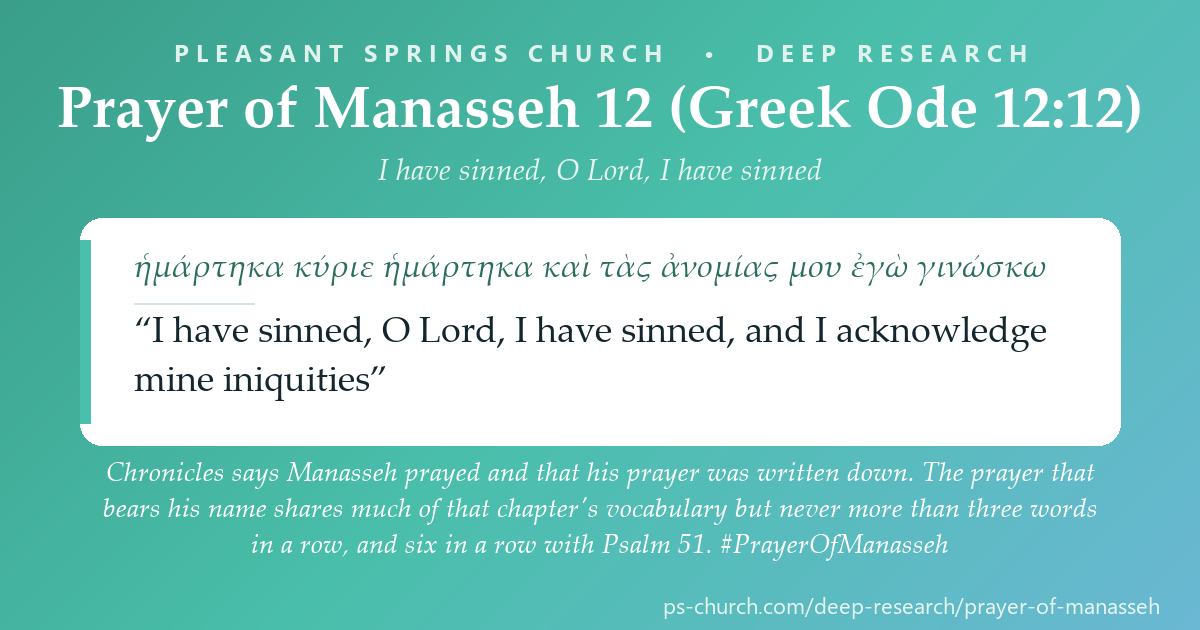
- One concrete response. Read Psalm 51 straight through this week, slowly, and pray its confession in your own words. The prayer’s 12:12 is another voice praying the same way: I have sinned, Lord, I have sinned, and I know my iniquities.
Prayer of Manasseh 12 · to share
Greek (Ode 12:12) · KJV Apocrypha (1769)Every Deep Research page traces its passage across the whole sweep — the Old Testament, the Second-Temple world between the testaments (historical witnesses, not Scripture), and the New Testament. Follow the thread:
Pleasant Springs Church — Deep Research
Research method after Michael S. Heiser’s Bible Research Method (examine dictionaries → ancient literature → important words → textual connections → academic publications → share), with the Pleasant Springs “Author & Audience” foundation. Scripture set in the Hebrew, the Greek editions named on each page and the ESV (Old Testament), and the Greek New Testament and the ESV (New Testament), per the practice of Pleasant Springs Church. ⚠️ Status: the Prayer of Manasseh is not part of the Protestant canon and is absent from the Hebrew Bible; it is carried among the Odes in Rahlfs’s Septuagint, printed in an appendix in the Clementine Vulgate and among the Apocrypha in the King James Bible. This study is filed under Apocrypha / Deuterocanon and nothing taught at Pleasant Springs rests on it. Greek text: the CATSS morphologically analysed Septuagint (Rahlfs), Odes.mlxx, Ode 12, quoted at verse level with attribution; every Greek string on this page is read out of the corpus files when the page is built. English for the prayer: the King James Apocrypha, standardised text of 1769, public domain (the verse-per-line edition from eBible.org held on this disk), quoted verbatim, with the two passages that have no counterpart in the Greek rows tinted; there is no ESV of this prayer and none is printed or named for it. Canonical comparison verses are quoted in the ESV only where the shelf holds a cached file (Psalms 134:3; Joel 2:13); elsewhere (2 Chronicles 33, Psalm 51, the New Testament verses) the English is this page’s own literal gloss, marked as such. Hebrew: the Masoretic text (Sefaria, Miqra according to the Masorah) for canonical comparison verses only. Latin: the Clementine Vulgate (public domain), a fourth witness, for 2 Chronicles 33; the Vulgate file the tools read holds no text of the prayer, and the two Latin clauses quoted from the appendix’s Oratio Manassæ are read from a Wikisource transcription held separately on this disk and not measured. Greek New Testament: SBLGNT via MorphGNT. Runs are contiguous whole word forms; tie bands are printed from both sides for every run the page argues from. Direction of influence is nowhere asserted.
Scripture quotations marked ESV are from the ESV® Bible (The Holy Bible, English Standard Version®), © 2001 by Crossway, a publishing ministry of Good News Publishers. ESV Text Edition: 2016. Used by permission. All rights reserved. The ESV text may not be quoted in any publication made available to the public by a Creative Commons license, and the ESV may not be translated in whole or in part into any other language. www.esv.org
|
Did this study bless you today? 💚 Give to Support PS Church100% of gifts go to the General Fund — thank you. |