Something strange turns up the moment you measure this chapter. Luke 5 holds the most cinematic scene in the Gospel’s early pages — the nets tearing, the boats going down under the weight of fish, Peter on his knees in the bilge saying “depart from me, I am a sinful man” — and, at the other end, a short dry saying about wineskins. Screened against the whole Greek New Testament outside Luke, the wineskins are the deepest verbatim seam in the chapter and the catch of fish is the shallowest. Ten consecutive words at 5:37, tie band one; nothing above five in the whole of 5:1–11. This study works the chapter all the way down — the call, the leper, the roof, the tax booth, the three objections — and prints the numbers that argue against its own headline as well as the ones that support it. See the method →
Luke 5:1–38 (selections)
Greek NT · ESVThe Shape of the Passage
Sequence — not a chiasmWho wrote this, for whom, and why does the chapter put a miracle first and three arguments after it?
Author
Luke — the physician (Col 4:14), writing an “orderly account” for Theophilus (Luke 1:1–4) out of what “those who from the beginning were eyewitnesses” delivered. Chapter 5 is where his narrative turns from announcement to consequence: chapter 4 put the program on the table in a synagogue; chapter 5 shows what happens when people start acting on it.
A physician’s eye, and a sailor’s. Luke is the only evangelist who gives the paralytic a κλινίδιον — a diminutive, a little stretcher-bed — and the only one who says the man was let down διὰ τῶν κεράμων, through the tiles, which is a Greco-Roman roof rather than the beaten-earth-and-branch roof Mark digs through. He is also the only one who tells the fishing story at all, and he tells it with the trade’s vocabulary: two boats, partners in a shared venture, nets that need washing before they are worth anything.
Audience
Theophilus and a readership that had to be told what a tax booth was. Luke explains, where Mark assumes. He is writing for people outside Galilee — and for those readers the shocking element of this chapter is not the miracles. It is who ends up at the table.
How they heard it. A first-century reader knew exactly what “full of leprosy” meant socially: excluded, and legally required to stay excluded (Lev 13:45–46 — see our Leviticus 13–14 study). They knew what a τελώνης was: a man who bought the right to take money from his neighbours on behalf of the ruling power. Luke sets those two figures either side of a paralytic whose sins are pronounced forgiven before his legs are mentioned — and then lets three separate objections pile up. The chapter is not really about healing. It is about who gets included, and on whose authority.
Orient on leprosy, toll-collectors, Pharisees, the Son of Man, and fasting.
Search by topic, not by verse: leprosy / skin disease, purification, tax collectors (publicani), Pharisees, scribes, Son of Man, fasting, wineskins, call narratives, Sea of Galilee.
Which articles are relevant?
- Dictionary of Jesus and the Gospels (IVP, 2nd ed.) — “Leprosy,” “Taxation,” “Pharisees,” “Son of Man,” “Fasting,” “Discipleship,” “Synoptic Problem.”
- Anchor Bible Dictionary — “Leprosy,” “Tax Collector,” “Galilee, Sea of,” “Fasting,” “Forgiveness.”
- Dictionary of New Testament Background — “Taxation, Greco-Roman,” “Purity,” “Fishing,” “Meals,” “Table Fellowship.”
- New International Dictionary of NT Theology & Exegesis — ἀφίημι, ἁμαρτωλός, τελώνης, νηστεύω, ἀκολουθέω.
Bibliography surfaced:
- Joseph Fitzmyer, The Gospel According to Luke I–IX (Anchor Bible); Darrell Bock, Luke 1:1–9:50 (BECNT); Joel Green, The Gospel of Luke (NICNT); John Nolland, Luke 1–9:20 (WBC); I. H. Marshall (NIGTC); François Bovon (Hermeneia).
- François Bovon and others on the Lukan “call” scenes; Jerome Neyrey (ed.), The Social World of Luke-Acts on purity, table fellowship and honour.
- K. C. Hanson & D. E. Oakman, Palestine in the Time of Jesus — the fishing economy and the toll system.
Boats, tolls, a purification rite, and a wedding week.
Read the scene against the working world it assumes: a commercial fishery, a Roman toll station, the Levitical cleansing rite, and Second-Temple fasting practice.
What is the world of this chapter?
The fishery. Luke’s Simon is not a man with a rod. He owns one of two boats working together, he has μέτοχοι — partners — in the other (v.7), and James and John are his κοινωνοί (v.10), both of them commercial terms, and he has been out all night, which is when the Galilean net fishery actually ran. The nets are being washed when Jesus arrives (v.2): the day’s work is over and the gear is being put away. Josephus, describing the same lake a generation later, was able to requisition 230 boats off it in a single operation. When they leave “everything” in verse 11, the everything is a business, and it is a business that has just had its best day.
The toll booth. A τελώνιον was a customs post on a trade road or a lakeshore landing. The man sitting in it was not a Roman official but a local contractor collecting for the ruling authority — in Capernaum’s Galilee that was Herod Antipas, a client ruler, not Rome directly — which is precisely why he was despised: the offence was not foreignness but collaboration, and the profit margin was whatever he could take above the contracted sum.
- Leviticus 13–14 — the diagnosis and the eight-day cleansing rite: two birds, cedar, scarlet, hyssop, then lambs and grain on the eighth day, all of it administered by a priest who certifies rather than heals. See our study of the whole rite. Jesus’ instruction in Luke 5:14 does not replace this; it sends the man into it.
- Leviticus 13:45–46 — the reason the crowd is a problem: the man is under a standing order to live outside the camp and, in the Hebrew, to cry “Unclean, unclean.” The Greek of 13:45 held here turns that clause round — ἀκάθαρτος κεκλήσεται, “he shall be called unclean” — a real divergence, named here rather than smoothed. Luke says he was in a city.
- Josephus, Jewish War 3.10.7–8 — the lake of Gennesaret, its water and its fish; and War 2.21.8 (§635), where he requisitions 230 boats off that lake at Tarichaeae — the usual basis for calling the fishery large. (Both cited from the standard English translations; the Greek of Josephus was not read for this page.)
- Didache 8:1 — “But let not your fasts be with the hypocrites; for they fast on the second and fifth day of the week; but do ye fast on the fourth day and the Preparation” (Roberts–Donaldson, Ante-Nicene Fathers vol. 7): a late-first- or early-second-century Christian text showing that which days you fast on was a live identity marker. Compare Luke 18:12, “I fast twice a week.” The Didache is an early church order, not Scripture.
- Tobit 12:8 — ἀγαθὸν προσευχὴ μετὰ νηστείας καὶ ἐλεημοσύνης, “prayer with fasting and almsgiving is good” (the B/A text held here) — pairs fasting with prayer and almsgiving, which is exactly the pairing verse 33 puts in the objectors’ mouths. Psalms of Solomon 3:8 does not make that pairing, and is cited only as a witness that fasting was settled piety: there the righteous man atones for sins of ignorance ἐν νηστείᾳ καὶ ταπεινώσει ψυχῆς αὐτοῦ, by fasting and humbling his soul. Both are deuterocanonical / pseudepigraphal, cited as witnesses to practice, not as Scripture.
New wine is still fermenting; it gives off gas. A skin that has already been stretched once and has gone brittle will split. Everyone in the room knew this, which is why it works as an argument rather than a picture: Jesus is not saying the old is bad, he is saying the old cannot hold this. And Luke — alone of the three — carries a coda in verse 39 about the man who has drunk the old and does not want the new, which is a wry and rather sympathetic note about why the objection keeps coming back. Verse 39 lies just past this page’s scope and is not quoted in English here; it is measured below.
A fisherman’s word for master, a hunter’s word for people, and four words all but confined to this chapter.
Counts below were produced by running a form screen over the whole Greek New Testament (MorphGNT, normalised column, with the lemma column where a whole word rather than a single form is counted), not taken from a concordance article.
“Master” — a supervisor, a foreman, the man in charge of the job. It occurs seven times in the Greek New Testament and all seven are in Luke (5:5; 8:24 twice; 8:45; 9:33; 9:49; 17:13). This is the first, and a fisherman uses it about fishing.
“Catching alive” — a compound of living and hunt. The form occurs once in the Greek New Testament, here. Fish caught in a net die; the word Jesus chooses for what Simon will do to people is the one that means taken alive.
“Sinner” — the thread that stitches the chapter together. Simon says it of himself at the miracle (v.8); the Pharisees say it of the guests at the banquet (v.30); Jesus takes the word back and makes it the job description (v.32).
“They have been forgiven” — a perfect passive: done, and standing done. Six occurrences in the Greek New Testament — four of them in Luke (5:20; 5:23; 7:47; 7:48), plus John 20:23 and 1 John 2:12. The passive leaves the actor unnamed, which is exactly what the scribes object to in the next verse.
“Little bed, pallet” — a diminutive. Both of its New Testament occurrences are in this passage (κλινιδίῳ v.19, κλινίδιον v.24 — two forms of one word). Luke uses the ordinary κλίνη in v.18 and then switches to the diminutive for the thing lowered through the roof and carried home.
“Contrary to expectation” — the root of English paradox. One occurrence in the whole Greek New Testament, here. The crowd does not say they have seen a miracle; they say they have seen something that should not have happened.
“Must be put” — a verbal adjective of obligation, a classical construction and a one-off in the Greek New Testament. The wineskin saying ends on the most formal word in the chapter.
“Teachers of the law” — the word stands three times in the Greek New Testament, the plural form twice: here, Acts 5:34 (Gamaliel), and 1 Timothy 1:7. Luke fills the room with the professionals before the question about blasphemy is asked.
What the vocabulary is doing
Luke 5 is not a lexically unusual chapter — measured by New Testament hapax density it stands twenty-second of Luke’s twenty-four, six once-only lemmas in 750 word tokens against 1.49% across Luke and 1.43% across the whole Greek New Testament — but four of its words are all but confined to it. ζωγρῶν, παράδοξα and βλητέον are each a single occurrence in the Greek New Testament, and κλινίδιον stands twice, in two forms, both times here. Set against that, the word that stitches the chapter together is its most ordinary one: ἁμαρτωλός, sinner, three times, in three different mouths.
A caution about “only here.” These are counts of word forms after normalisation, not of word families. ζωγρῶν is the only form of its verb in the New Testament, but the related ἐζωγρημένοι stands at 2 Timothy 2:26 — captured alive, by the devil. A hapax count is a fact about spelling, and it should be reported as one.
The chapter, measured against the rest of the Greek New Testament.
Method: every verse of Luke 5 against every verse of the Greek New Testament outside Luke, scoring the longest run of consecutive identical word forms. Word forms, not lemmas. The tie band — how many target verses reach the same depth — is reported beside every run, because a run without its band is misleading.
The screen, and what it found
Scope. Source: the 39 verses of Luke 5 in the SBLGNT (MorphGNT, field 6). Target: the 6,778 verses of the Greek New Testament outside Luke. Greek against Greek, so the edition’s own spelling equivalences are applied on both sides (movable nu, elision, the οὐ / οὐκ / οὐχ fold) — a shared run is not cut at a word the text merely spells two ways. Single-word matches count as 1, which is the Greek-side convention on this shelf; on this screen a zero would mean “shares no word at all,” and no row of Luke 5 scores zero.
Distribution. All 39 rows reach two; 33 reach three; 21 reach four; 18 reach five; 8 reach six; 5 reach seven; 3 reach eight; 2 reach nine; 1 reaches ten, and nothing reaches eleven.
| row | deepest partner outside Luke | run | tie band | the shared words |
|---|---|---|---|---|
| Luke 5:37 | Mark 2:22 | 10 | 1 | καὶ οὐδεὶς βάλλει οἶνον νέον εἰς ἀσκοὺς παλαιούς· εἰ δὲ |
| Luke 5:34 | Mark 2:19 | 9 | 1 | τοῦ νυμφῶνος ἐν ᾧ ὁ νυμφίος μετ’ αὐτῶν ἐστιν |
| Luke 5:14 | Mark 1:44 | 8 | 1 | τῷ ἱερεῖ καὶ προσένεγκε περὶ τοῦ καθαρισμοῦ σου |
| Luke 5:12 | Matthew 8:2 | 7 | 1 | λέγων κύριε ἐὰν θέλῃς δύνασαί με καθαρίσαι |
| Luke 5:30 | Matthew 9:11 | 7 | 1 | διὰ τί μετὰ τῶν τελωνῶν καὶ ἁμαρτωλῶν |
| Luke 5:13 | Matthew 8:3 | 6 | 1 | καὶ ἐκτείνας τὴν χεῖρα ἥψατο αὐτοῦ |
| Luke 5:35 | Matthew 9:15 and Mark 2:20 | 6 | 2 | ὅταν ἀπαρθῇ ἀπ’ αὐτῶν ὁ νυμφίος |
| Luke 5:38 | Mark 2:22 | 6 | 1 | ἀλλὰ οἶνον νέον εἰς ἀσκοὺς καινούς |
The deepest verbatim seam in Luke 5 is the wineskins. Not the catch of fish. Not “your sins are forgiven.” Not “follow me.” Ten consecutive words — καὶ οὐδεὶς βάλλει οἶνον νέον εἰς ἀσκοὺς παλαιούς· εἰ δὲ — stand in the same order in Luke 5:37 and Mark 2:22, and the tie band is one: no other verse in the New Testament outside Luke reaches that depth against this row. The second deepest is the bridegroom saying at nine, band one. The third is the instruction to the healed leper at eight, band one. All three are sayings, and the top of the chapter’s contact list is a run of arguments about fasting and purity, not a run of miracles.
Where the runs stop is as interesting as where they start
Three of the deep runs break at exactly the word that makes Luke’s version Luke’s.
| row | the run ends… | and the next word is |
|---|---|---|
| Luke 5:32 | after four words, καλέσαι δικαίους ἀλλὰ ἁμαρτωλούς (band 2 — Matthew 9:13 and Mark 2:17 both reach it) | εἰς μετάνοιαν — to repentance, which stands in neither parallel |
| Luke 5:34 | after nine words, at ἐστιν | ποιῆσαι νηστεῦσαι — make them fast, against Mark’s single νηστεύειν |
| Luke 5:37 | after ten words, at εἰ δὲ | μήγε against Mark’s μή; both then read ῥήξει ὁ οἶνος, and Luke alone carries ὁ νέος |
What this does and does not show. It shows that these Gospels hold the same words in the same order, and where the agreement ends. It says nothing whatever about who wrote first or who used whom. Two of the three deepest partners are in Mark and one in Matthew; that is a fact about wording, not a fact about copying, and this page does not turn it into one. The Synoptic Problem is a real question with serious defenders on more than one side, and a run screen is not competent to settle it.
The counter-example this page prints against itself
The most famous scene in the chapter is its shallowest. Break the screen down by unit and the shape is the reverse of what a reader would guess.
| unit | verses | deepest run in the unit | mean run per verse |
|---|---|---|---|
| the catch of fish | 5:1–11 | 5 | 3.00 |
| the leper | 5:12–16 | 8 | 5.20 |
| the paralytic | 5:17–26 | 5 | 4.10 |
| Levi and the banquet | 5:27–32 | 7 | 4.67 |
| fasting, cloth and wine | 5:33–38 | 10 | 6.50 |
| the old wine coda (past this page’s scope) | 5:39 | 2 | 2.00 |
The catch of fish — the boats, “put out into the deep,” “depart from me, for I am a sinful man,” “from now on you will be catching men” — peaks at five, and that five is Luke 5:1’s stock phrase τὸν λόγον τοῦ θεοῦ καί against Revelation 1:2, 1:9, 6:9 and 20:4, with a tie band of five — the fifth being Acts 19:1, which reaches five on a different string, ἐγένετο δὲ ἐν τῷ τόν. That is a formula, not a seam. Verse 10’s four (καὶ Ἰάκωβον καὶ Ἰωάννην, band 3) is a list of names.
Two named comparisons make the point sharper.
| comparison | deepest run | the words |
|---|---|---|
| Luke 5:1–11 vs John 21 (the other miraculous catch, with the same Simon Peter) | 3, band 1 | ἀπὸ τῆς γῆς at John 21:8 — from the land, a stock prepositional phrase |
| Luke 5:1–11 vs Mark 1:16–20 (the call of the same four men on the same lake) | 2 | nothing longer than τὰ δίκτυα / ἠκολούθησαν αὐτῷ; Luke 5:8 scores 0, which on this screen means it shares no single word with those five verses |
| Luke 5:5 vs John 21 (fallback off, so 0 = no two consecutive words) | 0 | — |
Whatever relationship these three fishing scenes have, it is not a verbal one. The page’s own thesis — that Luke 5’s wording is deeply shared — is true of the sayings and false of the story, and both halves are printed here so the runs of eight and ten are not read as more than they are.
“As Moses commanded” — measured against Moses
Luke 5:14 sends the cleansed man to the priest “καθὼς προσέταξεν Μωϋσῆς”. So we screened the verse against the Greek of Leviticus.
| comparison | deepest run | tie band | the words |
|---|---|---|---|
| Luke 5:14 vs the whole Greek Leviticus (859 rows, CATSS) | 3 | 2 | τῷ ἱερεῖ καί — at Leviticus 5:16 and 7:34, neither of which is about leprosy |
| Luke 5:14 vs the Greek New Testament outside Luke | 8 | 1 | τῷ ἱερεῖ καὶ προσένεγκε περὶ τοῦ καθαρισμοῦ σου |
The verse that points at the law of Moses shares eight consecutive words with a Gospel and three with the law. The noun Luke uses for the cleansing, καθαρισμός, stands only twice in the whole Greek Leviticus (14:32 and 15:13) — and neither is the verse the clause points to. The verb root is there: προστάξει stands at Leviticus 14:4, 5, 36 and 40, in the rite itself. So the connection is real and it is conceptual: Luke is describing the procedure of Leviticus 14, not quoting its sentences.
Scope note. The Leviticus screen used the CATSS Lev.mlxx file, which is on disk but is not in this shelf’s book map, so this particular figure is not covered by the standing regression lock the way the Greek New Testament figures are. It should be treated as a one-off measurement, reproducible but unpinned.
Is Peter’s “depart from me” an Isaiah 6 echo?
Commentators regularly hear the prophetic call pattern behind Luke 5:8 — the holy encounter, the confession of unworthiness, the commission. It is a good reading. It is not a verbal one.
| comparison | longest shared run | the words |
|---|---|---|
| Luke 5:8 vs Greek Isaiah 6:5 (“Woe is me… I am a man of unclean lips”) | 1 | τοῖς — the article |
| Luke 5:8 vs Greek 3 Kingdoms 17:18 (the widow to Elijah: “you have come to me to bring my sin to remembrance”) | 0 | no shared word at all |
A pair comparison carries no tie band and no unigram fallback, so a 0 here means the two verses share no word. The pattern that links these scenes is a pattern of shape — glory, then confession, then commission — and the measurement is the right tool to prove that it is not a pattern of words. Both facts belong on the page.
Where else this chapter reaches:
- Leviticus 13–14 — the rite Luke 5:14 sends the man into; and Leviticus 13:45–46, the exclusion he had been living under.
- Daniel 7:13–14 — the “one like a son of man” given authority. Luke 5:24 is the Gospel’s first use of the title in a claim about authority on earth. Measured: Luke 5:24’s deepest partner is five words with a tie band of 3 — ὅτι ὁ υἱὸς τοῦ ἀνθρώπου at Mark 9:31, and ἐπὶ τῆς γῆς ἀφιέναι ἁμαρτίας at Matthew 9:6 and Mark 2:10. The bare title ὁ υἱὸς τοῦ ἀνθρώπου stands in 45 verses of the Greek New Testament: a title, not a citation.
- Isaiah 43:25; 44:22; Exodus 34:6–7 — the Old Testament’s insistence that forgiving sins is God’s own act: the premise the scribes reason from in Luke 5:21, and they reason correctly.
- Hosea 6:6 — “I desire mercy and not sacrifice,” which stands in Matthew’s form of this same exchange (Matthew 9:13) and not in Luke’s. Luke’s extra words are at the other end: εἰς μετάνοιαν.
- Luke 4:16–30 — the program announced; Luke 7:34 — “a friend of tax collectors and sinners”; Luke 15:1–2; 19:1–10 — the same grumble, the same answer, three more times. The grumbling verb itself (γογγύζω / διαγογγύζω) stands three times in Luke, at 5:30, 15:2 and 19:7.
- 1 Timothy 1:15 — “Christ Jesus came into the world to save sinners, of whom I am the foremost”: Luke 5:32 in the first person.
The scholarship, and an honest account of this page’s limits.
This section exists to say where the page is weakest. A study that only reports its strengths is not usable by anyone checking it.
Commentaries and studies:
- Joseph A. Fitzmyer, The Gospel According to Luke I–IX (Anchor Bible 28) — the fullest philological treatment of these pericopes in English.
- Darrell Bock, Luke 1:1–9:50 (BECNT); Joel Green (NICNT); John Nolland (WBC 35A); I. H. Marshall (NIGTC); François Bovon, Luke 1 (Hermeneia).
- On the Synoptic Problem, deliberately from more than one side: B. H. Streeter, The Four Gospels (the two-source case); William Farmer, The Synoptic Problem (Griesbach); Mark Goodacre, The Case Against Q (Farrer). This page takes no position among them and its measurements do not require one.
- G. K. Beale & D. A. Carson (eds.), Commentary on the New Testament Use of the Old Testament — the standard first stop for the Leviticus and Daniel 7 questions raised above.
- Jerome Neyrey (ed.), The Social World of Luke-Acts; Hanson & Oakman, Palestine in the Time of Jesus — the toll system and the fishery.
Text-critical note:
The Greek column is the SBLGNT, and the SBLGNT itself flags a great deal of variation in this chapter. Counting its apparatus marks, 27 of Luke 5’s 39 verses carry at least one variation unit — among them the spelling of the paralytic’s command in v.23–24, the word order of “the Son of Man has authority” in v.24, the arrangement of “the Pharisees and their scribes” in v.30, and three separate points in v.39.
So the honest question is whether the runs this page reports survive that. We checked: none of the five deepest runs — the ten words at 5:37, the nine at 5:34, the eight at 5:14, and the sevens at 5:12 and 5:30 — contains a single word inside an SBLGNT variation unit. Verse 14 carries no apparatus mark at all. The deep seams sit in undisputed text; the disputed words in this chapter sit at the edges of the runs, not inside them.
Two further variants worth naming for readers using an older English Bible: many manuscripts add “and both are preserved” at the end of v.38, and v.39 is absent from Codex Bezae and part of the Old Latin tradition, with “better” for “good” in others. Neither affects anything argued here.
What this page did NOT check, and where it is weakest:
- No versional evidence was consulted. No Latin, Syriac or Coptic witness was read; the only apparatus behind the text-critical paragraph above is the SBLGNT’s own marking. A full apparatus (NA28, or Swanson) would say more and might say it differently.
- No rabbinic source was read in the original. The purity background is taken from the Levitical text itself and from secondary literature; m. Nega‘im and the related tractates are not quoted here, and should not be assumed behind anything above.
- Josephus was not read in Greek for the boat-count and lake description; that paragraph rests on standard translations and on secondary summaries of the Galilean fishing economy.
- The run screen cannot tell allusion from coincidence, and cannot tell direction. It measures verbatim contact only. A deep run proves shared wording; it does not prove dependence, and no sentence on this page claims that it does.
- The screen counts word forms, not lemmas. Luke 5:34’s ποιῆσαι νηστεῦσαι against Mark’s νηστεύειν scores as a break even though the two clauses mean the same thing. Every number here is therefore a lower bound on agreement of sense.
- No null baseline was computed. We did not ask how long a shared run would be expected to be, by chance, between two Greek narratives of this length and vocabulary. Without that, “ten words, tie band one” is a comparison within this chapter — the deepest of thirty-nine — and not a statement about how improbable ten words are in general. This is the single largest gap in the measurement, and it is not closed.
- The Leviticus figure is unpinned (see the scope note in Stage 4): it was measured from a CATSS file that is on disk but outside the shelf’s regression lock.
- The structure diagram is a reading. The three-verb escalation (5:21, 5:30, 5:33) is on the page and checkable; the labels “Call 1 / Objection 1” and the decision to call the shape a sequence rather than force it into a chiasm are editorial judgements, and a different reader could group the units differently.
- The English is the ESV, quoted under Crossway’s standing permission for short quotations — not under an API licence, which this site does not hold.
From a beach full of fish to a table full of the wrong people.
Name what you learned, why it matters, and one concrete thing you will do about it.
What should we carry away — and do?
- The call comes after the catch, not before it. Jesus does not ask Simon to leave his nets while they are empty and the night has been a failure. He fills them first, and then asks. What they walk away from in verse 11 is the best day the business ever had.
- “Depart from me” is answered with “do not be afraid.” Peter’s first instinct in the presence of holiness is to ask for distance. He is not corrected for the diagnosis — he really is a sinful man — he is corrected for the conclusion.
- Forgiveness came before the legs. Men carried a paralytic through a roof for a healing — Luke says only ἄνδρες, men; the “four” everyone remembers is Mark’s (Mark 2:3) — and the first thing he received was the thing nobody had asked for. Luke keeps the order.
- The objection is always about the table. Three times in this chapter, and it is never about doctrine in the abstract — it is about who is eating, and with whom. “I have not come to call the righteous, but sinners, to repentance.”
- New wine needs new skins — and the old skins are not villains. The saying is not an insult to what came before; it is a statement about what the old container can physically hold. Which is worth remembering when the thing God is doing does not fit the shape we had ready for it.
Step in response: take one of the three objections and put your own name in it. Then set a table this month — a literal one — with somebody the room would raise an eyebrow at, and do not make it a project. Levi threw a party; that is all the text says he did.
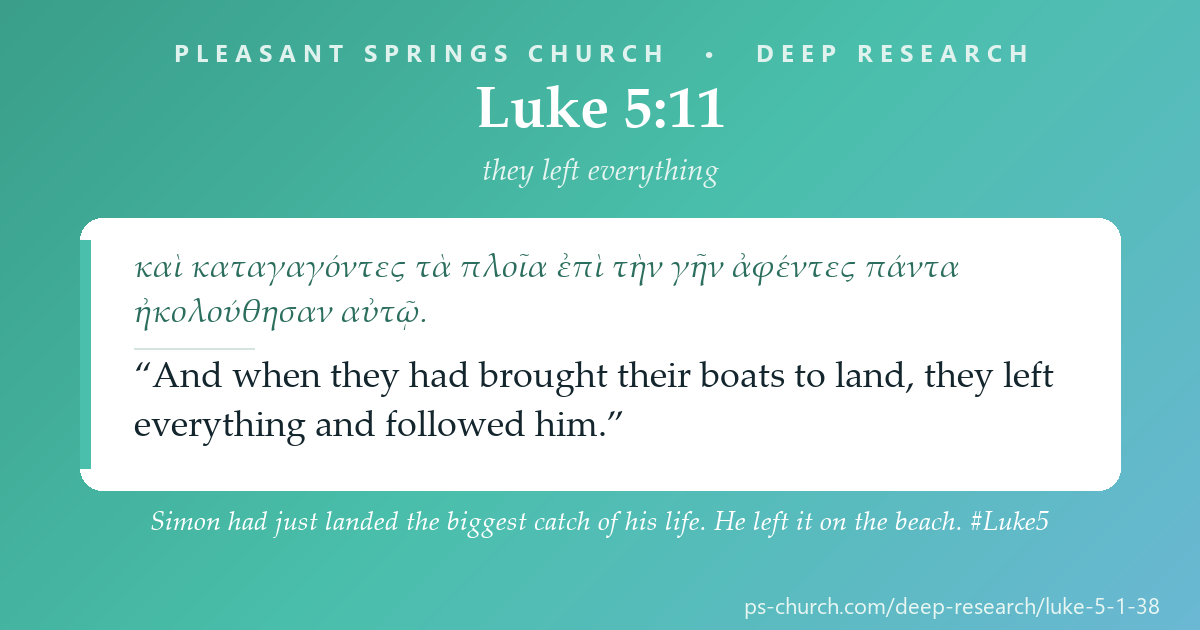
Luke 5:11 · to share
Greek NT + ESVEvery Deep Research page traces its passage across the whole sweep — the Old Testament, the Second-Temple world between the testaments (historical witnesses, not Scripture), and the New Testament. Follow the thread:
Pleasant Springs Church — Deep Research
Research method after Michael S. Heiser’s Bible Research Method (examine dictionaries → ancient literature → important words → textual connections → academic publications → share), with the Pleasant Springs “Author & Audience” foundation. Scripture set in the Hebrew, the Greek editions named on each page and the ESV (Old Testament), and the Greek New Testament and the ESV (New Testament), per the practice of Pleasant Springs Church. Luke 5:1–38 research grounded in Fitzmyer, Bock, Green, Nolland, Marshall and Bovon. Greek New Testament: SBLGNT via MorphGNT. Greek Old Testament: CATSS. Run measurements were produced for this page with the Deep Research measurement substrate and are reproducible.
Scripture quotations marked ESV are from the ESV® Bible (The Holy Bible, English Standard Version®), © 2001 by Crossway, a publishing ministry of Good News Publishers. ESV Text Edition: 2016. Used by permission. All rights reserved. The ESV text may not be quoted in any publication made available to the public by a Creative Commons license, and the ESV may not be translated in whole or in part into any other language. www.esv.org
|
Did this study bless you today? 💚 Give to Support PS Church100% of gifts go to the General Fund — thank you. |