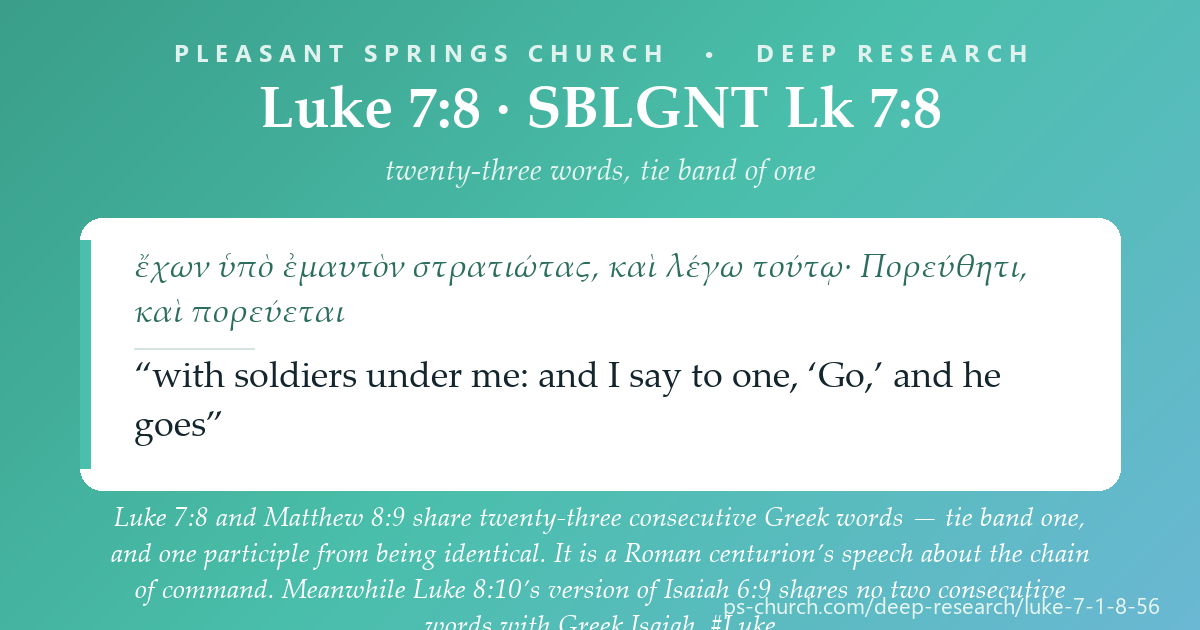
Two numbers hold this study together, and they point in opposite directions. Screened word for word against every verse of the Greek New Testament outside Luke — 6,778 of the 7,927 — the deepest verbatim contact anywhere in these one hundred and six verses is twenty-three consecutive words: Luke 7:8 and Matthew 8:9, tie band one. It is not a saying of Jesus and not a quotation of Scripture. It is a Roman centurion explaining how a chain of command works, and deleting one participle from Luke would make the two verses word-for-word identical, thirty against thirty. Only four verse-pairs in the whole New Testament reach deeper across a book boundary. Then, fifty-two verses later, the same chapter block quotes Isaiah 6:9 — and Luke 8:10 shares no two consecutive words with Greek Isaiah 6:9. Against the whole Greek Old Testament the passage’s deepest runs are a mere seven, and they are tied: the one verse that says it is written (7:27, with Exodus 23:20, not Malachi 3:1) and a crowd relaying a domestic message at a door (8:20, with Genesis 37:10). Twenty-three for a soldier’s speech, one for a prophet’s. This page prints both, prints its counter-examples, states what it could not check, and never says who read whom. See the method →
Luke 7:1–8:56 (seventeen rows of one hundred and six)
Greek New Testament (SBLGNT / MorphGNT) · ESV⚠️ Elsewhere in Luke the two columns do part, and it is worth knowing where. The MorphGNT text of Luke holds 1,149 verses. Two numbers carry no text in it — 17:36 and 23:17 — and the ESVprints both of those in footnotes rather than in the text, so the two agree on which verses exist and on the numbers of all the rest. Neither is in chapter 7 or chapter 8.
⚠️ The offsets that do bear on this page are all in the Old Testament, and every one of them is aligned. Exodus 23:20, Genesis 37:10, Isaiah 6:9, Isaiah 49:13 and Malachi 3:1 carry the same chapter-and-verse number in the Masoretic text, in the CATSS Greek and in the ESV. 3 Kingdoms 17:23 = 1 Kings 17:23: the Greek book is numbered 3 Kingdoms and the English 1 Kings, but chapter 17 has twenty-four verses in both columns and the verse numbers run together. One warning for anyone checking Malachi: the Masoretic text and the Greek both end at chapter 3, and the ESV prints a chapter 4 — ESV Malachi 4:1–6 = MT and Greek Malachi 3:19–24. Malachi 3:1 is 3:1 in all three.
The Shape of the Passage
A sequence in ten movements, with one measured verbal inclusioWhat can be observed but not measured is the second colour-link, at movements 1 and 2, and the pattern it belongs to: an officer’s slave and a widow’s son, a Pharisee and a woman, the Twelve and the women who funded them, a man in the tombs and a woman in the crowd. Anyone can count the pairs; nobody can prove from the text that Luke arranged them deliberately, and the page does not pretend otherwise. The pivot marked at 8:19–21 is marked by function — it is where the parable of the word becomes a definition of family — and not by position; it is the seventh of ten movements, not the fifth.
Who wrote this, to whom, and into what situation? Two chapters in which the people who get it right are a Roman officer, a widow, a woman with a reputation, a group of women with money, a Gentile ex-demoniac and a synagogue ruler — and the people who get it wrong are a Pharisee at his own table and twelve men in a boat.
Author
The Gospel is anonymous; tradition from the second century names Luke, the travelling companion of Paul. This page cannot test that from the text and does not try. What it can do is count what the two volumes share.
Luke and Acts behave like one writer’s vocabulary. Counted off disk: ἑκατοντάρχης stands in seventeen New Testament verses and sixteen of them are in Luke or Acts — three in Luke, thirteen in Acts, one in Matthew. τάσσω, the verb behind the participle at 7:8, stands in eight verses and five are in Luke or Acts. ἀνακαθίζω, sat up, stands in exactly two: Luke 7:15, where a dead young man sits up, and Acts 9:40, where Tabitha does. None of this proves authorship; it is what shared vocabulary looks like when it is counted rather than asserted.
And the same author handles the same Isaiah verse two different ways. At Luke 8:10 the Isaiah 6:9 line shares no two consecutive words with Greek Isaiah 6:9. At Acts 28:26 it shares thirteen. The page reports the gap and does not explain it.
Audience
The Gospel is addressed to one named reader — κράτιστε Θεόφιλε, 1:3 — and written for people who were not there. The prologue says as much: it is written so that Theophilus may have certainty concerning the things you have been taught (1:4). A writer who explains is writing for people who need it explained. Luke glosses Nain as a town called Nain (7:11), tells his reader that Chuza managed Herod’s household (8:3), and adds that the Gerasene country is opposite Galilee (8:26).
How these two chapters would have landed. A mixed congregation of Jews and Gentiles, some of them slaves and some of them wealthy women, hears a Gospel in which the deepest words are given to a centurion, the funding is credited to named women, and the man who owns the house misreads the room. Nobody in these chapters is commended for status.
And the money is not hidden. 8:3 says the women provided ἐκ τῶν ὑπαρχόντων αὐταῖς — out of what belonged to them. ὑπάρχοντα in that sense is a Lukan habit, and the Gospel that opens with a woman’s song about the rich being sent away empty is the one that keeps naming who paid.
Orient on centurions, Nain, widows, anointing at a meal, parables, Legion and Jairus.
Search by topic: Luke, Gospel of; centurion; Nain; widow; resurrection miracles; John the Baptist; anointing; Pharisees; meals and table fellowship; sinner; parable; sower; mystery / secret of the kingdom; Gerasenes; Legion; Jairus; haemorrhage; faith.
Which articles are relevant?
- Anchor Bible Dictionary — “Luke, Gospel of,” “Centurion,” “Nain,” “Widow,” “Anointing,” “Pharisees,” “Parable,” “Gerasa,” “Legion,” “Demon.”
- Dictionary of Jesus and the Gospels (IVP) — “Faith,” “Forgiveness of Sins,” “Women,” “Table Fellowship,” “Rich and Poor,” “Parable,” “Elijah and Elisha.”
- New International Dictionary of NT Theology and Exegesis — πίστις, σῴζω, ἁμαρτωλός, ἀγαπάω, ὑπομονή, ἐπισκέπτομαι, μυστήριον.
- Dictionary of NT Use of the OT (Beale & Carson) — on Luke 7:22, 7:27 and 8:10, which are the three places in this passage where the question of an Old Testament source is live.
Settle the numbering first — and in the passage itself there is nothing to settle
This shelf states the versification offset on every page, including the pages where there is none. This is one of them.
| Luke 7 | Luke 8 | whole Gospel | |
|---|---|---|---|
| SBLGNT (MorphGNT) | 50 | 56 | 1,149 verses of text |
| ESV | 50 | 56 | 1,149 verses of text, numbered to 1,151 |
Chapters 7 and 8 are identical in both columns, so every Luke reference on this page is a single number. Across the Gospel as a whole, two numbers carry no text in the SBLGNT — 17:36 and 23:17 — and the ESV prints both in footnotes rather than in the text. The two agree on which verses exist; they differ only in whether an empty number is printed. Neither is in this passage.
The offsets that do bear on this page are on the Old Testament side, and they are all aligned. Exodus 23:20, Genesis 37:10, Isaiah 6:9, Isaiah 49:13 and Malachi 3:1 carry the same number in the Masoretic text, in the CATSS Greek and in the ESV. The one book-name difference is 3 Kingdoms 17:23 = 1 Kings 17:23: the Greek names the book 3 Kingdoms where the English names it 1 Kings, and chapter 17 runs to twenty-four verses in both. A warning about Malachi, because it is a real trap: the Hebrew and the Greek both end at chapter 3, and the ESV prints a chapter 4. ESV Malachi 4:1–6 = MT and Greek Malachi 3:19–24. The verse this page cares about, Malachi 3:1, is 3:1 in all three columns.
A citation that turns out to be two texts, a resurrection that reuses six words of Elijah, and a dinner this page cannot fully reconstruct.
Luke 7:27 — one citation formula, and the columns do not say what a reader expects
Luke 7:27 says περὶ οὗ γέγραπται, of whom it is written, and then quotes. Here is what the Greek columns held on this shelf actually say, measured rather than assumed.
| row | run with Greek Exodus 23:20 | run with Greek Malachi 3:1 |
|---|---|---|
| Luke 7:27 | 7 — ἀποστέλλω τὸν ἄγγελόν μου πρὸ προσώπου σου | 3 — τὸν ἄγγελόν μου |
| Matthew 11:10 | 9 — ἰδοὺ ἐγὼ ἀποστέλλω τὸν ἄγγελόν μου πρὸ προσώπου σου | 3 |
| Mark 1:2 | 7 | 3 |
The two Old Testament verses as this shelf holds them:
Exodus 23:20 — καὶ ἰδοὺ ἐγὼ ἀποστέλλω τὸν ἄγγελόν μου πρὸ προσώπου σου ἵνα φυλάξῃ σε ἐν τῇ ὁδῷ…
Malachi 3:1 — ἰδοὺ ἐγὼ ἐξαποστέλλω τὸν ἄγγελόν μου καὶ ἐπιβλέψεται ὁδὸν πρὸ προσώπου μου…
Three differences do the whole job, and all three can be pointed at. (1) Malachi has the compound ἐξαποστέλλω where Exodus and all three Gospels have the simple ἀποστέλλω. (2) Malachi reads πρὸ προσώπου μου, before my face; Exodus and all three Gospels read πρὸ προσώπου σου, before your face. (3) Malachi puts καὶ ἐπιβλέψεται ὁδόν between the messenger and the face, which breaks the sequence outright.
And the second half of Luke 7:27 belongs to neither column. ὃς κατασκευάσει τὴν ὁδόν σου ἔμπροσθέν σου — who will prepare your way before you — matches Exodus 23:20 at zero and Malachi 3:1 at zero as a sequence. It has Malachi’s way and Exodus’s your, and the verb is in neither.
⚠️ What this page does not do. It does not call Luke’s citation wrong, does not say the quotation “is really” Exodus, does not decide whether Luke inherited a composite text or made one, and does not argue from the fact that Mark 1:2 attributes the same words to Isaiah while Luke names no prophet at all. Sorting that out needs a critical apparatus and a study of pre-Christian testimonia collections, and neither was consulted. The page prints the runs and stops.
Nain, and six words of Elijah
Luke 7:15 ends καὶ ἔδωκεν αὐτὸν τῇ μητρὶ αὐτοῦ. So does 3 Kingdoms 17:23.
Searched as an exact word sequence rather than as a run, that six-word phrase stands once in the 30,637 Greek Old Testament verse units held here — 3 Kingdoms 17:23, Elijah bringing the widow of Zarephath’s son down from the upper room — and once in the 7,927 verses of the Greek New Testament, here. One hit on each side, and nothing else in either corpus.
Around it the scene keeps company with the same story without repeating its words. Both are widows; both have lost a son; both stories end with a verdict about the man who raised him — but the two verdicts do not use the same word and do not share a phrase. The widow of Zarephath says now I know that you are a man of God (ἄνθρωπος θεοῦ, 3 Kingdoms 17:24); Luke’s crowd says a great prophet has arisen among us (προφήτης μέγας, 7:16). Measured against each other, those two verses run to 1. One phrase in the scene is verbatim; the rest of the resemblance is thematic, and the screen cannot see it. Luke 4:25–26 names the widow of Zarephath explicitly, three chapters earlier, and that passage is on this shelf. This page reports the overlap; it does not claim Luke built the scene from 3 Kingdoms 17.
A dinner, a jar, and what could not be checked
What can be counted. ἀλάβαστρον, the alabaster flask, stands in two New Testament verses — Matthew 26:7 and Luke 7:37. μύρον stands in thirteen, three of them in this scene (7:37, 7:38, 7:46). καταφιλέω, the intensive kiss, stands in six, and two are here (7:38, 7:45); a third is Judas in Mark 14:45.
What could not be checked, and the page says so plainly. This shelf holds Hebrew, Greek Old Testament and Greek New Testament texts. It holds no Tosefta, no Talmud and no Greco-Roman symposium literature at all, and the only Mishnah and Dead Sea Scrolls files on the disk are eight isolated passages and the 11Q5 Psalms scroll, fetched for other studies and no use here. So the ordinary Stage 2 questions here — what a host owed a guest by way of water, oil and a kiss; whether an uninvited person could stand at the edge of a formal meal; what a woman’s loosed hair signified in a first-century dining room; how a Roman officer in Galilee would have related to a local synagogue he had paid for — are real questions that this page has no primary text on disk to answer. They are named here rather than answered from memory. Anything the page said about them would be a commentary’s claim wearing a measurement’s clothes.
⚠️ One more that could not be checked: the geography. The SBLGNT reads Γερασηνῶν at 8:26 and the ESV reads Gerasenes; Matthew 8:28 reads Γαδαρηνῶν, and the manuscripts vary among three names. Adjudicating that needs an apparatus, which was not consulted, and a map, which is not a text.Ten words, each counted across the whole Greek New Testament off disk.
The one word that stops Luke 7:8 and Matthew 8:9 being identical. Its lemma τάσσω stands in eight New Testament verses; five are in Luke or Acts (Lk 7:8; Ac 13:48, 15:2, 22:10, 28:23).
Seventeen verses; sixteen in Luke–Acts (3 + 13), one in Matthew. Matthew’s own centurion story mostly uses a different lemma, ἑκατόνταρχος (Mt 8:5, 8:8, 27:54).
Once in the Greek New Testament — Luke 7:14. One of eighteen lemmas in these two chapters that occur in only one New Testament verse.
Nine verses. Three are in Luke — 7:12, 8:42 and 9:38 — and two of the three are in this passage; both are a dead or dying only child. The other six are John’s four, Hebrews 11:17 and 1 John 4:9.
The vocative of ἐπιστάτης, which stands in six New Testament verses and all six are in Luke (5:5, 8:24, 8:45, 9:33, 9:49, 17:13). Two of the six are in this passage. In five of the six a disciple is speaking; the sixth, 17:13, is the ten lepers.
Once in the Greek New Testament — Luke 7:41. Beside it χρεοφειλέτης, debtor, stands in two verses and both are Luke (7:41, 16:5).
Forty-five verses; seventeen in Luke — more than Matthew, Mark and John together. Three are in this passage: 7:34 (the charge against Jesus), 7:37 (the narrator), 7:39 (the host, thinking).
Thirty-one verses, overwhelmingly in the letters. Exactly two are in a Gospel — Luke 8:15 and Luke 21:19 — and 8:15 is the first. Matthew 13:23 and Mark 4:20 end the parable without it.
Nine verses. Luke 8:31 is the only one in any Gospel; the rest are Romans 10:7 and seven verses of Revelation. Mark 5:10 has the demons ask not to be sent out of the country instead.
As an exact three-word sequence, twice in the whole Greek New Testament — Luke 7:50 and Luke 8:48, both on this page. Mark 5:34 writes ὕπαγε εἰς εἰρήνην.
One English decision worth seeing
Luke 7:50 and Luke 8:48 carry the identical Greek clause, word for word: ἡ πίστις σου σέσωκέν σε· πορεύου εἰς εἰρήνην. The English splits it.
| Luke 7:50 — the woman at the table | Luke 8:48 — the woman in the crowd | |
|---|---|---|
| SBLGNT | ἡ πίστις σου σέσωκέν σε | ἡ πίστις σου σέσωκέν σε |
| ESV | your faith has saved you | your faith has made you well |
The verb σῴζω genuinely covers both rescue and cure, and a translator has to choose. The ESV chose one way at 7:50 and the other here, and so drew a distinction the Greek does not draw. The page is not calling the rendering wrong. It is pointing out that a reader working from English alone cannot see that Luke wrote the same five words twice, forty-eight verses apart, to a woman who was forgiven and a woman who was cured — and that the repetition is the tightest measurable bracket in these two chapters.
Every one of the 106 verses, screened against 6,778 non-Lukan Greek New Testament verses and 30,637 Greek Old Testament verse units.
Method, stated before the numbers
Greek against Greek. MorphGNT field 6 — the normalised word, the column that already resolves elision and the movable nu; CATSS FORM column, beta-code transliterated first. Both sides lowercased, accents and breathings dropped, final sigma folded, then filtered to Greek letters — the same filter applied to both corpora, together with the editions’ own spelling equivalences. Contiguous runs of whole word forms, never lemmas. Exhaustive and deterministic; nothing sampled, so no seed applies.
⚠️ What a low number means here. The screens use a unigram fallback, so a row sharing no two-word sequence still reports 1 if any single word matches. On this page 1 means “shares no two consecutive words”, never “shares nothing”. That is why Luke 8:10 measuring 1 against Isaiah 6:9 is a statement about sequence and not about relationship.
⚠️ And the tie band is printed beside every run, because a run of 7 with a band of 1 is a signal and a run of 3 with a band of 43 is a formula, and this page contains both.
Table 1 — the deepest rows into the New Testament outside Luke
| row | run | tie band | partner | what it is |
|---|---|---|---|---|
| Luke 7:8 | 23 | 1 | Matthew 8:9 | a centurion on the chain of command |
| Luke 7:27 | 14 | 1 | Matthew 11:10 | the citation formula and its quotation |
| Luke 8:33 | 13 | 1 | Mark 5:13 | the herd down the bank |
| Luke 7:24 | 12 | 1 | Matthew 11:7 | a reed shaken by the wind |
| Luke 8:28 | 10 | 1 | Mark 5:7 | the demon’s address |
| Luke 8:34 | 10 | 1 | Mark 5:14 | the herdsmen run to the town |
| Luke 8:48 | 10 | 1 | Mark 5:34 | daughter, your faith… |
| Luke 7:23 | 9 | 1 | Matthew 11:6 | blessed is the one who is not offended |
| Luke 7:32 · 7:34 · 8:25 · 8:44 | 8 | 1 | Mt 11:17 · Mt 11:19 · Mk 4:41 · Mt 9:20 | — |
| Luke 8:20 | 7 | 2 | Mt 12:47, Mk 3:32 | the crowd’s message at the door |
Distribution over all 106 rows: every row reaches at least 2; 96 reach 3; 58 reach 4; 35 reach 5; 21 reach 6; 16 reach 7; 12 reach 8; 7 reach 10; 4 reach 12; and one reaches 23.
Table 2 — where twenty-three sits in the whole New Testament
Every one of the 7,927 Greek New Testament verses was screened against every verse outside its own book. Here is the entire top of that list.
| run | the pair | what it is |
|---|---|---|
| 34 | Matthew 13:15 ↔ Acts 28:27 | both quoting Isaiah 6:10 |
| 26 | Matthew 6:24 ↔ Luke 16:13 | no servant can serve two masters |
| 24 | Matthew 8:20 ↔ Luke 9:58 | nowhere to lay his head |
| 24 | Matthew 12:41 ↔ Luke 11:32 | the men of Nineveh |
| 23 | Matthew 8:9 ↔ Luke 7:8 | the centurion — this page |
| 23 | Matthew 26:24 ↔ Mark 14:21 | woe to that man by whom he is betrayed |
| 22 | Matthew 3:9 ↔ Luke 3:8 | God can raise up children from stones |
| 20 | Matthew 3:10 ↔ Luke 3:9 | the axe at the root |
Twelve verses in the New Testament reach 23 or more outside their own book; Luke 7:8 is one of them. Only four verse-pairs reach deeper, and one other pair ties. Read the first row of that table beside Luke 8:10. The deepest cross-book contact in the New Testament is two writers quoting Isaiah 6:10 in identical words — and one of those two writers, in his other book, condenses Isaiah 6:9 to a clause that shares no two consecutive words with it.
Table 3 — the deepest rows into the Greek Old Testament, and a tie worth staring at
| row | run | tie band | partner | is there Scripture in the verse? |
|---|---|---|---|---|
| Luke 7:27 | 7 | 1 | Exodus 23:20 | yes — of whom it is written |
| Luke 8:20 | 7 | 1 | Genesis 37:10 | no — a message at a door |
| Luke 7:15 | 6 | 1 | 3 Kingdoms 17:23 | no — narration |
| Luke 7:12 | 5 | 1 | Judges (B) 16:2 | no |
| Luke 7:16 | 5 | 1 | Isaiah 49:13 | no — a crowd shouting |
| Luke 7:29 | 5 | 1 | Deuteronomy 17:13 | no |
| Luke 8:8 | 5 | 3 | Deut 31:20, 31:21, 1 Chr 28:8 | no — a parable |
| Luke 8:19 | 5 | 11 | 1 Maccabees × 6, Genesis 50 × 3, and two others | no — and that band is what a formula looks like |
Distribution over all 106 rows: 14 rows reach exactly 2, 49 reach 3, 31 reach 4, 9 reach 5, 1 reaches 6 and 2 reach 7. Nothing in these two chapters reaches eight words of the Greek Old Testament.
⚠️ The counter-example this page prints against itself. Luke 8:20 is not a quotation, is not an allusion, and is almost certainly not thinking about Joseph. It is seven words of ordinary family speech that happen to sit in the same order in Genesis 37:10 — and it ties with the passage’s only citation formula. If the reader takes the 7 at Luke 7:27 as evidence of a source, the 7 at Luke 8:20 must be taken the same way, and it cannot be. The number never makes the judgement.
Table 4 — the ten movements, profiled
| movement | verses | deepest into the NT outside Luke | deepest into the Greek OT |
|---|---|---|---|
| 7:1–10 the centurion | 10 | 23 | 3 |
| 7:11–17 the widow of Nain | 7 | 5 | 6 |
| 7:18–35 John’s question | 18 | 14 | 7 |
| 7:36–50 the woman and Simon | 15 | 5 | 4 |
| 8:1–3 the women | 3 | 5 | 4 |
| 8:4–18 the sower | 15 | 7 | 5 |
| 8:19–21 mother and brothers | 3 | 7 | 7 |
| 8:22–25 the storm | 4 | 8 | 5 |
| 8:26–39 the Gerasene | 14 | 13 | 5 |
| 8:40–56 Jairus and the woman | 17 | 10 | 4 |
The highlighted row is the one that surprised this page. The widow of Nain is the only movement in these two chapters whose deepest Old Testament run is deeper than its deepest New Testament run. It is also one of the movements with no Synoptic parallel — 8:1–3, the women who paid, is another, and whether 7:36–50 counts as a third depends on whether it is the same event as Mark 14:3–9, which this page does not decide. Where Luke has no Gospel parallel, the New Testament numbers collapse; that is what the screen is measuring, and it should not be read as a judgement about the material.
The same effect explains 7:36–50. Fifteen verses, and the deepest thing in the block is 5. Set beside it 8:26–39, where fourteen verses reach 13 — because Mark 5 tells the same story. The screen measures whether a story has a verbal twin. It does not measure whether a story matters.
Table 5 — the three places an Old Testament source is usually named
| row | the text usually named | measured run | note |
|---|---|---|---|
| Luke 7:22 | Isaiah 35:5–6, 61:1, 26:19, 29:18, 42:7, 42:18 | 1 against every one of them | the shared word is καί; the list gathers Isaiah’s vocabulary without reproducing a sequence |
| Luke 7:27 | Malachi 3:1 | 3 with Malachi, 7 with Exodus 23:20 | the only citation formula in the passage |
| Luke 8:10 | Isaiah 6:9 | 1 | Acts 28:26 reaches 13 with the same Isaiah verse; Matthew 13:14 also reaches 13; Mark 4:12 reaches 1 |
And the comparison that makes the point. Luke 4:18 — where the scroll is physically open in his hands — reaches twelve consecutive words with Greek Isaiah 61:1. Luke 7:22, answering John from the same prophet, reaches one. The difference is not that one is Scripture and the other is not. It is that one is read aloud and the other is summarised, and a contiguous-run screen can see the first and is blind to the second. Saying so is the whole reason this table exists.
Where this page is weakest, what it did not consult, and what it cannot settle.
What was NOT consulted — and this is the honest part
Every number on this page came from three text files and nothing else: the MorphGNT digitisation of the SBL Greek New Testament, the CATSS digitisation of Rahlfs’ Septuaginta, the Masoretic text as printed in Sefaria’s Miqra according to the Masorah. No commentary, no monograph, no journal article and no critical apparatus was consulted for any figure printed here. The books listed below are where a reader should go next; they are not sources for anything above.
⚠️ Specific things this page could not check.
(1) No critical apparatus, on any side. The SBLGNT prints Γερασηνῶν at 8:26; the manuscripts offer three place-names. The SBLGNT marks the clause ἰατροῖς προσαναλώσασα ὅλον τὸν βίον at 8:43 as contested, and the ESV prints it with a footnote saying some manuscripts omit it. This page reports that those variants exist and adjudicates none of them. Every run measured here is a run in one printed edition.
(2) No Second Temple Jewish literature beyond the Greek Old Testament files held here. There is no Tosefta and no Talmud on this disk at all, and the only rabbinic, Qumran and Josephus files on it are isolated fragments fetched for other studies — eight Mishnah passages, the 11Q5 Psalms scroll, and Josephus’ Antiquities I in Whiston’s English — and not one of them touches Luke or a Galilean table. So the questions a Stage 2 would normally answer — table etiquette, purity and touch, a woman’s hair in public, what a synagogue-building benefactor was to a Galilean town — are named in Stage 2 and left unanswered rather than filled in from memory.
(3) No Greco-Roman military or legal texts. The centurion’s speech is the deepest measured thing on this page, and this page cannot tell you how a first-century officer’s authority actually worked, only how many of his words two Gospels share.
(4) The screen finds verbatim contact, not allusion — and Luke is the worst possible book for that limitation. Luke 7:22 gathers Isaiah’s vocabulary from at least four chapters and measures 1 against every one of them. Luke 7:11–17 is shaped like 3 Kingdoms 17 and shares six words with it. A reader who took this page’s low numbers as evidence that Luke is not using Isaiah would be misusing the measurement, and the page says so in three separate places on purpose.
(5) Nothing here settles the Synoptic question, and nothing here tries. That Luke 7:8 and Matthew 8:9 share twenty-three words is a fact. That one of them read the other, or that both read a third thing, or that both preserve one memorable speech, is not a fact and is not asserted anywhere on this page.
(6) The structure diagram is a sequence, and the pairing pattern in its footnote is an observation, not a proof. The only part of the diagram that rests on a measurement is the bracket linking movements 4 and 10, at 7:50 and 8:48.
(7) The Old Testament corpus has a shape. The 30,637 Greek verse units screened here include the deuterocanonical books, which is why 1 Maccabees keeps appearing in the tie bands. That is a fact about the corpus, not about Luke. Where a run lands in 1 Maccabees or 1 Esdras with a band of eleven, it is a formula.
Where to read next
- Joseph A. Fitzmyer, The Gospel According to Luke I–IX (Anchor Bible, 1981).
- John Nolland, Luke 1–9:20 (Word Biblical Commentary, 1989).
- François Bovon, Luke 1: A Commentary on the Gospel of Luke 1:1–9:50 (Hermeneia, 2002).
- I. Howard Marshall, The Gospel of Luke (NIGTC, 1978).
- Richard Bauckham, Gospel Women (2002) — on Joanna, Luke 8:3 and Luke 24:10.
- Kenneth E. Bailey, Jesus Through Middle Eastern Eyes (2008) — on Luke 7:36–50 as a banquet scene.
- C. K. Barrett, The Acts of the Apostles (ICC) — on Acts 28:26–27 and the Isaiah 6 citation at the end of the second volume.
- None of these were consulted for any number on this page. The measurements were run on the text files named in the footer, and the structure diagram is labelled a sequence because that is what it is.
Two chapters in which the outsiders keep answering the question the insiders keep asking.
The soldier and the prophet
The deepest verbatim contact in these one hundred and six verses is not a saying of Jesus, not a beatitude, not a parable and not a quotation of Scripture. It is a Roman officer, speaking through messengers, explaining that he has never had to be present to have his orders obeyed.
Counted, not asserted: twenty-three consecutive Greek words shared with Matthew 8:9, tie band one, and one participle away from the two verses being identical. Only four verse-pairs in the whole New Testament reach deeper across a book boundary. He never appears on stage. He is quoted, at second hand, by friends he sent — and the sentence that made both Gospels keep his exact words is a sentence about not needing to be there.
And in the same block the prophetic quotation goes the other way. Luke 8:10 puts Isaiah 6:9 into a subordinate clause and keeps not one pair of consecutive words from the Greek Isaiah. The same author, writing his second volume, quotes the same verse at thirteen consecutive words (Acts 28:26) and the next verse at twenty-four (Acts 28:27, against Greek Isaiah 6:10); and Acts 28:27 shares thirty-four consecutive words with Matthew 13:15, the deepest cross-book pair in the New Testament. Twenty-three words for a centurion; one for a prophet. This page reports the asymmetry and does not explain it.
Two women, five words, and the only sentence Luke says twice
At the end of chapter 7 a woman with a reputation is told ἡ πίστις σου σέσωκέν σε· πορεύου εἰς εἰρήνην. Forty-eight verses later a woman who has been bleeding for twelve years is told the same eight words, in the same order, with one word of address added.
Searched as an exact sequence over all 7,927 verses of the Greek New Testament, πορεύου εἰς εἰρήνην occurs twice, and both are on this page. Mark 5:34 stands at exactly the same moment of exactly the same healing and writes a different verb. The repetition is Luke’s, and it brackets everything between the two women: the sower, the lamp, the family redefined, the storm, the tombs.
One is forgiven and one is cured, and the Greek does not distinguish them. The English printed on this page does — the ESV reads saved at 7:50 and made you well at 8:48. That is a defensible choice, and it is also why this shelf prints the Greek beside the English rather than instead of it.
One of ten Luke studies on this shelf, and the one that covers chapters 7 and 8. Two of the other nine bear directly on what is measured here: Luke 4:16–30, three chapters earlier, where the same Gospel reaches twelve words with Isaiah 61:1 because the scroll is open; and Luke 24:13–35, where Joanna — named here at 8:3 — has just come back from the tomb. The storm in 8:22–25 is studied from Mark’s side at Mark 4:35–41, and the seven-word run at 8:20 is reported from Mark’s side at Mark 2:1–3:35.
Every Deep Research page traces its passage across the whole sweep — the Old Testament, the Second-Temple world between the testaments (historical witnesses, not Scripture), and the New Testament. Follow the thread:
Pleasant Springs Church — Deep Research
Research method after Michael S. Heiser’s Bible Research Method (examine dictionaries → ancient literature → important words → textual connections → academic publications → share), with the Pleasant Springs “Author & Audience” foundation. Scripture set in the Hebrew, the Greek editions named on each page and the ESV (Old Testament), and the Greek New Testament and the ESV (New Testament), per the practice of Pleasant Springs Church. Luke research grounded in Fitzmyer (Anchor Bible), Nolland (WBC), Bovon (Hermeneia), Marshall (NIGTC), Bauckham (Gospel Women) and Bailey — none of which were consulted for any number on this page. Text: Greek New Testament from the SBL edition as digitized by MorphGNT; Greek Old Testament from Rahlfs’ Septuaginta as digitized by CATSS; Hebrew from the Masoretic text as printed in Sefaria’s Miqra according to the Masorah; English Scripture in the ESV, which is the one English column on this page. No critical apparatus was consulted on any side. ⚠️ VERSE NUMBERING — Luke is a New Testament book, so there is no Masoretic or Septuagint column for it and no offset to state; the page states it anyway, because this shelf states it everywhere. Counted off disk: SBLGNT Luke 7 = 50 verses and Luke 8 = 56, and the ESV prints the same 50 and 56, so a single number does for every Luke reference in this passage. Across the whole Gospel the MorphGNT text holds 1,149 verses; two numbers — 17:36 and 23:17 — carry no text in it, and the ESV prints both in footnotes rather than in the text. Neither is in chapter 7 or 8. The Old Testament references on this page are all aligned: Exodus 23:20, Genesis 37:10, Isaiah 6:9, Isaiah 49:13 and Malachi 3:1 carry the same chapter-and-verse number in the Masoretic text, in CATSS and in the ESV, and 3 Kingdoms 17:23 = 1 Kings 17:23 (a book-name difference, not a verse offset; chapter 17 has 24 verses in both). One trap named for anyone checking Malachi: ESV Malachi 4:1–6 = MT and Greek Malachi 3:19–24, though Malachi 3:1 is 3:1 in all three columns. ⚠️ The measurement, in full. Greek against Greek. MorphGNT field 6, the normalised word (the column that already resolves elision and the movable nu); CATSS FORM column (cols 0–24), beta-code transliterated first. Both sides lowercased, accents and breathings dropped, final sigma folded, then filtered to Greek letters — the same filter applied to both corpora, together with the editions’ own spelling equivalences (οὐ/οὐκ/οὐχ, ἐκ/ἐξ, the movable nu). Contiguous runs of whole word FORMS, never lemmas. Corpus: the 106 MorphGNT rows of Luke 7–8 against the 6,778 non-Lukan verses of the Greek New Testament, and against 30,637 verse units across the CATSS files held here. The cross-book ranking in Stage 4 screened all 7,927 Greek New Testament verses, each against every verse outside its own book. Hapax and lemma counts are by LEMMA (MorphGNT field 7) across all 27 MorphGNT files; every run on this page is by word form. Exhaustive and deterministic; nothing sampled, so no seed applies. The tie band — how many target verses reach the same maximum — is printed beside every run. ⚠️ What a low number means here. The Greek-side screens on this shelf use a unigram fallback, so a row sharing no two-word sequence still reports 1 if any single word matches. On this page 1 means “shares no two consecutive words”, never “shares nothing” — which is why Luke 8:10 measuring 1 against Isaiah 6:9 is a statement about sequence and not about relationship, and why the page says so three times. ⚠️ The structure diagram, and what kind of claim it is. It is labelled a sequence in ten movements, because that is what the text is. No chiasm is asserted. The one bracket on the diagram that rests on a measurement links movements 4 and 10: πορεύου εἰς εἰρήνην occurs twice in the whole Greek New Testament, at Luke 7:50 and Luke 8:48, both inside this passage. The man/woman pairing described in the diagram’s footnote is an observation anyone can count and nobody can prove was intended, and it is labelled as such. The pivot at 8:19–21 is marked by function, not position. ⚠️ Direction of influence is never asserted. Nothing here says Matthew read Luke, that Luke read Matthew, that either read Mark, or that any of them drew on a common source. Nothing here says Luke’s citation at 7:27 “is really” Exodus rather than Malachi, or that he misattributed anything — Luke names no prophet at all. Nothing here says the widow of Nain was written out of 3 Kingdoms 17. Nothing here says Luke 7:22 is or is not using Isaiah; the screen cannot see a paraphrase, and the page says so. It reports the runs, the tie bands and the counter-examples, and stops. Typology is handled per the house position: what the text says, what the New Testament itself draws, and what we see from this side of the cross — with the seeing left to the reader.
Scripture quotations marked ESV are from the ESV® Bible (The Holy Bible, English Standard Version®), © 2001 by Crossway, a publishing ministry of Good News Publishers. ESV Text Edition: 2016. Used by permission. All rights reserved. The ESV text may not be quoted in any publication made available to the public by a Creative Commons license, and the ESV may not be translated in whole or in part into any other language. www.esv.org
|
Did this study bless you today? 💚 Give to Support PS Church100% of gifts go to the General Fund — thank you. |