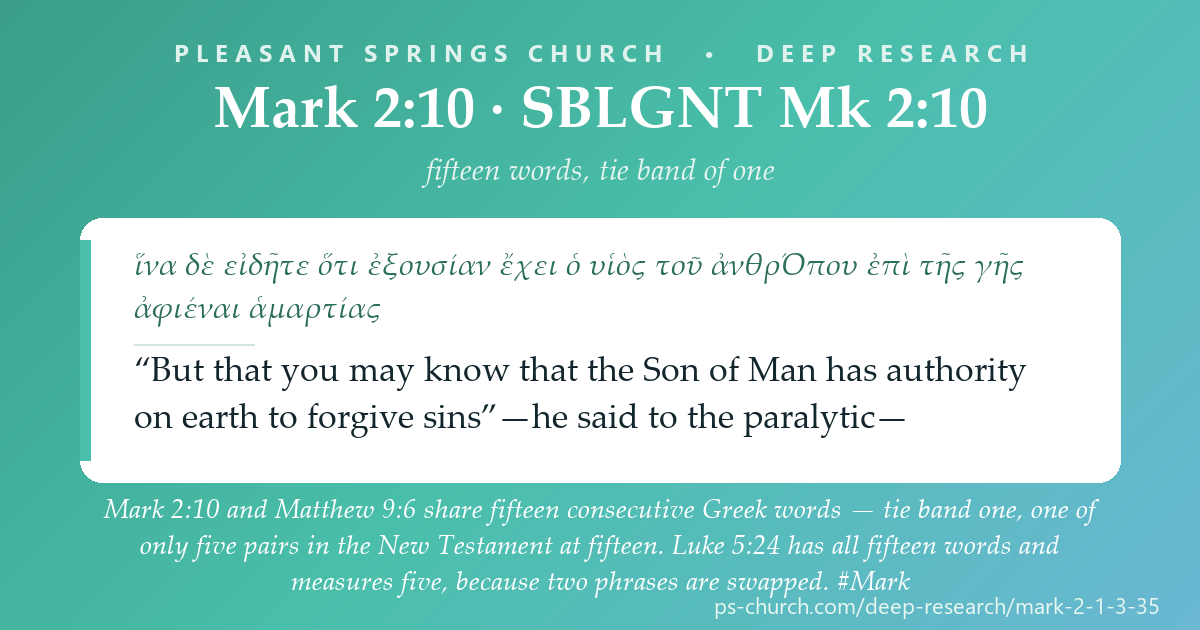
Two numbers hold this study together, and neither one is where a reader would look for it. Screened word for word against every verse of the Greek New Testament outside Mark — 7,254 of the 7,927 — the deepest verbatim contact anywhere in these sixty-three verses is fifteen consecutive words — Mark 2:10 and Matthew 9:6, tie band one — and the sentence is that you may know that the Son of Man has authority on earth to forgive sins. Only eighteen verse-pairs in the whole New Testament reach deeper across a book boundary. Screened against 30,637 verse units of the Greek Old Testament, the deepest run in the passage is seven consecutive words at Mark 3:32 — your mother and your brothers, shared with Genesis 37:10, tie band one — and there is no Scripture in that verse at all; it is a crowd passing on a message. Meanwhile the one appeal to Scripture in these two chapters — 2:25–26, “Have you never read?” — reaches four with the chapter it appeals to: 2:25 measures 1 against the whole of Greek 1 Kingdoms 21 and 2:26 measures 4, and 2:26’s own deepest Old Testament partner is a different David story altogether. Fifteen and four. This page prints both, prints its counter-examples, and never says who read whom. See the method →
Mark 2:1–3:35 (sixteen rows of sixty-three)
Greek New Testament (SBLGNT / MorphGNT) · ESV⚠️ Elsewhere in Mark the two columns do part, and it is worth knowing where. SBLGNT Mark runs 673 verses against the traditional 678. Five numbers carry no text in it — 7:16, 9:44, 9:46, 11:26 and 15:28 — and the ESV prints those five in footnotes rather than in the text, so the two agree on the verses that exist and on the numbers of all the rest. None of the five is in chapter 2 or chapter 3.
⚠️ Secondary offsets that bear on this page. The Old Testament chapter behind Mark 2:25–26 is numbered one ahead in the Hebrew and the Greek: MT and CATSS 1 Kingdoms 21:2–7 = ESV 1 Samuel 21:1–6. The bread of the Presence is given at 1 Kingdoms 21:7 = 1 Samuel 21:6. Every 1 Kingdoms reference on this page is in Hebrew and CATSS numbering.
⚠️ And two Greek Old Testament rows in the Stage 4 tables carry CATSS numbers that are not the English ones. Psalm 50:13 = ESV Psalm 51:11 (Greek Psalms run one behind the English from 9/10 through 147, and the superscription is counted), and Jeremiah 45:11 = ESV Jeremiah 38:11 (Greek Jeremiah is both shorter and differently ordered). Both are printed in CATSS numbering because that is the file they were measured in.
The Shape of the Passage
Two panels and a hinge — a concentric five, then a sandwichWho wrote this, to whom, and into what situation? Two chapters in which Jesus is called a blasphemer, a glutton’s companion, a Sabbath breaker, a madman and a man with a demon — written for people who were being called things themselves.
Author
Tradition from Papias onward names Mark, “interpreter of Peter.” The broader tradition identifies him with the John Mark of Acts 12:12 and 12:25. This page is not able to test that from the text, and does not try.
What the text does show is a writer in a hurry who slows down for detail. Counted off disk: εὐθύς, immediately, stands in fifty New Testament verses and forty of them are in Mark — eleven in chapter 1 alone, and three in this passage (2:8, 2:12, 3:6). Against that, the four men digging through a roof, the cushion of 4:35–41, the looking around at them with anger of 3:5. Mark is the only Gospel that says Jesus was angry here, and the only one that reports the family coming to seize him.
Craft: the sandwich. 3:20–35 begins a scene, breaks it off for an unrelated accusation, and comes back to it. The two halves interpret each other — his own people say he is out of his mind, the scribes say he has an unclean spirit, and the reader is left holding both.
Audience
Most locate Mark’s first readers in Rome in the 60s. The Gospel explains Jewish custom (7:3–4) and translates Aramaic when it uses it — Βοανηργές, ὅ ἐστιν Υἱοὶ Βροντῆς at 3:17. A writer who translates is writing for people who need it.
How they would have heard it. A congregation being accused — of atheism, of sedition, of breaking with their own families — reads two chapters in which every accusation made against Jesus is made by someone respectable, and in which his own relatives are the ones outside. The passage ends by telling them who their family is (3:35).
And they would have known the charge. The word the scribes think at 2:7 is the word the council pronounces at 14:64. Mark plants the verdict in chapter two.
Orient on controversy stories, the Sabbath, the Son of Man, and Mark’s sandwiches.
Search by topic: Mark, Gospel of; controversy stories / pronouncement stories; Sabbath; Son of Man; blasphemy; Beelzebul; unpardonable sin; Abiathar; bread of the Presence; Herodians; intercalation.
Which articles are relevant?
- Anchor Bible Dictionary — “Mark, Gospel of,” “Son of Man,” “Sabbath,” “Blasphemy,” “Beelzebul,” “Abiathar,” “Herodians,” “Bread of the Presence.”
- Dictionary of Jesus and the Gospels (IVP) — “Controversy Stories,” “Forgiveness of Sins,” “Sabbath,” “Demon, Devil, Satan,” “Family,” “Sin, Unforgivable.”
- New International Dictionary of NT Theology and Exegesis — ἐξουσία, ἀφίημι, βλασφημέω, σάββατον, πώρωσις.
- Dictionary of NT Use of the OT (Beale & Carson) — on Mark 2:23–28 and the 1 Samuel 21 background it treats there.
Settle the numbering first — and here there is nothing to settle
This shelf states the versification offset on every page, including the pages where there is none. This is one of them.
| Mark 2 | Mark 3 | whole Gospel | |
|---|---|---|---|
| SBLGNT (MorphGNT) | 28 | 35 | 673 |
| ESV | 28 | 35 | 673 verses of text, numbered to 678 |
Chapters 2 and 3 are identical in both columns, so every reference on this page is a single number. Across the Gospel as a whole, five numbers carry no text in the SBLGNT — 7:16, 9:44, 9:46, 11:26, 15:28 — and the ESV prints those five in footnotes rather than in the text. The two agree; they differ only in whether the number is printed with an empty slot. None of the five is in this passage. The longer ending, 16:9–20, is a separate question and does not touch these chapters.
The offsets that do bear on this page are in the Old Testament. Mark 2:25–26 summarises 1 Samuel 21, and the Hebrew and Greek of that chapter run one ahead of the English: MT and CATSS 1 Kingdoms 21:2 = ESV 1 Samuel 21:1, and the bread of the Presence is handed over at 1 Kingdoms 21:7 = 1 Samuel 21:6. Every 1 Kingdoms reference here is in Hebrew and CATSS numbering, and the English number is given beside it whenever it matters. Two other Greek Old Testament rows in Stage 4 are in CATSS numbering too: Psalm 50:13 = ESV Psalm 51:11 and Jeremiah 45:11 = ESV Jeremiah 38:11.
A priest with three names, a god the Greek column translates instead of transliterating, and a Sabbath rule this page cannot check.
Abiathar, Ahimelech, Abimelech — three names for one priest, and the page resolves nothing
Mark 2:26 says the David incident happened ἐπὶ Ἀβιαθὰρ ἀρχιερέως. Here is exactly what the three columns held on this shelf say.
| column | the priest at Nob | where |
|---|---|---|
| Masoretic Hebrew | אֲחִימֶלֶךְ — Ahimelech | 1 Samuel 21:2, 21:3, 21:9 |
| CATSS Greek (1 Kingdoms) | Αβιμελεχ — Abimelech | 1 Kingdoms 21:2, 21:7, 21:9 |
| SBLGNT (Mark) | Ἀβιαθάρ — Abiathar | Mark 2:26 |
Three things are measurable and this page reports all three.
(1) The Hebrew and the Greek Old Testament do not agree with each other about this priest’s name either. The Hebrew has Ahi-melech, brother of the king; the Greek column held here has Abi-melech, father of the king — the name of the Philistine kings of Genesis 20 and 26. The divergence is already there before Mark is involved. Searched across all 30,637 Greek verse units on this shelf, a form beginning Αχιμελ- stands in seven verses, none of them in 1 Kingdoms 21 or 22.
(2) Ἀβιαθάρ occurs once in the whole Greek New Testament — Mark 2:26 — and in twenty-eight verses of the Greek Old Testament held here. The first is 1 Kingdoms 22:20, where he is introduced as the one son of Abimelech who escapes the massacre at Nob and flees after David. In the story as the Greek Old Testament tells it, Abiathar is in the next chapter, and he is the priest’s son.
(3) The parallels do not have the name. Matthew 12:4 and Luke 6:4 tell the same incident, both mention the priests as a class (τοῖς ἱερεῦσιν, τοὺς ἱερεῖς), and neither names a priest at all. Checked by reading Matthew 12:1–8 and Luke 6:1–5 off disk.
⚠️ What this page does not do. It does not call Mark wrong, does not call the phrase a gloss, does not argue that ἐπὶ means in the passage about, and does not decide whether Matthew and Luke had the name and dropped it or never had it. Every one of those is a position in a long argument, and settling it needs a critical apparatus, which was not consulted. The page prints the three names and stops.
The bread of the Presence, read in Greek
The regulation Mark 2:26 is standing on is Leviticus 24:5–9, and the Greek of it can be read here.
Leviticus 24:8 sets the bread out τῇ ἡμέρᾳ τῶν σαββάτων, on the day of the sabbaths; 24:9 says it belongs to Aaron and his sons and that they shall eat it in a holy place. So the loaves David took were Sabbath loaves, replaced weekly — which is why the incident is worth citing in a Sabbath argument at all, and the Greek says so in as many words.
The phrase itself is rare in Greek. The exact four-word sequence τοὺς ἄρτους τῆς προθέσεως stands in exactly two verses of the Greek Old Testament held here — 1 Kingdoms 21:7 and 1 Chronicles 23:29 — and in three New Testament verses: Mark 2:26, Matthew 12:4 and Luke 6:4. The word πρόθεσις in any form stands in eighteen Greek Old Testament verses.
Beelzebul is not in the Greek Old Testament
Searched across all 30,637 Greek Old Testament verse units held here: Βεελζεβούλ occurs zero times. Not in a variant spelling, not in a proper name, not anywhere.
The god commonly connected with the name is the one Ahaziah sends to consult in 2 Kings 1 — 4 Kingdoms 1 in the Greek. And the Greek column does not transliterate that name; it translates it: τῇ Βααλ μυῖαν θεὸν Ακκαρων, Baal the fly, god of Ekron, at 4 Kingdoms 1:2, 1:3, 1:6 and 1:16 — four verses, and the same four words each time.
In the New Testament the name occurs in seven verses and never outside the Beelzebul controversy: Matthew 10:25, 12:24, 12:27; Mark 3:22; Luke 11:15, 11:18, 11:19. Mark uses it once.
What is and is not being claimed. That the two names are related is the standard proposal and it is a proposal. What is measurable is that the form the scribes use in Mark 3:22 is not in the Greek Old Testament held here, and that the Ekron god reaches that Greek as a translation rather than a name. No Ugaritic material was consulted, no inscription, no Second Temple demonology — and the name’s etymology, whether lord of the height, lord of the dwelling or lord of the flies, is not decided here.
The Sabbath rule — named, and not checked
The Pharisees’ objection at 2:24 assumes a definition of work that Mark does not supply, and this page cannot supply it either.
The standard reference frame is rabbinic: the thirty-nine classes of forbidden labour, of which reaping is one, set out in the Mishnah tractate Shabbat; and the Sabbath code of the Damascus Document from Qumran, which is stricter still. Neither was consulted for this page. They are named here as the kind of evidence the question turns on, not as something checked. The Mishnah is also two centuries later than Mark, which is a real problem for using it, and this page is not in a position to weigh it.
What the text itself supplies is narrower and can be counted. ἔξεστιν, it is lawful, stands three times in this passage — 2:24, 2:26, 3:4 — and all three are in the last two of the five controversies. The word for Sabbath stands in six verses of the passage: 2:23, 2:24, 2:27, 2:28, 3:2, 3:4. Nowhere does Mark say which rule is being broken.
Six words that occur once in the whole Greek New Testament, and three that hold the passage together.
Six New Testament hapax legomena, all inside these 63 verses
Every lemma in Mark 2–3 was counted against every lemma in the whole MorphGNT corpus. Six of them occur exactly once in the New Testament, and all six of those occurrences are here.
| word | verse | what it is |
|---|---|---|
| ἀποστεγάζω | 2:4 | to unroof — the four men taking the roof off |
| ἐπιράπτω | 2:21 | to sew on — the patch |
| Ἀβιαθάρ | 2:26 | the priest’s name |
| συλλυπέομαι | 3:5 | to grieve with — what Jesus feels alongside the anger |
| Ἰδουμαία | 3:8 | Idumea — in the crowd list |
| Βοανηργές | 3:17 | the name given to James and John, and Mark translates it |
Three of the six are the most physical things in the passage — a roof, a needle and thread, and a man’s face. The list is a count, not an argument: a hapax legomenon tells you a word is rare in this corpus and nothing at all about why.
Two occurrences in the passage, and they are the two ends of it: 2:10, the Son of Man has authority on earth to forgive sins, and 3:15, the Twelve are given authority to cast out demons. Nine verses of Mark carry the word: 1:22, 1:27, 2:10, 3:15, 6:7, 11:28, 11:29, 11:33, 13:34. Claimed, then handed over.
Six verses of Mark, and after 2:10 the word never appears again. 1:4 and 1:5 (John’s baptism), then 2:5, 2:7, 2:9, 2:10. The related noun ἁμάρτημα stands twice in Mark, both at the far end of this passage: 3:28 and 3:29.
Four verses of Mark, three of them here: 2:7 (the charge against Jesus), 3:28 and 3:29 (the charge he speaks of), and 15:29 (the passers-by at the cross). The noun βλασφημία stands at 3:28, 7:22 and 14:64. The word travels from a thought in chapter 2 to a verdict in chapter 14.
Two occurrences in the passage and they are on opposite sides. 2:12: the crowd were all amazed. 3:21: his own people say ἐξέστη, he is out of his mind. Four verses of Mark carry the verb: 2:12, 3:21, 5:42, 6:51.
Three occurrences, all in the last two controversies: 2:24 (what the disciples are doing), 2:26 (what David did), 3:4 (is it lawful on the Sabbath to do good or to do harm?). The question the Pharisees raise is the question Jesus turns round.
Three New Testament verses: Mark 3:5, Romans 11:25, Ephesians 4:18. Counted off disk by lemma: the noun stands in those three and no others. What stands at John 12:40 is the related verb πωρόω, which is commoner — Mark 6:52 and 8:17, John 12:40, Romans 11:7, 2 Corinthians 3:14. Mark uses it of the people watching to see whether he will heal on the Sabbath. The medical sense — the callus that forms over a broken bone — is reported in the reference works and is not verified here.
One word Mark has to explain
Mark 3:17 gives James and John a name and then translates it: Βοανηργές, ὅ ἐστιν Υἱοὶ Βροντῆς — which means Sons of Thunder.
The Greek form occurs once in the New Testament and its underlying Semitic form is disputed; this page can measure the first fact and not the second. What the translation shows is an audience that could not read the name, which is the same reason Mark stops to explain hand-washing at 7:3–4. Compare 5:41 and 15:34, where he does it again.
Fifteen words, four words, and the counter-examples that keep them honest.
Fifteen words, and where that sits in the New Testament
Every verse of the Greek New Testament was screened against every verse outside its own book. Of 7,927 verses, 244 reach a cross-book run of ten or more, 46 reach fifteen, 36 reach sixteen and 28 reach seventeen. Mark 2:10 and Matthew 9:6 are one of five pairs at exactly fifteen, and only eighteen pairs anywhere are deeper.
| run | the pair |
|---|---|
| 34 | Matthew 13:15 ↔ Acts 28:27 — both quoting Isaiah 6:9–10 |
| 26 | Matthew 6:24 ↔ Luke 16:13 |
| 24 | Matthew 8:20 ↔ Luke 9:58 · Matthew 12:41 ↔ Luke 11:32 |
| 23 | Matthew 8:9 ↔ Luke 7:8 · Matthew 26:24 ↔ Mark 14:21 |
| 22 | Matthew 3:9 ↔ Luke 3:8 |
| 20 | Matthew 3:10 ↔ Luke 3:9 |
| 19 | Matthew 22:44 ↔ Mark 12:36 |
| 18 | Mark 10:15 ↔ Luke 18:17 |
| 17 | Matthew 20:28 ↔ Mark 10:45 · Matthew 24:50 ↔ Luke 12:46 · Mark 1:24 ↔ Luke 4:34 · Ephesians 6:22 ↔ Colossians 4:8 |
| 16 | Matthew 10:22 ↔ Mark 13:13 · Matthew 16:24 ↔ Mark 8:34 · Matthew 16:25 ↔ Luke 9:24 · Matthew 12:42 ↔ Luke 11:31 |
| 15 | Mark 2:10 ↔ Matthew 9:6 · Matthew 12:27 ↔ Luke 11:19 · Matthew 12:30 ↔ Luke 11:23 · Matthew 10:21 ↔ Mark 13:12 · Matthew 15:32 ↔ Mark 8:2 |
⚠️ Read the top row before the others. The deepest cross-book agreement in the New Testament, at 34 words, is two books quoting the same Old Testament passage. Depth of run does not tell you what kind of relationship you are looking at. The table also ignores everything inside a book, so it says ‘across a book boundary’ and nothing wider.
The same fifteen words, in a different order, measure five
Luke 5:24 has every single one of the fifteen words in Mark 2:10, and against Mark 2:10 it measures 5.
| verse | the clause | run vs Mark 2:10 |
|---|---|---|
| Mark 2:10 | ἵνα δὲ εἰδῆτε ὅτι ἐξουσίαν ἔχει ὁ υἱὸς τοῦ ἀνθρώπου ἐπὶ τῆς γῆς ἀφιέναι ἁμαρτίας | — |
| Matthew 9:6 | the same words in the same order | 15, tie band 1 |
| Luke 5:24 | ἵνα δὲ εἰδῆτε ὅτι ὁ υἱὸς τοῦ ἀνθρώπου ἐξουσίαν ἔχει ἐπὶ τῆς γῆς ἀφιέναι ἁμαρτίας | 5 |
Two phrases swapped, and the number falls by ten. This is the clearest demonstration on the page of what the screen actually measures: contiguous sequence, not shared vocabulary. A low run does not mean two verses are unrelated. It means they do not say the same words in the same order. Luke is as close to Mark here as Matthew is; the screen cannot see it.
The whole passage against the Greek Old Testament
All 63 rows of Mark 2–3 screened against 30,637 Greek Old Testament verse units. Across the 63 rows: 62 reach two, 50 reach three, 22 reach four, 4 reach five, 3 reach six, 1 reaches seven, and nothing reaches eight.
| row | deepest OT partner | run | tie band | the shared words |
|---|---|---|---|---|
| Mk 3:32 | Genesis 37:10 | 7 | 1 | ἡ μήτηρ σου καὶ οἱ ἀδελφοί σου |
| Mk 3:31 | 1 Maccabees 16:21 | 6 | 1 | αὐτοῦ καὶ οἱ ἀδελφοὶ αὐτοῦ καὶ |
| Mk 2:26 | 2 Kingdoms 12:20 | 6 | 1 | εἰσῆλθεν εἰς τὸν οἶκον τοῦ θεοῦ |
| Mk 3:34 | 1 Maccabees 2:20 · Genesis 47:1 | 5 | 2 | μου καὶ οἱ ἀδελφοί μου |
| Mk 3:5 | Exodus 4:4 | 4 | 1 | ἔκτεινον τὴν χεῖρα καὶ |
| Mk 3:35 | 1 Esdras 8:16 | 4 | 1 | τὸ θέλημα τοῦ θεοῦ |
| Mk 3:27 | Jeremiah 45:11 = ESV Jer 38:11 | 4 | 1 | εἰς τὴν οἰκίαν τοῦ |
| Mk 2:20 | 1 Chronicles 29:22 · … | 4 | 33 | ἐν ἐκείνῃ τῇ ἡμέρᾳ |
Read the top row and the bottom row together. The deepest run in the passage is a crowd saying your mother and your brothers, and its partner is Jacob asking whether he and Joseph’s mother and brothers are to bow down. Seven words, tie band one, and no relationship of any kind between the two sentences. Meanwhile Mark 2:20 reaches four with a tie band of thirty-three — the same four words, on that day, standing in thirty-three different Old Testament verses. The band is what tells you which is which.
Three counter-examples the page prints against itself
Every commentary pairs these verses with Old Testament passages. Here is what the measurement returns for three of the best-known pairings.
| the pairing | run | the shared words |
|---|---|---|
| Mark 3:27 (the strong man bound) vs Isaiah 49:24–25 | 1 | ἐάν · τήν |
| Mark 2:7 (who can forgive sins but God alone?) vs Deuteronomy 6:4 | 2 | ὁ θεός |
| Mark 2:7 vs Isaiah 43:25 (I am he who blots out your transgressions) | 1 | μή |
All three pairings are thematically strong and all three are invisible to a contiguous-run screen. That is a limitation of the instrument, not a verdict on the pairings, and a page that printed only the high numbers would be lying by selection.
And one in the other direction. Mark 2:17 measures 1 against Greek Hosea 6:6. Matthew 9:13 and Matthew 12:7, at the same two points in the same two stories, both measure 5 against it — ἔλεος θέλω καὶ οὐ θυσίαν. Matthew’s versions of these scenes carry a Scripture citation that Mark’s do not. The page reports that and does not explain it.
The sentence Matthew and Luke do not have
Mark 2:23–28 and its two parallels were read off disk in full. Three things are in one Gospel and not the other two, and all three are measurable.
| in the text of… | what is there | and not in… |
|---|---|---|
| Mark 2:27 | The Sabbath was made for man, not man for the Sabbath | Matthew 12:1–8, Luke 6:1–5 — both go straight from the David story to the Son of Man is lord of the Sabbath |
| Mark 2:26 | in the time of Abiathar the high priest | Matthew 12:4, Luke 6:4 — neither names a priest |
| Matthew 12:5–7 | the priests profane the Sabbath and are guiltless; I desire mercy and not sacrifice | Mark 2:23–28, Luke 6:1–5 |
Measured against all 2,217 verses of Matthew and Luke together, Mark 2:27’s deepest run is 3, tie band one — and the three words are καὶ ἔλεγεν αὐτοῖς, and he said to them, which Luke 6:5 uses to introduce the sentence that follows this one. The four deepest rows in the same passage measure 15, 12, 11 and 10 — 2:10, 2:20, 2:19 and 2:17 — while inside the Sabbath story itself the rows measure 7, 6, 5, 4 and 3, and 2:24 measures 3 as well. The sentence is in one Gospel and not the other two.
⚠️ Direction of influence is not asserted. Nothing here says Matthew and Luke dropped the sentence, that Mark added it, or that any of the three is reading either of the others. The measurement establishes that the sentence is in one Gospel and not the other two, and stops there.
Where the passage floors out
The lowest-scoring row in the passage against Matthew and Luke together is Mark 3:30 — for they were saying, “He has an unclean spirit” — which measures 1 with a tie band of 344. It is Mark’s own one-line explanation of what the eternal sin was, and no other Gospel carries it. Read the zero convention correctly: on the Greek-side screens used here a row that shares no two-word sequence still reports 1 if any single word matches, so 1 means “shares no two consecutive words with anything in Matthew or Luke” and not “shares nothing.” The outer slices of the sandwich are nearly as low: Mark 3:20 measures 2 with a band of 11, and Mark 3:21 measures 3 with a band of 5.
What was not consulted, what could not be checked, and where this page is weakest.
The limits, named
No critical apparatus was consulted on any side. Not for the Greek New Testament, not for the Greek Old Testament, not for the Hebrew. That matters more than usual on this page, because the Abiathar question at 2:26 is a text-critical question as much as a historical one — part of the manuscript tradition of Mark does not carry the phrase at all, and this page is in no position to weigh that. It prints the SBLGNT reading and says what the other columns say.
The concentric reading of 2:1–3:6 is a proposal and the page labels it one. What is not a proposal is the topic sequence and the escalation of the objection; those can be read off the text. Whether 2:18–22 is a pivot or simply the third of five is an argument, and the diagram says so. A fabricated chiasm is a serious error on this shelf and the way to avoid it is to say which parts of a shape are counted and which are read.
The run screen finds verbatim contact. It does not find allusion. Three of the best-attested Old Testament pairings in this passage measure 1, 1 and 2, and they are printed in Stage 4 for exactly that reason. If a page reported only its high numbers it would be making an argument out of what its instrument happens to be able to see.
Where the page is weakest is Stage 2. The Sabbath halakhah that the objection at 2:24 presupposes is the single most important piece of background to the second half of this passage, and none of it was consulted. The Mishnah, the Damascus Document, Jubilees, Philo and Josephus are all named on this page or in its reading list and none was read for it. What was measured instead is narrower: which Greek words occur where.
What could not be checked at all
No rabbinic material. No Qumran text — and the Damascus Document’s Sabbath code is a real gap here. No Targum, Syriac, Vulgate or Old Latin. No patristic citations. No papyri. No Ugaritic material for the Beelzebul question. No archaeology of Capernaum, and nothing on first-century roof construction, which is what the hapax at 2:4 is actually about.
Three specific things this page states and cannot settle.
(1) Abiathar. The page prints three names in three columns and does not decide among the explanations. (2) Beelzebul. The page establishes that the name is absent from the Greek Old Testament held here and that the Ekron god arrives in Greek as a translation. It does not establish that the two names are the same name. (3) The eternal sin. Nothing on this page interprets Mark 3:29. What is reported is that αἰωνίου ἁμαρτήματος occurs once in the New Testament, that Mark supplies his own explanation at 3:30, and that the saying is introduced by the first Amen, I say to you in the Gospel.
One more limit, and it is about the English column. The ESV is quoted here under Crossway’s standing permission, which caps a study at half of any one book. This page quotes seventeen verses of Mark. The English column is the ESV and nothing else. Where it and the Greek printed beside it differ, the difference is the translators’, not the manuscripts’, unless the row says otherwise — and at 3:14 it does say otherwise.
Reading list
- R. T. France, The Gospel of Mark (NIGTC).
- Joel Marcus, Mark 1–8 (Anchor Yale Bible 27).
- Robert A. Guelich, Mark 1–8:26 (Word Biblical Commentary 34A).
- Adela Yarbro Collins, Mark (Hermeneia).
- Joanna Dewey, “The Literary Structure of the Controversy Stories in Mark 2:1–3:6,” JBL 92 (1973).
- James R. Edwards, “Markan Sandwiches,” Novum Testamentum 31 (1989).
- None of these were consulted for any number on this page. The measurements were run on the text files named in the footer, and the concentric reading in the structure diagram is labelled a proposal because it is one.
Two chapters in which everyone gets the answer wrong, including the family.
The word that travels
In the seventh verse of this passage some scribes think a word to themselves: he is blaspheming. Nobody says it out loud. Twelve chapters later a high priest tears his clothes and says it out loud, and it is the last word of the trial.
Counted, not asserted: βλασφημέω and its noun stand in six verses of Mark, and four of the six are here or at the cross. The charge is laid in chapter two and the verdict is delivered in chapter fourteen using the same word. Mark does not comment on it.
And the passage answers the charge before it is finished. The scribes ask who can forgive sins but God alone? (2:7). Twenty-one verses later a different group asks a Sabbath question and gets the answer the Son of Man is lord even of the Sabbath (2:28). Both replies are made by the same figure — the Son of Man — and those two verses are the first two times Mark uses the phrase. The first claims authority to forgive; the second claims lordship over a commandment.
Everyone outside, and one word that catches them all
Mark 2:12: the crowd is ἐξίστασθαι, beside itself, at what it has just seen. Mark 3:21: his own family says ἐξέστη — he is beside himself. Same verb, opposite verdict, and the passage puts them one chapter apart.
By the end of chapter 3 the scribes have said he has a demon, the Pharisees have gone out to arrange his death with the Herodians, and his mother and brothers are standing in the road outside the house asking for him. The people inside, sitting in a circle on the floor, are the ones he calls his family.
And the list he gives has a member the list outside does not. The crowd’s message names a mother and brothers (3:32). His answer names brother and sister and mother (3:35). There is no sister outside. The new family is one relation larger than the one that came to fetch him.
One of six Mark studies on this shelf, and the earliest by chapter — the first to cover chapters 2 and 3. The next along is Mark 4:35–41, one chapter later, where the disciples ask the question this passage has been raising all along: who then is this? The rest are Mark 8:1–38, Mark 10:1–11:33, Mark 13:1–37 and Mark 15:1–16:20.
Every Deep Research page traces its passage across the whole sweep — the Old Testament, the Second-Temple world between the testaments (historical witnesses, not Scripture), and the New Testament. Follow the thread:
Pleasant Springs Church — Deep Research
Research method after Michael S. Heiser’s Bible Research Method (examine dictionaries → ancient literature → important words → textual connections → academic publications → share), with the Pleasant Springs “Author & Audience” foundation. Scripture set in the Hebrew, the Greek editions named on each page and the ESV (Old Testament), and the Greek New Testament and the ESV (New Testament), per the practice of Pleasant Springs Church. Mark research grounded in France (NIGTC), Marcus (Anchor Yale), Guelich (WBC), Yarbro Collins (Hermeneia), Dewey (JBL 1973) and Edwards (NovT 1989) — none of which were consulted for any number on this page. Text: Greek New Testament from the SBL edition as digitized by MorphGNT; Greek Old Testament from Rahlfs’ Septuaginta as digitized by CATSS; Hebrew from the Masoretic text as printed in Sefaria’s Miqra according to the Masorah. No critical apparatus was consulted on any side. ⚠️ VERSE NUMBERING — Mark is a New Testament book, so there is no Masoretic or Septuagint column for it and no offset to state; the page states it anyway, because this shelf states it everywhere. Counted off disk: SBLGNT Mark 2 = 28 verses, Mark 3 = 35 verses, and the ESV prints the same 28 and 35 — a single number does for every reference in this passage. Across the whole Gospel the SBLGNT holds 673 verses against the traditional 678; five numbers — 7:16, 9:44, 9:46, 11:26, 15:28 — carry no text in it, and the ESV prints those five in footnotes rather than in the text. None is in chapter 2 or 3. Three secondary offsets bear on the page: MT and CATSS 1 Kingdoms 21:2–7 = ESV 1 Samuel 21:1–6, so the bread of the Presence is 1 Kingdoms 21:7 = 1 Samuel 21:6. Every 1 Kingdoms reference here is in Hebrew and CATSS numbering. Two further Greek Old Testament rows in Stage 4 are also in CATSS numbering: Psalm 50:13 = ESV Psalm 51:11 and Jeremiah 45:11 = ESV Jeremiah 38:11. ⚠️ The measurement, in full. Greek against Greek. MorphGNT field 6, the normalised word (the column that already resolves elision and the movable nu); CATSS FORM column (cols 0–24), beta-code transliterated first. Both sides lowercased, accents and breathings dropped, final sigma folded, then filtered to Greek letters — the same filter applied to both corpora, together with the editions’ own spelling equivalences (οὐ/οὐκ/οὐχ, ἐκ/ἐξ, the movable nu). Contiguous runs of whole word FORMS, never lemmas. Corpus: the 63 MorphGNT rows of Mark 2–3 against the 7,254 non-Markan verses of the Greek New Testament, against the 2,217 verses of Matthew and Luke, and against 30,637 verse units across the CATSS files held here. The cross-book ranking screened all 7,927 Greek New Testament verses, each against every verse outside its own book. Hapax counts are by LEMMA (MorphGNT field 7) across all 27 MorphGNT files; every other count on this page is by word form. Exhaustive and deterministic; nothing sampled, so no seed applies. The tie band — how many target verses reach the same maximum — is printed beside every run. ⚠️ What a low number means here. The Greek-side screens on this shelf use a unigram fallback, so a row sharing no two-word sequence still reports 1 if any single word matches. On this page 1 means “shares no two consecutive words”, never “shares nothing” — which is why Mark 3:27 measuring 1 against Isaiah 49:24–25 is a statement about sequence and not about relationship. ⚠️ The structure diagram, and what kind of claim it is. The intercalation at 3:20–35 is in the text: a scene is begun, interrupted and resumed. The concentric reading of 2:1–3:6 is a proposal, and is labelled one on the diagram; what is countable there is the topic sequence and the escalation of the objection from a thought (2:6) to a plot (3:6). No chiasm is asserted for the passage as a whole. ⚠️ Direction of influence is never asserted. Nothing here says Matthew is reading Mark, that Mark is reading Matthew, that Luke reordered anything, that Matthew and Luke omitted Mark 2:27, or that any of them draws on a common source. Nothing here says Mark is wrong about Abiathar, or right. Nothing here says Beelzebul is Baal-zebub. The page reports the runs, the tie bands and the counter-examples, and stops. Typology is handled per the house position: what the text says, what the New Testament itself draws, and what we see from this side of the cross — with the seeing left to the reader.
Scripture quotations marked ESV are from the ESV® Bible (The Holy Bible, English Standard Version®), © 2001 by Crossway, a publishing ministry of Good News Publishers. ESV Text Edition: 2016. Used by permission. All rights reserved. The ESV text may not be quoted in any publication made available to the public by a Creative Commons license, and the ESV may not be translated in whole or in part into any other language. www.esv.org
|
Did this study bless you today? 💚 Give to Support PS Church100% of gifts go to the General Fund — thank you. |