Mark 8 is the seam of the Gospel. Everything before it asks who this man is; everything after it walks to a cross. In the middle stands a healing that does not work the first time — a man who sees people as walking trees before he sees them as people. So we ran the obvious measurement: screen all thirty-eight verses against 30,348 verse units of the Greek Old Testament and see which Scriptures the chapter is built on. The answer came back almost empty. The deepest verbatim contact in the whole chapter is five consecutive words, and those five words are a coincidence about closing a dead man’s eyes. The verse every cross-reference system prints as a quotation measures two, tied with 1,732 others. Meanwhile the same chapter runs to sixteen consecutive words against the Greek New Testament. This is what we found, what it is worth, and where it stops. See the method →
Mark 8:1–38 (the whole chapter)
Greek New Testament (SBLGNT, via MorphGNT) · ESVElsewhere in Mark that is not true, and the page says so. The SBLGNT text held here has 673 verse rows for Mark; a printed ESV runs its verse numbers to 678. The five numbers with no Greek row here are 7:16, 9:44, 9:46, 11:26 and 15:28 — the ESV carries all five in footnotes rather than in the text, so the two are agreeing, not disagreeing. None of the five is in chapter 8. The other famous seam in Mark, the ending at 16:9–20, is outside this passage.
★ And the finding this page is built on is visible in the Greek column above. Verse 18 — ὀφθαλμοὺς ἔχοντες οὐ βλέπετε — is printed in practically every cross-reference system as a quotation of Jeremiah 5:21 or Ezekiel 12:2. Measured against the Greek Old Testament, it shares two consecutive words with either of them, and 1,732 verses of the Greek Old Testament tie at that depth (1,747 until the Odes came off the screening corpus on 30 August 2026; the fifteen that left were canticle copies of verses already counted). Stage 4 gives the numbers, the tie bands and the counter-examples.
The Shape of the Passage
A sequence, bracketed by two blind men — deliberately not a chiasmWho wrote this, to whom, in what situation? The measurement on this page turns out to bear directly on the audience question, so answer that first and let the numbers test it later.
Author
Early tradition, first recorded by Papias (quoted in Eusebius, Hist. eccl. 3.39.15) and repeated by Irenaeus, Clement of Alexandria and the Anti-Marcionite prologue, names John Mark — Peter’s interpreter, who “wrote down accurately whatever he remembered… though not in order.” The book itself names no author. Most place it around AD 65–75, before or just after the fall of Jerusalem.
The writer is a storyteller with a tight budget. The Greek is plain, paratactic, heavy with καί and the historic present. And he tells you where his hinges are without a formula: the Gospel breaks in half at the confession, and from 8:31 forward the narrative is on a road to Jerusalem with a passion prediction at every stage (8:31; 9:31; 10:33).
Audience
Not a synagogue. Mark translates Aramaic for his readers (talitha koum, 5:41; ephphatha, 7:34; eloi eloi, 15:34), explains Jewish handwashing custom from scratch (7:3–4), glosses coinage in Roman terms (12:42), and carries Latinisms (κεντυρίων, σπεκουλάτωρ, κῆνσος). His readers do not know these things already.
And they are under pressure. Chapter 8 ends with a saying about taking up a cross, losing your life, and being ashamed of Jesus “in this adulterous and sinful generation” — language that reads very differently to a congregation for whom crucifixion is a thing done in their city than to readers for whom it is a metaphor.
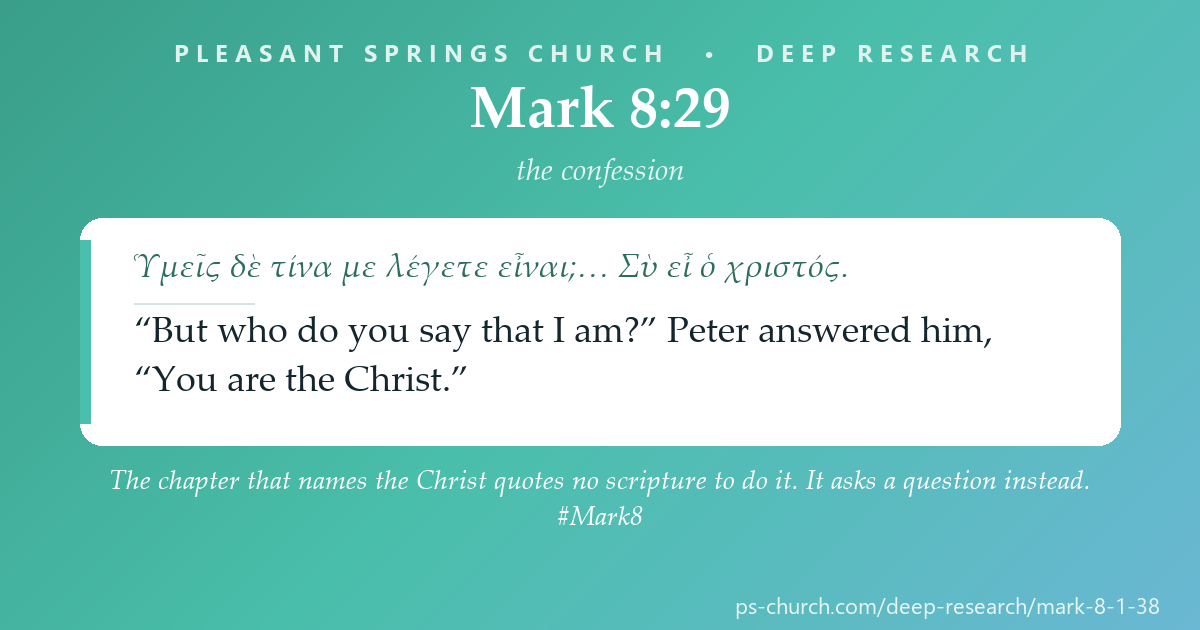
Here is where the measurement lands on the audience question. A page that argues a Messiah from Scripture is arguing with people who accept the Scripture and dispute the conclusion. Mark 8 does not argue that way at all. As Stage 4 shows, the chapter that names the Christ quotes nothing. The claim is put as a question — “who do you say that I am?” — and answered by a man, not by a text.
Orient on Caesarea Philippi, on Messiah, on the Son of Man, and on the two feedings.
Search by reference and by topic: Caesarea Philippi, Bethsaida, Dalmanutha, Messiah, Son of Man, messianic secret, leaven, hardness of heart, discipleship. Read the dictionary articles before the commentaries — they tell you which questions are live.
Which articles are relevant?
- Dictionary of Jesus and the Gospels (IVP, 2nd ed.) — “Mark, Gospel of,” “Christ,” “Son of Man,” “Messianic Secret,” “Discipleship,” “Blindness and Deafness.”
- Anchor Bible Dictionary — “Caesarea Philippi,” “Bethsaida,” “Dalmanutha,” “Messiah,” “Son of Man.” The Dalmanutha entry is the honest one: the place is otherwise unattested and unlocated.
- NIDNTTE — χριστός, πωρόω/πώρωσις, σημεῖον, ζύμη, ψυχή, ἀπαρνέομαι, ἐπαισχύνομαι.
- Dictionary of New Testament Background (IVP) — “Messianism,” “Crucifixion,” “Herodian Dynasty,” “Signs and Wonders,” “Healing.”
Bibliography surfaced:
- R. T. France, The Gospel of Mark (NIGTC); Joel Marcus, Mark 8–16 (Anchor Yale); Adela Yarbro Collins, Mark (Hermeneia).
- Robert Guelich / Craig Evans, Mark (WBC, two volumes); Morna Hooker, The Gospel according to St Mark (BNTC).
- William Wrede, Das Messiasgeheimnis in den Evangelien (1901) — the book that made the “messianic secret” a standing question.
- Richard Hays, Echoes of Scripture in the Gospels (2016), on Mark’s method of scriptural allusion — the exact question this page measures.
- None of these were consulted for any number on this page. The measurements were run on the text files named in the footer.
A pagan shrine, a demand for a sign, a Roman emperor who cured a blind man with spit, and a cross that was not a metaphor.
Put each element of the chapter beside the first-century world it was spoken in, and be exact about dates — a parallel written a century later is evidence of a shared idiom, not of a source.
Where does the confession happen, and does the place matter?
Caesarea Philippi is not a Jewish town. It sat at the foot of Mount Hermon at the springs of Paneas — named for the grotto of Pan, whose sanctuary was there. Josephus describes Herod the Great building a white marble temple to Caesar beside that cave (Ant. 15.363–364; War 1.404–406), and Herod’s son Philip the tetrarch later rebuilding the town and renaming it Caesarea — with his own name attached to distinguish it from Caesarea on the coast (Ant. 18.28).
So the geography is loaded: a question about who Jesus is, asked in front of a shrine to a Greek god and a temple to the divine Caesar, in a town named twice over for the emperor. Stated honestly: Mark himself makes nothing of this. He gives the name and moves on — he does not mention Pan, the grotto, or the Augusteum. The setting is real; the symbolism is ours, and we mark it as ours.
A sign from heaven — what were they asking for?
The Pharisees ask for σημεῖον ἀπὸ τοῦ οὐρανοῦ, and Jesus refuses flatly. Josephus supplies the background: first-century Judea produced a run of sign-prophets who promised exactly this kind of public spectacle — Theudas, who said he would part the Jordan (Ant. 20.97–98); “the Egyptian,” who promised the walls of Jerusalem would fall at his word (Ant. 20.169–172; War 2.261–263); and, on the eve of the war, prophets who led crowds into the desert “to show them the signs of deliverance” (War 2.259). Rome killed them all. A demand for a sign from the sky was, in that decade, a demand to be that kind of figure.
The chapter has just refused the request twice over. He has fed four thousand people in a wilderness — a sign if ever there was one — and it changed nobody’s mind, including his own disciples’ (vv.14–21). The refusal in v.12 is not withholding evidence; it is the observation that evidence has not been the problem.
Spitting on the eyes — is that a known practice?
Yes, and the closest parallel is very close in date. Tacitus (Histories 4.81) and Suetonius (Vespasian 7.2–3) both report that in Alexandria in AD 69–70 a blind man begged Vespasian to moisten his eyes with spittle; the emperor did, and the man saw. Tacitus adds that Vespasian hesitated, feared ridicule, and consulted physicians first. Pliny the Elder (Natural History 28.7) records fasting saliva as a standard remedy for inflammations of the eye.
What this does and does not show. It shows that a first-century reader would recognise the gesture as a healer’s gesture, not an oddity requiring explanation. It does not show any dependence in either direction: Tacitus wrote around AD 100–110, Suetonius around AD 120, and Mark is usually dated before either. The dates are close enough to be interesting and too close to build on. This page names the parallel and claims nothing from it.
What is genuinely unusual is not the spit. It is that the cure does not work the first time. So far as we can see, no other healing in the four Gospels needs a second touch — John 9 has a two-step procedure (anoint, then wash) and the ten lepers are cleansed as they go, but neither is a first attempt that leaves the man half-cured. That is a reading of the four Gospels, not a measurement; it is the one claim in Stage 2 we did not test with a tool.
“Take up his cross” — how did that land in the 60s?
Crucifixion was a public Roman instrument of terror in Judea within living memory of Mark’s first readers. Josephus reports Varus crucifying two thousand after the revolt of 4 BC (Ant. 17.295; War 2.75), Florus scourging and crucifying men of equestrian rank in Jerusalem (War 2.306–308), and, during the siege, so many crucified daily that “room was wanting for the crosses” (War 5.449–451). Cicero had already called it crudelissimum taeterrimumque supplicium, the most cruel and revolting punishment, and said the very word should be kept far from a Roman citizen’s ears (Pro Rabirio 5.16; In Verrem 2.5.165–170).
Not a burden patiently borne. A condemned man carrying the crossbeam through the streets to his own execution, already dead in law, already shamed. Verse 34 is not asking for endurance; it is asking for a public identification with a man the state is going to kill — which is precisely why verse 38 is about shame.
The vocabulary of the chapter, counted rather than asserted.
Every count below was taken from the MorphGNT text on disk, over all 7,927 verses of the Greek New Testament, on word forms rather than lemmas. Where a count is of a word group rather than a form, the chip says so.
Two different baskets, and the Greek New Testament never once confuses them. Counted here across all 7,927 verses: κόφινος occurs 6 times (Mt 14:20; Mt 16:9; Mk 6:43; Mk 8:19; Lk 9:17; Jn 6:13) and every one belongs to the five thousand. σπυρίς occurs 5 times (Mt 15:37; Mt 16:10; Mk 8:8; Mk 8:20; Ac 9:25) and every gospel occurrence belongs to the four thousand. Eleven occurrences, zero crossovers. Verses 19 and 20 keep the distinction inside a single sentence.
“Hardened” — perfect passive participle of πωρόω, from a noun for callus or petrifaction. Counted here across all 7,927 verses, the verb πωρόω occurs 5 times and the cognate noun πώρωσις 3 — 8 occurrences of the group, of which 3 are Mark’s: 3:5 (the noun, of the hardness of his opponents’ hearts), 6:52 (the disciples’, after the five thousand) and 8:17 (the disciples’, after the four thousand). The other five are Jn 12:40, Rom 11:7, Rom 11:25, 2 Cor 3:14 and Eph 4:18. Mark applies to the Twelve the word group he had used of the men plotting to destroy Jesus.
“Having sighed deeply” — a hapax legomenon: this form occurs nowhere else in the Greek New Testament. A groan from the chest, τῷ πνεύματι αὐτοῦ. The refusal of a sign is not cold.
“Far-shining, at a distance clearly” — another hapax. From τῆλε (far) and αὐγή (radiance). Not merely “he could see”: he could see into the distance, the very thing a half-cured eye cannot do.
“He saw through, saw clearly” — the verb διαβλέπω occurs only 3 times in the Greek New Testament: here, and at Matthew 7:5 and Luke 6:42, both of them the speck and the log. Two of its three uses are about a man who could not see because of what was in his own eye.
Not the ordinary ὀφθαλμός but the poetic word for eyes — only 2 occurrences in the Greek New Testament (here and Mt 20:34), and both are blind men being touched. Mark then switches back to ὀφθαλμούς for the second attempt in v.25.
Peter’s four words are said again, verbatim, by the high priest. Measured against the other 7,926 verses of the Greek New Testament — Mark itself inside the target here, unlike the Stage 4 table — Mark 8:29’s deepest run is six words, tie band 3; one of the three is Mark 14:61, λέγει αὐτῷ· Σὺ εἶ ὁ χριστός — where the sentence is not a confession but a capital charge. χριστός occurs just 7 times in Mark: 1:1, 8:29, 9:41, 12:35, 13:21, 14:61, 15:32.
“Behind me.” The identical phrase is the call and the rebuke, one verse apart. In Mark it occurs 4 times: 1:7 (John, of Jesus), 1:17 (δεῦτε ὀπίσω μου, the call of the fishermen), 8:33 (to Peter) and 8:34 (to anyone). Jesus does not tell Peter to go away; he tells him to get back into place.
“Let him deny himself.” ἀπαρνέομαι occurs 4 times in Mark, and the other three are all one man: 14:30, 14:31, 14:72 — Peter denying Jesus. The command in 8:34 and the failure in 14:72 are the same verb, and the same disciple is in both scenes.
“Is ashamed of.” Mark uses it twice, both inside verse 38 — the man ashamed of Jesus, and the Son of Man ashamed of him. It is the vocabulary of public honour, not private feeling; the counterpart to being seen carrying a crossbeam through a street.
One number worth pausing on: how strange is the language of this chapter?
Twenty-two word forms in Mark 8 occur exactly once in the whole Greek New Testament. Counted here over all 7,927 verses, on normalised word forms: ἀναστενάξας, ἀπεκατέστη, Δαλμανουθά, διέβλεψεν, δοῖ, ἔκλασα, ἐκλυθήσονται, ἐνέβλεπεν, ἐξήνεγκεν, ἐρημίας, ζημιωθῆναι, ἥκασιν, μοιχαλίδι, ὄμματα, παρατιθέναι, παρέθηκαν, πεντακισχιλίους, πεπωρωμένην, περισσεύματα, πόσων, σπυρίδων, τηλαυγῶς.
Read this carefully — a unique form is not the same as a unique word. πεντακισχιλίους is unique in that exact accusative form while “five thousand” occurs elsewhere in other cases, and ἐξήνεγκεν is one form of a verb used elsewhere. But three of the twenty-two are unique words, not merely unique forms — ἀναστενάξας, τηλαυγῶς and Δαλμανουθά. One more word of the chapter comes within a hair of the list without reaching it: ἀντάλλαγμα (v.37) occurs exactly twice in the Greek New Testament, here and in the Matthean parallel at 16:26 — which is why it is counted here and not there.
Verse 25 stacks three verbs and an adverb: διέβλεψεν καὶ ἀπεκατέστη καὶ ἐνέβλεπεν τηλαυγῶς ἅπαντα — he saw through, was restored, was looking, far-clearly. All four (διέβλεψεν, ἀπεκατέστη, ἐνέβλεπεν and the adverb τηλαυγῶς) are forms that occur nowhere else in the Greek New Testament. Whatever else Mark is doing at this verse, he is not reaching for stock phrases.
The measurement: what happens when you screen every verse of this chapter against the Greek Old Testament, and then against the Greek New Testament.
Greek against Greek. MorphGNT field 6 (the normalised word column, which already resolves elision and the movable nu) on the New Testament side; the CATSS FORM column, beta-code transliterated, on the Old Testament side. Both sides lowercased, accents and breathings dropped, final sigma folded, then filtered to Greek letters — the same filter applied to both corpora. Contiguous runs of whole word FORMS, never lemmas. The tie band — how many target verses reach the same maximum — is printed beside every run.
First: does the instrument work? A control on the same Gospel
Before reporting a null result it is only honest to show that the screen finds a quotation when there is one. The same measurement, run over the whole of Mark against the same 30,348 screened verse units of Greek Old Testament, returns:
| Mark | run | band | deepest match |
|---|---|---|---|
| 12:30 | 21 | 1 | Deuteronomy 6:5 — the Shema |
| 12:36 | 14 | 1 | LXX Psalm 109:1 = ESV Psalm 110:1 |
| 1:3 | 13 | 1 | Isaiah 40:3 |
| 10:7 | 10 | 1 | Genesis 2:24 |
| 12:10–11 | 10 | 1 | LXX Psalm 117:22–23 = ESV Psalm 118:22–23 |
| 12:29 | 9 | 1 | Deuteronomy 6:4 |
| 11:17 | 8 | 1 | Isaiah 56:7 |
| 1:2 | 7 | 1 | Exodus 23:20 — not Malachi 3:1 |
Twenty-one consecutive words at Mark 12:30, with a tie band of one. The instrument is not blunt. ⚠️ The last row in that table is new, and it is new because the shelf grew. Greek Exodus was fetched on 30 August 2026 with nineteen other CATSS files, taking the Greek Old Testament from 44 files and 23,061 verse units to 64 and 30,637. Against the smaller corpus Mark 1:2 topped out at 4, tie band 2, on a citation formula (καθὼς γέγραπται ἐν τῷ, shared with Daniel 9:13). Against the larger it reaches 7 with a tie band of 1 — ἀποστέλλω τὸν ἄγγελόν μου πρὸ προσώπου σου, I send my messenger before your face — and the verse it reaches is Exodus 23:20. Against Malachi 3:1, which every cross-reference system prints for this half of Mark 1:2, the same row measures 3. Malachi has ἐξαποστέλλω for the verb and πρὸ προσώπου μου, before MY face; Exodus has the simple verb and before YOUR face, and Mark has Exodus’s. Matthew 11:10 goes further still and reaches 9 against Exodus 23:20. Mark attributes the whole composite to Isaiah and the shelf attributes the first half to Exodus; neither of those is a verdict on what Mark meant, and this page does not offer one. What it offers is the number: a verse that was invisible to this instrument an hour before Exodus arrived now sits seventh in the Gospel’s own control table. That table is the top of the list, not all of it: three further Markan verses also reach eight — 7:6 against Isaiah 29:13 (band 1), 7:10 against Deuteronomy 5:16 (band 2) and 12:33 against 2 Chronicles 15:12 (band 1). Note the LXX numbering in that table: the psalm the New Testament calls 110 is Psalm 109 in the Greek Old Testament held here, and 118 is 117 — the standing one-behind offset through most of the Psalter. See Psalms in the New Testament.
Now the same screen on Mark 8. The whole chapter.
Thirty-eight verses against 30,348 verse units of the Greek Old Testament across the 63 CATSS files screened. The deepest verbatim contact anywhere in the chapter is FIVE consecutive words — and it belongs to a verse nobody has ever called a quotation.
| deepest run in the verse | how many of the 38 verses |
|---|---|
| 5 words | 1 (v.25) |
| 4 words | 7 (vv.1, 3, 4, 6, 27, 28, 38) |
| 3 words | 20 |
| 2 words | 10 |
| 6 or more | none |
And the single five is an accident. Mark 8:25, ἐπέθηκεν τὰς χεῖρας ἐπὶ τοὺς ὀφθαλμοὺς αὐτοῦ, shares τὰς χεῖρας ἐπὶ τοὺς ὀφθαλμούς with Genesis 46:4, tie band 2. Genesis 46:4 is God’s promise to Jacob going down to Egypt: “and Joseph shall lay his hands upon your eyes” — that is, shall close them when you die. The other verse in the band is 4 Kingdoms / 2 Kings 4:34, Elisha stretched out on the dead boy, eyes upon eyes and hands upon hands. Both are about hands and eyes. Neither has anything to do with a blind man at Bethsaida. This page prints its own deepest run as a coincidence, because that is what it is.
The verse everyone prints as a quotation: Mark 8:18
“Having eyes do you not see, and having ears do you not hear?” Cross-reference systems, study Bibles and commentaries routinely set Jeremiah 5:21 and Ezekiel 12:2 beside it. Measured against the Greek Old Testament, Mark 8:18 returns:
| candidate | run | the shared words |
|---|---|---|
| Jeremiah 5:21 | 2 | καὶ οὐ |
| Ezekiel 12:2 | 2 | καὶ ὦτα |
| Deuteronomy 29:3 = ESV 29:4 | 2 | καὶ ὦτα |
| LXX Psalm 113:13–14 = ESV Psalm 115:5–6 | 2 | καὶ οὐ |
| LXX Psalm 134:16–17 = ESV Psalm 135:16–17 | 2 | καὶ οὐ |
| Isaiah 6:9 | 2 | καὶ οὐ |
| Isaiah 6:10 | 1 | ὀφθαλμούς |
| Jeremiah 10:5 | 1 | οὐ |
Mark 8:18’s deepest contact with any of the 30,348 screened verse units is two words, and the tie band at that depth is 1,732. Seventeen hundred verses of the Greek Old Testament reach the same depth. Two words with a band of 1,732 is not a quotation; it is the Greek language.
⚠️ That band read 1,747 until 30 August 2026, and the fifteen verses that left are worth naming rather than deleting. They were all Odes rows — the fourteen liturgical canticles bound after the Greek Psalter, which arrived with the last twenty CATSS files and came back off the screening corpus the same day. Thirteen of the fifteen were verses this screen had already counted once under another name: Ode 2 is Deuteronomy 32 (five of them), Ode 3 is 1 Samuel 2, Ode 4 is Habakkuk 3, Ode 5 is Isaiah 26, Ode 7 is Daniel (Theodotion) 3, Ode 10 is Isaiah 5 (three of them) and Ode 11 is Isaiah 38. The other two are Ode 12, the Prayer of Manasseh. ⚠️ None of the fifteen was in Ode 9 or Ode 13, and that distinction matters: Ode 9 is Luke 1 and Ode 13 is Luke 2 — the Magnificat, the Benedictus and the Nunc Dimittis, filed under a Greek Old Testament shelfmark. Screened as Old Testament, Ode 9:48 matches Luke 1:48 at eighteen consecutive words, which is Luke measured against Luke; a Gospel page could report that as its deepest Old Testament contact and be measuring nothing but its own text. It did not happen here, and it is said here because the reader should know the instrument can do it and how it was caught. On this page the Odes did only the duller kind of damage — inflating a tie band by counting the same verse twice — and inflating a band is the direction that makes a null result look stronger than it is, which is why the corrected 1,732 is printed beside the published 1,747 rather than instead of it.
And the reason is visible on the page, once you set the texts side by side.
Ezek 12:2 οἳ ἔχουσιν ὀφθαλμοὺς τοῦ βλέπειν καὶ οὐ βλέπουσιν, καὶ ὦτα ἔχουσιν τοῦ ἀκούειν καὶ οὐκ ἀκούουσιν
Jer 5:21 ὀφθαλμοὶ αὐτοῖς καὶ οὐ βλέπουσιν, ὦτα αὐτοῖς καὶ οὐκ ἀκούουσιν
Mark 8:18 ὀφθαλμοὺς ἔχοντες οὐ βλέπετε καὶ ὦτα ἔχοντες οὐκ ἀκούετε
Every word that carries the meaning has been re-inflected. The prophets have third-person plural indicatives — a description of them, delivered to a third party. Mark has a participle and two second-person plurals — a question put to you, face to face, to eleven or twelve men in a boat. The shape survives perfectly; not one content word does. That is what a run of two means here.
Entitled: Mark 8:18 has no verbatim Greek contact with any prophetic text held here. Whoever put the sentence in this form was not copying a Greek scroll. The idiom — eyes that do not see, ears that do not hear — is common property of the prophets and of the idol-polemic psalms, and the shape is unmistakably that idiom.
Not entitled: to say Mark, or Jesus, “quotes” Jeremiah or Ezekiel here; to say either prophet is “behind” the verse in any traceable sense; to rank Jeremiah above Ezekiel or the reverse on this evidence; or to assert any direction of influence at all. The measurement finds verbatim contact. It does not find allusion, and allusion is plainly what is happening.
One honest wrinkle. The measurement treats οὐκ and οὐ as the same word — MorphGNT’s normalised column already reads οὐ for οὐκ, and the Greek Old Testament side is folded to match. So the run of two is if anything generous: the two texts do not even agree on how to spell the negation. Undoing the fold does not lengthen a single run in this chapter; we checked.
Now turn the screen around: Mark 8 against the Greek New Testament
Same method, different target: the 38 verses of Mark 8 against the 7,254 verses of the Greek New Testament that lie outside Mark. The whole Gospel is held out of the target, so every match in the table below is a match in another book; the Markan parallels are taken up separately in the counter-examples under it. The picture inverts completely.
| Mark 8 | run | band | deepest match |
|---|---|---|---|
| 8:34 | 16 | 1 | Matthew 16:24 |
| 8:2 | 15 | 1 | Matthew 15:32 |
| 8:35 | 13 | 1 | Matthew 16:25 |
| 8:31 | 10 | 1 | Luke 9:22 |
| 8:33 | 10 | 1 | Matthew 16:23 |
| 8:38 | 9 | 1 | Matthew 16:27 |
| 8:27 | 7 | 2 | John 2:2 · John 3:22 (a formula, not a parallel) |
| 8:6 · 8:15 · 8:29 | 6 | 1 · 2 · 2 | Matthew 15:36 · Matthew 16:6, 11 · Matthew 16:15, Luke 9:20 |
Sixteen consecutive words at 8:34, band of one, against Matthew 16:24; and five words at 8:25 is the best this chapter can do against the entire Greek Old Testament. The chapter is deeply, verbatim shared inside the Gospel tradition and almost untouched by the Greek scriptures.
Direction is not asserted and cannot be measured here. A run of sixteen between Mark 8:34 and Matthew 16:24 establishes that the two texts carry the same sixteen Greek words in the same order. It establishes nothing whatever about who wrote first, who copied whom, or whether both drew on something else. The Synoptic Problem is not solved by run lengths and this page does not pretend otherwise.
Counter-examples this page prints against itself
- The deepest run in the chapter is a coincidence. Mark 8:25 / Genesis 46:4, five words, band 2, about a dying man’s eyes being closed. If we let that count as contact, we would have to let it count as contact with a burial custom.
- The chapter’s most Danielic-sounding line is not Danielic in wording. Mark 8:38 — the Son of Man coming “in the glory of his Father with the holy angels” — measures 1 against Old Greek Daniel 7:13 and 2 against Theodotion. Compare Mark 14:62, which measures 5 against Theodotion Daniel 7:13 (μετὰ τῶν νεφελῶν τοῦ οὐρανοῦ). So Mark can put Danielic wording on Jesus’ lips — six chapters later. He does not do it here. See Daniel 7:9–14.
- The feeding is not eucharistic in its wording. Mark 8:6 shares only 2 consecutive words with Mark 14:22, the Last Supper (ἔκλασεν καί), because 8:6 has εὐχαριστήσας where 14:22 has εὐλογήσας. It shares 7 with Mark 6:41, the other feeding. On the wording alone, this scene belongs with the five thousand, not with the upper room. Whatever eucharistic resonance readers hear here is theological, not lexical, and should be argued as such.
- Mark 15 is shallower still. Screened the same way, the whole passion narrative in Mark 15 tops out at 4 consecutive words — even though Psalm 22 is audible in it throughout. Mark 15:34 measures 3 against LXX Psalm 21:2 (= ESV Psalm 22:1), and Mark 15:24 measures 2 against LXX Psalm 21:19 (= ESV 22:18). If shallow runs proved absence of Scripture, they would prove it of the crucifixion. They do not. They prove absence of copying.
- “Get behind me, Satan” is not a re-run of the temptation. Mark 8:33 measures 1 against Matthew 4:10 (Ὕπαγε, Σατανᾶ) in the SBLGNT text held here, because Matthew’s wording lacks ὀπίσω μου. That reading is text-critically disputed and we did not consult an apparatus; the honest statement is that the edition measured has no ὀπίσω μου at Matthew 4:10, and if a fuller reading is right the difference we are drawing from it disappears.
Cross-references worth following
- Mark 4:35–41 — “Who then is this?” The question chapter 8 finally answers, asked four chapters earlier by the same men in the same boat.
- Matthew 14:1–17:27 — the Matthean parallel to this whole block, including the confession at Caesarea Philippi and the passion prediction.
- Matthew 7:1–29 — the other two of the three New Testament uses of διαβλέπω, the “see clearly” verb of Mark 8:25, are the speck and the log.
- Daniel 7:9–14 — the Son of Man coming with the clouds; measured above against Mark 8:38 and Mark 14:62.
- Isaiah 52:13–53:12 — the suffering servant standing behind 8:31 conceptually. Measured: Mark 8:31 shares no run deeper than 3 with anything in the Greek Old Testament. The theology is there; the wording is not borrowed.
- Psalms 114–117 — includes ESV Psalm 115 (LXX 113:9–26), the idol polemic whose “eyes that do not see” is the closest idiomatic neighbour to Mark 8:18.
- Luke 4:16–30 — for contrast: a scene built on a quotation, where the run against the Greek Isaiah is long and the tie band is one.
The commentaries, the live disputes, and an explicit list of what was not checked.
This is the section that makes the shelf trustworthy. Say what was not consulted, what could not be checked, and where the page is weakest — before someone else has to.
Commentaries & studies:
- R. T. France, The Gospel of Mark (NIGTC, 2002) — the fullest defence of 8:22–10:52 as a deliberate literary unit bracketed by the two blind men.
- Joel Marcus, Mark 8–16 (Anchor Yale, 2009) — strongest on the Jewish background of the Son of Man material.
- Adela Yarbro Collins, Mark (Hermeneia, 2007); Robert Guelich and Craig Evans, Mark (WBC); Morna Hooker (BNTC); James Edwards (Pillar).
- William Wrede, The Messianic Secret (1901; ET 1971) — still the reference point for the command to silence in 8:30.
- Richard Hays, Echoes of Scripture in the Gospels (2016), ch.1 on Mark — argues that Mark works by allusion and metalepsis rather than citation. The measurement on this page is, so far as it goes, consistent with that thesis; it does not test it.
- Ernest Best, Following Jesus: Discipleship in the Gospel of Mark (1981); Robert Tannehill, “The Disciples in Mark: The Function of a Narrative Role,” JR 57 (1977).
Live disputes we are not pretending to settle:
- Dalmanutha (v.10) is unidentified. No other ancient source mentions it. Manuscripts vary (Magadan, Magdala, Melegada). The honest position is that nobody knows where it was, and proposals near Ginnosar remain proposals.
- Bethsaida’s site is contested. et-Tell and el-Araj have both been argued at length. This page names the village and takes no side.
- The messianic secret (v.30) has no agreed explanation. The main readings: a historical reticence of Jesus about a title loaded with military expectation; a Markan literary device delaying the true confession to 15:39; or Wrede’s thesis that it is an early-church construction. We think the first two are compatible and the evidence favours them; we do not think the question is closed.
- The two feedings. Whether 6:30–44 and 8:1–10 are two events or two tellings of one is genuinely disputed. What can be said from the text on disk is narrow and firm: the Greek New Testament preserves two distinct vocabularies for the baskets and never mixes them across eleven occurrences, and 8:19–21 requires both events to have happened.
- Whether 8:22–26 is a deliberate symbol. The bracket is measurable; the symbolism is an inference. Some readers hold the two-stage cure is simply what happened and Mark reports it because it is remarkable. That reading costs nothing and we do not dismiss it.
What this page did NOT check — stated plainly
- No critical apparatus was consulted, on either side. Not NA28, not the ECM, not Rahlfs’ or Göttingen apparatus. Where a reading is disputed (Matthew 4:10 above; the Dalmanutha variants; ἐπηρώτα vs ἐπηρώτησεν at 8:29) the page names the dispute and does not adjudicate it.
- The Greek Old Testament screened here is the CATSS digitisation of Rahlfs. It is a diplomatic base text, not a reconstructed original, and this shelf has already found a systematic dropout in one of its neighbouring corpora. A missing word in a CATSS row would shorten a run and could in principle hide contact. Sixty-three of the sixty-four files held are screened; the ones without a mapped book name are still included in the 30,348. Twenty of the sixty-four arrived on 30 August 2026 — Exodus, Leviticus, Numbers, Joshua in both recensions, and the deuterocanonical books. Every figure on this page was re-run against all sixty-four and every one of them reproduced exactly, with one addition: Mark 1:2, in the control table above. ⚠️ Then the Odes — one file, 289 verse units — came back OUT of the screening corpus the same day, because ten of its fourteen canticles are second copies of passages the corpus already holds and two of them (Ode 9 = Luke 1, Ode 13 = Luke 2) are New Testament text. HELD is 30,637 units in 64 files; SCREENED is 30,348 in 63. Everything on this page was re-run a third time against the 30,348, and exactly one figure moved: the tie band at Mark 8:18, from 1,747 to 1,732. The fifteen verses that left were Odes rows, thirteen of them duplicates of verses already counted; none was in Ode 9 or Ode 13. Judith, Tobit, Wisdom, Baruch, the books of Maccabees, Odes, the Psalms of Solomon, Bel and Susanna are witnesses, not Scripture, and are named as such wherever this shelf reports a hit in one.
- Not one commentary above was used to derive a number. The tables in Stage 4 come from the text files named in the footer and nothing else. Where a commentator would disagree with a figure, we would want to know.
- Hebrew was not screened at all. Mark is Greek and its author’s scriptural language, whatever it was, is not recoverable from a Greek-to-Greek run test. If Jesus said this sentence in Aramaic against a Hebrew Jeremiah, a Greek screen is blind to it by construction, and the null result on 8:18 would mean nothing at all about the underlying allusion. This is the single largest limitation of the whole page and it should be read as such.
- Targumic, rabbinic and Qumran literature were not screened. They are not held here in a machine-comparable form. Stage 2’s classical citations were checked against the standard editions by reference, not by text search.
- Nothing here dates anything. The page does not claim Mark is earliest, does not claim Matthew depends on Mark, and does not use run depth as evidence of priority. Runs measure agreement, not order.
Where this page is weakest
The honest weak point is the inference, not the measurement. The numbers in Stage 4 are reproducible and we would stand behind every one of them. What is arguable is the step from “Mark 8 has almost no verbatim Old Testament contact” to “Mark 8 is deliberately not arguing from Scripture.” That step assumes a null result is meaningful, and a null result is only meaningful if the instrument would have found the thing had it been there. We have shown the instrument works on Mark 12 and Mark 1. We have not shown that a first-century writer alluding heavily in Aramaic or Hebrew would leave a Greek verbatim trace. He might well not.
So the defensible version of the claim is the narrow one: whoever composed the Greek of Mark 8 was not copying from a Greek Old Testament scroll while he did it. Everything beyond that is reading, and the page marks it as reading.
From the boat to Monday.
Name what you learned, why it matters, and one concrete response.
What should we carry away — and do?
- Sight can be partial and still be sight. The man at Bethsaida was not faking when he said he saw men like trees. He genuinely saw, and he genuinely could not yet see properly. Peter says the true word and means something false by it. If you have ever been right and wrong at once about Jesus, Mark 8 has already described you, and it describes you sympathetically.
- He does not send the half-healed man away. The second touch is in the same paragraph. The disciples are called hardened in v.17 and are still with him in v.27, and still with him at 14:50 when they run, and still sought out at 16:7 — “tell his disciples and Peter.” Failure is not the end of the story in this Gospel; it is most of the middle of it.
- The evidence was never the problem. They had eaten the bread twice and counted the baskets themselves, and they still argued in the boat about lunch. Verse 12 refuses a sign not because signs are unavailable but because a sign has never yet been enough. Do not wait for a better one.
- “Get behind me” is a restoration, not an expulsion. The same two words called Peter in 1:17. He is not being cast out; he is being put back where a disciple stands — behind, following, not in front giving directions.
- The confession commits you to a road, not just to a word. Verse 29 and verse 34 are five verses apart on purpose. Naming him Christ and then telling him what the Christ may not do is exactly what verse 33 calls satanic. The title is not yours to define.
Step in response: read Mark 8:22 through 10:52 in one sitting this week — from the blind man at Bethsaida to blind Bartimaeus — and notice how many times someone is walking on the way, and who is in front. Then ask the question the chapter is actually built around, in the second person, out loud: who do you say that I am? The first-person answer is the only one Mark asks for.
Mark 8:29 · to share
Greek NT + ESVEvery Deep Research page traces its passage across the whole sweep — the Old Testament, the Second-Temple world between the testaments (historical witnesses, not Scripture), and the New Testament. Follow the thread:
Pleasant Springs Church — Deep Research
Research method after Michael S. Heiser’s Bible Research Method (examine dictionaries → ancient literature → important words → textual connections → academic publications → share), with the Pleasant Springs “Author & Audience” foundation. Scripture set in the Hebrew, the Greek editions named on each page and the ESV (Old Testament), and the Greek New Testament and the ESV (New Testament), per the practice of Pleasant Springs Church. Mark 8:1–38. Commentaries named in Stages 1 and 5 — France (NIGTC), Marcus (Anchor Yale), Yarbro Collins (Hermeneia), Guelich/Evans (WBC), Hooker (BNTC), Wrede, Hays — none of which were consulted for any number on this page. Ancient sources in Stage 2 cited by reference to the standard editions: Josephus (Ant. 15.363–364; 18.28; 20.97–98; 20.169–172; 17.295 · War 1.404–406; 2.75; 2.259; 2.261–263; 2.306–308; 5.449–451), Tacitus (Hist. 4.81), Suetonius (Vesp. 7.2–3), Pliny (NH 28.7), Cicero (Pro Rab. 5.16; Verr. 2.5.165–170), Papias via Eusebius (Hist. eccl. 3.39.15). Text: Greek New Testament from the SBL edition as digitised by MorphGNT (normalised word column); Greek Old Testament from Rahlfs’ Septuaginta as digitised by CATSS. No critical apparatus was consulted on any side. ⚠️ VERSE NUMBERING — Mark is a New Testament book, so there is no Masoretic or Septuagint column and no offset to state for the passage itself. Counted off disk: SBLGNT Mark 8 and the ESV both run 1–38 with no number skipped. Elsewhere in Mark the SBLGNT holds 673 verse rows against a printed ESV’s 678 verse numbers; the five without a Greek row here are 7:16, 9:44, 9:46, 11:26 and 15:28, all of which the ESV carries in footnotes rather than in the text, and none of which is in chapter 8. Where this page cites the Greek Psalter it gives both numbers, because the Septuagint runs one behind the English through most of the Psalms (LXX 109 = ESV 110; LXX 113:9–26 = ESV 115; LXX 117 = ESV 118; LXX 21 = ESV 22; LXX 134 = ESV 135), and Deuteronomy 29:3 in the Hebrew and Greek is 29:4 in the ESV because the Masoretic text gives chapter 28 sixty-nine verses. ⚠️ The measurement, in full. Greek against Greek. MorphGNT field 6, the normalised word column; CATSS FORM column (cols 0–24), beta-code transliterated first. Both sides lowercased, accents and breathings dropped, final sigma folded, then filtered to Greek letters — the same filter applied to both corpora. Contiguous runs of whole word FORMS, never lemmas. Corpus: the 38 MorphGNT rows of Mark 8 against 30,348 verse units across the 63 CATSS files screened — 64 files and 30,637 units are held, the Odes held and not screened — and against the 7,254 verses of the Greek New Testament that lie outside Mark, the whole Gospel held out of the target. Exhaustive and deterministic; nothing sampled, so no seed applies. The tie band — how many target verses reach the same maximum — is printed beside every run on this page. What the measurement finds is verbatim contact; it does not find allusion, and this chapter is the clearest case on the shelf of a passage full of allusion and empty of citation.
Scripture quotations marked ESV are from the ESV® Bible (The Holy Bible, English Standard Version®), © 2001 by Crossway, a publishing ministry of Good News Publishers. ESV Text Edition: 2016. Used by permission. All rights reserved. The ESV text may not be quoted in any publication made available to the public by a Creative Commons license, and the ESV may not be translated in whole or in part into any other language. www.esv.org
|
Did this study bless you today? 💚 Give to Support PS Church100% of gifts go to the General Fund — thank you. |