Four chapters, 129 verses of Greek, screened three ways. The expectation going in was that a block containing the transfiguration would be soaked in the Old Testament. It is not. Its deepest contact with the entire Greek Old Testament is eight words, in the one place Matthew stops to say “Isaiah prophesied”; its deepest contact with anything is sixteen words shared with Mark, with Luke, and with Matthew’s own twelfth chapter. The voice on the mountain measures two words against Psalm 2 and eleven against Matthew 3. And the deepest run in the section that is not a citation turns out to be six words shared with a book Pleasant Springs does not receive as Scripture — in one of its two Greek recensions, and not the other. See the method →
Matthew 14:1–17:27
Greek NT · ESVThe Shape of the Passage
Sequence — two panels, three declarationsWho wrote this, to whom, in what situation? These four chapters sit between two of Matthew’s five discourses — they are the narrative bridge from Galilee to the road to Jerusalem, and the place where Matthew’s vocabulary of not understanding is densest.
Author
Church tradition from Papias onward names Matthew the tax collector (Matt 9:9; 10:3). His Gospel is built around five discourses (chs. 5–7, 10, 13, 18, 23–25), each sealed with “when Jesus finished these sayings” (7:28; 11:1; 13:53; 19:1; 26:1). Matthew 14–17 is not a discourse. It is the narrative block between the parables of chapter 13 and the community rules of chapter 18 — and Matthew has arranged it as a sequence of paired scenes.
One thing about the author is measurable here. Of the six occurrences of the ὀλιγοπιστ- word group (“of little faith” — five of the adjective ὀλιγόπιστος and one of the noun ὀλιγοπιστία) in the whole Greek New Testament, five are Matthew’s and three of the six fall in these four chapters (14:31; 16:8; 17:20). The group does not occur once in the 30,348 verse units of the Greek Old Testament held here. Whatever else it is, it is a word this author reached for, and reached for most in this section.
Audience
A largely Jewish-Christian community (often located at Antioch, writing c. 60s–80s AD), living through the parting from the synagogue. Three details in these chapters assume that audience and no other: the hand-washing dispute of 15:1–20 is an intra-Jewish argument about the tradition of the elders; the Corban vow of 15:5 needs no explanation from Matthew, though Mark stops to translate it (Mk 7:11); and the half-shekel temple tax of 17:24 is a question you can only ask a Jew.
And one detail assumes they had already read chapter 3. The voice at 17:5 shares eleven consecutive words with the voice at Matthew 3:17 — the deepest tie the transfiguration has with anything in Matthew. An audience that had heard this Gospel read aloud would recognise the sentence before it was finished. See Stage 4.
Orient on the feedings, Caesarea Philippi, the transfiguration, Corban, the tassel and the temple tax.
Search by reference and by topic: feeding miracles, doublet, Caesarea Philippi, transfiguration, Elijah redivivus, Corban, tzitzit, temple tax, ekklesia. Then, because two of this page’s findings are about books outside the Protestant canon, look up Tobit and Sirach as well.
Which articles are relevant?
- Dictionary of Jesus and the Gospels (IVP, 2nd ed.) — “Feeding of the Multitude,” “Transfiguration,” “Peter,” “Elijah,” “Clean and Unclean,” “Taxation.”
- Anchor Bible Dictionary — “Transfiguration,” “Caesarea Philippi,” “Corban,” “Fringes,” “Temple Tax,” “Tobit, Book of.”
- NIDNTTE — ἐκκλησία, μεταμορφόω, ὀλιγόπιστος, κράσπεδον, ᾅδης, συνίημι.
- Dictionary of New Testament Background (IVP) — “Taxation, Jewish,” “Vows and Oaths,” “Apocrypha and Pseudepigrapha,” “Qumran: Place and History.”
- Encyclopaedia Judaica / Jewish Encyclopedia — “Shekel,” “Tzitzit,” “Nedarim,” “Fiscus Judaicus.”
Bibliography surfaced:
- W. D. Davies & Dale Allison, Matthew 8–18 (ICC vol. 2) — the fullest technical treatment of this block.
- R. T. France, The Gospel of Matthew (NICNT); Craig Keener, A Commentary on the Gospel of Matthew; John Nolland (NIGTC); Donald Hagner (WBC 33B).
- Ulrich Luz, Matthew 8–20 (Hermeneia) — especially on 16:17–19 and its reception history.
- Carey C. Newman (ed.), The Transfiguration of Christ; A. D. A. Moses, Matthew’s Transfiguration Story and Jewish-Christian Controversy.
- Carey A. Moore, Tobit (Anchor Bible 40A); Joseph A. Fitzmyer, Tobit (Commentaries on Early Jewish Literature) — for the two Greek recensions and the Qumran fragments.
- Patrick W. Skehan & Alexander A. Di Lella, The Wisdom of Ben Sira (Anchor Bible 39) — for Sirach 48 on Elijah.
Four objects in these chapters — a tassel, a vow, a coin, and a returning prophet — and what the ancient sources say about each.
Do not ask “what does this symbolise?” first. Ask what the object was, who handled it, and what it cost. Then read the scene again.
The tassel (14:36)
The crowds at Gennesaret beg to touch τοῦ κρασπέδου τοῦ ἱματίου αὐτοῦ. The word is not “hem” in the sense of a stitched edge; it is the tassel commanded at Numbers 15:38–39, worn on the corners of the outer garment as a memory device — the Greek of Numbers 15:39 reads “and you shall look at them and remember all the commandments of the Lord.” Matthew has already told you Jesus wore them (9:20) and criticised those who enlarged theirs (23:5).
κράσπεδον occurs five times in the Greek New Testament (Mt 9:20; 14:36; 23:5; Mk 6:56; Lk 8:44) and five times in the whole Greek Old Testament held here — Numbers 15:38 (twice), Numbers 15:39, Deuteronomy 22:12, and Zechariah 8:23. That last one is the one to sit with: “ten men from all the languages of the nations shall take hold of the tassel of a Jew, saying, We will go with you, for we have heard that God is with you.” Of the five Greek Old Testament occurrences, four are the law that makes the tassel; Zechariah 8:23 is the only verse in the Greek Old Testament in which anyone takes hold of one — and the ones doing it are Gentiles. The measurement, stated honestly: the two verses share a run of two words (τοῦ κρασπέδου). That is a shared object, not a quotation, and this page does not upgrade it into one.
The vow (15:5) — Corban
“What you would have gained from me is δῶρον” — a gift, i.e. dedicated to the temple. Mark preserves the Aramaic word and translates it for his readers (Κορβᾶν, Mk 7:11); Matthew does not, because his readers did not need it. The rabbinic tractate Nedarim is largely taken up with such vows and with the grounds for dissolving them — m. Nedarim 9:1 explicitly debates whether a vow may be released “for the honour of father and mother.” A first-century ossuary from the Kidron valley carries the word qorban in a dedication formula, so the practice is attested outside the literature as well.
The dispute is real and both sides are arguing from Scripture. That matters for how the scene is taught: Jesus is not opposing “tradition” in the abstract but naming a specific case in which one rule — the inviolability of a vow (Num 30:2; Deut 23:21–23) — had been allowed to cancel another, the fifth commandment. The Greek verb at 15:6 is ἠκυρώσατε, a legal term: to annul, to make void a contract.
The coin (17:24–27)
The collectors ask about τὰ δίδραχμα, the two-drachma tax — the annual half-shekel of Exodus 30:11–16, which the Greek Exodus itself renders with this very word: τὸ ἥμισυ τοῦ διδράχμου, “half of the didrachm” (Exod 30:13). Josephus describes the tax being collected from Jews across the empire (Antiquities 18.312), and the Mishnah tractate Shekalim is devoted to it. After AD 70 Rome redirected it to the temple of Jupiter Capitolinus as the fiscus Judaicus (Josephus, War 7.218; Dio Cassius 66.7) — which is why a scene about whether the sons pay would have landed hard on a community reading this Gospel in the 80s.
δίδραχμον occurs 26 times in the Greek Old Testament held here and exactly twice in the Greek New Testament — both of them in Matthew 17:24, in one verse. στατήρ, the four-drachma coin that pays for two, occurs exactly once in the Greek New Testament: Matthew 17:27, inside a fish.
The returning prophet (17:10–13) — and a real Second-Temple measurement
“Why do the scribes say that first Elijah must come?” The expectation comes from the last lines of the Book of the Twelve. Sirach 48:10 shows it was already a fixed expectation before Matthew: describing Elijah, Ben Sira says he is ἐπιστρέψαι καρδίαν πατρὸς πρὸς υἱόν, “to turn the heart of a father to a son.”
Sirach 48:10 and Greek Malachi 3:23 (= ESV Malachi 4:6) share a contiguous run of five words: καρδίαν πατρὸς πρὸς υἱὸν καί. Whatever the direction of dependence — and this page does not claim one — a Second-Temple Jewish writer was reproducing five consecutive words of the Elijah oracle in Greek. The expectation the disciples raise at 17:10 is documented in the literature, in the same language, before the Gospel was written.
Tobit — what it is, and why it is about to matter
Tobit is a Jewish novella of the Second-Temple period, probably third or second century BC. Pleasant Springs does not receive it as Scripture, and nothing on this page treats it as such. It matters here for one reason: it is a Greek text of the period, it is in the corpus this shelf measures against, and Stage 4 found the deepest non-citation contact in these four chapters inside it.
Two facts about the book are load-bearing for that finding, so they are stated up front:
- Tobit survives in two substantially different Greek recensions. The shorter (GI) is the text of Vaticanus and Alexandrinus; the longer (GII) is the text of Sinaiticus. This shelf holds both — the CATSS files
TobitBAandTobitS. They are not minor variants of each other; they are different editions. - Aramaic and Hebrew fragments were found at Qumran (4Q196–200), and they generally align with the longer Sinaiticus form — which is why most modern editions and translations now follow GII.
Six words, each with its count. Where a count is a negative, the corpus it is a negative over is named.
A word study on this shelf is a count before it is a meaning. Every figure below was produced by an exhaustive regex screen over the normalised forms of the corpora named — 7,927 verses of the Greek New Testament, and the 30,348 verse units of Greek Old Testament this shelf screens — the 64 CATSS files hold 30,637, and the 289 units of the Odes are held but not screened. Why, under the gates of Hades count below.
4 in the Greek NT — Mt 17:2, Mk 9:2, Rom 12:2, 2 Cor 3:18. 0 in the Greek Old Testament.
The whole word group — adjective and noun — occurs 6 times in the Greek NT (Mt 6:30; 8:26; 14:31; 16:8; 17:20 the noun ὀλιγοπιστία; Lk 12:28). 5 are Matthew’s, 3 of the 6 are in these four chapters, and there are 0 in the Greek Old Testament.
114 in the Greek NT — but only 3 in all four Gospels, and all three are Matthew’s (16:18; 18:17 twice). 116 in the Greek Old Testament.
5 in the Greek NT and 5 in the Greek Old Testament — Num 15:38 (twice), 15:39, Deut 22:12, Zech 8:23.
1 in the Greek NT (Mt 16:18). 4 in the Greek Old Testament — and the grammar differs every time. This read 5 until 30 August 2026, and the fifth was a second copy of the first. See below.
6 in the Greek NT, of which 2 are Matthew’s — 16:12 and 17:13, both in this passage. Matthew’s only other aorist of the verb is συνήκατε at 13:51, asked as a question.
“And the gates of Hades shall not prevail against it” (16:18) — a grammatical count
The phrase is not new with Matthew. What is new is what the gates are doing in the sentence. Here is every occurrence in the 30,348 verse units of Greek Old Testament screened here, with the case each time:
- Isaiah 38:10 — ἐν πύλαις ᾅδου καταλείψω, “in the gates of Hades I shall leave the remainder of my years” — dative, after a preposition. Hezekiah’s psalm.
- Wisdom 16:13 — κατάγεις εἰς πύλας ᾅδου καὶ ἀνάγεις, “you bring down to the gates of Hades and bring up” — accusative, after a preposition.
- 3 Maccabees 5:51 — πρὸς πύλαις ᾅδου καθεστῶτας, “already standing at the gates of Hades” — dative, after a preposition.
- Psalms of Solomon 16:2 — σύνεγγυς πυλῶν ᾅδου, “near the gates of Hades” — genitive, after an adverb of place.
⚠️ This count read five until 30 August 2026, and the fifth was a second copy of the first. The list above used to carry one more line: Odes 11:10, annotated — correctly — “the same verse, since Ode 11 is Hezekiah’s psalm.” That parenthesis was the whole problem. The Odes are the liturgical canticles bound after the Greek Psalter, and ten of them are second copies of passages already in the corpus: Ode 1 is Exodus 15, Ode 2 is Deuteronomy 32, Ode 3 is 1 Samuel 2, Ode 4 is Habakkuk 3, Ode 6 is Jonah 2, Ode 11 is Isaiah 38. Counted twice, one occurrence looks like two and a tie band of one looks like a band of two. The Odes stay on this disk; they are out of the screening corpus, so this count is four — and it was never five texts. It was four texts and a duplicate. The old number is printed here rather than swapped in silently.
⚠️ The sharper half of the same trap did not touch this page, and a reader of a measuring shelf should know it is there. Ode 9 is Luke 1 — the Magnificat and the Benedictus — and Ode 13 is Luke 2, the Nunc Dimittis. Screened as Old Testament, Ode 9:48 matches Luke 1:48 at eighteen consecutive words: a Gospel measuring its own text under a Septuagint shelfmark, and a page could print that as a Gospel’s deepest Old Testament contact. Nothing on this page ever landed in Ode 9 or Ode 13 — the one row that moved here came out of the duplication arm, not the Luke arm. It was caught the same way both arms are caught: by asking which book a hit came out of before believing the number.
In all four Greek Old Testament occurrences the gates of Hades are a place you are taken to, left in, or standing near — the phrase is always governed by a preposition or an adverb, and never once is it the subject of a verb. In Matthew 16:18 it is nominative: πύλαι ᾅδου οὐ κατισχύσουσιν αὐτῆς — the gates are the subject, and they are the ones failing to prevail.
What this does and does not settle. It is a fact about grammar, and it is exhaustive over the corpus named. It does not settle the old exegetical question of whether the church is pictured storming a fortress or withstanding a siege — κατισχύω can be read either way, and competent commentators land on both sides. What the count does establish is that the change is on Matthew’s side of the sentence: he took a stock phrase for the realm of the dead and made it the grammatical actor.
“He was transfigured” (17:2) — a word with no Septuagint
μετεμορφώθη occurs four times in the Greek New Testament and not once in the 30,348 verse units of Greek Old Testament screened here — not in Exodus 34, where Moses’ face shines, and not in Daniel 10 or 12, where the wise shine like stars. The Septuagint has plenty of glory, plenty of shining, plenty of transformation-language of other kinds; it does not have this verb.
Two of the four occurrences are Gospel narrative (Mt 17:2; Mk 9:2). The other two are about Christians — Romans 12:2, “be transformed by the renewal of your mind,” and 2 Corinthians 3:18, “we all… are being transformed into the same image from one degree of glory to another.” The New Testament uses this verb of exactly two subjects: Jesus on the mountain, and the people who belong to him.
This zero is a Greek-side zero over the corpus named: 64 CATSS files, 30,348 verse units screened of the 30,637 held, covering the canonical Greek Old Testament plus the deuterocanonical books. It is not a claim that the verb is absent from all Hellenistic Greek — it is well attested outside the Bible, and its overtones in Greco-Roman literature (Ovid’s Metamorphoses is the same idea in Latin) are exactly why some translators reach for “transfigured” rather than “transformed.” The count says the translators of the Septuagint never used it. It says nothing about anyone else.
Three exhaustive screens of the same 129 verses, and what each one is for.
Every number below is a contiguous run of whole word forms after normalisation, with its tie band — how many target verses reach the same maximum. A run of 8 with a band of 1 is a signal. A run of 4 with a band of 11 is a formula. A run without its band is misleading, and this shelf does not print one.
Settle the numbering first
Matthew has no versification offset. Chapter and verse are the same number in a Greek New Testament and in an English Bible, all the way through, because there is no second column to be offset from — there is no Masoretic Matthew and no Septuagint Matthew.
There is one hole, and it is in this passage. The SBLGNT prints no verse 17:21. Counted out, these four chapters run 36 / 39 / 28 / 26 = 129 verses of Greek text across a numbering that goes to 130. The ESV likewise skips from 17:20 to 17:22 and footnotes the omission. Every count on this page is over the 129 verses that carry text.
But the offset problem is still in the room, three times, because these chapters quote and echo books that carry one. Where a Greek Old Testament reference appears anywhere on this page it is printed in Greek numbering with the English beside it:
- Isaiah 29:13 — no offset. Greek, Hebrew and English all number it 29:13. The one quotation in these chapters that carries a citation formula is also the one with nothing to convert.
- Exodus 21 — the Greek transposes two verses. “Whoever reviles father or mother shall die” is Greek Exodus 21:16 and Hebrew/ESV Exodus 21:17; the law about kidnapping swaps with it. Matthew 15:4 quotes this law, so the reference you cite depends on which Bible you are holding.
- Malachi — ESV 4:5–6 = Hebrew 3:23–24 = Greek 3:22–23. The English has four chapters; the Hebrew and the Greek have three. And the Greek does something further — see the next question.
- Psalm 62:12 — ESV 62:12 = Hebrew 62:13 = Greek Psalm 61:13. This is the verse usually cited behind Matthew 16:27, and it carries a double offset: the Greek psalm number runs one behind the Hebrew from Psalm 9/10 through 147, and the Hebrew counts the superscription as verse 1.
A numbering fact worth its own paragraph: how the Twelve ends
The last three verses of Malachi are the same three verses in Hebrew and in Greek — but they are not in the same order. In the Masoretic text and in every English Bible:
- MT 3:22 = ESV 4:4 — “Remember the law of my servant Moses.”
- MT 3:23 = ESV 4:5 — “Behold, I send you Elijah the prophet.”
- MT 3:24 = ESV 4:6 — “And he will turn the hearts of fathers to children.”
In the Greek text this shelf holds (CATSS, following Rahlfs) the order is:
- Greek 3:22 — “Behold, I send you Elijah the Tishbite.”
- Greek 3:23 — “who will restore the heart of a father to a son.”
- Greek 3:24 — “Remember the law of Moses my servant.”
The Hebrew Book of the Twelve ends with Elijah. The Greek Book of the Twelve ends with Moses. That is a flat description of the two texts as they stand in the editions named, and it is exactly the kind of divergence this shelf exists to disclose rather than smooth over.
It is also, plainly, interesting next to Matthew 17, where Moses and Elijah appear together on a mountain and the disciples then ask why Elijah must come first. But no connection is being asserted. There is no measured contact between Matthew 17 and either ordering — Matthew 17:11 against Greek Malachi 3:22 measures a run of 1. The two facts sit beside each other on this page because both are true, not because one explains the other. A reader who wants to make more of it is welcome to; the page will not do it for them.
Screen 1 — the 129 verses against the whole Greek Old Testament
Scope. Every one of the 129 SBLGNT verses of Matthew 14:1–17:27 against every one of the 30,348 of the 30,637 verse units in the 64 CATSS Greek Old Testament files held here — the canonical books together with the deuterocanonical ones. Greek against Greek, lowercased, accents and breathings dropped, final sigma folded, contiguous runs of whole word forms, never lemmas. Exhaustive and deterministic.
The distribution. All 129 rows reach two; 104 reach three; 39 reach four; 8 reach five; 2 reach six; 1 reaches eight; and nothing reaches nine.
⚠️ Re-screened on 30 August 2026 with the Odes out of the corpus, and this table did not move. Every row below, its run and its tie band, is identical over 30,348 units and over 30,637, and so is the distribution. The eight deepest contacts these four chapters have with the Greek Old Testament were never touching a canticle. The one figure on this page that did move is the gates-of-Hades count in stage 3, five to four.
Here are all eight rows that reach five or more, with the tie band on every one. This is the whole list — nothing has been selected out:
- Mt 15:8 — run 8, band 1 — Isaiah 29:13. ἡ δὲ καρδία αὐτῶν πόρρω ἀπέχει ἀπ᾽ ἐμοῦ. A citation, and Matthew says so: “well did Isaiah prophesy of you.”
- Mt 17:6 — run 6, band 1 — Tobit 12:16 (Sinaiticus recension). Not a citation. Discussed below.
- Mt 15:9 — run 5, band 1 — Isaiah 29:13 again. μάτην δὲ σέβονταί με διδάσκοντες. The same citation, continued.
- Mt 15:4 — run 5, band 2 — Deuteronomy 21:13 and 1 Esdras 4:25. This is a citation of the fifth commandment that does not measure against the fifth commandment. Discussed below.
- Mt 14:2 — run 5, band 2 — Greek 3 Kingdoms 21:12 and 21:31 (= ESV 1 Kings 20:12, 20:31). καὶ εἶπεν τοῖς παισὶν αὐτοῦ, “and he said to his servants” — a narrative formula, and nothing more.
- Mt 14:35 — run 5, band 1 — Genesis 26:7. αὐτὸν οἱ ἄνδρες τοῦ τόπου. Five words shared with the men of Gerar asking Isaac about his wife. A coincidence.
- Mt 15:11 — run 5, band 1 — Numbers 32:24. τὸ ἐκπορευόμενον ἐκ τοῦ στόματος. In Numbers it is a vow you must keep; in Matthew it is what defiles a person. A coincidence — and a good one, because the words are identical and the subject is opposite.
- Mt 17:27 — run 5, band 2 — Greek Daniel 3:25 in both the Old Greek and Theodotion. καὶ ἀνοίξας τὸ στόμα αὐτοῦ. In Daniel, Azariah opens his mouth in the furnace to pray; in Matthew, Peter opens a fish’s. A coincidence.
Of the eight deepest contacts these four chapters have with the entire Greek Old Testament, two are the one explicit citation, one is a stock narrative formula, three are coincidences, one is the Tobit row, and one is a citation that the method partly missed. That ratio is the finding. These chapters are not built out of Old Testament quotation. Matthew quotes Isaiah once, with a formula, and otherwise tells a story.
The deepest non-citation run in the passage — and why it is fragile
Matthew 17:6 — the disciples’ reaction to the voice from the cloud — carries a run of six consecutive words with a tie band of 1. It is the deepest contact in these four chapters that is not the Isaiah citation. Its partner is Tobit 12:16, in the Sinaiticus recension:
καὶ ἐταράχθησαν οἱ δύο καὶ ἔπεσαν ἐπὶ πρόσωπον αὐτῶν καὶ ἐφοβήθησανTobit 12:16, Sinaiticus (GII) — “and the two were troubled, and they fell on their face and were afraid”
καὶ ἀκούσαντες οἱ μαθηταὶ ἔπεσαν ἐπὶ πρόσωπον αὐτῶν καὶ ἐφοβήθησαν σφόδραMatthew 17:6 — “and when the disciples heard it, they fell on their face and were exceedingly afraid”
And in both books, the very next verse is the same reassurance: Tobit 12:17, μὴ φοβεῖσθε; Matthew 17:7, ἐγέρθητε καὶ μὴ φοβεῖσθε.
First, the run depends entirely on which Tobit you hold. The other Greek recension — Vaticanus and Alexandrinus, the CATSS TobitBA file — reads ἔπεσον ἐπὶ πρόσωπον ὅτι ἐφοβήθησαν — a different aorist, no αὐτῶν, and ὅτι for καί. Screened against that recension, Matthew 17:6 measures 2. The finding is six in one edition and two in the other.
Second, this is the standard idiom for the reaction to an angel, and the nearest neighbours prove it. Numbers 16:22 reaches five — ἔπεσαν ἐπὶ πρόσωπον αὐτῶν καὶ — and stops only because Moses and Aaron then speak instead of fearing. The shelf holds two Greek Judges, and they differ at exactly the word that matters: the B-text of Judges 13:20 reads ἔπεσαν ἐπὶ πρόσωπον αὐτῶν and measures 4, while the A-text reads ἔπεσον where Matthew has ἔπεσαν and so breaks at the verb (run 3). Leviticus 9:24 has ἔπεσαν ἐπὶ πρόσωπον (run 3); Genesis reaches 3 (42:35), and Daniel, Ezekiel and Joshua fall at 2. The phrase is common property. What Tobit 12:16 adds beyond Numbers 16:22 is one word — the fear verb welded on with καί — and that full combination happens to occur nowhere else in 30,348 screened verse units.
Third, and most important: no direction of influence is being claimed, in either direction. Matthew carries no citation formula here and gives no sign of quoting anything. Two Greek writers describing the same kind of scene — people flat on the ground in front of a heavenly messenger who then tells them not to be afraid — reached for the same six words. That is what the measurement found. What it means is a separate question, and the honest answer is that six words of shared narrative idiom will not settle it.
The counter-example this page owes you: a citation the method half-missed
At Matthew 15:4 Jesus quotes the fifth commandment with an explicit formula: ὁ γὰρ θεὸς εἶπεν, “for God said.” If a run-length screen were a reliable citation-detector, its deepest hit should be Exodus 20:12 or Deuteronomy 5:16. It is neither.
- Mt 15:4 against Greek Exodus 20:12 — run 3. τίμα τὸν πατέρα and then it stops.
- Mt 15:4 against Greek Deuteronomy 5:16 — run 3. Same three words, same stop.
- Mt 15:4 against Deuteronomy 21:13 — run 5. A captive bride mourning her father and mother.
- Mt 15:4 against 1 Esdras 4:25 — run 5. A courtier arguing that a man loves his wife more than his father and mother.
Because of one two-letter pronoun. Greek Exodus 20:12 reads τίμα τὸν πατέρα σου καὶ τὴν μητέρα; Matthew 15:4 reads τίμα τὸν πατέρα καὶ τὴν μητέρα, with no σου. The run engine is contiguous and exact; the pronoun breaks the chain at word three. Deuteronomy 21:13 and 1 Esdras 4:25 happen to lack it, so they score five — and they are talking about something else entirely.
The second half of the verse does the same thing. “Whoever reviles father or mother must surely die” is Greek Exodus 21:16 = Hebrew and ESV Exodus 21:17, which reads ὁ κακολογῶν πατέρα αὐτοῦ ἢ μητέρα αὐτοῦ τελευτήσει θανάτῳ. Matthew drops both pronouns and ends θανάτῳ τελευτάτω where the Greek has τελευτήσει θανάτῳ — the order reversed and the verb form changed with it. Run: 3.
So print this beside every deep run on this page. A run of 5 can be an accident (Matthew 14:35 and the men of Gerar) and a run of 3 can be a quotation the author announces out loud. The measurement finds verbatim contact. It does not find citation, and it does not find allusion. Read it as evidence, not as a verdict.
Screen 2 — the same 129 verses against the rest of the Greek New Testament
Scope. The 129 verses against the other 7,798 verses of the Greek New Testament. Same normalisation, same run engine.
The distribution runs twice as deep as Screen 1. All 129 reach two; 120 reach three; 91 reach four; 64 reach five; 39 reach six; 23 reach seven; 19 reach eight; 13 reach nine; 12 reach ten; 9 reach eleven; 8 reach twelve; 6 reach fourteen; 4 reach fifteen; 3 reach sixteen; and nothing reaches seventeen.
The three rows at sixteen, each with a tie band of 1:
- Mt 16:24 — sixteen words with Mark 8:34: εἴ τις θέλει ὀπίσω μου ἐλθεῖν… καὶ ἀκολουθείτω μοι.
- Mt 16:25 — sixteen words with Luke 9:24.
- Mt 16:4 — sixteen words with Matthew 12:39. The third of the three deepest ties this passage has with anything at all is Matthew with himself, eleven chapters earlier, on the sign of Jonah.
Deepest contact with the entire Greek Old Testament: 8 words, and it carries a citation formula. Deepest contact with the rest of the Greek New Testament: 16 words, and there is no citation formula anywhere in the section. Twice the depth, none of the announcement.
What that does and does not license. It is a strong quantitative statement of the Synoptic problem — these four chapters share long stretches of exact Greek with Mark 6–9 and Luke 9. It says nothing whatever about who wrote first. A run is symmetrical; it has no arrow. Matthew 16:24 and Mark 8:34 share sixteen words, and the measurement is silent on how they came to. That the third row of the three is Matthew beside Matthew ought to keep anyone honest: the same depth is reachable without any second author at all.
The voice on the mountain — where the measurement lands hardest
Matthew 17:5 is routinely taught as a fusion of Old Testament texts: Psalm 2:7 (“you are my Son”), Isaiah 42:1 (“my chosen, in whom my soul delights”), Deuteronomy 18:15 (“listen to him”), sometimes Genesis 22:2 (“your beloved son”). Here is what those four comparisons actually measure:
- Mt 17:5 against Greek Psalm 2:7 — run 2 (υἱός μου).
- Mt 17:5 against Greek Isaiah 42:1 — run 1.
- Mt 17:5 against Greek Deuteronomy 18:15 — run 1.
- Mt 17:5 against Greek Genesis 22:2 — run 1.
- Mt 17:5 against Greek Exodus 24:16 — run 2 (τῆς νεφέλης) — the cloud on Sinai, six days, the voice from the cloud. Two words.
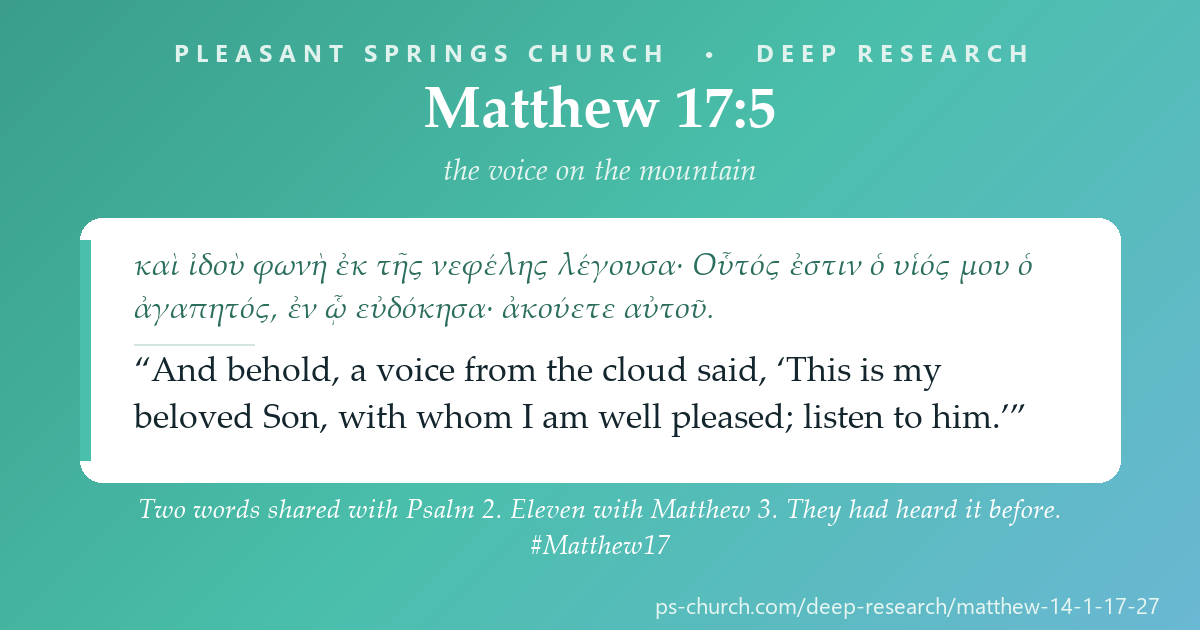
- Mt 17:5 against Matthew 3:17 — run 11, band 1. λέγουσα οὗτός ἐστιν ὁ υἱός μου ὁ ἀγαπητός, ἐν ᾧ εὐδόκησα.
This is not a refutation of the fusion reading. A verbal allusion does not have to be verbatim, and “beloved son,” “in whom I am well pleased” and “listen to him” are recognisably the language of Psalm 2, Isaiah 42 and Deuteronomy 18 even at a run of one or two. Davies–Allison, France and Luz all read it that way and they may well be right.
What the measurement establishes is narrower and still worth having. If you are looking for verbatim contact, there is almost none with the Old Testament and a great deal with Matthew’s own third chapter. The sentence on the mountain is, word for word, the sentence at the Jordan — with ἀκούετε αὐτοῦ added. For a first audience hearing this Gospel read aloud, the loudest echo in 17:5 was not a psalm they had to recall. It was chapter 3, which they had heard an hour earlier.
And the same holds for the Elijah question. Matthew 17:11 uses ἀποκαταστήσει, “will restore” — the only occurrence of that verb form in the Greek New Testament, and one of five in the Greek Old Testament, where one of the five is the Elijah oracle itself (Greek Malachi 3:23 = ESV 4:6). The run against that verse is 1. One shared word, and it is exactly the right word. The engine cannot tell you that; you have to look.
Screen 3 — the 129 verses against each other
Scope. Each of the 129 verses against the other 128, and separately against the other 939 verses of Matthew.
Inside the passage: 125 rows reach two, 78 reach three, 39 reach four, 18 reach five, 6 reach six, 2 reach seven, and nothing reaches eight. The two rows at seven are 16:6 and 16:11 — the warning about the leaven of the Pharisees and Sadducees, given and then repeated within five verses. The rows at six include the pair this study cares about most: 14:20 and 15:37, the two feedings, καὶ ἔφαγον πάντες καὶ ἐχορτάσθησαν καί.
Against the rest of Matthew: the deepest is 16:4 with 12:39 at sixteen, then 17:5 with 3:17 at eleven, then 16:16 with 26:63 at eight — Peter’s confession and the high priest’s question share the clause σὺ εἶ ὁ χριστὸς ὁ υἱὸς τοῦ θεοῦ. The same eight words are a confession in chapter 16 and an accusation in chapter 26.
It is the control. Screens 1 and 2 tell you how a passage relates to things outside it; Screen 3 tells you how much of the depth is just this author repeating himself. On these four chapters the answer is: a great deal. The two feedings, the two leaven-warnings, the two “then they understood” clauses, and the confession that reappears in the trial. Any claim about Matthew’s contact with an outside text has to clear that internal noise floor first.
What was consulted, what was not, and the four places this page is weakest.
This is the section that makes the rest of the shelf trustworthy. If a page will not say what it could not check, its confident sentences are worth nothing.
What was actually consulted
Two Greek editions and one English translation, all named: the SBL Greek New Testament as digitised by MorphGNT; Rahlfs’ Septuaginta as digitised by CATSS; the Masoretic Hebrew (Sefaria’s Miqra according to the Masorah) for the Malachi and Exodus ordering checks only; and the ESV for the English column. The commentaries listed in Stage 1 informed the framing, and where this page disagrees with a standard reading it says so out loud rather than quietly.
What was NOT consulted — and what follows from that
- No critical apparatus of any kind. Not Nestle-Aland, not the UBS, not Swete, not the Göttingen Septuagint. Every “the text reads” on this page means these two digital editions read. Where a variant is known to matter it is named — 17:21, and the two Tobit recensions — but no variant has been adjudicated here and none should be taken as adjudicated.
- The Göttingen edition of Tobit was not consulted, and it is the edition that matters for the Tobit finding. This page’s run of six rests on the CATSS transcription of the Sinaiticus recension. Hanhart’s critical text could read differently at exactly the words that produce the run. This is the single largest hole in the page, and the finding is stated conditionally throughout because of it.
- No Qumran text was read directly. The remarks about 4Q196–200 are reported from the secondary literature (Fitzmyer, Moore), not from photographs or transcriptions on this disk.
- No rabbinic text was read in the original. Nedarim, Shekalim and the Corban discussion are reported from standard reference works. The dates involved are late and the page says so.
- No archaeological report was read. The Corban ossuary is cited as it is reported in the dictionaries, not from the excavation publication.
- Josephus and Dio Cassius were not read in the original languages here. The temple-tax references are standard and easily checked, but they were not verified against a critical edition on this disk.
The four places this page is weakest
- 1. The Tobit run is edition-dependent, and this page knows it. Six words in the Sinaiticus recension, two in the Vaticanus/Alexandrinus one. Anyone quoting the number must quote the recension with it, or they are quoting a number that does not exist on its own.
- 2. Matthew’s Bible may not have contained Tobit at all. Whether a Jewish-Christian community in the 80s counted Tobit as Scripture is exactly the question the page cannot settle, and it does not need to: the finding is a fact about two Greek texts, not a claim about a canon. But a reader who wants the finding to mean something will have to settle that question first, and this page has not.
- 3. The Malachi ordering point is a description of two editions, not an argument. The Greek manuscript tradition of Malachi is not uniform, and Rahlfs’ text is an edited text. That the Twelve ends with Moses in the Greek held here is true of the Greek held here. A different edition could order it differently, and the page has not checked one.
- 4. The negative counts are corpus-bounded and nothing more. “Zero occurrences of μεταμορφόω” means zero across 64 CATSS files. “Zero occurrences of ὀλιγόπιστος” means the same. Neither is a claim about Greek at large, about Philo, about Josephus, or about any papyrus.
Where a competent reader should push back
On the transfiguration. The strongest objection to Stage 4’s handling of 17:5 is that run-length is simply the wrong instrument for allusion, and that a scholar who reads Psalm 2 and Isaiah 42 there is not making a claim the run engine is competent to test. That objection is correct, and the page grants it in the section itself. What is offered is not a refutation but a measurement placed beside the reading, so that a reader knows the difference between “the words are the same” and “the theology is the same.”
On Matthew 16:18. The grammatical count is solid and the exegesis it supports is deliberately thin. Whether πέτρα is Peter, Peter’s confession, or Christ himself is a question this page does not touch, because no measurement available here bears on it. Readers should be suspicious of anyone who claims that a word count settles it.
On the two feedings. Most critical scholarship treats 14:13–21 and 15:32–39 as two tellings of one tradition. The evidence assembled here — the six-word run, the differing numbers, and 16:9–10 — establishes that Matthew presents them as two events. It does not establish that they were two events, and the page does not claim it does.
Questions this page could not answer
- Does the Göttingen Tobit preserve the six words? Not checkable here.
- Is the Rahlfs ordering of Malachi 3:22–24 supported across the Greek manuscript tradition, or is it one witness family? Not checkable here.
- Do any of Matthew’s deep synoptic runs favour one solution to the Synoptic problem over another? Not from run lengths. A run is symmetrical and carries no direction.
- Was the temple tax of 17:24 the biblical half-shekel or the post-70 fiscus Judaicus in the mind of Matthew’s first readers? Both are defensible; nothing on this disk decides it.
What to carry out of four chapters, and one honest question to sit with.
The through-line
Read straight through, Matthew 14–17 is a story about people who are present at everything and understand almost nothing. They distribute the bread themselves and then panic about bread twice more (14:19; 15:36; 16:7). They watch a man walk on water and confess him Son of God, and two chapters later he is the one asking them who they think he is (14:33; 16:13). The ὀλιγοπιστ- word lands on them three times in four chapters — Peter alone at 14:31 (ὀλιγόπιστε, singular), the disciples together at 16:8 (ὀλιγόπιστοι), and their ὀλιγοπιστία at 17:20.
And twice — only twice in the whole Greek New Testament, and both of them here — Matthew writes τότε συνῆκαν, “then they understood” (16:12; 17:13, where he adds “the disciples”). Both times it comes after a rebuke, not instead of one. Understanding, in this section, is not the reward for being clever. It is what happens on the far side of being told you have missed it.
One question worth sitting with
The deepest verbal tie the transfiguration has is with the baptism — eleven words, said twice, the second time with two Greek words added: “listen to him.” The Father says the same thing at the beginning of the ministry and near its turn, and the only difference the second time is a command to the people standing there.
If the sentence had not changed, what would you have concluded from hearing it again? And what does it mean that the one thing added was not new information about the Son, but an instruction to the listeners?
Share what you find. Bring a question to a Wednesday study, or write to us — the measurements on this page are all reproducible, and a reader who finds one of them wrong is doing the shelf a service.
Every Deep Research page traces its passage across the whole sweep — the Old Testament, the Second-Temple world between the testaments (historical witnesses, not Scripture), and the New Testament. Follow the thread:
Pleasant Springs Church — Deep Research
Research method after Michael S. Heiser’s Bible Research Method (examine dictionaries → ancient literature → important words → textual connections → academic publications → share), with the Pleasant Springs “Author & Audience” foundation. Scripture set in the Hebrew, the Greek editions named on each page and the ESV (Old Testament), and the Greek New Testament and the ESV (New Testament), per the practice of Pleasant Springs Church. Matthew 14–17 research grounded in Davies–Allison (ICC vol. 2), France (NICNT), Keener, Nolland (NIGTC), Hagner (WBC) and Luz (Hermeneia); Tobit’s two recensions per Moore (AB 40A) and Fitzmyer; Sirach per Skehan–Di Lella (AB 39). Text: Greek New Testament from the SBL edition as digitised by MorphGNT; Greek Old Testament from Rahlfs’ Septuaginta as digitised by CATSS; Hebrew from Sefaria’s Miqra according to the Masorah. No critical apparatus of any kind was consulted, and no variant was adjudicated. ⚠️ VERSE NUMBERING — Matthew has NO offset, and one hole. Chapter and verse are identical in the Greek New Testament and in the ESV throughout, because there is no Masoretic or Septuagint Matthew to be offset from. The one irregularity is in this passage: the SBLGNT prints no verse 17:21 and the ESV skips from 17:20 to 17:22 with a footnote, so these four chapters run 36 / 39 / 28 / 26 = 129 verses of Greek text over a numbering that reaches 130. Every count on this page is over the 129 verses that carry text. Three Old Testament texts quoted or echoed here DO carry offsets, and they are printed in Greek numbering with the English beside them: “whoever reviles father or mother” is Greek Exodus 21:16 = Hebrew/ESV Exodus 21:17, the Greek having transposed two verses; the Elijah oracle is Greek Malachi 3:22 = Hebrew 3:23 = ESV Malachi 4:5, and the Greek further moves “Remember the law of Moses” from before the oracle to after it, so that the Hebrew Book of the Twelve ends with Elijah and the Greek ends with Moses; and the verse usually cited behind Matthew 16:27 is Greek Psalm 61:13 = Hebrew 62:13 = ESV Psalm 62:12. Isaiah 29:13 — the one formal citation in these chapters — carries no offset at all. ⚠️ The measurement, in full. Greek against Greek. MorphGNT field 6, the normalised word (the column that already resolves elision and the movable nu); CATSS FORM column (cols 0–24), beta-code transliterated first. Both sides lowercased, accents and breathings dropped, final sigma folded, then filtered to Greek letters — the same filter applied to both corpora. Contiguous runs of whole word FORMS, never lemmas. Three screens: the 129 SBLGNT verses against 30,348 verse units across 64 CATSS Greek Old Testament files (the canonical books plus the deuterocanonical ones — 30,637 units are held; the 289 units of the Odes are held and not screened, for the reason given in stage 3); against the other 7,798 verses of the Greek New Testament; and each verse against the other 128 verses of the passage and the other 939 verses of Matthew. Exhaustive and deterministic; nothing sampled, so no seed applies. Every run on this page is printed with its tie band. Small numbers use the Greek-side convention (unigram_fallback=True): a reported run of 1 means the two verses share one word and no two consecutive words. ⚠️ The page prints its own counter-examples. Matthew 15:4 quotes the fifth commandment with a formula and measures 3 against Greek Exodus 20:12 while measuring 5 against a captive bride in Deuteronomy 21 and a courtier’s speech in 1 Esdras — because Matthew drops one two-letter pronoun. Matthew 17:5 measures 2 against Psalm 2:7 and 1 against Isaiah 42:1 and Deuteronomy 18:15. Matthew 17:11 measures 1 against the Elijah oracle whose verb it uses. Three of the eight deepest Old Testament contacts in the section — Genesis 26:7, Numbers 32:24 and Greek Daniel 3:25 — are coincidences, and are labelled as such above. The measurement finds verbatim contact. It does not find allusion, and it never carries a direction of influence. ⚠️ Tobit is not Scripture on this shelf. Pleasant Springs does not receive the deuterocanonical books as Scripture. Tobit appears on this page because it is in the Greek corpus being screened, and the run of six at Matthew 17:6 — which exists in the Sinaiticus recension and drops to two in the Vaticanus/Alexandrinus one — is reported as a measurement, not as a source. The Göttingen critical edition of Tobit was NOT consulted, and that is the largest single gap in this page.
Scripture quotations marked ESV are from the ESV® Bible (The Holy Bible, English Standard Version®), © 2001 by Crossway, a publishing ministry of Good News Publishers. ESV Text Edition: 2016. Used by permission. All rights reserved. The ESV text may not be quoted in any publication made available to the public by a Creative Commons license, and the ESV may not be translated in whole or in part into any other language. www.esv.org
|
Did this study bless you today? 💚 Give to Support PS Church100% of gifts go to the General Fund — thank you. |